SOFTWARE TESTING
METHODOLOGIES
COURSE OUTCOMES
CO1: Understand the basic concepts of
software testing
CO2: Apply Dynamic Testing Techniques and
validation activities
CO3: Apply software test management
practices
CO4: Gain knowledge on automation testing
CO5: Analyze various testing strategies for a
given application (Assignment)
UNIT 1
Introduction to Software Testing:
Introduction, evolution of software testing,
software testing-Myths and Facts, goals of
software testing, Psychology for software
testing, Software Testing Definitions, Model
of software testing, Effective Software Testing
Vs Exhaustive Software Testing, Software
Testing Terminology, Software Testing Life
Cycle(STLC), Testing methodology.
Testing Methodology
• Software testing has always been considered
a single phase performed after coding.
• But time has proved that our failures in
software projects are mainly due to the fact
that we have not realized the role of software
testing as a process.
Testing Methodology
• Thus, its role is not limited to only a single
phase in the software development life cycle
(SDLC), but it starts as soon as the
requirements in a project have been
gathered.
Testing Methodology
• Complete software testing has also been
perceived for a long time.
• Again, it has been proved that exhaustive
testing is not possible and we should shift
our attention to effective testing.
Testing Methodology
• Thus, effective and early testing concepts build
our testing methodology.
• Testing methodology shows the path for
successful testing.
• This is the reason that parallel to SDLC, software
testing life cycle (STLC) has also been
established now. The testing methodology is
related to many issues.
Introduction to Software Testing
• Software is becoming complex, but the
demand for quality in software products has
increased.
• This rise in customer awareness for quality
increases the workload and responsibility of
the software development team.
Introduction to Software Testing
• That is why software testing has gained so
much popularity in the last decade. Job
trends have shifted from development to
software testing.
Introduction to Software Testing
• Software development is driven with testing
outputs.
• If the testing team claims the presence of
bugs in the software, then the development
team cannot release the product.
Introduction to Software Testing
• While many industries have adopted effective
software testing techniques and the
development is driven by testing efforts,
there are still some loopholes.
• Industries are dependent on automation of
test execution.
• Therefore, testers also rely on efficient tools.
Introduction to Software Testing
• But there may be an instance where automation
will not help, which is why they also need to
design test cases and execute them manually.
• Are the testers prepared for this case?
• This requires testing teams to have a knowledge
of testing tactics and procedures of how to
design test cases.
Introduction to Software Testing
• How do industries measure their testing
process?
Introduction to Software Testing
• Since software testing is a complete process
today, it must be measured to check whether
the process is suitable for projects.
• CMM (Capability Maturity Model) has
measured the development process on a
scale of 1–5 and companies are running for
the highest scale.
Introduction to Software Testing
• But how many managers, developers, testers,
and of course students, know that we have a
Testing Maturity Model (TMM) for measuring
the maturity status of a testing process?
Introduction to Software Testing
• Testing is an important segment of software
development and it has to be thoroughly
done.
• Therefore, there should be a separate testing
group with divided responsibilities among
the members.
EVOLUTION OF SOFTWARE TESTING
• In the early days of software development,
software testing was considered only a
debugging process for removing errors after the
development of software.
• By 1970, the term ‘software engineering’ was in
common use.
• But software testing was just a beginning at that
time.
EVOLUTION OF SOFTWARE TESTING
• In 1978, G. J. Myers realized the need to
discuss the techniques of software testing in
a separate subject.
EVOLUTION OF SOFTWARE TESTING
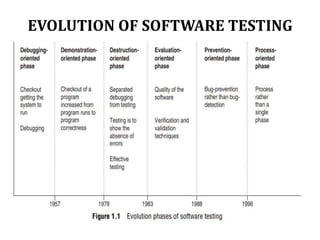
1. Debugging-oriented Phase (Before 1957)
2. Demonstration-oriented Phase (1957–78)
3. Destruction-oriented Phase (1979–82)
4. Evaluation-oriented Phase (1983–87)
5. Prevention-oriented Phase (1988–95)
6. Process-oriented Phase (1996 onwards)
EVOLUTION OF SOFTWARE TESTING
• The evolution of software testing was also
discussed by Hung Q. Nguyen and Rob
Pirozzi in a white paper, in three phases,
namely Software Testing 1.0, Software
Testing 2.0, and Software Testing 3.0.

1_Introduction to Software Testing - Part 1.pptx

  • 1.
  • 2.
    COURSE OUTCOMES CO1: Understandthe basic concepts of software testing CO2: Apply Dynamic Testing Techniques and validation activities CO3: Apply software test management practices CO4: Gain knowledge on automation testing CO5: Analyze various testing strategies for a given application (Assignment)
  • 3.
    UNIT 1 Introduction toSoftware Testing: Introduction, evolution of software testing, software testing-Myths and Facts, goals of software testing, Psychology for software testing, Software Testing Definitions, Model of software testing, Effective Software Testing Vs Exhaustive Software Testing, Software Testing Terminology, Software Testing Life Cycle(STLC), Testing methodology.
  • 4.
    Testing Methodology • Softwaretesting has always been considered a single phase performed after coding. • But time has proved that our failures in software projects are mainly due to the fact that we have not realized the role of software testing as a process.
  • 5.
    Testing Methodology • Thus,its role is not limited to only a single phase in the software development life cycle (SDLC), but it starts as soon as the requirements in a project have been gathered.
  • 6.
    Testing Methodology • Completesoftware testing has also been perceived for a long time. • Again, it has been proved that exhaustive testing is not possible and we should shift our attention to effective testing.
  • 7.
    Testing Methodology • Thus,effective and early testing concepts build our testing methodology. • Testing methodology shows the path for successful testing. • This is the reason that parallel to SDLC, software testing life cycle (STLC) has also been established now. The testing methodology is related to many issues.
  • 8.
    Introduction to SoftwareTesting • Software is becoming complex, but the demand for quality in software products has increased. • This rise in customer awareness for quality increases the workload and responsibility of the software development team.
  • 9.
    Introduction to SoftwareTesting • That is why software testing has gained so much popularity in the last decade. Job trends have shifted from development to software testing.
  • 10.
    Introduction to SoftwareTesting • Software development is driven with testing outputs. • If the testing team claims the presence of bugs in the software, then the development team cannot release the product.
  • 11.
    Introduction to SoftwareTesting • While many industries have adopted effective software testing techniques and the development is driven by testing efforts, there are still some loopholes. • Industries are dependent on automation of test execution. • Therefore, testers also rely on efficient tools.
  • 12.
    Introduction to SoftwareTesting • But there may be an instance where automation will not help, which is why they also need to design test cases and execute them manually. • Are the testers prepared for this case? • This requires testing teams to have a knowledge of testing tactics and procedures of how to design test cases.
  • 13.
    Introduction to SoftwareTesting • How do industries measure their testing process?
  • 14.
    Introduction to SoftwareTesting • Since software testing is a complete process today, it must be measured to check whether the process is suitable for projects. • CMM (Capability Maturity Model) has measured the development process on a scale of 1–5 and companies are running for the highest scale.
  • 15.
    Introduction to SoftwareTesting • But how many managers, developers, testers, and of course students, know that we have a Testing Maturity Model (TMM) for measuring the maturity status of a testing process?
  • 16.
    Introduction to SoftwareTesting • Testing is an important segment of software development and it has to be thoroughly done. • Therefore, there should be a separate testing group with divided responsibilities among the members.
  • 17.
    EVOLUTION OF SOFTWARETESTING • In the early days of software development, software testing was considered only a debugging process for removing errors after the development of software. • By 1970, the term ‘software engineering’ was in common use. • But software testing was just a beginning at that time.
  • 18.
    EVOLUTION OF SOFTWARETESTING • In 1978, G. J. Myers realized the need to discuss the techniques of software testing in a separate subject.
  • 19.
  • 20.
    EVOLUTION OF SOFTWARETESTING 1. Debugging-oriented Phase (Before 1957) 2. Demonstration-oriented Phase (1957–78) 3. Destruction-oriented Phase (1979–82) 4. Evaluation-oriented Phase (1983–87) 5. Prevention-oriented Phase (1988–95) 6. Process-oriented Phase (1996 onwards)
  • 21.
    EVOLUTION OF SOFTWARETESTING • The evolution of software testing was also discussed by Hung Q. Nguyen and Rob Pirozzi in a white paper, in three phases, namely Software Testing 1.0, Software Testing 2.0, and Software Testing 3.0.