Done by Muminova Malika
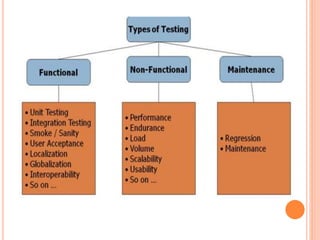
There are numerous types of testing;
however in the parlance of software
testing following five classes have
been defined & practiced by the
software testing community.
1) Methodology wise testing
2) Conventions wise testing
3) Level wise testing
4) Technique wise testing
5) Intent wise testing
1) Manual Testing: is a process in which all the
phases of Software Testing Life Cycle like Test
Planning, Test Development, Test Execution,
Result Analysis, Bug Tracking and Reporting are
accomplished till successful completion by manual
means i.e. with human efforts.
There are few drawbacks of Manual
Testing: such as
# More people are required.
# It is more time consuming.
# It renders less accuracy.
# It is strenuous.
# Simultaneous actions are difficult.
# Repetitive tasks are difficult to perform.
2) Automation Testing: is a process in which
majority of drawbacks of manual testing gets
addressed properly and it provides speed and
accuracy to the existing testing phase.
It must be remembered that automation testing is not
a replacement for manual testing. It is in fact a
continuation of manual testing aimed to provide
speed and accuracy to the testing effort.
Automated testing primarily uses an automation tool,
which is assistance to the test engineers. An
automation tool works on the basis of instructions
and information. Automated tools are broadly of three
Types like 1) Functional Tools (like HP quickest, IBM
RFT) 2) Management Tools (Like HP Quality Center)
3) Performance Tools (Like HP Load Runner)
Intent wise there are
following four types of
Testing
1) Acceptance Testing
2) Performance Testing
3) Load Testing
4) Regression Testing

Classification of testing

  • 1.
  • 4.
    There are numeroustypes of testing; however in the parlance of software testing following five classes have been defined & practiced by the software testing community. 1) Methodology wise testing 2) Conventions wise testing 3) Level wise testing 4) Technique wise testing 5) Intent wise testing
  • 5.
    1) Manual Testing:is a process in which all the phases of Software Testing Life Cycle like Test Planning, Test Development, Test Execution, Result Analysis, Bug Tracking and Reporting are accomplished till successful completion by manual means i.e. with human efforts. There are few drawbacks of Manual Testing: such as # More people are required. # It is more time consuming. # It renders less accuracy. # It is strenuous. # Simultaneous actions are difficult. # Repetitive tasks are difficult to perform.
  • 6.
    2) Automation Testing:is a process in which majority of drawbacks of manual testing gets addressed properly and it provides speed and accuracy to the existing testing phase. It must be remembered that automation testing is not a replacement for manual testing. It is in fact a continuation of manual testing aimed to provide speed and accuracy to the testing effort. Automated testing primarily uses an automation tool, which is assistance to the test engineers. An automation tool works on the basis of instructions and information. Automated tools are broadly of three Types like 1) Functional Tools (like HP quickest, IBM RFT) 2) Management Tools (Like HP Quality Center) 3) Performance Tools (Like HP Load Runner)
  • 7.
    Intent wise thereare following four types of Testing 1) Acceptance Testing 2) Performance Testing 3) Load Testing 4) Regression Testing