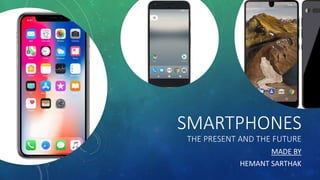
SMARTPHONES
THE PRESENT AND THE FUTURE
MADE BY
HEMANT SARTHAK
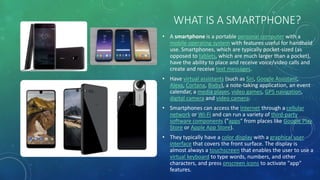
WHAT IS A SMARTPHONE?
• A smartphone is a portable personal computer with a
mobile operating system with features useful for handheld
use. Smartphones, which are typically pocket-sized (as
opposed to tablets, which are much larger than a pocket),
have the ability to place and receive voice/video calls and
create and receive text messages.
• Have virtual assistants (such as Siri, Google Assistant,
Alexa, Cortana, Bixby), a note-taking application, an event
calendar, a media player, video games, GPS navigation,
digital camera and video camera.
• Smartphones can access the Internet through a cellular
network or Wi-Fi and can run a variety of third-party
software components ("apps" from places like Google Play
Store or Apple App Store).
• They typically have a color display with a graphical user
interface that covers the front surface. The display is
almost always a touchscreen that enables the user to use a
virtual keyboard to type words, numbers, and other
characters, and press onscreen icons to activate "app"
features.
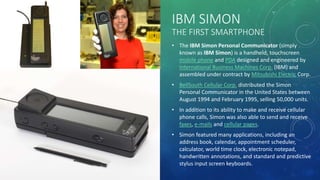
IBM SIMON
THE FIRST SMARTPHONE
• The IBM Simon Personal Communicator (simply
known as IBM Simon) is a handheld, touchscreen
mobile phone and PDA designed and engineered by
International Business Machines Corp. (IBM) and
assembled under contract by Mitsubishi Electric Corp.
• BellSouth Cellular Corp. distributed the Simon
Personal Communicator in the United States between
August 1994 and February 1995, selling 50,000 units.
• In addition to its ability to make and receive cellular
phone calls, Simon was also able to send and receive
faxes, e-mails and cellular pages.
• Simon featured many applications, including an
address book, calendar, appointment scheduler,
calculator, world time clock, electronic notepad,
handwritten annotations, and standard and predictive
stylus input screen keyboards.
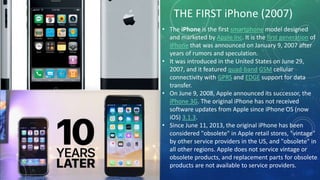
THE FIRST iPhone (2007)
• The iPhone is the first smartphone model designed
and marketed by Apple Inc. It is the first generation of
iPhone that was announced on January 9, 2007 after
years of rumors and speculation.
• It was introduced in the United States on June 29,
2007, and it featured quad-band GSM cellular
connectivity with GPRS and EDGE support for data
transfer.
• On June 9, 2008, Apple announced its successor, the
iPhone 3G. The original iPhone has not received
software updates from Apple since iPhone OS (now
iOS) 3.1.3.
• Since June 11, 2013, the original iPhone has been
considered "obsolete" in Apple retail stores, "vintage"
by other service providers in the US, and "obsolete" in
all other regions. Apple does not service vintage or
obsolete products, and replacement parts for obsolete
products are not available to service providers.
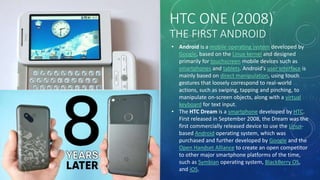
HTC ONE (2008)
THE FIRST ANDROID
• Android is a mobile operating system developed by
Google, based on the Linux kernel and designed
primarily for touchscreen mobile devices such as
smartphones and tablets. Android's user interface is
mainly based on direct manipulation, using touch
gestures that loosely correspond to real-world
actions, such as swiping, tapping and pinching, to
manipulate on-screen objects, along with a virtual
keyboard for text input.
• The HTC Dream is a smartphone developed by HTC.
First released in September 2008, the Dream was the
first commercially released device to use the Linux-
based Android operating system, which was
purchased and further developed by Google and the
Open Handset Alliance to create an open competitor
to other major smartphone platforms of the time,
such as Symbian operating system, BlackBerry OS,
and iOS.
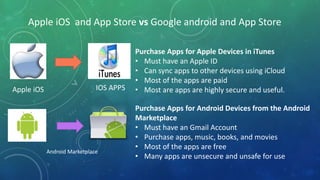
IOS APPSApple iOS
Purchase Apps for Apple Devices in iTunes
• Must have an Apple ID
• Can sync apps to other devices using iCloud
• Most of the apps are paid
• Most are apps are highly secure and useful.
Android Marketplace
Purchase Apps for Android Devices from the Android
Marketplace
• Must have an Gmail Account
• Purchase apps, music, books, and movies
• Most of the apps are free
• Many apps are unsecure and unsafe for use
Apple iOS and App Store vs Google android and App Store
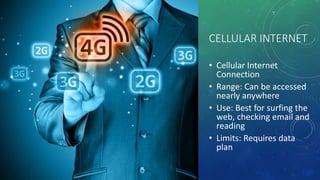
CELLULAR INTERNET
• Cellular Internet
Connection
• Range: Can be accessed
nearly anywhere
• Use: Best for surfing the
web, checking email and
reading
• Limits: Requires data
plan
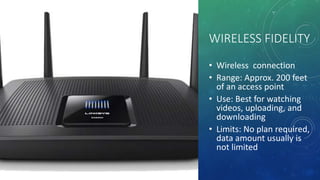
WIRELESS FIDELITY
• Wireless connection
• Range: Approx. 200 feet
of an access point
• Use: Best for watching
videos, uploading, and
downloading
• Limits: No plan required,
data amount usually is
not limited
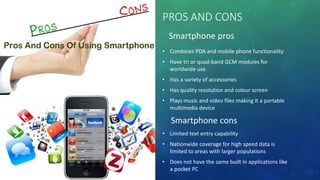
PROS AND CONS
Smartphone pros
• Combines PDA and mobile phone functionality
• Have tri or quad-band GCM modules for
worldwide use
• Has a variety of accessories
• Has quality resolution and colour screen
• Plays music and video files making it a portable
multimedia device
Smartphone cons
• Limited text entry capability
• Nationwide coverage for high speed data is
limited to areas with larger populations
• Does not have the same built in applications like
a pocket PC
Thank You
Hemant Sarthak

Smartphone

  • 1.
    SMARTPHONES THE PRESENT ANDTHE FUTURE MADE BY HEMANT SARTHAK
  • 2.
    WHAT IS ASMARTPHONE? • A smartphone is a portable personal computer with a mobile operating system with features useful for handheld use. Smartphones, which are typically pocket-sized (as opposed to tablets, which are much larger than a pocket), have the ability to place and receive voice/video calls and create and receive text messages. • Have virtual assistants (such as Siri, Google Assistant, Alexa, Cortana, Bixby), a note-taking application, an event calendar, a media player, video games, GPS navigation, digital camera and video camera. • Smartphones can access the Internet through a cellular network or Wi-Fi and can run a variety of third-party software components ("apps" from places like Google Play Store or Apple App Store). • They typically have a color display with a graphical user interface that covers the front surface. The display is almost always a touchscreen that enables the user to use a virtual keyboard to type words, numbers, and other characters, and press onscreen icons to activate "app" features.
  • 3.
    IBM SIMON THE FIRSTSMARTPHONE • The IBM Simon Personal Communicator (simply known as IBM Simon) is a handheld, touchscreen mobile phone and PDA designed and engineered by International Business Machines Corp. (IBM) and assembled under contract by Mitsubishi Electric Corp. • BellSouth Cellular Corp. distributed the Simon Personal Communicator in the United States between August 1994 and February 1995, selling 50,000 units. • In addition to its ability to make and receive cellular phone calls, Simon was also able to send and receive faxes, e-mails and cellular pages. • Simon featured many applications, including an address book, calendar, appointment scheduler, calculator, world time clock, electronic notepad, handwritten annotations, and standard and predictive stylus input screen keyboards.
  • 5.
    THE FIRST iPhone(2007) • The iPhone is the first smartphone model designed and marketed by Apple Inc. It is the first generation of iPhone that was announced on January 9, 2007 after years of rumors and speculation. • It was introduced in the United States on June 29, 2007, and it featured quad-band GSM cellular connectivity with GPRS and EDGE support for data transfer. • On June 9, 2008, Apple announced its successor, the iPhone 3G. The original iPhone has not received software updates from Apple since iPhone OS (now iOS) 3.1.3. • Since June 11, 2013, the original iPhone has been considered "obsolete" in Apple retail stores, "vintage" by other service providers in the US, and "obsolete" in all other regions. Apple does not service vintage or obsolete products, and replacement parts for obsolete products are not available to service providers.
  • 6.
    HTC ONE (2008) THEFIRST ANDROID • Android is a mobile operating system developed by Google, based on the Linux kernel and designed primarily for touchscreen mobile devices such as smartphones and tablets. Android's user interface is mainly based on direct manipulation, using touch gestures that loosely correspond to real-world actions, such as swiping, tapping and pinching, to manipulate on-screen objects, along with a virtual keyboard for text input. • The HTC Dream is a smartphone developed by HTC. First released in September 2008, the Dream was the first commercially released device to use the Linux- based Android operating system, which was purchased and further developed by Google and the Open Handset Alliance to create an open competitor to other major smartphone platforms of the time, such as Symbian operating system, BlackBerry OS, and iOS.
  • 7.
    IOS APPSApple iOS PurchaseApps for Apple Devices in iTunes • Must have an Apple ID • Can sync apps to other devices using iCloud • Most of the apps are paid • Most are apps are highly secure and useful. Android Marketplace Purchase Apps for Android Devices from the Android Marketplace • Must have an Gmail Account • Purchase apps, music, books, and movies • Most of the apps are free • Many apps are unsecure and unsafe for use Apple iOS and App Store vs Google android and App Store
  • 8.
    CELLULAR INTERNET • CellularInternet Connection • Range: Can be accessed nearly anywhere • Use: Best for surfing the web, checking email and reading • Limits: Requires data plan
  • 9.
    WIRELESS FIDELITY • Wirelessconnection • Range: Approx. 200 feet of an access point • Use: Best for watching videos, uploading, and downloading • Limits: No plan required, data amount usually is not limited
  • 10.
    PROS AND CONS Smartphonepros • Combines PDA and mobile phone functionality • Have tri or quad-band GCM modules for worldwide use • Has a variety of accessories • Has quality resolution and colour screen • Plays music and video files making it a portable multimedia device Smartphone cons • Limited text entry capability • Nationwide coverage for high speed data is limited to areas with larger populations • Does not have the same built in applications like a pocket PC
  • 11.

Editor's Notes

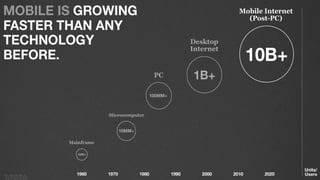
  • #5 2010 Mobile Statistics provided by Nielsen There are 223m mobile phone users in the US 18% are Smartphones 26% have the web/data package, up 33% since 2008 Currently only 7% of mobile device owners viewed video on their phones In Q-3 of ‘09 over 25% of all mobile devices sold were Smartphones, 2010 it is predicted to be 40-50%. Looking ahead to mid-2011 it is estimated there will be 150m Smartphones in use in the US. 120m will be web-enabled. Video viewership will surge from 5m now, to 120m Texting has gone from 75b in 2008 to 1 trillion in 2009.
  • #8 iPhone, iPad, iTouch
  • #11 Even in legal aspects and in getting information generally, smart-phones could offer for example journalists and the public an easy and cost effective way of providing