“Testing is a process of executing a program with the
intent of finding an errors.”
Testing = Verification + Validation by executing Code
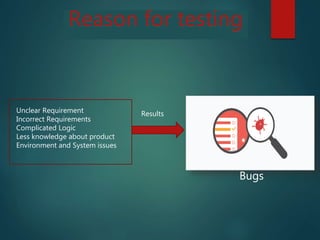
Reason for testing
Unclear Requirement
Incorrect Requirements
Complicated Logic
Less knowledge about product
Environment and System issues
Results
Bugs
Software Testing Best Practices
1. Keeping an eye on the user Experience
2. Get clear about the proper requirements by asking question
3. Practice Good test management and reporting
4. Testers and developers should work closely together
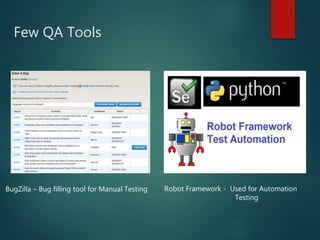
Few QA Tools
BugZilla – Bug filling tool for Manual Testing Robot Framework - Used for Automation
Testing
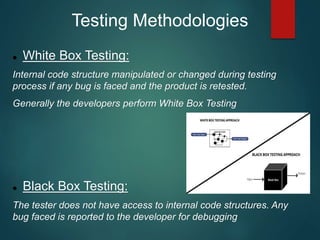
Testing Methodologies
 White Box Testing:
Internal code structure manipulated or changed during testing
process if any bug is faced and the product is retested.
Generally the developers perform White Box Testing
 Black Box Testing:
The tester does not have access to internal code structures. Any
bug faced is reported to the developer for debugging
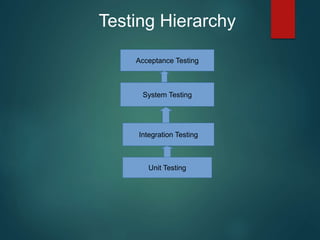
Testing Hierarchy
Unit Testing
Integration Testing
System Testing
Acceptance Testing
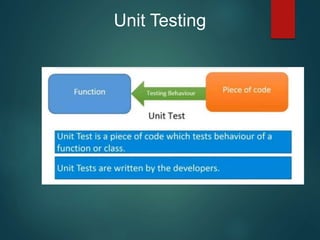
Unit Testing
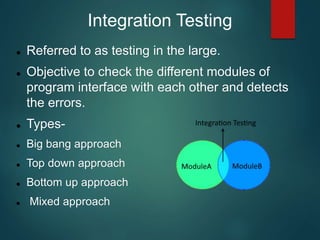
 Referred to as testing in the large.
 Objective to check the different modules of
program interface with each other and detects
the errors.
 Types-
 Big bang approach
 Top down approach
 Bottom up approach
 Mixed approach
Integration Testing
Big bang Integration Testing
 All the modules making up a system are
integrated in a single step.
 Usefull for very small system
 Problems- once an errors are found ,difficult to
localize the error as it lie in any of the modules.
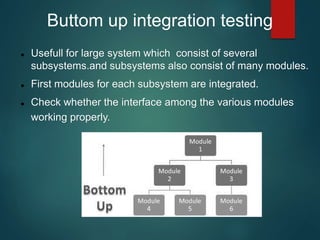
 Usefull for large system which consist of several
subsystems.and subsystems also consist of many modules.
 First modules for each subsystem are integrated.
 Check whether the interface among the various modules
working properly.
Buttom up integration testing
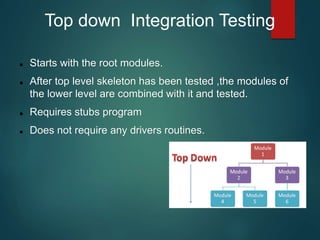
 Starts with the root modules.
 After top level skeleton has been tested ,the modules of
the lower level are combined with it and tested.
 Requires stubs program
 Does not require any drivers routines.
Top down Integration Testing
System Testing
 System Tests are designed to validate a fully
developed system to assure that it meets its
requirements.
 Alpha Testing: testing carried out by the test
team.
 Beta Testing: It is performed by selected group
of friendly user.
 Acceptance Test: It is performed by customer .
Performance Testing
 To Check the system meets the non functional
requirements.
 All performance testing considered as the
black box testing.
 Example of performance testing – security
testing, stress testing, recovery testing,
Documentation testing etc..
Debugging
 BruteForce – Using logs after each and every statement
 Backtracking- source code is tracked backward to find bug
 Program Slicing – Here the entire code is sliced up into parts
and bug tracing is done
 Cause Elimination Method – Cause for bug is analysed and that
portion of the code is debugged
Thank You

Software Testing

  • 2.
    “Testing is aprocess of executing a program with the intent of finding an errors.”
  • 3.
    Testing = Verification+ Validation by executing Code
  • 4.
    Reason for testing UnclearRequirement Incorrect Requirements Complicated Logic Less knowledge about product Environment and System issues Results Bugs
  • 5.
    Software Testing BestPractices 1. Keeping an eye on the user Experience 2. Get clear about the proper requirements by asking question 3. Practice Good test management and reporting 4. Testers and developers should work closely together
  • 6.
    Few QA Tools BugZilla– Bug filling tool for Manual Testing Robot Framework - Used for Automation Testing
  • 7.
    Testing Methodologies  WhiteBox Testing: Internal code structure manipulated or changed during testing process if any bug is faced and the product is retested. Generally the developers perform White Box Testing  Black Box Testing: The tester does not have access to internal code structures. Any bug faced is reported to the developer for debugging
  • 8.
    Testing Hierarchy Unit Testing IntegrationTesting System Testing Acceptance Testing
  • 9.
  • 10.
     Referred toas testing in the large.  Objective to check the different modules of program interface with each other and detects the errors.  Types-  Big bang approach  Top down approach  Bottom up approach  Mixed approach Integration Testing
  • 11.
    Big bang IntegrationTesting  All the modules making up a system are integrated in a single step.  Usefull for very small system  Problems- once an errors are found ,difficult to localize the error as it lie in any of the modules.
  • 12.
     Usefull forlarge system which consist of several subsystems.and subsystems also consist of many modules.  First modules for each subsystem are integrated.  Check whether the interface among the various modules working properly. Buttom up integration testing
  • 13.
     Starts withthe root modules.  After top level skeleton has been tested ,the modules of the lower level are combined with it and tested.  Requires stubs program  Does not require any drivers routines. Top down Integration Testing
  • 14.
    System Testing  SystemTests are designed to validate a fully developed system to assure that it meets its requirements.  Alpha Testing: testing carried out by the test team.  Beta Testing: It is performed by selected group of friendly user.  Acceptance Test: It is performed by customer .
  • 15.
    Performance Testing  ToCheck the system meets the non functional requirements.  All performance testing considered as the black box testing.  Example of performance testing – security testing, stress testing, recovery testing, Documentation testing etc..
  • 16.
    Debugging  BruteForce –Using logs after each and every statement  Backtracking- source code is tracked backward to find bug  Program Slicing – Here the entire code is sliced up into parts and bug tracing is done  Cause Elimination Method – Cause for bug is analysed and that portion of the code is debugged
  • 17.