How to Support
Your Child in
Mathematics
October 2013
Success WILF is …
• To inform you of what we teach
• To share our methods
• To equip you with strategies so that
you can support your child
Assessing Pupil Progress
• Assessment for Learning: formative and
summative
• National / Dobcroft averages / rates of
progress
• End of KS1
Key Skills
• Knowledge and speedy recall of number
pairs up to 10, 20, 100
• Understanding Place Value: the value of
each digit in a number
• Understanding and applying the 4
operations of number
+ - X
Number Pairs
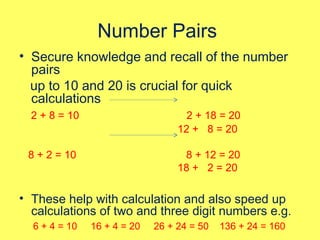
• Secure knowledge and recall of the number
pairs
up to 10 and 20 is crucial for quick
calculations
2 + 8 = 10 2 + 18 = 20
12 + 8 = 20
8 + 2 = 10 8 + 12 = 20
18 + 2 = 20
• These help with calculation and also speed up
calculations of two and three digit numbers e.g.
6 + 4 = 10 16 + 4 = 20 26 + 24 = 50 136 + 24 = 160
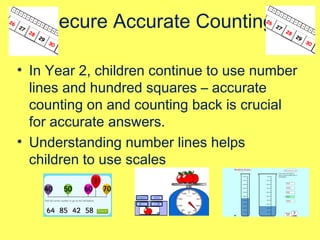
Secure Accurate Counting
• In Year 2, children continue to use number
lines and hundred squares – accurate
counting on and counting back is crucial
for accurate answers.
• Understanding number lines helps
children to use scales
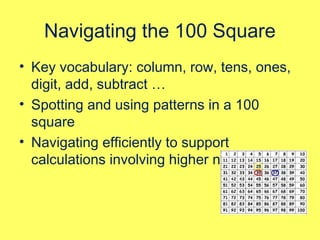
Navigating the 100 Square
• Key vocabulary: column, row, tens, ones,
digit, add, subtract …
• Spotting and using patterns in a 100
square
• Navigating efficiently to support
calculations involving higher numbers
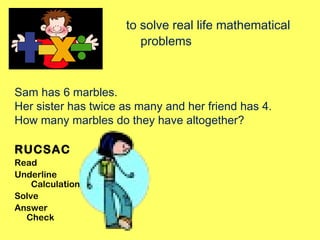
to solve real life mathematical
problems
Sam has 6 marbles.
Her sister has twice as many and her friend has 4.
How many marbles do they have altogether?
RUCSAC
Read
Underline
Calculation?
Solve
Answer
Check
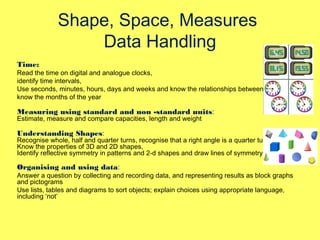
Shape, Space, Measures
Data Handling
Time:
Read the time on digital and analogue clocks,
identify time intervals,
Use seconds, minutes, hours, days and weeks and know the relationships between them,
know the months of the year
Measuring using standard and non -standard units:
Estimate, measure and compare capacities, length and weight
Understanding Shapes:
Recognise whole, half and quarter turns, recognise that a right angle is a quarter turn,
Know the properties of 3D and 2D shapes,
Identify reflective symmetry in patterns and 2-d shapes and draw lines of symmetry
Organising and using data:
Answer a question by collecting and recording data, and representing results as block graphs
and pictograms
Use lists, tables and diagrams to sort objects; explain choices using appropriate language,
including ‘not’
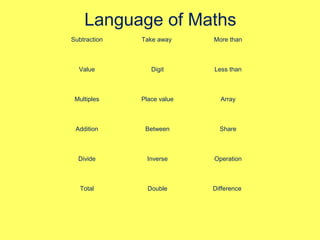
Language of Maths
Subtraction Take away More than
Value Digit Less than
Multiples Place value Array
Addition Between Share
Divide Inverse Operation
Total Double Difference
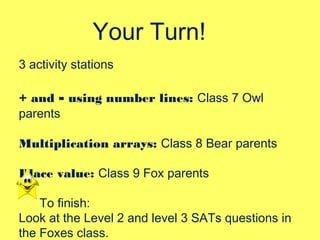
Your Turn!
3 activity stations
+ and - using number lines: Class 7 Owl
parents
Multiplication arrays: Class 8 Bear parents
Place value: Class 9 Fox parents
To finish:
Look at the Level 2 and level 3 SATs questions in
the Foxes class.

Maths Workshop Y2

  • 1.
    How to Support YourChild in Mathematics October 2013
  • 2.
    Success WILF is… • To inform you of what we teach • To share our methods • To equip you with strategies so that you can support your child
  • 3.
    Assessing Pupil Progress •Assessment for Learning: formative and summative • National / Dobcroft averages / rates of progress • End of KS1
  • 4.
    Key Skills • Knowledgeand speedy recall of number pairs up to 10, 20, 100 • Understanding Place Value: the value of each digit in a number • Understanding and applying the 4 operations of number + - X
  • 5.
    Number Pairs • Secureknowledge and recall of the number pairs up to 10 and 20 is crucial for quick calculations 2 + 8 = 10 2 + 18 = 20 12 + 8 = 20 8 + 2 = 10 8 + 12 = 20 18 + 2 = 20 • These help with calculation and also speed up calculations of two and three digit numbers e.g. 6 + 4 = 10 16 + 4 = 20 26 + 24 = 50 136 + 24 = 160
  • 6.
    Secure Accurate Counting •In Year 2, children continue to use number lines and hundred squares – accurate counting on and counting back is crucial for accurate answers. • Understanding number lines helps children to use scales
  • 7.
    Navigating the 100Square • Key vocabulary: column, row, tens, ones, digit, add, subtract … • Spotting and using patterns in a 100 square • Navigating efficiently to support calculations involving higher numbers
  • 8.
    to solve reallife mathematical problems Sam has 6 marbles. Her sister has twice as many and her friend has 4. How many marbles do they have altogether? RUCSAC Read Underline Calculation? Solve Answer Check
  • 9.
    Shape, Space, Measures DataHandling Time: Read the time on digital and analogue clocks, identify time intervals, Use seconds, minutes, hours, days and weeks and know the relationships between them, know the months of the year Measuring using standard and non -standard units: Estimate, measure and compare capacities, length and weight Understanding Shapes: Recognise whole, half and quarter turns, recognise that a right angle is a quarter turn, Know the properties of 3D and 2D shapes, Identify reflective symmetry in patterns and 2-d shapes and draw lines of symmetry Organising and using data: Answer a question by collecting and recording data, and representing results as block graphs and pictograms Use lists, tables and diagrams to sort objects; explain choices using appropriate language, including ‘not’
  • 10.
    Language of Maths SubtractionTake away More than Value Digit Less than Multiples Place value Array Addition Between Share Divide Inverse Operation Total Double Difference
  • 11.
    Your Turn! 3 activitystations + and - using number lines: Class 7 Owl parents Multiplication arrays: Class 8 Bear parents Place value: Class 9 Fox parents To finish: Look at the Level 2 and level 3 SATs questions in the Foxes class.

Editor's Notes

  • #2 Jenny: Introduce team
  • #3 Jenny
  • #4 Jane: App grids and copy of tracker to be available Children enter year 2 with a level that was awarded by teacher assessment at the end of Y1 Half termly assessments are then carried out and the results of these are entered into a pupil tracker – this will flag up if children are not progressing at the expected rate and will also identify children who are making accelerated progress There is a national bench mark used to ensure that our assessments are in line with other schools throughout the country. In the summer term the standardised assessments tests are still being administered (SATS). However it is teacher assessment that has more weighting and due to our rigorous assessments and tracking we always have sufficient evidence to back up our judgments
  • #5 Lisa; Every aspect of mathematics is important, but there are some key skills which children need to support their learning An understanding that addition is the inverse of subtraction and vice-versa An understanding that multiplication is the inverse of division and vice-versa
  • #6 Lisa: Demonstrate flapjack
  • #7 Claire: show variety of number lines and counting hoop: count in 2s, 10s etc.
  • #8 Claire: Use Active primary – splat? Emphasize correct vocab when adding / subtracting 10s (not moving down / up 1 square) Use active primary splat. Parents to have 100 squares address misconception on a 100 squ. numbers. When children begin to use a hundred square to support calculations involving higher numbers they may still try counting on in steps of 1. This is open to errors as they reach the end of one row and have to transfer their finger on to the row below. Calculations A regular 100 square has many patterns which can support children in their counting-speeding up their calculations and ensuring more accurate calculations
  • #9 Jenny: explain RUSCAC Context of money, weight, cm, metres etc.
  • #10 Jenny: Look at the ?s in Class 9 to see the range