A fraction with its denominator as `100'
is called a percentage. Percentage means per
hundred.
So it is a fraction of the form
6
1 0 0
3 7
1 0 0
1 5 1
1 0 0
, and and these fractions
can be expressed as 6%, 37% and 151%
respectively.
In such a fraction, the numerator is called
rate percent.
To express x% as a fraction or a decimal,
divide xby 100.
If the price of an item increases by r%,
then the reduction in consumption, so that the
expenditure remains the same is
r
r
x







1 0 0
1 0 0 %
If the price of the commodity decreases
by r%, the increase in consumption, so that
the expenditure remains the same is
r
r
x
1 0 0
1 0 0 %







If the value is first increased by x% and
then by y%, the final increase is
x y
xy
 






100
%
If there is a decrease instead of increase, a
negative sign is attached to the corresponding
rate percent.
If the value of a number is first increased
by x% and later it is decreased by x% then net
change is always a decrease which is equal to
x2
100





%
If pass marks in an examination is x% and
if a student secures y marks and fails by z
marks, then the maximum mark
=
1 0 0 ( )y z
x
A candidate scores x% in an examina-
tion fails by `a' marks while another candi-
date who scores y% gets `b' marks more than
the minimum required for a pass, then the
maximum mark =
100 (a b)
y x
If the length of a rectangle is increased
by x% and the breadth is decreased by y%,
then the area is increased or decreased by
( )%x y
xy
 
100
according to the (+) ve or
(-) ve sign obtained.
If the present population is P which in-
creases R% annually, then
(i) the population after n years
= P
R
n
100
100






(ii) the population n years ago
=
n
R100
100
P 






If the present value of a machine is P
which depreciates at R% per annum, then
(i) the value of the machine after n years
= P
R
n
100
100






(ii) the value of the machine n years ago
=
P
R
n
100
100 






Percentage
4 In an examination 36% are pass marks.
If an examinee gets 17 marks and fails by 10
marks, what are the maximum marks?
Ans : Pass mark=(17+10)= 27
Let maximum marks be x
Then 36% of x= 27 or
3 6
1 0 0
2 7x x 
x  
2 7 1 0 0
3 6
7 5
x
Hence, maximum marks = 75
The answer can be arrived quickly by
Maximum marks =
1 0 0 1 7 1 0
3 6
( )
=
1 0 0 2 7
3 6
7 5
x

5. Subtracting 40% of a number from the
number, we get the result as 30. Find the num-
ber.
Ans: Let the number be x.
  x x
4 0
1 0 0
3 0 (ie) x 1
2
5
3 0





 
x  30
5
3
50x
6. If the price of sugar be increased by
25%, find by how much percent must its con-
sumption be decreased to keep the expendi-
ture fixed on sugar?
Ans:
Decrease in consumption
=
25
100 25
100%






 =
2 5 1 0 0
1 2 5
2 0 %
x
% 
7. The salary of a worker was first increased
by 10% and thereafter decreased by 5%.
What was the effect in his salary?
Ans: % effect = 10 5
10 5
100
 






x
%
 His salary is increased by 4.5% (because
the sign is +ve.)
If x% students failed in a particular sub-
ject, y% students failed in another subject, and
z% students failed in both subjects, then the
pass present = 100+z-(x+y)
Fractional Equivalents of important percents
1%
1
100
40%
2
5
6
1
4
1
16
8
1
3
1
12




%
%
2%
1
50
60%
3
5
12
1
2
1
8
16
2
3
1
6




%
%
4%
1
25
80%
4
5
25%
1
4
33
1
3
1
3



%
5%
1
20
100% 1
37
1
2
3
8
66
2
3
2
3




%
%
8%
2
25
50%
1
2
83
1
3
5
6


%
10%
1
10
62
1
2
5
8

%
20%
1
5
75%
3
4


SOLVEDEXAMPLES:
1. Find 33
1
3
% of 600
Ans: 33
1
3
% of 600 =
1
3
x600 = 200
2. What percent of 144 is 36?
Ans: Let x% of 144 = 36
(ie)
x
1 0 0
14 4 36x 
(ie) x  
3 6 1 0 0
1 4 4
2 5
x
3. 2.5 is 5% of what?
Ans : Let the number be x
 5% 2 5of x .
5
100
2 5 50x x x  .
87
1
2
7
8
%
2 8
133
1
3
4
3
%
8. The value of a machine depriciates at the
rate of 10% per annum. If its present value is
Rs. 81,000 what will be its worth after 2
years?
Ans: The value of the machine after
2 years = Rs. 81,000x 1
1 0
1 00
2







= Rs. 81000 x
9
1 0
9
1 0
6 5 6 1 0x Rs . ,
9. Due to fall of 10% in the rate of sugar,
500 gm more sugar can be purchased for Rs.
140. Find the original rate and reduced rate.
Ans : Money spent originally=Rs. 140
Less Money to be spent now
= 10% of 140
= Rs. 14
 Rs. 14 now yield 500gm sugar
 Present rate of sugar = Rs. 28 per kg.
If the present value is Rs. 90, the original value
= Rs. 100
If the present value is Rs. 28 the original value
= Rs.
1 0 0
9 0
2 8x
= Rs. 31.11
10. In an examination, 42% students failed
in History and 52% failed in Geography. If 17%
students failed in both subjects, find the per-
centage of those students who passed in both
the subjects.
Ans:- Pass percent=100+17-(42+52)
= 117 - 94
= 23
PRACTICETEST
1. 65% of 7+35% of 3 = ?% of 56
a) 1 b) 1 0 c) 5 0 d) 100
2. What is 20% of a number whose 200%
is 360?
a) 7 2 b) 3 6 c) 5 2 d) 144
3. What percent of
4
7
2
35
is ?
a) 2.5% b) 1000%
c) 2 5 % d) 1 0 %
4. The total income of A and B is Rs. 6000.
A spends 60% of his income and B spends
80% of his income. If their savings are equal,
then the income of A is,
a) Rs. 3500 b) Rs. 2000
c) Rs. 4000 d) Rs. 3000
5. With an increase of Rs. 2,000, Vishnu's
monthly salary became Rs. 12,000. What is
the percent increase in his salary?
a) 2 0 b) 2 5 c) 4 0 d) 8 0
6. if 75% of the students in a school are
boys and the number of girls is 420, the num-
ber of boys is
a) 1176 b) 1350
c) 1260 d) 1125
7. The salary of a worker is first increased
by 10% and therafter it was reduced by 10%.
What was the change in his salary?
a) 1% increase b) 5% increase
c) no change d) 1% decrease
8. A water tank contains 5% salt by
weight. xlitres of fresh water is added to 40
litres of tank water, so that the solution con-
tains 2% salt. The value of xis
a) 4 0 b) 5 0 c) 5 5 d) 6 0
9. The population of a town increases 5%
annually. If it is 15,435 now, what was it 2
years ago?
a) 14,000 b) 13,473
c) 12,345 d) 10,145
10. Navin spends 15% of his salary on cloths,
30% on food and 10% on transport. After this
if he is left with Rs. 900/- what is his salary?
a) Rs. 1,500 b) Rs. 2000
c) Rs. 1,635 d) Rs. 2500
11. When the price of an article was reduced
by 15% the sale of the article is increased by
20%. What was the effect on the sales?
a) 2% increase b) 1% increase
c) 2% decrease d) 1% decrease
12. In an election between two candidates,
the one gets 35% of the votes polled is de-
feated by 15000 votes. The number of votes
casted by the winning candidate is
a) 15,000 b) 1,75,000
c) 32,500 d) 52,500
13. In an examination, 70% students passed
in English and 75% in Hindi while 20% failed
in both the subjects. If 260 students passed in
both the subjects, the total number of students
is
a) 400 b) 500
c) 340 d) 460
14. If the radius of a circle is diminished by
10%, the area is diminished by
a) 3 6 % b) 2 0 %
c) 1 9 % d) 1 0 %
15. The price of an article is cut by 10%. In
order to restore it to its former value, the new
price must be increased by
a) 10
1
3
% b) 1 1 %
c) 11
1
9
% d) 12
1
9
%
16. The breadth of a rectangular field is 60%
of its length. If the perimeter of the field is
800m, What is the area of the field?
a) 37,500 sq.m. b) 4,800 sq.m
c) 18,750 sq.m d) 40,000 sq.m
17. In a factory, 60% of the employees are
males. Among them 20% are matriculates and
the remaining are graduates. Among the fe-
males 40% are matriculates and the remain-
ing are graduates. If the total number of fe-
male employees in the factory is 640, how
many graduates are there in the factory?
a) 1024 b) 896
c) 1,152 d) 1000
18. In an employment exchange, 40% of the
job seekers are graduates, 20% are post-
graduates and remaining 6000 are non-gradu-
ates. How many post-graduate job seekers are
there?
a) 3,000 b) 6,000
c) 9,000 d) 12,000
19. A company hired a salesman on a monthly
salary of Rs. 3,000. In addition to it, the sales-
man was entitled for 20% commission on the
monthly sale. How much sale the salesman
should do if he wants his monthly income as
Rs. 10,000?
a) Rs. 50,000 b) Rs. 15,000
c) Rs. 35,000 d) Rs. 21,000
20. In a public sector company, 30% employ-
ees opted for pension and 50% employees
opted for provident fund. The remaining em-
ployees were uncertain. If the difference be-
tween those who opted for provident fund and
those who were uncertain was 1440, how
many employees were there in the company?
a) 7,200 b) 2,400
c) 2,880 d) 4,800
21. Prasanna spends 25% of her monthly in-
come on petrol for her car,
2
3
rd of the remain-
ing income on house hold items, rent, etc. If
she is left with Rs. 1,800 with her at the end
of the month how much does she spend on
petrol?
a) Rs. 1,800 b) Rs. 720
c) Rs. 2,500 d) Rs. 1,440
22. Rajesh earns Rs. 2,300 per month. He
spends Rs. 1,200 on food, Rs. 630 on convey-
ance, 10% of his monthly income on other in-
cidentals and saves the remaining amount. How
much money will he save in one year?
a) Rs. 2300 b) Rs. 2880
c) Rs. 2600 d) Rs. 2400
23. In an examination, Hari got 8 marks less
than 80% of the full marks and Ravi got 5
marks more than 70% of the full marks. Hari
beats Ravi by 2 marks. The marks scored by
Ravi is
a) 9 0 b) 110 c) 130 d) 140
ANSWERSTO PRACTICE
1. (b) 2. (b) 3. (d) 4. (b) 5. (a) 6. (c) 7. (d) 8.(d)
9. (a) 10. (b) 11. (a) 12. (c) 13. (a) 14. (c) 15. (c) 16.(a)
17. (c) 18. (a) 19. (c) 20. (d) 21.(a) 22. (b) 23. (b)
Cost Price: The price for which an article is
purchased is called the Cost Price (C.P.)
Selling price : The price at which an article is
sold is called the Selling Price (S.P.)
Profit (Gain) : The difference between the sell-
ing price and the cost price (when S.P. is more
than C.P) is called the Profit.
Loss:The difference between the cost price
and selling price (when C.P. is more than S.P.)
is called the Loss.
Points to remember:
1. Gain = (S.P) - (C.P); Loss = (C.P) - (S.P)
2. Gain%=
Gainx
C P
1 0 0
. .
=
SP CP





CP
x 100
Loss%=
Lossx
C P
1 0 0
. .
=
C S
CP
x
P P




 100
3. When the cost price and gain percent are
given,
S.P. = C.P. x
100
100






Gain%
4. When the cost price and loss percent are
given
S.P. = C.P. x
100
100






Loss%
5. When the selling price and gain percent
are given
C.P. = S.P. x
100
100 






Gain%
6. When the selling price and loss percent
are given
C.P. = S.P. x
1 0 0
1 0 0( % ) Loss
7. The discount percent is calculated on the
marked price.
Discount percent
=
Discount
M arked price
x 100
8. If there are two successive profits of x%
and y% in a transaction then the resultant
profit percent is
x
x
 y
y
10 0
9. If there is a profit of x% and loss of y% in
a transaction, then the resultant profit and loss
percent is
x
x
 y
y
1 0 0
according to the (+)ve and
the (-)ve signs respectively.
10. If cost price of xarticles is equal to the
selling price of y articles, then profit percent.
=
x y
y
x





 100
SOLVEDEXAMPLES
1. A man buys a toy for Rs. 25 and sells it
for Rs. 30. Find his gain percent.
Ans: Gain = 30 - 25 = Rs. 5
Gain % =
5
2 5
1 00 2 0 %x Rs .
2. By selling a watch for Rs. 144 a man
loses 10%. At what price should he sell it in
order to gain 10%?
Ans: S.P. = Rs. 144; Loss = 10%
 






C P Rs x. .
100
100 10
144
Profit & Loss
= Rs.
1 0 0
9 0
1 44 1 6 0x Rs .
Gain required = 15%
  S P Rs x Rs. . . .
1 1 5
1 0 0
1 6 0 1 8 4
Short cut:
Required SP =
1 4 4
9 0
1 1 5 1 8 4x Rs .
3. I sold a book at a profit of 16%. Had I
sold it for Rs. 18 more, 20% would have been
gained. Find the cost price.
Ans: Here 120% of C.P._ 116% of C.P.
= Rs. 18
 4% 18of t Rscos .
  C P
x
Rs. . .
18 100
4
450
Formula :
C.P =
M ore gain x
Dif f in percent age prof it
1 0 0
.
=
1 8 1 0 0
2 0 1 6
4 5 0
x
Rs

 .
4. A shopkeeper mixes two varieties of tea,
one costing Rs. 35 per kg. and another at
Rs. 45 per kg. in the ratio 3:2. If he sells the
mixed variety at Rs. 41.60 per kg. what is his
gain or loss percent?
Ans: - C.P of 5 kg. mix
= Rs. (35x3+45x2) = Rs. 195
S.P. of 5 kg. mix = Rs. (41.60x5)
= Rs. 208
Gain = Rs. (208-195) = Rs. 13
Gain% =
1 3
1 9 5
1 0 0 6
2
3
x  %
5. By selling a table for Rs. 40 instead of
Rs. 50, 5% more is lost. Find the cost of the
table.
Ans : Let the C.P. be Rs. x
Then if S.P.=Rs. 40, loss=Rs. (x-40)
If S.P = Rs. 50, loss = Rs. (x-50)
    ( ) ( )X X X4 0 5 0
5
1 0 0
x
   1 0
5
1 0 0
2 0 0 0x R sX X .
6. A grocer sells rice at a profit of 10% and
uses weights which are 20% less than the
marked weight. The total gain earned by him
will be
Ans: Let us consider a packet of rice marked
1 Kg.
Then its actual weight=80% of 1Kg.=0.8 Kg.
Let C.P. of 1 Kg be Rs. x
Then C.P. of 0.8Kg = Rs. 0.8 x
Now, S.P. = 110% of C.P. of 1 Kg
=
1 1 0
1 0 0
11x RsX X . .
Gain %=
0 3
0 8
.
.
X
X x 100% = 37.5%
7. The cost price of 10 articles is equal to
the selling price of 9 articles. Find the gain
percent.
Ans: Let the cp of 1 article = Rs. 1
Then CP of 9 articles = Rs. 9
CP of 10 articles = Rs. 10
 SP of 9 articles = Rs. 10
Gain =
10 9
9
100
100
9
11
1
9





   %
8. A boy buys oranges at Rs. 2 for 3 or-
anges and sells them at one rupee each. To
make a profit of Rs. 10 he must sell:
Ans: Suppose he sells xoranges.
CP of xoranges = Rs.
2
3
x
SP of xoranges = Rs. x
Profit on xoranges = x-
2
3
x
=
x
3
  
x
x
3
10 = 30
9. A man sells two horses for Rs. 4000 each
neither losing nor gaining in the deal. If he sold
one horse at a gain of 25%, the other horse
would be sold at a loss of:
Ans: Let the other horse be sold at x% loss
Then 25 - x-
25
100
0
x

 x 20%
10. A discount series of 10%, 20% and 40%
is equal to a single discount of .....
Ans: Equivalent single discount
= 100
60
100
80
100
90 56 8% x x .
PRACTICETEST
1. By selling an article for Rs. 100, one gains
Rs. 10. Then the gain percent is
a) 1 0 % b) 9 %
c) 11
1
9
% d) 10
1
2
%
2. A loss of 5% was suffered by selling a
plot for Rs. 4,085. The cost price of the plot
was:
a) Rs. 4350 b) Rs. 4259.25
c) Rs. 4200 d) Rs. 4300
3. A dealer sold a mixer for Rs. 420 at a
loss of 12.5%. At what price should he have
sold it to gain 12.5%?
a) Rs. 620 b) Rs. 540
c) Rs. 650 d) Rs. 750 4.
4. On selling 33m. of cloth, a person gained
an amount equivalent to the S.P. of 11m. of
cloth. The profit in the deal is
a) 5 0 % b) 2 0 %
c) 7 0 % d) 3 0 %
5. There are two consecutive discounts of
35% and 10% on a saree. If a person paid Rs.
1170 for that, then what was the original price
of the saree before the discounts?
a) Rs. 2,000 b) Rs. 1,800
c) Rs. 1,900 d) Rs. 1,700
6. A dishonest dealer claims to sell his goods
at cost price, but he uses a weight of 960 gm
for the kg weight. His gain percent is
a) 4 % b) 4
1
6
%
c) 2
1
2
% d) 3
3
4
%
7. By selling a vehicle for Rs. 36,300, a per-
son gains 21% profit. What was his gain in
Rupees?
a) Rs. 3,000 b) Rs. 7,623
c) Rs. 3,600 d) Rs. 6,300
8. Hameed bought a calculator for Rs. 520
and sold it with 15% profit on the price he
bought. At what price did he sell the calcula-
tor?
a) Rs. 598/- b) Rs. 542/-
c) Rs. 528/- d) Rs. 780/-
9. Ramesh purchased four old cycles at the
rate of Rs. 625 for each. He spent Rs. 175 on
each cycle for repairing and painting. At what
price should he sell each cycle in order to make
35% profit on the money he spent?
a) Rs. 1,019 b) Rs. 1,000
c) Rs. 1,080 d) Rs. 844
10. Raghu bought 10kg. of sugar at the rate
of Rs. 14 per kg and 15kg. of sugar at the
rate of Rs. 16 per kg. He mixed the two vari-
eties and sold the mixture at the rate of Rs.
18 per kg. What was his total gain by doing
so?
a) Rs. 50 b) Rs. 70
c) Rs. 40 d) Rs. 80
11. Ravi buys a radio three-fourth of its value
and sells it for 20% more than its value. What
will be the profit percent?
a) 5 0 % b) 4 0 %
c) 6 0 % d) 7 0 %
12. A man buys pencils at 10 for Rs. 3 and
sells at 8 for Rs. 3. His gain percent is
a) 20 b) 25 c) 30 d) 27
ANSWERS TO PRACTICE
1. (c) 2. (d) 3. (b) 4. (a) 5. (a) 6. (b) 7. (d) 8.(a)
9. (c) 10. (b) 11. (c) 12. (b) 13. (c) 14. (b) 15. (b) 16.(a)
17. (b) 18. (c) 19. (b) 20. (a) 21.(b) 22. (a) 23. (c) 24. (d)
25. (c) 26. (d)
13. A fruit seller buys lemons at 2 for a ru-
pee and sells them at 5 for three rupees. His
gain percent is
a) 1 0 % b) 1 5 %
c) 2 0 % d) 1 2 %
14. Toffee are bought at a rate of 8 for one
rupee. To gain 60% they must be sold at
a) 6 for Re. 1 b) 5 for Re. 1
c) 9 for Re. 2 d) 24 for Re. 5
15. By selling sugar at Rs. 5.58 per kg. a man
loses 7%. To gain 7% it must be sold at the
rate of Rs.
a) 5.62 per kg b) 6.42 per kg
c) 7.32 per kg d) 6.62 per kg
16. A tradesman's prices are 20% above
C.P. He allows his customers some discount
on his bill and makes a profit of 8%. The rate
of discount is :
a) 1 0 % b) 1 2 %
c) 1 4 % d) 1 6 %
17. An article was sold at a loss of 5%.If it
were sold for Rs. 30 more ,the gain would have
been 1.25%. The cost price of the article is
a) Rs. 488 b) Rs. 480
c) Rs. 460 d) Rs. 420
18. Anitha sold a painting at a profit of 11%.
Had she sold it for Rs.175 more, she would
have gained 18%. The C.P of the painting is
a) Rs. 2250 b) Rs. 2350
c) Rs. 2500 d) Rs. 2550
19. Pradeep bought a toy with 20% discount
on its labelled price. He sold it for Rs. 468 at
4% profit on the labelled price. At what price
did he by the toy ?
a) Rs. 450 b) Rs. 360
c) Rs. 390 d) Rs. 380
20. Arun purchased a bag with 25% discount
on the labelled price. At what percentage
profit on the price he bought should he sell it
to make 20% profit on the labelled price?
a) 6 0 % b) 4 0 %
c) 4 5 % d) 5 0 %
21. Nimesh bought a cycle for Rs. 1,850.He
spent Rs.380 for buying different accesso-
ries. Approximately, at what price should he
sell the cycle to make 20% profit in the trans-
action?
a) Rs. 2900 b) Rs. 2676
c) Rs. 3000 d) Rs. 3125
22. A man buys an article and sells it at a profit
of 20%.If he bought at 20%less and sold it
for Rs. 75 less, he would have gained 25%.
What is the cost price ?
a) Rs. 375 b) Rs. 425
c) Rs. 350 d)Data inadequate
23. A man sells a car to his friend at 10%
loss. If the friend sells it for Rs. 54,000 and
gains 20%, the C.P. of the car was:
a) Rs. 25,000 b) Rs. 37,500
c) Rs. 50,000 d) Rs. 60,000
24. Listed price of an article is Rs. 65. A
customer pays Rs. 56.16 for it. He was given
two successive discounts. If the first discount
is 10% find the second .
a) 8 % b) 6% c) 5 % d) 4%
25. A single discount equivalent to a discount
series of 20%,10% and 25% is
a) 5 5 % b) 54%
c) 4 6 % d) 42%
26. A trader allows two successive discounts
of 20% and 10%. if he sells an article for Rs.
108, then the market price of the article is
a) Rs. 140 b) Rs. 142
c) Rs. 148 d) Rs. 150
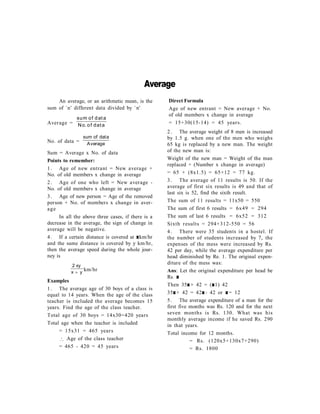
An average, or an arithmetic mean, is the
sum of `n' different data divided by `n'
Average =
sum of dat a
No of data.
No. of data =
sum of data
Average
Sum = Average x No. of data
Points to remember:
1. Age of new entrant = New average +
No. of old members x change in average
2. Age of one who left = New average -
No. of old members x change in average
3. Age of new person = Age of the removed
person + No. of members x change in aver-
age
In all the above three cases, if there is a
decrease in the average, the sign of change in
average will be negative.
4. If a certain distance is covered at xkm/hr
and the same distance is covered by y km/hr,
then the average speed during the whole jour-
ney is
2 x
x
y
y
km/hr
Examples
1. The average age of 30 boys of a class is
equal to 14 years. When the age of the class
teacher is included the average becomes 15
years. Find the age of the class teacher.
Total age of 30 boys = 14x30=420 years
Total age when the teacher is included
= 15x31 = 465 years
 Age of the class teacher
= 465 - 420 = 45 years
Direct Formula
Age of new entrant = New average + No.
of old members x change in average
= 15+30(15-14) = 45 years.
2. The average weight of 8 men is increased
by 1.5 g. when one of the men who weighs
65 kg is replaced by a new man. The weight
of the new man is:
Weight of the new man = Weight of the man
replaced + (Number x change in average)
= 65 + (8x1.5) = 65+12 = 77 kg.
3. The average of 11 results is 50. If the
average of first six results is 49 and that of
last six is 52, find the sixth result.
The sum of 11 results = 11x50 = 550
The sum of first 6 results = 6x49 = 294
The sum of last 6 results = 6x52 = 312
Sixth results = 294+312-550 = 56
4. There were 35 students in a hostel. If
the number of students increased by 7, the
expenses of the mess were increased by Rs.
42 per day, while the average expenditure per
head diminished by Re. 1. The original expen-
diture of the mess was:
Ans: Let the original expenditure per head be
Rs. x.
Then 35x + 42 = (x-1) 42
35x+ 42 = 42x- 42 or x= 12
5. The average expenditure of a man for the
first five months was Rs. 120 and for the next
seven months is Rs. 130. What was his
monthly average income if he saved Rs. 290
in that years.
Total income for 12 months.
= Rs. (120x5+130x7+290)
= Rs. 1800
Average
 Average monthly income
=
1800
12
150Rs.
6. There are 50 boys in a class. Their aver-
age weight is 45 kg. When one boy leaves the
class, the average reduces by 100 gms. Find
the weight of the boy who left the class.
Weight of the boy left = New average -
No. of old members x change in average
= 44.9-50x(-0.1) = 44.9+5 = 49.9kg.
7. The average attendance in a school for
the first 4 days of the week is 30 and for the
first 5 days of the week is 32. The attendance
on the fifth day is:
Total attendance for the first 4 days
= 4x30 = 120
Total attendance for the first 5 days
= 5x32 = 160
Attendance on the fifth day
= 160-120 = 40
PRACTICETEST
1. The marks obtained by a student in five
subjects are 68,73,62,85 and 79. Find the
average score.
a) 7 3 b) 73.4
c) 7 5 d) 74.5
2. The average income of a group of 9 work-
ers is Rs. 137.30 and that of another group of
7 workers is Rs. 95.06. The average income
of all the persons is:
a) Rs. 118.82 b) Rs. 116.18
c) Rs. 125.18 d) Rs. 128.15
3. There are 40 boys in a class. One boy
weighing 40 kg goes away, and at the same
time another boy joins the class. If the aver-
age weight of the class is thus increased by
100 gm, the weight of the new boy is.
a) 39.9 kg b) 44.1 kg
c) 40.1 kg d) 44 kg
4. My average expenses for 4 days is Rs.
6.00. I spend Rs. 7.70 on first day and Rs.
6.30 on second day. If I spent Rs. 10 on third
day, what did I spend on the 4th day?
a) Rs. 2/- b) Rs. 3/-
c) Rs. 4/- d) Nothing
5. The average temperature on Tuesday,
Wednesday and Thursday was 37° centigrade.
The average tempeature on Wednesday,
Thursday and Friday was 38° centigrade. If
the temperature on Friday was 39° centigrade,
the temperature on Tuesday was:
a) 35° C b) 36° C
c) 37° C d) 38° C
6. The average age of students in two
classes of 40 students each is 10 years and 8
years respectively. The average age of stu-
dents in both the classes taken together is:
a) 8 years b) 9 years
c) 10 years d) 11 years
7. The average age of 50 soldiers in troop
is 25 years. If the captain's age is included,
the average age of all of them still remains
the same. What is the captain's age in years?
a) 2 5 b) More than 25
c) Less than 25 d) Cannot be
determined
8. Two towns A and B are some distance
apart. A girl cycles from A to B at a speed of
10 km/hr and then back from B to A at the
rate of 15 km/ hr. The average speed during
the journey is:
a) 12.5 km/hr b) 15 km/hr
c) 12 km/hr d) 13.5 km/hr
9. An employee's average contribution to
his provident fund for the first 9 months was
Rs. 3,500 each and for each of the remaining
3 months, the contribution was Rs. 5,500. By
what amount was his total contribution short
of Rs. 58,000?
a) Rs. 4,000 b) Rs. 16,500
c) Rs. 8,000 d) Rs. 10,000
10. What fraction must be subtracted from
the sum of
1
4
and
1
6
to have an average of
1
12
of these the two fractiaons?
a)
1
3
b)
1
2
c)
1
4
d)
1
8
11. The average marks of 12 students was
calculated as 40. But it was later found that
marks of one student had been entered
wrongly as 42 instead of 54 and of another as
74 instead of 50. The correct average is:
a) 3 9 b) 4 0 c) 4 1 d) 4 3
12. The average salary of workers in an in-
dustry is Rs. 2000, the average salary of 150
technicians being Rs. 4000, and the non-tech-
nicians being Rs. 1,250. The total number of
workers is
a) 450 b) 300
c) 550 d) 500
13. The average age of a husband and a wife
who were married four years ago was 20 years
then. What will be the average age of the fam-
ily now if they have a three years old child?
a) 1 5
2
3
years b) 1 6
1
3
years
c) 17 years d) 16 years
14. The average of three consecutive odd
numbers is 39. What is the sum of the first
two of these numbers?
a) 7 8 b) 7 6 c) 2 4 d) 1 1
15. If the average of 9 consecutive numbers
is 20, the highest of these numbers is:
a) 2 0 b) 2 1 c) 2 4 d) 2 6
16. The sum of two consecutive even num-
bers is 23 more than the average of these two
numbers. What is the second number?
a) 2 2 b) 2 4 c) 2 6
d) Data indequate
17. The average of 17 numbers is 10.9 If the
average of first nine is 10.5 and that of the
last nine is 11.4, the middle number is
a) 11.8 b) 11.4
c) 10.9 d) 11.7
18. The average monthly expenditure of a
family was Rs. 2,200 during first 3 months,
Rs. 2,550 during next 4 months and Rs. 3,120
during last 5 months of the year. If the total
saving during the year was Rs. 1,260, find
average monthly income.
a) Rs. 3,960 b) Rs. 760.8
c) Rs. 2,805 d) Rs. 3,125
19. 30 pens and 75 pencils were purchased
for Rs. 510. if the average price of a pencil
was Rs. 2.00, find the average price of a pen.
a) Rs. 12 b) Rs. 15
c) Rs. 19 d) Rs. 25
20. the average age of the husband and wife
who were married 7 years ago was 25 years
then. The average age of the family including
the husband, wife and the child born during
the interval is 22 years, now. How old is the
child now?
a) 2 years b) 3.5 years
c) 1 years d) 4 years
21. Average monthly income of a family of
four earning members was Rs. 735. One of
the earning members died and therefore the
average income came down to Rs. 650. The
income of the deceased was:
a) Rs. 820 b) Rs. 990
c) Rs. 692.50 d) Rs. 1,385
22. A batsman has certain average runs for
20 innings. In the 21st inning, he served 107
runs thereby increasing his average by 2. What
is his average after 21 innings?
a) 6 7 b) 6 5 c) 6 0 d) 7 2
ANSWERS TO PRACTICE TEST
1. (b) 2. (a) 3. (d) 4. (d) 5. (b) 6. (b) 7. (a) 8.(c)
9. (d) 10. (c) 11. (a) 12. (c) 13. (c) 14. (b) 15. (c) 16.(b)
17. (a) 18. (c) 19. (a) 20. (a) 21.(b) 22. (a)
ii) In a:b : : c:d, d is the fourth proportional
to a,b and c.
iii) If xis the third proportional to a and b
then a: b : : b: x.
iv) Mean proportional between a and b is
( ).ab
Other properties
If
a
b
c
d
 `or' a: b : : c:d.
i)
d
dc
b
ba 


ii)
a b
b
c d
d



iii)
a b
a b
c d
c d





iv)
a
b
c
d
a c
b d
ka kc
kb kd
 





Solved examples:
1. If a: b = 4:5 and b:c = 6:7, find the
ratios a:c and a:b:c
Given,
a
b
b
c
 
4
5
6
7
;
  
a
b
x
b
c
x ie
a
c
4
5
6
7
2 4
35
( )
 a c: :24 35
Here `b' term is common to both the equa-
tions and so their corresponding values should
be made equal.
(ie) a:b = 24 : 3 0
b:c = 30 : 35
 a b c: : : :24 30 35
Ratio: The number of times one quantity con-
tains another quantity of the same kind is called
ratio of the two quantities. The ratio of a to b
is written as
a : b a
b
a b  
In the ratio a : b, a and b are called the terms
of ratio, `a' is the antecedent and `b' is the
consequent.
Points to remember:
i) The order of the terms in a ratio is very
important
ii) The quantities of a ratio must be ex-
pressed in the same units.
iii) The ratio is unaltered if each term is
multiplied or divided by the same num-
ber.
iv) When a certain quantity`q' is divided in
a given ratio a:b, the two parts are
aq
a b
and
bq
a b 
v) If a: b and c : d are two ratios, then
ac: bd is called the compounded ratio of the
given ratios.
Proportion: The equality of the two ratios is
called proportion. Suppose the two ratios a:b
and c:d are equal, i.e, a:b = c:d, then we write,
a:b: : c:d
Here, a and d are called as extremes and b, c
are called means.
Rule:
i) ad = bc `or'
Product of extremes = Product of
means.
Ratio&Proportion
2. Divide Rs. 54 in the ratio 4 : 5
Sum of ratios = 4+5 = 9
 First part = 54 x
4
9
= Rs. 24
Second part = 54 x
5
9
= Rs. 30
3. In a ratio, which is equal to 7 : 8 , if the
antecedent is 35, what is the consequent?
Let the consequent be x
  8 35
8 3 5
7
4 0x
x
x;
4. The sides of a triangle are in the ratio of
1
2
1
3
1
4
: : . If the perimeter is 104 cms, find
the length of the smallest side.
Given ratio is
1
2
1
3
1
4
6 4 3: : : :
(Multiplying with the L.C.M. of
2,3, & 4)
Sum of ratio = 6+4+3= 13
 Smallest side  de x
3
13
104 24 cms.
5. The incomes of A and B are in the ratio
2:3 and their expenditure are in the ratio 1:2,
If each saves Rs. 2,400, find A's income.
Let the income of A and B be 2xand 3x
Since, Income - Savings = Expenditure,
(2x- 2400) : (3x- 2400) = 1:2
 2 (2x-2400) = 3x- 2400
x = 2400
 As income 2x=2x2400
= Rs. 4800.
6. In 40 litres mixture of milk and water,
the ratio of milk and water is 3:1. How much
water should be added in the mixture so that
the ratio of milk to water becomes 2:1?
In 40 litres of mixture, quantity of milk
=
3
4
40 30x litres
Quantity of water = 40-30=10 litres
Suppose xlitres of water be added in 40 litres
of mixture.

3 0
1 0
2
1

x
  2 10 30 5   x x litres
7. Two numbers are such that the ratio be-
tween them is 3:5 but if each is increased by
10, the ratio between them becomes 5:7. Find
the numbers.
Let the numbers be 3xand 5x
Then
3 10
5 10
5
7
x
x



 7 (3x+10)=5(5x+10)  x = 5
 The numbers are 15 and 25
8. A bag contains rupees, fifty paise, and
twenty five paise coins in the proportion 5:6:8.
If the total amount is Rs. 210. Find the num-
ber of coins of each kind.
Ans: Let there be 5 rupee coins, 6 fifty paise
coins, and 8 twenty five paise coins the value
of 6 fifty paise coins
= Rs. 3
The value of 8 twenty five paise coins
= Rs. 2
The number of rupee coins
=
5 2 1 0
1 0
1 0 5
x

The number of 50 paise coins
=
6 21 0
1 0
1 26
x

The number of 25 paise coins
=
8 210
10
168
x

girls should be admitted to make the ratio 1:1?
a) 9 0 b) 120
c) 220 d) 240
11. The ratio of the number of boys and girls
at a party was 1:2 but when 2 boys and 2
girls left, the ratio became 1:3. then the num-
ber of persons initially in the party was
a) 2 4 b) 3 6
c) 1 2 d) 1 5
12. A sum of Rs. 3400 has been divided
among A,B and C in such a way that A gets
2
3
of what B gets and B gets
1
4
of what C
gets. Then, B's share is
a) Rs. 600 b) Rs. 340
c) Rs. 400 d) Rs. 500
13. Two numbers are in the ratio 3:5, If 8 is
subtracted from each, then they are in the ratio
1:3. Then, the second number is
a) 1 5 b) 2 0
c) 4 d) 1 2
14. The proportion of copper and zinc in brass
is 13:7. How much zinc will be there in 100
kg of brass?
a) 20 kg b) 35 kg
c) 45 kg d) 50kg
15. The ratio of the father's age to son's age
is 4:1. The product of their ages is 196. The
ratio of their ages after 5 years will be:
a) 3:1 b) 10:3
c) 11:4 d) 14:5
16. The ages of Manoj and Amit are in the
ratio 2:3. After 12 years, their ages will be in
the ratio 11:15. The age of Amit is:
a) 32 years b) 40 years
c) 48 years d) 56 years
17. Rs. 780 is divided among 2 men, 6 women
and 8 boys so that the share of a man, a woman
and a boy are in the ratio 3:2:1. Then, how
much does a boy get?
a) Rs. 130 b) Rs. 60
c) Rs. 240 d) Rs. 40
PRACTICETEST
1. If A:B = 3:2 B:C= 4:3 then A:B:C=?
a) 6:4:3 b) 3:2:3
c) 3:4:3 d) 3:2:1
2. Ratio between two numbers is 3:2 and
their difference is 225, then the smaller num-
ber is:
a) 9 0 b) 675
c) 135 d) 450
3. If 2x=3y = 4z, then x: y : z is
a) 4:3:2 b) 6:3:4
c) 3:4:2 d) 6:4:3
4. The mean proportion between 9 and 36
is
a) 22.5 b) 1 8
c) 6 d) 3 6
5. The fourth proportion to 3,6,15 is
a) 1 5 b) 3 0 c) 5 d) 1 8
6. Two numbres are in the ratio 7:9. If 12
is subtracted from each of them, the ratio
becomes 3:5. The product of the numbers is:
a) 432 b) 567
c) 1575 d) 1263
7. What must be added to each term of the
ratio 7:13 so that the ratio becomes 2:3?
a) 1 b) 2 c) 3 d) 5
8. A total amount of Rs. 1800 is to be di-
vided among A,B and C in such a way that
half of A's part, one third of B's part and one-
fourth of C's part is equal. The A's part is
a) Rs. 400 b) Rs. 600
c) Rs. 800 d) Rs. 900
9. A sum of Rs. 53 is divided among A,B,C
in such a way that A gets Rs. 7 more than B
and B to gets Rs. 8 more than C. Then the
ratio of their shares is
a) 10:18:25 b) 18:25:10
c) 25:18:10 d) 15:18:20
10. The ratio of number of boys and girls in a
school of 720 students is 7:5. How many more
18. The ratio between the annual incomes of
A and B is 5:4 and between their expenditures
is 4:3. If at the end of the year, A and B re-
spectively save Rs. 400 and Rs. 500, then the
income of A is:
a) Rs. 4,000 b) Rs. 3,200
c) Rs. 3,700 d) Rs. 4,800
19. A bag contains one rupee, 50 paise and
25 paise coins in the ratio 5:7:9. If the total
amount in the bag is Rs. 430, find the number
of coins of 25 paise.
a) 200 b) 280
c) 360 d) 300
20. A mixture contains milk and water in the
ratio 3:2. If 4 litres of water is added to the
mixture, milk and water in the mixture becomes
equal. The quantity of milk in the mixture in
litre is.
a) 1 8 b) 4
c) 6 d) 1 2
21. Two equal glasses are
1
2
and
2
3
full of
milk respectively. The two are completely filled
up with water. The contents of the two glasses
are then mixed in another vessel. The ratio of
milk and water in the vessel is
a) 5:7 b) 7:5
c) 1:1 d) 2:3
22. An amount is to be distributed among A,B
and C in the ratio 3:7:5 respectively. If the
difference in the shares of A and B is Rs. 7,600/
- what will be the share of C?
a) Rs. 5,700 b) Rs. 19,000
c) Rs. 9,500 d) Rs. 10,000
23. Two varieties of oil are mixed in the ratio
4:3 to produce first quality and if they are
mixed in the ratio 2:3 second quality is ob-
tained. How many kg. of the first quality be
mixed with 10kg of the second quality so that
a third quality having the two verieties in the
ratio 5 : 4 may be produced?
a) 48 kg b) 42 kg
c) 88 kg d) 98 kg
24. The ratio of the number of gents to la-
dies in a party was 2:3. When 20 more gents
joined the group, the ratio was reversed. The
number of ladies in the party was
a) 1 6 b) 2 4 c) 3 0 d) 3 6
25. The HCF of three numbers is 12. If they
are in the ratio of 1:2:3, the numbers are
a) 12,24,36 b) 10,20,30
c) 5,10,15 d) 4,8,12
26. If the ratio of the areas of two squares is
1:4, the ratio of their perimeters is
a) 1:2 b) 1:4
c) 1:6 d) 1:8
27. Two numbers are such that their differ-
ence, their sum and their product are in the
ratio of 1:7:24. The product of the numbers
is
a) 6 b) 1 2 c) 2 4 d) 4 8
28. The incomes of A, B and C are in the ra-
tio 7:9:12 and their spending are in the ratio
8:9:15. If A saves
1
4
th of his income, then
the savings of A,B and C are in the ratio of
a) 56:99:69 b) 99:56:69
c) 69:56:99 d) 99:69:56
29. Rs. 180 contained in a box is made up of
one rupee, 50 paise, and 25 paise coins in the
proportion of 2:3:4. What is the number of 50
paise coins?
a) 150 b) 180
c) 240 d) 120
30. 81 is divided into three parts, such that
half of the first part, one-third of the second
part and one-fourth of the third part are equal.
The third part is more than the first by
a) 9 b) 1 8
c) 2 7 d) 3 6
ANSWERS TO PRACTICE TEST
1. (a) 2. (d) 3. (d) 4. (b) 5. (b) 6. (b) 7. (d) 8. (a)
9. (c) 10. (b) 11. (c) 12. (a) 13. (b) 14. (b) 15. (c) 16.(c)
17. (b) 18. (a) 19. (c) 20. (d) 21.(b) 22. (c) 23. (d) 24.(b)
25. (a) 26. (a) 27. (d) 28. (a) 29.(d) 30. (b)

Percentages average r&p

  • 1.
    A fraction withits denominator as `100' is called a percentage. Percentage means per hundred. So it is a fraction of the form 6 1 0 0 3 7 1 0 0 1 5 1 1 0 0 , and and these fractions can be expressed as 6%, 37% and 151% respectively. In such a fraction, the numerator is called rate percent. To express x% as a fraction or a decimal, divide xby 100. If the price of an item increases by r%, then the reduction in consumption, so that the expenditure remains the same is r r x        1 0 0 1 0 0 % If the price of the commodity decreases by r%, the increase in consumption, so that the expenditure remains the same is r r x 1 0 0 1 0 0 %        If the value is first increased by x% and then by y%, the final increase is x y xy         100 % If there is a decrease instead of increase, a negative sign is attached to the corresponding rate percent. If the value of a number is first increased by x% and later it is decreased by x% then net change is always a decrease which is equal to x2 100      % If pass marks in an examination is x% and if a student secures y marks and fails by z marks, then the maximum mark = 1 0 0 ( )y z x A candidate scores x% in an examina- tion fails by `a' marks while another candi- date who scores y% gets `b' marks more than the minimum required for a pass, then the maximum mark = 100 (a b) y x If the length of a rectangle is increased by x% and the breadth is decreased by y%, then the area is increased or decreased by ( )%x y xy   100 according to the (+) ve or (-) ve sign obtained. If the present population is P which in- creases R% annually, then (i) the population after n years = P R n 100 100       (ii) the population n years ago = n R100 100 P        If the present value of a machine is P which depreciates at R% per annum, then (i) the value of the machine after n years = P R n 100 100       (ii) the value of the machine n years ago = P R n 100 100        Percentage
  • 2.
    4 In anexamination 36% are pass marks. If an examinee gets 17 marks and fails by 10 marks, what are the maximum marks? Ans : Pass mark=(17+10)= 27 Let maximum marks be x Then 36% of x= 27 or 3 6 1 0 0 2 7x x  x   2 7 1 0 0 3 6 7 5 x Hence, maximum marks = 75 The answer can be arrived quickly by Maximum marks = 1 0 0 1 7 1 0 3 6 ( ) = 1 0 0 2 7 3 6 7 5 x  5. Subtracting 40% of a number from the number, we get the result as 30. Find the num- ber. Ans: Let the number be x.   x x 4 0 1 0 0 3 0 (ie) x 1 2 5 3 0        x  30 5 3 50x 6. If the price of sugar be increased by 25%, find by how much percent must its con- sumption be decreased to keep the expendi- ture fixed on sugar? Ans: Decrease in consumption = 25 100 25 100%        = 2 5 1 0 0 1 2 5 2 0 % x %  7. The salary of a worker was first increased by 10% and thereafter decreased by 5%. What was the effect in his salary? Ans: % effect = 10 5 10 5 100         x %  His salary is increased by 4.5% (because the sign is +ve.) If x% students failed in a particular sub- ject, y% students failed in another subject, and z% students failed in both subjects, then the pass present = 100+z-(x+y) Fractional Equivalents of important percents 1% 1 100 40% 2 5 6 1 4 1 16 8 1 3 1 12     % % 2% 1 50 60% 3 5 12 1 2 1 8 16 2 3 1 6     % % 4% 1 25 80% 4 5 25% 1 4 33 1 3 1 3    % 5% 1 20 100% 1 37 1 2 3 8 66 2 3 2 3     % % 8% 2 25 50% 1 2 83 1 3 5 6   % 10% 1 10 62 1 2 5 8  % 20% 1 5 75% 3 4   SOLVEDEXAMPLES: 1. Find 33 1 3 % of 600 Ans: 33 1 3 % of 600 = 1 3 x600 = 200 2. What percent of 144 is 36? Ans: Let x% of 144 = 36 (ie) x 1 0 0 14 4 36x  (ie) x   3 6 1 0 0 1 4 4 2 5 x 3. 2.5 is 5% of what? Ans : Let the number be x  5% 2 5of x . 5 100 2 5 50x x x  . 87 1 2 7 8 % 2 8 133 1 3 4 3 %
  • 3.
    8. The valueof a machine depriciates at the rate of 10% per annum. If its present value is Rs. 81,000 what will be its worth after 2 years? Ans: The value of the machine after 2 years = Rs. 81,000x 1 1 0 1 00 2        = Rs. 81000 x 9 1 0 9 1 0 6 5 6 1 0x Rs . , 9. Due to fall of 10% in the rate of sugar, 500 gm more sugar can be purchased for Rs. 140. Find the original rate and reduced rate. Ans : Money spent originally=Rs. 140 Less Money to be spent now = 10% of 140 = Rs. 14  Rs. 14 now yield 500gm sugar  Present rate of sugar = Rs. 28 per kg. If the present value is Rs. 90, the original value = Rs. 100 If the present value is Rs. 28 the original value = Rs. 1 0 0 9 0 2 8x = Rs. 31.11 10. In an examination, 42% students failed in History and 52% failed in Geography. If 17% students failed in both subjects, find the per- centage of those students who passed in both the subjects. Ans:- Pass percent=100+17-(42+52) = 117 - 94 = 23 PRACTICETEST 1. 65% of 7+35% of 3 = ?% of 56 a) 1 b) 1 0 c) 5 0 d) 100 2. What is 20% of a number whose 200% is 360? a) 7 2 b) 3 6 c) 5 2 d) 144 3. What percent of 4 7 2 35 is ? a) 2.5% b) 1000% c) 2 5 % d) 1 0 % 4. The total income of A and B is Rs. 6000. A spends 60% of his income and B spends 80% of his income. If their savings are equal, then the income of A is, a) Rs. 3500 b) Rs. 2000 c) Rs. 4000 d) Rs. 3000 5. With an increase of Rs. 2,000, Vishnu's monthly salary became Rs. 12,000. What is the percent increase in his salary? a) 2 0 b) 2 5 c) 4 0 d) 8 0 6. if 75% of the students in a school are boys and the number of girls is 420, the num- ber of boys is a) 1176 b) 1350 c) 1260 d) 1125 7. The salary of a worker is first increased by 10% and therafter it was reduced by 10%. What was the change in his salary? a) 1% increase b) 5% increase c) no change d) 1% decrease 8. A water tank contains 5% salt by weight. xlitres of fresh water is added to 40 litres of tank water, so that the solution con- tains 2% salt. The value of xis a) 4 0 b) 5 0 c) 5 5 d) 6 0 9. The population of a town increases 5% annually. If it is 15,435 now, what was it 2 years ago? a) 14,000 b) 13,473 c) 12,345 d) 10,145 10. Navin spends 15% of his salary on cloths, 30% on food and 10% on transport. After this if he is left with Rs. 900/- what is his salary? a) Rs. 1,500 b) Rs. 2000 c) Rs. 1,635 d) Rs. 2500 11. When the price of an article was reduced by 15% the sale of the article is increased by
  • 4.
    20%. What wasthe effect on the sales? a) 2% increase b) 1% increase c) 2% decrease d) 1% decrease 12. In an election between two candidates, the one gets 35% of the votes polled is de- feated by 15000 votes. The number of votes casted by the winning candidate is a) 15,000 b) 1,75,000 c) 32,500 d) 52,500 13. In an examination, 70% students passed in English and 75% in Hindi while 20% failed in both the subjects. If 260 students passed in both the subjects, the total number of students is a) 400 b) 500 c) 340 d) 460 14. If the radius of a circle is diminished by 10%, the area is diminished by a) 3 6 % b) 2 0 % c) 1 9 % d) 1 0 % 15. The price of an article is cut by 10%. In order to restore it to its former value, the new price must be increased by a) 10 1 3 % b) 1 1 % c) 11 1 9 % d) 12 1 9 % 16. The breadth of a rectangular field is 60% of its length. If the perimeter of the field is 800m, What is the area of the field? a) 37,500 sq.m. b) 4,800 sq.m c) 18,750 sq.m d) 40,000 sq.m 17. In a factory, 60% of the employees are males. Among them 20% are matriculates and the remaining are graduates. Among the fe- males 40% are matriculates and the remain- ing are graduates. If the total number of fe- male employees in the factory is 640, how many graduates are there in the factory? a) 1024 b) 896 c) 1,152 d) 1000 18. In an employment exchange, 40% of the job seekers are graduates, 20% are post- graduates and remaining 6000 are non-gradu- ates. How many post-graduate job seekers are there? a) 3,000 b) 6,000 c) 9,000 d) 12,000 19. A company hired a salesman on a monthly salary of Rs. 3,000. In addition to it, the sales- man was entitled for 20% commission on the monthly sale. How much sale the salesman should do if he wants his monthly income as Rs. 10,000? a) Rs. 50,000 b) Rs. 15,000 c) Rs. 35,000 d) Rs. 21,000 20. In a public sector company, 30% employ- ees opted for pension and 50% employees opted for provident fund. The remaining em- ployees were uncertain. If the difference be- tween those who opted for provident fund and those who were uncertain was 1440, how many employees were there in the company? a) 7,200 b) 2,400 c) 2,880 d) 4,800 21. Prasanna spends 25% of her monthly in- come on petrol for her car, 2 3 rd of the remain- ing income on house hold items, rent, etc. If she is left with Rs. 1,800 with her at the end of the month how much does she spend on petrol? a) Rs. 1,800 b) Rs. 720 c) Rs. 2,500 d) Rs. 1,440 22. Rajesh earns Rs. 2,300 per month. He spends Rs. 1,200 on food, Rs. 630 on convey- ance, 10% of his monthly income on other in- cidentals and saves the remaining amount. How much money will he save in one year? a) Rs. 2300 b) Rs. 2880 c) Rs. 2600 d) Rs. 2400 23. In an examination, Hari got 8 marks less than 80% of the full marks and Ravi got 5 marks more than 70% of the full marks. Hari beats Ravi by 2 marks. The marks scored by Ravi is a) 9 0 b) 110 c) 130 d) 140 ANSWERSTO PRACTICE 1. (b) 2. (b) 3. (d) 4. (b) 5. (a) 6. (c) 7. (d) 8.(d) 9. (a) 10. (b) 11. (a) 12. (c) 13. (a) 14. (c) 15. (c) 16.(a) 17. (c) 18. (a) 19. (c) 20. (d) 21.(a) 22. (b) 23. (b)
  • 5.
    Cost Price: Theprice for which an article is purchased is called the Cost Price (C.P.) Selling price : The price at which an article is sold is called the Selling Price (S.P.) Profit (Gain) : The difference between the sell- ing price and the cost price (when S.P. is more than C.P) is called the Profit. Loss:The difference between the cost price and selling price (when C.P. is more than S.P.) is called the Loss. Points to remember: 1. Gain = (S.P) - (C.P); Loss = (C.P) - (S.P) 2. Gain%= Gainx C P 1 0 0 . . = SP CP      CP x 100 Loss%= Lossx C P 1 0 0 . . = C S CP x P P      100 3. When the cost price and gain percent are given, S.P. = C.P. x 100 100       Gain% 4. When the cost price and loss percent are given S.P. = C.P. x 100 100       Loss% 5. When the selling price and gain percent are given C.P. = S.P. x 100 100        Gain% 6. When the selling price and loss percent are given C.P. = S.P. x 1 0 0 1 0 0( % ) Loss 7. The discount percent is calculated on the marked price. Discount percent = Discount M arked price x 100 8. If there are two successive profits of x% and y% in a transaction then the resultant profit percent is x x  y y 10 0 9. If there is a profit of x% and loss of y% in a transaction, then the resultant profit and loss percent is x x  y y 1 0 0 according to the (+)ve and the (-)ve signs respectively. 10. If cost price of xarticles is equal to the selling price of y articles, then profit percent. = x y y x       100 SOLVEDEXAMPLES 1. A man buys a toy for Rs. 25 and sells it for Rs. 30. Find his gain percent. Ans: Gain = 30 - 25 = Rs. 5 Gain % = 5 2 5 1 00 2 0 %x Rs . 2. By selling a watch for Rs. 144 a man loses 10%. At what price should he sell it in order to gain 10%? Ans: S.P. = Rs. 144; Loss = 10%         C P Rs x. . 100 100 10 144 Profit & Loss
  • 6.
    = Rs. 1 00 9 0 1 44 1 6 0x Rs . Gain required = 15%   S P Rs x Rs. . . . 1 1 5 1 0 0 1 6 0 1 8 4 Short cut: Required SP = 1 4 4 9 0 1 1 5 1 8 4x Rs . 3. I sold a book at a profit of 16%. Had I sold it for Rs. 18 more, 20% would have been gained. Find the cost price. Ans: Here 120% of C.P._ 116% of C.P. = Rs. 18  4% 18of t Rscos .   C P x Rs. . . 18 100 4 450 Formula : C.P = M ore gain x Dif f in percent age prof it 1 0 0 . = 1 8 1 0 0 2 0 1 6 4 5 0 x Rs   . 4. A shopkeeper mixes two varieties of tea, one costing Rs. 35 per kg. and another at Rs. 45 per kg. in the ratio 3:2. If he sells the mixed variety at Rs. 41.60 per kg. what is his gain or loss percent? Ans: - C.P of 5 kg. mix = Rs. (35x3+45x2) = Rs. 195 S.P. of 5 kg. mix = Rs. (41.60x5) = Rs. 208 Gain = Rs. (208-195) = Rs. 13 Gain% = 1 3 1 9 5 1 0 0 6 2 3 x  % 5. By selling a table for Rs. 40 instead of Rs. 50, 5% more is lost. Find the cost of the table. Ans : Let the C.P. be Rs. x Then if S.P.=Rs. 40, loss=Rs. (x-40) If S.P = Rs. 50, loss = Rs. (x-50)     ( ) ( )X X X4 0 5 0 5 1 0 0 x    1 0 5 1 0 0 2 0 0 0x R sX X . 6. A grocer sells rice at a profit of 10% and uses weights which are 20% less than the marked weight. The total gain earned by him will be Ans: Let us consider a packet of rice marked 1 Kg. Then its actual weight=80% of 1Kg.=0.8 Kg. Let C.P. of 1 Kg be Rs. x Then C.P. of 0.8Kg = Rs. 0.8 x Now, S.P. = 110% of C.P. of 1 Kg = 1 1 0 1 0 0 11x RsX X . . Gain %= 0 3 0 8 . . X X x 100% = 37.5% 7. The cost price of 10 articles is equal to the selling price of 9 articles. Find the gain percent. Ans: Let the cp of 1 article = Rs. 1 Then CP of 9 articles = Rs. 9 CP of 10 articles = Rs. 10  SP of 9 articles = Rs. 10 Gain = 10 9 9 100 100 9 11 1 9         % 8. A boy buys oranges at Rs. 2 for 3 or- anges and sells them at one rupee each. To make a profit of Rs. 10 he must sell: Ans: Suppose he sells xoranges. CP of xoranges = Rs. 2 3 x SP of xoranges = Rs. x Profit on xoranges = x- 2 3 x = x 3    x x 3 10 = 30
  • 7.
    9. A mansells two horses for Rs. 4000 each neither losing nor gaining in the deal. If he sold one horse at a gain of 25%, the other horse would be sold at a loss of: Ans: Let the other horse be sold at x% loss Then 25 - x- 25 100 0 x   x 20% 10. A discount series of 10%, 20% and 40% is equal to a single discount of ..... Ans: Equivalent single discount = 100 60 100 80 100 90 56 8% x x . PRACTICETEST 1. By selling an article for Rs. 100, one gains Rs. 10. Then the gain percent is a) 1 0 % b) 9 % c) 11 1 9 % d) 10 1 2 % 2. A loss of 5% was suffered by selling a plot for Rs. 4,085. The cost price of the plot was: a) Rs. 4350 b) Rs. 4259.25 c) Rs. 4200 d) Rs. 4300 3. A dealer sold a mixer for Rs. 420 at a loss of 12.5%. At what price should he have sold it to gain 12.5%? a) Rs. 620 b) Rs. 540 c) Rs. 650 d) Rs. 750 4. 4. On selling 33m. of cloth, a person gained an amount equivalent to the S.P. of 11m. of cloth. The profit in the deal is a) 5 0 % b) 2 0 % c) 7 0 % d) 3 0 % 5. There are two consecutive discounts of 35% and 10% on a saree. If a person paid Rs. 1170 for that, then what was the original price of the saree before the discounts? a) Rs. 2,000 b) Rs. 1,800 c) Rs. 1,900 d) Rs. 1,700 6. A dishonest dealer claims to sell his goods at cost price, but he uses a weight of 960 gm for the kg weight. His gain percent is a) 4 % b) 4 1 6 % c) 2 1 2 % d) 3 3 4 % 7. By selling a vehicle for Rs. 36,300, a per- son gains 21% profit. What was his gain in Rupees? a) Rs. 3,000 b) Rs. 7,623 c) Rs. 3,600 d) Rs. 6,300 8. Hameed bought a calculator for Rs. 520 and sold it with 15% profit on the price he bought. At what price did he sell the calcula- tor? a) Rs. 598/- b) Rs. 542/- c) Rs. 528/- d) Rs. 780/- 9. Ramesh purchased four old cycles at the rate of Rs. 625 for each. He spent Rs. 175 on each cycle for repairing and painting. At what price should he sell each cycle in order to make 35% profit on the money he spent? a) Rs. 1,019 b) Rs. 1,000 c) Rs. 1,080 d) Rs. 844 10. Raghu bought 10kg. of sugar at the rate of Rs. 14 per kg and 15kg. of sugar at the rate of Rs. 16 per kg. He mixed the two vari- eties and sold the mixture at the rate of Rs. 18 per kg. What was his total gain by doing so? a) Rs. 50 b) Rs. 70 c) Rs. 40 d) Rs. 80 11. Ravi buys a radio three-fourth of its value and sells it for 20% more than its value. What will be the profit percent? a) 5 0 % b) 4 0 % c) 6 0 % d) 7 0 % 12. A man buys pencils at 10 for Rs. 3 and sells at 8 for Rs. 3. His gain percent is a) 20 b) 25 c) 30 d) 27
  • 8.
    ANSWERS TO PRACTICE 1.(c) 2. (d) 3. (b) 4. (a) 5. (a) 6. (b) 7. (d) 8.(a) 9. (c) 10. (b) 11. (c) 12. (b) 13. (c) 14. (b) 15. (b) 16.(a) 17. (b) 18. (c) 19. (b) 20. (a) 21.(b) 22. (a) 23. (c) 24. (d) 25. (c) 26. (d) 13. A fruit seller buys lemons at 2 for a ru- pee and sells them at 5 for three rupees. His gain percent is a) 1 0 % b) 1 5 % c) 2 0 % d) 1 2 % 14. Toffee are bought at a rate of 8 for one rupee. To gain 60% they must be sold at a) 6 for Re. 1 b) 5 for Re. 1 c) 9 for Re. 2 d) 24 for Re. 5 15. By selling sugar at Rs. 5.58 per kg. a man loses 7%. To gain 7% it must be sold at the rate of Rs. a) 5.62 per kg b) 6.42 per kg c) 7.32 per kg d) 6.62 per kg 16. A tradesman's prices are 20% above C.P. He allows his customers some discount on his bill and makes a profit of 8%. The rate of discount is : a) 1 0 % b) 1 2 % c) 1 4 % d) 1 6 % 17. An article was sold at a loss of 5%.If it were sold for Rs. 30 more ,the gain would have been 1.25%. The cost price of the article is a) Rs. 488 b) Rs. 480 c) Rs. 460 d) Rs. 420 18. Anitha sold a painting at a profit of 11%. Had she sold it for Rs.175 more, she would have gained 18%. The C.P of the painting is a) Rs. 2250 b) Rs. 2350 c) Rs. 2500 d) Rs. 2550 19. Pradeep bought a toy with 20% discount on its labelled price. He sold it for Rs. 468 at 4% profit on the labelled price. At what price did he by the toy ? a) Rs. 450 b) Rs. 360 c) Rs. 390 d) Rs. 380 20. Arun purchased a bag with 25% discount on the labelled price. At what percentage profit on the price he bought should he sell it to make 20% profit on the labelled price? a) 6 0 % b) 4 0 % c) 4 5 % d) 5 0 % 21. Nimesh bought a cycle for Rs. 1,850.He spent Rs.380 for buying different accesso- ries. Approximately, at what price should he sell the cycle to make 20% profit in the trans- action? a) Rs. 2900 b) Rs. 2676 c) Rs. 3000 d) Rs. 3125 22. A man buys an article and sells it at a profit of 20%.If he bought at 20%less and sold it for Rs. 75 less, he would have gained 25%. What is the cost price ? a) Rs. 375 b) Rs. 425 c) Rs. 350 d)Data inadequate 23. A man sells a car to his friend at 10% loss. If the friend sells it for Rs. 54,000 and gains 20%, the C.P. of the car was: a) Rs. 25,000 b) Rs. 37,500 c) Rs. 50,000 d) Rs. 60,000 24. Listed price of an article is Rs. 65. A customer pays Rs. 56.16 for it. He was given two successive discounts. If the first discount is 10% find the second . a) 8 % b) 6% c) 5 % d) 4% 25. A single discount equivalent to a discount series of 20%,10% and 25% is a) 5 5 % b) 54% c) 4 6 % d) 42% 26. A trader allows two successive discounts of 20% and 10%. if he sells an article for Rs. 108, then the market price of the article is a) Rs. 140 b) Rs. 142 c) Rs. 148 d) Rs. 150
  • 9.
    An average, oran arithmetic mean, is the sum of `n' different data divided by `n' Average = sum of dat a No of data. No. of data = sum of data Average Sum = Average x No. of data Points to remember: 1. Age of new entrant = New average + No. of old members x change in average 2. Age of one who left = New average - No. of old members x change in average 3. Age of new person = Age of the removed person + No. of members x change in aver- age In all the above three cases, if there is a decrease in the average, the sign of change in average will be negative. 4. If a certain distance is covered at xkm/hr and the same distance is covered by y km/hr, then the average speed during the whole jour- ney is 2 x x y y km/hr Examples 1. The average age of 30 boys of a class is equal to 14 years. When the age of the class teacher is included the average becomes 15 years. Find the age of the class teacher. Total age of 30 boys = 14x30=420 years Total age when the teacher is included = 15x31 = 465 years  Age of the class teacher = 465 - 420 = 45 years Direct Formula Age of new entrant = New average + No. of old members x change in average = 15+30(15-14) = 45 years. 2. The average weight of 8 men is increased by 1.5 g. when one of the men who weighs 65 kg is replaced by a new man. The weight of the new man is: Weight of the new man = Weight of the man replaced + (Number x change in average) = 65 + (8x1.5) = 65+12 = 77 kg. 3. The average of 11 results is 50. If the average of first six results is 49 and that of last six is 52, find the sixth result. The sum of 11 results = 11x50 = 550 The sum of first 6 results = 6x49 = 294 The sum of last 6 results = 6x52 = 312 Sixth results = 294+312-550 = 56 4. There were 35 students in a hostel. If the number of students increased by 7, the expenses of the mess were increased by Rs. 42 per day, while the average expenditure per head diminished by Re. 1. The original expen- diture of the mess was: Ans: Let the original expenditure per head be Rs. x. Then 35x + 42 = (x-1) 42 35x+ 42 = 42x- 42 or x= 12 5. The average expenditure of a man for the first five months was Rs. 120 and for the next seven months is Rs. 130. What was his monthly average income if he saved Rs. 290 in that years. Total income for 12 months. = Rs. (120x5+130x7+290) = Rs. 1800 Average
  • 10.
     Average monthlyincome = 1800 12 150Rs. 6. There are 50 boys in a class. Their aver- age weight is 45 kg. When one boy leaves the class, the average reduces by 100 gms. Find the weight of the boy who left the class. Weight of the boy left = New average - No. of old members x change in average = 44.9-50x(-0.1) = 44.9+5 = 49.9kg. 7. The average attendance in a school for the first 4 days of the week is 30 and for the first 5 days of the week is 32. The attendance on the fifth day is: Total attendance for the first 4 days = 4x30 = 120 Total attendance for the first 5 days = 5x32 = 160 Attendance on the fifth day = 160-120 = 40 PRACTICETEST 1. The marks obtained by a student in five subjects are 68,73,62,85 and 79. Find the average score. a) 7 3 b) 73.4 c) 7 5 d) 74.5 2. The average income of a group of 9 work- ers is Rs. 137.30 and that of another group of 7 workers is Rs. 95.06. The average income of all the persons is: a) Rs. 118.82 b) Rs. 116.18 c) Rs. 125.18 d) Rs. 128.15 3. There are 40 boys in a class. One boy weighing 40 kg goes away, and at the same time another boy joins the class. If the aver- age weight of the class is thus increased by 100 gm, the weight of the new boy is. a) 39.9 kg b) 44.1 kg c) 40.1 kg d) 44 kg 4. My average expenses for 4 days is Rs. 6.00. I spend Rs. 7.70 on first day and Rs. 6.30 on second day. If I spent Rs. 10 on third day, what did I spend on the 4th day? a) Rs. 2/- b) Rs. 3/- c) Rs. 4/- d) Nothing 5. The average temperature on Tuesday, Wednesday and Thursday was 37° centigrade. The average tempeature on Wednesday, Thursday and Friday was 38° centigrade. If the temperature on Friday was 39° centigrade, the temperature on Tuesday was: a) 35° C b) 36° C c) 37° C d) 38° C 6. The average age of students in two classes of 40 students each is 10 years and 8 years respectively. The average age of stu- dents in both the classes taken together is: a) 8 years b) 9 years c) 10 years d) 11 years 7. The average age of 50 soldiers in troop is 25 years. If the captain's age is included, the average age of all of them still remains the same. What is the captain's age in years? a) 2 5 b) More than 25 c) Less than 25 d) Cannot be determined 8. Two towns A and B are some distance apart. A girl cycles from A to B at a speed of 10 km/hr and then back from B to A at the rate of 15 km/ hr. The average speed during the journey is: a) 12.5 km/hr b) 15 km/hr c) 12 km/hr d) 13.5 km/hr 9. An employee's average contribution to his provident fund for the first 9 months was Rs. 3,500 each and for each of the remaining 3 months, the contribution was Rs. 5,500. By what amount was his total contribution short of Rs. 58,000? a) Rs. 4,000 b) Rs. 16,500 c) Rs. 8,000 d) Rs. 10,000 10. What fraction must be subtracted from the sum of 1 4 and 1 6 to have an average of
  • 11.
    1 12 of these thetwo fractiaons? a) 1 3 b) 1 2 c) 1 4 d) 1 8 11. The average marks of 12 students was calculated as 40. But it was later found that marks of one student had been entered wrongly as 42 instead of 54 and of another as 74 instead of 50. The correct average is: a) 3 9 b) 4 0 c) 4 1 d) 4 3 12. The average salary of workers in an in- dustry is Rs. 2000, the average salary of 150 technicians being Rs. 4000, and the non-tech- nicians being Rs. 1,250. The total number of workers is a) 450 b) 300 c) 550 d) 500 13. The average age of a husband and a wife who were married four years ago was 20 years then. What will be the average age of the fam- ily now if they have a three years old child? a) 1 5 2 3 years b) 1 6 1 3 years c) 17 years d) 16 years 14. The average of three consecutive odd numbers is 39. What is the sum of the first two of these numbers? a) 7 8 b) 7 6 c) 2 4 d) 1 1 15. If the average of 9 consecutive numbers is 20, the highest of these numbers is: a) 2 0 b) 2 1 c) 2 4 d) 2 6 16. The sum of two consecutive even num- bers is 23 more than the average of these two numbers. What is the second number? a) 2 2 b) 2 4 c) 2 6 d) Data indequate 17. The average of 17 numbers is 10.9 If the average of first nine is 10.5 and that of the last nine is 11.4, the middle number is a) 11.8 b) 11.4 c) 10.9 d) 11.7 18. The average monthly expenditure of a family was Rs. 2,200 during first 3 months, Rs. 2,550 during next 4 months and Rs. 3,120 during last 5 months of the year. If the total saving during the year was Rs. 1,260, find average monthly income. a) Rs. 3,960 b) Rs. 760.8 c) Rs. 2,805 d) Rs. 3,125 19. 30 pens and 75 pencils were purchased for Rs. 510. if the average price of a pencil was Rs. 2.00, find the average price of a pen. a) Rs. 12 b) Rs. 15 c) Rs. 19 d) Rs. 25 20. the average age of the husband and wife who were married 7 years ago was 25 years then. The average age of the family including the husband, wife and the child born during the interval is 22 years, now. How old is the child now? a) 2 years b) 3.5 years c) 1 years d) 4 years 21. Average monthly income of a family of four earning members was Rs. 735. One of the earning members died and therefore the average income came down to Rs. 650. The income of the deceased was: a) Rs. 820 b) Rs. 990 c) Rs. 692.50 d) Rs. 1,385 22. A batsman has certain average runs for 20 innings. In the 21st inning, he served 107 runs thereby increasing his average by 2. What is his average after 21 innings? a) 6 7 b) 6 5 c) 6 0 d) 7 2 ANSWERS TO PRACTICE TEST 1. (b) 2. (a) 3. (d) 4. (d) 5. (b) 6. (b) 7. (a) 8.(c) 9. (d) 10. (c) 11. (a) 12. (c) 13. (c) 14. (b) 15. (c) 16.(b) 17. (a) 18. (c) 19. (a) 20. (a) 21.(b) 22. (a)
  • 12.
    ii) In a:b: : c:d, d is the fourth proportional to a,b and c. iii) If xis the third proportional to a and b then a: b : : b: x. iv) Mean proportional between a and b is ( ).ab Other properties If a b c d  `or' a: b : : c:d. i) d dc b ba    ii) a b b c d d    iii) a b a b c d c d      iv) a b c d a c b d ka kc kb kd        Solved examples: 1. If a: b = 4:5 and b:c = 6:7, find the ratios a:c and a:b:c Given, a b b c   4 5 6 7 ;    a b x b c x ie a c 4 5 6 7 2 4 35 ( )  a c: :24 35 Here `b' term is common to both the equa- tions and so their corresponding values should be made equal. (ie) a:b = 24 : 3 0 b:c = 30 : 35  a b c: : : :24 30 35 Ratio: The number of times one quantity con- tains another quantity of the same kind is called ratio of the two quantities. The ratio of a to b is written as a : b a b a b   In the ratio a : b, a and b are called the terms of ratio, `a' is the antecedent and `b' is the consequent. Points to remember: i) The order of the terms in a ratio is very important ii) The quantities of a ratio must be ex- pressed in the same units. iii) The ratio is unaltered if each term is multiplied or divided by the same num- ber. iv) When a certain quantity`q' is divided in a given ratio a:b, the two parts are aq a b and bq a b  v) If a: b and c : d are two ratios, then ac: bd is called the compounded ratio of the given ratios. Proportion: The equality of the two ratios is called proportion. Suppose the two ratios a:b and c:d are equal, i.e, a:b = c:d, then we write, a:b: : c:d Here, a and d are called as extremes and b, c are called means. Rule: i) ad = bc `or' Product of extremes = Product of means. Ratio&Proportion
  • 13.
    2. Divide Rs.54 in the ratio 4 : 5 Sum of ratios = 4+5 = 9  First part = 54 x 4 9 = Rs. 24 Second part = 54 x 5 9 = Rs. 30 3. In a ratio, which is equal to 7 : 8 , if the antecedent is 35, what is the consequent? Let the consequent be x   8 35 8 3 5 7 4 0x x x; 4. The sides of a triangle are in the ratio of 1 2 1 3 1 4 : : . If the perimeter is 104 cms, find the length of the smallest side. Given ratio is 1 2 1 3 1 4 6 4 3: : : : (Multiplying with the L.C.M. of 2,3, & 4) Sum of ratio = 6+4+3= 13  Smallest side  de x 3 13 104 24 cms. 5. The incomes of A and B are in the ratio 2:3 and their expenditure are in the ratio 1:2, If each saves Rs. 2,400, find A's income. Let the income of A and B be 2xand 3x Since, Income - Savings = Expenditure, (2x- 2400) : (3x- 2400) = 1:2  2 (2x-2400) = 3x- 2400 x = 2400  As income 2x=2x2400 = Rs. 4800. 6. In 40 litres mixture of milk and water, the ratio of milk and water is 3:1. How much water should be added in the mixture so that the ratio of milk to water becomes 2:1? In 40 litres of mixture, quantity of milk = 3 4 40 30x litres Quantity of water = 40-30=10 litres Suppose xlitres of water be added in 40 litres of mixture.  3 0 1 0 2 1  x   2 10 30 5   x x litres 7. Two numbers are such that the ratio be- tween them is 3:5 but if each is increased by 10, the ratio between them becomes 5:7. Find the numbers. Let the numbers be 3xand 5x Then 3 10 5 10 5 7 x x     7 (3x+10)=5(5x+10)  x = 5  The numbers are 15 and 25 8. A bag contains rupees, fifty paise, and twenty five paise coins in the proportion 5:6:8. If the total amount is Rs. 210. Find the num- ber of coins of each kind. Ans: Let there be 5 rupee coins, 6 fifty paise coins, and 8 twenty five paise coins the value of 6 fifty paise coins = Rs. 3 The value of 8 twenty five paise coins = Rs. 2 The number of rupee coins = 5 2 1 0 1 0 1 0 5 x  The number of 50 paise coins = 6 21 0 1 0 1 26 x  The number of 25 paise coins = 8 210 10 168 x 
  • 14.
    girls should beadmitted to make the ratio 1:1? a) 9 0 b) 120 c) 220 d) 240 11. The ratio of the number of boys and girls at a party was 1:2 but when 2 boys and 2 girls left, the ratio became 1:3. then the num- ber of persons initially in the party was a) 2 4 b) 3 6 c) 1 2 d) 1 5 12. A sum of Rs. 3400 has been divided among A,B and C in such a way that A gets 2 3 of what B gets and B gets 1 4 of what C gets. Then, B's share is a) Rs. 600 b) Rs. 340 c) Rs. 400 d) Rs. 500 13. Two numbers are in the ratio 3:5, If 8 is subtracted from each, then they are in the ratio 1:3. Then, the second number is a) 1 5 b) 2 0 c) 4 d) 1 2 14. The proportion of copper and zinc in brass is 13:7. How much zinc will be there in 100 kg of brass? a) 20 kg b) 35 kg c) 45 kg d) 50kg 15. The ratio of the father's age to son's age is 4:1. The product of their ages is 196. The ratio of their ages after 5 years will be: a) 3:1 b) 10:3 c) 11:4 d) 14:5 16. The ages of Manoj and Amit are in the ratio 2:3. After 12 years, their ages will be in the ratio 11:15. The age of Amit is: a) 32 years b) 40 years c) 48 years d) 56 years 17. Rs. 780 is divided among 2 men, 6 women and 8 boys so that the share of a man, a woman and a boy are in the ratio 3:2:1. Then, how much does a boy get? a) Rs. 130 b) Rs. 60 c) Rs. 240 d) Rs. 40 PRACTICETEST 1. If A:B = 3:2 B:C= 4:3 then A:B:C=? a) 6:4:3 b) 3:2:3 c) 3:4:3 d) 3:2:1 2. Ratio between two numbers is 3:2 and their difference is 225, then the smaller num- ber is: a) 9 0 b) 675 c) 135 d) 450 3. If 2x=3y = 4z, then x: y : z is a) 4:3:2 b) 6:3:4 c) 3:4:2 d) 6:4:3 4. The mean proportion between 9 and 36 is a) 22.5 b) 1 8 c) 6 d) 3 6 5. The fourth proportion to 3,6,15 is a) 1 5 b) 3 0 c) 5 d) 1 8 6. Two numbres are in the ratio 7:9. If 12 is subtracted from each of them, the ratio becomes 3:5. The product of the numbers is: a) 432 b) 567 c) 1575 d) 1263 7. What must be added to each term of the ratio 7:13 so that the ratio becomes 2:3? a) 1 b) 2 c) 3 d) 5 8. A total amount of Rs. 1800 is to be di- vided among A,B and C in such a way that half of A's part, one third of B's part and one- fourth of C's part is equal. The A's part is a) Rs. 400 b) Rs. 600 c) Rs. 800 d) Rs. 900 9. A sum of Rs. 53 is divided among A,B,C in such a way that A gets Rs. 7 more than B and B to gets Rs. 8 more than C. Then the ratio of their shares is a) 10:18:25 b) 18:25:10 c) 25:18:10 d) 15:18:20 10. The ratio of number of boys and girls in a school of 720 students is 7:5. How many more
  • 15.
    18. The ratiobetween the annual incomes of A and B is 5:4 and between their expenditures is 4:3. If at the end of the year, A and B re- spectively save Rs. 400 and Rs. 500, then the income of A is: a) Rs. 4,000 b) Rs. 3,200 c) Rs. 3,700 d) Rs. 4,800 19. A bag contains one rupee, 50 paise and 25 paise coins in the ratio 5:7:9. If the total amount in the bag is Rs. 430, find the number of coins of 25 paise. a) 200 b) 280 c) 360 d) 300 20. A mixture contains milk and water in the ratio 3:2. If 4 litres of water is added to the mixture, milk and water in the mixture becomes equal. The quantity of milk in the mixture in litre is. a) 1 8 b) 4 c) 6 d) 1 2 21. Two equal glasses are 1 2 and 2 3 full of milk respectively. The two are completely filled up with water. The contents of the two glasses are then mixed in another vessel. The ratio of milk and water in the vessel is a) 5:7 b) 7:5 c) 1:1 d) 2:3 22. An amount is to be distributed among A,B and C in the ratio 3:7:5 respectively. If the difference in the shares of A and B is Rs. 7,600/ - what will be the share of C? a) Rs. 5,700 b) Rs. 19,000 c) Rs. 9,500 d) Rs. 10,000 23. Two varieties of oil are mixed in the ratio 4:3 to produce first quality and if they are mixed in the ratio 2:3 second quality is ob- tained. How many kg. of the first quality be mixed with 10kg of the second quality so that a third quality having the two verieties in the ratio 5 : 4 may be produced? a) 48 kg b) 42 kg c) 88 kg d) 98 kg 24. The ratio of the number of gents to la- dies in a party was 2:3. When 20 more gents joined the group, the ratio was reversed. The number of ladies in the party was a) 1 6 b) 2 4 c) 3 0 d) 3 6 25. The HCF of three numbers is 12. If they are in the ratio of 1:2:3, the numbers are a) 12,24,36 b) 10,20,30 c) 5,10,15 d) 4,8,12 26. If the ratio of the areas of two squares is 1:4, the ratio of their perimeters is a) 1:2 b) 1:4 c) 1:6 d) 1:8 27. Two numbers are such that their differ- ence, their sum and their product are in the ratio of 1:7:24. The product of the numbers is a) 6 b) 1 2 c) 2 4 d) 4 8 28. The incomes of A, B and C are in the ra- tio 7:9:12 and their spending are in the ratio 8:9:15. If A saves 1 4 th of his income, then the savings of A,B and C are in the ratio of a) 56:99:69 b) 99:56:69 c) 69:56:99 d) 99:69:56 29. Rs. 180 contained in a box is made up of one rupee, 50 paise, and 25 paise coins in the proportion of 2:3:4. What is the number of 50 paise coins? a) 150 b) 180 c) 240 d) 120 30. 81 is divided into three parts, such that half of the first part, one-third of the second part and one-fourth of the third part are equal. The third part is more than the first by a) 9 b) 1 8 c) 2 7 d) 3 6 ANSWERS TO PRACTICE TEST 1. (a) 2. (d) 3. (d) 4. (b) 5. (b) 6. (b) 7. (d) 8. (a) 9. (c) 10. (b) 11. (c) 12. (a) 13. (b) 14. (b) 15. (c) 16.(c) 17. (b) 18. (a) 19. (c) 20. (d) 21.(b) 22. (c) 23. (d) 24.(b) 25. (a) 26. (a) 27. (d) 28. (a) 29.(d) 30. (b)