A glimpse
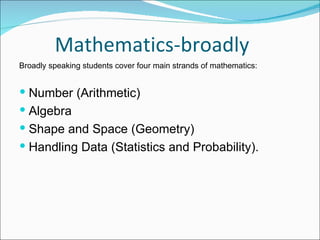
Mathematics-broadly Broadly speaking students cover four main strands of mathematics:  Number (Arithmetic) Algebra Shape and Space (Geometry) Handling Data (Statistics and Probability).
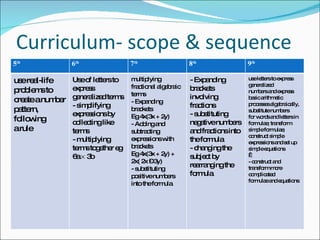
Curriculum- scope & sequence  5 th   6 th   7 th   8 th   9 th   use real-life problems to create a number pattern, following a rule Use of letters to express generalized terms - simplifying expressions by collecting like terms - multiplying terms together eg 6a    3b multiplying fractional algebraic terms  - Expanding brackets  Eg 4x(3x + 2y) - Adding and subtracting expressions with brackets Eg 4x(3x + 2y) + 2x( 2x – 3y)  - substituting positive numbers into the formula  - Expanding brackets involving fractions - substituting negative numbers and fractions into the formula  - changing the subject by rearranging the formula use letters to express generalized numbers and express basic arithmetic processes algebraically, substitute numbers for words and letters in formulae; transform simple formulae; construct simple expressions and set up simple equations   - construct and transform more complicated formulae and equations
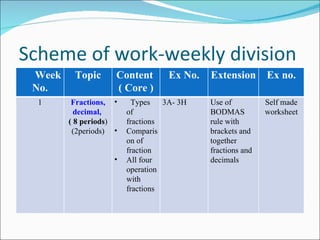
Scheme of work-weekly division  Week No. Topic Content  ( Core ) Ex No. Extension Ex no. 1 Fractions, decimal,  ( 8 periods ) (2periods) Types of fractions Comparison of fraction All four operation with fractions 3A- 3H Use of BODMAS rule with brackets and together fractions and decimals Self made worksheet
core PWS values
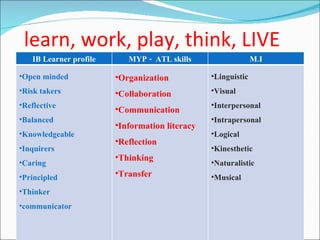
learn, work, play, think, LIVE IB Learner profile MYP -  ATL skills M.I Open minded Risk takers Reflective Balanced Knowledgeable Inquirers Caring Principled Thinker communicator Organization  Collaboration Communication Information literacy Reflection Thinking Transfer  Linguistic Visual Interpersonal Intrapersonal Logical Kinesthetic Naturalistic Musical
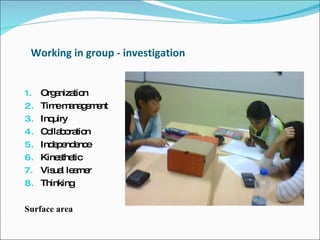
Working in group - investigation Organization Time management Inquiry  Collaboration Independence  Kinesthetic  Visual learner Thinking  Surface area
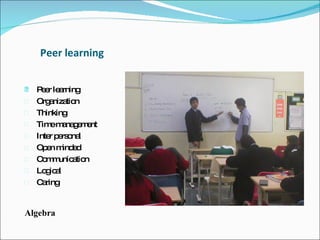
Peer learning Peer learning Organization  Thinking Time management Inter personal  Open minded  Communication  Logical  Caring  Algebra
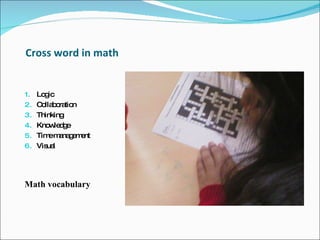
Cross word in math Logic Collaboration  Thinking Knowledge  Time management  Visual  Math vocabulary
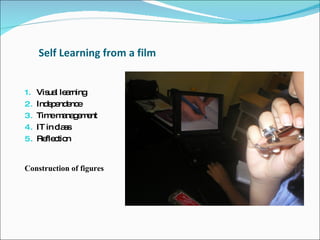
Self Learning from a film Visual learning  Independence Time management  IT in class Reflection  Construction of figures
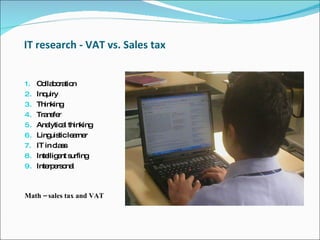
IT research - VAT vs. Sales tax Collaboration Inquiry Thinking Transfer Analytical thinking Linguistic learner  IT in class Intelligent surfing  Interpersonal  Math – sales tax and VAT
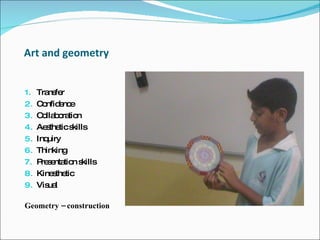
Art and geometry Transfer Confidence Collaboration Aesthetic skills Inquiry  Thinking  Presentation skills  Kinesthetic  Visual  Geometry – construction
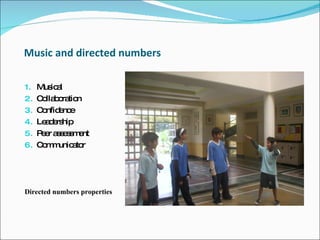
Music and directed numbers Musical Collaboration Confidence  Leadership  Peer assessment  Communicator  Directed numbers properties
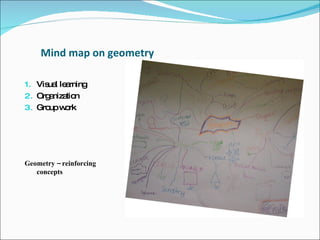
Mind map on geometry Visual learning  Organization  Group work  Geometry – reinforcing  concepts
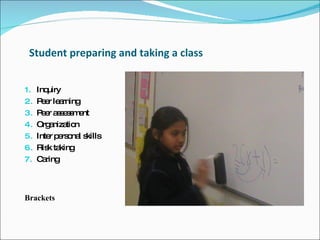
Student preparing and taking a class  Inquiry  Peer learning  Peer assessment  Organization  Inter personal skills Risk taking  Caring  Brackets
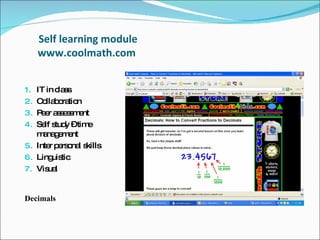
Self learning module www.coolmath.com  IT in class Collaboration Peer assessment  Self study – time management  Inter personal skills  Linguistic  Visual  Decimals
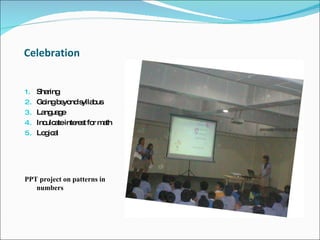
Celebration  Sharing Going beyond syllabus Language  Inculcate interest for math Logical  PPT project on patterns in numbers
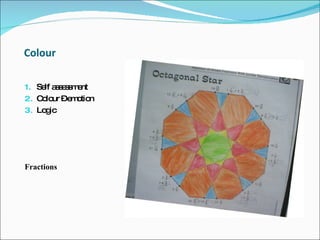
Colour  Self assessment  Colour – emotion  Logic  Fractions
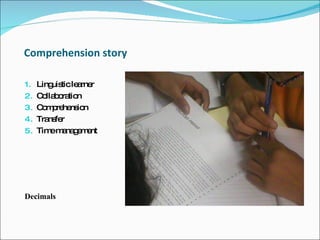
Comprehension story Linguistic learner  Collaboration  Comprehension Transfer  Time management  Decimals
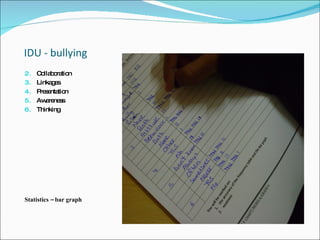
IDU - bullying Collaboration Linkages Presentation  Awareness Thinking  Statistics – bar graph
writing a story – use of math-grade 6 Transfer Linguistic learner  Pythagorean triplets – reinforcement  “ The river Nile flooded and all the boundaries of the farms were washed away. A man was told that he can redraw the boundaries, but the farm should be a right triangle……” Write a story with this plot  showing clearly how the use of Pythagorean triplets helped the man draw the boundary again. You can draw pictures to supplement the story
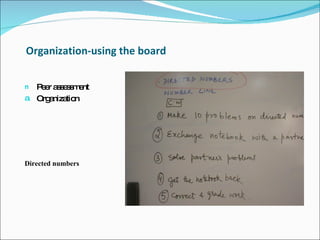
Organization-using the board Peer assessment  Organization  Directed numbers
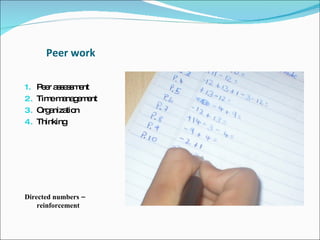
Peer work  Peer assessment  Time management Organization  Thinking  Directed numbers – reinforcement
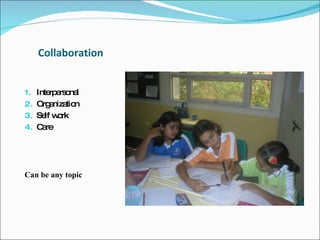
Collaboration  Interpersonal Organization  Self work Care  Can be any topic
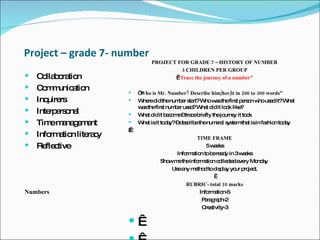
Project – grade 7- number Collaboration Communication Inquirers Interpersonal  Time management  Information literacy  Reflective Numbers  PROJECT FOR GRADE 7 – HISTORY OF NUMBER   3 CHILDREN PER GROUP    “ Trace the journey of a number”   “ Who is Mr. Number? Describe him/her/it in 200 to 300 words” Where did the number start? Who was the first person who used it? What was the first number used? What did it look like? What did it become – trace briefly the journey it took What is it today? – describe the numeral system that is in fashion today    TIME FRAME 5 weeks Information to be ready in 3 weeks Show me the information collected every Monday  Use any method to display your project.   RUBRIC- total 10 marks Information-5 Paragraph-2 Creativity-3    
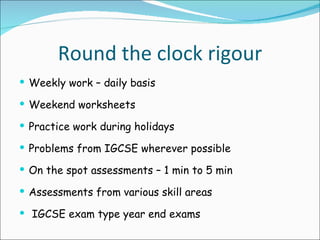
Round the clock rigour Weekly work – daily basis  Weekend worksheets Practice work during holidays Problems from IGCSE wherever possible On the spot assessments – 1 min to 5 min Assessments from various skill areas  IGCSE exam type year end exams
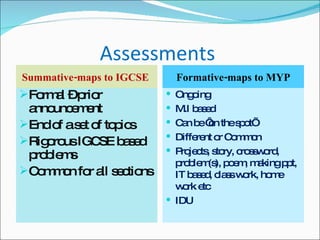
Assessments  Summative-maps to IGCSE  Formative-maps to MYP Formal – prior announcement End of a set of topics Rigorous IGCSE based problems  Common for all sections Ongoing M.I based Can be ‘on the spot’ Different or Common  Projects, story, crossword, problem(s), poem, making ppt, IT based, class work, home work etc  IDU
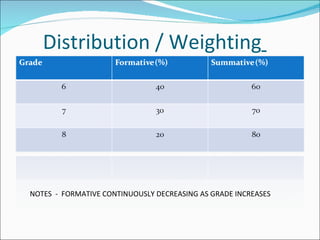
Distribution / Weighting   NOTES  -  FORMATIVE CONTINUOUSLY DECREASING AS GRADE INCREASES
Question for us…teachers and parents Do I see a classroom as a space where a subject is taught and exam skills are covered? And that is where a teacher’s role ends? Or do I see a classroom as a space where situations and challenges are created to nurture life skills; and exam skills is  one of them ?
 

Maths Pres Parents

  • 1.
  • 2.
    Mathematics-broadly Broadly speakingstudents cover four main strands of mathematics: Number (Arithmetic) Algebra Shape and Space (Geometry) Handling Data (Statistics and Probability).
  • 3.
    Curriculum- scope &sequence 5 th 6 th 7 th 8 th 9 th use real-life problems to create a number pattern, following a rule Use of letters to express generalized terms - simplifying expressions by collecting like terms - multiplying terms together eg 6a  3b multiplying fractional algebraic terms - Expanding brackets Eg 4x(3x + 2y) - Adding and subtracting expressions with brackets Eg 4x(3x + 2y) + 2x( 2x – 3y) - substituting positive numbers into the formula - Expanding brackets involving fractions - substituting negative numbers and fractions into the formula - changing the subject by rearranging the formula use letters to express generalized numbers and express basic arithmetic processes algebraically, substitute numbers for words and letters in formulae; transform simple formulae; construct simple expressions and set up simple equations   - construct and transform more complicated formulae and equations
  • 4.
    Scheme of work-weeklydivision Week No. Topic Content ( Core ) Ex No. Extension Ex no. 1 Fractions, decimal, ( 8 periods ) (2periods) Types of fractions Comparison of fraction All four operation with fractions 3A- 3H Use of BODMAS rule with brackets and together fractions and decimals Self made worksheet
  • 5.
  • 6.
    learn, work, play,think, LIVE IB Learner profile MYP - ATL skills M.I Open minded Risk takers Reflective Balanced Knowledgeable Inquirers Caring Principled Thinker communicator Organization Collaboration Communication Information literacy Reflection Thinking Transfer Linguistic Visual Interpersonal Intrapersonal Logical Kinesthetic Naturalistic Musical
  • 7.
    Working in group- investigation Organization Time management Inquiry Collaboration Independence Kinesthetic Visual learner Thinking Surface area
  • 8.
    Peer learning Peerlearning Organization Thinking Time management Inter personal Open minded Communication Logical Caring Algebra
  • 9.
    Cross word inmath Logic Collaboration Thinking Knowledge Time management Visual Math vocabulary
  • 10.
    Self Learning froma film Visual learning Independence Time management IT in class Reflection Construction of figures
  • 11.
    IT research -VAT vs. Sales tax Collaboration Inquiry Thinking Transfer Analytical thinking Linguistic learner IT in class Intelligent surfing Interpersonal Math – sales tax and VAT
  • 12.
    Art and geometryTransfer Confidence Collaboration Aesthetic skills Inquiry Thinking Presentation skills Kinesthetic Visual Geometry – construction
  • 13.
    Music and directednumbers Musical Collaboration Confidence Leadership Peer assessment Communicator Directed numbers properties
  • 14.
    Mind map ongeometry Visual learning Organization Group work Geometry – reinforcing concepts
  • 15.
    Student preparing andtaking a class Inquiry Peer learning Peer assessment Organization Inter personal skills Risk taking Caring Brackets
  • 16.
    Self learning modulewww.coolmath.com IT in class Collaboration Peer assessment Self study – time management Inter personal skills Linguistic Visual Decimals
  • 17.
    Celebration SharingGoing beyond syllabus Language Inculcate interest for math Logical PPT project on patterns in numbers
  • 18.
    Colour Selfassessment Colour – emotion Logic Fractions
  • 19.
    Comprehension story Linguisticlearner Collaboration Comprehension Transfer Time management Decimals
  • 20.
    IDU - bullyingCollaboration Linkages Presentation Awareness Thinking Statistics – bar graph
  • 21.
    writing a story– use of math-grade 6 Transfer Linguistic learner Pythagorean triplets – reinforcement “ The river Nile flooded and all the boundaries of the farms were washed away. A man was told that he can redraw the boundaries, but the farm should be a right triangle……” Write a story with this plot showing clearly how the use of Pythagorean triplets helped the man draw the boundary again. You can draw pictures to supplement the story
  • 22.
    Organization-using the boardPeer assessment Organization Directed numbers
  • 23.
    Peer work Peer assessment Time management Organization Thinking Directed numbers – reinforcement
  • 24.
    Collaboration InterpersonalOrganization Self work Care Can be any topic
  • 25.
    Project – grade7- number Collaboration Communication Inquirers Interpersonal Time management Information literacy Reflective Numbers PROJECT FOR GRADE 7 – HISTORY OF NUMBER   3 CHILDREN PER GROUP   “ Trace the journey of a number”   “ Who is Mr. Number? Describe him/her/it in 200 to 300 words” Where did the number start? Who was the first person who used it? What was the first number used? What did it look like? What did it become – trace briefly the journey it took What is it today? – describe the numeral system that is in fashion today    TIME FRAME 5 weeks Information to be ready in 3 weeks Show me the information collected every Monday Use any method to display your project.   RUBRIC- total 10 marks Information-5 Paragraph-2 Creativity-3    
  • 26.
    Round the clockrigour Weekly work – daily basis Weekend worksheets Practice work during holidays Problems from IGCSE wherever possible On the spot assessments – 1 min to 5 min Assessments from various skill areas IGCSE exam type year end exams
  • 27.
    Assessments Summative-mapsto IGCSE Formative-maps to MYP Formal – prior announcement End of a set of topics Rigorous IGCSE based problems Common for all sections Ongoing M.I based Can be ‘on the spot’ Different or Common Projects, story, crossword, problem(s), poem, making ppt, IT based, class work, home work etc IDU
  • 28.
    Distribution / Weighting NOTES - FORMATIVE CONTINUOUSLY DECREASING AS GRADE INCREASES
  • 29.
    Question for us…teachersand parents Do I see a classroom as a space where a subject is taught and exam skills are covered? And that is where a teacher’s role ends? Or do I see a classroom as a space where situations and challenges are created to nurture life skills; and exam skills is one of them ?
  • 30.