Computer-AssistedComputer-Assisted
Teaching ofTeaching of
MathematicsMathematics
Lucian Constantin VladescuLucian Constantin Vladescu
The school with I-VIII classes Schitu, Olt,The school with I-VIII classes Schitu, Olt,
RomaniaRomania
lucconstvl@yahoo.comlucconstvl@yahoo.com
AbstractAbstract
 In this paper I will exemplify the IntelTeach method ofIn this paper I will exemplify the IntelTeach method of
teaching mathematics through projects for the lessonteaching mathematics through projects for the lesson
“Integers”. I participated in the training course "Intel“Integers”. I participated in the training course "Intel
Teach-Training in the Knowledge Based Society." ThisTeach-Training in the Knowledge Based Society." This
course helped me to make my lessons more attractivecourse helped me to make my lessons more attractive
by integrating resources and IT tools in teachingby integrating resources and IT tools in teaching
mathematics. I present this lesson and in terms of amathematics. I present this lesson and in terms of a
math teacher in a rural school. Children in thismath teacher in a rural school. Children in this
environment have many disadvantages compared toenvironment have many disadvantages compared to
those from urban areas, in particular economic, socialthose from urban areas, in particular economic, social
and technical. AEL laboratories recently broke into thisand technical. AEL laboratories recently broke into this
environment. The project represents an alternativeenvironment. The project represents an alternative
assessment method.assessment method.
1. Introduction1. Introduction
 In this unit, students learn theIn this unit, students learn the
concepts of:concepts of:
 •• Integer, oppositeInteger, opposite
 •• Comparing and ordering integersComparing and ordering integers
 •• Operations with integersOperations with integers
 •• Rules for calculating with powersRules for calculating with powers
 •• using the order of operations andusing the order of operations and
parenthesesparentheses
 •• Solving equations in ZSolving equations in Z
 •• Solving inequalities in Z.Solving inequalities in Z.
 Essential Question:Essential Question:
 How math helps us in solvingHow math helps us in solving
practical content?practical content?
 Unit Questions:Unit Questions:
 Why we need to know the conceptWhy we need to know the concept
of integer?of integer?
 How help us use these concepts inHow help us use these concepts in
problem solving?problem solving?
 Content Questions:Content Questions:
 How do we define an integer?How do we define an integer?
 What is the opposite of anWhat is the opposite of an
integer?integer?
 How it compares integers?How it compares integers?
 What are the operations withWhat are the operations with
integers?integers?
 What is the order ofWhat is the order of
operations in Z?operations in Z?
 How to solve problems thatHow to solve problems that
arise in operations witharise in operations with
integers?integers?
 How to calculate the power ofHow to calculate the power of
an integer?an integer?
 What are the rules ofWhat are the rules of
computing powers?computing powers?
 How to solve equations andHow to solve equations and
inequalities in Z?inequalities in Z?
2. Unit’s Objectives2. Unit’s Objectives
 1. Use algebra to simplify computing elements calculations and for1. Use algebra to simplify computing elements calculations and for
solving equations.solving equations.
 2. Identify-problem situations, to transpose them into2. Identify-problem situations, to transpose them into
mathematical language and effectively organize how to solvemathematical language and effectively organize how to solve
them.them.
 3. Build problems, based on a model (graph or formula).3. Build problems, based on a model (graph or formula).
 4. Consistently provide the solution to a problem, using various4. Consistently provide the solution to a problem, using various
modes of expression (words, mathematical symbols, diagrams,modes of expression (words, mathematical symbols, diagrams,
tables, various construction materials).tables, various construction materials).
 5. Identify uses of mathematical concepts and methods studied in5. Identify uses of mathematical concepts and methods studied in
solving practical problems.solving practical problems.
 6. To assume different roles within a learning group, arguing ideas6. To assume different roles within a learning group, arguing ideas
and mathematical methods, using different sources of informationand mathematical methods, using different sources of information
to verify and support opinions.to verify and support opinions.
3. Operational Objectives3. Operational Objectives
 Students will be able:Students will be able:
 - To understand what an integer is;- To understand what an integer is;
 - To solve problems that arise in- To solve problems that arise in
operations with integers;operations with integers;
 -To calculate the power of an integer;-To calculate the power of an integer;
 -To solve equations and inequalities in Z.-To solve equations and inequalities in Z.
 By this method, the students are in the centerBy this method, the students are in the center
of learning process.of learning process.
 Students will participate in solving individualStudents will participate in solving individual
and group applications, the degree of difficultyand group applications, the degree of difficulty
gradually differentiated learning styles andgradually differentiated learning styles and
level of understanding focused on:level of understanding focused on:
 -Identification of issues involved;-Identification of issues involved;
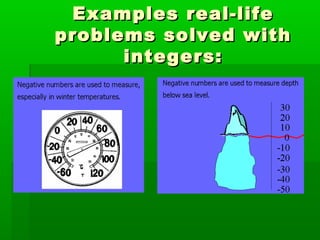
 -Find real-life problems solved with integers,-Find real-life problems solved with integers,
the development of the graphicalthe development of the graphical
representation;representation;
 -Identify problem situations, which can be-Identify problem situations, which can be
transcribed into mathematical language, usingtranscribed into mathematical language, using
algebraic calculations to determine analgebraic calculations to determine an
unknown in an equation in Z.unknown in an equation in Z.
Examples real-lifeExamples real-life
problems solved withproblems solved with
integers:integers:
4. Didactical Strategy4. Didactical Strategy
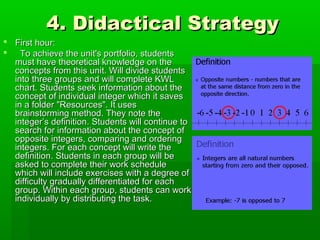
 First hour:First hour:
 To achieve the unit's portfolio, studentsTo achieve the unit's portfolio, students
must have theoretical knowledge on themust have theoretical knowledge on the
concepts from this unit. Will divide studentsconcepts from this unit. Will divide students
into three groups and will complete KWLinto three groups and will complete KWL
chart. Students seek information about thechart. Students seek information about the
concept of individual integer which it savesconcept of individual integer which it saves
in a folder "Resources". It usesin a folder "Resources". It uses
brainstorming method. They note thebrainstorming method. They note the
integer’s definition. Students will continue tointeger’s definition. Students will continue to
search for information about the concept ofsearch for information about the concept of
opposite integers, comparing and orderingopposite integers, comparing and ordering
integers. For each concept will write theintegers. For each concept will write the
definition. Students in each group will bedefinition. Students in each group will be
asked to complete their work scheduleasked to complete their work schedule
which will include exercises with a degree ofwhich will include exercises with a degree of
difficulty gradually differentiated for eachdifficulty gradually differentiated for each
group. Within each group, students can workgroup. Within each group, students can work
individually by distributing the task.individually by distributing the task.
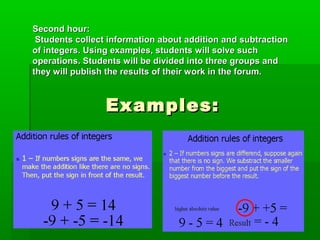
Examples:Examples:
Second hour:Second hour:
Students collect information about addition and subtractionStudents collect information about addition and subtraction
of integers. Using examples, students will solve suchof integers. Using examples, students will solve such
operations. Students will be divided into three groups andoperations. Students will be divided into three groups and
they will publish the results of their work in the forum.they will publish the results of their work in the forum.
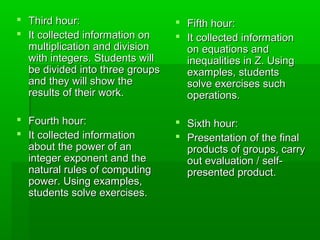
 Third hour:Third hour:
 It collected information onIt collected information on
multiplication and divisionmultiplication and division
with integers. Students willwith integers. Students will
be divided into three groupsbe divided into three groups
and they will show theand they will show the
results of their work.results of their work.
 Fourth hour:Fourth hour:
 It collected informationIt collected information
about the power of anabout the power of an
integer exponent and theinteger exponent and the
natural rules of computingnatural rules of computing
power. Using examples,power. Using examples,
students solve exercises.students solve exercises.
 Fifth hour:Fifth hour:
 It collected informationIt collected information
on equations andon equations and
inequalities in Z. Usinginequalities in Z. Using
examples, studentsexamples, students
solve exercises suchsolve exercises such
operations.operations.
 Sixth hour:Sixth hour:
 Presentation of the finalPresentation of the final
products of groups, carryproducts of groups, carry
out evaluation / self-out evaluation / self-
presented product.presented product.
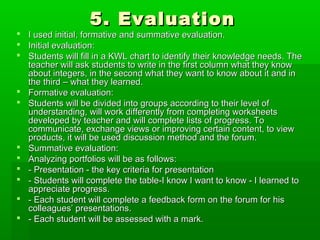
5. Evaluation5. Evaluation
 I used initial, formative and summative evaluation.I used initial, formative and summative evaluation.
 Initial evaluation:Initial evaluation:
 Students will fill in a KWL chart to identify their knowledge needs. TheStudents will fill in a KWL chart to identify their knowledge needs. The
teacher will ask students to write in the first column what they knowteacher will ask students to write in the first column what they know
about integers, in the second what they want to know about it and inabout integers, in the second what they want to know about it and in
the third – what they learned.the third – what they learned.
 Formative evaluation:Formative evaluation:
 Students will be divided into groups according to their level ofStudents will be divided into groups according to their level of
understanding, will work differently from completing worksheetsunderstanding, will work differently from completing worksheets
developed by teacher and will complete lists of progress. Todeveloped by teacher and will complete lists of progress. To
communicate, exchange views or improving certain content, to viewcommunicate, exchange views or improving certain content, to view
products, it will be used discussion method and the forum.products, it will be used discussion method and the forum.
 Summative evaluation:Summative evaluation:
 Analyzing portfolios will be as follows:Analyzing portfolios will be as follows:
 - Presentation - the key criteria for presentation- Presentation - the key criteria for presentation
 - Students will complete the table-I know I want to know - I learned to- Students will complete the table-I know I want to know - I learned to
appreciate progress.appreciate progress.
 - Each student will complete a feedback form on the forum for his- Each student will complete a feedback form on the forum for his
colleagues’ presentations.colleagues’ presentations.
 - Each student will be assessed with a mark.- Each student will be assessed with a mark.
6. Conclusions6. Conclusions
 I noticed that students are very attracted to this type ofI noticed that students are very attracted to this type of
learning, though things started hard, students of rurallearning, though things started hard, students of rural
environment had not benefited from the advantages ofenvironment had not benefited from the advantages of
urban students. KWL chart (I know, I want to know, Iurban students. KWL chart (I know, I want to know, I
learned) has been a very effective tool and highlylearned) has been a very effective tool and highly
appreciated by students. They learned to expressappreciated by students. They learned to express
ideas, knowledge, to discuss, collaborate in teams,ideas, knowledge, to discuss, collaborate in teams,
something new for them. It was difficult initially to makesomething new for them. It was difficult initially to make
them think by themselves, take initiative and to expressthem think by themselves, take initiative and to express
ideas using brainstorming method. To explain theideas using brainstorming method. To explain the
concept of integer, I used many applications andconcept of integer, I used many applications and
examples from real life, because only this way Iexamples from real life, because only this way I
managed to attract their attention and make themmanaged to attract their attention and make them
understand.understand. I concluded that only if you consistently
apply this method at least over a full cycle of four
years, results can be achieved with the students.
7. Acknowledgements7. Acknowledgements
 I would like to thank the “Hands onI would like to thank the “Hands on
Science Romania” coordinator DanScience Romania” coordinator Dan
Sporea for his support andSporea for his support and
encouragements.encouragements.
 Also I want to thank to all organizers ofAlso I want to thank to all organizers of
the Workshop for their work.the Workshop for their work.
8. References8. References
 [1] http://www.didactic.ro/index.php?[1] http://www.didactic.ro/index.php?
cid=cautare&action=search&words=Numerecid=cautare&action=search&words=Numere
+intregi&cat=10&cls+intregi&cat=10&cls
%5B6%5D=true&disciplina=0 [03/27/2010]%5B6%5D=true&disciplina=0 [03/27/2010]
 [2][2] Textbook course IntelteachTextbook course Intelteach
 [3][3] Textbook for grade VI-th, Dana Radu,Textbook for grade VI-th, Dana Radu,
Eugen Radu-Editura TeoraEugen Radu-Editura Teora

Ppt lucian vladescu

  • 1.
    Computer-AssistedComputer-Assisted Teaching ofTeaching of MathematicsMathematics LucianConstantin VladescuLucian Constantin Vladescu The school with I-VIII classes Schitu, Olt,The school with I-VIII classes Schitu, Olt, RomaniaRomania lucconstvl@yahoo.comlucconstvl@yahoo.com
  • 2.
    AbstractAbstract  In thispaper I will exemplify the IntelTeach method ofIn this paper I will exemplify the IntelTeach method of teaching mathematics through projects for the lessonteaching mathematics through projects for the lesson “Integers”. I participated in the training course "Intel“Integers”. I participated in the training course "Intel Teach-Training in the Knowledge Based Society." ThisTeach-Training in the Knowledge Based Society." This course helped me to make my lessons more attractivecourse helped me to make my lessons more attractive by integrating resources and IT tools in teachingby integrating resources and IT tools in teaching mathematics. I present this lesson and in terms of amathematics. I present this lesson and in terms of a math teacher in a rural school. Children in thismath teacher in a rural school. Children in this environment have many disadvantages compared toenvironment have many disadvantages compared to those from urban areas, in particular economic, socialthose from urban areas, in particular economic, social and technical. AEL laboratories recently broke into thisand technical. AEL laboratories recently broke into this environment. The project represents an alternativeenvironment. The project represents an alternative assessment method.assessment method.
  • 3.
    1. Introduction1. Introduction In this unit, students learn theIn this unit, students learn the concepts of:concepts of:  •• Integer, oppositeInteger, opposite  •• Comparing and ordering integersComparing and ordering integers  •• Operations with integersOperations with integers  •• Rules for calculating with powersRules for calculating with powers  •• using the order of operations andusing the order of operations and parenthesesparentheses  •• Solving equations in ZSolving equations in Z  •• Solving inequalities in Z.Solving inequalities in Z.  Essential Question:Essential Question:  How math helps us in solvingHow math helps us in solving practical content?practical content?  Unit Questions:Unit Questions:  Why we need to know the conceptWhy we need to know the concept of integer?of integer?  How help us use these concepts inHow help us use these concepts in problem solving?problem solving?  Content Questions:Content Questions:  How do we define an integer?How do we define an integer?  What is the opposite of anWhat is the opposite of an integer?integer?  How it compares integers?How it compares integers?  What are the operations withWhat are the operations with integers?integers?  What is the order ofWhat is the order of operations in Z?operations in Z?  How to solve problems thatHow to solve problems that arise in operations witharise in operations with integers?integers?  How to calculate the power ofHow to calculate the power of an integer?an integer?  What are the rules ofWhat are the rules of computing powers?computing powers?  How to solve equations andHow to solve equations and inequalities in Z?inequalities in Z?
  • 4.
    2. Unit’s Objectives2.Unit’s Objectives  1. Use algebra to simplify computing elements calculations and for1. Use algebra to simplify computing elements calculations and for solving equations.solving equations.  2. Identify-problem situations, to transpose them into2. Identify-problem situations, to transpose them into mathematical language and effectively organize how to solvemathematical language and effectively organize how to solve them.them.  3. Build problems, based on a model (graph or formula).3. Build problems, based on a model (graph or formula).  4. Consistently provide the solution to a problem, using various4. Consistently provide the solution to a problem, using various modes of expression (words, mathematical symbols, diagrams,modes of expression (words, mathematical symbols, diagrams, tables, various construction materials).tables, various construction materials).  5. Identify uses of mathematical concepts and methods studied in5. Identify uses of mathematical concepts and methods studied in solving practical problems.solving practical problems.  6. To assume different roles within a learning group, arguing ideas6. To assume different roles within a learning group, arguing ideas and mathematical methods, using different sources of informationand mathematical methods, using different sources of information to verify and support opinions.to verify and support opinions.
  • 5.
    3. Operational Objectives3.Operational Objectives  Students will be able:Students will be able:  - To understand what an integer is;- To understand what an integer is;  - To solve problems that arise in- To solve problems that arise in operations with integers;operations with integers;  -To calculate the power of an integer;-To calculate the power of an integer;  -To solve equations and inequalities in Z.-To solve equations and inequalities in Z.
  • 6.
     By thismethod, the students are in the centerBy this method, the students are in the center of learning process.of learning process.  Students will participate in solving individualStudents will participate in solving individual and group applications, the degree of difficultyand group applications, the degree of difficulty gradually differentiated learning styles andgradually differentiated learning styles and level of understanding focused on:level of understanding focused on:  -Identification of issues involved;-Identification of issues involved;  -Find real-life problems solved with integers,-Find real-life problems solved with integers, the development of the graphicalthe development of the graphical representation;representation;  -Identify problem situations, which can be-Identify problem situations, which can be transcribed into mathematical language, usingtranscribed into mathematical language, using algebraic calculations to determine analgebraic calculations to determine an unknown in an equation in Z.unknown in an equation in Z.
  • 7.
    Examples real-lifeExamples real-life problemssolved withproblems solved with integers:integers:
  • 8.
    4. Didactical Strategy4.Didactical Strategy  First hour:First hour:  To achieve the unit's portfolio, studentsTo achieve the unit's portfolio, students must have theoretical knowledge on themust have theoretical knowledge on the concepts from this unit. Will divide studentsconcepts from this unit. Will divide students into three groups and will complete KWLinto three groups and will complete KWL chart. Students seek information about thechart. Students seek information about the concept of individual integer which it savesconcept of individual integer which it saves in a folder "Resources". It usesin a folder "Resources". It uses brainstorming method. They note thebrainstorming method. They note the integer’s definition. Students will continue tointeger’s definition. Students will continue to search for information about the concept ofsearch for information about the concept of opposite integers, comparing and orderingopposite integers, comparing and ordering integers. For each concept will write theintegers. For each concept will write the definition. Students in each group will bedefinition. Students in each group will be asked to complete their work scheduleasked to complete their work schedule which will include exercises with a degree ofwhich will include exercises with a degree of difficulty gradually differentiated for eachdifficulty gradually differentiated for each group. Within each group, students can workgroup. Within each group, students can work individually by distributing the task.individually by distributing the task.
  • 9.
    Examples:Examples: Second hour:Second hour: Studentscollect information about addition and subtractionStudents collect information about addition and subtraction of integers. Using examples, students will solve suchof integers. Using examples, students will solve such operations. Students will be divided into three groups andoperations. Students will be divided into three groups and they will publish the results of their work in the forum.they will publish the results of their work in the forum.
  • 10.
     Third hour:Thirdhour:  It collected information onIt collected information on multiplication and divisionmultiplication and division with integers. Students willwith integers. Students will be divided into three groupsbe divided into three groups and they will show theand they will show the results of their work.results of their work.  Fourth hour:Fourth hour:  It collected informationIt collected information about the power of anabout the power of an integer exponent and theinteger exponent and the natural rules of computingnatural rules of computing power. Using examples,power. Using examples, students solve exercises.students solve exercises.  Fifth hour:Fifth hour:  It collected informationIt collected information on equations andon equations and inequalities in Z. Usinginequalities in Z. Using examples, studentsexamples, students solve exercises suchsolve exercises such operations.operations.  Sixth hour:Sixth hour:  Presentation of the finalPresentation of the final products of groups, carryproducts of groups, carry out evaluation / self-out evaluation / self- presented product.presented product.
  • 11.
    5. Evaluation5. Evaluation I used initial, formative and summative evaluation.I used initial, formative and summative evaluation.  Initial evaluation:Initial evaluation:  Students will fill in a KWL chart to identify their knowledge needs. TheStudents will fill in a KWL chart to identify their knowledge needs. The teacher will ask students to write in the first column what they knowteacher will ask students to write in the first column what they know about integers, in the second what they want to know about it and inabout integers, in the second what they want to know about it and in the third – what they learned.the third – what they learned.  Formative evaluation:Formative evaluation:  Students will be divided into groups according to their level ofStudents will be divided into groups according to their level of understanding, will work differently from completing worksheetsunderstanding, will work differently from completing worksheets developed by teacher and will complete lists of progress. Todeveloped by teacher and will complete lists of progress. To communicate, exchange views or improving certain content, to viewcommunicate, exchange views or improving certain content, to view products, it will be used discussion method and the forum.products, it will be used discussion method and the forum.  Summative evaluation:Summative evaluation:  Analyzing portfolios will be as follows:Analyzing portfolios will be as follows:  - Presentation - the key criteria for presentation- Presentation - the key criteria for presentation  - Students will complete the table-I know I want to know - I learned to- Students will complete the table-I know I want to know - I learned to appreciate progress.appreciate progress.  - Each student will complete a feedback form on the forum for his- Each student will complete a feedback form on the forum for his colleagues’ presentations.colleagues’ presentations.  - Each student will be assessed with a mark.- Each student will be assessed with a mark.
  • 12.
    6. Conclusions6. Conclusions I noticed that students are very attracted to this type ofI noticed that students are very attracted to this type of learning, though things started hard, students of rurallearning, though things started hard, students of rural environment had not benefited from the advantages ofenvironment had not benefited from the advantages of urban students. KWL chart (I know, I want to know, Iurban students. KWL chart (I know, I want to know, I learned) has been a very effective tool and highlylearned) has been a very effective tool and highly appreciated by students. They learned to expressappreciated by students. They learned to express ideas, knowledge, to discuss, collaborate in teams,ideas, knowledge, to discuss, collaborate in teams, something new for them. It was difficult initially to makesomething new for them. It was difficult initially to make them think by themselves, take initiative and to expressthem think by themselves, take initiative and to express ideas using brainstorming method. To explain theideas using brainstorming method. To explain the concept of integer, I used many applications andconcept of integer, I used many applications and examples from real life, because only this way Iexamples from real life, because only this way I managed to attract their attention and make themmanaged to attract their attention and make them understand.understand. I concluded that only if you consistently apply this method at least over a full cycle of four years, results can be achieved with the students.
  • 13.
    7. Acknowledgements7. Acknowledgements I would like to thank the “Hands onI would like to thank the “Hands on Science Romania” coordinator DanScience Romania” coordinator Dan Sporea for his support andSporea for his support and encouragements.encouragements.  Also I want to thank to all organizers ofAlso I want to thank to all organizers of the Workshop for their work.the Workshop for their work.
  • 14.
    8. References8. References [1] http://www.didactic.ro/index.php?[1] http://www.didactic.ro/index.php? cid=cautare&action=search&words=Numerecid=cautare&action=search&words=Numere +intregi&cat=10&cls+intregi&cat=10&cls %5B6%5D=true&disciplina=0 [03/27/2010]%5B6%5D=true&disciplina=0 [03/27/2010]  [2][2] Textbook course IntelteachTextbook course Intelteach  [3][3] Textbook for grade VI-th, Dana Radu,Textbook for grade VI-th, Dana Radu, Eugen Radu-Editura TeoraEugen Radu-Editura Teora