BRINGING MATH INTO LITERACY
OR
BRINGING LITERACY INTO MATH
Marcy Myers
ABOUT ME
 16 years of experience
 8 years as a 7th or 8th teacher (basic
Math, Algebra, and Reading for low achieving
readers)
 8 years Math Facilitator K-8
 Our school is a phase 3 balanced literacy school so
I have worked with our literacy facilitators to discuss
how to use the similar format with Math.
OUTLINE OF THIS SESSION
 Fill out Google Form to receive Documents
 Real Story
 Math Problem
 Mathematical Practice 3 and Relationship with
Literacy
 Confusing Terms and Symbols
 Interactive Read Aloud
 Graphic Organizers
 Reading and Visual Literacy
 Literature Contributes to Math
 Awesome Resource
SIGN IN TO RECEIVE ELECTRONIC
DOCUMENTS
 https://docs.google.com/forms/d/1Qh2vOUjtYG7pu
_NSi9BWFbMR3wow_VQePx9wuzEpG4w/viewfor
m
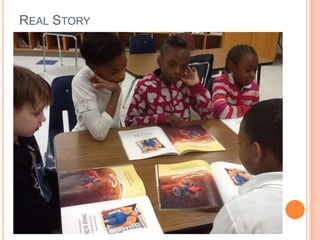
REAL STORY
MATH PROBLEM
 “The 512 Ants on Sullivan Street” has ants all
through the book carrying different items.
 There was 1 ant carrying a crumb, 2 ants carried
some pieces of plum, 4 ants carried a barbecue
chip. How many total ants were there if this pattern
continues with the most ants were the ants who
carried a cake was 512 ants?
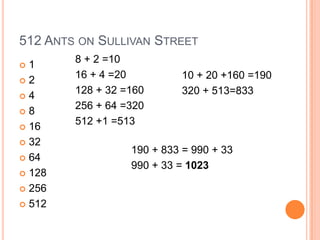
512 ANTS ON SULLIVAN STREET
 1
 2
 4
 8
 16
 32
 64
 128
 256
 512
8 + 2 =10
16 + 4 =20
128 + 32 =160
256 + 64 =320
512 +1 =513
10 + 20 +160 =190
320 + 513=833
190 + 833 = 990 + 33
990 + 33 = 1023
CCSS.MATH.PRACTICE.MP3
 Construct viable arguments and critique the reasoning of others.
 Mathematically proficient students understand and use stated
assumptions, definitions, and previously established results in
constructing arguments. They make conjectures and build a logical
progression of statements to explore the truth of their conjectures. They
are able to analyze situations by breaking them into cases, and can
recognize and use counterexamples. They justify their
conclusions, communicate them to others, and respond to the arguments
of others. They reason inductively about data, making plausible
arguments that take into account the context from which the data arose.
Mathematically proficient students are also able to compare the
effectiveness of two plausible arguments, distinguish correct logic or
reasoning from that which is flawed, and—if there is a flaw in an
argument—explain what it is. Elementary students can construct
arguments using concrete referents such as
objects, drawings, diagrams, and actions. Such arguments can make
sense and be correct, even though they are not generalized or made
formal until later grades. Later, students learn to determine domains to
which an argument applies. Students at all grades can listen or read the
arguments of others, decide whether they make sense, and ask useful
questions to clarify or improve the arguments.
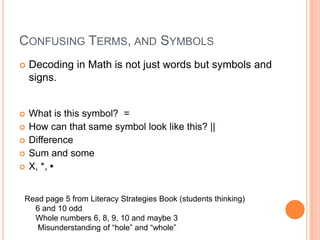
CONFUSING TERMS, AND SYMBOLS
 What is this symbol? =
 How can that same symbol look like this? ||
 Difference
 Sum and some
 X, *, •
 Decoding in Math is not just words but symbols and
signs.
Read page 5 from Literacy Strategies Book (students thinking)
6 and 10 odd
Whole numbers 6, 8, 9, 10 and maybe 3
Misunderstanding of “hole” and “whole”
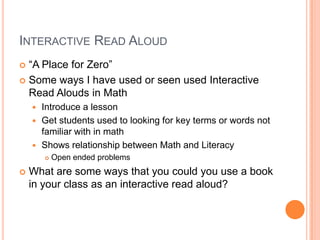
INTERACTIVE READ ALOUD
 “A Place for Zero”
 Some ways I have used or seen used Interactive
Read Alouds in Math
ď‚— Introduce a lesson
ď‚— Get students used to looking for key terms or words not
familiar with in math
ď‚— Shows relationship between Math and Literacy
 Open ended problems
 What are some ways that you could you use a book
in your class as an interactive read aloud?
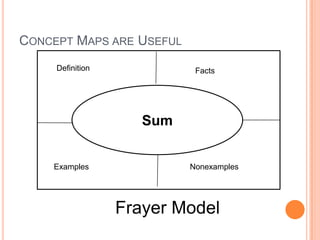
CONCEPT MAPS ARE USEFUL
Sum
Definition Facts
Examples Nonexamples
Frayer Model
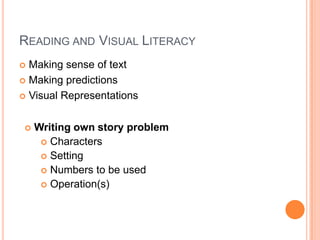
READING AND VISUAL LITERACY
 Making sense of text
 Making predictions
 Visual Representations
 Writing own story problem
 Characters
 Setting
 Numbers to be used
 Operation(s)
WHAT LITERATURE CONTRIBUTES TO MATH
 Contexts for Math
 Expressing and Recalling thoughts
 Expressing strategies and solutions
 Encourages communication (MP 3)
AWESOME RESOURCE
 Math Reads by Marilyn Burns
 Example Lesson
 Books are Leveled
QUICK SURVEY
https://docs.google.com/a/cms.k12.nc.us/forms/d/1hUzp3ZdxD34Hnip
KHf0oNCA0WKYj3sGEJWZUFtbVmYw/viewform
REFERENCES
 Literacy Strategies for Improving Mathematics
Instruction by Joan M. Kenney
 Math Reads by Marilyn Burns
 Common Core Standards
 “Sharing Beans with Friends” article from Teaching
Children Mathematics November 2013 Volume 20
Number 4 by Clare V. Bell

Bringing math into literacy

  • 1.
    BRINGING MATH INTOLITERACY OR BRINGING LITERACY INTO MATH Marcy Myers
  • 2.
    ABOUT ME  16years of experience  8 years as a 7th or 8th teacher (basic Math, Algebra, and Reading for low achieving readers)  8 years Math Facilitator K-8  Our school is a phase 3 balanced literacy school so I have worked with our literacy facilitators to discuss how to use the similar format with Math.
  • 3.
    OUTLINE OF THISSESSION  Fill out Google Form to receive Documents  Real Story  Math Problem  Mathematical Practice 3 and Relationship with Literacy  Confusing Terms and Symbols  Interactive Read Aloud  Graphic Organizers  Reading and Visual Literacy  Literature Contributes to Math  Awesome Resource
  • 4.
    SIGN IN TORECEIVE ELECTRONIC DOCUMENTS  https://docs.google.com/forms/d/1Qh2vOUjtYG7pu _NSi9BWFbMR3wow_VQePx9wuzEpG4w/viewfor m
  • 5.
  • 6.
    MATH PROBLEM  “The512 Ants on Sullivan Street” has ants all through the book carrying different items.  There was 1 ant carrying a crumb, 2 ants carried some pieces of plum, 4 ants carried a barbecue chip. How many total ants were there if this pattern continues with the most ants were the ants who carried a cake was 512 ants?
  • 7.
    512 ANTS ONSULLIVAN STREET  1  2  4  8  16  32  64  128  256  512 8 + 2 =10 16 + 4 =20 128 + 32 =160 256 + 64 =320 512 +1 =513 10 + 20 +160 =190 320 + 513=833 190 + 833 = 990 + 33 990 + 33 = 1023
  • 8.
    CCSS.MATH.PRACTICE.MP3  Construct viablearguments and critique the reasoning of others.  Mathematically proficient students understand and use stated assumptions, definitions, and previously established results in constructing arguments. They make conjectures and build a logical progression of statements to explore the truth of their conjectures. They are able to analyze situations by breaking them into cases, and can recognize and use counterexamples. They justify their conclusions, communicate them to others, and respond to the arguments of others. They reason inductively about data, making plausible arguments that take into account the context from which the data arose. Mathematically proficient students are also able to compare the effectiveness of two plausible arguments, distinguish correct logic or reasoning from that which is flawed, and—if there is a flaw in an argument—explain what it is. Elementary students can construct arguments using concrete referents such as objects, drawings, diagrams, and actions. Such arguments can make sense and be correct, even though they are not generalized or made formal until later grades. Later, students learn to determine domains to which an argument applies. Students at all grades can listen or read the arguments of others, decide whether they make sense, and ask useful questions to clarify or improve the arguments.
  • 9.
    CONFUSING TERMS, ANDSYMBOLS  What is this symbol? =  How can that same symbol look like this? ||  Difference  Sum and some  X, *, •  Decoding in Math is not just words but symbols and signs. Read page 5 from Literacy Strategies Book (students thinking) 6 and 10 odd Whole numbers 6, 8, 9, 10 and maybe 3 Misunderstanding of “hole” and “whole”
  • 10.
    INTERACTIVE READ ALOUD “A Place for Zero”  Some ways I have used or seen used Interactive Read Alouds in Math  Introduce a lesson  Get students used to looking for key terms or words not familiar with in math  Shows relationship between Math and Literacy  Open ended problems  What are some ways that you could you use a book in your class as an interactive read aloud?
  • 11.
    CONCEPT MAPS AREUSEFUL Sum Definition Facts Examples Nonexamples Frayer Model
  • 12.
    READING AND VISUALLITERACY  Making sense of text  Making predictions  Visual Representations  Writing own story problem  Characters  Setting  Numbers to be used  Operation(s)
  • 13.
    WHAT LITERATURE CONTRIBUTESTO MATH  Contexts for Math  Expressing and Recalling thoughts  Expressing strategies and solutions  Encourages communication (MP 3)
  • 14.
    AWESOME RESOURCE  MathReads by Marilyn Burns  Example Lesson  Books are Leveled
  • 15.
  • 16.
    REFERENCES  Literacy Strategiesfor Improving Mathematics Instruction by Joan M. Kenney  Math Reads by Marilyn Burns  Common Core Standards  “Sharing Beans with Friends” article from Teaching Children Mathematics November 2013 Volume 20 Number 4 by Clare V. Bell