Isaac School District, No. 5
                                              Mathematics Curriculum Guide: 2nd Grade

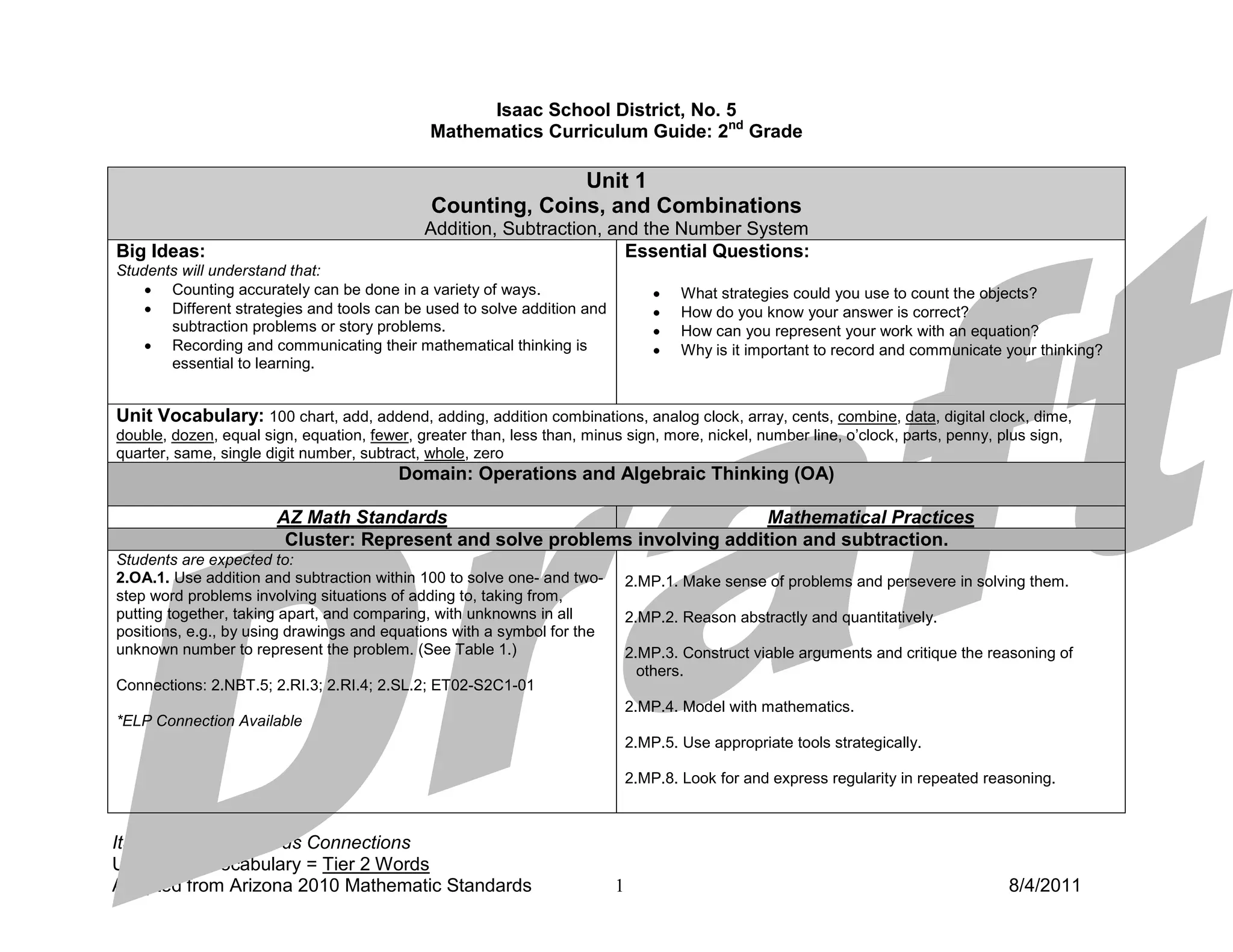
                                                            Unit 1
                                              Counting, Coins, and Combinations
                                             Addition, Subtraction, and the Number System
Big Ideas:                                                            Essential Questions:
Students will understand that:
    • Counting accurately can be done in a variety of ways.                       •   What strategies could you use to count the objects?
    • Different strategies and tools can be used to solve addition and            •   How do you know your answer is correct?
       subtraction problems or story problems.                                    •   How can you represent your work with an equation?
    • Recording and communicating their mathematical thinking is                  •   Why is it important to record and communicate your thinking?
       essential to learning.


Unit Vocabulary: 100 chart, add, addend, adding, addition combinations, analog clock, array, cents, combine, data, digital clock, dime,
double, dozen, equal sign, equation, fewer, greater than, less than, minus sign, more, nickel, number line, o’clock, parts, penny, plus sign,
quarter, same, single digit number, subtract, whole, zero
                                          Domain: Operations and Algebraic Thinking (OA)

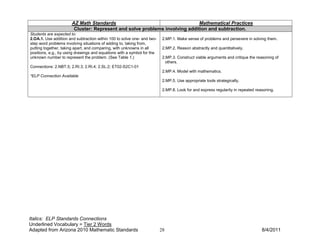
                       AZ Math Standards                                     Mathematical Practices
                        Cluster: Represent and solve problems involving addition and subtraction.
Students are expected to:
2.OA.1. Use addition and subtraction within 100 to solve one- and two-        2.MP.1. Make sense of problems and persevere in solving them.
step word problems involving situations of adding to, taking from,
putting together, taking apart, and comparing, with unknowns in all           2.MP.2. Reason abstractly and quantitatively.
positions, e.g., by using drawings and equations with a symbol for the
unknown number to represent the problem. (See Table 1.)                       2.MP.3. Construct viable arguments and critique the reasoning of
                                                                                others.
Connections: 2.NBT.5; 2.RI.3; 2.RI.4; 2.SL.2; ET02-S2C1-01
                                                                              2.MP.4. Model with mathematics.
*ELP Connection Available
                                                                              2.MP.5. Use appropriate tools strategically.

                                                                              2.MP.8. Look for and express regularity in repeated reasoning.


Italics: ELP Standards Connections
Underlined Vocabulary = Tier 2 Words
Adapted from Arizona 2010 Mathematic Standards                            1                                                          8/4/2011
Explanations and Examples

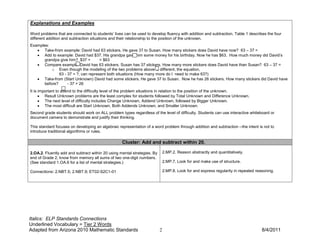
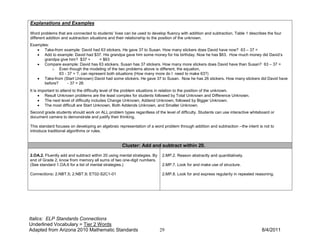
Word problems that are connected to students’ lives can be used to develop fluency with addition and subtraction. Table 1 describes the four
different addition and subtraction situations and their relationship to the position of the unknown.
Examples:
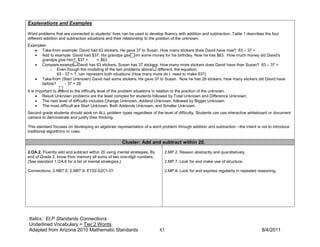
   • Take-from example: David had 63 stickers. He gave 37 to Susan. How many stickers does David have now? 63 – 37 =
   • Add to example: David had $37. His grandpa gave him some money for his birthday. Now he has $63. How much money did David’s
      grandpa give him? $37 +        = $63
   • Compare example: David has 63 stickers. Susan has 37 stickers. How many more stickers does David have than Susan? 63 – 37 =
          o Even though the modeling of the two problems above is different, the equation,
              63 - 37 = ?, can represent both situations (How many more do I need to make 63?)
   • Take-from (Start Unknown) David had some stickers. He gave 37 to Susan. Now he has 26 stickers. How many stickers did David have
      before?      - 37 = 26
It is important to attend to the difficulty level of the problem situations in relation to the position of the unknown.
      • Result Unknown problems are the least complex for students followed by Total Unknown and Difference Unknown.
      • The next level of difficulty includes Change Unknown, Addend Unknown, followed by Bigger Unknown.
      • The most difficult are Start Unknown, Both Addends Unknown, and Smaller Unknown.
Second grade students should work on ALL problem types regardless of the level of difficulty. Students can use interactive whiteboard or
document camera to demonstrate and justify their thinking.

This standard focuses on developing an algebraic representation of a word problem through addition and subtraction --the intent is not to
introduce traditional algorithms or rules.

                                                   Cluster: Add and subtract within 20.

2.OA.2. Fluently add and subtract within 20 using mental strategies. By       2.MP.2. Reason abstractly and quantitatively.
end of Grade 2, know from memory all sums of two one-digit numbers.
(See standard 1.OA.6 for a list of mental strategies.)                        2.MP.7. Look for and make use of structure.

Connections: 2.NBT.5; 2.NBT.9; ET02-S2C1-01                                   2.MP.8. Look for and express regularity in repeated reasoning.


Italics: ELP Standards Connections
Underlined Vocabulary = Tier 2 Words
Adapted from Arizona 2010 Mathematic Standards                            2                                                          8/4/2011
Explanations and Examples

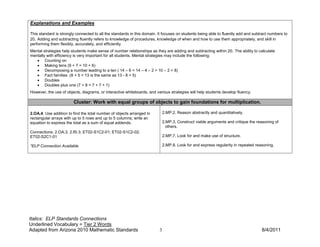
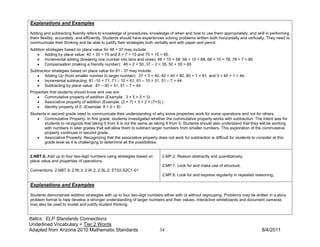
This standard is strongly connected to all the standards in this domain. It focuses on students being able to fluently add and subtract numbers to
20. Adding and subtracting fluently refers to knowledge of procedures, knowledge of when and how to use them appropriately, and skill in
performing them flexibly, accurately, and efficiently.
Mental strategies help students make sense of number relationships as they are adding and subtracting within 20. The ability to calculate
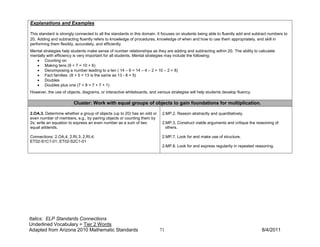
mentally with efficiency is very important for all students. Mental strategies may include the following:
   • Counting on
   • Making tens (9 + 7 = 10 + 6)
   • Decomposing a number leading to a ten ( 14 – 6 = 14 – 4 – 2 = 10 – 2 = 8)
   • Fact families (8 + 5 = 13 is the same as 13 - 8 = 5)
   • Doubles
   • Doubles plus one (7 + 8 = 7 + 7 + 1)
However, the use of objects, diagrams, or interactive whiteboards, and various strategies will help students develop fluency.

                        Cluster: Work with equal groups of objects to gain foundations for multiplication.

2.OA.4. Use addition to find the total number of objects arranged in         2.MP.2. Reason abstractly and quantitatively.
rectangular arrays with up to 5 rows and up to 5 columns; write an
equation to express the total as a sum of equal addends.                     2.MP.3, Construct viable arguments and critique the reasoning of
                                                                               others.
Connections: 2.OA.3, 2.RI.3; ET02-S1C2-01; ET02-S1C2-02;
ET02-S2C1-01                                                                 2.MP.7. Look for and make use of structure.

*ELP Connection Available                                                    2.MP.8. Look for and express regularity in repeated reasoning.


Italics: ELP Standards Connections
Underlined Vocabulary = Tier 2 Words
Adapted from Arizona 2010 Mathematic Standards                           3                                                          8/4/2011
Explanations and Examples
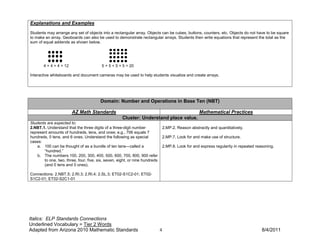
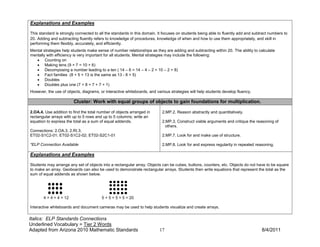
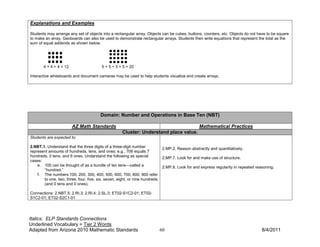
Students may arrange any set of objects into a rectangular array. Objects can be cubes, buttons, counters, etc. Objects do not have to be square
to make an array. Geoboards can also be used to demonstrate rectangular arrays. Students then write equations that represent the total as the
sum of equal addends as shown below.


       4 + 4 + 4 = 12                    5 + 5 + 5 + 5 = 20

Interactive whiteboards and document cameras may be used to help students visualize and create arrays.


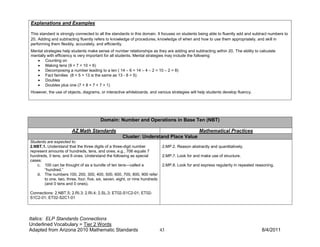
                                        Domain: Number and Operations in Base Ten (NBT)

                        AZ Math Standards                                                            Mathematical Practices
                                                     Cluster: Understand place value.
Students are expected to:
2.NBT.1. Understand that the three digits of a three-digit number                2.MP.2. Reason abstractly and quantitatively.
represent amounts of hundreds, tens, and ones; e.g., 706 equals 7
hundreds, 0 tens, and 6 ones. Understand the following as special                2.MP.7. Look for and make use of structure.
cases:
    a. 100 can be thought of as a bundle of ten tens—called a                    2.MP.8. Look for and express regularity in repeated reasoning.
       “hundred.”
    b. The numbers 100, 200, 300, 400, 500, 600, 700, 800, 900 refer
       to one, two, three, four, five, six, seven, eight, or nine hundreds
       (and 0 tens and 0 ones).

Connections: 2.NBT.5; 2.RI.3; 2.RI.4; 2.SL.3; ET02-S1C2-01; ET02-
S1C2-01; ET02-S2C1-01


Italics: ELP Standards Connections
Underlined Vocabulary = Tier 2 Words
Adapted from Arizona 2010 Mathematic Standards                               4                                                          8/4/2011
Explanations and Examples

Understanding that 10 ones make one ten and that 10 tens make one hundred is fundamental to students’ mathematical development. Students
need multiple opportunities counting and “bundling” groups of tens in first grade. In second grade, students build on their understanding by
making bundles of 100s with or without leftovers using base ten blocks, cubes in towers of 10, ten frames, etc. This emphasis on bundling
hundreds will support students’ discovery of place value patterns.
As students are representing the various amounts, it is important that emphasis is placed on the language associated with the quantity. For
example, 243 can be expressed in multiple ways such as 2 groups of hundred, 4 groups of ten and 3 ones, as well as 24 tens with 3 ones. When
students read numbers, they should read in standard form as well as using place value concepts. For example, 243 should be read as “two
hundred forty-three” as well as two hundreds, 4 tens, 3 ones.

A document camera or interactive whiteboard can also be used to demonstrate “bundling” of objects. This gives students the opportunity to
communicate their counting and thinking.


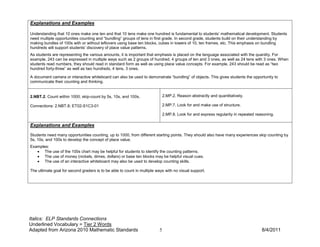
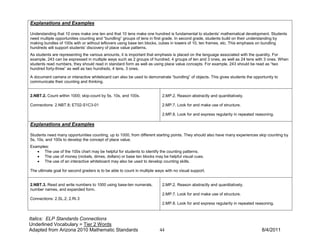
2.NBT.2. Count within 1000; skip-count by 5s, 10s, and 100s.                  2.MP.2. Reason abstractly and quantitatively.

Connections: 2.NBT.8; ET02-S1C3-01                                            2.MP.7. Look for and make use of structure.

                                                                              2.MP.8. Look for and express regularity in repeated reasoning.

Explanations and Examples
Students need many opportunities counting, up to 1000, from different starting points. They should also have many experiences skip counting by
5s, 10s, and 100s to develop the concept of place value.
Examples:
   • The use of the 100s chart may be helpful for students to identify the counting patterns.
   • The use of money (nickels, dimes, dollars) or base ten blocks may be helpful visual cues.
   • The use of an interactive whiteboard may also be used to develop counting skills.

The ultimate goal for second graders is to be able to count in multiple ways with no visual support.


Italics: ELP Standards Connections
Underlined Vocabulary = Tier 2 Words
Adapted from Arizona 2010 Mathematic Standards                            5                                                          8/4/2011
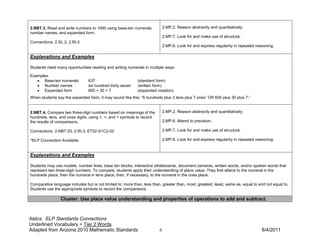
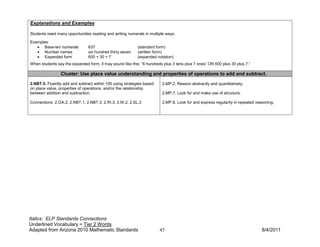
2.NBT.3. Read and write numbers to 1000 using base-ten numerals,             2.MP.2. Reason abstractly and quantitatively.
number names, and expanded form.
                                                                             2.MP.7. Look for and make use of structure.
Connections: 2.SL.2; 2.RI.3
                                                                             2.MP.8. Look for and express regularity in repeated reasoning.

Explanations and Examples

Students need many opportunities reading and writing numerals in multiple ways.

Examples:
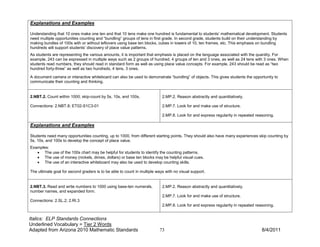
   • Base-ten numerals           637                         (standard form)
   • Number names                six hundred thirty seven    (written form)
   • Expanded form               600 + 30 + 7                (expanded notation)
When students say the expanded form, it may sound like this: “6 hundreds plus 3 tens plus 7 ones” OR 600 plus 30 plus 7.”


2.NBT.4. Compare two three-digit numbers based on meanings of the            2.MP.2. Reason abstractly and quantitatively.
hundreds, tens, and ones digits, using >, =, and < symbols to record
the results of comparisons.                                                  2.MP.6. Attend to precision.

Connections: 2.NBT.03; 2.RI.3; ET02-S1C2-02                                  2.MP.7. Look for and make use of structure.

*ELP Connection Available                                                    2.MP.8. Look for and express regularity in repeated reasoning.


Explanations and Examples

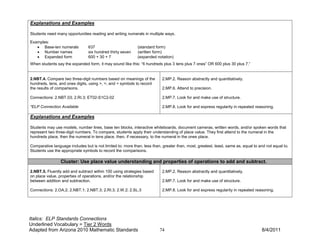
Students may use models, number lines, base ten blocks, interactive whiteboards, document cameras, written words, and/or spoken words that
represent two three-digit numbers. To compare, students apply their understanding of place value. They first attend to the numeral in the
hundreds place, then the numeral in tens place, then, if necessary, to the numeral in the ones place.

Comparative language includes but is not limited to: more than, less than, greater than, most, greatest, least, same as, equal to and not equal to.
Students use the appropriate symbols to record the comparisons.

                 Cluster: Use place value understanding and properties of operations to add and subtract.


Italics: ELP Standards Connections
Underlined Vocabulary = Tier 2 Words
Adapted from Arizona 2010 Mathematic Standards                           6                                                          8/4/2011
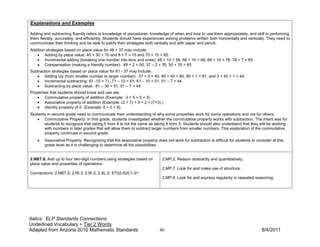
2.NBT.5. Fluently add and subtract within 100 using strategies based          2.MP.2. Reason abstractly and quantitatively.
on place value, properties of operations, and/or the relationship
between addition and subtraction.                                             2.MP.7. Look for and make use of structure.

Connections: 2.OA.2; 2.NBT.1; 2.NBT.3; 2.RI.3; 2.W.2; 2.SL.3                  2.MP.8. Look for and express regularity in repeated reasoning.

Explanations and Examples

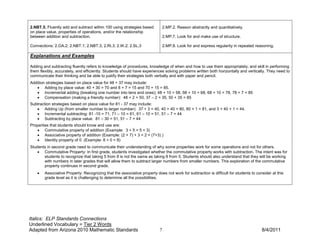
Adding and subtracting fluently refers to knowledge of procedures, knowledge of when and how to use them appropriately, and skill in performing
them flexibly, accurately, and efficiently. Students should have experiences solving problems written both horizontally and vertically. They need to
communicate their thinking and be able to justify their strategies both verbally and with paper and pencil.
Addition strategies based on place value for 48 + 37 may include:
   • Adding by place value: 40 + 30 = 70 and 8 + 7 = 15 and 70 + 15 = 85.
   • Incremental adding (breaking one number into tens and ones); 48 + 10 = 58, 58 + 10 = 68, 68 + 10 = 78, 78 + 7 = 85
   • Compensation (making a friendly number): 48 + 2 = 50, 37 – 2 = 35, 50 + 35 = 85
Subtraction strategies based on place value for 81 - 37 may include:
   • Adding Up (from smaller number to larger number): 37 + 3 = 40, 40 + 40 = 80, 80 + 1 = 81, and 3 + 40 + 1 = 44.
   • Incremental subtracting: 81 -10 = 71, 71 – 10 = 61, 61 – 10 = 51, 51 – 7 = 44
   • Subtracting by place value: 81 – 30 = 51, 51 – 7 = 44
Properties that students should know and use are:
   • Commutative property of addition (Example: 3 + 5 = 5 + 3)
   • Associative property of addition (Example: (2 + 7) + 3 = 2 + (7+3) )
   • Identity property of 0 (Example: 8 + 0 = 8)
Students in second grade need to communicate their understanding of why some properties work for some operations and not for others.
    • Commutative Property: In first grade, students investigated whether the commutative property works with subtraction. The intent was for
       students to recognize that taking 5 from 8 is not the same as taking 8 from 5. Students should also understand that they will be working
       with numbers in later grades that will allow them to subtract larger numbers from smaller numbers. This exploration of the commutative
       property continues in second grade.
    •   Associative Property: Recognizing that the associative property does not work for subtraction is difficult for students to consider at this
        grade level as it is challenging to determine all the possibilities.


Italics: ELP Standards Connections
Underlined Vocabulary = Tier 2 Words
Adapted from Arizona 2010 Mathematic Standards                            7                                                           8/4/2011
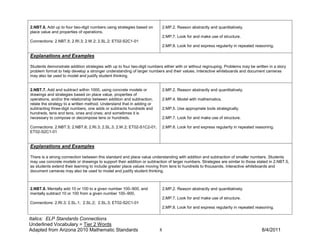
2.NBT.6. Add up to four two-digit numbers using strategies based on         2.MP.2. Reason abstractly and quantitatively.
place value and properties of operations.
                                                                            2.MP.7. Look for and make use of structure.
Connections: 2.NBT.5; 2.RI.3; 2.W.2; 2.SL.2; ET02-S2C1-01
                                                                            2.MP.8. Look for and express regularity in repeated reasoning.

Explanations and Examples

Students demonstrate addition strategies with up to four two-digit numbers either with or without regrouping. Problems may be written in a story
problem format to help develop a stronger understanding of larger numbers and their values. Interactive whiteboards and document cameras
may also be used to model and justify student thinking.


2.NBT.7. Add and subtract within 1000, using concrete models or             2.MP.2. Reason abstractly and quantitatively.
drawings and strategies based on place value, properties of
operations, and/or the relationship between addition and subtraction;       2.MP.4. Model with mathematics.
relate the strategy to a written method. Understand that in adding or
subtracting three-digit numbers, one adds or subtracts hundreds and         2.MP.5. Use appropriate tools strategically.
hundreds, tens and tens, ones and ones; and sometimes it is
necessary to compose or decompose tens or hundreds.                         2.MP.7. Look for and make use of structure.

Connections: 2.NBT.5; 2.NBT.6; 2.RI.3; 2.SL.3; 2.W.2; ET02-S1C2-01;         2.MP.8. Look for and express regularity in repeated reasoning.
ET02-S2C1-01


Explanations and Examples

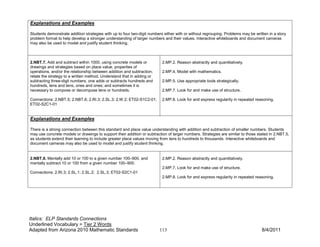
There is a strong connection between this standard and place value understanding with addition and subtraction of smaller numbers. Students
may use concrete models or drawings to support their addition or subtraction of larger numbers. Strategies are similar to those stated in 2.NBT.5,
as students extend their learning to include greater place values moving from tens to hundreds to thousands. Interactive whiteboards and
document cameras may also be used to model and justify student thinking.


2.NBT.8. Mentally add 10 or 100 to a given number 100–900, and              2.MP.2. Reason abstractly and quantitatively.
mentally subtract 10 or 100 from a given number 100–900.
                                                                            2.MP.7. Look for and make use of structure.
Connections: 2.RI.3; 2.SL.1; 2.SL.2; 2.SL.3; ET02-S2C1-01
                                                                            2.MP.8. Look for and express regularity in repeated reasoning.

Italics: ELP Standards Connections
Underlined Vocabulary = Tier 2 Words
Adapted from Arizona 2010 Mathematic Standards                          8                                                          8/4/2011
Explanations and Examples

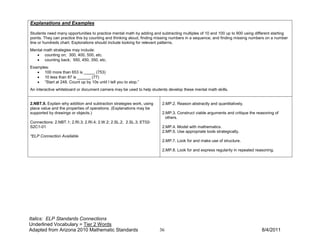
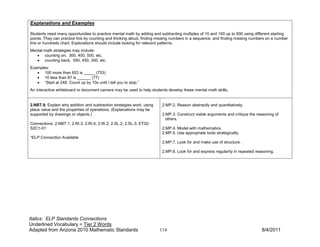
Students need many opportunities to practice mental math by adding and subtracting multiples of 10 and 100 up to 900 using different starting
points. They can practice this by counting and thinking aloud, finding missing numbers in a sequence, and finding missing numbers on a number
line or hundreds chart. Explorations should include looking for relevant patterns.
Mental math strategies may include:
   • counting on; 300, 400, 500, etc.
   • counting back; 550, 450, 350, etc.
Examples:
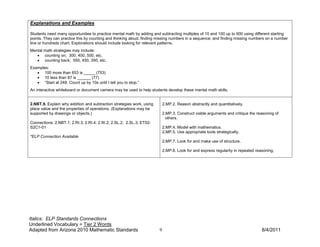
   • 100 more than 653 is _____ (753)
   • 10 less than 87 is ______ (77)
   • “Start at 248. Count up by 10s until I tell you to stop.”
An interactive whiteboard or document camera may be used to help students develop these mental math skills.


2.NBT.9. Explain why addition and subtraction strategies work, using       2.MP.2. Reason abstractly and quantitatively.
place value and the properties of operations. (Explanations may be
supported by drawings or objects.)                                         2.MP.3. Construct viable arguments and critique the reasoning of
                                                                             others.
Connections: 2.NBT.1; 2.RI.3; 2.RI.4; 2.W.2; 2.SL.2; 2.SL.3; ET02-
S2C1-01                                                                    2.MP.4. Model with mathematics.
                                                                           2.MP.5. Use appropriate tools strategically.
*ELP Connection Available
                                                                           2.MP.7. Look for and make use of structure.

                                                                           2.MP.8. Look for and express regularity in repeated reasoning.


Italics: ELP Standards Connections
Underlined Vocabulary = Tier 2 Words
Adapted from Arizona 2010 Mathematic Standards                         9                                                          8/4/2011
Explanations and Examples

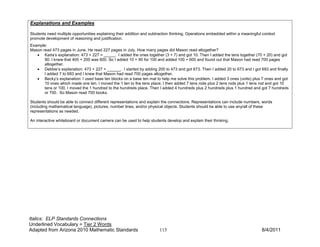
Students need multiple opportunities explaining their addition and subtraction thinking. Operations embedded within a meaningful context
promote development of reasoning and justification.
Example:
Mason read 473 pages in June. He read 227 pages in July. How many pages did Mason read altogether?
   • Karla’s explanation: 473 + 227 = _____. I added the ones together (3 + 7) and got 10. Then I added the tens together (70 + 20) and got
       90. I knew that 400 + 200 was 600. So I added 10 + 90 for 100 and added 100 + 600 and found out that Mason had read 700 pages
       altogether.

    •   Debbie’s explanation: 473 + 227 = ______. I started by adding 200 to 473 and got 673. Then I added 20 to 673 and I got 693 and finally
        I added 7 to 693 and I knew that Mason had read 700 pages altogether.

    •   Becky’s explanation: I used base ten blocks on a base ten mat to help me solve this problem. I added 3 ones (units) plus 7 ones and got
        10 ones which made one ten. I moved the 1 ten to the tens place. I then added 7 tens rods plus 2 tens rods plus 1 tens rod and got 10
        tens or 100. I moved the 1 hundred to the hundreds place. Then I added 4 hundreds plus 2 hundreds plus 1 hundred and got 7 hundreds
        or 700. So Mason read 700 books.

Students should be able to connect different representations and explain the connections. Representations can include numbers, words
(including mathematical language), pictures, number lines, and/or physical objects. Students should be able to use any/all of these
representations as needed.

An interactive whiteboard or document camera can be used to help students develop and explain their thinking.


                                                Domain: Measurement and Data (MD)


Italics: ELP Standards Connections
Underlined Vocabulary = Tier 2 Words
Adapted from Arizona 2010 Mathematic Standards                         10                                                       8/4/2011
AZ Math Standards                                      Mathematical Practices
                                   Cluster: Relate addition and subtraction to length.
Students are expected to:
2.MD.6. Represent whole numbers as lengths from 0 on a number line       2.MP.2. Reason abstractly and quantitatively.
diagram with equally spaced points corresponding to the numbers 0, 1,
2, …, and represent whole-number sums and differences within 100 on      2.MP.4. Model with mathematics.
a number line diagram.
                                                                         2.MP.5. Use appropriate tools strategically.
Connections: 2.NBT.2; 2.OA.1; 2.MD.5; 2.RI.3;
2.SL.3; ET02-S1C2-02

Explanations and Examples
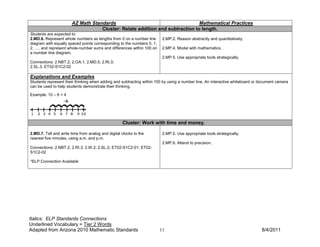
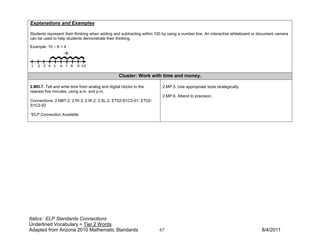
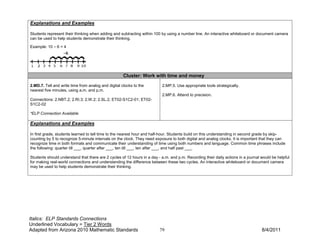
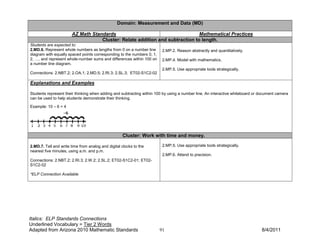
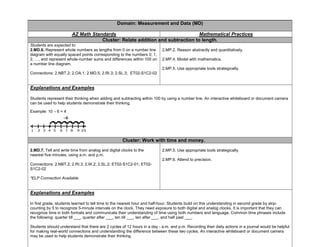
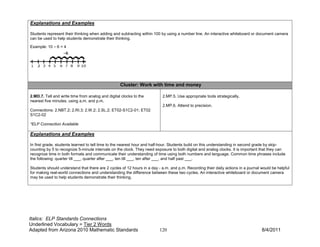
Students represent their thinking when adding and subtracting within 100 by using a number line. An interactive whiteboard or document camera
can be used to help students demonstrate their thinking.

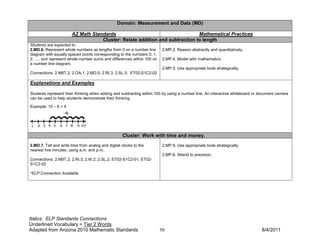
Example: 10 – 6 = 4


                                                    Cluster: Work with time and money.

2.MD.7. Tell and write time from analog and digital clocks to the        2.MP.5. Use appropriate tools strategically.
nearest five minutes, using a.m. and p.m.
                                                                         2.MP.6. Attend to precision.
Connections: 2.NBT.2; 2.RI.3; 2.W.2; 2.SL.2; ET02-S1C2-01; ET02-
S1C2-02

*ELP Connection Available


Italics: ELP Standards Connections
Underlined Vocabulary = Tier 2 Words
Adapted from Arizona 2010 Mathematic Standards                          11                                                    8/4/2011
Explanations and Examples

In first grade, students learned to tell time to the nearest hour and half-hour. Students build on this understanding in second grade by skip-
counting by 5 to recognize 5-minute intervals on the clock. They need exposure to both digital and analog clocks. It is important that they can
recognize time in both formats and communicate their understanding of time using both numbers and language. Common time phrases include
the following: quarter till ___, quarter after ___, ten till ___, ten after ___, and half past ___.

Students should understand that there are 2 cycles of 12 hours in a day - a.m. and p.m. Recording their daily actions in a journal would be helpful
for making real-world connections and understanding the difference between these two cycles. An interactive whiteboard or document camera
may be used to help students demonstrate their thinking.


2.MD.8. Solve word problems involving dollar bills, quarters, dimes,       2.MP.1. Make sense of problems and persevere in solving them.
nickels, and pennies, using $ and ¢ symbols appropriately. Example: If
you have 2 dimes and 3 pennies, how many cents do you have?                2.MP.2. Reason abstractly and quantitatively.

Connections: 2.NBT.1; 2.NBT.5; 2.RI.3; 2.RI.4; 2.W.2; 2.SL.2; ET02-        2.MP.4. Model with mathematics.
S1C2-01; ET02-S1C2-02
                                                                           2.MP.5. Use appropriate tools strategically.
*ELP Connection Available
                                                                           2.MP.8. Look for and express regularity in repeated reasoning.

Explanations and Examples

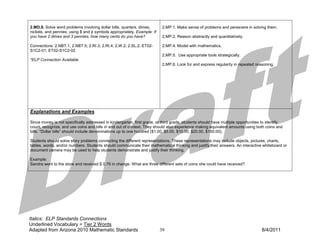
Since money is not specifically addressed in kindergarten, first grade, or third grade, students should have multiple opportunities to identify,
count, recognize, and use coins and bills in and out of context. They should also experience making equivalent amounts using both coins and
bills. “Dollar bills” should include denominations up to one hundred ($1.00, $5.00, $10.00, $20.00, $100.00).

Students should solve story problems connecting the different representations. These representations may include objects, pictures, charts,
tables, words, and/or numbers. Students should communicate their mathematical thinking and justify their answers. An interactive whiteboard or
document camera may be used to help students demonstrate and justify their thinking.

Example:
Sandra went to the store and received $ 0.76 in change. What are three different sets of coins she could have received?


                                                           Domain: Geometry (G)


Italics: ELP Standards Connections
Underlined Vocabulary = Tier 2 Words
Adapted from Arizona 2010 Mathematic Standards                           12                                                         8/4/2011
AZ Math Standards                                    Mathematical Practices
                                   Cluster: Reason with shapes and their attributes.
Students are expected to:
2.G.1. Recognize and draw shapes having specified attributes, such as    2.MP.4. Model with mathematics.
a given number of angles or a given number of equal faces. Identify
triangles, quadrilaterals, pentagons, hexagons, and cubes. (Sizes are    2.MP.7. Look for and make use of structure.
compared directly or visually, not compared by measuring.)

Connections: 2.RI.3; 2.RI.4; 2.W.2; 2.SL.2; 2.SL.3; SC02-S5C1-01;
ET02-S2C1-01

Explanations and Examples

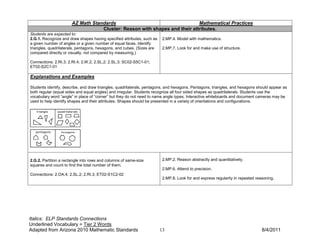
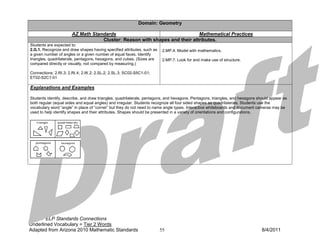
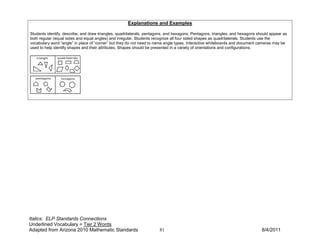
Students identify, describe, and draw triangles, quadrilaterals, pentagons, and hexagons. Pentagons, triangles, and hexagons should appear as
both regular (equal sides and equal angles) and irregular. Students recognize all four sided shapes as quadrilaterals. Students use the
vocabulary word “angle” in place of “corner” but they do not need to name angle types. Interactive whiteboards and document cameras may be
used to help identify shapes and their attributes. Shapes should be presented in a variety of orientations and configurations.


2.G.2. Partition a rectangle into rows and columns of same-size          2.MP.2. Reason abstractly and quantitatively.
squares and count to find the total number of them.
                                                                         2.MP.6. Attend to precision.
Connections: 2.OA.4; 2.SL.2; 2.RI.3; ET02-S1C2-02
                                                                         2.MP.8. Look for and express regularity in repeated reasoning.


Italics: ELP Standards Connections
Underlined Vocabulary = Tier 2 Words
Adapted from Arizona 2010 Mathematic Standards                          13                                                      8/4/2011
Explanations and Examples

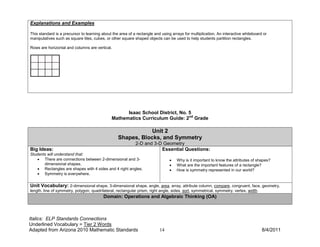
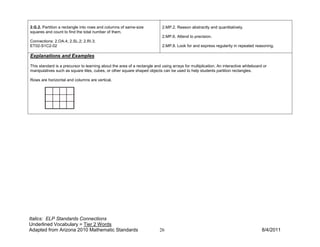
This standard is a precursor to learning about the area of a rectangle and using arrays for multiplication. An interactive whiteboard or
manipulatives such as square tiles, cubes, or other square shaped objects can be used to help students partition rectangles.

Rows are horizontal and columns are vertical.


                                                    Isaac School District, No. 5
                                              Mathematics Curriculum Guide: 2nd Grade

                                                              Unit 2
                                                  Shapes, Blocks, and Symmetry
                                                            2-D and 3-D Geometry
Big Ideas:                                                             Essential Questions:
Students will understand that:
    • There are connections between 2-dimensional and 3-                        •   Why is it important to know the attributes of shapes?
       dimensional shapes.                                                      •   What are the important features of a rectangle?
    • Rectangles are shapes with 4 sides and 4 right angles.                    •   How is symmetry represented in our world?
    • Symmetry is everywhere.


Unit Vocabulary: 2-dimensional shape, 3-dimensional shape, angle, area, array, attribute column, compare, congruent, face, geometry,
length, line of symmetry, polygon, quadrilateral, rectangular prism, right angle, sides, sort, symmetrical, symmetry, vertex, width
                                          Domain: Operations and Algebraic Thinking (OA)


Italics: ELP Standards Connections
Underlined Vocabulary = Tier 2 Words
Adapted from Arizona 2010 Mathematic Standards                            14                                                         8/4/2011
AZ Math Standards                                     Mathematical Practices
                        Cluster: Represent and solve problems involving addition and subtraction.
Students are expected to:
2.OA.1. Use addition and subtraction within 100 to solve one- and two-    2.MP.1. Make sense of problems and persevere in solving them.
step word problems involving situations of adding to, taking from,
putting together, taking apart, and comparing, with unknowns in all       2.MP.2. Reason abstractly and quantitatively.
positions, e.g., by using drawings and equations with a symbol for the
unknown number to represent the problem. (See Table 1.)                   2.MP.3. Construct viable arguments and critique the reasoning of
                                                                            others.
Connections: 2.NBT.5; 2.RI.3; 2.RI.4; 2.SL.2; ET02-S2C1-01
                                                                          2.MP.4. Model with mathematics.
*ELP Connection Available
                                                                          2.MP.5. Use appropriate tools strategically.

                                                                          2.MP.8. Look for and express regularity in repeated reasoning.


Italics: ELP Standards Connections
Underlined Vocabulary = Tier 2 Words
Adapted from Arizona 2010 Mathematic Standards                           15                                                      8/4/2011
Explanations and Examples

Word problems that are connected to students’ lives can be used to develop fluency with addition and subtraction. Table 1 describes the four
different addition and subtraction situations and their relationship to the position of the unknown.
Examples:
   • Take-from example: David had 63 stickers. He gave 37 to Susan. How many stickers does David have now? 63 – 37 =
   • Add to example: David had $37. His grandpa gave him some money for his birthday. Now he has $63. How much money did David’s
      grandpa give him? $37 +        = $63
   • Compare example: David has 63 stickers. Susan has 37 stickers. How many more stickers does David have than Susan? 63 – 37 =
          o Even though the modeling of the two problems above is different, the equation,
              63 - 37 = ?, can represent both situations (How many more do I need to make 63?)
   • Take-from (Start Unknown) David had some stickers. He gave 37 to Susan. Now he has 26 stickers. How many stickers did David have
      before?      - 37 = 26
It is important to attend to the difficulty level of the problem situations in relation to the position of the unknown.
      • Result Unknown problems are the least complex for students followed by Total Unknown and Difference Unknown.
      • The next level of difficulty includes Change Unknown, Addend Unknown, followed by Bigger Unknown.
      • The most difficult are Start Unknown, Both Addends Unknown, and Smaller Unknown.
Second grade students should work on ALL problem types regardless of the level of difficulty. Students can use interactive whiteboard or
document camera to demonstrate and justify their thinking.

This standard focuses on developing an algebraic representation of a word problem through addition and subtraction --the intent is not to
introduce traditional algorithms or rules.

                                                   Cluster: Add and subtract within 20.
2.OA.2. Fluently add and subtract within 20 using mental strategies. By    2.MP.2. Reason abstractly and quantitatively.
end of Grade 2, know from memory all sums of two one-digit numbers.
(See standard 1.OA.6 for a list of mental strategies.)                     2.MP.7. Look for and make use of structure.

Connections: 2.NBT.5; 2.NBT.9; ET02-S2C1-01                                2.MP.8. Look for and express regularity in repeated reasoning.


Italics: ELP Standards Connections
Underlined Vocabulary = Tier 2 Words
Adapted from Arizona 2010 Mathematic Standards                            16                                                      8/4/2011
Explanations and Examples

This standard is strongly connected to all the standards in this domain. It focuses on students being able to fluently add and subtract numbers to
20. Adding and subtracting fluently refers to knowledge of procedures, knowledge of when and how to use them appropriately, and skill in
performing them flexibly, accurately, and efficiently.
Mental strategies help students make sense of number relationships as they are adding and subtracting within 20. The ability to calculate
mentally with efficiency is very important for all students. Mental strategies may include the following:
   • Counting on
   • Making tens (9 + 7 = 10 + 6)
   • Decomposing a number leading to a ten ( 14 – 6 = 14 – 4 – 2 = 10 – 2 = 8)
   • Fact families (8 + 5 = 13 is the same as 13 - 8 = 5)
   • Doubles
   • Doubles plus one (7 + 8 = 7 + 7 + 1)
However, the use of objects, diagrams, or interactive whiteboards, and various strategies will help students develop fluency.

                        Cluster: Work with equal groups of objects to gain foundations for multiplication.

2.OA.4. Use addition to find the total number of objects arranged in      2.MP.2. Reason abstractly and quantitatively.
rectangular arrays with up to 5 rows and up to 5 columns; write an
equation to express the total as a sum of equal addends.                  2.MP.3, Construct viable arguments and critique the reasoning of
                                                                            others.
Connections: 2.OA.3, 2.RI.3;
ET02-S1C2-01; ET02-S1C2-02; ET02-S2C1-01                                  2.MP.7. Look for and make use of structure.

*ELP Connection Available                                                 2.MP.8. Look for and express regularity in repeated reasoning.

Explanations and Examples

Students may arrange any set of objects into a rectangular array. Objects can be cubes, buttons, counters, etc. Objects do not have to be square
to make an array. Geoboards can also be used to demonstrate rectangular arrays. Students then write equations that represent the total as the
sum of equal addends as shown below.


       4 + 4 + 4 = 12                   5 + 5 + 5 + 5 = 20

Interactive whiteboards and document cameras may be used to help students visualize and create arrays.

Italics: ELP Standards Connections
Underlined Vocabulary = Tier 2 Words
Adapted from Arizona 2010 Mathematic Standards                           17                                                        8/4/2011
Domain: Number and Operations in Base Ten (NBT)

                       AZ Math Standards                                                        Mathematical Practices
                                                    Cluster: Understand place value.
2.NBT.2. Count within 1000; skip-count by 5s, 10s, and 100s.               2.MP.2. Reason abstractly and quantitatively.

Connections: 2.NBT.8; ET02-S1C3-01                                         2.MP.7. Look for and make use of structure.

*ELP Connection Available                                                  2.MP.8. Look for and express regularity in repeated reasoning.

Explanations and Examples

Students need many opportunities counting, up to 1000, from different starting points. They should also have many experiences skip counting by
5s, 10s, and 100s to develop the concept of place value.
Examples:
   • The use of the 100s chart may be helpful for students to identify the counting patterns.
   • The use of money (nickels, dimes, dollars) or base ten blocks may be helpful visual cues.
   • The use of an interactive whiteboard may also be used to develop counting skills.

The ultimate goal for second graders is to be able to count in multiple ways with no visual support.


2.NBT.3. Read and write numbers to 1000 using base-ten numerals,           2.MP.2. Reason abstractly and quantitatively.
number names, and expanded form.
                                                                           2.MP.7. Look for and make use of structure.
Connections: 2.SL.2; 2.RI.3
                                                                           2.MP.8. Look for and express regularity in repeated reasoning.


Italics: ELP Standards Connections
Underlined Vocabulary = Tier 2 Words
Adapted from Arizona 2010 Mathematic Standards                            18                                                      8/4/2011
Explanations and Examples

Students need many opportunities reading and writing numerals in multiple ways.

Examples:
   • Base-ten numerals          637                        (standard form)
   • Number names               six hundred thirty seven   (written form)
   • Expanded form              600 + 30 + 7               (expanded notation)
When students say the expanded form, it may sound like this: “6 hundreds plus 3 tens plus 7 ones” OR 600 plus 30 plus 7.”


                Cluster: Use place value understanding and properties of operations to add and subtract.
2.NBT.5. Fluently add and subtract within 100 using strategies based    2.MP.2. Reason abstractly and quantitatively.
on place value, properties of operations, and/or the relationship
between addition and subtraction.                                       2.MP.7. Look for and make use of structure.

Connections: 2.OA.2; 2.NBT.1; 2.NBT.3; 2.RI.3; 2.W.2; 2.SL.3            2.MP.8. Look for and express regularity in repeated reasoning.


Italics: ELP Standards Connections
Underlined Vocabulary = Tier 2 Words
Adapted from Arizona 2010 Mathematic Standards                         19                                                      8/4/2011
Explanations and Examples

Adding and subtracting fluently refers to knowledge of procedures, knowledge of when and how to use them appropriately, and skill in performing
them flexibly, accurately, and efficiently. Students should have experiences solving problems written both horizontally and vertically. They need to
communicate their thinking and be able to justify their strategies both verbally and with paper and pencil.
Addition strategies based on place value for 48 + 37 may include:
   • Adding by place value: 40 + 30 = 70 and 8 + 7 = 15 and 70 + 15 = 85.
   • Incremental adding (breaking one number into tens and ones); 48 + 10 = 58, 58 + 10 = 68, 68 + 10 = 78, 78 + 7 = 85
   • Compensation (making a friendly number): 48 + 2 = 50, 37 – 2 = 35, 50 + 35 = 85
Subtraction strategies based on place value for 81 - 37 may include:
   • Adding Up (from smaller number to larger number): 37 + 3 = 40, 40 + 40 = 80, 80 + 1 = 81, and 3 + 40 + 1 = 44.
   • Incremental subtracting: 81 -10 = 71, 71 – 10 = 61, 61 – 10 = 51, 51 – 7 = 44
   • Subtracting by place value: 81 – 30 = 51, 51 – 7 = 44
Properties that students should know and use are:
   • Commutative property of addition (Example: 3 + 5 = 5 + 3)
   • Associative property of addition (Example: (2 + 7) + 3 = 2 + (7+3) )
   • Identity property of 0 (Example: 8 + 0 = 8)
Students in second grade need to communicate their understanding of why some properties work for some operations and not for others.
    • Commutative Property: In first grade, students investigated whether the commutative property works with subtraction. The intent was for
       students to recognize that taking 5 from 8 is not the same as taking 8 from 5. Students should also understand that they will be working
       with numbers in later grades that will allow them to subtract larger numbers from smaller numbers. This exploration of the commutative
       property continues in second grade.
    • Associative Property: Recognizing that the associative property does not work for subtraction is difficult for students to consider at this
       grade level as it is challenging to determine all the possibilities.

2.NBT.6. Add up to four two-digit numbers using strategies based on        2.MP.2. Reason abstractly and quantitatively.
place value and properties of operations.
                                                                           2.MP.7. Look for and make use of structure.
Connections: 2.NBT.5; 2.RI.3; 2.W.2; 2.SL.2; ET02-S2C1-01
                                                                           2.MP.8. Look for and express regularity in repeated reasoning.


Italics: ELP Standards Connections
Underlined Vocabulary = Tier 2 Words
Adapted from Arizona 2010 Mathematic Standards                           20                                                         8/4/2011
Explanations and Examples

 Students demonstrate addition strategies with up to four two-digit numbers either with or without regrouping. Problems may be written in a story
 problem format to help develop a stronger understanding of larger numbers and their values. Interactive whiteboards and document cameras
 may also be used to model and justify student thinking.


2.NBT.7. Add and subtract within 1000, using concrete models or           2.MP.2. Reason abstractly and quantitatively.
drawings and strategies based on place value, properties of
operations, and/or the relationship between addition and subtraction;     2.MP.4. Model with mathematics.
relate the strategy to a written method. Understand that in adding or
subtracting three-digit numbers, one adds or subtracts hundreds and       2.MP.5. Use appropriate tools strategically.
hundreds, tens and tens, ones and ones; and sometimes it is
necessary to compose or decompose tens or hundreds.                       2.MP.7. Look for and make use of structure.

Connections: 2.NBT.5; 2.NBT.6; 2.RI.3; 2.SL.3; 2.W.2; ET02-S1C2-01;       2.MP.8. Look for and express regularity in repeated reasoning.
ET02-S2C1-01

*ELP Connection Available

Explanations and Examples

There is a strong connection between this standard and place value understanding with addition and subtraction of smaller numbers. Students
may use concrete models or drawings to support their addition or subtraction of larger numbers. Strategies are similar to those stated in 2.NBT.5,
as students extend their learning to include greater place values moving from tens to hundreds to thousands. Interactive whiteboards and
document cameras may also be used to model and justify student thinking.


2.NBT.8. Mentally add 10 or 100 to a given number 100–900, and            2.MP.2. Reason abstractly and quantitatively.
mentally subtract 10 or 100 from a given number 100–900.
                                                                          2.MP.7. Look for and make use of structure.
Connections: 2.RI.3; 2.SL.1; 2.SL.2; 2.SL.3; ET02-S2C1-01
                                                                          2.MP.8. Look for and express regularity in repeated reasoning.
*ELP Connection Available


Italics: ELP Standards Connections
Underlined Vocabulary = Tier 2 Words
Adapted from Arizona 2010 Mathematic Standards                          21                                                        8/4/2011
Explanations and Examples

Students need many opportunities to practice mental math by adding and subtracting multiples of 10 and 100 up to 900 using different starting
points. They can practice this by counting and thinking aloud, finding missing numbers in a sequence, and finding missing numbers on a number
line or hundreds chart. Explorations should include looking for relevant patterns.
Mental math strategies may include:
   • counting on; 300, 400, 500, etc.
   • counting back; 550, 450, 350, etc.
Examples:
   • 100 more than 653 is _____ (753)
   • 10 less than 87 is ______ (77)
   • “Start at 248. Count up by 10s until I tell you to stop.”
An interactive whiteboard or document camera may be used to help students develop these mental math skills.


2.NBT.9. Explain why addition and subtraction strategies work, using    2.MP.2. Reason abstractly and quantitatively.
place value and the properties of operations. (Explanations may be
supported by drawings or objects.)                                      2.MP.3. Construct viable arguments and critique the reasoning of
                                                                          others.
Connections: 2.NBT.1; 2.RI.3; 2.RI.4; 2.W.2;
2.SL.2; 2.SL.3; ET02-S2C1-01                                            2.MP.4. Model with mathematics.
                                                                        2.MP.5. Use appropriate tools strategically.
*ELP Connection Available
                                                                        2.MP.7. Look for and make use of structure.

                                                                        2.MP.8. Look for and express regularity in repeated reasoning.


Italics: ELP Standards Connections
Underlined Vocabulary = Tier 2 Words
Adapted from Arizona 2010 Mathematic Standards                         22                                                      8/4/2011
Explanations and Examples

Students need multiple opportunities explaining their addition and subtraction thinking. Operations embedded within a meaningful context
promote development of reasoning and justification.
Example:
Mason read 473 pages in June. He read 227 pages in July. How many pages did Mason read altogether?
   • Karla’s explanation: 473 + 227 = _____. I added the ones together (3 + 7) and got 10. Then I added the tens together (70 + 20) and got
       90. I knew that 400 + 200 was 600. So I added 10 + 90 for 100 and added 100 + 600 and found out that Mason had read 700 pages
       altogether.
   • Debbie’s explanation: 473 + 227 = ______. I started by adding 200 to 473 and got 673. Then I added 20 to 673 and I got 693 and finally
       I added 7 to 693 and I knew that Mason had read 700 pages altogether.
   • Becky’s explanation: I used base ten blocks on a base ten mat to help me solve this problem. I added 3 ones (units) plus 7 ones and got
       10 ones which made one ten. I moved the 1 ten to the tens place. I then added 7 tens rods plus 2 tens rods plus 1 tens rod and got 10
       tens or 100. I moved the 1 hundred to the hundreds place. Then I added 4 hundreds plus 2 hundreds plus 1 hundred and got 7 hundreds
       or 700. So Mason read 700 books.

Students should be able to connect different representations and explain the connections. Representations can include numbers, words
(including mathematical language), pictures, number lines, and/or physical objects. Students should be able to use any/all of these
representations as needed.

An interactive whiteboard or document camera can be used to help students develop and explain their thinking.


                                                Domain: Measurement and Data (MD)

                       AZ Math Standards                                      Mathematical Practices
                                   Cluster: Relate addition and subtraction to length.
Students are expected to:
2.MD.6. Represent whole numbers as lengths from 0 on a number line       2.MP.2. Reason abstractly and quantitatively.
diagram with equally spaced points corresponding to the numbers 0, 1,
2, …and represent whole-number sums and differences within 100 on        2.MP.4. Model with mathematics.
a number line diagram.
                                                                         2.MP.5. Use appropriate tools strategically.
Connections: 2.NBT.2; 2.OA.1; 2.MD.5; 2.RI.3; 2.SL.3; ET02-S1C2-02


Italics: ELP Standards Connections
Underlined Vocabulary = Tier 2 Words
Adapted from Arizona 2010 Mathematic Standards                          23                                                      8/4/2011
Explanations and Examples

Students represent their thinking when adding and subtracting within 100 by using a number line. An interactive whiteboard or document camera
can be used to help students demonstrate their thinking.

Example: 10 – 6 = 4


                                                    Cluster: Work with time and money.
2.MD.7. Tell and write time from analog and digital clocks to the         2.MP.5. Use appropriate tools strategically.
nearest five minutes, using a.m. and p.m.
                                                                          2.MP.6. Attend to precision.
Connections: 2.NBT.2; 2.RI.3; 2.W.2; 2.SL.2; ET02-S1C2-01; ET02-
S1C2-02

*ELP Connection Available

Explanations and Examples

In first grade, students learned to tell time to the nearest hour and half-hour. Students build on this understanding in second grade by skip-
counting by 5 to recognize 5-minute intervals on the clock. They need exposure to both digital and analog clocks. It is important that they can
recognize time in both formats and communicate their understanding of time using both numbers and language. Common time phrases include
the following: quarter till ___, quarter after ___, ten till ___, ten after ___, and half past ___.

Students should understand that there are 2 cycles of 12 hours in a day - a.m. and p.m. Recording their daily actions in a journal would be helpful
for making real-world connections and understanding the difference between these two cycles. An interactive whiteboard or document camera
may be used to help students demonstrate their thinking.


Italics: ELP Standards Connections
Underlined Vocabulary = Tier 2 Words
Adapted from Arizona 2010 Mathematic Standards                           24                                                        8/4/2011
Domain: Geometry (G)

                      AZ Math Standards                                    Mathematical Practices
                                  Cluster: Reason with shapes and their attributes.
Students are expected to:
2.G.1. Recognize and draw shapes having specified attributes, such as    2.MP.4. Model with mathematics.
a given number of angles or a given number of equal faces. Identify
triangles, quadrilaterals, pentagons, hexagons, and cubes. (Sizes are    2.MP.7. Look for and make use of structure.
compared directly or visually, not compared by measuring.)

Connections: 2.RI.3; 2.RI.4; 2.W.2; 2.SL.2; 2.SL.3; SC02-S5C1-01;
ET02-S2C1-01

Explanations and Examples

Students identify, describe, and draw triangles, quadrilaterals, pentagons, and hexagons. Pentagons, triangles, and hexagons should appear as
both regular (equal sides and equal angles) and irregular. Students recognize all four sided shapes as quadrilaterals. Students use the
vocabulary word “angle” in place of “corner” but they do not need to name angle types. Interactive whiteboards and document cameras may be
used to help identify shapes and their attributes. Shapes should be presented in a variety of orientations and configurations.


Italics: ELP Standards Connections
Underlined Vocabulary = Tier 2 Words
Adapted from Arizona 2010 Mathematic Standards                          25                                                     8/4/2011
2.G.2. Partition a rectangle into rows and columns of same-size            2.MP.2. Reason abstractly and quantitatively.
squares and count to find the total number of them.
                                                                           2.MP.6. Attend to precision.
Connections: 2.OA.4; 2.SL.2; 2.RI.3;
ET02-S1C2-02                                                               2.MP.8. Look for and express regularity in repeated reasoning.

Explanations and Examples

This standard is a precursor to learning about the area of a rectangle and using arrays for multiplication. An interactive whiteboard or
manipulatives such as square tiles, cubes, or other square shaped objects can be used to help students partition rectangles.

Rows are horizontal and columns are vertical.


Italics: ELP Standards Connections
Underlined Vocabulary = Tier 2 Words
Adapted from Arizona 2010 Mathematic Standards                            26                                                         8/4/2011
Isaac School District, No. 5
                                             Mathematics Curriculum Guide: 2nd Grade

                                                        Unit 3
                                     Stickers, Number Strings, and Story Problems
                                           Addition, Subtraction, and the Number System 2
Big Ideas:                                                          Essential Questions:
Students will understand that:
    • The order of addends in an equation does not affect the sum.           •   What other ways can you use addends of an equation to find
    • Addition and subtraction are inverse operations; one is the                the sum?
       opposite of the other.                                                •   How are addition and subtraction related?
    • Patterns and skip counting can be used to count money.                 •   What strategies do you use to help you count money?
    • Even numbers are groups of two (partners) and two equal                •   How can you prove a number is even or odd?
       groups (teams).
                                                                             •   Why do we need to know the value of each digit?
    • The position of a digit in a number determines its value.


Unit Vocabulary: 2-digit number, addend, addition, calculator, collect, combination, count all, count back, counting by 10s, counting by 5s,
counting on, difference, dime, doubles, doubles combinations, doubles plus or minus 1, equal, equal groups, equation, even, grouping by 2s (5s,
10s), minus, near doubles, nickel, number sentence, odd, ones, ones place, order, penny, plus, plus 10 combinations, quarter, strategy,
subtraction, tally marks, tens, tens place, total
                                        Domain: Operations and Algebraic Thinking (OA)


Italics: ELP Standards Connections
Underlined Vocabulary = Tier 2 Words
Adapted from Arizona 2010 Mathematic Standards                         27                                                       8/4/2011
AZ Math Standards                                     Mathematical Practices
                        Cluster: Represent and solve problems involving addition and subtraction.
Students are expected to:
2.OA.1. Use addition and subtraction within 100 to solve one- and two-    2.MP.1. Make sense of problems and persevere in solving them.
step word problems involving situations of adding to, taking from,
putting together, taking apart, and comparing, with unknowns in all       2.MP.2. Reason abstractly and quantitatively.
positions, e.g., by using drawings and equations with a symbol for the
unknown number to represent the problem. (See Table 1.)                   2.MP.3. Construct viable arguments and critique the reasoning of
                                                                            others.
Connections: 2.NBT.5; 2.RI.3; 2.RI.4; 2.SL.2; ET02-S2C1-01
                                                                          2.MP.4. Model with mathematics.
*ELP Connection Available
                                                                          2.MP.5. Use appropriate tools strategically.

                                                                          2.MP.8. Look for and express regularity in repeated reasoning.


Italics: ELP Standards Connections
Underlined Vocabulary = Tier 2 Words
Adapted from Arizona 2010 Mathematic Standards                           28                                                      8/4/2011
Explanations and Examples

Word problems that are connected to students’ lives can be used to develop fluency with addition and subtraction. Table 1 describes the four
different addition and subtraction situations and their relationship to the position of the unknown.
Examples:
   • Take-from example: David had 63 stickers. He gave 37 to Susan. How many stickers does David have now? 63 – 37 =
   • Add to example: David had $37. His grandpa gave him some money for his birthday. Now he has $63. How much money did David’s
      grandpa give him? $37 +        = $63
   • Compare example: David has 63 stickers. Susan has 37 stickers. How many more stickers does David have than Susan? 63 – 37 =
          o Even though the modeling of the two problems above is different, the equation,
              63 - 37 = ?, can represent both situations (How many more do I need to make 63?)
   • Take-from (Start Unknown) David had some stickers. He gave 37 to Susan. Now he has 26 stickers. How many stickers did David have
      before?      - 37 = 26
It is important to attend to the difficulty level of the problem situations in relation to the position of the unknown.
      • Result Unknown problems are the least complex for students followed by Total Unknown and Difference Unknown.
      • The next level of difficulty includes Change Unknown, Addend Unknown, followed by Bigger Unknown.
      • The most difficult are Start Unknown, Both Addends Unknown, and Smaller Unknown.
Second grade students should work on ALL problem types regardless of the level of difficulty. Students can use interactive whiteboard or
document camera to demonstrate and justify their thinking.

This standard focuses on developing an algebraic representation of a word problem through addition and subtraction --the intent is not to
introduce traditional algorithms or rules.


                                                   Cluster: Add and subtract within 20.
2.OA.2. Fluently add and subtract within 20 using mental strategies. By    2.MP.2. Reason abstractly and quantitatively.
end of Grade 2, know from memory all sums of two one-digit numbers.
(See standard 1.OA.6 for a list of mental strategies.)                     2.MP.7. Look for and make use of structure.

Connections: 2.NBT.5; 2.NBT.9; ET02-S2C1-01                                2.MP.8. Look for and express regularity in repeated reasoning.


Italics: ELP Standards Connections
Underlined Vocabulary = Tier 2 Words
Adapted from Arizona 2010 Mathematic Standards                            29                                                      8/4/2011
Explanations and Examples

This standard is strongly connected to all the standards in this domain. It focuses on students being able to fluently add and subtract numbers to
20. Adding and subtracting fluently refers to knowledge of procedures, knowledge of when and how to use them appropriately, and skill in
performing them flexibly, accurately, and efficiently.
Mental strategies help students make sense of number relationships as they are adding and subtracting within 20. The ability to calculate
mentally with efficiency is very important for all students. Mental strategies may include the following:
   • Counting on
   • Making tens (9 + 7 = 10 + 6)
   • Decomposing a number leading to a ten ( 14 – 6 = 14 – 4 – 2 = 10 – 2 = 8)
   • Fact families (8 + 5 = 13 is the same as 13 - 8 = 5)
   • Doubles
   • Doubles plus one (7 + 8 = 7 + 7 + 1)
However, the use of objects, diagrams, or interactive whiteboards, and various strategies will help students develop fluency.

                        Cluster: Work with equal groups of objects to gain foundations for multiplication.

2.OA.3. Determine whether a group of objects (up to 20) has an odd or     2.MP.2. Reason abstractly and quantitatively.
even number of members, e.g., by pairing objects or counting them by
2s; write an equation to express an even number as a sum of two           2.MP.3, Construct viable arguments and critique the reasoning of
equal addends.                                                              others.

Connections: 2.OA.4; 2.RI.3; 2.RI.4; ET02-S1C1-01; ET02-S2C1-01           2.MP.7. Look for and make use of structure.

                                                                          2.MP.8. Look for and express regularity in repeated reasoning.


Italics: ELP Standards Connections
Underlined Vocabulary = Tier 2 Words
Adapted from Arizona 2010 Mathematic Standards                           30                                                        8/4/2011
Explanations and Examples

Students explore odd and even numbers in a variety of ways including the following: students may investigate if a number is odd or even by
determining if the number of objects can be divided into two equal sets, arranged into pairs or counted by twos. After the above experiences,
students may derive that they only need to look at the digit in the ones place to determine if a number is odd or even since any number of tens
will always split into two even groups.

Example:

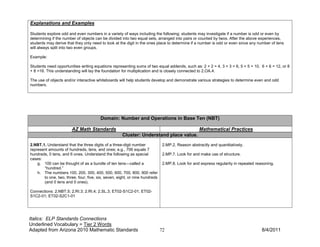
Students need opportunities writing equations representing sums of two equal addends, such as: 2 + 2 = 4, 3 + 3 = 6, 5 + 5 = 10, 6 + 6 = 12, or 8
+ 8 =16. This understanding will lay the foundation for multiplication and is closely connected to 2.OA.4.

The use of objects and/or interactive whiteboards will help students develop and demonstrate various strategies to determine even and odd
numbers.


                                        Domain: Number and Operations in Base Ten (NBT)

                        AZ Math Standards                                                         Mathematical Practices
                                                     Cluster: Understand place value.
Students are expected to:
2.NBT.1. Understand that the three digits of a three-digit number             2.MP.2. Reason abstractly and quantitatively.
represent amounts of hundreds, tens, and ones; e.g., 706 equals 7
hundreds, 0 tens, and 6 ones. Understand the following as special             2.MP.7. Look for and make use of structure.
cases:
    a. 100 can be thought of as a bundle of ten tens—called a                 2.MP.8. Look for and express regularity in repeated reasoning.
       “hundred.”
    b. The numbers 100, 200, 300, 400, 500, 600, 700, 800, 900 refer
       to one, two, three, four, five, six, seven, eight, or nine hundreds
       (and 0 tens and 0 ones).

Connections: 2.NBT.5; 2.RI.3; 2.RI.4; 2.SL.3; ET02-S1C2-01; ET02-
S1C2-01; ET02-S2C1-01


Italics: ELP Standards Connections
Underlined Vocabulary = Tier 2 Words
Adapted from Arizona 2010 Mathematic Standards                               31                                                      8/4/2011
Explanations and Examples

Understanding that 10 ones make one ten and that 10 tens make one hundred is fundamental to students’ mathematical development. Students
need multiple opportunities counting and “bundling” groups of tens in first grade. In second grade, students build on their understanding by
making bundles of 100s with or without leftovers using base ten blocks, cubes in towers of 10, ten frames, etc. This emphasis on bundling
hundreds will support students’ discovery of place value patterns.
As students are representing the various amounts, it is important that emphasis is placed on the language associated with the quantity. For
example, 243 can be expressed in multiple ways such as 2 groups of hundred, 4 groups of ten and 3 ones, as well as 24 tens with 3 ones. When
students read numbers, they should read in standard form as well as using place value concepts. For example, 243 should be read as “two
hundred forty-three” as well as two hundreds, 4 tens, 3 ones.

A document camera or interactive whiteboard can also be used to demonstrate “bundling” of objects. This gives students the opportunity to
communicate their counting and thinking.


2.NBT.2. Count within 1000; skip-count by 5s, 10s, and 100s.               2.MP.2. Reason abstractly and quantitatively.
Connections: 2.NBT.8; ET02-S1C3-01
                                                                           2.MP.7. Look for and make use of structure.

                                                                           2.MP.8. Look for and express regularity in repeated reasoning.

Explanations and Examples

Students need many opportunities counting, up to 1000, from different starting points. They should also have many experiences skip counting by
5s, 10s, and 100s to develop the concept of place value.
Examples:
   • The use of the 100s chart may be helpful for students to identify the counting patterns.
   • The use of money (nickels, dimes, dollars) or base ten blocks may be helpful visual cues.
   • The use of an interactive whiteboard may also be used to develop counting skills.

The ultimate goal for second graders is to be able to count in multiple ways with no visual support.


2.NBT.3. Read and write numbers to 1000 using base-ten numerals,           2.MP.2. Reason abstractly and quantitatively.
number names, and expanded form.
                                                                           2.MP.7. Look for and make use of structure.
Connections: 2.SL.2; 2.RI.3
                                                                           2.MP.8. Look for and express regularity in repeated reasoning.


Italics: ELP Standards Connections
Underlined Vocabulary = Tier 2 Words
Adapted from Arizona 2010 Mathematic Standards                            32                                                      8/4/2011
Explanations and Examples

Students need many opportunities reading and writing numerals in multiple ways.

Examples:
   • Base-ten numerals          637                        (standard form)
   • Number names               six hundred thirty seven   (written form)
   • Expanded form              600 + 30 + 7               (expanded notation)
When students say the expanded form, it may sound like this: “6 hundreds plus 3 tens plus 7 ones” OR 600 plus 30 plus 7.”

                Cluster: Use place value understanding and properties of operations to add and subtract.
2.NBT.5. Fluently add and subtract within 100 using strategies based    2.MP.2. Reason abstractly and quantitatively.
on place value, properties of operations, and/or the relationship
between addition and subtraction.                                       2.MP.7. Look for and make use of structure.

Connections: 2.OA.2; 2.NBT.1; 2.NBT.3; 2.RI.3; 2.W.2; 2.SL.3            2.MP.8. Look for and express regularity in repeated reasoning.


Italics: ELP Standards Connections
Underlined Vocabulary = Tier 2 Words
Adapted from Arizona 2010 Mathematic Standards                         33                                                      8/4/2011
Explanations and Examples

Adding and subtracting fluently refers to knowledge of procedures, knowledge of when and how to use them appropriately, and skill in performing
them flexibly, accurately, and efficiently. Students should have experiences solving problems written both horizontally and vertically. They need to
communicate their thinking and be able to justify their strategies both verbally and with paper and pencil.
Addition strategies based on place value for 48 + 37 may include:
   • Adding by place value: 40 + 30 = 70 and 8 + 7 = 15 and 70 + 15 = 85.
   • Incremental adding (breaking one number into tens and ones); 48 + 10 = 58, 58 + 10 = 68, 68 + 10 = 78, 78 + 7 = 85
   • Compensation (making a friendly number): 48 + 2 = 50, 37 – 2 = 35, 50 + 35 = 85
Subtraction strategies based on place value for 81 - 37 may include:
   • Adding Up (from smaller number to larger number): 37 + 3 = 40, 40 + 40 = 80, 80 + 1 = 81, and 3 + 40 + 1 = 44.
   • Incremental subtracting: 81 -10 = 71, 71 – 10 = 61, 61 – 10 = 51, 51 – 7 = 44
   • Subtracting by place value: 81 – 30 = 51, 51 – 7 = 44
Properties that students should know and use are:
   • Commutative property of addition (Example: 3 + 5 = 5 + 3)
   • Associative property of addition (Example: (2 + 7) + 3 = 2 + (7+3) )
   • Identity property of 0 (Example: 8 + 0 = 8)
Students in second grade need to communicate their understanding of why some properties work for some operations and not for others.
    • Commutative Property: In first grade, students investigated whether the commutative property works with subtraction. The intent was for
       students to recognize that taking 5 from 8 is not the same as taking 8 from 5. Students should also understand that they will be working
       with numbers in later grades that will allow them to subtract larger numbers from smaller numbers. This exploration of the commutative
       property continues in second grade.
    • Associative Property: Recognizing that the associative property does not work for subtraction is difficult for students to consider at this
       grade level as it is challenging to determine all the possibilities.


2.NBT.6. Add up to four two-digit numbers using strategies based on        2.MP.2. Reason abstractly and quantitatively.
place value and properties of operations.
                                                                           2.MP.7. Look for and make use of structure.
Connections: 2.NBT.5; 2.RI.3; 2.W.2; 2.SL.2; ET02-S2C1-01
                                                                           2.MP.8. Look for and express regularity in repeated reasoning.

Explanations and Examples

Students demonstrate addition strategies with up to four two-digit numbers either with or without regrouping. Problems may be written in a story
problem format to help develop a stronger understanding of larger numbers and their values. Interactive whiteboards and document cameras
may also be used to model and justify student thinking.


Italics: ELP Standards Connections
Underlined Vocabulary = Tier 2 Words
Adapted from Arizona 2010 Mathematic Standards                           34                                                         8/4/2011
2.NBT.7. Add and subtract within 1000, using concrete models or           2.MP.2. Reason abstractly and quantitatively.
drawings and strategies based on place value, properties of
operations, and/or the relationship between addition and subtraction;     2.MP.4. Model with mathematics.
relate the strategy to a written method. Understand that in adding or
subtracting three-digit numbers, one adds or subtracts hundreds and       2.MP.5. Use appropriate tools strategically.
hundreds, tens and tens, ones and ones; and sometimes it is
necessary to compose or decompose tens or hundreds.                       2.MP.7. Look for and make use of structure.

Connections: 2.NBT.5; 2.NBT.6; 2.RI.3; 2.SL.3; 2.W.2; ET02-S1C2-01;       2.MP.8. Look for and express regularity in repeated reasoning.
ET02-S2C1-01

Explanations and Examples

There is a strong connection between this standard and place value understanding with addition and subtraction of smaller numbers. Students
may use concrete models or drawings to support their addition or subtraction of larger numbers. Strategies are similar to those stated in 2.NBT.5,
as students extend their learning to include greater place values moving from tens to hundreds to thousands. Interactive whiteboards and
document cameras may also be used to model and justify student thinking.


2.NBT.8. Mentally add 10 or 100 to a given number 100–900, and            2.MP.2. Reason abstractly and quantitatively.
mentally subtract 10 or 100 from a given number 100–900.
                                                                          2.MP.7. Look for and make use of structure.
Connections: 2.RI.3; 2.SL.1; 2.SL.2; 2.SL.3; ET02-S2C1-01
                                                                          2.MP.8. Look for and express regularity in repeated reasoning.


Italics: ELP Standards Connections
Underlined Vocabulary = Tier 2 Words
Adapted from Arizona 2010 Mathematic Standards                          35                                                        8/4/2011
Explanations and Examples

Students need many opportunities to practice mental math by adding and subtracting multiples of 10 and 100 up to 900 using different starting
points. They can practice this by counting and thinking aloud, finding missing numbers in a sequence, and finding missing numbers on a number
line or hundreds chart. Explorations should include looking for relevant patterns.
Mental math strategies may include:
   • counting on; 300, 400, 500, etc.
   • counting back; 550, 450, 350, etc.
Examples:
   • 100 more than 653 is _____ (753)
   • 10 less than 87 is ______ (77)
   • “Start at 248. Count up by 10s until I tell you to stop.”
An interactive whiteboard or document camera may be used to help students develop these mental math skills.


2.NBT.9. Explain why addition and subtraction strategies work, using    2.MP.2. Reason abstractly and quantitatively.
place value and the properties of operations. (Explanations may be
supported by drawings or objects.)                                      2.MP.3. Construct viable arguments and critique the reasoning of
                                                                          others.
Connections: 2.NBT.1; 2.RI.3; 2.RI.4; 2.W.2; 2.SL.2; 2.SL.3; ET02-
S2C1-01                                                                 2.MP.4. Model with mathematics.
                                                                        2.MP.5. Use appropriate tools strategically.
*ELP Connection Available
                                                                        2.MP.7. Look for and make use of structure.

                                                                        2.MP.8. Look for and express regularity in repeated reasoning.


Italics: ELP Standards Connections
Underlined Vocabulary = Tier 2 Words
Adapted from Arizona 2010 Mathematic Standards                         36                                                      8/4/2011
Explanations and Examples

Students need multiple opportunities explaining their addition and subtraction thinking. Operations embedded within a meaningful context
promote development of reasoning and justification.
Example:
Mason read 473 pages in June. He read 227 pages in July. How many pages did Mason read altogether?
   • Karla’s explanation: 473 + 227 = _____. I added the ones together (3 + 7) and got 10. Then I added the tens together (70 + 20) and got
       90. I knew that 400 + 200 was 600. So I added 10 + 90 for 100 and added 100 + 600 and found out that Mason had read 700 pages
       altogether.
   • Debbie’s explanation: 473 + 227 = ______. I started by adding 200 to 473 and got 673. Then I added 20 to 673 and I got 693 and finally
       I added 7 to 693 and I knew that Mason had read 700 pages altogether.
   • Becky’s explanation: I used base ten blocks on a base ten mat to help me solve this problem. I added 3 ones (units) plus 7 ones and got
       10 ones which made one ten. I moved the 1 ten to the tens place. I then added 7 tens rods plus 2 tens rods plus 1 tens rod and got 10
       tens or 100. I moved the 1 hundred to the hundreds place. Then I added 4 hundreds plus 2 hundreds plus 1 hundred and got 7 hundreds
       or 700. So Mason read 700 books.

Students should be able to connect different representations and explain the connections. Representations can include numbers, words
(including mathematical language), pictures, number lines, and/or physical objects. Students should be able to use any/all of these
representations as needed.

An interactive whiteboard or document camera can be used to help students develop and explain their thinking.


                                                Domain: Measurement and Data (MD)

                       AZ Math Standards                                      Mathematical Practices
                                   Cluster: Relate addition and subtraction to length.
Students are expected to:
2.MD.6. Represent whole numbers as lengths from 0 on a number line
                                                                         2.MP.2. Reason abstractly and quantitatively.
diagram with equally spaced points corresponding to the numbers 0, 1,
2, …and represent whole-number sums and differences within 100 on
                                                                         2.MP.4. Model with mathematics.
a number line diagram.
                                                                         2.MP.5. Use appropriate tools strategically.
Connections: 2.NBT.2; 2.OA.1; 2.MD.5; 2.RI.3; 2.SL.3; ET02-S1C2-02


Italics: ELP Standards Connections
Underlined Vocabulary = Tier 2 Words
Adapted from Arizona 2010 Mathematic Standards                          37                                                      8/4/2011
Explanations and Examples

Students represent their thinking when adding and subtracting within 100 by using a number line. An interactive whiteboard or document camera
can be used to help students demonstrate their thinking.

Example: 10 – 6 = 4


                                                    Cluster: Work with time and money.
2.MD.7. Tell and write time from analog and digital clocks to the
nearest five minutes, using a.m. and p.m.
                                                                          2.MP.5. Use appropriate tools strategically.
Connections: 2.NBT.2; 2.RI.3; 2.W.2; 2.SL.2; ET02-S1C2-01; ET02-
S1C2-02                                                                   2.MP.6. Attend to precision.

*ELP Connection Available

Explanations and Examples

In first grade, students learned to tell time to the nearest hour and half-hour. Students build on this understanding in second grade by skip-
counting by 5 to recognize 5-minute intervals on the clock. They need exposure to both digital and analog clocks. It is important that they can
recognize time in both formats and communicate their understanding of time using both numbers and language. Common time phrases include
the following: quarter till ___, quarter after ___, ten till ___, ten after ___, and half past ___.

Students should understand that there are 2 cycles of 12 hours in a day - a.m. and p.m. Recording their daily actions in a journal would be helpful
for making real-world connections and understanding the difference between these two cycles. An interactive whiteboard or document camera
may be used to help students demonstrate their thinking.


Italics: ELP Standards Connections
Underlined Vocabulary = Tier 2 Words
Adapted from Arizona 2010 Mathematic Standards                           38                                                        8/4/2011
2.MD.8. Solve word problems involving dollar bills, quarters, dimes,       2.MP.1. Make sense of problems and persevere in solving them.
nickels, and pennies, using $ and ¢ symbols appropriately. Example: If
you have 2 dimes and 3 pennies, how many cents do you have?                2.MP.2. Reason abstractly and quantitatively.

Connections: 2.NBT.1; 2.NBT.5; 2.RI.3; 2.RI.4; 2.W.2; 2.SL.2; ET02-        2.MP.4. Model with mathematics.
S1C2-01; ET02-S1C2-02
                                                                           2.MP.5. Use appropriate tools strategically.
*ELP Connection Available
                                                                           2.MP.8. Look for and express regularity in repeated reasoning.


Explanations and Examples

Since money is not specifically addressed in kindergarten, first grade, or third grade, students should have multiple opportunities to identify,
count, recognize, and use coins and bills in and out of context. They should also experience making equivalent amounts using both coins and
bills. “Dollar bills” should include denominations up to one hundred ($1.00, $5.00, $10.00, $20.00, $100.00).

Students should solve story problems connecting the different representations. These representations may include objects, pictures, charts,
tables, words, and/or numbers. Students should communicate their mathematical thinking and justify their answers. An interactive whiteboard or
document camera may be used to help students demonstrate and justify their thinking.

Example:
Sandra went to the store and received $ 0.76 in change. What are three different sets of coins she could have received?


Italics: ELP Standards Connections
Underlined Vocabulary = Tier 2 Words
Adapted from Arizona 2010 Mathematic Standards                           39                                                         8/4/2011
Isaac School District, No. 5
                                              Mathematics Curriculum Guide: 2nd Grade

                                                            Unit 4
                                              Pockets, Teeth and Favorite Things
                                                                 Data Analysis
Big Ideas:                                                              Essential Questions:
Students will understand that:
    • Data can be sorted in many ways using attributes.                        •   How can you sort a set of data?
    • Data displays organized information that can be easily                   •   How can you represent a set of data?
       analyzed                                                                •   What are some ways data can be displayed to communicate
                                                                                   information?
Unit Vocabulary: attribute, category, compare, data, describe, equal, graph, greatest, information, interpret, least, less than, line plot, mode,
more than, most, order, organize, outlier, questionnaire, range, representation, results, rule, survey, venn diagram
                                         Domain: Operations and Algebraic Thinking (OA)


Italics: ELP Standards Connections
Underlined Vocabulary = Tier 2 Words
Adapted from Arizona 2010 Mathematic Standards                           40                                                       8/4/2011
AZ Math Standards                                     Mathematical Practices
                       Cluster: Represent and solve problems involving addition and subtraction.
Students are expected to:
2.OA.1. Use addition and subtraction within 100 to solve one- and two-    2.MP.1. Make sense of problems and persevere in solving them.
step word problems involving situations of adding to, taking from,
putting together, taking apart, and comparing, with unknowns in all       2.MP.2. Reason abstractly and quantitatively.
positions, e.g., by using drawings and equations with a symbol for the
unknown number to represent the problem. (See Table 1.)                   2.MP.3. Construct viable arguments and critique the reasoning of
                                                                            others.
Connections: 2.NBT.5; 2.RI.3; 2.RI.4; 2.SL.2; ET02-S2C1-01
                                                                          2.MP.4. Model with mathematics.
*ELP Connection Available
                                                                          2.MP.5. Use appropriate tools strategically.

                                                                          2.MP.8. Look for and express regularity in repeated reasoning.


Italics: ELP Standards Connections
Underlined Vocabulary = Tier 2 Words
Adapted from Arizona 2010 Mathematic Standards                           41                                                      8/4/2011
Explanations and Examples

Word problems that are connected to students’ lives can be used to develop fluency with addition and subtraction. Table 1 describes the four
different addition and subtraction situations and their relationship to the position of the unknown.
Examples:
   • Take-from example: David had 63 stickers. He gave 37 to Susan. How many stickers does David have now? 63 – 37 =
   • Add to example: David had $37. His grandpa gave him some money for his birthday. Now he has $63. How much money did David’s
      grandpa give him? $37 +        = $63
   • Compare example: David has 63 stickers. Susan has 37 stickers. How many more stickers does David have than Susan? 63 – 37 =
          o Even though the modeling of the two problems above is different, the equation,
              63 - 37 = ?, can represent both situations (How many more do I need to make 63?)
   • Take-from (Start Unknown) David had some stickers. He gave 37 to Susan. Now he has 26 stickers. How many stickers did David have
      before?      - 37 = 26
It is important to attend to the difficulty level of the problem situations in relation to the position of the unknown.
      • Result Unknown problems are the least complex for students followed by Total Unknown and Difference Unknown.
      • The next level of difficulty includes Change Unknown, Addend Unknown, followed by Bigger Unknown.
      • The most difficult are Start Unknown, Both Addends Unknown, and Smaller Unknown.
Second grade students should work on ALL problem types regardless of the level of difficulty. Students can use interactive whiteboard or
document camera to demonstrate and justify their thinking.

This standard focuses on developing an algebraic representation of a word problem through addition and subtraction --the intent is not to
introduce traditional algorithms or rules.

                                                   Cluster: Add and subtract within 20.
2.OA.2. Fluently add and subtract within 20 using mental strategies.     2.MP.2. Reason abstractly and quantitatively.
By end of Grade 2, know from memory all sums of two one-digit
numbers. (See standard 1.OA.6 for a list of mental strategies.)          2.MP.7. Look for and make use of structure.

Connections: 2.NBT.5; 2.NBT.9; ET02-S2C1-01                              2.MP.8. Look for and express regularity in repeated reasoning.


Italics: ELP Standards Connections
Underlined Vocabulary = Tier 2 Words
Adapted from Arizona 2010 Mathematic Standards                          42                                                       8/4/2011
Explanations and Examples

This standard is strongly connected to all the standards in this domain. It focuses on students being able to fluently add and subtract numbers to
20. Adding and subtracting fluently refers to knowledge of procedures, knowledge of when and how to use them appropriately, and skill in
performing them flexibly, accurately, and efficiently.
Mental strategies help students make sense of number relationships as they are adding and subtracting within 20. The ability to calculate
mentally with efficiency is very important for all students. Mental strategies may include the following:
   • Counting on
   • Making tens (9 + 7 = 10 + 6)
   • Decomposing a number leading to a ten ( 14 – 6 = 14 – 4 – 2 = 10 – 2 = 8)
   • Fact families (8 + 5 = 13 is the same as 13 - 8 = 5)
   • Doubles
   • Doubles plus one (7 + 8 = 7 + 7 + 1)
However, the use of objects, diagrams, or interactive whiteboards, and various strategies will help students develop fluency.


                                        Domain: Number and Operations in Base Ten (NBT)

                        AZ Math Standards                                                         Mathematical Practices
                                                     Cluster: Understand Place Value
Students are expected to:
2.NBT.1. Understand that the three digits of a three-digit number             2.MP.2. Reason abstractly and quantitatively.
represent amounts of hundreds, tens, and ones; e.g., 706 equals 7
hundreds, 0 tens, and 6 ones. Understand the following as special             2.MP.7. Look for and make use of structure.
cases:
    c. 100 can be thought of as a bundle of ten tens—called a                 2.MP.8. Look for and express regularity in repeated reasoning.
       “hundred.”
    d. The numbers 100, 200, 300, 400, 500, 600, 700, 800, 900 refer
       to one, two, three, four, five, six, seven, eight, or nine hundreds
       (and 0 tens and 0 ones).

Connections: 2.NBT.5; 2.RI.3; 2.RI.4; 2.SL.3; ET02-S1C2-01; ET02-
S1C2-01; ET02-S2C1-01


Italics: ELP Standards Connections
Underlined Vocabulary = Tier 2 Words
Adapted from Arizona 2010 Mathematic Standards                               43                                                      8/4/2011
Explanations and Examples

Understanding that 10 ones make one ten and that 10 tens make one hundred is fundamental to students’ mathematical development. Students
need multiple opportunities counting and “bundling” groups of tens in first grade. In second grade, students build on their understanding by
making bundles of 100s with or without leftovers using base ten blocks, cubes in towers of 10, ten frames, etc. This emphasis on bundling
hundreds will support students’ discovery of place value patterns.
As students are representing the various amounts, it is important that emphasis is placed on the language associated with the quantity. For
example, 243 can be expressed in multiple ways such as 2 groups of hundred, 4 groups of ten and 3 ones, as well as 24 tens with 3 ones. When
students read numbers, they should read in standard form as well as using place value concepts. For example, 243 should be read as “two
hundred forty-three” as well as two hundreds, 4 tens, 3 ones.

A document camera or interactive whiteboard can also be used to demonstrate “bundling” of objects. This gives students the opportunity to
communicate their counting and thinking.


2.NBT.2. Count within 1000; skip-count by 5s, 10s, and 100s.               2.MP.2. Reason abstractly and quantitatively.

Connections: 2.NBT.8; ET02-S1C3-01                                         2.MP.7. Look for and make use of structure.

                                                                           2.MP.8. Look for and express regularity in repeated reasoning.

Explanations and Examples

Students need many opportunities counting, up to 1000, from different starting points. They should also have many experiences skip counting by
5s, 10s, and 100s to develop the concept of place value.
Examples:
   • The use of the 100s chart may be helpful for students to identify the counting patterns.
   • The use of money (nickels, dimes, dollars) or base ten blocks may be helpful visual cues.
   • The use of an interactive whiteboard may also be used to develop counting skills.

The ultimate goal for second graders is to be able to count in multiple ways with no visual support.


2.NBT.3. Read and write numbers to 1000 using base-ten numerals,           2.MP.2. Reason abstractly and quantitatively.
number names, and expanded form.
                                                                           2.MP.7. Look for and make use of structure.
Connections: 2.SL.2; 2.RI.3
                                                                           2.MP.8. Look for and express regularity in repeated reasoning.


Italics: ELP Standards Connections
Underlined Vocabulary = Tier 2 Words
Adapted from Arizona 2010 Mathematic Standards                            44                                                      8/4/2011
Explanations and Examples

Students need many opportunities reading and writing numerals in multiple ways.

Examples:
   • Base-ten numerals          637                        (standard form)
   • Number names               six hundred thirty seven   (written form)
   • Expanded form              600 + 30 + 7               (expanded notation)
When students say the expanded form, it may sound like this: “6 hundreds plus 3 tens plus 7 ones” OR 600 plus 30 plus 7.”

                Cluster: Use place value understanding and properties of operations to add and subtract.
2.NBT.5. Fluently add and subtract within 100 using strategies based    2.MP.2. Reason abstractly and quantitatively.
on place value, properties of operations, and/or the relationship
between addition and subtraction.                                       2.MP.7. Look for and make use of structure.

Connections: 2.OA.2; 2.NBT.1; 2.NBT.3; 2.RI.3; 2.W.2; 2.SL.3            2.MP.8. Look for and express regularity in repeated reasoning.


Italics: ELP Standards Connections
Underlined Vocabulary = Tier 2 Words
Adapted from Arizona 2010 Mathematic Standards                         45                                                      8/4/2011
Explanations and Examples

Adding and subtracting fluently refers to knowledge of procedures, knowledge of when and how to use them appropriately, and skill in performing
them flexibly, accurately, and efficiently. Students should have experiences solving problems written both horizontally and vertically. They need to
communicate their thinking and be able to justify their strategies both verbally and with paper and pencil.
Addition strategies based on place value for 48 + 37 may include:
   • Adding by place value: 40 + 30 = 70 and 8 + 7 = 15 and 70 + 15 = 85.
   • Incremental adding (breaking one number into tens and ones); 48 + 10 = 58, 58 + 10 = 68, 68 + 10 = 78, 78 + 7 = 85
   • Compensation (making a friendly number): 48 + 2 = 50, 37 – 2 = 35, 50 + 35 = 85
Subtraction strategies based on place value for 81 - 37 may include:
   • Adding Up (from smaller number to larger number): 37 + 3 = 40, 40 + 40 = 80, 80 + 1 = 81, and 3 + 40 + 1 = 44.
   • Incremental subtracting: 81 -10 = 71, 71 – 10 = 61, 61 – 10 = 51, 51 – 7 = 44
   • Subtracting by place value: 81 – 30 = 51, 51 – 7 = 44
Properties that students should know and use are:
   • Commutative property of addition (Example: 3 + 5 = 5 + 3)
   • Associative property of addition (Example: (2 + 7) + 3 = 2 + (7+3) )
   • Identity property of 0 (Example: 8 + 0 = 8)
Students in second grade need to communicate their understanding of why some properties work for some operations and not for others.
    • Commutative Property: In first grade, students investigated whether the commutative property works with subtraction. The intent was for
       students to recognize that taking 5 from 8 is not the same as taking 8 from 5. Students should also understand that they will be working
       with numbers in later grades that will allow them to subtract larger numbers from smaller numbers. This exploration of the commutative
       property continues in second grade.
    •   Associative Property: Recognizing that the associative property does not work for subtraction is difficult for students to consider at this
        grade level as it is challenging to determine all the possibilities.


2.NBT.6. Add up to four two-digit numbers using strategies based on         2.MP.2. Reason abstractly and quantitatively.
place value and properties of operations.
                                                                            2.MP.7. Look for and make use of structure.
Connections: 2.NBT.5; 2.RI.3; 2.W.2; 2.SL.2; ET02-S2C1-01
                                                                            2.MP.8. Look for and express regularity in repeated reasoning.


Italics: ELP Standards Connections
Underlined Vocabulary = Tier 2 Words
Adapted from Arizona 2010 Mathematic Standards                            46                                                          8/4/2011
Explanations and Examples

Students demonstrate addition strategies with up to four two-digit numbers either with or without regrouping. Problems may be written in a story
problem format to help develop a stronger understanding of larger numbers and their values. Interactive whiteboards and document cameras
may also be used to model and justify student thinking.


2.NBT.7. Add and subtract within 1000, using concrete models or           2.MP.2. Reason abstractly and quantitatively.
drawings and strategies based on place value, properties of
operations, and/or the relationship between addition and subtraction;     2.MP.4. Model with mathematics.
relate the strategy to a written method. Understand that in adding or
subtracting three-digit numbers, one adds or subtracts hundreds and       2.MP.5. Use appropriate tools strategically.
hundreds, tens and tens, ones and ones; and sometimes it is
necessary to compose or decompose tens or hundreds.                       2.MP.7. Look for and make use of structure.

Connections: 2.NBT.5; 2.NBT.6; 2.RI.3; 2.SL.3; 2.W.2; ET02-S1C2-01;       2.MP.8. Look for and express regularity in repeated reasoning.
ET02-S2C1-01


Explanations and Examples

There is a strong connection between this standard and place value understanding with addition and subtraction of smaller numbers. Students
may use concrete models or drawings to support their addition or subtraction of larger numbers. Strategies are similar to those stated in 2.NBT.5,
as students extend their learning to include greater place values moving from tens to hundreds to thousands. Interactive whiteboards and
document cameras may also be used to model and justify student thinking.


2.NBT.8. Mentally add 10 or 100 to a given number 100–900, and            2.MP.2. Reason abstractly and quantitatively.
mentally subtract 10 or 100 from a given number 100–900.
                                                                          2.MP.7. Look for and make use of structure.
Connections: 2.RI.3; 2.SL.1; 2.SL.2; 2.SL.3; ET02-S2C1-01
                                                                          2.MP.8. Look for and express regularity in repeated reasoning.


Italics: ELP Standards Connections
Underlined Vocabulary = Tier 2 Words
Adapted from Arizona 2010 Mathematic Standards                          47                                                        8/4/2011
Explanations and Examples

Students need many opportunities to practice mental math by adding and subtracting multiples of 10 and 100 up to 900 using different starting
points. They can practice this by counting and thinking aloud, finding missing numbers in a sequence, and finding missing numbers on a number
line or hundreds chart. Explorations should include looking for relevant patterns.
Mental math strategies may include:
   • counting on; 300, 400, 500, etc.
   • counting back; 550, 450, 350, etc.
Examples:
   • 100 more than 653 is _____ (753)
   • 10 less than 87 is ______ (77)
   • “Start at 248. Count up by 10s until I tell you to stop.”
An interactive whiteboard or document camera may be used to help students develop these mental math skills.


2.NBT.9. Explain why addition and subtraction strategies work, using    2.MP.2. Reason abstractly and quantitatively.
place value and the properties of operations. (Explanations may be
supported by drawings or objects.)                                      2.MP.3. Construct viable arguments and critique the reasoning of
                                                                          others.
Connections: 2.NBT.1; 2.RI.3; 2.RI.4; 2.W.2; 2.SL.2; 2.SL.3; ET02-
S2C1-01                                                                 2.MP.4. Model with mathematics.
                                                                        2.MP.5. Use appropriate tools strategically.
*ELP Connection Available
                                                                        2.MP.7. Look for and make use of structure.

                                                                        2.MP.8. Look for and express regularity in repeated reasoning.


Italics: ELP Standards Connections
Underlined Vocabulary = Tier 2 Words
Adapted from Arizona 2010 Mathematic Standards                         48                                                      8/4/2011
Explanations and Examples

Students need multiple opportunities explaining their addition and subtraction thinking. Operations embedded within a meaningful context
promote development of reasoning and justification.
Example:
Mason read 473 pages in June. He read 227 pages in July. How many pages did Mason read altogether?
   • Karla’s explanation: 473 + 227 = _____. I added the ones together (3 + 7) and got 10. Then I added the tens together (70 + 20) and got
       90. I knew that 400 + 200 was 600. So I added 10 + 90 for 100 and added 100 + 600 and found out that Mason had read 700 pages
       altogether.
   • Debbie’s explanation: 473 + 227 = ______. I started by adding 200 to 473 and got 673. Then I added 20 to 673 and I got 693 and finally
       I added 7 to 693 and I knew that Mason had read 700 pages altogether.
   • Becky’s explanation: I used base ten blocks on a base ten mat to help me solve this problem. I added 3 ones (units) plus 7 ones and got
       10 ones which made one ten. I moved the 1 ten to the tens place. I then added 7 tens rods plus 2 tens rods plus 1 tens rod and got 10
       tens or 100. I moved the 1 hundred to the hundreds place. Then I added 4 hundreds plus 2 hundreds plus 1 hundred and got 7 hundreds
       or 700. So Mason read 700 books.

Students should be able to connect different representations and explain the connections. Representations can include numbers, words
(including mathematical language), pictures, number lines, and/or physical objects. Students should be able to use any/all of these
representations as needed.

An interactive whiteboard or document camera can be used to help students develop and explain their thinking.


Italics: ELP Standards Connections
Underlined Vocabulary = Tier 2 Words
Adapted from Arizona 2010 Mathematic Standards                         49                                                       8/4/2011
Domain: Measurement and Data (MD)

                       AZ Math Standards                                     Mathematical Practices
                                   Cluster: Relate addition and subtraction to length
Students are expected to:
2.MD.6. Represent whole numbers as lengths from 0 on a number line       2.MP.2. Reason abstractly and quantitatively.
diagram with equally spaced points corresponding to the numbers 0, 1,
2, …, and represent whole-number sums and differences within 100 on      2.MP.4. Model with mathematics.
a number line diagram.
                                                                         2.MP.5. Use appropriate tools strategically.
Connections: 2.NBT.2; 2.OA.1; 2.MD.5; 2.RI.3; 2.SL.3; ET02-S1C2-02

Explanations and Examples

Students represent their thinking when adding and subtracting within 100 by using a number line. An interactive whiteboard or document camera
can be used to help students demonstrate their thinking.

Example: 10 – 6 = 4


                                                    Cluster: Work with time and money.
2.MD.7. Tell and write time from analog and digital clocks to the        2.MP.5. Use appropriate tools strategically.
nearest five minutes, using a.m. and p.m.
                                                                         2.MP.6. Attend to precision.
Connections: 2.NBT.2; 2.RI.3; 2.W.2; 2.SL.2; ET02-S1C2-01; ET02-
S1C2-02

*ELP Connection Available


Italics: ELP Standards Connections
Underlined Vocabulary = Tier 2 Words
Adapted from Arizona 2010 Mathematic Standards                          50                                                    8/4/2011
Explanations and Examples

In first grade, students learned to tell time to the nearest hour and half-hour. Students build on this understanding in second grade by skip-
counting by 5 to recognize 5-minute intervals on the clock. They need exposure to both digital and analog clocks. It is important that they can
recognize time in both formats and communicate their understanding of time using both numbers and language. Common time phrases include
the following: quarter till ___, quarter after ___, ten till ___, ten after ___, and half past ___.

Students should understand that there are 2 cycles of 12 hours in a day - a.m. and p.m. Recording their daily actions in a journal would be helpful
for making real-world connections and understanding the difference between these two cycles. An interactive whiteboard or document camera
may be used to help students demonstrate their thinking.


2.MD.8. Solve word problems involving dollar bills, quarters, dimes,      2.MP.1. Make sense of problems and persevere in solving them.
nickels, and pennies, using $ and ¢ symbols appropriately. Example: If
you have 2 dimes and 3 pennies, how many cents do you have?               2.MP.2. Reason abstractly and quantitatively.

Connections: 2.NBT.1; 2.NBT.5; 2.RI.3; 2.RI.4; 2.W.2; 2.SL.2; ET02-       2.MP.4. Model with mathematics.
S1C2-01; ET02-S1C2-02
                                                                          2.MP.5. Use appropriate tools strategically.
*ELP Connection Available
                                                                          2.MP.8. Look for and express regularity in repeated reasoning.


Italics: ELP Standards Connections
Underlined Vocabulary = Tier 2 Words
Adapted from Arizona 2010 Mathematic Standards                           51                                                        8/4/2011
Explanations and Examples

Since money is not specifically addressed in kindergarten, first grade, or third grade, students should have multiple opportunities to identify,
count, recognize, and use coins and bills in and out of context. They should also experience making equivalent amounts using both coins and
bills. “Dollar bills” should include denominations up to one hundred ($1.00, $5.00, $10.00, $20.00, $100.00).

Students should solve story problems connecting the different representations. These representations may include objects, pictures, charts,
tables, words, and/or numbers. Students should communicate their mathematical thinking and justify their answers. An interactive whiteboard or
document camera may be used to help students demonstrate and justify their thinking.

Example:
Sandra went to the store and received $ 0.76 in change. What are three different sets of coins she could have received?


                                                     Cluster: Represent and interpret data

2.MD.9. Generate measurement data by measuring lengths of several          2.MP.4. Model with mathematics.
objects to the nearest whole unit, or by making repeated
measurements of the same object. Show the measurements by making           2.MP.5. Use appropriate tools strategically.
a line plot, where the horizontal scale is marked off in whole-number
units.                                                                     2.MP.6. Attend to precision.

Connections: 2.RI.3; 2.RI.4; 2.W.2;                                        2.MP.8. Look for and express regularity in repeated reasoning.
SC02-S1C2-04; SC02-S1C3-01;
ET02-S2C1-01


Italics: ELP Standards Connections
Underlined Vocabulary = Tier 2 Words
Adapted from Arizona 2010 Mathematic Standards                           52                                                         8/4/2011
Explanations and Examples

This standard emphasizes representing data using a line plot. Students will use the measurement skills learned in earlier standards to measure
objects. Line plots are first introduced in this grade level. A line plot can be thought of as plotting data on a number line. An interactive whiteboard
may be used to create and/or model line plots.


2.MD.10. Draw a picture graph and a bar graph (with single-unit scale)       2.MP.1. Make sense of problems and persevere in solving them.
to represent a data set with up to four categories. Solve simple put-
together, take-apart, and compare problems using information                 2.MP.2. Reason abstractly and quantitatively.
presented in a bar graph. (See Table 1.)
                                                                             2.MP.4. Model with mathematics.
Connections: 2.RI.3; 2.RI.4; 2.W.2; 2.SL.2; 2.SL.3; SC02-S1C2-04;
SC02-S1C3-01; SC02-S1C3-03; ET02-S2C1-01                                     2.MP.5. Use appropriate tools strategically.

*ELP Connection Available                                                    2.MP.6. Attend to precision.

                                                                             2.MP.8. Look for and express regularity in repeated reasoning.


Italics: ELP Standards Connections
Underlined Vocabulary = Tier 2 Words
Adapted from Arizona 2010 Mathematic Standards                             53                                                          8/4/2011
Explanations and Examples

Students should draw both picture and bar graphs representing data that can be sorted up to four categories using single unit scales (e.g., scales
should count by ones). The data should be used to solve put together, take-apart, and compare problems as listed in Table 1.

In second grade, picture graphs (pictographs) include symbols that represent single units. Pictographs should include a title, categories, category
label, key, and data.


Continued on next page

Second graders should draw both horizontal and vertical bar graphs. Bar graphs include a title, scale, scale label, categories, category label, and
data.


Italics: ELP Standards Connections
Underlined Vocabulary = Tier 2 Words
Adapted from Arizona 2010 Mathematic Standards                           54                                                        8/4/2011
Domain: Geometry

                      AZ Math Standards                                    Mathematical Practices
                                  Cluster: Reason with shapes and their attributes.
Students are expected to:
2.G.1. Recognize and draw shapes having specified attributes, such as    2.MP.4. Model with mathematics.
a given number of angles or a given number of equal faces. Identify
triangles, quadrilaterals, pentagons, hexagons, and cubes. (Sizes are    2.MP.7. Look for and make use of structure.
compared directly or visually, not compared by measuring.)

Connections: 2.RI.3; 2.RI.4; 2.W.2; 2.SL.2; 2.SL.3; SC02-S5C1-01;
ET02-S2C1-01

Explanations and Examples

Students identify, describe, and draw triangles, quadrilaterals, pentagons, and hexagons. Pentagons, triangles, and hexagons should appear as
both regular (equal sides and equal angles) and irregular. Students recognize all four sided shapes as quadrilaterals. Students use the
vocabulary word “angle” in place of “corner” but they do not need to name angle types. Interactive whiteboards and document cameras may be
used to help identify shapes and their attributes. Shapes should be presented in a variety of orientations and configurations.


Italics: ELP Standards Connections
Underlined Vocabulary = Tier 2 Words
Adapted from Arizona 2010 Mathematic Standards                          55                                                     8/4/2011
Isaac School District, No. 5
                                             Mathematics Curriculum Guide: 2nd Grade

                                                         Unit 5
                                           How Many Floors? How Many Rooms?
                                                    Patterns, Functions, and Change
Big Ideas:                                                           Essential Questions:
Students will understand that:
    • There is a relationship between two quantities in a constant            •   How can recognizing patterns help you problem solve?
       ratio situation.                                                       •   Why is it important to know pattern rules?
    • Patterns are everywhere.                                                •   Why is it important to verify a rule in a pattern and why it works
                                                                                  in a given problem?

Unit Vocabulary: column, even, floor plan, hexagon, information, multiple, off, ratio, repeating patterns, rhombus, row, table, triangle,
trapezoid, unit
                                        Domain: Operations and Algebraic Thinking (OA)

                       AZ Math Standards                                     Mathematical Practices
                        Cluster: Represent and solve problems involving addition and subtraction.
Students are expected to:
2.OA.1. Use addition and subtraction within 100 to solve one- and two-    2.MP.1. Make sense of problems and persevere in solving them.
step word problems involving situations of adding to, taking from,
putting together, taking apart, and comparing, with unknowns in all       2.MP.2. Reason abstractly and quantitatively.
positions, e.g., by using drawings and equations with a symbol for the
unknown number to represent the problem. (See Table 1.)                   2.MP.3. Construct viable arguments and critique the reasoning of
                                                                            others.
Connections: 2.NBT.5; 2.RI.3; 2.RI.4; 2.SL.2; ET02-S2C1-01
                                                                          2.MP.4. Model with mathematics.
*ELP Connection Available
                                                                          2.MP.5. Use appropriate tools strategically.

                                                                          2.MP.8. Look for and express regularity in repeated reasoning.


Italics: ELP Standards Connections
Underlined Vocabulary = Tier 2 Words
Adapted from Arizona 2010 Mathematic Standards                           56                                                         8/4/2011
Explanations and Examples

Word problems that are connected to students’ lives can be used to develop fluency with addition and subtraction. Table 1 describes the four
different addition and subtraction situations and their relationship to the position of the unknown.
Examples:
   • Take-from example: David had 63 stickers. He gave 37 to Susan. How many stickers does David have now? 63 – 37 =
   • Add to example: David had $37. His grandpa gave him some money for his birthday. Now he has $63. How much money did David’s
      grandpa give him? $37 +        = $63
   • Compare example: David has 63 stickers. Susan has 37 stickers. How many more stickers does David have than Susan? 63 – 37 =
          o Even though the modeling of the two problems above is different, the equation,
              63 - 37 = ?, can represent both situations (How many more do I need to make 63?)
   • Take-from (Start Unknown) David had some stickers. He gave 37 to Susan. Now he has 26 stickers. How many stickers did David have
      before?      - 37 = 26
It is important to attend to the difficulty level of the problem situations in relation to the position of the unknown.
      • Result Unknown problems are the least complex for students followed by Total Unknown and Difference Unknown.
      • The next level of difficulty includes Change Unknown, Addend Unknown, followed by Bigger Unknown.
      • The most difficult are Start Unknown, Both Addends Unknown, and Smaller Unknown.
Second grade students should work on ALL problem types regardless of the level of difficulty. Students can use interactive whiteboard or
document camera to demonstrate and justify their thinking.

This standard focuses on developing an algebraic representation of a word problem through addition and subtraction --the intent is not to
introduce traditional algorithms or rules.


                                                   Cluster: Add and subtract within 20.
2.OA.2. Fluently add and subtract within 20 using mental strategies. By    2.MP.2. Reason abstractly and quantitatively.
end of Grade 2, know from memory all sums of two one-digit numbers.
(See standard 1.OA.6 for a list of mental strategies.)                     2.MP.7. Look for and make use of structure.

Connections: 2.NBT.5; 2.NBT.9; ET02-S2C1-01                                2.MP.8. Look for and express regularity in repeated reasoning.


Italics: ELP Standards Connections
Underlined Vocabulary = Tier 2 Words
Adapted from Arizona 2010 Mathematic Standards                            57                                                      8/4/2011
Explanations and Examples

This standard is strongly connected to all the standards in this domain. It focuses on students being able to fluently add and subtract numbers to
20. Adding and subtracting fluently refers to knowledge of procedures, knowledge of when and how to use them appropriately, and skill in
performing them flexibly, accurately, and efficiently.
Mental strategies help students make sense of number relationships as they are adding and subtracting within 20. The ability to calculate
mentally with efficiency is very important for all students. Mental strategies may include the following:
   • Counting on
   • Making tens (9 + 7 = 10 + 6)
   • Decomposing a number leading to a ten ( 14 – 6 = 14 – 4 – 2 = 10 – 2 = 8)
   • Fact families (8 + 5 = 13 is the same as 13 - 8 = 5)
   • Doubles
   • Doubles plus one (7 + 8 = 7 + 7 + 1)
However, the use of objects, diagrams, or interactive whiteboards, and various strategies will help students develop fluency.

                        Cluster: Work with equal groups of objects to gain foundations for multiplication.

2.OA.3. Determine whether a group of objects (up to 20) has an odd or     2.MP.2. Reason abstractly and quantitatively.
even number of members, e.g., by pairing objects or counting them by
2s; write an equation to express an even number as a sum of two           2.MP.3, Construct viable arguments and critique the reasoning of
equal addends.                                                              others.

Connections: 2.OA.4; 2.RI.3; 2.RI.4;                                      2.MP.7. Look for and make use of structure.
ET02-S1C1-01; ET02-S2C1-01
                                                                          2.MP.8. Look for and express regularity in repeated reasoning.


Italics: ELP Standards Connections
Underlined Vocabulary = Tier 2 Words
Adapted from Arizona 2010 Mathematic Standards                           58                                                        8/4/2011
Explanations and Examples

Students explore odd and even numbers in a variety of ways including the following: students may investigate if a number is odd or even by
determining if the number of objects can be divided into two equal sets, arranged into pairs or counted by twos. After the above experiences,
students may derive that they only need to look at the digit in the ones place to determine if a number is odd or even since any number of tens
will always split into two even groups.

Example:

Students need opportunities writing equations representing sums of two equal addends, such as: 2 + 2 = 4, 3 + 3 = 6, 5 + 5 = 10, 6 + 6 = 12, or 8
+ 8 =16. This understanding will lay the foundation for multiplication and is closely connected to 2.OA.4.

The use of objects and/or interactive whiteboards will help students develop and demonstrate various strategies to determine even and odd
numbers.


2.OA.4. Use addition to find the total number of objects arranged in      2.MP.2. Reason abstractly and quantitatively.
rectangular arrays with up to 5 rows and up to 5 columns; write an
equation to express the total as a sum of equal addends.                  2.MP.3, Construct viable arguments and critique the reasoning of
                                                                            others.
Connections: 2.OA.3, 2.RI.3; ET02-S1C2-01;
ET02-S1C2-02; ET02-S2C1-01                                                2.MP.7. Look for and make use of structure.

*ELP Connection Available                                                 2.MP.8. Look for and express regularity in repeated reasoning.


Italics: ELP Standards Connections
Underlined Vocabulary = Tier 2 Words
Adapted from Arizona 2010 Mathematic Standards                          59                                                        8/4/2011
Explanations and Examples

Students may arrange any set of objects into a rectangular array. Objects can be cubes, buttons, counters, etc. Objects do not have to be square
to make an array. Geoboards can also be used to demonstrate rectangular arrays. Students then write equations that represent the total as the
sum of equal addends as shown below.


       4 + 4 + 4 = 12                    5 + 5 + 5 + 5 = 20

Interactive whiteboards and document cameras may be used to help students visualize and create arrays.


                                        Domain: Number and Operations in Base Ten (NBT)

                        AZ Math Standards                                                         Mathematical Practices
                                                     Cluster: Understand place value.
Students are expected to:

2.NBT.1. Understand that the three digits of a three-digit number             2.MP.2. Reason abstractly and quantitatively.
represent amounts of hundreds, tens, and ones; e.g., 706 equals 7
hundreds, 0 tens, and 6 ones. Understand the following as special             2.MP.7. Look for and make use of structure.
cases:
    e. 100 can be thought of as a bundle of ten tens—called a                 2.MP.8. Look for and express regularity in repeated reasoning.
       “hundred.”
    f. The numbers 100, 200, 300, 400, 500, 600, 700, 800, 900 refer
       to one, two, three, four, five, six, seven, eight, or nine hundreds
       (and 0 tens and 0 ones).

Connections: 2.NBT.5; 2.RI.3; 2.RI.4; 2.SL.3; ET02-S1C2-01; ET02-
S1C2-01; ET02-S2C1-01


Italics: ELP Standards Connections
Underlined Vocabulary = Tier 2 Words
Adapted from Arizona 2010 Mathematic Standards                               60                                                      8/4/2011
Explanations and Examples

Understanding that 10 ones make one ten and that 10 tens make one hundred is fundamental to students’ mathematical development. Students
need multiple opportunities counting and “bundling” groups of tens in first grade. In second grade, students build on their understanding by
making bundles of 100s with or without leftovers using base ten blocks, cubes in towers of 10, ten frames, etc. This emphasis on bundling
hundreds will support students’ discovery of place value patterns.
As students are representing the various amounts, it is important that emphasis is placed on the language associated with the quantity. For
example, 243 can be expressed in multiple ways such as 2 groups of hundred, 4 groups of ten and 3 ones, as well as 24 tens with 3 ones. When
students read numbers, they should read in standard form as well as using place value concepts. For example, 243 should be read as “two
hundred forty-three” as well as two hundreds, 4 tens, 3 ones.

A document camera or interactive whiteboard can also be used to demonstrate “bundling” of objects. This gives students the opportunity to
communicate their counting and thinking.


2.NBT.2. Count within 1000; skip-count by 5s, 10s, and 100s.               2.MP.2. Reason abstractly and quantitatively.

Connections: 2.NBT.8; ET02-S1C3-01                                         2.MP.7. Look for and make use of structure.

                                                                           2.MP.8. Look for and express regularity in repeated reasoning.

Explanations and Examples

Students need many opportunities counting, up to 1000, from different starting points. They should also have many experiences skip counting by
5s, 10s, and 100s to develop the concept of place value.
Examples:
   • The use of the 100s chart may be helpful for students to identify the counting patterns.
   • The use of money (nickels, dimes, dollars) or base ten blocks may be helpful visual cues.
   • The use of an interactive whiteboard may also be used to develop counting skills.

The ultimate goal for second graders is to be able to count in multiple ways with no visual support.


Italics: ELP Standards Connections
Underlined Vocabulary = Tier 2 Words
Adapted from Arizona 2010 Mathematic Standards                            61                                                      8/4/2011
2.NBT.3. Read and write numbers to 1000 using base-ten numerals,        2.MP.2. Reason abstractly and quantitatively.
number names, and expanded form.
                                                                        2.MP.7. Look for and make use of structure.
Connections: 2.SL.2; 2.RI.3
                                                                        2.MP.8. Look for and express regularity in repeated reasoning.

                                                      Explanations and Examples

Students need many opportunities reading and writing numerals in multiple ways.

Examples:
   • Base-ten numerals          637                        (standard form)
   • Number names               six hundred thirty seven   (written form)
   • Expanded form              600 + 30 + 7               (expanded notation)
When students say the expanded form, it may sound like this: “6 hundreds plus 3 tens plus 7 ones” OR 600 plus 30 plus 7.”

                Cluster: Use place value understanding and properties of operations to add and subtract.
2.NBT.5. Fluently add and subtract within 100 using strategies based    2.MP.2. Reason abstractly and quantitatively.
on place value, properties of operations, and/or the relationship
between addition and subtraction.                                       2.MP.7. Look for and make use of structure.

Connections: 2.OA.2; 2.NBT.1; 2.NBT.3; 2.RI.3; 2.W.2; 2.SL.3            2.MP.8. Look for and express regularity in repeated reasoning.


Italics: ELP Standards Connections
Underlined Vocabulary = Tier 2 Words
Adapted from Arizona 2010 Mathematic Standards                         62                                                      8/4/2011
Explanations and Examples

Adding and subtracting fluently refers to knowledge of procedures, knowledge of when and how to use them appropriately, and skill in performing
them flexibly, accurately, and efficiently. Students should have experiences solving problems written both horizontally and vertically. They need to
communicate their thinking and be able to justify their strategies both verbally and with paper and pencil.
Addition strategies based on place value for 48 + 37 may include:
   • Adding by place value: 40 + 30 = 70 and 8 + 7 = 15 and 70 + 15 = 85.
   • Incremental adding (breaking one number into tens and ones); 48 + 10 = 58, 58 + 10 = 68, 68 + 10 = 78, 78 + 7 = 85
   • Compensation (making a friendly number): 48 + 2 = 50, 37 – 2 = 35, 50 + 35 = 85
Subtraction strategies based on place value for 81 - 37 may include:
   • Adding Up (from smaller number to larger number): 37 + 3 = 40, 40 + 40 = 80, 80 + 1 = 81, and 3 + 40 + 1 = 44.
   • Incremental subtracting: 81 -10 = 71, 71 – 10 = 61, 61 – 10 = 51, 51 – 7 = 44
   • Subtracting by place value: 81 – 30 = 51, 51 – 7 = 44
Properties that students should know and use are:
   • Commutative property of addition (Example: 3 + 5 = 5 + 3)
   • Associative property of addition (Example: (2 + 7) + 3 = 2 + (7+3) )
   • Identity property of 0 (Example: 8 + 0 = 8)
Students in second grade need to communicate their understanding of why some properties work for some operations and not for others.
    • Commutative Property: In first grade, students investigated whether the commutative property works with subtraction. The intent was for
       students to recognize that taking 5 from 8 is not the same as taking 8 from 5. Students should also understand that they will be working
       with numbers in later grades that will allow them to subtract larger numbers from smaller numbers. This exploration of the commutative
       property continues in second grade.
    • Associative Property: Recognizing that the associative property does not work for subtraction is difficult for students to consider at this
       grade level as it is challenging to determine all the possibilities.

2.NBT.6. Add up to four two-digit numbers using strategies based on        2.MP.2. Reason abstractly and quantitatively.
place value and properties of operations.
                                                                           2.MP.7. Look for and make use of structure.
Connections: 2.NBT.5; 2.RI.3; 2.W.2; 2.SL.2; ET02-S2C1-01
                                                                           2.MP.8. Look for and express regularity in repeated reasoning.


Italics: ELP Standards Connections
Underlined Vocabulary = Tier 2 Words
Adapted from Arizona 2010 Mathematic Standards                           63                                                         8/4/2011
Explanations and Examples
Students demonstrate addition strategies with up to four two-digit numbers either with or without regrouping. Problems may be written in a story
problem format to help develop a stronger understanding of larger numbers and their values. Interactive whiteboards and document cameras
may also be used to model and justify student thinking.


2.NBT.7. Add and subtract within 1000, using concrete models or           2.MP.2. Reason abstractly and quantitatively.
drawings and strategies based on place value, properties of
operations, and/or the relationship between addition and subtraction;     2.MP.4. Model with mathematics.
relate the strategy to a written method. Understand that in adding or
subtracting three-digit numbers, one adds or subtracts hundreds and       2.MP.5. Use appropriate tools strategically.
hundreds, tens and tens, ones and ones; and sometimes it is
necessary to compose or decompose tens or hundreds.                       2.MP.7. Look for and make use of structure.

Connections: 2.NBT.5; 2.NBT.6; 2.RI.3; 2.SL.3; 2.W.2; ET02-S1C2-01;       2.MP.8. Look for and express regularity in repeated reasoning.
ET02-S2C1-01

                                                       Explanations and Examples

There is a strong connection between this standard and place value understanding with addition and subtraction of smaller numbers. Students
may use concrete models or drawings to support their addition or subtraction of larger numbers. Strategies are similar to those stated in 2.NBT.5,
as students extend their learning to include greater place values moving from tens to hundreds to thousands. Interactive whiteboards and
document cameras may also be used to model and justify student thinking.


2.NBT.8. Mentally add 10 or 100 to a given number 100–900, and            2.MP.2. Reason abstractly and quantitatively.
mentally subtract 10 or 100 from a given number 100–900.
                                                                          2.MP.7. Look for and make use of structure.
Connections: 2.RI.3; 2.SL.1; 2.SL.2; 2.SL.3; ET02-S2C1-01
                                                                          2.MP.8. Look for and express regularity in repeated reasoning.


Italics: ELP Standards Connections
Underlined Vocabulary = Tier 2 Words
Adapted from Arizona 2010 Mathematic Standards                          64                                                        8/4/2011
Explanations and Examples

Students need many opportunities to practice mental math by adding and subtracting multiples of 10 and 100 up to 900 using different starting
points. They can practice this by counting and thinking aloud, finding missing numbers in a sequence, and finding missing numbers on a number
line or hundreds chart. Explorations should include looking for relevant patterns.
Mental math strategies may include:
   • counting on; 300, 400, 500, etc.
   • counting back; 550, 450, 350, etc.
Examples:
   • 100 more than 653 is _____ (753)
   • 10 less than 87 is ______ (77)
   • “Start at 248. Count up by 10s until I tell you to stop.”
An interactive whiteboard or document camera may be used to help students develop these mental math skills.


2.NBT.9. Explain why addition and subtraction strategies work, using    2.MP.2. Reason abstractly and quantitatively.
place value and the properties of operations. (Explanations may be
supported by drawings or objects.)                                      2.MP.3. Construct viable arguments and critique the reasoning of
                                                                          others.
Connections: 2.NBT.1; 2.RI.3; 2.RI.4; 2.W.2; 2.SL.2; 2.SL.3; ET02-
S2C1-01                                                                 2.MP.4. Model with mathematics.
                                                                        2.MP.5. Use appropriate tools strategically.
*ELP Connection Available
                                                                        2.MP.7. Look for and make use of structure.

                                                                        2.MP.8. Look for and express regularity in repeated reasoning.


Italics: ELP Standards Connections
Underlined Vocabulary = Tier 2 Words
Adapted from Arizona 2010 Mathematic Standards                         65                                                      8/4/2011
Explanations and Examples

Students need multiple opportunities explaining their addition and subtraction thinking. Operations embedded within a meaningful context
promote development of reasoning and justification.
Example:
Mason read 473 pages in June. He read 227 pages in July. How many pages did Mason read altogether?
   • Karla’s explanation: 473 + 227 = _____. I added the ones together (3 + 7) and got 10. Then I added the tens together (70 + 20) and got
       90. I knew that 400 + 200 was 600. So I added 10 + 90 for 100 and added 100 + 600 and found out that Mason had read 700 pages
       altogether.
   • Debbie’s explanation: 473 + 227 = ______. I started by adding 200 to 473 and got 673. Then I added 20 to 673 and I got 693 and finally
       I added 7 to 693 and I knew that Mason had read 700 pages altogether.
   • Becky’s explanation: I used base ten blocks on a base ten mat to help me solve this problem. I added 3 ones (units) plus 7 ones and got
       10 ones which made one ten. I moved the 1 ten to the tens place. I then added 7 tens rods plus 2 tens rods plus 1 tens rod and got 10
       tens or 100. I moved the 1 hundred to the hundreds place. Then I added 4 hundreds plus 2 hundreds plus 1 hundred and got 7 hundreds
       or 700. So Mason read 700 books.

Students should be able to connect different representations and explain the connections. Representations can include numbers, words
(including mathematical language), pictures, number lines, and/or physical objects. Students should be able to use any/all of these
representations as needed.

An interactive whiteboard or document camera can be used to help students develop and explain their thinking.


                                                Domain: Measurement and Data (MD)

                       AZ Math Standards                                       Mathematical Practices
                                   Cluster: Relate addition and subtraction to length.
2.MD.6. Represent whole numbers as lengths from 0 on a number line
                                                                         2.MP.2. Reason abstractly and quantitatively.
diagram with equally spaced points corresponding to the numbers 0, 1,
2, … and represent whole-number sums and differences within 100 on
                                                                         2.MP.4. Model with mathematics.
a number line diagram.
                                                                         2.MP.5. Use appropriate tools strategically.
Connections: 2.NBT.2; 2.OA.1; 2.MD.5; 2.RI.3; 2.SL.3; ET02-S1C2-02


Italics: ELP Standards Connections
Underlined Vocabulary = Tier 2 Words
Adapted from Arizona 2010 Mathematic Standards                          66                                                      8/4/2011
Explanations and Examples

Students represent their thinking when adding and subtracting within 100 by using a number line. An interactive whiteboard or document camera
can be used to help students demonstrate their thinking.

Example: 10 – 6 = 4


                                                  Cluster: Work with time and money.

2.MD.7. Tell and write time from analog and digital clocks to the       2.MP.5. Use appropriate tools strategically.
nearest five minutes, using a.m. and p.m.
                                                                        2.MP.6. Attend to precision.
Connections: 2.NBT.2; 2.RI.3; 2.W.2; 2.SL.2; ET02-S1C2-01; ET02-
S1C2-02

*ELP Connection Available


Italics: ELP Standards Connections
Underlined Vocabulary = Tier 2 Words
Adapted from Arizona 2010 Mathematic Standards                        67                                                      8/4/2011
Explanations and Examples

In first grade, students learned to tell time to the nearest hour and half-hour. Students build on this understanding in second grade by skip-
counting by 5 to recognize 5-minute intervals on the clock. They need exposure to both digital and analog clocks. It is important that they can
recognize time in both formats and communicate their understanding of time using both numbers and language. Common time phrases include
the following: quarter till ___, quarter after ___, ten till ___, ten after ___, and half past ___.

Students should understand that there are 2 cycles of 12 hours in a day - a.m. and p.m. Recording their daily actions in a journal would be helpful
for making real-world connections and understanding the difference between these two cycles. An interactive whiteboard or document camera
may be used to help students demonstrate their thinking.


2.MD.8. Solve word problems involving dollar bills, quarters, dimes,       2.MP.1. Make sense of problems and persevere in solving them.
nickels, and pennies, using $ and ¢ symbols appropriately. Example: If
you have 2 dimes and 3 pennies, how many cents do you have?                2.MP.2. Reason abstractly and quantitatively.

Connections: 2.NBT.1; 2.NBT.5; 2.RI.3; 2.RI.4; 2.W.2; 2.SL.2; ET02-        2.MP.4. Model with mathematics.
S1C2-01; ET02-S1C2-02
                                                                           2.MP.5. Use appropriate tools strategically.
*ELP Connection Available
                                                                           2.MP.8. Look for and express regularity in repeated reasoning.

                                                       Explanations and Examples

Since money is not specifically addressed in kindergarten, first grade, or third grade, students should have multiple opportunities to identify,
count, recognize, and use coins and bills in and out of context. They should also experience making equivalent amounts using both coins and
bills. “Dollar bills” should include denominations up to one hundred ($1.00, $5.00, $10.00, $20.00, $100.00).

Students should solve story problems connecting the different representations. These representations may include objects, pictures, charts,
tables, words, and/or numbers. Students should communicate their mathematical thinking and justify their answers. An interactive whiteboard or
document camera may be used to help students demonstrate and justify their thinking.

Example:
Sandra went to the store and received $ 0.76 in change. What are three different sets of coins she could have received?


Italics: ELP Standards Connections
Underlined Vocabulary = Tier 2 Words
Adapted from Arizona 2010 Mathematic Standards                           68                                                         8/4/2011
Isaac School District, No. 5
                                           Mathematics Curriculum Guide: Second Grade

                                                              Unit 6
                                                  How Many Tens? How Many Ones?
                                                   Addition, Subtraction, System 3 Number
Big Ideas:                                                              Essential Questions:
Students will understand that:
    • A successful problem solver uses efficient methods for adding           •   What strategy could you use to find the solution?
       and subtracting numbers.                                               •   How might you create an equation for a word problem?
    • Equations represent mathematical situations.                            •   What patterns do you see in the 100’s chart?
    • There are patterns in the number system.

Unit Vocabulary: 100 chart, addition, array, cents, difference, dime, dollar, equation, multiple, nickel, number line, ones, penny, represent,
skip counting, story problem, subtraction, tens

                                         Domain: Operations and Algebraic Thinking (OA)

                       AZ Math Standards                                     Mathematical Practices
                        Cluster: Represent and solve problems involving addition and subtraction.
2.OA.1. Use addition and subtraction within 100 to solve one- and two-    2.MP.1. Make sense of problems and persevere in solving them.
step word problems involving situations of adding to, taking from,
putting together, taking apart, and comparing, with unknowns in all       2.MP.2. Reason abstractly and quantitatively.
positions, e.g., by using drawings and equations with a symbol for the
unknown number to represent the problem. (See Table 1.)                   2.MP.3. Construct viable arguments and critique the reasoning of
                                                                            others.
Connections: 2.NBT.5; 2.RI.3; 2.RI.4; 2.SL.2; ET02-S2C1-01
                                                                          2.MP.4. Model with mathematics.
*ELP Connection Available
                                                                          2.MP.5. Use appropriate tools strategically.

                                                                          2.MP.8. Look for and express regularity in repeated reasoning.


Italics: ELP Standards Connections
Underlined Vocabulary = Tier 2 Words
Adapted from Arizona 2010 Mathematic Standards                           69                                                      8/4/2011
Explanations and Examples

Word problems that are connected to students’ lives can be used to develop fluency with addition and subtraction. Table 1 describes the four
different addition and subtraction situations and their relationship to the position of the unknown.
Examples:
   • Take-from example: David had 63 stickers. He gave 37 to Susan. How many stickers does David have now? 63 – 37 =
   • Add to example: David had $37. His grandpa gave him some money for his birthday. Now he has $63. How much money did David’s
      grandpa give him? $37 +        = $63
   • Compare example: David has 63 stickers. Susan has 37 stickers. How many more stickers does David have than Susan? 63 – 37 =
          o Even though the modeling of the two problems above is different, the equation,
              63 - 37 = ?, can represent both situations (How many more do I need to make 63?)
   • Take-from (Start Unknown) David had some stickers. He gave 37 to Susan. Now he has 26 stickers. How many stickers did David have
      before?      - 37 = 26
It is important to attend to the difficulty level of the problem situations in relation to the position of the unknown.
      • Result Unknown problems are the least complex for students followed by Total Unknown and Difference Unknown.
      • The next level of difficulty includes Change Unknown, Addend Unknown, followed by Bigger Unknown.
      • The most difficult are Start Unknown, Both Addends Unknown, and Smaller Unknown.
Second grade students should work on ALL problem types regardless of the level of difficulty. Students can use interactive whiteboard or
document camera to demonstrate and justify their thinking.
This standard focuses on developing an algebraic representation of a word problem through addition and subtraction --the intent is not to
 introduce traditional algorithms or rules.
                         Cluster: Operations and Algebraic Thinking (OA) Add and subtract within 20
2.OA.2. Fluently add and subtract within 20 using mental strategies. By    2.MP.2. Reason abstractly and quantitatively.
end of Grade 2, know from memory all sums of two one-digit numbers.
(See standard 1.OA.6 for a list of mental strategies.)                     2.MP.7. Look for and make use of structure.

Connections: 2.NBT.5; 2.NBT.9; ET02-S2C1-01                                2.MP.8. Look for and express regularity in repeated reasoning.


Italics: ELP Standards Connections
Underlined Vocabulary = Tier 2 Words
Adapted from Arizona 2010 Mathematic Standards                            70                                                      8/4/2011
Explanations and Examples

This standard is strongly connected to all the standards in this domain. It focuses on students being able to fluently add and subtract numbers to
20. Adding and subtracting fluently refers to knowledge of procedures, knowledge of when and how to use them appropriately, and skill in
performing them flexibly, accurately, and efficiently.
Mental strategies help students make sense of number relationships as they are adding and subtracting within 20. The ability to calculate
mentally with efficiency is very important for all students. Mental strategies may include the following:
   • Counting on
   • Making tens (9 + 7 = 10 + 6)
   • Decomposing a number leading to a ten ( 14 – 6 = 14 – 4 – 2 = 10 – 2 = 8)
   • Fact families (8 + 5 = 13 is the same as 13 - 8 = 5)
   • Doubles
   • Doubles plus one (7 + 8 = 7 + 7 + 1)
However, the use of objects, diagrams, or interactive whiteboards, and various strategies will help students develop fluency.

                        Cluster: Work with equal groups of objects to gain foundations for multiplication.

2.OA.3. Determine whether a group of objects (up to 20) has an odd or     2.MP.2. Reason abstractly and quantitatively.
even number of members, e.g., by pairing objects or counting them by
2s; write an equation to express an even number as a sum of two           2.MP.3, Construct viable arguments and critique the reasoning of
equal addends.                                                              others.

Connections: 2.OA.4; 2.RI.3; 2.RI.4;                                      2.MP.7. Look for and make use of structure.
ET02-S1C1-01; ET02-S2C1-01
                                                                          2.MP.8. Look for and express regularity in repeated reasoning.


Italics: ELP Standards Connections
Underlined Vocabulary = Tier 2 Words
Adapted from Arizona 2010 Mathematic Standards                           71                                                        8/4/2011
Explanations and Examples

Students explore odd and even numbers in a variety of ways including the following: students may investigate if a number is odd or even by
determining if the number of objects can be divided into two equal sets, arranged into pairs or counted by twos. After the above experiences,
students may derive that they only need to look at the digit in the ones place to determine if a number is odd or even since any number of tens
will always split into two even groups.

Example:

Students need opportunities writing equations representing sums of two equal addends, such as: 2 + 2 = 4, 3 + 3 = 6, 5 + 5 = 10, 6 + 6 = 12, or 8
+ 8 =16. This understanding will lay the foundation for multiplication and is closely connected to 2.OA.4.

The use of objects and/or interactive whiteboards will help students develop and demonstrate various strategies to determine even and odd
numbers.


                                        Domain: Number and Operations in Base Ten (NBT)

                        AZ Math Standards                                                         Mathematical Practices
                                                     Cluster: Understand place value.
2.NBT.1. Understand that the three digits of a three-digit number             2.MP.2. Reason abstractly and quantitatively.
represent amounts of hundreds, tens, and ones; e.g., 706 equals 7
hundreds, 0 tens, and 6 ones. Understand the following as special             2.MP.7. Look for and make use of structure.
cases:
    g. 100 can be thought of as a bundle of ten tens—called a                 2.MP.8. Look for and express regularity in repeated reasoning.
       “hundred.”
    h. The numbers 100, 200, 300, 400, 500, 600, 700, 800, 900 refer
       to one, two, three, four, five, six, seven, eight, or nine hundreds
       (and 0 tens and 0 ones).

Connections: 2.NBT.5; 2.RI.3; 2.RI.4; 2.SL.3; ET02-S1C2-01; ET02-
S1C2-01; ET02-S2C1-01


Italics: ELP Standards Connections
Underlined Vocabulary = Tier 2 Words
Adapted from Arizona 2010 Mathematic Standards                               72                                                      8/4/2011
Explanations and Examples

Understanding that 10 ones make one ten and that 10 tens make one hundred is fundamental to students’ mathematical development. Students
need multiple opportunities counting and “bundling” groups of tens in first grade. In second grade, students build on their understanding by
making bundles of 100s with or without leftovers using base ten blocks, cubes in towers of 10, ten frames, etc. This emphasis on bundling
hundreds will support students’ discovery of place value patterns.
As students are representing the various amounts, it is important that emphasis is placed on the language associated with the quantity. For
example, 243 can be expressed in multiple ways such as 2 groups of hundred, 4 groups of ten and 3 ones, as well as 24 tens with 3 ones. When
students read numbers, they should read in standard form as well as using place value concepts. For example, 243 should be read as “two
hundred forty-three” as well as two hundreds, 4 tens, 3 ones.

A document camera or interactive whiteboard can also be used to demonstrate “bundling” of objects. This gives students the opportunity to
communicate their counting and thinking.


2.NBT.2. Count within 1000; skip-count by 5s, 10s, and 100s.               2.MP.2. Reason abstractly and quantitatively.

Connections: 2.NBT.8; ET02-S1C3-01                                         2.MP.7. Look for and make use of structure.

                                                                           2.MP.8. Look for and express regularity in repeated reasoning.

Explanations and Examples

Students need many opportunities counting, up to 1000, from different starting points. They should also have many experiences skip counting by
5s, 10s, and 100s to develop the concept of place value.
Examples:
   • The use of the 100s chart may be helpful for students to identify the counting patterns.
   • The use of money (nickels, dimes, dollars) or base ten blocks may be helpful visual cues.
   • The use of an interactive whiteboard may also be used to develop counting skills.

The ultimate goal for second graders is to be able to count in multiple ways with no visual support.


2.NBT.3. Read and write numbers to 1000 using base-ten numerals,           2.MP.2. Reason abstractly and quantitatively.
number names, and expanded form.
                                                                           2.MP.7. Look for and make use of structure.
Connections: 2.SL.2; 2.RI.3
                                                                           2.MP.8. Look for and express regularity in repeated reasoning.


Italics: ELP Standards Connections
Underlined Vocabulary = Tier 2 Words
Adapted from Arizona 2010 Mathematic Standards                            73                                                      8/4/2011
Explanations and Examples

Students need many opportunities reading and writing numerals in multiple ways.

Examples:
   • Base-ten numerals           637                         (standard form)
   • Number names                six hundred thirty seven    (written form)
   • Expanded form               600 + 30 + 7                (expanded notation)
When students say the expanded form, it may sound like this: “6 hundreds plus 3 tens plus 7 ones” OR 600 plus 30 plus 7.”


2.NBT.4. Compare two three-digit numbers based on meanings of the          2.MP.2. Reason abstractly and quantitatively.
hundreds, tens, and ones digits, using >, =, and < symbols to record
the results of comparisons.                                                2.MP.6. Attend to precision.

Connections: 2.NBT.03; 2.RI.3; ET02-S1C2-02                                2.MP.7. Look for and make use of structure.

*ELP Connection Available                                                  2.MP.8. Look for and express regularity in repeated reasoning.

Explanations and Examples

Students may use models, number lines, base ten blocks, interactive whiteboards, document cameras, written words, and/or spoken words that
represent two three-digit numbers. To compare, students apply their understanding of place value. They first attend to the numeral in the
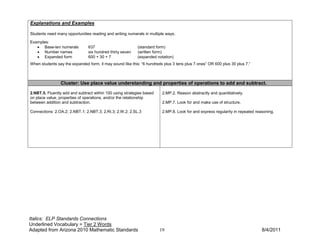
hundreds place, then the numeral in tens place, then, if necessary, to the numeral in the ones place.

Comparative language includes but is not limited to: more than, less than, greater than, most, greatest, least, same as, equal to and not equal to.
Students use the appropriate symbols to record the comparisons.

                 Cluster: Use place value understanding and properties of operations to add and subtract.
2.NBT.5. Fluently add and subtract within 100 using strategies based       2.MP.2. Reason abstractly and quantitatively.
on place value, properties of operations, and/or the relationship
between addition and subtraction.                                          2.MP.7. Look for and make use of structure.

Connections: 2.OA.2; 2.NBT.1; 2.NBT.3; 2.RI.3; 2.W.2; 2.SL.3               2.MP.8. Look for and express regularity in repeated reasoning.


Italics: ELP Standards Connections
Underlined Vocabulary = Tier 2 Words
Adapted from Arizona 2010 Mathematic Standards                           74                                                        8/4/2011
Explanations and Examples

Adding and subtracting fluently refers to knowledge of procedures, knowledge of when and how to use them appropriately, and skill in performing
them flexibly, accurately, and efficiently. Students should have experiences solving problems written both horizontally and vertically. They need to
communicate their thinking and be able to justify their strategies both verbally and with paper and pencil.
Addition strategies based on place value for 48 + 37 may include:
   • Adding by place value: 40 + 30 = 70 and 8 + 7 = 15 and 70 + 15 = 85.
   • Incremental adding (breaking one number into tens and ones); 48 + 10 = 58, 58 + 10 = 68, 68 + 10 = 78, 78 + 7 = 85
   • Compensation (making a friendly number): 48 + 2 = 50, 37 – 2 = 35, 50 + 35 = 85
Subtraction strategies based on place value for 81 - 37 may include:
   • Adding Up (from smaller number to larger number): 37 + 3 = 40, 40 + 40 = 80, 80 + 1 = 81, and 3 + 40 + 1 = 44.
   • Incremental subtracting: 81 -10 = 71, 71 – 10 = 61, 61 – 10 = 51, 51 – 7 = 44
   • Subtracting by place value: 81 – 30 = 51, 51 – 7 = 44
Properties that students should know and use are:
   • Commutative property of addition (Example: 3 + 5 = 5 + 3)
   • Associative property of addition (Example: (2 + 7) + 3 = 2 + (7+3) )
   • Identity property of 0 (Example: 8 + 0 = 8)
Students in second grade need to communicate their understanding of why some properties work for some operations and not for others.
    • Commutative Property: In first grade, students investigated whether the commutative property works with subtraction. The intent was for
       students to recognize that taking 5 from 8 is not the same as taking 8 from 5. Students should also understand that they will be working
       with numbers in later grades that will allow them to subtract larger numbers from smaller numbers. This exploration of the commutative
       property continues in second grade.
    •   Associative Property: Recognizing that the associative property does not work for subtraction is difficult for students to consider at this
        grade level as it is challenging to determine all the possibilities.

2.NBT.6. Add up to four two-digit numbers using strategies based on         2.MP.2. Reason abstractly and quantitatively.
place value and properties of operations.
                                                                            2.MP.7. Look for and make use of structure.
Connections: 2.NBT.5; 2.RI.3; 2.W.2; 2.SL.2; ET02-S2C1-01
                                                                            2.MP.8. Look for and express regularity in repeated reasoning.


Explanations and Examples

Students demonstrate addition strategies with up to four two-digit numbers either with or without regrouping. Problems may be written in a story
problem format to help develop a stronger understanding of larger numbers and their values. Interactive whiteboards and document cameras
may also be used to model and justify student thinking.


Italics: ELP Standards Connections
Underlined Vocabulary = Tier 2 Words
Adapted from Arizona 2010 Mathematic Standards                            75                                                          8/4/2011
2.NBT.7. Add and subtract within 1000, using concrete models or           2.MP.2. Reason abstractly and quantitatively.
drawings and strategies based on place value, properties of
operations, and/or the relationship between addition and subtraction;     2.MP.4. Model with mathematics.
relate the strategy to a written method. Understand that in adding or
subtracting three-digit numbers, one adds or subtracts hundreds and       2.MP.5. Use appropriate tools strategically.
hundreds, tens and tens, ones and ones; and sometimes it is
necessary to compose or decompose tens or hundreds.                       2.MP.7. Look for and make use of structure.

Connections: 2.NBT.5; 2.NBT.6; 2.RI.3; 2.SL.3; 2.W.2; ET02-S1C2-01;       2.MP.8. Look for and express regularity in repeated reasoning.
ET02-S2C1-01

Explanations and Examples

There is a strong connection between this standard and place value understanding with addition and subtraction of smaller numbers. Students
may use concrete models or drawings to support their addition or subtraction of larger numbers. Strategies are similar to those stated in 2.NBT.5,
as students extend their learning to include greater place values moving from tens to hundreds to thousands. Interactive whiteboards and
document cameras may also be used to model and justify student thinking.


2.NBT.8. Mentally add 10 or 100 to a given number 100–900, and            2.MP.2. Reason abstractly and quantitatively.
mentally subtract 10 or 100 from a given number 100–900.
                                                                          2.MP.7. Look for and make use of structure.
Connections: 2.RI.3; 2.SL.1; 2.SL.2; 2.SL.3; ET02-S2C1-01
                                                                          2.MP.8. Look for and express regularity in repeated reasoning.


Italics: ELP Standards Connections
Underlined Vocabulary = Tier 2 Words
Adapted from Arizona 2010 Mathematic Standards                          76                                                        8/4/2011
Explanations and Examples

Students need many opportunities to practice mental math by adding and subtracting multiples of 10 and 100 up to 900 using different starting
points. They can practice this by counting and thinking aloud, finding missing numbers in a sequence, and finding missing numbers on a number
line or hundreds chart. Explorations should include looking for relevant patterns.
Mental math strategies may include:
   • counting on; 300, 400, 500, etc.
   • counting back; 550, 450, 350, etc.
Examples:
   • 100 more than 653 is _____ (753)
   • 10 less than 87 is ______ (77)
   • “Start at 248. Count up by 10s until I tell you to stop.”
An interactive whiteboard or document camera may be used to help students develop these mental math skills.


2.NBT.9. Explain why addition and subtraction strategies work, using    2.MP.2. Reason abstractly and quantitatively.
place value and the properties of operations. (Explanations may be
supported by drawings or objects.)                                      2.MP.3. Construct viable arguments and critique the reasoning of
                                                                          others.
Connections: 2.NBT.1; 2.RI.3; 2.RI.4; 2.W.2; 2.SL.2; 2.SL.3; ET02-
S2C1-01                                                                 2.MP.4. Model with mathematics.
                                                                        2.MP.5. Use appropriate tools strategically.
*ELP Connection Available
                                                                        2.MP.7. Look for and make use of structure.

                                                                        2.MP.8. Look for and express regularity in repeated reasoning.


Italics: ELP Standards Connections
Underlined Vocabulary = Tier 2 Words
Adapted from Arizona 2010 Mathematic Standards                         77                                                      8/4/2011
Explanations and Examples

Students need multiple opportunities explaining their addition and subtraction thinking. Operations embedded within a meaningful context
promote development of reasoning and justification.
Example:
Mason read 473 pages in June. He read 227 pages in July. How many pages did Mason read altogether?
   • Karla’s explanation: 473 + 227 = _____. I added the ones together (3 + 7) and got 10. Then I added the tens together (70 + 20) and got
       90. I knew that 400 + 200 was 600. So I added 10 + 90 for 100 and added 100 + 600 and found out that Mason had read 700 pages
       altogether.
   • Debbie’s explanation: 473 + 227 = ______. I started by adding 200 to 473 and got 673. Then I added 20 to 673 and I got 693 and finally
       I added 7 to 693 and I knew that Mason had read 700 pages altogether.
   • Becky’s explanation: I used base ten blocks on a base ten mat to help me solve this problem. I added 3 ones (units) plus 7 ones and got
       10 ones which made one ten. I moved the 1 ten to the tens place. I then added 7 tens rods plus 2 tens rods plus 1 tens rod and got 10
       tens or 100. I moved the 1 hundred to the hundreds place. Then I added 4 hundreds plus 2 hundreds plus 1 hundred and got 7 hundreds
       or 700. So Mason read 700 books.

Students should be able to connect different representations and explain the connections. Representations can include numbers, words
(including mathematical language), pictures, number lines, and/or physical objects. Students should be able to use any/all of these
representations as needed.

An interactive whiteboard or document camera can be used to help students develop and explain their thinking.


                                                   Domain: Measurement and Data

                       AZ Math Standards                                      Mathematical Practices
                                   Cluster: Relate addition and subtraction to length.
2.MD.6. Represent whole numbers as lengths from 0 on a number line       2.MP.2. Reason abstractly and quantitatively.
diagram with equally spaced points corresponding to the numbers 0, 1,
2, …, and represent whole-number sums and differences within 100 on      2.MP.4. Model with mathematics.
a number line diagram.
                                                                         2.MP.5. Use appropriate tools strategically.
Connections: 2.NBT.2; 2.OA.1; 2.MD.5; 2.RI.3; 2.SL.3; ET02-S1C2-02


Italics: ELP Standards Connections
Underlined Vocabulary = Tier 2 Words
Adapted from Arizona 2010 Mathematic Standards                          78                                                      8/4/2011
Explanations and Examples

Students represent their thinking when adding and subtracting within 100 by using a number line. An interactive whiteboard or document camera
can be used to help students demonstrate their thinking.

Example: 10 – 6 = 4


                                                     Cluster: Work with time and money
2.MD.7. Tell and write time from analog and digital clocks to the         2.MP.5. Use appropriate tools strategically.
nearest five minutes, using a.m. and p.m.
                                                                          2.MP.6. Attend to precision.
Connections: 2.NBT.2; 2.RI.3; 2.W.2; 2.SL.2; ET02-S1C2-01; ET02-
S1C2-02

*ELP Connection Available

Explanations and Examples

In first grade, students learned to tell time to the nearest hour and half-hour. Students build on this understanding in second grade by skip-
counting by 5 to recognize 5-minute intervals on the clock. They need exposure to both digital and analog clocks. It is important that they can
recognize time in both formats and communicate their understanding of time using both numbers and language. Common time phrases include
the following: quarter till ___, quarter after ___, ten till ___, ten after ___, and half past ___.

Students should understand that there are 2 cycles of 12 hours in a day - a.m. and p.m. Recording their daily actions in a journal would be helpful
for making real-world connections and understanding the difference between these two cycles. An interactive whiteboard or document camera
may be used to help students demonstrate their thinking.


Italics: ELP Standards Connections
Underlined Vocabulary = Tier 2 Words
Adapted from Arizona 2010 Mathematic Standards                           79                                                        8/4/2011
2.MD.8. Solve word problems involving dollar bills, quarters, dimes,       2.MP.1. Make sense of problems and persevere in solving them.
nickels, and pennies, using $ and ¢ symbols appropriately. Example: If
you have 2 dimes and 3 pennies, how many cents do you have?                2.MP.2. Reason abstractly and quantitatively.

Connections: 2.NBT.1; 2.NBT.5; 2.RI.3; 2.RI.4; 2.W.2; 2.SL.2; ET02-        2.MP.4. Model with mathematics.
S1C2-01; ET02-S1C2-02
                                                                           2.MP.5. Use appropriate tools strategically.
*ELP Connection Available
                                                                           2.MP.8. Look for and express regularity in repeated reasoning.

Explanations and Examples

Since money is not specifically addressed in kindergarten, first grade, or third grade, students should have multiple opportunities to identify,
count, recognize, and use coins and bills in and out of context. They should also experience making equivalent amounts using both coins and
bills. “Dollar bills” should include denominations up to one hundred ($1.00, $5.00, $10.00, $20.00, $100.00).

Students should solve story problems connecting the different representations. These representations may include objects, pictures, charts,
tables, words, and/or numbers. Students should communicate their mathematical thinking and justify their answers. An interactive whiteboard or
document camera may be used to help students demonstrate and justify their thinking.

Example:
   • Sandra went to the store and received $ 0.76 in change. What are three different sets of coins she could have received?


                                                             Domain: Geometry

                       AZ Math Standards                                    Mathematical Practices
                                   Cluster: Reason with shapes and their attributes
2.G.1. Recognize and draw shapes having specified attributes, such as      2.MP.4. Model with mathematics.
a given number of angles or a given number of equal faces. Identify
triangles, quadrilaterals, pentagons, hexagons, and cubes. (Sizes are      2.MP.7. Look for and make use of structure.
compared directly or visually, not compared by measuring.)

Connections: 2.RI.3; 2.RI.4; 2.W.2; 2.SL.2; 2.SL.3; SC02-S5C1-01;
ET02-S2C1-01


Italics: ELP Standards Connections
Underlined Vocabulary = Tier 2 Words
Adapted from Arizona 2010 Mathematic Standards                           80                                                         8/4/2011
Explanations and Examples

Students identify, describe, and draw triangles, quadrilaterals, pentagons, and hexagons. Pentagons, triangles, and hexagons should appear as
both regular (equal sides and equal angles) and irregular. Students recognize all four sided shapes as quadrilaterals. Students use the
vocabulary word “angle” in place of “corner” but they do not need to name angle types. Interactive whiteboards and document cameras may be
used to help identify shapes and their attributes. Shapes should be presented in a variety of orientations and configurations.


Italics: ELP Standards Connections
Underlined Vocabulary = Tier 2 Words
Adapted from Arizona 2010 Mathematic Standards                         81                                                      8/4/2011
Isaac School District, No. 5
                                                  Mathematics Curriculum Guide: 2nd Grade

                                                                Unit 7
                                                  Parts of a Whole, Parts of a Group
                                                                      Fractions
Big Ideas:                                                                   Essential Questions:
Students will understand that:
    • Fractions are equal parts of a whole or group.                                  •   How are the numerator and the denominator related?
    • Fraction parts can be modeled or named.                                         •   How could you represent fractions?


Unit Vocabulary: denominator, equal, fourths, fraction, half, numerator, one and a half, one fourth, one half, one quarter, one third, part, pieces,
sets, thirds, two and a half, two thirds, whole

                                            Domain: Operations and Algebraic Thinking (OA)

                          AZ Math Standards                                      Mathematical Practices
                           Cluster: Represent and solve problems involving addition and subtraction.
Students are expected to:
2.OA.1. Use addition and subtraction within 100 to solve one- and two-            2.MP.1. Make sense of problems and persevere in solving them.
step word problems involving situations of adding to, taking from, putting
together, taking apart, and comparing, with unknowns in all positions,            2.MP.2. Reason abstractly and quantitatively.
e.g., by using drawings and equations with a symbol for the unknown
number to represent the problem. (See Table 1.)                                   2.MP.3. Construct viable arguments and critique the reasoning of
                                                                                    others.
Connections: 2.NBT.5; 2.RI.3; 2.RI.4; 2.SL.2; ET02-S2C1-01
                                                                                  2.MP.4. Model with mathematics.
*ELP Connection Available
                                                                                  2.MP.5. Use appropriate tools strategically.

                                                                                  2.MP.8. Look for and express regularity in repeated reasoning.


Italics: ELP Standards Connections
Underlined Vocabulary = Tier 2 Words
Adapted from Arizona 2010 Mathematic Standards                               82                                                        8/4/2011
Explanations and Examples

Word problems that are connected to students’ lives can be used to develop fluency with addition and subtraction. Table 1 describes the four
different addition and subtraction situations and their relationship to the position of the unknown.
Examples:
   • Take-from example: David had 63 stickers. He gave 37 to Susan. How many stickers does David have now? 63 – 37 =
   • Add to example: David had $37. His grandpa gave him some money for his birthday. Now he has $63. How much money did David’s
      grandpa give him? $37 +        = $63
   • Compare example: David has 63 stickers. Susan has 37 stickers. How many more stickers does David have than Susan? 63 – 37 =
          o Even though the modeling of the two problems above is different, the equation,
              63 - 37 = ?, can represent both situations (How many more do I need to make 63?)
   • Take-from (Start Unknown) David had some stickers. He gave 37 to Susan. Now he has 26 stickers. How many stickers did David have
      before?      - 37 = 26
It is important to attend to the difficulty level of the problem situations in relation to the position of the unknown.
      • Result Unknown problems are the least complex for students followed by Total Unknown and Difference Unknown.
      • The next level of difficulty includes Change Unknown, Addend Unknown, followed by Bigger Unknown.
      • The most difficult are Start Unknown, Both Addends Unknown, and Smaller Unknown.
Second grade students should work on ALL problem types regardless of the level of difficulty. Students can use interactive whiteboard or document
camera to demonstrate and justify their thinking.

This standard focuses on developing an algebraic representation of a word problem through addition and subtraction --the intent is not to introduce
traditional algorithms or rules.

                                                     Cluster: Add and subtract within 20.
2.OA.2. Fluently add and subtract within 20 using mental strategies. By        2.MP.2. Reason abstractly and quantitatively.
end of Grade 2, know from memory all sums of two one-digit numbers.
(See standard 1.OA.6 for a list of mental strategies.)                         2.MP.7. Look for and make use of structure.

Connections: 2.NBT.5; 2.NBT.9; ET02-S2C1-01                                    2.MP.8. Look for and express regularity in repeated reasoning.


Italics: ELP Standards Connections
Underlined Vocabulary = Tier 2 Words
Adapted from Arizona 2010 Mathematic Standards                            83                                                        8/4/2011
This standard is strongly connected to all the standards in this domain. It focuses on students being able to fluently add and subtract numbers to 20.
Adding and subtracting fluently refers to knowledge of procedures, knowledge of when and how to use them appropriately, and skill in performing
them flexibly, accurately, and efficiently.
Mental strategies help students make sense of number relationships as they are adding and subtracting within 20. The ability to calculate mentally
with efficiency is very important for all students. Mental strategies may include the following:
    • Counting on
    • Making tens (9 + 7 = 10 + 6)
    • Decomposing a number leading to a ten ( 14 – 6 = 14 – 4 – 2 = 10 – 2 = 8)
    • Fact families (8 + 5 = 13 is the same as 13 - 8 = 5)
    • Doubles
    • Doubles plus one (7 + 8 = 7 + 7 + 1)
However, the use of objects, diagrams, or interactive whiteboards, and various strategies will help students develop fluency.

                                         Domain: Number and Operations in Base Ten (NBT)

                         AZ Math Standards                                                          Mathematical Practices
                                                      Cluster: Understand place value.
Students are expected to:
2.NBT.1. Understand that the three digits of a three-digit number               2.MP.2. Reason abstractly and quantitatively.
represent amounts of hundreds, tens, and ones; e.g., 706 equals 7
hundreds, 0 tens, and 6 ones. Understand the following as special cases:        2.MP.7. Look for and make use of structure.
    i. 100 can be thought of as a bundle of ten tens—called a
       “hundred.”                                                               2.MP.8. Look for and express regularity in repeated reasoning.
    j. The numbers 100, 200, 300, 400, 500, 600, 700, 800, 900 refer to
       one, two, three, four, five, six, seven, eight, or nine hundreds (and
       0 tens and 0 ones).

Connections: 2.NBT.5; 2.RI.3; 2.RI.4; 2.SL.3; ET02-S1C2-01; ET02-
S1C2-01; ET02-S2C1-01


Italics: ELP Standards Connections
Underlined Vocabulary = Tier 2 Words
Adapted from Arizona 2010 Mathematic Standards                             84                                                        8/4/2011
Explanations and Examples

Understanding that 10 ones make one ten and that 10 tens make one hundred is fundamental to students’ mathematical development. Students
need multiple opportunities counting and “bundling” groups of tens in first grade. In second grade, students build on their understanding by making
bundles of 100s with or without leftovers using base ten blocks, cubes in towers of 10, ten frames, etc. This emphasis on bundling hundreds will
support students’ discovery of place value patterns.
As students are representing the various amounts, it is important that emphasis is placed on the language associated with the quantity. For
example, 243 can be expressed in multiple ways such as 2 groups of hundred, 4 groups of ten and 3 ones, as well as 24 tens with 3 ones. When
students read numbers, they should read in standard form as well as using place value concepts. For example, 243 should be read as “two hundred
forty-three” as well as two hundreds, 4 tens, 3 ones.

A document camera or interactive whiteboard can also be used to demonstrate “bundling” of objects. This gives students the opportunity to
communicate their counting and thinking.


2.NBT.2. Count within 1000; skip-count by 5s, 10s, and 100s.                    2.MP.2. Reason abstractly and quantitatively.

Connections: 2.NBT.8; ET02-S1C3-01                                              2.MP.7. Look for and make use of structure.

                                                                                2.MP.8. Look for and express regularity in repeated reasoning.

Explanations and Examples

Students need many opportunities counting, up to 1000, from different starting points. They should also have many experiences skip counting by
5s, 10s, and 100s to develop the concept of place value.
Examples:
   • The use of the 100s chart may be helpful for students to identify the counting patterns.
   • The use of money (nickels, dimes, dollars) or base ten blocks may be helpful visual cues.
   • The use of an interactive whiteboard may also be used to develop counting skills.

The ultimate goal for second graders is to be able to count in multiple ways with no visual support.


2.NBT.3. Read and write numbers to 1000 using base-ten numerals,                2.MP.2. Reason abstractly and quantitatively.
number names, and expanded form.
                                                                                2.MP.7. Look for and make use of structure.
Connections: 2.SL.2; 2.RI.3
                                                                                2.MP.8. Look for and express regularity in repeated reasoning.

Italics: ELP Standards Connections
Underlined Vocabulary = Tier 2 Words
Adapted from Arizona 2010 Mathematic Standards                             85                                                        8/4/2011
Explanations and Examples

Students need many opportunities reading and writing numerals in multiple ways.

Examples:
   • Base-ten numerals         637                         (standard form)
   • Number names              six hundred thirty seven    (written form)
   • Expanded form             600 + 30 + 7                (expanded notation)
When students say the expanded form, it may sound like this: “6 hundreds plus 3 tens plus 7 ones” OR 600 plus 30 plus 7.”

                  Cluster: Use place value understanding and properties of operations to add and subtract.

2.NBT.5. Fluently add and subtract within 100 using strategies based on        2.MP.2. Reason abstractly and quantitatively.
place value, properties of operations, and/or the relationship between
addition and subtraction.                                                      2.MP.7. Look for and make use of structure.

Connections: 2.OA.2; 2.NBT.1; 2.NBT.3; 2.RI.3; 2.W.2; 2.SL.3                   2.MP.8. Look for and express regularity in repeated reasoning.


Italics: ELP Standards Connections
Underlined Vocabulary = Tier 2 Words
Adapted from Arizona 2010 Mathematic Standards                            86                                                        8/4/2011
Explanations and Examples

Adding and subtracting fluently refers to knowledge of procedures, knowledge of when and how to use them appropriately, and skill in performing
them flexibly, accurately, and efficiently. Students should have experiences solving problems written both horizontally and vertically. They need to
communicate their thinking and be able to justify their strategies both verbally and with paper and pencil.
Addition strategies based on place value for 48 + 37 may include:
   • Adding by place value: 40 + 30 = 70 and 8 + 7 = 15 and 70 + 15 = 85.
   • Incremental adding (breaking one number into tens and ones); 48 + 10 = 58, 58 + 10 = 68, 68 + 10 = 78, 78 + 7 = 85
   • Compensation (making a friendly number): 48 + 2 = 50, 37 – 2 = 35, 50 + 35 = 85
Subtraction strategies based on place value for 81 - 37 may include:
   • Adding Up (from smaller number to larger number): 37 + 3 = 40, 40 + 40 = 80, 80 + 1 = 81, and 3 + 40 + 1 = 44.
   • Incremental subtracting: 81 -10 = 71, 71 – 10 = 61, 61 – 10 = 51, 51 – 7 = 44
   • Subtracting by place value: 81 – 30 = 51, 51 – 7 = 44
Properties that students should know and use are:
   • Commutative property of addition (Example: 3 + 5 = 5 + 3)
   • Associative property of addition (Example: (2 + 7) + 3 = 2 + (7+3) )
   • Identity property of 0 (Example: 8 + 0 = 8)
Students in second grade need to communicate their understanding of why some properties work for some operations and not for others.
    • Commutative Property: In first grade, students investigated whether the commutative property works with subtraction. The intent was for
       students to recognize that taking 5 from 8 is not the same as taking 8 from 5. Students should also understand that they will be working with
       numbers in later grades that will allow them to subtract larger numbers from smaller numbers. This exploration of the commutative property
       continues in second grade.
    • Associative Property: Recognizing that the associative property does not work for subtraction is difficult for students to consider at this
       grade level as it is challenging to determine all the possibilities.

2.NBT.6. Add up to four two-digit numbers using strategies based on             2.MP.2. Reason abstractly and quantitatively.
place value and properties of operations.
                                                                                2.MP.7. Look for and make use of structure.
Connections: 2.NBT.5; 2.RI.3; 2.W.2; 2.SL.2; ET02-S2C1-01
                                                                                2.MP.8. Look for and express regularity in repeated reasoning.


Italics: ELP Standards Connections
Underlined Vocabulary = Tier 2 Words
Adapted from Arizona 2010 Mathematic Standards                             87                                                        8/4/2011
Explanations and Examples

Students demonstrate addition strategies with up to four two-digit numbers either with or without regrouping. Problems may be written in a story
problem format to help develop a stronger understanding of larger numbers and their values. Interactive whiteboards and document cameras may
also be used to model and justify student thinking.


2.NBT.7. Add and subtract within 1000, using concrete models or                2.MP.2. Reason abstractly and quantitatively.
drawings and strategies based on place value, properties of operations,
and/or the relationship between addition and subtraction; relate the           2.MP.4. Model with mathematics.
strategy to a written method. Understand that in adding or subtracting
three-digit numbers, one adds or subtracts hundreds and hundreds, tens         2.MP.5. Use appropriate tools strategically.
and tens, ones and ones; and sometimes it is necessary to compose or
decompose tens or hundreds.                                                    2.MP.7. Look for and make use of structure.

Connections: 2.NBT.5; 2.NBT.6; 2.RI.3; 2.SL.3; 2.W.2; ET02-S1C2-01;            2.MP.8. Look for and express regularity in repeated reasoning.
ET02-S2C1-01

Explanations and Examples

There is a strong connection between this standard and place value understanding with addition and subtraction of smaller numbers. Students may
use concrete models or drawings to support their addition or subtraction of larger numbers. Strategies are similar to those stated in 2.NBT.5, as
students extend their learning to include greater place values moving from tens to hundreds to thousands. Interactive whiteboards and document
cameras may also be used to model and justify student thinking.


2.NBT.8. Mentally add 10 or 100 to a given number 100–900, and                 2.MP.2. Reason abstractly and quantitatively.
mentally subtract 10 or 100 from a given number 100–900.
                                                                               2.MP.7. Look for and make use of structure.
Connections: 2.RI.3; 2.SL.1; 2.SL.2; 2.SL.3;ET02-S2C1-01
                                                                               2.MP.8. Look for and express regularity in repeated reasoning.


Italics: ELP Standards Connections
Underlined Vocabulary = Tier 2 Words
Adapted from Arizona 2010 Mathematic Standards                            88                                                        8/4/2011
Explanations and Examples

Students need many opportunities to practice mental math by adding and subtracting multiples of 10 and 100 up to 900 using different starting
points. They can practice this by counting and thinking aloud, finding missing numbers in a sequence, and finding missing numbers on a number
line or hundreds chart. Explorations should include looking for relevant patterns.
Mental math strategies may include:
   • counting on; 300, 400, 500, etc.
   • counting back; 550, 450, 350, etc.
Examples:
   • 100 more than 653 is _____ (753)
   • 10 less than 87 is ______ (77)
   • “Start at 248. Count up by 10s until I tell you to stop.”
An interactive whiteboard or document camera may be used to help students develop these mental math skills.


2.NBT.9. Explain why addition and subtraction strategies work, using         2.MP.2. Reason abstractly and quantitatively.
place value and the properties of operations. (Explanations may be
supported by drawings or objects.)                                           2.MP.3. Construct viable arguments and critique the reasoning of
                                                                               others.
Connections: 2.NBT.1; 2.RI.3; 2.RI.4; 2.W.2;
2.SL.2; 2.SL.3; ET02-S2C1-01                                                 2.MP.4. Model with mathematics.

*ELP Connection Available                                                    2.MP.5. Use appropriate tools strategically.

                                                                             2.MP.7. Look for and make use of structure.

                                                                             2.MP.8. Look for and express regularity in repeated reasoning.


Italics: ELP Standards Connections
Underlined Vocabulary = Tier 2 Words
Adapted from Arizona 2010 Mathematic Standards                          89                                                        8/4/2011
Explanations and Examples

Students need multiple opportunities explaining their addition and subtraction thinking. Operations embedded within a meaningful context promote
development of reasoning and justification.
Example:
Mason read 473 pages in June. He read 227 pages in July. How many pages did Mason read altogether?
   • Karla’s explanation: 473 + 227 = _____. I added the ones together (3 + 7) and got 10. Then I added the tens together (70 + 20) and got 90.
       I knew that 400 + 200 was 600. So I added 10 + 90 for 100 and added 100 + 600 and found out that Mason had read 700 pages altogether.
   • Debbie’s explanation: 473 + 227 = ______. I started by adding 200 to 473 and got 673. Then I added 20 to 673 and I got 693 and finally I
       added 7 to 693 and I knew that Mason had read 700 pages altogether.

    •   Becky’s explanation: I used base ten blocks on a base ten mat to help me solve this problem. I added 3 ones (units) plus 7 ones and got 10
        ones which made one ten. I moved the 1 ten to the tens place. I then added 7 tens rods plus 2 tens rods plus 1 tens rod and got 10 tens or
        100. I moved the 1 hundred to the hundreds place. Then I added 4 hundreds plus 2 hundreds plus 1 hundred and got 7 hundreds or 700.
        So Mason read 700 books.

Students should be able to connect different representations and explain the connections. Representations can include numbers, words (including
mathematical language), pictures, number lines, and/or physical objects. Students should be able to use any/all of these representations as needed.

An interactive whiteboard or document camera can be used to help students develop and explain their thinking.


Italics: ELP Standards Connections
Underlined Vocabulary = Tier 2 Words
Adapted from Arizona 2010 Mathematic Standards                           90                                                       8/4/2011
Domain: Measurement and Data (MD)

                       AZ Math Standards                                      Mathematical Practices
                                   Cluster: Relate addition and subtraction to length.
Students are expected to:
2.MD.6. Represent whole numbers as lengths from 0 on a number line       2.MP.2. Reason abstractly and quantitatively.
diagram with equally spaced points corresponding to the numbers 0, 1,
2, …, and represent whole-number sums and differences within 100 on      2.MP.4. Model with mathematics.
a number line diagram.
                                                                         2.MP.5. Use appropriate tools strategically.
Connections: 2.NBT.2; 2.OA.1; 2.MD.5; 2.RI.3; 2.SL.3; ET02-S1C2-02

Explanations and Examples

Students represent their thinking when adding and subtracting within 100 by using a number line. An interactive whiteboard or document camera
can be used to help students demonstrate their thinking.

Example: 10 – 6 = 4


                                                    Cluster: Work with time and money.

2.MD.7. Tell and write time from analog and digital clocks to the        2.MP.5. Use appropriate tools strategically.
nearest five minutes, using a.m. and p.m.
                                                                         2.MP.6. Attend to precision.
Connections: 2.NBT.2; 2.RI.3; 2.W.2; 2.SL.2; ET02-S1C2-01; ET02-
S1C2-02

*ELP Connection Available


Italics: ELP Standards Connections
Underlined Vocabulary = Tier 2 Words
Adapted from Arizona 2010 Mathematic Standards                          91                                                    8/4/2011
Explanations and Examples

In first grade, students learned to tell time to the nearest hour and half-hour. Students build on this understanding in second grade by skip-
counting by 5 to recognize 5-minute intervals on the clock. They need exposure to both digital and analog clocks. It is important that they can
recognize time in both formats and communicate their understanding of time using both numbers and language. Common time phrases include
the following: quarter till ___, quarter after ___, ten till ___, ten after ___, and half past ___.

Students should understand that there are 2 cycles of 12 hours in a day - a.m. and p.m. Recording their daily actions in a journal would be helpful
for making real-world connections and understanding the difference between these two cycles. An interactive whiteboard or document camera
may be used to help students demonstrate their thinking.


2.MD.8. Solve word problems involving dollar bills, quarters, dimes,       2.MP.1. Make sense of problems and persevere in solving them.
nickels, and pennies, using $ and ¢ symbols appropriately. Example: If
you have 2 dimes and 3 pennies, how many cents do you have?                2.MP.2. Reason abstractly and quantitatively.

Connections: 2.NBT.1; 2.NBT.5; 2.RI.3; 2.RI.4; 2.W.2; 2.SL.2; ET02-        2.MP.4. Model with mathematics.
S1C2-01; ET02-S1C2-02
                                                                           2.MP.5. Use appropriate tools strategically.
*ELP Connection Available
                                                                           2.MP.8. Look for and express regularity in repeated reasoning.

Explanations and Examples

Since money is not specifically addressed in kindergarten, first grade, or third grade, students should have multiple opportunities to identify,
count, recognize, and use coins and bills in and out of context. They should also experience making equivalent amounts using both coins and
bills. “Dollar bills” should include denominations up to one hundred ($1.00, $5.00, $10.00, $20.00, $100.00).

Students should solve story problems connecting the different representations. These representations may include objects, pictures, charts,
tables, words, and/or numbers. Students should communicate their mathematical thinking and justify their answers. An interactive whiteboard or
document camera may be used to help students demonstrate and justify their thinking.

Example:
Sandra went to the store and received $ 0.76 in change. What are three different sets of coins she could have received?


Italics: ELP Standards Connections
Underlined Vocabulary = Tier 2 Words
Adapted from Arizona 2010 Mathematic Standards                           92                                                         8/4/2011
Domain: Geometry (G)

                       AZ Math Standards                                    Mathematical Practices
                                   Cluster: Reason with shapes and their attributes.

2.G.3. Partition circles and rectangles into two, three, or four equal      2.MP.2. Reason abstractly and quantitatively.
shares, describe the shares using the words halves, thirds, half of, a
third of, etc., and describe the whole as two halves, three thirds, four    2.MP.3. Construct viable arguments and critique the reasoning of
fourths. Recognize that equal shares of identical wholes need not have        others.
the same shape.
                                                                            2.MP.6. Attend to precision.
Connections: 2.RI.3; 2.RI.4; 2.W.2; 2.SL.2; 2.SL.3; ET02-S1C2-02
                                                                            2.MP.8. Look for and express regularity in repeated reasoning.
*ELP Connection Available


Italics: ELP Standards Connections
Underlined Vocabulary = Tier 2 Words
Adapted from Arizona 2010 Mathematic Standards                             93                                                      8/4/2011
Explanations and Examples

This standard introduces fractions in an area model. Students need experiences with different sizes, circles, and rectangles. For example,
students should recognize that when they cut a circle into three equal pieces, each piece will equal one third of its original whole. In this case,
students should describe the whole as three thirds. If a circle is cut into four equal pieces, each piece will equal one fourth of its original whole
and the whole is described as four fourths.


Students should see circles and rectangles partitioned in multiple ways so they learn to recognize that equal shares can be different shapes
within the same whole. An interactive whiteboard may be used to show partitions of shapes.


Italics: ELP Standards Connections
Underlined Vocabulary = Tier 2 Words
Adapted from Arizona 2010 Mathematic Standards                              94                                                          8/4/2011
Isaac School District, No. 5
                                             Mathematics Curriculum Guide: 2nd Grade

                                                            Unit 8
                                               Partners, Teams, and Paper Clips
                                           Addition, Subtraction, and the Number System 4
Big Ideas:                                                          Essential Questions:
Students will understand that:
    • A sum can be predicted as even or odd.                                  •   What do you notice when you add even and odd numbers?
    • Familiar combinations can be used to develop unfamiliar                 •   How can you predict if a sum will be odd or even?
       combinations.                                                          •   How can you use combinations you know to help solve
    • A successful problem solver uses efficient methods for adding               problems?
       and subtracting.                                                       •   How can different equations represent the same problem?
                                                                              •   What strategies could you use to solve a problem?

Unit Vocabulary: conjecture, diagonal, digit, equal, equation, even, horizontal, odd, open number line, pair, solve, story problems, strategy,
sum, vertical, whole

                                        Domain: Operations and Algebraic Thinking (OA)

                       AZ Math Standards                                     Mathematical Practices
                        Cluster: Represent and solve problems involving addition and subtraction.
Students are expected to:
2.OA.1. Use addition and subtraction within 100 to solve one- and two-    2.MP.1. Make sense of problems and persevere in solving them.
step word problems involving situations of adding to, taking from,
putting together, taking apart, and comparing, with unknowns in all       2.MP.2. Reason abstractly and quantitatively.
positions, e.g., by using drawings and equations with a symbol for the
unknown number to represent the problem. (See Table 1.)                   2.MP.3. Construct viable arguments and critique the reasoning of
                                                                            others.
Connections: 2.NBT.5; 2.RI.3; 2.RI.4; 2.SL.2; ET02-S2C1-01
                                                                          2.MP.4. Model with mathematics.
*ELP Connection Available
                                                                          2.MP.5. Use appropriate tools strategically.

                                                                          2.MP.8. Look for and express regularity in repeated reasoning.


Italics: ELP Standards Connections
Underlined Vocabulary = Tier 2 Words
Adapted from Arizona 2010 Mathematic Standards                           95                                                      8/4/2011
Explanations and Examples
Word problems that are connected to students’ lives can be used to develop fluency with addition and subtraction. Table 1 describes the four
different addition and subtraction situations and their relationship to the position of the unknown.
Examples:
   • Take-from example: David had 63 stickers. He gave 37 to Susan. How many stickers does David have now? 63 – 37 =
   • Add to example: David had $37. His grandpa gave him some money for his birthday. Now he has $63. How much money did David’s
      grandpa give him? $37 +        = $63
   • Compare example: David has 63 stickers. Susan has 37 stickers. How many more stickers does David have than Susan? 63 – 37 =
          o Even though the modeling of the two problems above is different, the equation,
              63 - 37 = ?, can represent both situations (How many more do I need to make 63?)
   • Take-from (Start Unknown) David had some stickers. He gave 37 to Susan. Now he has 26 stickers. How many stickers did David have
      before?      - 37 = 26
It is important to attend to the difficulty level of the problem situations in relation to the position of the unknown.
      • Result Unknown problems are the least complex for students followed by Total Unknown and Difference Unknown.
      • The next level of difficulty includes Change Unknown, Addend Unknown, followed by Bigger Unknown.
      • The most difficult are Start Unknown, Both Addends Unknown, and Smaller Unknown.
Second grade students should work on ALL problem types regardless of the level of difficulty. Students can use interactive whiteboard or
document camera to demonstrate and justify their thinking.

This standard focuses on developing an algebraic representation of a word problem through addition and subtraction --the intent is not to
introduce traditional algorithms or rules.

                                                   Cluster: Add and subtract within 20.
2.OA.2. Fluently add and subtract within 20 using mental strategies. By    2.MP.2. Reason abstractly and quantitatively.
end of Grade 2, know from memory all sums of two one-digit numbers.
(See standard 1.OA.6 for a list of mental strategies.)                     2.MP.7. Look for and make use of structure.

Connections: 2.NBT.5; 2.NBT.9; ET02-S2C1-01                                2.MP.8. Look for and express regularity in repeated reasoning.


Italics: ELP Standards Connections
Underlined Vocabulary = Tier 2 Words
Adapted from Arizona 2010 Mathematic Standards                            96                                                      8/4/2011
Explanations and Examples

This standard is strongly connected to all the standards in this domain. It focuses on students being able to fluently add and subtract numbers to
20. Adding and subtracting fluently refers to knowledge of procedures, knowledge of when and how to use them appropriately, and skill in
performing them flexibly, accurately, and efficiently.
Mental strategies help students make sense of number relationships as they are adding and subtracting within 20. The ability to calculate
mentally with efficiency is very important for all students. Mental strategies may include the following:
   • Counting on
   • Making tens (9 + 7 = 10 + 6)
   • Decomposing a number leading to a ten ( 14 – 6 = 14 – 4 – 2 = 10 – 2 = 8)
   • Fact families (8 + 5 = 13 is the same as 13 - 8 = 5)
   • Doubles
   • Doubles plus one (7 + 8 = 7 + 7 + 1)
However, the use of objects, diagrams, or interactive whiteboards, and various strategies will help students develop fluency.

                        Cluster: Work with equal groups of objects to gain foundations for multiplication.

2.OA.3. Determine whether a group of objects (up to 20) has an odd or     2.MP.2. Reason abstractly and quantitatively.
even number of members, e.g., by pairing objects or counting them by
2s; write an equation to express an even number as a sum of two           2.MP.3. Construct viable arguments and critique the reasoning of
equal addends.                                                              others.

Connections: 2.OA.4; 2.RI.3; 2.RI.4; ET02-S1C1-01; ET02-S2C1-01           2.MP.7. Look for and make use of structure.

                                                                          2.MP.8. Look for and express regularity in repeated reasoning.


Italics: ELP Standards Connections
Underlined Vocabulary = Tier 2 Words
Adapted from Arizona 2010 Mathematic Standards                           97                                                        8/4/2011
Explanations and Examples

Students explore odd and even numbers in a variety of ways including the following: students may investigate if a number is odd or even by
determining if the number of objects can be divided into two equal sets, arranged into pairs or counted by twos. After the above experiences,
students may derive that they only need to look at the digit in the ones place to determine if a number is odd or even since any number of tens
will always split into two even groups.

Example:

Students need opportunities writing equations representing sums of two equal addends, such as: 2 + 2 = 4, 3 + 3 = 6, 5 + 5 = 10, 6 + 6 = 12, or 8
+ 8 =16. This understanding will lay the foundation for multiplication and is closely connected to 2.OA.4.

The use of objects and/or interactive whiteboards will help students develop and demonstrate various strategies to determine even and odd
numbers.


                                        Domain: Number and Operations in Base Ten (NBT)

                        AZ Math Standards                                                         Mathematical Practices
                                                     Cluster: Understand place value.
Students are expected to:
2.NBT.1. Understand that the three digits of a three-digit number             2.MP.2. Reason abstractly and quantitatively.
represent amounts of hundreds, tens, and ones; e.g., 706 equals 7
hundreds, 0 tens, and 6 ones. Understand the following as special             2.MP.7. Look for and make use of structure.
cases:
    k. 100 can be thought of as a bundle of ten tens—called a                 2.MP.8. Look for and express regularity in repeated reasoning.
       “hundred.”
    l. The numbers 100, 200, 300, 400, 500, 600, 700, 800, 900 refer
       to one, two, three, four, five, six, seven, eight, or nine hundreds
       (and 0 tens and 0 ones).

Connections: 2.NBT.5; 2.RI.3; 2.RI.4; 2.SL.3; ET02-S1C2-01; ET02-
S1C2-01; ET02-S2C1-01


Italics: ELP Standards Connections
Underlined Vocabulary = Tier 2 Words
Adapted from Arizona 2010 Mathematic Standards                               98                                                      8/4/2011
Explanations and Examples

Understanding that 10 ones make one ten and that 10 tens make one hundred is fundamental to students’ mathematical development. Students
need multiple opportunities counting and “bundling” groups of tens in first grade. In second grade, students build on their understanding by
making bundles of 100s with or without leftovers using base ten blocks, cubes in towers of 10, ten frames, etc. This emphasis on bundling
hundreds will support students’ discovery of place value patterns.
As students are representing the various amounts, it is important that emphasis is placed on the language associated with the quantity. For
example, 243 can be expressed in multiple ways such as 2 groups of hundred, 4 groups of ten and 3 ones, as well as 24 tens with 3 ones. When
students read numbers, they should read in standard form as well as using place value concepts. For example, 243 should be read as “two
hundred forty-three” as well as two hundreds, 4 tens, 3 ones.

A document camera or interactive whiteboard can also be used to demonstrate “bundling” of objects. This gives students the opportunity to
communicate their counting and thinking.


2.NBT.2. Count within 1000; skip-count by 5s, 10s, and 100s.               2.MP.2. Reason abstractly and quantitatively.

Connections: 2.NBT.8; ET02-S1C3-01                                         2.MP.7. Look for and make use of structure.

                                                                           2.MP.8. Look for and express regularity in repeated reasoning.

Explanations and Examples

Students need many opportunities counting, up to 1000, from different starting points. They should also have many experiences skip counting by
5s, 10s, and 100s to develop the concept of place value.
Examples:
   • The use of the 100s chart may be helpful for students to identify the counting patterns.
   • The use of money (nickels, dimes, dollars) or base ten blocks may be helpful visual cues.
   • The use of an interactive whiteboard may also be used to develop counting skills.

The ultimate goal for second graders is to be able to count in multiple ways with no visual support.


Italics: ELP Standards Connections
Underlined Vocabulary = Tier 2 Words
Adapted from Arizona 2010 Mathematic Standards                            99                                                      8/4/2011
2.NBT.3. Read and write numbers to 1000 using base-ten numerals,        2.MP.2. Reason abstractly and quantitatively.
number names, and expanded form.
                                                                        2.MP.7. Look for and make use of structure.
Connections: 2.SL.2; 2.RI.3
                                                                        2.MP.8. Look for and express regularity in repeated reasoning.


Explanations and Examples

Students need many opportunities reading and writing numerals in multiple ways.

Examples:
   • Base-ten numerals          637                        (standard form)
   • Number names               six hundred thirty seven   (written form)
   • Expanded form              600 + 30 + 7               (expanded notation)
When students say the expanded form, it may sound like this: “6 hundreds plus 3 tens plus 7 ones” OR 600 plus 30 plus 7.”

                Cluster: Use place value understanding and properties of operations to add and subtract.
2.NBT.5. Fluently add and subtract within 100 using strategies based    2.MP.2. Reason abstractly and quantitatively.
on place value, properties of operations, and/or the relationship
between addition and subtraction.                                       2.MP.7. Look for and make use of structure.

Connections: 2.OA.2; 2.NBT.1; 2.NBT.3; 2.RI.3; 2.W.2; 2.SL.3            2.MP.8. Look for and express regularity in repeated reasoning.


Italics: ELP Standards Connections
Underlined Vocabulary = Tier 2 Words
Adapted from Arizona 2010 Mathematic Standards                         100                                                     8/4/2011
Explanations and Examples

Adding and subtracting fluently refers to knowledge of procedures, knowledge of when and how to use them appropriately, and skill in performing
them flexibly, accurately, and efficiently. Students should have experiences solving problems written both horizontally and vertically. They need to
communicate their thinking and be able to justify their strategies both verbally and with paper and pencil.
Addition strategies based on place value for 48 + 37 may include:
   • Adding by place value: 40 + 30 = 70 and 8 + 7 = 15 and 70 + 15 = 85.
   • Incremental adding (breaking one number into tens and ones); 48 + 10 = 58, 58 + 10 = 68, 68 + 10 = 78, 78 + 7 = 85
   • Compensation (making a friendly number): 48 + 2 = 50, 37 – 2 = 35, 50 + 35 = 85
Subtraction strategies based on place value for 81 - 37 may include:
   • Adding Up (from smaller number to larger number): 37 + 3 = 40, 40 + 40 = 80, 80 + 1 = 81, and 3 + 40 + 1 = 44.
   • Incremental subtracting: 81 -10 = 71, 71 – 10 = 61, 61 – 10 = 51, 51 – 7 = 44
   • Subtracting by place value: 81 – 30 = 51, 51 – 7 = 44
Properties that students should know and use are:
   • Commutative property of addition (Example: 3 + 5 = 5 + 3)
   • Associative property of addition (Example: (2 + 7) + 3 = 2 + (7+3) )
   • Identity property of 0 (Example: 8 + 0 = 8)
Students in second grade need to communicate their understanding of why some properties work for some operations and not for others.
    • Commutative Property: In first grade, students investigated whether the commutative property works with subtraction. The intent was for
       students to recognize that taking 5 from 8 is not the same as taking 8 from 5. Students should also understand that they will be working
       with numbers in later grades that will allow them to subtract larger numbers from smaller numbers. This exploration of the commutative
       property continues in second grade.
    • Associative Property: Recognizing that the associative property does not work for subtraction is difficult for students to consider at this
       grade level as it is challenging to determine all the possibilities.

2.NBT.6. Add up to four two-digit numbers using strategies based on        2.MP.2. Reason abstractly and quantitatively.
place value and properties of operations.
                                                                           2.MP.7. Look for and make use of structure.
Connections: 2.NBT.5; 2.RI.3; 2.W.2; 2.SL.2; ET02-S2C1-01
                                                                           2.MP.8. Look for and express regularity in repeated reasoning.


Italics: ELP Standards Connections
Underlined Vocabulary = Tier 2 Words
Adapted from Arizona 2010 Mathematic Standards                           101                                                        8/4/2011
Explanations and Examples

Students demonstrate addition strategies with up to four two-digit numbers either with or without regrouping. Problems may be written in a story
problem format to help develop a stronger understanding of larger numbers and their values. Interactive whiteboards and document cameras
may also be used to model and justify student thinking.


2.NBT.7. Add and subtract within 1000, using concrete models or           2.MP.2. Reason abstractly and quantitatively.
drawings and strategies based on place value, properties of
operations, and/or the relationship between addition and subtraction;     2.MP.4. Model with mathematics.
relate the strategy to a written method. Understand that in adding or
subtracting three-digit numbers, one adds or subtracts hundreds and       2.MP.5. Use appropriate tools strategically.
hundreds, tens and tens, ones and ones; and sometimes it is
necessary to compose or decompose tens or hundreds.                       2.MP.7. Look for and make use of structure.

Connections: 2.NBT.5; 2.NBT.6; 2.RI.3; 2.SL.3; 2.W.2; ET02-S1C2-01;       2.MP.8. Look for and express regularity in repeated reasoning.
ET02-S2C1-01


Explanations and Examples

There is a strong connection between this standard and place value understanding with addition and subtraction of smaller numbers. Students
may use concrete models or drawings to support their addition or subtraction of larger numbers. Strategies are similar to those stated in 2.NBT.5,
as students extend their learning to include greater place values moving from tens to hundreds to thousands. Interactive whiteboards and
document cameras may also be used to model and justify student thinking.


2.NBT.8. Mentally add 10 or 100 to a given number 100–900, and            2.MP.2. Reason abstractly and quantitatively.
mentally subtract 10 or 100 from a given number 100–900.
                                                                          2.MP.7. Look for and make use of structure.
Connections: 2.RI.3; 2.SL.1; 2.SL.2; 2.SL.3; ET02-S2C1-01
                                                                          2.MP.8. Look for and express regularity in repeated reasoning.


Italics: ELP Standards Connections
Underlined Vocabulary = Tier 2 Words
Adapted from Arizona 2010 Mathematic Standards                          102                                                       8/4/2011
Explanations and Examples

Students need many opportunities to practice mental math by adding and subtracting multiples of 10 and 100 up to 900 using different starting
points. They can practice this by counting and thinking aloud, finding missing numbers in a sequence, and finding missing numbers on a number
line or hundreds chart. Explorations should include looking for relevant patterns.
Mental math strategies may include:
   • counting on; 300, 400, 500, etc.
   • counting back; 550, 450, 350, etc.
Examples:
   • 100 more than 653 is _____ (753)
   • 10 less than 87 is ______ (77)
   • “Start at 248. Count up by 10s until I tell you to stop.”
An interactive whiteboard or document camera may be used to help students develop these mental math skills.


2.NBT.9. Explain why addition and subtraction strategies work, using    2.MP.2. Reason abstractly and quantitatively.
place value and the properties of operations. (Explanations may be
supported by drawings or objects.)                                      2.MP.3. Construct viable arguments and critique the reasoning of
                                                                          others.
Connections: 2.NBT.1; 2.RI.3; 2.RI.4; 2.W.2; 2.SL.2; 2.SL.3; ET02-
S2C1-01                                                                 2.MP.4. Model with mathematics.
                                                                        2.MP.5. Use appropriate tools strategically.
*ELP Connection Available
                                                                        2.MP.7. Look for and make use of structure.

                                                                        2.MP.8. Look for and express regularity in repeated reasoning.


Italics: ELP Standards Connections
Underlined Vocabulary = Tier 2 Words
Adapted from Arizona 2010 Mathematic Standards                         103                                                     8/4/2011
Explanations and Examples

Students need multiple opportunities explaining their addition and subtraction thinking. Operations embedded within a meaningful context
promote development of reasoning and justification.
Example:
Mason read 473 pages in June. He read 227 pages in July. How many pages did Mason read altogether?
   • Karla’s explanation: 473 + 227 = _____. I added the ones together (3 + 7) and got 10. Then I added the tens together (70 + 20) and got
       90. I knew that 400 + 200 was 600. So I added 10 + 90 for 100 and added 100 + 600 and found out that Mason had read 700 pages
       altogether.
   • Debbie’s explanation: 473 + 227 = ______. I started by adding 200 to 473 and got 673. Then I added 20 to 673 and I got 693 and finally
       I added 7 to 693 and I knew that Mason had read 700 pages altogether.
   • Becky’s explanation: I used base ten blocks on a base ten mat to help me solve this problem. I added 3 ones (units) plus 7 ones and got
       10 ones which made one ten. I moved the 1 ten to the tens place. I then added 7 tens rods plus 2 tens rods plus 1 tens rod and got 10
       tens or 100. I moved the 1 hundred to the hundreds place. Then I added 4 hundreds plus 2 hundreds plus 1 hundred and got 7 hundreds
       or 700. So Mason read 700 books.

Students should be able to connect different representations and explain the connections. Representations can include numbers, words
(including mathematical language), pictures, number lines, and/or physical objects. Students should be able to use any/all of these
representations as needed.

An interactive whiteboard or document camera can be used to help students develop and explain their thinking.


Italics: ELP Standards Connections
Underlined Vocabulary = Tier 2 Words
Adapted from Arizona 2010 Mathematic Standards                         104                                                      8/4/2011
Domain: Measurement and Data (MD)

                        AZ Math Standards                                      Mathematical Practices
                                    Cluster: Relate addition and subtraction to length.
Students are expected to:
2.MD.6. Represent whole numbers as lengths from 0 on a number line        2.MP.2. Reason abstractly and quantitatively.
diagram with equally spaced points corresponding to the numbers 0, 1,
2, …, and represent whole-number sums and differences within 100 on       2.MP.4. Model with mathematics.
a number line diagram.
                                                                          2.MP.5. Use appropriate tools strategically.
Connections: 2.NBT.2; 2.OA.1; 2.MD.5; 2.RI.3; 2.SL.3; ET02-S1C2-02


Explanations and Examples

Students represent their thinking when adding and subtracting within 100 by using a number line. An interactive whiteboard or document camera
can be used to help students demonstrate their thinking.

Example: 10 – 6 = 4


                                                    Cluster: Work with time and money.
2.MD.7. Tell and write time from analog and digital clocks to the         2.MP.5. Use appropriate tools strategically.
nearest five minutes, using a.m. and p.m.
                                                                          2.MP.6. Attend to precision.
Connections: 2.NBT.2; 2.RI.3; 2.W.2; 2.SL.2; ET02-S1C2-01; ET02-
S1C2-02

*ELP Connection Available


Explanations and Examples

 In first grade, students learned to tell time to the nearest hour and half-hour. Students build on this understanding in second grade by skip-
 counting by 5 to recognize 5-minute intervals on the clock. They need exposure to both digital and analog clocks. It is important that they can
 recognize time in both formats and communicate their understanding of time using both numbers and language. Common time phrases include
Italics: ELPquarter till ___, quarter after ___, ten till ___, ten after ___, and half past ___.
 the following: Standards Connections
Underlined Vocabulary =that there are 2 cycles of 12 hours in a day - a.m. and p.m. Recording their daily actions in a journal would be helpful
Students should understand
                              Tier 2 Words
Adapted from Arizona 2010 Mathematic Standards                         105                                                      8/4/2011
for making real-world connections and understanding the difference between these two cycles. An interactive whiteboard or document camera
may be used to help students demonstrate their thinking.
2.MD.8. Solve word problems involving dollar bills, quarters, dimes,       2.MP.1. Make sense of problems and persevere in solving them.
nickels, and pennies, using $ and ¢ symbols appropriately. Example: If
you have 2 dimes and 3 pennies, how many cents do you have?                2.MP.2. Reason abstractly and quantitatively.

Connections: 2.NBT.1; 2.NBT.5; 2.RI.3; 2.RI.4; 2.W.2; 2.SL.2; ET02-        2.MP.4. Model with mathematics.
S1C2-01; ET02-S1C2-02
                                                                           2.MP.5. Use appropriate tools strategically.
*ELP Connection Available
                                                                           2.MP.8. Look for and express regularity in repeated reasoning.


Explanations and Examples

Since money is not specifically addressed in kindergarten, first grade, or third grade, students should have multiple opportunities to identify,
count, recognize, and use coins and bills in and out of context. They should also experience making equivalent amounts using both coins and
bills. “Dollar bills” should include denominations up to one hundred ($1.00, $5.00, $10.00, $20.00, $100.00).

Students should solve story problems connecting the different representations. These representations may include objects, pictures, charts,
tables, words, and/or numbers. Students should communicate their mathematical thinking and justify their answers. An interactive whiteboard or
document camera may be used to help students demonstrate and justify their thinking.

Example:
Sandra went to the store and received $ 0.76 in change. What are three different sets of coins she could have received?


Italics: ELP Standards Connections
Underlined Vocabulary = Tier 2 Words
Adapted from Arizona 2010 Mathematic Standards                           106                                                        8/4/2011
Isaac School District, No. 5
                                              Mathematics Curriculum Guide: 2nd Grade

                                                              Unit 9
                                                    Measuring Length and Time
                                                                 Measurement
Big Ideas:                                                             Essential Questions:
Students will understand that:
    • Different size units yield different counts (the smaller the unit         •   How are units of measure related?
       the higher the count).                                                   •   What determines the choice of a measurement tool?
    • The choice of measurement tools depends on the measurable                 •   What are some ways times can be represented?
       attributes and the degree of precision desired.                          •   How do you determine and show duration on a timeline?
    • Time can be represented as a horizontal sequence.


Unit Vocabulary: A.M., accurately, benchmark, centimeter, difference, duration, estimate, foot, foot length, half hour, height, inch, interval,
length, measure, measurement, meter, metric system, midnight, noon, P.M., quarter hour, ruler, solution, strategy, tape measure, timeline, unit,
width, yard, yardstick

                                         Domain: Operations and Algebraic Thinking (OA)

                       AZ Math Standards                                     Mathematical Practices
                        Cluster: Represent and solve problems involving addition and subtraction.
Students are expected to:
2.OA.1. Use addition and subtraction within 100 to solve one- and two-     2.MP.1. Make sense of problems and persevere in solving them.
step word problems involving situations of adding to, taking from,
putting together, taking apart, and comparing, with unknowns in all        2.MP.2. Reason abstractly and quantitatively.
positions, e.g., by using drawings and equations with a symbol for the
unknown number to represent the problem. (See Table 1.)                    2.MP.3. Construct viable arguments and critique the reasoning of
                                                                             others.
Connections: 2.NBT.5; 2.RI.3; 2.RI.4; 2.SL.2; ET02-S2C1-01
                                                                           2.MP.4. Model with mathematics.
*ELP Connection Available
                                                                           2.MP.5. Use appropriate tools strategically.

                                                                           2.MP.8. Look for and express regularity in repeated reasoning.


Italics: ELP Standards Connections
Underlined Vocabulary = Tier 2 Words
Adapted from Arizona 2010 Mathematic Standards                            107                                                     8/4/2011
Explanations and Examples

Word problems that are connected to students’ lives can be used to develop fluency with addition and subtraction. Table 1 describes the four
different addition and subtraction situations and their relationship to the position of the unknown.
Examples:
   • Take-from example: David had 63 stickers. He gave 37 to Susan. How many stickers does David have now? 63 – 37 =
   • Add to example: David had $37. His grandpa gave him some money for his birthday. Now he has $63. How much money did David’s
      grandpa give him? $37 +        = $63
   • Compare example: David has 63 stickers. Susan has 37 stickers. How many more stickers does David have than Susan? 63 – 37 =
          o Even though the modeling of the two problems above is different, the equation,
              63 - 37 = ?, can represent both situations (How many more do I need to make 63?)
   • Take-from (Start Unknown) David had some stickers. He gave 37 to Susan. Now he has 26 stickers. How many stickers did David have
      before?      - 37 = 26
It is important to attend to the difficulty level of the problem situations in relation to the position of the unknown.
      • Result Unknown problems are the least complex for students followed by Total Unknown and Difference Unknown.
      • The next level of difficulty includes Change Unknown, Addend Unknown, followed by Bigger Unknown.
      • The most difficult are Start Unknown, Both Addends Unknown, and Smaller Unknown.
Second grade students should work on ALL problem types regardless of the level of difficulty. Students can use interactive whiteboard or
document camera to demonstrate and justify their thinking.

This standard focuses on developing an algebraic representation of a word problem through addition and subtraction --the intent is not to
introduce traditional algorithms or rules.

                                                    Cluster: Add and subtract within 20
2.OA.2. Fluently add and subtract within 20 using mental strategies. By    2.MP.2. Reason abstractly and quantitatively.
end of Grade 2, know from memory all sums of two one-digit numbers.
(See standard 1.OA.6 for a list of mental strategies.)                     2.MP.7. Look for and make use of structure.

Connections: 2.NBT.5; 2.NBT.9; ET02-S2C1-01                                2.MP.8. Look for and express regularity in repeated reasoning.


Italics: ELP Standards Connections
Underlined Vocabulary = Tier 2 Words
Adapted from Arizona 2010 Mathematic Standards                            108                                                     8/4/2011
Explanations and Examples

This standard is strongly connected to all the standards in this domain. It focuses on students being able to fluently add and subtract numbers to
20. Adding and subtracting fluently refers to knowledge of procedures, knowledge of when and how to use them appropriately, and skill in
performing them flexibly, accurately, and efficiently.
Mental strategies help students make sense of number relationships as they are adding and subtracting within 20. The ability to calculate
mentally with efficiency is very important for all students. Mental strategies may include the following:
   • Counting on
   • Making tens (9 + 7 = 10 + 6)
   • Decomposing a number leading to a ten ( 14 – 6 = 14 – 4 – 2 = 10 – 2 = 8)
   • Fact families (8 + 5 = 13 is the same as 13 - 8 = 5)
   • Doubles
   • Doubles plus one (7 + 8 = 7 + 7 + 1)
However, the use of objects, diagrams, or interactive whiteboards, and various strategies will help students develop fluency.


                                        Domain: Number and Operations in Base Ten (NBT)

                        AZ Math Standards                                                         Mathematical Practices
                                                     Cluster: Understand place value
Students are expected to:
2.NBT.1. Understand that the three digits of a three-digit number             2.MP.2. Reason abstractly and quantitatively.
represent amounts of hundreds, tens, and ones; e.g., 706 equals 7
hundreds, 0 tens, and 6 ones. Understand the following as special             2.MP.7. Look for and make use of structure.
cases:
    m. 100 can be thought of as a bundle of ten tens—called a                 2.MP.8. Look for and express regularity in repeated reasoning.
       “hundred.”
    n. The numbers 100, 200, 300, 400, 500, 600, 700, 800, 900 refer
       to one, two, three, four, five, six, seven, eight, or nine hundreds
       (and 0 tens and 0 ones).

Connections: 2.NBT.5; 2.RI.3; 2.RI.4; 2.SL.3; ET02-S1C2-01; ET02-
S1C2-01; ET02-S2C1-01


Italics: ELP Standards Connections
Underlined Vocabulary = Tier 2 Words
Adapted from Arizona 2010 Mathematic Standards                               109                                                     8/4/2011
Explanations and Examples

Understanding that 10 ones make one ten and that 10 tens make one hundred is fundamental to students’ mathematical development. Students
need multiple opportunities counting and “bundling” groups of tens in first grade. In second grade, students build on their understanding by
making bundles of 100s with or without leftovers using base ten blocks, cubes in towers of 10, ten frames, etc. This emphasis on bundling
hundreds will support students’ discovery of place value patterns.
As students are representing the various amounts, it is important that emphasis is placed on the language associated with the quantity. For
example, 243 can be expressed in multiple ways such as 2 groups of hundred, 4 groups of ten and 3 ones, as well as 24 tens with 3 ones. When
students read numbers, they should read in standard form as well as using place value concepts. For example, 243 should be read as “two
hundred forty-three” as well as two hundreds, 4 tens, 3 ones.

A document camera or interactive whiteboard can also be used to demonstrate “bundling” of objects. This gives students the opportunity to
communicate their counting and thinking.


2.NBT.2. Count within 1000; skip-count by 5s, 10s, and 100s.               2.MP.2. Reason abstractly and quantitatively.

Connections: 2.NBT.8; ET02-S1C3-01                                         2.MP.7. Look for and make use of structure.

                                                                           2.MP.8. Look for and express regularity in repeated reasoning.

Explanations and Examples

Students need many opportunities counting, up to 1000, from different starting points. They should also have many experiences skip counting by
5s, 10s, and 100s to develop the concept of place value.
Examples:
   • The use of the 100s chart may be helpful for students to identify the counting patterns.
   • The use of money (nickels, dimes, dollars) or base ten blocks may be helpful visual cues.
   • The use of an interactive whiteboard may also be used to develop counting skills.

The ultimate goal for second graders is to be able to count in multiple ways with no visual support.


Italics: ELP Standards Connections
Underlined Vocabulary = Tier 2 Words
Adapted from Arizona 2010 Mathematic Standards                            110                                                     8/4/2011
2.NBT.3. Read and write numbers to 1000 using base-ten numerals,        2.MP.2. Reason abstractly and quantitatively.
number names, and expanded form.
                                                                        2.MP.7. Look for and make use of structure.
Connections: 2.SL.2; 2.RI.3
                                                                        2.MP.8. Look for and express regularity in repeated reasoning.


Explanations and Examples

Students need many opportunities reading and writing numerals in multiple ways.

Examples:
   • Base-ten numerals          637                        (standard form)
   • Number names               six hundred thirty seven   (written form)
   • Expanded form              600 + 30 + 7               (expanded notation)
When students say the expanded form, it may sound like this: “6 hundreds plus 3 tens plus 7 ones” OR 600 plus 30 plus 7.”

                 Cluster: Use place value understanding and properties of operations to add and subtract
2.NBT.5. Fluently add and subtract within 100 using strategies based    2.MP.2. Reason abstractly and quantitatively.
on place value, properties of operations, and/or the relationship
between addition and subtraction.                                       2.MP.7. Look for and make use of structure.

Connections: 2.OA.2; 2.NBT.1; 2.NBT.3; 2.RI.3; 2.W.2; 2.SL.3            2.MP.8. Look for and express regularity in repeated reasoning.


Italics: ELP Standards Connections
Underlined Vocabulary = Tier 2 Words
Adapted from Arizona 2010 Mathematic Standards                         111                                                     8/4/2011
Explanations and Examples

Adding and subtracting fluently refers to knowledge of procedures, knowledge of when and how to use them appropriately, and skill in performing
them flexibly, accurately, and efficiently. Students should have experiences solving problems written both horizontally and vertically. They need to
communicate their thinking and be able to justify their strategies both verbally and with paper and pencil.
Addition strategies based on place value for 48 + 37 may include:
   • Adding by place value: 40 + 30 = 70 and 8 + 7 = 15 and 70 + 15 = 85.
   • Incremental adding (breaking one number into tens and ones); 48 + 10 = 58, 58 + 10 = 68, 68 + 10 = 78, 78 + 7 = 85
   • Compensation (making a friendly number): 48 + 2 = 50, 37 – 2 = 35, 50 + 35 = 85
Subtraction strategies based on place value for 81 - 37 may include:
   • Adding Up (from smaller number to larger number): 37 + 3 = 40, 40 + 40 = 80, 80 + 1 = 81, and 3 + 40 + 1 = 44.
   • Incremental subtracting: 81 -10 = 71, 71 – 10 = 61, 61 – 10 = 51, 51 – 7 = 44
   • Subtracting by place value: 81 – 30 = 51, 51 – 7 = 44
Properties that students should know and use are:
   • Commutative property of addition (Example: 3 + 5 = 5 + 3)
   • Associative property of addition (Example: (2 + 7) + 3 = 2 + (7+3) )
   • Identity property of 0 (Example: 8 + 0 = 8)
Students in second grade need to communicate their understanding of why some properties work for some operations and not for others.
    • Commutative Property: In first grade, students investigated whether the commutative property works with subtraction. The intent was for
       students to recognize that taking 5 from 8 is not the same as taking 8 from 5. Students should also understand that they will be working
       with numbers in later grades that will allow them to subtract larger numbers from smaller numbers. This exploration of the commutative
       property continues in second grade.
    •   Associative Property: Recognizing that the associative property does not work for subtraction is difficult for students to consider at this
        grade level as it is challenging to determine all the possibilities.

2.NBT.6. Add up to four two-digit numbers using strategies based on         2.MP.2. Reason abstractly and quantitatively.
place value and properties of operations.
                                                                            2.MP.7. Look for and make use of structure.
Connections: 2.NBT.5; 2.RI.3; 2.W.2; 2.SL.2; ET02-S2C1-01
                                                                            2.MP.8. Look for and express regularity in repeated reasoning.


Italics: ELP Standards Connections
Underlined Vocabulary = Tier 2 Words
Adapted from Arizona 2010 Mathematic Standards                            112                                                         8/4/2011
Explanations and Examples

Students demonstrate addition strategies with up to four two-digit numbers either with or without regrouping. Problems may be written in a story
problem format to help develop a stronger understanding of larger numbers and their values. Interactive whiteboards and document cameras
may also be used to model and justify student thinking.


2.NBT.7. Add and subtract within 1000, using concrete models or           2.MP.2. Reason abstractly and quantitatively.
drawings and strategies based on place value, properties of
operations, and/or the relationship between addition and subtraction;     2.MP.4. Model with mathematics.
relate the strategy to a written method. Understand that in adding or
subtracting three-digit numbers, one adds or subtracts hundreds and       2.MP.5. Use appropriate tools strategically.
hundreds, tens and tens, ones and ones; and sometimes it is
necessary to compose or decompose tens or hundreds.                       2.MP.7. Look for and make use of structure.

Connections: 2.NBT.5; 2.NBT.6; 2.RI.3; 2.SL.3; 2.W.2; ET02-S1C2-01;       2.MP.8. Look for and express regularity in repeated reasoning.
ET02-S2C1-01


Explanations and Examples

There is a strong connection between this standard and place value understanding with addition and subtraction of smaller numbers. Students
may use concrete models or drawings to support their addition or subtraction of larger numbers. Strategies are similar to those stated in 2.NBT.5,
as students extend their learning to include greater place values moving from tens to hundreds to thousands. Interactive whiteboards and
document cameras may also be used to model and justify student thinking.


2.NBT.8. Mentally add 10 or 100 to a given number 100–900, and            2.MP.2. Reason abstractly and quantitatively.
mentally subtract 10 or 100 from a given number 100–900.
                                                                          2.MP.7. Look for and make use of structure.
Connections: 2.RI.3; 2.SL.1; 2.SL.2; 2.SL.3; ET02-S2C1-01
                                                                          2.MP.8. Look for and express regularity in repeated reasoning.


Italics: ELP Standards Connections
Underlined Vocabulary = Tier 2 Words
Adapted from Arizona 2010 Mathematic Standards                          113                                                       8/4/2011
Explanations and Examples

Students need many opportunities to practice mental math by adding and subtracting multiples of 10 and 100 up to 900 using different starting
points. They can practice this by counting and thinking aloud, finding missing numbers in a sequence, and finding missing numbers on a number
line or hundreds chart. Explorations should include looking for relevant patterns.
Mental math strategies may include:
   • counting on; 300, 400, 500, etc.
   • counting back; 550, 450, 350, etc.
Examples:
   • 100 more than 653 is _____ (753)
   • 10 less than 87 is ______ (77)
   • “Start at 248. Count up by 10s until I tell you to stop.”
An interactive whiteboard or document camera may be used to help students develop these mental math skills.


2.NBT.9. Explain why addition and subtraction strategies work, using    2.MP.2. Reason abstractly and quantitatively.
place value and the properties of operations. (Explanations may be
supported by drawings or objects.)                                      2.MP.3. Construct viable arguments and critique the reasoning of
                                                                          others.
Connections: 2.NBT.1; 2.RI.3; 2.RI.4; 2.W.2; 2.SL.2; 2.SL.3; ET02-
S2C1-01                                                                 2.MP.4. Model with mathematics.
                                                                        2.MP.5. Use appropriate tools strategically.
*ELP Connection Available
                                                                        2.MP.7. Look for and make use of structure.

                                                                        2.MP.8. Look for and express regularity in repeated reasoning.


Italics: ELP Standards Connections
Underlined Vocabulary = Tier 2 Words
Adapted from Arizona 2010 Mathematic Standards                         114                                                     8/4/2011
Explanations and Examples

Students need multiple opportunities explaining their addition and subtraction thinking. Operations embedded within a meaningful context
promote development of reasoning and justification.
Example:
Mason read 473 pages in June. He read 227 pages in July. How many pages did Mason read altogether?
   • Karla’s explanation: 473 + 227 = _____. I added the ones together (3 + 7) and got 10. Then I added the tens together (70 + 20) and got
       90. I knew that 400 + 200 was 600. So I added 10 + 90 for 100 and added 100 + 600 and found out that Mason had read 700 pages
       altogether.
   • Debbie’s explanation: 473 + 227 = ______. I started by adding 200 to 473 and got 673. Then I added 20 to 673 and I got 693 and finally
       I added 7 to 693 and I knew that Mason had read 700 pages altogether.
   • Becky’s explanation: I used base ten blocks on a base ten mat to help me solve this problem. I added 3 ones (units) plus 7 ones and got
       10 ones which made one ten. I moved the 1 ten to the tens place. I then added 7 tens rods plus 2 tens rods plus 1 tens rod and got 10
       tens or 100. I moved the 1 hundred to the hundreds place. Then I added 4 hundreds plus 2 hundreds plus 1 hundred and got 7 hundreds
       or 700. So Mason read 700 books.

Students should be able to connect different representations and explain the connections. Representations can include numbers, words
(including mathematical language), pictures, number lines, and/or physical objects. Students should be able to use any/all of these
representations as needed.

An interactive whiteboard or document camera can be used to help students develop and explain their thinking.


Italics: ELP Standards Connections
Underlined Vocabulary = Tier 2 Words
Adapted from Arizona 2010 Mathematic Standards                         115                                                      8/4/2011
Domain: Measurement and Data (MD)

                       AZ Math Standards                                    Mathematical Practices
                                Cluster: Measure and estimate lengths in standard units
Students are expected to:
2.MD.1. Measure the length of an object by selecting and using            2.MP.5. Use appropriate tools strategically.
appropriate tools such as rulers, yardsticks, meter sticks, and
measuring tapes.                                                          2.MP.6. Attend to precision.

Connections: 2.SL.3; SC02-S1C2-03                                         2.MP.7. Look for and make use of structure.


Explanations and Examples

Students in second grade will build upon what they learned in first grade from measuring length with non-standard units to the new skill of
measuring length in metric and U.S. Customary with standard units of measure. They should have many experiences measuring the length of
objects with rulers, yardsticks, meter sticks, and tape measures. They will need to be taught how to actually use a ruler appropriately to measure
the length of an object especially as to where to begin the measuring. Do you start at the end of the ruler or at the zero?


2.MD.2. Measure the length of an object twice, using length units of      2.MP.2. Reason abstractly and quantitatively.
different lengths for the two measurements; describe how the two
measurements relate to the size of the unit chosen.                       2.MP.3. Construct viable arguments and critique the reasoning of
                                                                            others.
Connections: 2.MD.1; 2.MD.3; 2.MD.4; 2.RI.3; 2.RI.4; 2.W.2;
2.SL.3; SC02-S1C2-03;                                                     2.MP.5. Use appropriate tools strategically.
ET02-S2C1-02
                                                                          2.MP.6. Attend to precision.
*ELP Connection Available

                                                                          2.MP.7. Look for and make use of structure.


Italics: ELP Standards Connections
Underlined Vocabulary = Tier 2 Words
Adapted from Arizona 2010 Mathematic Standards                           116                                                       8/4/2011
Explanations and Examples

Students need multiple opportunities to measure using different units of measure. They should not be limited to measuring within the same
standard unit. Students should have access to tools, both U.S.Customary and metric. The more students work with a specific unit of measure, the
better they become at choosing the appropriate tool when measuring.

Students measure the length of the same object using different tools (ruler with inches, ruler with centimeters, a yardstick, or meter stick). This
will help students learn which tool is more appropriate for measuring a given object. They describe the relationship between the size of the
measurement unit and the number of units needed to measure something. For instance, a student might say, “The longer the unit, the fewer I
need.” Multiple opportunities to explore provide the foundation for relating metric units to customary units, as well as relating within customary
(inches to feet to yards) and within metric (centimeters to meters).


2.MD.3. Estimate lengths using units of inches, feet, centimeters, and      2.MP.5. Use appropriate tools strategically.
meters.
                                                                            2.MP.6. Attend to precision.
Connections: 2.MD.1; 2.W.2; 2.SL.3


Italics: ELP Standards Connections
Underlined Vocabulary = Tier 2 Words
Adapted from Arizona 2010 Mathematic Standards                             117                                                        8/4/2011
Explanations and Examples

Estimation helps develop familiarity with the specific unit of measure being used. To measure the length of a shoe, knowledge of an inch or a
centimeter is important so that one can approximate the length in inches or centimeters. Students should begin practicing estimation with items
which are familiar to them (length of desk, pencil, favorite book, etc.).
Some useful benchmarks for measurement are:
   • First joint to the tip of a thumb is about an inch
   • Length from your elbow to your wrist is about a foot
   • If your arm is held out perpendicular to your body, the length from your nose to the tip of your fingers is about a yard


                                           Cluster: Relate addition and subtraction to length
2.MD.5. Use addition and subtraction within 100 to solve word             2.MP.1. Make sense of problems and persevere in solving them.
problems involving lengths that are given in the same units, e.g., by
using drawings (such as drawings of rulers) and equations with a          2.MP.2. Reason abstractly and quantitatively.
symbol for the unknown number to represent the problem.
                                                                          2.MP.4. Model with mathematics.
Connections: 2.OA.1; 2.NBT.5; 2.RI.3; 2.W.2; 2.SL.2; 2.SL.3; ET02-
S1C2-02                                                                   2.MP.5. Use appropriate tools strategically.

                                                                          2.MP.8. Look for and express regularity in repeated reasoning.


Italics: ELP Standards Connections
Underlined Vocabulary = Tier 2 Words
Adapted from Arizona 2010 Mathematic Standards                           118                                                     8/4/2011
Explanations and Examples

Students need experience working with addition and subtraction to solve word problems which include measures of length. It is important that
word problems stay within the same unit of measure. Counting on and/or counting back on a number line will help tie this concept to previous
knowledge. Some representations students can use include drawings, rulers, pictures, and/or physical objects. An interactive whiteboard or
document camera may be used to help students develop and demonstrate their thinking.

Equations include:
   •                                         20 + 35 = c
   •                                         c - 20 = 35
   •                                         c – 35 = 20
   •                                         20 + b = 55
   •                                         35 + a = 55
   •                                         55 = a + 35
   •                                         55 = 20 + b

Example:
   • A word problem for 5 – n = 2 could be: Mary is making a dress. She has 5 yards of fabric. She uses some of the fabric and has 2 yards
      left. How many yards did Mary use?

There is a strong connection between this standard and demonstrating fluency of addition and subtraction facts. Addition facts through 10 + 10
and the related subtraction facts should be included.


2.MD.6. Represent whole numbers as lengths from 0 on a number line       2.MP.2. Reason abstractly and quantitatively.
diagram with equally spaced points corresponding to the numbers 0, 1,
2, … and represent whole-number sums and differences within 100 on       2.MP.4. Model with mathematics.
a number line diagram.
                                                                         2.MP.5. Use appropriate tools strategically.
Connections: 2.NBT.2; 2.OA.1; 2.MD.5; 2.RI.3; 2.SL.3;
 ET02-S1C2-02


Italics: ELP Standards Connections
Underlined Vocabulary = Tier 2 Words
Adapted from Arizona 2010 Mathematic Standards                          119                                                      8/4/2011
Explanations and Examples

Students represent their thinking when adding and subtracting within 100 by using a number line. An interactive whiteboard or document camera
can be used to help students demonstrate their thinking.

Example: 10 – 6 = 4


                                                   Cluster: Work with time and money

2.MD.7. Tell and write time from analog and digital clocks to the          2.MP.5. Use appropriate tools strategically.
nearest five minutes, using a.m. and p.m.
                                                                           2.MP.6. Attend to precision.
Connections: 2.NBT.2; 2.RI.3; 2.W.2; 2.SL.2; ET02-S1C2-01; ET02
S1C2-02

*ELP Connection Available

Explanations and Examples

In first grade, students learned to tell time to the nearest hour and half-hour. Students build on this understanding in second grade by skip-
counting by 5 to recognize 5-minute intervals on the clock. They need exposure to both digital and analog clocks. It is important that they can
recognize time in both formats and communicate their understanding of time using both numbers and language. Common time phrases include
the following: quarter till ___, quarter after ___, ten till ___, ten after ___, and half past ___.

Students should understand that there are 2 cycles of 12 hours in a day - a.m. and p.m. Recording their daily actions in a journal would be helpful
for making real-world connections and understanding the difference between these two cycles. An interactive whiteboard or document camera
may be used to help students demonstrate their thinking.


Italics: ELP Standards Connections
Underlined Vocabulary = Tier 2 Words
Adapted from Arizona 2010 Mathematic Standards                           120                                                       8/4/2011
2.MD.8. Solve word problems involving dollar bills, quarters, dimes,      2.MP.1. Make sense of problems and persevere in solving them.
nickels, and pennies, using $ and ¢ symbols appropriately. Example: If
you have 2 dimes and 3 pennies, how many cents do you have?               2.MP.2. Reason abstractly and quantitatively.

Connections: 2.NBT.1; 2.NBT.5; 2.RI.3; 2.RI.4; 2.W.2; 2.SL.2; ET02-       2.MP.4. Model with mathematics.
S1C2-01; ET02-S1C2-02
                                                                          2.MP.5. Use appropriate tools strategically.
*ELP Connection Available
                                                                          2.MP.8. Look for and express regularity in repeated reasoning.


Italics: ELP Standards Connections
Underlined Vocabulary = Tier 2 Words
Adapted from Arizona 2010 Mathematic Standards                           121                                                     8/4/2011
Explanations and Examples

Since money is not specifically addressed in kindergarten, first grade, or third grade, students should have multiple opportunities to identify,
count, recognize, and use coins and bills in and out of context. They should also experience making equivalent amounts using both coins and
bills. “Dollar bills” should include denominations up to one hundred ($1.00, $5.00, $10.00, $20.00, $100.00).

Students should solve story problems connecting the different representations. These representations may include objects, pictures, charts,
tables, words, and/or numbers. Students should communicate their mathematical thinking and justify their answers. An interactive whiteboard or
document camera may be used to help students demonstrate and justify their thinking.

Example:
Sandra went to the store and received $ 0.76 in change. What are three different sets of coins she could have received?


                                                 Cluster: Represent and interpret data

2.MD.9. Generate measurement data by measuring lengths of several          2.MP.4. Model with mathematics.
objects to the nearest whole unit, or by making repeated
measurements of the same object. Show the measurements by making           2.MP.5. Use appropriate tools strategically.
a line plot, where the horizontal scale is marked off in whole-number
units.                                                                     2.MP.6. Attend to precision.

Connections: 2.RI.3; 2.RI.4; 2.W.2; SC02-S1C2-04; SC02-S1C3-01;            2.MP.8. Look for and express regularity in repeated reasoning.
ET02-S2C1-01


Italics: ELP Standards Connections
Underlined Vocabulary = Tier 2 Words
Adapted from Arizona 2010 Mathematic Standards                           122                                                        8/4/2011
Explanations and Examples

This standard emphasizes representing data using a line plot. Students will use the measurement skills learned in earlier standards to measure
objects. Line plots are first introduced in this grade level. A line plot can be thought of as plotting data on a number line. An interactive whiteboard
may be used to create and/or model line plots.


Italics: ELP Standards Connections
Underlined Vocabulary = Tier 2 Words
Adapted from Arizona 2010 Mathematic Standards                             123                                                         8/4/2011

Second Grade Curriculum Guides

  • 1.
    Isaac School District,No. 5 Mathematics Curriculum Guide: 2nd Grade Unit 1 Counting, Coins, and Combinations Addition, Subtraction, and the Number System Big Ideas: Essential Questions: Students will understand that: • Counting accurately can be done in a variety of ways. • What strategies could you use to count the objects? • Different strategies and tools can be used to solve addition and • How do you know your answer is correct? subtraction problems or story problems. • How can you represent your work with an equation? • Recording and communicating their mathematical thinking is • Why is it important to record and communicate your thinking? essential to learning. Unit Vocabulary: 100 chart, add, addend, adding, addition combinations, analog clock, array, cents, combine, data, digital clock, dime, double, dozen, equal sign, equation, fewer, greater than, less than, minus sign, more, nickel, number line, o’clock, parts, penny, plus sign, quarter, same, single digit number, subtract, whole, zero Domain: Operations and Algebraic Thinking (OA) AZ Math Standards Mathematical Practices Cluster: Represent and solve problems involving addition and subtraction. Students are expected to: 2.OA.1. Use addition and subtraction within 100 to solve one- and two- 2.MP.1. Make sense of problems and persevere in solving them. step word problems involving situations of adding to, taking from, putting together, taking apart, and comparing, with unknowns in all 2.MP.2. Reason abstractly and quantitatively. positions, e.g., by using drawings and equations with a symbol for the unknown number to represent the problem. (See Table 1.) 2.MP.3. Construct viable arguments and critique the reasoning of others. Connections: 2.NBT.5; 2.RI.3; 2.RI.4; 2.SL.2; ET02-S2C1-01 2.MP.4. Model with mathematics. *ELP Connection Available 2.MP.5. Use appropriate tools strategically. 2.MP.8. Look for and express regularity in repeated reasoning. Italics: ELP Standards Connections Underlined Vocabulary = Tier 2 Words Adapted from Arizona 2010 Mathematic Standards 1 8/4/2011
  • 2.
    Explanations and Examples Wordproblems that are connected to students’ lives can be used to develop fluency with addition and subtraction. Table 1 describes the four different addition and subtraction situations and their relationship to the position of the unknown. Examples: • Take-from example: David had 63 stickers. He gave 37 to Susan. How many stickers does David have now? 63 – 37 = • Add to example: David had $37. His grandpa gave him some money for his birthday. Now he has $63. How much money did David’s grandpa give him? $37 + = $63 • Compare example: David has 63 stickers. Susan has 37 stickers. How many more stickers does David have than Susan? 63 – 37 = o Even though the modeling of the two problems above is different, the equation, 63 - 37 = ?, can represent both situations (How many more do I need to make 63?) • Take-from (Start Unknown) David had some stickers. He gave 37 to Susan. Now he has 26 stickers. How many stickers did David have before? - 37 = 26 It is important to attend to the difficulty level of the problem situations in relation to the position of the unknown. • Result Unknown problems are the least complex for students followed by Total Unknown and Difference Unknown. • The next level of difficulty includes Change Unknown, Addend Unknown, followed by Bigger Unknown. • The most difficult are Start Unknown, Both Addends Unknown, and Smaller Unknown. Second grade students should work on ALL problem types regardless of the level of difficulty. Students can use interactive whiteboard or document camera to demonstrate and justify their thinking. This standard focuses on developing an algebraic representation of a word problem through addition and subtraction --the intent is not to introduce traditional algorithms or rules. Cluster: Add and subtract within 20. 2.OA.2. Fluently add and subtract within 20 using mental strategies. By 2.MP.2. Reason abstractly and quantitatively. end of Grade 2, know from memory all sums of two one-digit numbers. (See standard 1.OA.6 for a list of mental strategies.) 2.MP.7. Look for and make use of structure. Connections: 2.NBT.5; 2.NBT.9; ET02-S2C1-01 2.MP.8. Look for and express regularity in repeated reasoning. Italics: ELP Standards Connections Underlined Vocabulary = Tier 2 Words Adapted from Arizona 2010 Mathematic Standards 2 8/4/2011
  • 3.
    Explanations and Examples Thisstandard is strongly connected to all the standards in this domain. It focuses on students being able to fluently add and subtract numbers to 20. Adding and subtracting fluently refers to knowledge of procedures, knowledge of when and how to use them appropriately, and skill in performing them flexibly, accurately, and efficiently. Mental strategies help students make sense of number relationships as they are adding and subtracting within 20. The ability to calculate mentally with efficiency is very important for all students. Mental strategies may include the following: • Counting on • Making tens (9 + 7 = 10 + 6) • Decomposing a number leading to a ten ( 14 – 6 = 14 – 4 – 2 = 10 – 2 = 8) • Fact families (8 + 5 = 13 is the same as 13 - 8 = 5) • Doubles • Doubles plus one (7 + 8 = 7 + 7 + 1) However, the use of objects, diagrams, or interactive whiteboards, and various strategies will help students develop fluency. Cluster: Work with equal groups of objects to gain foundations for multiplication. 2.OA.4. Use addition to find the total number of objects arranged in 2.MP.2. Reason abstractly and quantitatively. rectangular arrays with up to 5 rows and up to 5 columns; write an equation to express the total as a sum of equal addends. 2.MP.3, Construct viable arguments and critique the reasoning of others. Connections: 2.OA.3, 2.RI.3; ET02-S1C2-01; ET02-S1C2-02; ET02-S2C1-01 2.MP.7. Look for and make use of structure. *ELP Connection Available 2.MP.8. Look for and express regularity in repeated reasoning. Italics: ELP Standards Connections Underlined Vocabulary = Tier 2 Words Adapted from Arizona 2010 Mathematic Standards 3 8/4/2011
  • 4.
    Explanations and Examples Studentsmay arrange any set of objects into a rectangular array. Objects can be cubes, buttons, counters, etc. Objects do not have to be square to make an array. Geoboards can also be used to demonstrate rectangular arrays. Students then write equations that represent the total as the sum of equal addends as shown below. 4 + 4 + 4 = 12 5 + 5 + 5 + 5 = 20 Interactive whiteboards and document cameras may be used to help students visualize and create arrays. Domain: Number and Operations in Base Ten (NBT) AZ Math Standards Mathematical Practices Cluster: Understand place value. Students are expected to: 2.NBT.1. Understand that the three digits of a three-digit number 2.MP.2. Reason abstractly and quantitatively. represent amounts of hundreds, tens, and ones; e.g., 706 equals 7 hundreds, 0 tens, and 6 ones. Understand the following as special 2.MP.7. Look for and make use of structure. cases: a. 100 can be thought of as a bundle of ten tens—called a 2.MP.8. Look for and express regularity in repeated reasoning. “hundred.” b. The numbers 100, 200, 300, 400, 500, 600, 700, 800, 900 refer to one, two, three, four, five, six, seven, eight, or nine hundreds (and 0 tens and 0 ones). Connections: 2.NBT.5; 2.RI.3; 2.RI.4; 2.SL.3; ET02-S1C2-01; ET02- S1C2-01; ET02-S2C1-01 Italics: ELP Standards Connections Underlined Vocabulary = Tier 2 Words Adapted from Arizona 2010 Mathematic Standards 4 8/4/2011
  • 5.
    Explanations and Examples Understandingthat 10 ones make one ten and that 10 tens make one hundred is fundamental to students’ mathematical development. Students need multiple opportunities counting and “bundling” groups of tens in first grade. In second grade, students build on their understanding by making bundles of 100s with or without leftovers using base ten blocks, cubes in towers of 10, ten frames, etc. This emphasis on bundling hundreds will support students’ discovery of place value patterns. As students are representing the various amounts, it is important that emphasis is placed on the language associated with the quantity. For example, 243 can be expressed in multiple ways such as 2 groups of hundred, 4 groups of ten and 3 ones, as well as 24 tens with 3 ones. When students read numbers, they should read in standard form as well as using place value concepts. For example, 243 should be read as “two hundred forty-three” as well as two hundreds, 4 tens, 3 ones. A document camera or interactive whiteboard can also be used to demonstrate “bundling” of objects. This gives students the opportunity to communicate their counting and thinking. 2.NBT.2. Count within 1000; skip-count by 5s, 10s, and 100s. 2.MP.2. Reason abstractly and quantitatively. Connections: 2.NBT.8; ET02-S1C3-01 2.MP.7. Look for and make use of structure. 2.MP.8. Look for and express regularity in repeated reasoning. Explanations and Examples Students need many opportunities counting, up to 1000, from different starting points. They should also have many experiences skip counting by 5s, 10s, and 100s to develop the concept of place value. Examples: • The use of the 100s chart may be helpful for students to identify the counting patterns. • The use of money (nickels, dimes, dollars) or base ten blocks may be helpful visual cues. • The use of an interactive whiteboard may also be used to develop counting skills. The ultimate goal for second graders is to be able to count in multiple ways with no visual support. Italics: ELP Standards Connections Underlined Vocabulary = Tier 2 Words Adapted from Arizona 2010 Mathematic Standards 5 8/4/2011
  • 6.
    2.NBT.3. Read andwrite numbers to 1000 using base-ten numerals, 2.MP.2. Reason abstractly and quantitatively. number names, and expanded form. 2.MP.7. Look for and make use of structure. Connections: 2.SL.2; 2.RI.3 2.MP.8. Look for and express regularity in repeated reasoning. Explanations and Examples Students need many opportunities reading and writing numerals in multiple ways. Examples: • Base-ten numerals 637 (standard form) • Number names six hundred thirty seven (written form) • Expanded form 600 + 30 + 7 (expanded notation) When students say the expanded form, it may sound like this: “6 hundreds plus 3 tens plus 7 ones” OR 600 plus 30 plus 7.” 2.NBT.4. Compare two three-digit numbers based on meanings of the 2.MP.2. Reason abstractly and quantitatively. hundreds, tens, and ones digits, using >, =, and < symbols to record the results of comparisons. 2.MP.6. Attend to precision. Connections: 2.NBT.03; 2.RI.3; ET02-S1C2-02 2.MP.7. Look for and make use of structure. *ELP Connection Available 2.MP.8. Look for and express regularity in repeated reasoning. Explanations and Examples Students may use models, number lines, base ten blocks, interactive whiteboards, document cameras, written words, and/or spoken words that represent two three-digit numbers. To compare, students apply their understanding of place value. They first attend to the numeral in the hundreds place, then the numeral in tens place, then, if necessary, to the numeral in the ones place. Comparative language includes but is not limited to: more than, less than, greater than, most, greatest, least, same as, equal to and not equal to. Students use the appropriate symbols to record the comparisons. Cluster: Use place value understanding and properties of operations to add and subtract. Italics: ELP Standards Connections Underlined Vocabulary = Tier 2 Words Adapted from Arizona 2010 Mathematic Standards 6 8/4/2011
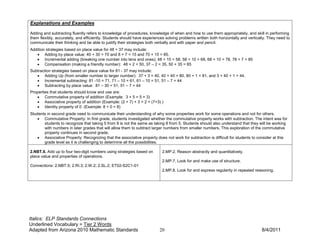
  • 7.
    2.NBT.5. Fluently addand subtract within 100 using strategies based 2.MP.2. Reason abstractly and quantitatively. on place value, properties of operations, and/or the relationship between addition and subtraction. 2.MP.7. Look for and make use of structure. Connections: 2.OA.2; 2.NBT.1; 2.NBT.3; 2.RI.3; 2.W.2; 2.SL.3 2.MP.8. Look for and express regularity in repeated reasoning. Explanations and Examples Adding and subtracting fluently refers to knowledge of procedures, knowledge of when and how to use them appropriately, and skill in performing them flexibly, accurately, and efficiently. Students should have experiences solving problems written both horizontally and vertically. They need to communicate their thinking and be able to justify their strategies both verbally and with paper and pencil. Addition strategies based on place value for 48 + 37 may include: • Adding by place value: 40 + 30 = 70 and 8 + 7 = 15 and 70 + 15 = 85. • Incremental adding (breaking one number into tens and ones); 48 + 10 = 58, 58 + 10 = 68, 68 + 10 = 78, 78 + 7 = 85 • Compensation (making a friendly number): 48 + 2 = 50, 37 – 2 = 35, 50 + 35 = 85 Subtraction strategies based on place value for 81 - 37 may include: • Adding Up (from smaller number to larger number): 37 + 3 = 40, 40 + 40 = 80, 80 + 1 = 81, and 3 + 40 + 1 = 44. • Incremental subtracting: 81 -10 = 71, 71 – 10 = 61, 61 – 10 = 51, 51 – 7 = 44 • Subtracting by place value: 81 – 30 = 51, 51 – 7 = 44 Properties that students should know and use are: • Commutative property of addition (Example: 3 + 5 = 5 + 3) • Associative property of addition (Example: (2 + 7) + 3 = 2 + (7+3) ) • Identity property of 0 (Example: 8 + 0 = 8) Students in second grade need to communicate their understanding of why some properties work for some operations and not for others. • Commutative Property: In first grade, students investigated whether the commutative property works with subtraction. The intent was for students to recognize that taking 5 from 8 is not the same as taking 8 from 5. Students should also understand that they will be working with numbers in later grades that will allow them to subtract larger numbers from smaller numbers. This exploration of the commutative property continues in second grade. • Associative Property: Recognizing that the associative property does not work for subtraction is difficult for students to consider at this grade level as it is challenging to determine all the possibilities. Italics: ELP Standards Connections Underlined Vocabulary = Tier 2 Words Adapted from Arizona 2010 Mathematic Standards 7 8/4/2011
  • 8.
    2.NBT.6. Add upto four two-digit numbers using strategies based on 2.MP.2. Reason abstractly and quantitatively. place value and properties of operations. 2.MP.7. Look for and make use of structure. Connections: 2.NBT.5; 2.RI.3; 2.W.2; 2.SL.2; ET02-S2C1-01 2.MP.8. Look for and express regularity in repeated reasoning. Explanations and Examples Students demonstrate addition strategies with up to four two-digit numbers either with or without regrouping. Problems may be written in a story problem format to help develop a stronger understanding of larger numbers and their values. Interactive whiteboards and document cameras may also be used to model and justify student thinking. 2.NBT.7. Add and subtract within 1000, using concrete models or 2.MP.2. Reason abstractly and quantitatively. drawings and strategies based on place value, properties of operations, and/or the relationship between addition and subtraction; 2.MP.4. Model with mathematics. relate the strategy to a written method. Understand that in adding or subtracting three-digit numbers, one adds or subtracts hundreds and 2.MP.5. Use appropriate tools strategically. hundreds, tens and tens, ones and ones; and sometimes it is necessary to compose or decompose tens or hundreds. 2.MP.7. Look for and make use of structure. Connections: 2.NBT.5; 2.NBT.6; 2.RI.3; 2.SL.3; 2.W.2; ET02-S1C2-01; 2.MP.8. Look for and express regularity in repeated reasoning. ET02-S2C1-01 Explanations and Examples There is a strong connection between this standard and place value understanding with addition and subtraction of smaller numbers. Students may use concrete models or drawings to support their addition or subtraction of larger numbers. Strategies are similar to those stated in 2.NBT.5, as students extend their learning to include greater place values moving from tens to hundreds to thousands. Interactive whiteboards and document cameras may also be used to model and justify student thinking. 2.NBT.8. Mentally add 10 or 100 to a given number 100–900, and 2.MP.2. Reason abstractly and quantitatively. mentally subtract 10 or 100 from a given number 100–900. 2.MP.7. Look for and make use of structure. Connections: 2.RI.3; 2.SL.1; 2.SL.2; 2.SL.3; ET02-S2C1-01 2.MP.8. Look for and express regularity in repeated reasoning. Italics: ELP Standards Connections Underlined Vocabulary = Tier 2 Words Adapted from Arizona 2010 Mathematic Standards 8 8/4/2011
  • 9.
    Explanations and Examples Studentsneed many opportunities to practice mental math by adding and subtracting multiples of 10 and 100 up to 900 using different starting points. They can practice this by counting and thinking aloud, finding missing numbers in a sequence, and finding missing numbers on a number line or hundreds chart. Explorations should include looking for relevant patterns. Mental math strategies may include: • counting on; 300, 400, 500, etc. • counting back; 550, 450, 350, etc. Examples: • 100 more than 653 is _____ (753) • 10 less than 87 is ______ (77) • “Start at 248. Count up by 10s until I tell you to stop.” An interactive whiteboard or document camera may be used to help students develop these mental math skills. 2.NBT.9. Explain why addition and subtraction strategies work, using 2.MP.2. Reason abstractly and quantitatively. place value and the properties of operations. (Explanations may be supported by drawings or objects.) 2.MP.3. Construct viable arguments and critique the reasoning of others. Connections: 2.NBT.1; 2.RI.3; 2.RI.4; 2.W.2; 2.SL.2; 2.SL.3; ET02- S2C1-01 2.MP.4. Model with mathematics. 2.MP.5. Use appropriate tools strategically. *ELP Connection Available 2.MP.7. Look for and make use of structure. 2.MP.8. Look for and express regularity in repeated reasoning. Italics: ELP Standards Connections Underlined Vocabulary = Tier 2 Words Adapted from Arizona 2010 Mathematic Standards 9 8/4/2011
  • 10.
    Explanations and Examples Studentsneed multiple opportunities explaining their addition and subtraction thinking. Operations embedded within a meaningful context promote development of reasoning and justification. Example: Mason read 473 pages in June. He read 227 pages in July. How many pages did Mason read altogether? • Karla’s explanation: 473 + 227 = _____. I added the ones together (3 + 7) and got 10. Then I added the tens together (70 + 20) and got 90. I knew that 400 + 200 was 600. So I added 10 + 90 for 100 and added 100 + 600 and found out that Mason had read 700 pages altogether. • Debbie’s explanation: 473 + 227 = ______. I started by adding 200 to 473 and got 673. Then I added 20 to 673 and I got 693 and finally I added 7 to 693 and I knew that Mason had read 700 pages altogether. • Becky’s explanation: I used base ten blocks on a base ten mat to help me solve this problem. I added 3 ones (units) plus 7 ones and got 10 ones which made one ten. I moved the 1 ten to the tens place. I then added 7 tens rods plus 2 tens rods plus 1 tens rod and got 10 tens or 100. I moved the 1 hundred to the hundreds place. Then I added 4 hundreds plus 2 hundreds plus 1 hundred and got 7 hundreds or 700. So Mason read 700 books. Students should be able to connect different representations and explain the connections. Representations can include numbers, words (including mathematical language), pictures, number lines, and/or physical objects. Students should be able to use any/all of these representations as needed. An interactive whiteboard or document camera can be used to help students develop and explain their thinking. Domain: Measurement and Data (MD) Italics: ELP Standards Connections Underlined Vocabulary = Tier 2 Words Adapted from Arizona 2010 Mathematic Standards 10 8/4/2011
  • 11.
    AZ Math Standards Mathematical Practices Cluster: Relate addition and subtraction to length. Students are expected to: 2.MD.6. Represent whole numbers as lengths from 0 on a number line 2.MP.2. Reason abstractly and quantitatively. diagram with equally spaced points corresponding to the numbers 0, 1, 2, …, and represent whole-number sums and differences within 100 on 2.MP.4. Model with mathematics. a number line diagram. 2.MP.5. Use appropriate tools strategically. Connections: 2.NBT.2; 2.OA.1; 2.MD.5; 2.RI.3; 2.SL.3; ET02-S1C2-02 Explanations and Examples Students represent their thinking when adding and subtracting within 100 by using a number line. An interactive whiteboard or document camera can be used to help students demonstrate their thinking. Example: 10 – 6 = 4 Cluster: Work with time and money. 2.MD.7. Tell and write time from analog and digital clocks to the 2.MP.5. Use appropriate tools strategically. nearest five minutes, using a.m. and p.m. 2.MP.6. Attend to precision. Connections: 2.NBT.2; 2.RI.3; 2.W.2; 2.SL.2; ET02-S1C2-01; ET02- S1C2-02 *ELP Connection Available Italics: ELP Standards Connections Underlined Vocabulary = Tier 2 Words Adapted from Arizona 2010 Mathematic Standards 11 8/4/2011
  • 12.
    Explanations and Examples Infirst grade, students learned to tell time to the nearest hour and half-hour. Students build on this understanding in second grade by skip- counting by 5 to recognize 5-minute intervals on the clock. They need exposure to both digital and analog clocks. It is important that they can recognize time in both formats and communicate their understanding of time using both numbers and language. Common time phrases include the following: quarter till ___, quarter after ___, ten till ___, ten after ___, and half past ___. Students should understand that there are 2 cycles of 12 hours in a day - a.m. and p.m. Recording their daily actions in a journal would be helpful for making real-world connections and understanding the difference between these two cycles. An interactive whiteboard or document camera may be used to help students demonstrate their thinking. 2.MD.8. Solve word problems involving dollar bills, quarters, dimes, 2.MP.1. Make sense of problems and persevere in solving them. nickels, and pennies, using $ and ¢ symbols appropriately. Example: If you have 2 dimes and 3 pennies, how many cents do you have? 2.MP.2. Reason abstractly and quantitatively. Connections: 2.NBT.1; 2.NBT.5; 2.RI.3; 2.RI.4; 2.W.2; 2.SL.2; ET02- 2.MP.4. Model with mathematics. S1C2-01; ET02-S1C2-02 2.MP.5. Use appropriate tools strategically. *ELP Connection Available 2.MP.8. Look for and express regularity in repeated reasoning. Explanations and Examples Since money is not specifically addressed in kindergarten, first grade, or third grade, students should have multiple opportunities to identify, count, recognize, and use coins and bills in and out of context. They should also experience making equivalent amounts using both coins and bills. “Dollar bills” should include denominations up to one hundred ($1.00, $5.00, $10.00, $20.00, $100.00). Students should solve story problems connecting the different representations. These representations may include objects, pictures, charts, tables, words, and/or numbers. Students should communicate their mathematical thinking and justify their answers. An interactive whiteboard or document camera may be used to help students demonstrate and justify their thinking. Example: Sandra went to the store and received $ 0.76 in change. What are three different sets of coins she could have received? Domain: Geometry (G) Italics: ELP Standards Connections Underlined Vocabulary = Tier 2 Words Adapted from Arizona 2010 Mathematic Standards 12 8/4/2011
  • 13.
    AZ Math Standards Mathematical Practices Cluster: Reason with shapes and their attributes. Students are expected to: 2.G.1. Recognize and draw shapes having specified attributes, such as 2.MP.4. Model with mathematics. a given number of angles or a given number of equal faces. Identify triangles, quadrilaterals, pentagons, hexagons, and cubes. (Sizes are 2.MP.7. Look for and make use of structure. compared directly or visually, not compared by measuring.) Connections: 2.RI.3; 2.RI.4; 2.W.2; 2.SL.2; 2.SL.3; SC02-S5C1-01; ET02-S2C1-01 Explanations and Examples Students identify, describe, and draw triangles, quadrilaterals, pentagons, and hexagons. Pentagons, triangles, and hexagons should appear as both regular (equal sides and equal angles) and irregular. Students recognize all four sided shapes as quadrilaterals. Students use the vocabulary word “angle” in place of “corner” but they do not need to name angle types. Interactive whiteboards and document cameras may be used to help identify shapes and their attributes. Shapes should be presented in a variety of orientations and configurations. 2.G.2. Partition a rectangle into rows and columns of same-size 2.MP.2. Reason abstractly and quantitatively. squares and count to find the total number of them. 2.MP.6. Attend to precision. Connections: 2.OA.4; 2.SL.2; 2.RI.3; ET02-S1C2-02 2.MP.8. Look for and express regularity in repeated reasoning. Italics: ELP Standards Connections Underlined Vocabulary = Tier 2 Words Adapted from Arizona 2010 Mathematic Standards 13 8/4/2011
  • 14.
    Explanations and Examples Thisstandard is a precursor to learning about the area of a rectangle and using arrays for multiplication. An interactive whiteboard or manipulatives such as square tiles, cubes, or other square shaped objects can be used to help students partition rectangles. Rows are horizontal and columns are vertical. Isaac School District, No. 5 Mathematics Curriculum Guide: 2nd Grade Unit 2 Shapes, Blocks, and Symmetry 2-D and 3-D Geometry Big Ideas: Essential Questions: Students will understand that: • There are connections between 2-dimensional and 3- • Why is it important to know the attributes of shapes? dimensional shapes. • What are the important features of a rectangle? • Rectangles are shapes with 4 sides and 4 right angles. • How is symmetry represented in our world? • Symmetry is everywhere. Unit Vocabulary: 2-dimensional shape, 3-dimensional shape, angle, area, array, attribute column, compare, congruent, face, geometry, length, line of symmetry, polygon, quadrilateral, rectangular prism, right angle, sides, sort, symmetrical, symmetry, vertex, width Domain: Operations and Algebraic Thinking (OA) Italics: ELP Standards Connections Underlined Vocabulary = Tier 2 Words Adapted from Arizona 2010 Mathematic Standards 14 8/4/2011
  • 15.
    AZ Math Standards Mathematical Practices Cluster: Represent and solve problems involving addition and subtraction. Students are expected to: 2.OA.1. Use addition and subtraction within 100 to solve one- and two- 2.MP.1. Make sense of problems and persevere in solving them. step word problems involving situations of adding to, taking from, putting together, taking apart, and comparing, with unknowns in all 2.MP.2. Reason abstractly and quantitatively. positions, e.g., by using drawings and equations with a symbol for the unknown number to represent the problem. (See Table 1.) 2.MP.3. Construct viable arguments and critique the reasoning of others. Connections: 2.NBT.5; 2.RI.3; 2.RI.4; 2.SL.2; ET02-S2C1-01 2.MP.4. Model with mathematics. *ELP Connection Available 2.MP.5. Use appropriate tools strategically. 2.MP.8. Look for and express regularity in repeated reasoning. Italics: ELP Standards Connections Underlined Vocabulary = Tier 2 Words Adapted from Arizona 2010 Mathematic Standards 15 8/4/2011
  • 16.
    Explanations and Examples Wordproblems that are connected to students’ lives can be used to develop fluency with addition and subtraction. Table 1 describes the four different addition and subtraction situations and their relationship to the position of the unknown. Examples: • Take-from example: David had 63 stickers. He gave 37 to Susan. How many stickers does David have now? 63 – 37 = • Add to example: David had $37. His grandpa gave him some money for his birthday. Now he has $63. How much money did David’s grandpa give him? $37 + = $63 • Compare example: David has 63 stickers. Susan has 37 stickers. How many more stickers does David have than Susan? 63 – 37 = o Even though the modeling of the two problems above is different, the equation, 63 - 37 = ?, can represent both situations (How many more do I need to make 63?) • Take-from (Start Unknown) David had some stickers. He gave 37 to Susan. Now he has 26 stickers. How many stickers did David have before? - 37 = 26 It is important to attend to the difficulty level of the problem situations in relation to the position of the unknown. • Result Unknown problems are the least complex for students followed by Total Unknown and Difference Unknown. • The next level of difficulty includes Change Unknown, Addend Unknown, followed by Bigger Unknown. • The most difficult are Start Unknown, Both Addends Unknown, and Smaller Unknown. Second grade students should work on ALL problem types regardless of the level of difficulty. Students can use interactive whiteboard or document camera to demonstrate and justify their thinking. This standard focuses on developing an algebraic representation of a word problem through addition and subtraction --the intent is not to introduce traditional algorithms or rules. Cluster: Add and subtract within 20. 2.OA.2. Fluently add and subtract within 20 using mental strategies. By 2.MP.2. Reason abstractly and quantitatively. end of Grade 2, know from memory all sums of two one-digit numbers. (See standard 1.OA.6 for a list of mental strategies.) 2.MP.7. Look for and make use of structure. Connections: 2.NBT.5; 2.NBT.9; ET02-S2C1-01 2.MP.8. Look for and express regularity in repeated reasoning. Italics: ELP Standards Connections Underlined Vocabulary = Tier 2 Words Adapted from Arizona 2010 Mathematic Standards 16 8/4/2011
  • 17.
    Explanations and Examples Thisstandard is strongly connected to all the standards in this domain. It focuses on students being able to fluently add and subtract numbers to 20. Adding and subtracting fluently refers to knowledge of procedures, knowledge of when and how to use them appropriately, and skill in performing them flexibly, accurately, and efficiently. Mental strategies help students make sense of number relationships as they are adding and subtracting within 20. The ability to calculate mentally with efficiency is very important for all students. Mental strategies may include the following: • Counting on • Making tens (9 + 7 = 10 + 6) • Decomposing a number leading to a ten ( 14 – 6 = 14 – 4 – 2 = 10 – 2 = 8) • Fact families (8 + 5 = 13 is the same as 13 - 8 = 5) • Doubles • Doubles plus one (7 + 8 = 7 + 7 + 1) However, the use of objects, diagrams, or interactive whiteboards, and various strategies will help students develop fluency. Cluster: Work with equal groups of objects to gain foundations for multiplication. 2.OA.4. Use addition to find the total number of objects arranged in 2.MP.2. Reason abstractly and quantitatively. rectangular arrays with up to 5 rows and up to 5 columns; write an equation to express the total as a sum of equal addends. 2.MP.3, Construct viable arguments and critique the reasoning of others. Connections: 2.OA.3, 2.RI.3; ET02-S1C2-01; ET02-S1C2-02; ET02-S2C1-01 2.MP.7. Look for and make use of structure. *ELP Connection Available 2.MP.8. Look for and express regularity in repeated reasoning. Explanations and Examples Students may arrange any set of objects into a rectangular array. Objects can be cubes, buttons, counters, etc. Objects do not have to be square to make an array. Geoboards can also be used to demonstrate rectangular arrays. Students then write equations that represent the total as the sum of equal addends as shown below. 4 + 4 + 4 = 12 5 + 5 + 5 + 5 = 20 Interactive whiteboards and document cameras may be used to help students visualize and create arrays. Italics: ELP Standards Connections Underlined Vocabulary = Tier 2 Words Adapted from Arizona 2010 Mathematic Standards 17 8/4/2011
  • 18.
    Domain: Number andOperations in Base Ten (NBT) AZ Math Standards Mathematical Practices Cluster: Understand place value. 2.NBT.2. Count within 1000; skip-count by 5s, 10s, and 100s. 2.MP.2. Reason abstractly and quantitatively. Connections: 2.NBT.8; ET02-S1C3-01 2.MP.7. Look for and make use of structure. *ELP Connection Available 2.MP.8. Look for and express regularity in repeated reasoning. Explanations and Examples Students need many opportunities counting, up to 1000, from different starting points. They should also have many experiences skip counting by 5s, 10s, and 100s to develop the concept of place value. Examples: • The use of the 100s chart may be helpful for students to identify the counting patterns. • The use of money (nickels, dimes, dollars) or base ten blocks may be helpful visual cues. • The use of an interactive whiteboard may also be used to develop counting skills. The ultimate goal for second graders is to be able to count in multiple ways with no visual support. 2.NBT.3. Read and write numbers to 1000 using base-ten numerals, 2.MP.2. Reason abstractly and quantitatively. number names, and expanded form. 2.MP.7. Look for and make use of structure. Connections: 2.SL.2; 2.RI.3 2.MP.8. Look for and express regularity in repeated reasoning. Italics: ELP Standards Connections Underlined Vocabulary = Tier 2 Words Adapted from Arizona 2010 Mathematic Standards 18 8/4/2011
  • 19.
    Explanations and Examples Studentsneed many opportunities reading and writing numerals in multiple ways. Examples: • Base-ten numerals 637 (standard form) • Number names six hundred thirty seven (written form) • Expanded form 600 + 30 + 7 (expanded notation) When students say the expanded form, it may sound like this: “6 hundreds plus 3 tens plus 7 ones” OR 600 plus 30 plus 7.” Cluster: Use place value understanding and properties of operations to add and subtract. 2.NBT.5. Fluently add and subtract within 100 using strategies based 2.MP.2. Reason abstractly and quantitatively. on place value, properties of operations, and/or the relationship between addition and subtraction. 2.MP.7. Look for and make use of structure. Connections: 2.OA.2; 2.NBT.1; 2.NBT.3; 2.RI.3; 2.W.2; 2.SL.3 2.MP.8. Look for and express regularity in repeated reasoning. Italics: ELP Standards Connections Underlined Vocabulary = Tier 2 Words Adapted from Arizona 2010 Mathematic Standards 19 8/4/2011
  • 20.
    Explanations and Examples Addingand subtracting fluently refers to knowledge of procedures, knowledge of when and how to use them appropriately, and skill in performing them flexibly, accurately, and efficiently. Students should have experiences solving problems written both horizontally and vertically. They need to communicate their thinking and be able to justify their strategies both verbally and with paper and pencil. Addition strategies based on place value for 48 + 37 may include: • Adding by place value: 40 + 30 = 70 and 8 + 7 = 15 and 70 + 15 = 85. • Incremental adding (breaking one number into tens and ones); 48 + 10 = 58, 58 + 10 = 68, 68 + 10 = 78, 78 + 7 = 85 • Compensation (making a friendly number): 48 + 2 = 50, 37 – 2 = 35, 50 + 35 = 85 Subtraction strategies based on place value for 81 - 37 may include: • Adding Up (from smaller number to larger number): 37 + 3 = 40, 40 + 40 = 80, 80 + 1 = 81, and 3 + 40 + 1 = 44. • Incremental subtracting: 81 -10 = 71, 71 – 10 = 61, 61 – 10 = 51, 51 – 7 = 44 • Subtracting by place value: 81 – 30 = 51, 51 – 7 = 44 Properties that students should know and use are: • Commutative property of addition (Example: 3 + 5 = 5 + 3) • Associative property of addition (Example: (2 + 7) + 3 = 2 + (7+3) ) • Identity property of 0 (Example: 8 + 0 = 8) Students in second grade need to communicate their understanding of why some properties work for some operations and not for others. • Commutative Property: In first grade, students investigated whether the commutative property works with subtraction. The intent was for students to recognize that taking 5 from 8 is not the same as taking 8 from 5. Students should also understand that they will be working with numbers in later grades that will allow them to subtract larger numbers from smaller numbers. This exploration of the commutative property continues in second grade. • Associative Property: Recognizing that the associative property does not work for subtraction is difficult for students to consider at this grade level as it is challenging to determine all the possibilities. 2.NBT.6. Add up to four two-digit numbers using strategies based on 2.MP.2. Reason abstractly and quantitatively. place value and properties of operations. 2.MP.7. Look for and make use of structure. Connections: 2.NBT.5; 2.RI.3; 2.W.2; 2.SL.2; ET02-S2C1-01 2.MP.8. Look for and express regularity in repeated reasoning. Italics: ELP Standards Connections Underlined Vocabulary = Tier 2 Words Adapted from Arizona 2010 Mathematic Standards 20 8/4/2011
  • 21.
    Explanations and Examples Students demonstrate addition strategies with up to four two-digit numbers either with or without regrouping. Problems may be written in a story problem format to help develop a stronger understanding of larger numbers and their values. Interactive whiteboards and document cameras may also be used to model and justify student thinking. 2.NBT.7. Add and subtract within 1000, using concrete models or 2.MP.2. Reason abstractly and quantitatively. drawings and strategies based on place value, properties of operations, and/or the relationship between addition and subtraction; 2.MP.4. Model with mathematics. relate the strategy to a written method. Understand that in adding or subtracting three-digit numbers, one adds or subtracts hundreds and 2.MP.5. Use appropriate tools strategically. hundreds, tens and tens, ones and ones; and sometimes it is necessary to compose or decompose tens or hundreds. 2.MP.7. Look for and make use of structure. Connections: 2.NBT.5; 2.NBT.6; 2.RI.3; 2.SL.3; 2.W.2; ET02-S1C2-01; 2.MP.8. Look for and express regularity in repeated reasoning. ET02-S2C1-01 *ELP Connection Available Explanations and Examples There is a strong connection between this standard and place value understanding with addition and subtraction of smaller numbers. Students may use concrete models or drawings to support their addition or subtraction of larger numbers. Strategies are similar to those stated in 2.NBT.5, as students extend their learning to include greater place values moving from tens to hundreds to thousands. Interactive whiteboards and document cameras may also be used to model and justify student thinking. 2.NBT.8. Mentally add 10 or 100 to a given number 100–900, and 2.MP.2. Reason abstractly and quantitatively. mentally subtract 10 or 100 from a given number 100–900. 2.MP.7. Look for and make use of structure. Connections: 2.RI.3; 2.SL.1; 2.SL.2; 2.SL.3; ET02-S2C1-01 2.MP.8. Look for and express regularity in repeated reasoning. *ELP Connection Available Italics: ELP Standards Connections Underlined Vocabulary = Tier 2 Words Adapted from Arizona 2010 Mathematic Standards 21 8/4/2011
  • 22.
    Explanations and Examples Studentsneed many opportunities to practice mental math by adding and subtracting multiples of 10 and 100 up to 900 using different starting points. They can practice this by counting and thinking aloud, finding missing numbers in a sequence, and finding missing numbers on a number line or hundreds chart. Explorations should include looking for relevant patterns. Mental math strategies may include: • counting on; 300, 400, 500, etc. • counting back; 550, 450, 350, etc. Examples: • 100 more than 653 is _____ (753) • 10 less than 87 is ______ (77) • “Start at 248. Count up by 10s until I tell you to stop.” An interactive whiteboard or document camera may be used to help students develop these mental math skills. 2.NBT.9. Explain why addition and subtraction strategies work, using 2.MP.2. Reason abstractly and quantitatively. place value and the properties of operations. (Explanations may be supported by drawings or objects.) 2.MP.3. Construct viable arguments and critique the reasoning of others. Connections: 2.NBT.1; 2.RI.3; 2.RI.4; 2.W.2; 2.SL.2; 2.SL.3; ET02-S2C1-01 2.MP.4. Model with mathematics. 2.MP.5. Use appropriate tools strategically. *ELP Connection Available 2.MP.7. Look for and make use of structure. 2.MP.8. Look for and express regularity in repeated reasoning. Italics: ELP Standards Connections Underlined Vocabulary = Tier 2 Words Adapted from Arizona 2010 Mathematic Standards 22 8/4/2011
  • 23.
    Explanations and Examples Studentsneed multiple opportunities explaining their addition and subtraction thinking. Operations embedded within a meaningful context promote development of reasoning and justification. Example: Mason read 473 pages in June. He read 227 pages in July. How many pages did Mason read altogether? • Karla’s explanation: 473 + 227 = _____. I added the ones together (3 + 7) and got 10. Then I added the tens together (70 + 20) and got 90. I knew that 400 + 200 was 600. So I added 10 + 90 for 100 and added 100 + 600 and found out that Mason had read 700 pages altogether. • Debbie’s explanation: 473 + 227 = ______. I started by adding 200 to 473 and got 673. Then I added 20 to 673 and I got 693 and finally I added 7 to 693 and I knew that Mason had read 700 pages altogether. • Becky’s explanation: I used base ten blocks on a base ten mat to help me solve this problem. I added 3 ones (units) plus 7 ones and got 10 ones which made one ten. I moved the 1 ten to the tens place. I then added 7 tens rods plus 2 tens rods plus 1 tens rod and got 10 tens or 100. I moved the 1 hundred to the hundreds place. Then I added 4 hundreds plus 2 hundreds plus 1 hundred and got 7 hundreds or 700. So Mason read 700 books. Students should be able to connect different representations and explain the connections. Representations can include numbers, words (including mathematical language), pictures, number lines, and/or physical objects. Students should be able to use any/all of these representations as needed. An interactive whiteboard or document camera can be used to help students develop and explain their thinking. Domain: Measurement and Data (MD) AZ Math Standards Mathematical Practices Cluster: Relate addition and subtraction to length. Students are expected to: 2.MD.6. Represent whole numbers as lengths from 0 on a number line 2.MP.2. Reason abstractly and quantitatively. diagram with equally spaced points corresponding to the numbers 0, 1, 2, …and represent whole-number sums and differences within 100 on 2.MP.4. Model with mathematics. a number line diagram. 2.MP.5. Use appropriate tools strategically. Connections: 2.NBT.2; 2.OA.1; 2.MD.5; 2.RI.3; 2.SL.3; ET02-S1C2-02 Italics: ELP Standards Connections Underlined Vocabulary = Tier 2 Words Adapted from Arizona 2010 Mathematic Standards 23 8/4/2011
  • 24.
    Explanations and Examples Studentsrepresent their thinking when adding and subtracting within 100 by using a number line. An interactive whiteboard or document camera can be used to help students demonstrate their thinking. Example: 10 – 6 = 4 Cluster: Work with time and money. 2.MD.7. Tell and write time from analog and digital clocks to the 2.MP.5. Use appropriate tools strategically. nearest five minutes, using a.m. and p.m. 2.MP.6. Attend to precision. Connections: 2.NBT.2; 2.RI.3; 2.W.2; 2.SL.2; ET02-S1C2-01; ET02- S1C2-02 *ELP Connection Available Explanations and Examples In first grade, students learned to tell time to the nearest hour and half-hour. Students build on this understanding in second grade by skip- counting by 5 to recognize 5-minute intervals on the clock. They need exposure to both digital and analog clocks. It is important that they can recognize time in both formats and communicate their understanding of time using both numbers and language. Common time phrases include the following: quarter till ___, quarter after ___, ten till ___, ten after ___, and half past ___. Students should understand that there are 2 cycles of 12 hours in a day - a.m. and p.m. Recording their daily actions in a journal would be helpful for making real-world connections and understanding the difference between these two cycles. An interactive whiteboard or document camera may be used to help students demonstrate their thinking. Italics: ELP Standards Connections Underlined Vocabulary = Tier 2 Words Adapted from Arizona 2010 Mathematic Standards 24 8/4/2011
  • 25.
    Domain: Geometry (G) AZ Math Standards Mathematical Practices Cluster: Reason with shapes and their attributes. Students are expected to: 2.G.1. Recognize and draw shapes having specified attributes, such as 2.MP.4. Model with mathematics. a given number of angles or a given number of equal faces. Identify triangles, quadrilaterals, pentagons, hexagons, and cubes. (Sizes are 2.MP.7. Look for and make use of structure. compared directly or visually, not compared by measuring.) Connections: 2.RI.3; 2.RI.4; 2.W.2; 2.SL.2; 2.SL.3; SC02-S5C1-01; ET02-S2C1-01 Explanations and Examples Students identify, describe, and draw triangles, quadrilaterals, pentagons, and hexagons. Pentagons, triangles, and hexagons should appear as both regular (equal sides and equal angles) and irregular. Students recognize all four sided shapes as quadrilaterals. Students use the vocabulary word “angle” in place of “corner” but they do not need to name angle types. Interactive whiteboards and document cameras may be used to help identify shapes and their attributes. Shapes should be presented in a variety of orientations and configurations. Italics: ELP Standards Connections Underlined Vocabulary = Tier 2 Words Adapted from Arizona 2010 Mathematic Standards 25 8/4/2011
  • 26.
    2.G.2. Partition arectangle into rows and columns of same-size 2.MP.2. Reason abstractly and quantitatively. squares and count to find the total number of them. 2.MP.6. Attend to precision. Connections: 2.OA.4; 2.SL.2; 2.RI.3; ET02-S1C2-02 2.MP.8. Look for and express regularity in repeated reasoning. Explanations and Examples This standard is a precursor to learning about the area of a rectangle and using arrays for multiplication. An interactive whiteboard or manipulatives such as square tiles, cubes, or other square shaped objects can be used to help students partition rectangles. Rows are horizontal and columns are vertical. Italics: ELP Standards Connections Underlined Vocabulary = Tier 2 Words Adapted from Arizona 2010 Mathematic Standards 26 8/4/2011
  • 27.
    Isaac School District,No. 5 Mathematics Curriculum Guide: 2nd Grade Unit 3 Stickers, Number Strings, and Story Problems Addition, Subtraction, and the Number System 2 Big Ideas: Essential Questions: Students will understand that: • The order of addends in an equation does not affect the sum. • What other ways can you use addends of an equation to find • Addition and subtraction are inverse operations; one is the the sum? opposite of the other. • How are addition and subtraction related? • Patterns and skip counting can be used to count money. • What strategies do you use to help you count money? • Even numbers are groups of two (partners) and two equal • How can you prove a number is even or odd? groups (teams). • Why do we need to know the value of each digit? • The position of a digit in a number determines its value. Unit Vocabulary: 2-digit number, addend, addition, calculator, collect, combination, count all, count back, counting by 10s, counting by 5s, counting on, difference, dime, doubles, doubles combinations, doubles plus or minus 1, equal, equal groups, equation, even, grouping by 2s (5s, 10s), minus, near doubles, nickel, number sentence, odd, ones, ones place, order, penny, plus, plus 10 combinations, quarter, strategy, subtraction, tally marks, tens, tens place, total Domain: Operations and Algebraic Thinking (OA) Italics: ELP Standards Connections Underlined Vocabulary = Tier 2 Words Adapted from Arizona 2010 Mathematic Standards 27 8/4/2011
  • 28.
    AZ Math Standards Mathematical Practices Cluster: Represent and solve problems involving addition and subtraction. Students are expected to: 2.OA.1. Use addition and subtraction within 100 to solve one- and two- 2.MP.1. Make sense of problems and persevere in solving them. step word problems involving situations of adding to, taking from, putting together, taking apart, and comparing, with unknowns in all 2.MP.2. Reason abstractly and quantitatively. positions, e.g., by using drawings and equations with a symbol for the unknown number to represent the problem. (See Table 1.) 2.MP.3. Construct viable arguments and critique the reasoning of others. Connections: 2.NBT.5; 2.RI.3; 2.RI.4; 2.SL.2; ET02-S2C1-01 2.MP.4. Model with mathematics. *ELP Connection Available 2.MP.5. Use appropriate tools strategically. 2.MP.8. Look for and express regularity in repeated reasoning. Italics: ELP Standards Connections Underlined Vocabulary = Tier 2 Words Adapted from Arizona 2010 Mathematic Standards 28 8/4/2011
  • 29.
    Explanations and Examples Wordproblems that are connected to students’ lives can be used to develop fluency with addition and subtraction. Table 1 describes the four different addition and subtraction situations and their relationship to the position of the unknown. Examples: • Take-from example: David had 63 stickers. He gave 37 to Susan. How many stickers does David have now? 63 – 37 = • Add to example: David had $37. His grandpa gave him some money for his birthday. Now he has $63. How much money did David’s grandpa give him? $37 + = $63 • Compare example: David has 63 stickers. Susan has 37 stickers. How many more stickers does David have than Susan? 63 – 37 = o Even though the modeling of the two problems above is different, the equation, 63 - 37 = ?, can represent both situations (How many more do I need to make 63?) • Take-from (Start Unknown) David had some stickers. He gave 37 to Susan. Now he has 26 stickers. How many stickers did David have before? - 37 = 26 It is important to attend to the difficulty level of the problem situations in relation to the position of the unknown. • Result Unknown problems are the least complex for students followed by Total Unknown and Difference Unknown. • The next level of difficulty includes Change Unknown, Addend Unknown, followed by Bigger Unknown. • The most difficult are Start Unknown, Both Addends Unknown, and Smaller Unknown. Second grade students should work on ALL problem types regardless of the level of difficulty. Students can use interactive whiteboard or document camera to demonstrate and justify their thinking. This standard focuses on developing an algebraic representation of a word problem through addition and subtraction --the intent is not to introduce traditional algorithms or rules. Cluster: Add and subtract within 20. 2.OA.2. Fluently add and subtract within 20 using mental strategies. By 2.MP.2. Reason abstractly and quantitatively. end of Grade 2, know from memory all sums of two one-digit numbers. (See standard 1.OA.6 for a list of mental strategies.) 2.MP.7. Look for and make use of structure. Connections: 2.NBT.5; 2.NBT.9; ET02-S2C1-01 2.MP.8. Look for and express regularity in repeated reasoning. Italics: ELP Standards Connections Underlined Vocabulary = Tier 2 Words Adapted from Arizona 2010 Mathematic Standards 29 8/4/2011
  • 30.
    Explanations and Examples Thisstandard is strongly connected to all the standards in this domain. It focuses on students being able to fluently add and subtract numbers to 20. Adding and subtracting fluently refers to knowledge of procedures, knowledge of when and how to use them appropriately, and skill in performing them flexibly, accurately, and efficiently. Mental strategies help students make sense of number relationships as they are adding and subtracting within 20. The ability to calculate mentally with efficiency is very important for all students. Mental strategies may include the following: • Counting on • Making tens (9 + 7 = 10 + 6) • Decomposing a number leading to a ten ( 14 – 6 = 14 – 4 – 2 = 10 – 2 = 8) • Fact families (8 + 5 = 13 is the same as 13 - 8 = 5) • Doubles • Doubles plus one (7 + 8 = 7 + 7 + 1) However, the use of objects, diagrams, or interactive whiteboards, and various strategies will help students develop fluency. Cluster: Work with equal groups of objects to gain foundations for multiplication. 2.OA.3. Determine whether a group of objects (up to 20) has an odd or 2.MP.2. Reason abstractly and quantitatively. even number of members, e.g., by pairing objects or counting them by 2s; write an equation to express an even number as a sum of two 2.MP.3, Construct viable arguments and critique the reasoning of equal addends. others. Connections: 2.OA.4; 2.RI.3; 2.RI.4; ET02-S1C1-01; ET02-S2C1-01 2.MP.7. Look for and make use of structure. 2.MP.8. Look for and express regularity in repeated reasoning. Italics: ELP Standards Connections Underlined Vocabulary = Tier 2 Words Adapted from Arizona 2010 Mathematic Standards 30 8/4/2011
  • 31.
    Explanations and Examples Studentsexplore odd and even numbers in a variety of ways including the following: students may investigate if a number is odd or even by determining if the number of objects can be divided into two equal sets, arranged into pairs or counted by twos. After the above experiences, students may derive that they only need to look at the digit in the ones place to determine if a number is odd or even since any number of tens will always split into two even groups. Example: Students need opportunities writing equations representing sums of two equal addends, such as: 2 + 2 = 4, 3 + 3 = 6, 5 + 5 = 10, 6 + 6 = 12, or 8 + 8 =16. This understanding will lay the foundation for multiplication and is closely connected to 2.OA.4. The use of objects and/or interactive whiteboards will help students develop and demonstrate various strategies to determine even and odd numbers. Domain: Number and Operations in Base Ten (NBT) AZ Math Standards Mathematical Practices Cluster: Understand place value. Students are expected to: 2.NBT.1. Understand that the three digits of a three-digit number 2.MP.2. Reason abstractly and quantitatively. represent amounts of hundreds, tens, and ones; e.g., 706 equals 7 hundreds, 0 tens, and 6 ones. Understand the following as special 2.MP.7. Look for and make use of structure. cases: a. 100 can be thought of as a bundle of ten tens—called a 2.MP.8. Look for and express regularity in repeated reasoning. “hundred.” b. The numbers 100, 200, 300, 400, 500, 600, 700, 800, 900 refer to one, two, three, four, five, six, seven, eight, or nine hundreds (and 0 tens and 0 ones). Connections: 2.NBT.5; 2.RI.3; 2.RI.4; 2.SL.3; ET02-S1C2-01; ET02- S1C2-01; ET02-S2C1-01 Italics: ELP Standards Connections Underlined Vocabulary = Tier 2 Words Adapted from Arizona 2010 Mathematic Standards 31 8/4/2011
  • 32.
    Explanations and Examples Understandingthat 10 ones make one ten and that 10 tens make one hundred is fundamental to students’ mathematical development. Students need multiple opportunities counting and “bundling” groups of tens in first grade. In second grade, students build on their understanding by making bundles of 100s with or without leftovers using base ten blocks, cubes in towers of 10, ten frames, etc. This emphasis on bundling hundreds will support students’ discovery of place value patterns. As students are representing the various amounts, it is important that emphasis is placed on the language associated with the quantity. For example, 243 can be expressed in multiple ways such as 2 groups of hundred, 4 groups of ten and 3 ones, as well as 24 tens with 3 ones. When students read numbers, they should read in standard form as well as using place value concepts. For example, 243 should be read as “two hundred forty-three” as well as two hundreds, 4 tens, 3 ones. A document camera or interactive whiteboard can also be used to demonstrate “bundling” of objects. This gives students the opportunity to communicate their counting and thinking. 2.NBT.2. Count within 1000; skip-count by 5s, 10s, and 100s. 2.MP.2. Reason abstractly and quantitatively. Connections: 2.NBT.8; ET02-S1C3-01 2.MP.7. Look for and make use of structure. 2.MP.8. Look for and express regularity in repeated reasoning. Explanations and Examples Students need many opportunities counting, up to 1000, from different starting points. They should also have many experiences skip counting by 5s, 10s, and 100s to develop the concept of place value. Examples: • The use of the 100s chart may be helpful for students to identify the counting patterns. • The use of money (nickels, dimes, dollars) or base ten blocks may be helpful visual cues. • The use of an interactive whiteboard may also be used to develop counting skills. The ultimate goal for second graders is to be able to count in multiple ways with no visual support. 2.NBT.3. Read and write numbers to 1000 using base-ten numerals, 2.MP.2. Reason abstractly and quantitatively. number names, and expanded form. 2.MP.7. Look for and make use of structure. Connections: 2.SL.2; 2.RI.3 2.MP.8. Look for and express regularity in repeated reasoning. Italics: ELP Standards Connections Underlined Vocabulary = Tier 2 Words Adapted from Arizona 2010 Mathematic Standards 32 8/4/2011
  • 33.
    Explanations and Examples Studentsneed many opportunities reading and writing numerals in multiple ways. Examples: • Base-ten numerals 637 (standard form) • Number names six hundred thirty seven (written form) • Expanded form 600 + 30 + 7 (expanded notation) When students say the expanded form, it may sound like this: “6 hundreds plus 3 tens plus 7 ones” OR 600 plus 30 plus 7.” Cluster: Use place value understanding and properties of operations to add and subtract. 2.NBT.5. Fluently add and subtract within 100 using strategies based 2.MP.2. Reason abstractly and quantitatively. on place value, properties of operations, and/or the relationship between addition and subtraction. 2.MP.7. Look for and make use of structure. Connections: 2.OA.2; 2.NBT.1; 2.NBT.3; 2.RI.3; 2.W.2; 2.SL.3 2.MP.8. Look for and express regularity in repeated reasoning. Italics: ELP Standards Connections Underlined Vocabulary = Tier 2 Words Adapted from Arizona 2010 Mathematic Standards 33 8/4/2011
  • 34.
    Explanations and Examples Addingand subtracting fluently refers to knowledge of procedures, knowledge of when and how to use them appropriately, and skill in performing them flexibly, accurately, and efficiently. Students should have experiences solving problems written both horizontally and vertically. They need to communicate their thinking and be able to justify their strategies both verbally and with paper and pencil. Addition strategies based on place value for 48 + 37 may include: • Adding by place value: 40 + 30 = 70 and 8 + 7 = 15 and 70 + 15 = 85. • Incremental adding (breaking one number into tens and ones); 48 + 10 = 58, 58 + 10 = 68, 68 + 10 = 78, 78 + 7 = 85 • Compensation (making a friendly number): 48 + 2 = 50, 37 – 2 = 35, 50 + 35 = 85 Subtraction strategies based on place value for 81 - 37 may include: • Adding Up (from smaller number to larger number): 37 + 3 = 40, 40 + 40 = 80, 80 + 1 = 81, and 3 + 40 + 1 = 44. • Incremental subtracting: 81 -10 = 71, 71 – 10 = 61, 61 – 10 = 51, 51 – 7 = 44 • Subtracting by place value: 81 – 30 = 51, 51 – 7 = 44 Properties that students should know and use are: • Commutative property of addition (Example: 3 + 5 = 5 + 3) • Associative property of addition (Example: (2 + 7) + 3 = 2 + (7+3) ) • Identity property of 0 (Example: 8 + 0 = 8) Students in second grade need to communicate their understanding of why some properties work for some operations and not for others. • Commutative Property: In first grade, students investigated whether the commutative property works with subtraction. The intent was for students to recognize that taking 5 from 8 is not the same as taking 8 from 5. Students should also understand that they will be working with numbers in later grades that will allow them to subtract larger numbers from smaller numbers. This exploration of the commutative property continues in second grade. • Associative Property: Recognizing that the associative property does not work for subtraction is difficult for students to consider at this grade level as it is challenging to determine all the possibilities. 2.NBT.6. Add up to four two-digit numbers using strategies based on 2.MP.2. Reason abstractly and quantitatively. place value and properties of operations. 2.MP.7. Look for and make use of structure. Connections: 2.NBT.5; 2.RI.3; 2.W.2; 2.SL.2; ET02-S2C1-01 2.MP.8. Look for and express regularity in repeated reasoning. Explanations and Examples Students demonstrate addition strategies with up to four two-digit numbers either with or without regrouping. Problems may be written in a story problem format to help develop a stronger understanding of larger numbers and their values. Interactive whiteboards and document cameras may also be used to model and justify student thinking. Italics: ELP Standards Connections Underlined Vocabulary = Tier 2 Words Adapted from Arizona 2010 Mathematic Standards 34 8/4/2011
  • 35.
    2.NBT.7. Add andsubtract within 1000, using concrete models or 2.MP.2. Reason abstractly and quantitatively. drawings and strategies based on place value, properties of operations, and/or the relationship between addition and subtraction; 2.MP.4. Model with mathematics. relate the strategy to a written method. Understand that in adding or subtracting three-digit numbers, one adds or subtracts hundreds and 2.MP.5. Use appropriate tools strategically. hundreds, tens and tens, ones and ones; and sometimes it is necessary to compose or decompose tens or hundreds. 2.MP.7. Look for and make use of structure. Connections: 2.NBT.5; 2.NBT.6; 2.RI.3; 2.SL.3; 2.W.2; ET02-S1C2-01; 2.MP.8. Look for and express regularity in repeated reasoning. ET02-S2C1-01 Explanations and Examples There is a strong connection between this standard and place value understanding with addition and subtraction of smaller numbers. Students may use concrete models or drawings to support their addition or subtraction of larger numbers. Strategies are similar to those stated in 2.NBT.5, as students extend their learning to include greater place values moving from tens to hundreds to thousands. Interactive whiteboards and document cameras may also be used to model and justify student thinking. 2.NBT.8. Mentally add 10 or 100 to a given number 100–900, and 2.MP.2. Reason abstractly and quantitatively. mentally subtract 10 or 100 from a given number 100–900. 2.MP.7. Look for and make use of structure. Connections: 2.RI.3; 2.SL.1; 2.SL.2; 2.SL.3; ET02-S2C1-01 2.MP.8. Look for and express regularity in repeated reasoning. Italics: ELP Standards Connections Underlined Vocabulary = Tier 2 Words Adapted from Arizona 2010 Mathematic Standards 35 8/4/2011
  • 36.
    Explanations and Examples Studentsneed many opportunities to practice mental math by adding and subtracting multiples of 10 and 100 up to 900 using different starting points. They can practice this by counting and thinking aloud, finding missing numbers in a sequence, and finding missing numbers on a number line or hundreds chart. Explorations should include looking for relevant patterns. Mental math strategies may include: • counting on; 300, 400, 500, etc. • counting back; 550, 450, 350, etc. Examples: • 100 more than 653 is _____ (753) • 10 less than 87 is ______ (77) • “Start at 248. Count up by 10s until I tell you to stop.” An interactive whiteboard or document camera may be used to help students develop these mental math skills. 2.NBT.9. Explain why addition and subtraction strategies work, using 2.MP.2. Reason abstractly and quantitatively. place value and the properties of operations. (Explanations may be supported by drawings or objects.) 2.MP.3. Construct viable arguments and critique the reasoning of others. Connections: 2.NBT.1; 2.RI.3; 2.RI.4; 2.W.2; 2.SL.2; 2.SL.3; ET02- S2C1-01 2.MP.4. Model with mathematics. 2.MP.5. Use appropriate tools strategically. *ELP Connection Available 2.MP.7. Look for and make use of structure. 2.MP.8. Look for and express regularity in repeated reasoning. Italics: ELP Standards Connections Underlined Vocabulary = Tier 2 Words Adapted from Arizona 2010 Mathematic Standards 36 8/4/2011
  • 37.
    Explanations and Examples Studentsneed multiple opportunities explaining their addition and subtraction thinking. Operations embedded within a meaningful context promote development of reasoning and justification. Example: Mason read 473 pages in June. He read 227 pages in July. How many pages did Mason read altogether? • Karla’s explanation: 473 + 227 = _____. I added the ones together (3 + 7) and got 10. Then I added the tens together (70 + 20) and got 90. I knew that 400 + 200 was 600. So I added 10 + 90 for 100 and added 100 + 600 and found out that Mason had read 700 pages altogether. • Debbie’s explanation: 473 + 227 = ______. I started by adding 200 to 473 and got 673. Then I added 20 to 673 and I got 693 and finally I added 7 to 693 and I knew that Mason had read 700 pages altogether. • Becky’s explanation: I used base ten blocks on a base ten mat to help me solve this problem. I added 3 ones (units) plus 7 ones and got 10 ones which made one ten. I moved the 1 ten to the tens place. I then added 7 tens rods plus 2 tens rods plus 1 tens rod and got 10 tens or 100. I moved the 1 hundred to the hundreds place. Then I added 4 hundreds plus 2 hundreds plus 1 hundred and got 7 hundreds or 700. So Mason read 700 books. Students should be able to connect different representations and explain the connections. Representations can include numbers, words (including mathematical language), pictures, number lines, and/or physical objects. Students should be able to use any/all of these representations as needed. An interactive whiteboard or document camera can be used to help students develop and explain their thinking. Domain: Measurement and Data (MD) AZ Math Standards Mathematical Practices Cluster: Relate addition and subtraction to length. Students are expected to: 2.MD.6. Represent whole numbers as lengths from 0 on a number line 2.MP.2. Reason abstractly and quantitatively. diagram with equally spaced points corresponding to the numbers 0, 1, 2, …and represent whole-number sums and differences within 100 on 2.MP.4. Model with mathematics. a number line diagram. 2.MP.5. Use appropriate tools strategically. Connections: 2.NBT.2; 2.OA.1; 2.MD.5; 2.RI.3; 2.SL.3; ET02-S1C2-02 Italics: ELP Standards Connections Underlined Vocabulary = Tier 2 Words Adapted from Arizona 2010 Mathematic Standards 37 8/4/2011
  • 38.
    Explanations and Examples Studentsrepresent their thinking when adding and subtracting within 100 by using a number line. An interactive whiteboard or document camera can be used to help students demonstrate their thinking. Example: 10 – 6 = 4 Cluster: Work with time and money. 2.MD.7. Tell and write time from analog and digital clocks to the nearest five minutes, using a.m. and p.m. 2.MP.5. Use appropriate tools strategically. Connections: 2.NBT.2; 2.RI.3; 2.W.2; 2.SL.2; ET02-S1C2-01; ET02- S1C2-02 2.MP.6. Attend to precision. *ELP Connection Available Explanations and Examples In first grade, students learned to tell time to the nearest hour and half-hour. Students build on this understanding in second grade by skip- counting by 5 to recognize 5-minute intervals on the clock. They need exposure to both digital and analog clocks. It is important that they can recognize time in both formats and communicate their understanding of time using both numbers and language. Common time phrases include the following: quarter till ___, quarter after ___, ten till ___, ten after ___, and half past ___. Students should understand that there are 2 cycles of 12 hours in a day - a.m. and p.m. Recording their daily actions in a journal would be helpful for making real-world connections and understanding the difference between these two cycles. An interactive whiteboard or document camera may be used to help students demonstrate their thinking. Italics: ELP Standards Connections Underlined Vocabulary = Tier 2 Words Adapted from Arizona 2010 Mathematic Standards 38 8/4/2011
  • 39.
    2.MD.8. Solve wordproblems involving dollar bills, quarters, dimes, 2.MP.1. Make sense of problems and persevere in solving them. nickels, and pennies, using $ and ¢ symbols appropriately. Example: If you have 2 dimes and 3 pennies, how many cents do you have? 2.MP.2. Reason abstractly and quantitatively. Connections: 2.NBT.1; 2.NBT.5; 2.RI.3; 2.RI.4; 2.W.2; 2.SL.2; ET02- 2.MP.4. Model with mathematics. S1C2-01; ET02-S1C2-02 2.MP.5. Use appropriate tools strategically. *ELP Connection Available 2.MP.8. Look for and express regularity in repeated reasoning. Explanations and Examples Since money is not specifically addressed in kindergarten, first grade, or third grade, students should have multiple opportunities to identify, count, recognize, and use coins and bills in and out of context. They should also experience making equivalent amounts using both coins and bills. “Dollar bills” should include denominations up to one hundred ($1.00, $5.00, $10.00, $20.00, $100.00). Students should solve story problems connecting the different representations. These representations may include objects, pictures, charts, tables, words, and/or numbers. Students should communicate their mathematical thinking and justify their answers. An interactive whiteboard or document camera may be used to help students demonstrate and justify their thinking. Example: Sandra went to the store and received $ 0.76 in change. What are three different sets of coins she could have received? Italics: ELP Standards Connections Underlined Vocabulary = Tier 2 Words Adapted from Arizona 2010 Mathematic Standards 39 8/4/2011
  • 40.
    Isaac School District,No. 5 Mathematics Curriculum Guide: 2nd Grade Unit 4 Pockets, Teeth and Favorite Things Data Analysis Big Ideas: Essential Questions: Students will understand that: • Data can be sorted in many ways using attributes. • How can you sort a set of data? • Data displays organized information that can be easily • How can you represent a set of data? analyzed • What are some ways data can be displayed to communicate information? Unit Vocabulary: attribute, category, compare, data, describe, equal, graph, greatest, information, interpret, least, less than, line plot, mode, more than, most, order, organize, outlier, questionnaire, range, representation, results, rule, survey, venn diagram Domain: Operations and Algebraic Thinking (OA) Italics: ELP Standards Connections Underlined Vocabulary = Tier 2 Words Adapted from Arizona 2010 Mathematic Standards 40 8/4/2011
  • 41.
    AZ Math Standards Mathematical Practices Cluster: Represent and solve problems involving addition and subtraction. Students are expected to: 2.OA.1. Use addition and subtraction within 100 to solve one- and two- 2.MP.1. Make sense of problems and persevere in solving them. step word problems involving situations of adding to, taking from, putting together, taking apart, and comparing, with unknowns in all 2.MP.2. Reason abstractly and quantitatively. positions, e.g., by using drawings and equations with a symbol for the unknown number to represent the problem. (See Table 1.) 2.MP.3. Construct viable arguments and critique the reasoning of others. Connections: 2.NBT.5; 2.RI.3; 2.RI.4; 2.SL.2; ET02-S2C1-01 2.MP.4. Model with mathematics. *ELP Connection Available 2.MP.5. Use appropriate tools strategically. 2.MP.8. Look for and express regularity in repeated reasoning. Italics: ELP Standards Connections Underlined Vocabulary = Tier 2 Words Adapted from Arizona 2010 Mathematic Standards 41 8/4/2011
  • 42.
    Explanations and Examples Wordproblems that are connected to students’ lives can be used to develop fluency with addition and subtraction. Table 1 describes the four different addition and subtraction situations and their relationship to the position of the unknown. Examples: • Take-from example: David had 63 stickers. He gave 37 to Susan. How many stickers does David have now? 63 – 37 = • Add to example: David had $37. His grandpa gave him some money for his birthday. Now he has $63. How much money did David’s grandpa give him? $37 + = $63 • Compare example: David has 63 stickers. Susan has 37 stickers. How many more stickers does David have than Susan? 63 – 37 = o Even though the modeling of the two problems above is different, the equation, 63 - 37 = ?, can represent both situations (How many more do I need to make 63?) • Take-from (Start Unknown) David had some stickers. He gave 37 to Susan. Now he has 26 stickers. How many stickers did David have before? - 37 = 26 It is important to attend to the difficulty level of the problem situations in relation to the position of the unknown. • Result Unknown problems are the least complex for students followed by Total Unknown and Difference Unknown. • The next level of difficulty includes Change Unknown, Addend Unknown, followed by Bigger Unknown. • The most difficult are Start Unknown, Both Addends Unknown, and Smaller Unknown. Second grade students should work on ALL problem types regardless of the level of difficulty. Students can use interactive whiteboard or document camera to demonstrate and justify their thinking. This standard focuses on developing an algebraic representation of a word problem through addition and subtraction --the intent is not to introduce traditional algorithms or rules. Cluster: Add and subtract within 20. 2.OA.2. Fluently add and subtract within 20 using mental strategies. 2.MP.2. Reason abstractly and quantitatively. By end of Grade 2, know from memory all sums of two one-digit numbers. (See standard 1.OA.6 for a list of mental strategies.) 2.MP.7. Look for and make use of structure. Connections: 2.NBT.5; 2.NBT.9; ET02-S2C1-01 2.MP.8. Look for and express regularity in repeated reasoning. Italics: ELP Standards Connections Underlined Vocabulary = Tier 2 Words Adapted from Arizona 2010 Mathematic Standards 42 8/4/2011
  • 43.
    Explanations and Examples Thisstandard is strongly connected to all the standards in this domain. It focuses on students being able to fluently add and subtract numbers to 20. Adding and subtracting fluently refers to knowledge of procedures, knowledge of when and how to use them appropriately, and skill in performing them flexibly, accurately, and efficiently. Mental strategies help students make sense of number relationships as they are adding and subtracting within 20. The ability to calculate mentally with efficiency is very important for all students. Mental strategies may include the following: • Counting on • Making tens (9 + 7 = 10 + 6) • Decomposing a number leading to a ten ( 14 – 6 = 14 – 4 – 2 = 10 – 2 = 8) • Fact families (8 + 5 = 13 is the same as 13 - 8 = 5) • Doubles • Doubles plus one (7 + 8 = 7 + 7 + 1) However, the use of objects, diagrams, or interactive whiteboards, and various strategies will help students develop fluency. Domain: Number and Operations in Base Ten (NBT) AZ Math Standards Mathematical Practices Cluster: Understand Place Value Students are expected to: 2.NBT.1. Understand that the three digits of a three-digit number 2.MP.2. Reason abstractly and quantitatively. represent amounts of hundreds, tens, and ones; e.g., 706 equals 7 hundreds, 0 tens, and 6 ones. Understand the following as special 2.MP.7. Look for and make use of structure. cases: c. 100 can be thought of as a bundle of ten tens—called a 2.MP.8. Look for and express regularity in repeated reasoning. “hundred.” d. The numbers 100, 200, 300, 400, 500, 600, 700, 800, 900 refer to one, two, three, four, five, six, seven, eight, or nine hundreds (and 0 tens and 0 ones). Connections: 2.NBT.5; 2.RI.3; 2.RI.4; 2.SL.3; ET02-S1C2-01; ET02- S1C2-01; ET02-S2C1-01 Italics: ELP Standards Connections Underlined Vocabulary = Tier 2 Words Adapted from Arizona 2010 Mathematic Standards 43 8/4/2011
  • 44.
    Explanations and Examples Understandingthat 10 ones make one ten and that 10 tens make one hundred is fundamental to students’ mathematical development. Students need multiple opportunities counting and “bundling” groups of tens in first grade. In second grade, students build on their understanding by making bundles of 100s with or without leftovers using base ten blocks, cubes in towers of 10, ten frames, etc. This emphasis on bundling hundreds will support students’ discovery of place value patterns. As students are representing the various amounts, it is important that emphasis is placed on the language associated with the quantity. For example, 243 can be expressed in multiple ways such as 2 groups of hundred, 4 groups of ten and 3 ones, as well as 24 tens with 3 ones. When students read numbers, they should read in standard form as well as using place value concepts. For example, 243 should be read as “two hundred forty-three” as well as two hundreds, 4 tens, 3 ones. A document camera or interactive whiteboard can also be used to demonstrate “bundling” of objects. This gives students the opportunity to communicate their counting and thinking. 2.NBT.2. Count within 1000; skip-count by 5s, 10s, and 100s. 2.MP.2. Reason abstractly and quantitatively. Connections: 2.NBT.8; ET02-S1C3-01 2.MP.7. Look for and make use of structure. 2.MP.8. Look for and express regularity in repeated reasoning. Explanations and Examples Students need many opportunities counting, up to 1000, from different starting points. They should also have many experiences skip counting by 5s, 10s, and 100s to develop the concept of place value. Examples: • The use of the 100s chart may be helpful for students to identify the counting patterns. • The use of money (nickels, dimes, dollars) or base ten blocks may be helpful visual cues. • The use of an interactive whiteboard may also be used to develop counting skills. The ultimate goal for second graders is to be able to count in multiple ways with no visual support. 2.NBT.3. Read and write numbers to 1000 using base-ten numerals, 2.MP.2. Reason abstractly and quantitatively. number names, and expanded form. 2.MP.7. Look for and make use of structure. Connections: 2.SL.2; 2.RI.3 2.MP.8. Look for and express regularity in repeated reasoning. Italics: ELP Standards Connections Underlined Vocabulary = Tier 2 Words Adapted from Arizona 2010 Mathematic Standards 44 8/4/2011
  • 45.
    Explanations and Examples Studentsneed many opportunities reading and writing numerals in multiple ways. Examples: • Base-ten numerals 637 (standard form) • Number names six hundred thirty seven (written form) • Expanded form 600 + 30 + 7 (expanded notation) When students say the expanded form, it may sound like this: “6 hundreds plus 3 tens plus 7 ones” OR 600 plus 30 plus 7.” Cluster: Use place value understanding and properties of operations to add and subtract. 2.NBT.5. Fluently add and subtract within 100 using strategies based 2.MP.2. Reason abstractly and quantitatively. on place value, properties of operations, and/or the relationship between addition and subtraction. 2.MP.7. Look for and make use of structure. Connections: 2.OA.2; 2.NBT.1; 2.NBT.3; 2.RI.3; 2.W.2; 2.SL.3 2.MP.8. Look for and express regularity in repeated reasoning. Italics: ELP Standards Connections Underlined Vocabulary = Tier 2 Words Adapted from Arizona 2010 Mathematic Standards 45 8/4/2011
  • 46.
    Explanations and Examples Addingand subtracting fluently refers to knowledge of procedures, knowledge of when and how to use them appropriately, and skill in performing them flexibly, accurately, and efficiently. Students should have experiences solving problems written both horizontally and vertically. They need to communicate their thinking and be able to justify their strategies both verbally and with paper and pencil. Addition strategies based on place value for 48 + 37 may include: • Adding by place value: 40 + 30 = 70 and 8 + 7 = 15 and 70 + 15 = 85. • Incremental adding (breaking one number into tens and ones); 48 + 10 = 58, 58 + 10 = 68, 68 + 10 = 78, 78 + 7 = 85 • Compensation (making a friendly number): 48 + 2 = 50, 37 – 2 = 35, 50 + 35 = 85 Subtraction strategies based on place value for 81 - 37 may include: • Adding Up (from smaller number to larger number): 37 + 3 = 40, 40 + 40 = 80, 80 + 1 = 81, and 3 + 40 + 1 = 44. • Incremental subtracting: 81 -10 = 71, 71 – 10 = 61, 61 – 10 = 51, 51 – 7 = 44 • Subtracting by place value: 81 – 30 = 51, 51 – 7 = 44 Properties that students should know and use are: • Commutative property of addition (Example: 3 + 5 = 5 + 3) • Associative property of addition (Example: (2 + 7) + 3 = 2 + (7+3) ) • Identity property of 0 (Example: 8 + 0 = 8) Students in second grade need to communicate their understanding of why some properties work for some operations and not for others. • Commutative Property: In first grade, students investigated whether the commutative property works with subtraction. The intent was for students to recognize that taking 5 from 8 is not the same as taking 8 from 5. Students should also understand that they will be working with numbers in later grades that will allow them to subtract larger numbers from smaller numbers. This exploration of the commutative property continues in second grade. • Associative Property: Recognizing that the associative property does not work for subtraction is difficult for students to consider at this grade level as it is challenging to determine all the possibilities. 2.NBT.6. Add up to four two-digit numbers using strategies based on 2.MP.2. Reason abstractly and quantitatively. place value and properties of operations. 2.MP.7. Look for and make use of structure. Connections: 2.NBT.5; 2.RI.3; 2.W.2; 2.SL.2; ET02-S2C1-01 2.MP.8. Look for and express regularity in repeated reasoning. Italics: ELP Standards Connections Underlined Vocabulary = Tier 2 Words Adapted from Arizona 2010 Mathematic Standards 46 8/4/2011
  • 47.
    Explanations and Examples Studentsdemonstrate addition strategies with up to four two-digit numbers either with or without regrouping. Problems may be written in a story problem format to help develop a stronger understanding of larger numbers and their values. Interactive whiteboards and document cameras may also be used to model and justify student thinking. 2.NBT.7. Add and subtract within 1000, using concrete models or 2.MP.2. Reason abstractly and quantitatively. drawings and strategies based on place value, properties of operations, and/or the relationship between addition and subtraction; 2.MP.4. Model with mathematics. relate the strategy to a written method. Understand that in adding or subtracting three-digit numbers, one adds or subtracts hundreds and 2.MP.5. Use appropriate tools strategically. hundreds, tens and tens, ones and ones; and sometimes it is necessary to compose or decompose tens or hundreds. 2.MP.7. Look for and make use of structure. Connections: 2.NBT.5; 2.NBT.6; 2.RI.3; 2.SL.3; 2.W.2; ET02-S1C2-01; 2.MP.8. Look for and express regularity in repeated reasoning. ET02-S2C1-01 Explanations and Examples There is a strong connection between this standard and place value understanding with addition and subtraction of smaller numbers. Students may use concrete models or drawings to support their addition or subtraction of larger numbers. Strategies are similar to those stated in 2.NBT.5, as students extend their learning to include greater place values moving from tens to hundreds to thousands. Interactive whiteboards and document cameras may also be used to model and justify student thinking. 2.NBT.8. Mentally add 10 or 100 to a given number 100–900, and 2.MP.2. Reason abstractly and quantitatively. mentally subtract 10 or 100 from a given number 100–900. 2.MP.7. Look for and make use of structure. Connections: 2.RI.3; 2.SL.1; 2.SL.2; 2.SL.3; ET02-S2C1-01 2.MP.8. Look for and express regularity in repeated reasoning. Italics: ELP Standards Connections Underlined Vocabulary = Tier 2 Words Adapted from Arizona 2010 Mathematic Standards 47 8/4/2011
  • 48.
    Explanations and Examples Studentsneed many opportunities to practice mental math by adding and subtracting multiples of 10 and 100 up to 900 using different starting points. They can practice this by counting and thinking aloud, finding missing numbers in a sequence, and finding missing numbers on a number line or hundreds chart. Explorations should include looking for relevant patterns. Mental math strategies may include: • counting on; 300, 400, 500, etc. • counting back; 550, 450, 350, etc. Examples: • 100 more than 653 is _____ (753) • 10 less than 87 is ______ (77) • “Start at 248. Count up by 10s until I tell you to stop.” An interactive whiteboard or document camera may be used to help students develop these mental math skills. 2.NBT.9. Explain why addition and subtraction strategies work, using 2.MP.2. Reason abstractly and quantitatively. place value and the properties of operations. (Explanations may be supported by drawings or objects.) 2.MP.3. Construct viable arguments and critique the reasoning of others. Connections: 2.NBT.1; 2.RI.3; 2.RI.4; 2.W.2; 2.SL.2; 2.SL.3; ET02- S2C1-01 2.MP.4. Model with mathematics. 2.MP.5. Use appropriate tools strategically. *ELP Connection Available 2.MP.7. Look for and make use of structure. 2.MP.8. Look for and express regularity in repeated reasoning. Italics: ELP Standards Connections Underlined Vocabulary = Tier 2 Words Adapted from Arizona 2010 Mathematic Standards 48 8/4/2011
  • 49.
    Explanations and Examples Studentsneed multiple opportunities explaining their addition and subtraction thinking. Operations embedded within a meaningful context promote development of reasoning and justification. Example: Mason read 473 pages in June. He read 227 pages in July. How many pages did Mason read altogether? • Karla’s explanation: 473 + 227 = _____. I added the ones together (3 + 7) and got 10. Then I added the tens together (70 + 20) and got 90. I knew that 400 + 200 was 600. So I added 10 + 90 for 100 and added 100 + 600 and found out that Mason had read 700 pages altogether. • Debbie’s explanation: 473 + 227 = ______. I started by adding 200 to 473 and got 673. Then I added 20 to 673 and I got 693 and finally I added 7 to 693 and I knew that Mason had read 700 pages altogether. • Becky’s explanation: I used base ten blocks on a base ten mat to help me solve this problem. I added 3 ones (units) plus 7 ones and got 10 ones which made one ten. I moved the 1 ten to the tens place. I then added 7 tens rods plus 2 tens rods plus 1 tens rod and got 10 tens or 100. I moved the 1 hundred to the hundreds place. Then I added 4 hundreds plus 2 hundreds plus 1 hundred and got 7 hundreds or 700. So Mason read 700 books. Students should be able to connect different representations and explain the connections. Representations can include numbers, words (including mathematical language), pictures, number lines, and/or physical objects. Students should be able to use any/all of these representations as needed. An interactive whiteboard or document camera can be used to help students develop and explain their thinking. Italics: ELP Standards Connections Underlined Vocabulary = Tier 2 Words Adapted from Arizona 2010 Mathematic Standards 49 8/4/2011
  • 50.
    Domain: Measurement andData (MD) AZ Math Standards Mathematical Practices Cluster: Relate addition and subtraction to length Students are expected to: 2.MD.6. Represent whole numbers as lengths from 0 on a number line 2.MP.2. Reason abstractly and quantitatively. diagram with equally spaced points corresponding to the numbers 0, 1, 2, …, and represent whole-number sums and differences within 100 on 2.MP.4. Model with mathematics. a number line diagram. 2.MP.5. Use appropriate tools strategically. Connections: 2.NBT.2; 2.OA.1; 2.MD.5; 2.RI.3; 2.SL.3; ET02-S1C2-02 Explanations and Examples Students represent their thinking when adding and subtracting within 100 by using a number line. An interactive whiteboard or document camera can be used to help students demonstrate their thinking. Example: 10 – 6 = 4 Cluster: Work with time and money. 2.MD.7. Tell and write time from analog and digital clocks to the 2.MP.5. Use appropriate tools strategically. nearest five minutes, using a.m. and p.m. 2.MP.6. Attend to precision. Connections: 2.NBT.2; 2.RI.3; 2.W.2; 2.SL.2; ET02-S1C2-01; ET02- S1C2-02 *ELP Connection Available Italics: ELP Standards Connections Underlined Vocabulary = Tier 2 Words Adapted from Arizona 2010 Mathematic Standards 50 8/4/2011
  • 51.
    Explanations and Examples Infirst grade, students learned to tell time to the nearest hour and half-hour. Students build on this understanding in second grade by skip- counting by 5 to recognize 5-minute intervals on the clock. They need exposure to both digital and analog clocks. It is important that they can recognize time in both formats and communicate their understanding of time using both numbers and language. Common time phrases include the following: quarter till ___, quarter after ___, ten till ___, ten after ___, and half past ___. Students should understand that there are 2 cycles of 12 hours in a day - a.m. and p.m. Recording their daily actions in a journal would be helpful for making real-world connections and understanding the difference between these two cycles. An interactive whiteboard or document camera may be used to help students demonstrate their thinking. 2.MD.8. Solve word problems involving dollar bills, quarters, dimes, 2.MP.1. Make sense of problems and persevere in solving them. nickels, and pennies, using $ and ¢ symbols appropriately. Example: If you have 2 dimes and 3 pennies, how many cents do you have? 2.MP.2. Reason abstractly and quantitatively. Connections: 2.NBT.1; 2.NBT.5; 2.RI.3; 2.RI.4; 2.W.2; 2.SL.2; ET02- 2.MP.4. Model with mathematics. S1C2-01; ET02-S1C2-02 2.MP.5. Use appropriate tools strategically. *ELP Connection Available 2.MP.8. Look for and express regularity in repeated reasoning. Italics: ELP Standards Connections Underlined Vocabulary = Tier 2 Words Adapted from Arizona 2010 Mathematic Standards 51 8/4/2011
  • 52.
    Explanations and Examples Sincemoney is not specifically addressed in kindergarten, first grade, or third grade, students should have multiple opportunities to identify, count, recognize, and use coins and bills in and out of context. They should also experience making equivalent amounts using both coins and bills. “Dollar bills” should include denominations up to one hundred ($1.00, $5.00, $10.00, $20.00, $100.00). Students should solve story problems connecting the different representations. These representations may include objects, pictures, charts, tables, words, and/or numbers. Students should communicate their mathematical thinking and justify their answers. An interactive whiteboard or document camera may be used to help students demonstrate and justify their thinking. Example: Sandra went to the store and received $ 0.76 in change. What are three different sets of coins she could have received? Cluster: Represent and interpret data 2.MD.9. Generate measurement data by measuring lengths of several 2.MP.4. Model with mathematics. objects to the nearest whole unit, or by making repeated measurements of the same object. Show the measurements by making 2.MP.5. Use appropriate tools strategically. a line plot, where the horizontal scale is marked off in whole-number units. 2.MP.6. Attend to precision. Connections: 2.RI.3; 2.RI.4; 2.W.2; 2.MP.8. Look for and express regularity in repeated reasoning. SC02-S1C2-04; SC02-S1C3-01; ET02-S2C1-01 Italics: ELP Standards Connections Underlined Vocabulary = Tier 2 Words Adapted from Arizona 2010 Mathematic Standards 52 8/4/2011
  • 53.
    Explanations and Examples Thisstandard emphasizes representing data using a line plot. Students will use the measurement skills learned in earlier standards to measure objects. Line plots are first introduced in this grade level. A line plot can be thought of as plotting data on a number line. An interactive whiteboard may be used to create and/or model line plots. 2.MD.10. Draw a picture graph and a bar graph (with single-unit scale) 2.MP.1. Make sense of problems and persevere in solving them. to represent a data set with up to four categories. Solve simple put- together, take-apart, and compare problems using information 2.MP.2. Reason abstractly and quantitatively. presented in a bar graph. (See Table 1.) 2.MP.4. Model with mathematics. Connections: 2.RI.3; 2.RI.4; 2.W.2; 2.SL.2; 2.SL.3; SC02-S1C2-04; SC02-S1C3-01; SC02-S1C3-03; ET02-S2C1-01 2.MP.5. Use appropriate tools strategically. *ELP Connection Available 2.MP.6. Attend to precision. 2.MP.8. Look for and express regularity in repeated reasoning. Italics: ELP Standards Connections Underlined Vocabulary = Tier 2 Words Adapted from Arizona 2010 Mathematic Standards 53 8/4/2011
  • 54.
    Explanations and Examples Studentsshould draw both picture and bar graphs representing data that can be sorted up to four categories using single unit scales (e.g., scales should count by ones). The data should be used to solve put together, take-apart, and compare problems as listed in Table 1. In second grade, picture graphs (pictographs) include symbols that represent single units. Pictographs should include a title, categories, category label, key, and data. Continued on next page Second graders should draw both horizontal and vertical bar graphs. Bar graphs include a title, scale, scale label, categories, category label, and data. Italics: ELP Standards Connections Underlined Vocabulary = Tier 2 Words Adapted from Arizona 2010 Mathematic Standards 54 8/4/2011
  • 55.
    Domain: Geometry AZ Math Standards Mathematical Practices Cluster: Reason with shapes and their attributes. Students are expected to: 2.G.1. Recognize and draw shapes having specified attributes, such as 2.MP.4. Model with mathematics. a given number of angles or a given number of equal faces. Identify triangles, quadrilaterals, pentagons, hexagons, and cubes. (Sizes are 2.MP.7. Look for and make use of structure. compared directly or visually, not compared by measuring.) Connections: 2.RI.3; 2.RI.4; 2.W.2; 2.SL.2; 2.SL.3; SC02-S5C1-01; ET02-S2C1-01 Explanations and Examples Students identify, describe, and draw triangles, quadrilaterals, pentagons, and hexagons. Pentagons, triangles, and hexagons should appear as both regular (equal sides and equal angles) and irregular. Students recognize all four sided shapes as quadrilaterals. Students use the vocabulary word “angle” in place of “corner” but they do not need to name angle types. Interactive whiteboards and document cameras may be used to help identify shapes and their attributes. Shapes should be presented in a variety of orientations and configurations. Italics: ELP Standards Connections Underlined Vocabulary = Tier 2 Words Adapted from Arizona 2010 Mathematic Standards 55 8/4/2011
  • 56.
    Isaac School District,No. 5 Mathematics Curriculum Guide: 2nd Grade Unit 5 How Many Floors? How Many Rooms? Patterns, Functions, and Change Big Ideas: Essential Questions: Students will understand that: • There is a relationship between two quantities in a constant • How can recognizing patterns help you problem solve? ratio situation. • Why is it important to know pattern rules? • Patterns are everywhere. • Why is it important to verify a rule in a pattern and why it works in a given problem? Unit Vocabulary: column, even, floor plan, hexagon, information, multiple, off, ratio, repeating patterns, rhombus, row, table, triangle, trapezoid, unit Domain: Operations and Algebraic Thinking (OA) AZ Math Standards Mathematical Practices Cluster: Represent and solve problems involving addition and subtraction. Students are expected to: 2.OA.1. Use addition and subtraction within 100 to solve one- and two- 2.MP.1. Make sense of problems and persevere in solving them. step word problems involving situations of adding to, taking from, putting together, taking apart, and comparing, with unknowns in all 2.MP.2. Reason abstractly and quantitatively. positions, e.g., by using drawings and equations with a symbol for the unknown number to represent the problem. (See Table 1.) 2.MP.3. Construct viable arguments and critique the reasoning of others. Connections: 2.NBT.5; 2.RI.3; 2.RI.4; 2.SL.2; ET02-S2C1-01 2.MP.4. Model with mathematics. *ELP Connection Available 2.MP.5. Use appropriate tools strategically. 2.MP.8. Look for and express regularity in repeated reasoning. Italics: ELP Standards Connections Underlined Vocabulary = Tier 2 Words Adapted from Arizona 2010 Mathematic Standards 56 8/4/2011
  • 57.
    Explanations and Examples Wordproblems that are connected to students’ lives can be used to develop fluency with addition and subtraction. Table 1 describes the four different addition and subtraction situations and their relationship to the position of the unknown. Examples: • Take-from example: David had 63 stickers. He gave 37 to Susan. How many stickers does David have now? 63 – 37 = • Add to example: David had $37. His grandpa gave him some money for his birthday. Now he has $63. How much money did David’s grandpa give him? $37 + = $63 • Compare example: David has 63 stickers. Susan has 37 stickers. How many more stickers does David have than Susan? 63 – 37 = o Even though the modeling of the two problems above is different, the equation, 63 - 37 = ?, can represent both situations (How many more do I need to make 63?) • Take-from (Start Unknown) David had some stickers. He gave 37 to Susan. Now he has 26 stickers. How many stickers did David have before? - 37 = 26 It is important to attend to the difficulty level of the problem situations in relation to the position of the unknown. • Result Unknown problems are the least complex for students followed by Total Unknown and Difference Unknown. • The next level of difficulty includes Change Unknown, Addend Unknown, followed by Bigger Unknown. • The most difficult are Start Unknown, Both Addends Unknown, and Smaller Unknown. Second grade students should work on ALL problem types regardless of the level of difficulty. Students can use interactive whiteboard or document camera to demonstrate and justify their thinking. This standard focuses on developing an algebraic representation of a word problem through addition and subtraction --the intent is not to introduce traditional algorithms or rules. Cluster: Add and subtract within 20. 2.OA.2. Fluently add and subtract within 20 using mental strategies. By 2.MP.2. Reason abstractly and quantitatively. end of Grade 2, know from memory all sums of two one-digit numbers. (See standard 1.OA.6 for a list of mental strategies.) 2.MP.7. Look for and make use of structure. Connections: 2.NBT.5; 2.NBT.9; ET02-S2C1-01 2.MP.8. Look for and express regularity in repeated reasoning. Italics: ELP Standards Connections Underlined Vocabulary = Tier 2 Words Adapted from Arizona 2010 Mathematic Standards 57 8/4/2011
  • 58.
    Explanations and Examples Thisstandard is strongly connected to all the standards in this domain. It focuses on students being able to fluently add and subtract numbers to 20. Adding and subtracting fluently refers to knowledge of procedures, knowledge of when and how to use them appropriately, and skill in performing them flexibly, accurately, and efficiently. Mental strategies help students make sense of number relationships as they are adding and subtracting within 20. The ability to calculate mentally with efficiency is very important for all students. Mental strategies may include the following: • Counting on • Making tens (9 + 7 = 10 + 6) • Decomposing a number leading to a ten ( 14 – 6 = 14 – 4 – 2 = 10 – 2 = 8) • Fact families (8 + 5 = 13 is the same as 13 - 8 = 5) • Doubles • Doubles plus one (7 + 8 = 7 + 7 + 1) However, the use of objects, diagrams, or interactive whiteboards, and various strategies will help students develop fluency. Cluster: Work with equal groups of objects to gain foundations for multiplication. 2.OA.3. Determine whether a group of objects (up to 20) has an odd or 2.MP.2. Reason abstractly and quantitatively. even number of members, e.g., by pairing objects or counting them by 2s; write an equation to express an even number as a sum of two 2.MP.3, Construct viable arguments and critique the reasoning of equal addends. others. Connections: 2.OA.4; 2.RI.3; 2.RI.4; 2.MP.7. Look for and make use of structure. ET02-S1C1-01; ET02-S2C1-01 2.MP.8. Look for and express regularity in repeated reasoning. Italics: ELP Standards Connections Underlined Vocabulary = Tier 2 Words Adapted from Arizona 2010 Mathematic Standards 58 8/4/2011
  • 59.
    Explanations and Examples Studentsexplore odd and even numbers in a variety of ways including the following: students may investigate if a number is odd or even by determining if the number of objects can be divided into two equal sets, arranged into pairs or counted by twos. After the above experiences, students may derive that they only need to look at the digit in the ones place to determine if a number is odd or even since any number of tens will always split into two even groups. Example: Students need opportunities writing equations representing sums of two equal addends, such as: 2 + 2 = 4, 3 + 3 = 6, 5 + 5 = 10, 6 + 6 = 12, or 8 + 8 =16. This understanding will lay the foundation for multiplication and is closely connected to 2.OA.4. The use of objects and/or interactive whiteboards will help students develop and demonstrate various strategies to determine even and odd numbers. 2.OA.4. Use addition to find the total number of objects arranged in 2.MP.2. Reason abstractly and quantitatively. rectangular arrays with up to 5 rows and up to 5 columns; write an equation to express the total as a sum of equal addends. 2.MP.3, Construct viable arguments and critique the reasoning of others. Connections: 2.OA.3, 2.RI.3; ET02-S1C2-01; ET02-S1C2-02; ET02-S2C1-01 2.MP.7. Look for and make use of structure. *ELP Connection Available 2.MP.8. Look for and express regularity in repeated reasoning. Italics: ELP Standards Connections Underlined Vocabulary = Tier 2 Words Adapted from Arizona 2010 Mathematic Standards 59 8/4/2011
  • 60.
    Explanations and Examples Studentsmay arrange any set of objects into a rectangular array. Objects can be cubes, buttons, counters, etc. Objects do not have to be square to make an array. Geoboards can also be used to demonstrate rectangular arrays. Students then write equations that represent the total as the sum of equal addends as shown below. 4 + 4 + 4 = 12 5 + 5 + 5 + 5 = 20 Interactive whiteboards and document cameras may be used to help students visualize and create arrays. Domain: Number and Operations in Base Ten (NBT) AZ Math Standards Mathematical Practices Cluster: Understand place value. Students are expected to: 2.NBT.1. Understand that the three digits of a three-digit number 2.MP.2. Reason abstractly and quantitatively. represent amounts of hundreds, tens, and ones; e.g., 706 equals 7 hundreds, 0 tens, and 6 ones. Understand the following as special 2.MP.7. Look for and make use of structure. cases: e. 100 can be thought of as a bundle of ten tens—called a 2.MP.8. Look for and express regularity in repeated reasoning. “hundred.” f. The numbers 100, 200, 300, 400, 500, 600, 700, 800, 900 refer to one, two, three, four, five, six, seven, eight, or nine hundreds (and 0 tens and 0 ones). Connections: 2.NBT.5; 2.RI.3; 2.RI.4; 2.SL.3; ET02-S1C2-01; ET02- S1C2-01; ET02-S2C1-01 Italics: ELP Standards Connections Underlined Vocabulary = Tier 2 Words Adapted from Arizona 2010 Mathematic Standards 60 8/4/2011
  • 61.
    Explanations and Examples Understandingthat 10 ones make one ten and that 10 tens make one hundred is fundamental to students’ mathematical development. Students need multiple opportunities counting and “bundling” groups of tens in first grade. In second grade, students build on their understanding by making bundles of 100s with or without leftovers using base ten blocks, cubes in towers of 10, ten frames, etc. This emphasis on bundling hundreds will support students’ discovery of place value patterns. As students are representing the various amounts, it is important that emphasis is placed on the language associated with the quantity. For example, 243 can be expressed in multiple ways such as 2 groups of hundred, 4 groups of ten and 3 ones, as well as 24 tens with 3 ones. When students read numbers, they should read in standard form as well as using place value concepts. For example, 243 should be read as “two hundred forty-three” as well as two hundreds, 4 tens, 3 ones. A document camera or interactive whiteboard can also be used to demonstrate “bundling” of objects. This gives students the opportunity to communicate their counting and thinking. 2.NBT.2. Count within 1000; skip-count by 5s, 10s, and 100s. 2.MP.2. Reason abstractly and quantitatively. Connections: 2.NBT.8; ET02-S1C3-01 2.MP.7. Look for and make use of structure. 2.MP.8. Look for and express regularity in repeated reasoning. Explanations and Examples Students need many opportunities counting, up to 1000, from different starting points. They should also have many experiences skip counting by 5s, 10s, and 100s to develop the concept of place value. Examples: • The use of the 100s chart may be helpful for students to identify the counting patterns. • The use of money (nickels, dimes, dollars) or base ten blocks may be helpful visual cues. • The use of an interactive whiteboard may also be used to develop counting skills. The ultimate goal for second graders is to be able to count in multiple ways with no visual support. Italics: ELP Standards Connections Underlined Vocabulary = Tier 2 Words Adapted from Arizona 2010 Mathematic Standards 61 8/4/2011
  • 62.
    2.NBT.3. Read andwrite numbers to 1000 using base-ten numerals, 2.MP.2. Reason abstractly and quantitatively. number names, and expanded form. 2.MP.7. Look for and make use of structure. Connections: 2.SL.2; 2.RI.3 2.MP.8. Look for and express regularity in repeated reasoning. Explanations and Examples Students need many opportunities reading and writing numerals in multiple ways. Examples: • Base-ten numerals 637 (standard form) • Number names six hundred thirty seven (written form) • Expanded form 600 + 30 + 7 (expanded notation) When students say the expanded form, it may sound like this: “6 hundreds plus 3 tens plus 7 ones” OR 600 plus 30 plus 7.” Cluster: Use place value understanding and properties of operations to add and subtract. 2.NBT.5. Fluently add and subtract within 100 using strategies based 2.MP.2. Reason abstractly and quantitatively. on place value, properties of operations, and/or the relationship between addition and subtraction. 2.MP.7. Look for and make use of structure. Connections: 2.OA.2; 2.NBT.1; 2.NBT.3; 2.RI.3; 2.W.2; 2.SL.3 2.MP.8. Look for and express regularity in repeated reasoning. Italics: ELP Standards Connections Underlined Vocabulary = Tier 2 Words Adapted from Arizona 2010 Mathematic Standards 62 8/4/2011
  • 63.
    Explanations and Examples Addingand subtracting fluently refers to knowledge of procedures, knowledge of when and how to use them appropriately, and skill in performing them flexibly, accurately, and efficiently. Students should have experiences solving problems written both horizontally and vertically. They need to communicate their thinking and be able to justify their strategies both verbally and with paper and pencil. Addition strategies based on place value for 48 + 37 may include: • Adding by place value: 40 + 30 = 70 and 8 + 7 = 15 and 70 + 15 = 85. • Incremental adding (breaking one number into tens and ones); 48 + 10 = 58, 58 + 10 = 68, 68 + 10 = 78, 78 + 7 = 85 • Compensation (making a friendly number): 48 + 2 = 50, 37 – 2 = 35, 50 + 35 = 85 Subtraction strategies based on place value for 81 - 37 may include: • Adding Up (from smaller number to larger number): 37 + 3 = 40, 40 + 40 = 80, 80 + 1 = 81, and 3 + 40 + 1 = 44. • Incremental subtracting: 81 -10 = 71, 71 – 10 = 61, 61 – 10 = 51, 51 – 7 = 44 • Subtracting by place value: 81 – 30 = 51, 51 – 7 = 44 Properties that students should know and use are: • Commutative property of addition (Example: 3 + 5 = 5 + 3) • Associative property of addition (Example: (2 + 7) + 3 = 2 + (7+3) ) • Identity property of 0 (Example: 8 + 0 = 8) Students in second grade need to communicate their understanding of why some properties work for some operations and not for others. • Commutative Property: In first grade, students investigated whether the commutative property works with subtraction. The intent was for students to recognize that taking 5 from 8 is not the same as taking 8 from 5. Students should also understand that they will be working with numbers in later grades that will allow them to subtract larger numbers from smaller numbers. This exploration of the commutative property continues in second grade. • Associative Property: Recognizing that the associative property does not work for subtraction is difficult for students to consider at this grade level as it is challenging to determine all the possibilities. 2.NBT.6. Add up to four two-digit numbers using strategies based on 2.MP.2. Reason abstractly and quantitatively. place value and properties of operations. 2.MP.7. Look for and make use of structure. Connections: 2.NBT.5; 2.RI.3; 2.W.2; 2.SL.2; ET02-S2C1-01 2.MP.8. Look for and express regularity in repeated reasoning. Italics: ELP Standards Connections Underlined Vocabulary = Tier 2 Words Adapted from Arizona 2010 Mathematic Standards 63 8/4/2011
  • 64.
    Explanations and Examples Studentsdemonstrate addition strategies with up to four two-digit numbers either with or without regrouping. Problems may be written in a story problem format to help develop a stronger understanding of larger numbers and their values. Interactive whiteboards and document cameras may also be used to model and justify student thinking. 2.NBT.7. Add and subtract within 1000, using concrete models or 2.MP.2. Reason abstractly and quantitatively. drawings and strategies based on place value, properties of operations, and/or the relationship between addition and subtraction; 2.MP.4. Model with mathematics. relate the strategy to a written method. Understand that in adding or subtracting three-digit numbers, one adds or subtracts hundreds and 2.MP.5. Use appropriate tools strategically. hundreds, tens and tens, ones and ones; and sometimes it is necessary to compose or decompose tens or hundreds. 2.MP.7. Look for and make use of structure. Connections: 2.NBT.5; 2.NBT.6; 2.RI.3; 2.SL.3; 2.W.2; ET02-S1C2-01; 2.MP.8. Look for and express regularity in repeated reasoning. ET02-S2C1-01 Explanations and Examples There is a strong connection between this standard and place value understanding with addition and subtraction of smaller numbers. Students may use concrete models or drawings to support their addition or subtraction of larger numbers. Strategies are similar to those stated in 2.NBT.5, as students extend their learning to include greater place values moving from tens to hundreds to thousands. Interactive whiteboards and document cameras may also be used to model and justify student thinking. 2.NBT.8. Mentally add 10 or 100 to a given number 100–900, and 2.MP.2. Reason abstractly and quantitatively. mentally subtract 10 or 100 from a given number 100–900. 2.MP.7. Look for and make use of structure. Connections: 2.RI.3; 2.SL.1; 2.SL.2; 2.SL.3; ET02-S2C1-01 2.MP.8. Look for and express regularity in repeated reasoning. Italics: ELP Standards Connections Underlined Vocabulary = Tier 2 Words Adapted from Arizona 2010 Mathematic Standards 64 8/4/2011
  • 65.
    Explanations and Examples Studentsneed many opportunities to practice mental math by adding and subtracting multiples of 10 and 100 up to 900 using different starting points. They can practice this by counting and thinking aloud, finding missing numbers in a sequence, and finding missing numbers on a number line or hundreds chart. Explorations should include looking for relevant patterns. Mental math strategies may include: • counting on; 300, 400, 500, etc. • counting back; 550, 450, 350, etc. Examples: • 100 more than 653 is _____ (753) • 10 less than 87 is ______ (77) • “Start at 248. Count up by 10s until I tell you to stop.” An interactive whiteboard or document camera may be used to help students develop these mental math skills. 2.NBT.9. Explain why addition and subtraction strategies work, using 2.MP.2. Reason abstractly and quantitatively. place value and the properties of operations. (Explanations may be supported by drawings or objects.) 2.MP.3. Construct viable arguments and critique the reasoning of others. Connections: 2.NBT.1; 2.RI.3; 2.RI.4; 2.W.2; 2.SL.2; 2.SL.3; ET02- S2C1-01 2.MP.4. Model with mathematics. 2.MP.5. Use appropriate tools strategically. *ELP Connection Available 2.MP.7. Look for and make use of structure. 2.MP.8. Look for and express regularity in repeated reasoning. Italics: ELP Standards Connections Underlined Vocabulary = Tier 2 Words Adapted from Arizona 2010 Mathematic Standards 65 8/4/2011
  • 66.
    Explanations and Examples Studentsneed multiple opportunities explaining their addition and subtraction thinking. Operations embedded within a meaningful context promote development of reasoning and justification. Example: Mason read 473 pages in June. He read 227 pages in July. How many pages did Mason read altogether? • Karla’s explanation: 473 + 227 = _____. I added the ones together (3 + 7) and got 10. Then I added the tens together (70 + 20) and got 90. I knew that 400 + 200 was 600. So I added 10 + 90 for 100 and added 100 + 600 and found out that Mason had read 700 pages altogether. • Debbie’s explanation: 473 + 227 = ______. I started by adding 200 to 473 and got 673. Then I added 20 to 673 and I got 693 and finally I added 7 to 693 and I knew that Mason had read 700 pages altogether. • Becky’s explanation: I used base ten blocks on a base ten mat to help me solve this problem. I added 3 ones (units) plus 7 ones and got 10 ones which made one ten. I moved the 1 ten to the tens place. I then added 7 tens rods plus 2 tens rods plus 1 tens rod and got 10 tens or 100. I moved the 1 hundred to the hundreds place. Then I added 4 hundreds plus 2 hundreds plus 1 hundred and got 7 hundreds or 700. So Mason read 700 books. Students should be able to connect different representations and explain the connections. Representations can include numbers, words (including mathematical language), pictures, number lines, and/or physical objects. Students should be able to use any/all of these representations as needed. An interactive whiteboard or document camera can be used to help students develop and explain their thinking. Domain: Measurement and Data (MD) AZ Math Standards Mathematical Practices Cluster: Relate addition and subtraction to length. 2.MD.6. Represent whole numbers as lengths from 0 on a number line 2.MP.2. Reason abstractly and quantitatively. diagram with equally spaced points corresponding to the numbers 0, 1, 2, … and represent whole-number sums and differences within 100 on 2.MP.4. Model with mathematics. a number line diagram. 2.MP.5. Use appropriate tools strategically. Connections: 2.NBT.2; 2.OA.1; 2.MD.5; 2.RI.3; 2.SL.3; ET02-S1C2-02 Italics: ELP Standards Connections Underlined Vocabulary = Tier 2 Words Adapted from Arizona 2010 Mathematic Standards 66 8/4/2011
  • 67.
    Explanations and Examples Studentsrepresent their thinking when adding and subtracting within 100 by using a number line. An interactive whiteboard or document camera can be used to help students demonstrate their thinking. Example: 10 – 6 = 4 Cluster: Work with time and money. 2.MD.7. Tell and write time from analog and digital clocks to the 2.MP.5. Use appropriate tools strategically. nearest five minutes, using a.m. and p.m. 2.MP.6. Attend to precision. Connections: 2.NBT.2; 2.RI.3; 2.W.2; 2.SL.2; ET02-S1C2-01; ET02- S1C2-02 *ELP Connection Available Italics: ELP Standards Connections Underlined Vocabulary = Tier 2 Words Adapted from Arizona 2010 Mathematic Standards 67 8/4/2011
  • 68.
    Explanations and Examples Infirst grade, students learned to tell time to the nearest hour and half-hour. Students build on this understanding in second grade by skip- counting by 5 to recognize 5-minute intervals on the clock. They need exposure to both digital and analog clocks. It is important that they can recognize time in both formats and communicate their understanding of time using both numbers and language. Common time phrases include the following: quarter till ___, quarter after ___, ten till ___, ten after ___, and half past ___. Students should understand that there are 2 cycles of 12 hours in a day - a.m. and p.m. Recording their daily actions in a journal would be helpful for making real-world connections and understanding the difference between these two cycles. An interactive whiteboard or document camera may be used to help students demonstrate their thinking. 2.MD.8. Solve word problems involving dollar bills, quarters, dimes, 2.MP.1. Make sense of problems and persevere in solving them. nickels, and pennies, using $ and ¢ symbols appropriately. Example: If you have 2 dimes and 3 pennies, how many cents do you have? 2.MP.2. Reason abstractly and quantitatively. Connections: 2.NBT.1; 2.NBT.5; 2.RI.3; 2.RI.4; 2.W.2; 2.SL.2; ET02- 2.MP.4. Model with mathematics. S1C2-01; ET02-S1C2-02 2.MP.5. Use appropriate tools strategically. *ELP Connection Available 2.MP.8. Look for and express regularity in repeated reasoning. Explanations and Examples Since money is not specifically addressed in kindergarten, first grade, or third grade, students should have multiple opportunities to identify, count, recognize, and use coins and bills in and out of context. They should also experience making equivalent amounts using both coins and bills. “Dollar bills” should include denominations up to one hundred ($1.00, $5.00, $10.00, $20.00, $100.00). Students should solve story problems connecting the different representations. These representations may include objects, pictures, charts, tables, words, and/or numbers. Students should communicate their mathematical thinking and justify their answers. An interactive whiteboard or document camera may be used to help students demonstrate and justify their thinking. Example: Sandra went to the store and received $ 0.76 in change. What are three different sets of coins she could have received? Italics: ELP Standards Connections Underlined Vocabulary = Tier 2 Words Adapted from Arizona 2010 Mathematic Standards 68 8/4/2011
  • 69.
    Isaac School District,No. 5 Mathematics Curriculum Guide: Second Grade Unit 6 How Many Tens? How Many Ones? Addition, Subtraction, System 3 Number Big Ideas: Essential Questions: Students will understand that: • A successful problem solver uses efficient methods for adding • What strategy could you use to find the solution? and subtracting numbers. • How might you create an equation for a word problem? • Equations represent mathematical situations. • What patterns do you see in the 100’s chart? • There are patterns in the number system. Unit Vocabulary: 100 chart, addition, array, cents, difference, dime, dollar, equation, multiple, nickel, number line, ones, penny, represent, skip counting, story problem, subtraction, tens Domain: Operations and Algebraic Thinking (OA) AZ Math Standards Mathematical Practices Cluster: Represent and solve problems involving addition and subtraction. 2.OA.1. Use addition and subtraction within 100 to solve one- and two- 2.MP.1. Make sense of problems and persevere in solving them. step word problems involving situations of adding to, taking from, putting together, taking apart, and comparing, with unknowns in all 2.MP.2. Reason abstractly and quantitatively. positions, e.g., by using drawings and equations with a symbol for the unknown number to represent the problem. (See Table 1.) 2.MP.3. Construct viable arguments and critique the reasoning of others. Connections: 2.NBT.5; 2.RI.3; 2.RI.4; 2.SL.2; ET02-S2C1-01 2.MP.4. Model with mathematics. *ELP Connection Available 2.MP.5. Use appropriate tools strategically. 2.MP.8. Look for and express regularity in repeated reasoning. Italics: ELP Standards Connections Underlined Vocabulary = Tier 2 Words Adapted from Arizona 2010 Mathematic Standards 69 8/4/2011
  • 70.
    Explanations and Examples Wordproblems that are connected to students’ lives can be used to develop fluency with addition and subtraction. Table 1 describes the four different addition and subtraction situations and their relationship to the position of the unknown. Examples: • Take-from example: David had 63 stickers. He gave 37 to Susan. How many stickers does David have now? 63 – 37 = • Add to example: David had $37. His grandpa gave him some money for his birthday. Now he has $63. How much money did David’s grandpa give him? $37 + = $63 • Compare example: David has 63 stickers. Susan has 37 stickers. How many more stickers does David have than Susan? 63 – 37 = o Even though the modeling of the two problems above is different, the equation, 63 - 37 = ?, can represent both situations (How many more do I need to make 63?) • Take-from (Start Unknown) David had some stickers. He gave 37 to Susan. Now he has 26 stickers. How many stickers did David have before? - 37 = 26 It is important to attend to the difficulty level of the problem situations in relation to the position of the unknown. • Result Unknown problems are the least complex for students followed by Total Unknown and Difference Unknown. • The next level of difficulty includes Change Unknown, Addend Unknown, followed by Bigger Unknown. • The most difficult are Start Unknown, Both Addends Unknown, and Smaller Unknown. Second grade students should work on ALL problem types regardless of the level of difficulty. Students can use interactive whiteboard or document camera to demonstrate and justify their thinking. This standard focuses on developing an algebraic representation of a word problem through addition and subtraction --the intent is not to introduce traditional algorithms or rules. Cluster: Operations and Algebraic Thinking (OA) Add and subtract within 20 2.OA.2. Fluently add and subtract within 20 using mental strategies. By 2.MP.2. Reason abstractly and quantitatively. end of Grade 2, know from memory all sums of two one-digit numbers. (See standard 1.OA.6 for a list of mental strategies.) 2.MP.7. Look for and make use of structure. Connections: 2.NBT.5; 2.NBT.9; ET02-S2C1-01 2.MP.8. Look for and express regularity in repeated reasoning. Italics: ELP Standards Connections Underlined Vocabulary = Tier 2 Words Adapted from Arizona 2010 Mathematic Standards 70 8/4/2011
  • 71.
    Explanations and Examples Thisstandard is strongly connected to all the standards in this domain. It focuses on students being able to fluently add and subtract numbers to 20. Adding and subtracting fluently refers to knowledge of procedures, knowledge of when and how to use them appropriately, and skill in performing them flexibly, accurately, and efficiently. Mental strategies help students make sense of number relationships as they are adding and subtracting within 20. The ability to calculate mentally with efficiency is very important for all students. Mental strategies may include the following: • Counting on • Making tens (9 + 7 = 10 + 6) • Decomposing a number leading to a ten ( 14 – 6 = 14 – 4 – 2 = 10 – 2 = 8) • Fact families (8 + 5 = 13 is the same as 13 - 8 = 5) • Doubles • Doubles plus one (7 + 8 = 7 + 7 + 1) However, the use of objects, diagrams, or interactive whiteboards, and various strategies will help students develop fluency. Cluster: Work with equal groups of objects to gain foundations for multiplication. 2.OA.3. Determine whether a group of objects (up to 20) has an odd or 2.MP.2. Reason abstractly and quantitatively. even number of members, e.g., by pairing objects or counting them by 2s; write an equation to express an even number as a sum of two 2.MP.3, Construct viable arguments and critique the reasoning of equal addends. others. Connections: 2.OA.4; 2.RI.3; 2.RI.4; 2.MP.7. Look for and make use of structure. ET02-S1C1-01; ET02-S2C1-01 2.MP.8. Look for and express regularity in repeated reasoning. Italics: ELP Standards Connections Underlined Vocabulary = Tier 2 Words Adapted from Arizona 2010 Mathematic Standards 71 8/4/2011
  • 72.
    Explanations and Examples Studentsexplore odd and even numbers in a variety of ways including the following: students may investigate if a number is odd or even by determining if the number of objects can be divided into two equal sets, arranged into pairs or counted by twos. After the above experiences, students may derive that they only need to look at the digit in the ones place to determine if a number is odd or even since any number of tens will always split into two even groups. Example: Students need opportunities writing equations representing sums of two equal addends, such as: 2 + 2 = 4, 3 + 3 = 6, 5 + 5 = 10, 6 + 6 = 12, or 8 + 8 =16. This understanding will lay the foundation for multiplication and is closely connected to 2.OA.4. The use of objects and/or interactive whiteboards will help students develop and demonstrate various strategies to determine even and odd numbers. Domain: Number and Operations in Base Ten (NBT) AZ Math Standards Mathematical Practices Cluster: Understand place value. 2.NBT.1. Understand that the three digits of a three-digit number 2.MP.2. Reason abstractly and quantitatively. represent amounts of hundreds, tens, and ones; e.g., 706 equals 7 hundreds, 0 tens, and 6 ones. Understand the following as special 2.MP.7. Look for and make use of structure. cases: g. 100 can be thought of as a bundle of ten tens—called a 2.MP.8. Look for and express regularity in repeated reasoning. “hundred.” h. The numbers 100, 200, 300, 400, 500, 600, 700, 800, 900 refer to one, two, three, four, five, six, seven, eight, or nine hundreds (and 0 tens and 0 ones). Connections: 2.NBT.5; 2.RI.3; 2.RI.4; 2.SL.3; ET02-S1C2-01; ET02- S1C2-01; ET02-S2C1-01 Italics: ELP Standards Connections Underlined Vocabulary = Tier 2 Words Adapted from Arizona 2010 Mathematic Standards 72 8/4/2011
  • 73.
    Explanations and Examples Understandingthat 10 ones make one ten and that 10 tens make one hundred is fundamental to students’ mathematical development. Students need multiple opportunities counting and “bundling” groups of tens in first grade. In second grade, students build on their understanding by making bundles of 100s with or without leftovers using base ten blocks, cubes in towers of 10, ten frames, etc. This emphasis on bundling hundreds will support students’ discovery of place value patterns. As students are representing the various amounts, it is important that emphasis is placed on the language associated with the quantity. For example, 243 can be expressed in multiple ways such as 2 groups of hundred, 4 groups of ten and 3 ones, as well as 24 tens with 3 ones. When students read numbers, they should read in standard form as well as using place value concepts. For example, 243 should be read as “two hundred forty-three” as well as two hundreds, 4 tens, 3 ones. A document camera or interactive whiteboard can also be used to demonstrate “bundling” of objects. This gives students the opportunity to communicate their counting and thinking. 2.NBT.2. Count within 1000; skip-count by 5s, 10s, and 100s. 2.MP.2. Reason abstractly and quantitatively. Connections: 2.NBT.8; ET02-S1C3-01 2.MP.7. Look for and make use of structure. 2.MP.8. Look for and express regularity in repeated reasoning. Explanations and Examples Students need many opportunities counting, up to 1000, from different starting points. They should also have many experiences skip counting by 5s, 10s, and 100s to develop the concept of place value. Examples: • The use of the 100s chart may be helpful for students to identify the counting patterns. • The use of money (nickels, dimes, dollars) or base ten blocks may be helpful visual cues. • The use of an interactive whiteboard may also be used to develop counting skills. The ultimate goal for second graders is to be able to count in multiple ways with no visual support. 2.NBT.3. Read and write numbers to 1000 using base-ten numerals, 2.MP.2. Reason abstractly and quantitatively. number names, and expanded form. 2.MP.7. Look for and make use of structure. Connections: 2.SL.2; 2.RI.3 2.MP.8. Look for and express regularity in repeated reasoning. Italics: ELP Standards Connections Underlined Vocabulary = Tier 2 Words Adapted from Arizona 2010 Mathematic Standards 73 8/4/2011
  • 74.
    Explanations and Examples Studentsneed many opportunities reading and writing numerals in multiple ways. Examples: • Base-ten numerals 637 (standard form) • Number names six hundred thirty seven (written form) • Expanded form 600 + 30 + 7 (expanded notation) When students say the expanded form, it may sound like this: “6 hundreds plus 3 tens plus 7 ones” OR 600 plus 30 plus 7.” 2.NBT.4. Compare two three-digit numbers based on meanings of the 2.MP.2. Reason abstractly and quantitatively. hundreds, tens, and ones digits, using >, =, and < symbols to record the results of comparisons. 2.MP.6. Attend to precision. Connections: 2.NBT.03; 2.RI.3; ET02-S1C2-02 2.MP.7. Look for and make use of structure. *ELP Connection Available 2.MP.8. Look for and express regularity in repeated reasoning. Explanations and Examples Students may use models, number lines, base ten blocks, interactive whiteboards, document cameras, written words, and/or spoken words that represent two three-digit numbers. To compare, students apply their understanding of place value. They first attend to the numeral in the hundreds place, then the numeral in tens place, then, if necessary, to the numeral in the ones place. Comparative language includes but is not limited to: more than, less than, greater than, most, greatest, least, same as, equal to and not equal to. Students use the appropriate symbols to record the comparisons. Cluster: Use place value understanding and properties of operations to add and subtract. 2.NBT.5. Fluently add and subtract within 100 using strategies based 2.MP.2. Reason abstractly and quantitatively. on place value, properties of operations, and/or the relationship between addition and subtraction. 2.MP.7. Look for and make use of structure. Connections: 2.OA.2; 2.NBT.1; 2.NBT.3; 2.RI.3; 2.W.2; 2.SL.3 2.MP.8. Look for and express regularity in repeated reasoning. Italics: ELP Standards Connections Underlined Vocabulary = Tier 2 Words Adapted from Arizona 2010 Mathematic Standards 74 8/4/2011
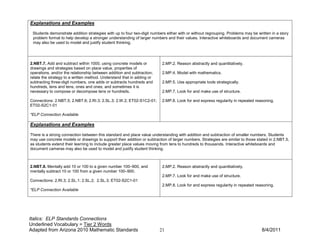
  • 75.
    Explanations and Examples Addingand subtracting fluently refers to knowledge of procedures, knowledge of when and how to use them appropriately, and skill in performing them flexibly, accurately, and efficiently. Students should have experiences solving problems written both horizontally and vertically. They need to communicate their thinking and be able to justify their strategies both verbally and with paper and pencil. Addition strategies based on place value for 48 + 37 may include: • Adding by place value: 40 + 30 = 70 and 8 + 7 = 15 and 70 + 15 = 85. • Incremental adding (breaking one number into tens and ones); 48 + 10 = 58, 58 + 10 = 68, 68 + 10 = 78, 78 + 7 = 85 • Compensation (making a friendly number): 48 + 2 = 50, 37 – 2 = 35, 50 + 35 = 85 Subtraction strategies based on place value for 81 - 37 may include: • Adding Up (from smaller number to larger number): 37 + 3 = 40, 40 + 40 = 80, 80 + 1 = 81, and 3 + 40 + 1 = 44. • Incremental subtracting: 81 -10 = 71, 71 – 10 = 61, 61 – 10 = 51, 51 – 7 = 44 • Subtracting by place value: 81 – 30 = 51, 51 – 7 = 44 Properties that students should know and use are: • Commutative property of addition (Example: 3 + 5 = 5 + 3) • Associative property of addition (Example: (2 + 7) + 3 = 2 + (7+3) ) • Identity property of 0 (Example: 8 + 0 = 8) Students in second grade need to communicate their understanding of why some properties work for some operations and not for others. • Commutative Property: In first grade, students investigated whether the commutative property works with subtraction. The intent was for students to recognize that taking 5 from 8 is not the same as taking 8 from 5. Students should also understand that they will be working with numbers in later grades that will allow them to subtract larger numbers from smaller numbers. This exploration of the commutative property continues in second grade. • Associative Property: Recognizing that the associative property does not work for subtraction is difficult for students to consider at this grade level as it is challenging to determine all the possibilities. 2.NBT.6. Add up to four two-digit numbers using strategies based on 2.MP.2. Reason abstractly and quantitatively. place value and properties of operations. 2.MP.7. Look for and make use of structure. Connections: 2.NBT.5; 2.RI.3; 2.W.2; 2.SL.2; ET02-S2C1-01 2.MP.8. Look for and express regularity in repeated reasoning. Explanations and Examples Students demonstrate addition strategies with up to four two-digit numbers either with or without regrouping. Problems may be written in a story problem format to help develop a stronger understanding of larger numbers and their values. Interactive whiteboards and document cameras may also be used to model and justify student thinking. Italics: ELP Standards Connections Underlined Vocabulary = Tier 2 Words Adapted from Arizona 2010 Mathematic Standards 75 8/4/2011
  • 76.
    2.NBT.7. Add andsubtract within 1000, using concrete models or 2.MP.2. Reason abstractly and quantitatively. drawings and strategies based on place value, properties of operations, and/or the relationship between addition and subtraction; 2.MP.4. Model with mathematics. relate the strategy to a written method. Understand that in adding or subtracting three-digit numbers, one adds or subtracts hundreds and 2.MP.5. Use appropriate tools strategically. hundreds, tens and tens, ones and ones; and sometimes it is necessary to compose or decompose tens or hundreds. 2.MP.7. Look for and make use of structure. Connections: 2.NBT.5; 2.NBT.6; 2.RI.3; 2.SL.3; 2.W.2; ET02-S1C2-01; 2.MP.8. Look for and express regularity in repeated reasoning. ET02-S2C1-01 Explanations and Examples There is a strong connection between this standard and place value understanding with addition and subtraction of smaller numbers. Students may use concrete models or drawings to support their addition or subtraction of larger numbers. Strategies are similar to those stated in 2.NBT.5, as students extend their learning to include greater place values moving from tens to hundreds to thousands. Interactive whiteboards and document cameras may also be used to model and justify student thinking. 2.NBT.8. Mentally add 10 or 100 to a given number 100–900, and 2.MP.2. Reason abstractly and quantitatively. mentally subtract 10 or 100 from a given number 100–900. 2.MP.7. Look for and make use of structure. Connections: 2.RI.3; 2.SL.1; 2.SL.2; 2.SL.3; ET02-S2C1-01 2.MP.8. Look for and express regularity in repeated reasoning. Italics: ELP Standards Connections Underlined Vocabulary = Tier 2 Words Adapted from Arizona 2010 Mathematic Standards 76 8/4/2011
  • 77.
    Explanations and Examples Studentsneed many opportunities to practice mental math by adding and subtracting multiples of 10 and 100 up to 900 using different starting points. They can practice this by counting and thinking aloud, finding missing numbers in a sequence, and finding missing numbers on a number line or hundreds chart. Explorations should include looking for relevant patterns. Mental math strategies may include: • counting on; 300, 400, 500, etc. • counting back; 550, 450, 350, etc. Examples: • 100 more than 653 is _____ (753) • 10 less than 87 is ______ (77) • “Start at 248. Count up by 10s until I tell you to stop.” An interactive whiteboard or document camera may be used to help students develop these mental math skills. 2.NBT.9. Explain why addition and subtraction strategies work, using 2.MP.2. Reason abstractly and quantitatively. place value and the properties of operations. (Explanations may be supported by drawings or objects.) 2.MP.3. Construct viable arguments and critique the reasoning of others. Connections: 2.NBT.1; 2.RI.3; 2.RI.4; 2.W.2; 2.SL.2; 2.SL.3; ET02- S2C1-01 2.MP.4. Model with mathematics. 2.MP.5. Use appropriate tools strategically. *ELP Connection Available 2.MP.7. Look for and make use of structure. 2.MP.8. Look for and express regularity in repeated reasoning. Italics: ELP Standards Connections Underlined Vocabulary = Tier 2 Words Adapted from Arizona 2010 Mathematic Standards 77 8/4/2011
  • 78.
    Explanations and Examples Studentsneed multiple opportunities explaining their addition and subtraction thinking. Operations embedded within a meaningful context promote development of reasoning and justification. Example: Mason read 473 pages in June. He read 227 pages in July. How many pages did Mason read altogether? • Karla’s explanation: 473 + 227 = _____. I added the ones together (3 + 7) and got 10. Then I added the tens together (70 + 20) and got 90. I knew that 400 + 200 was 600. So I added 10 + 90 for 100 and added 100 + 600 and found out that Mason had read 700 pages altogether. • Debbie’s explanation: 473 + 227 = ______. I started by adding 200 to 473 and got 673. Then I added 20 to 673 and I got 693 and finally I added 7 to 693 and I knew that Mason had read 700 pages altogether. • Becky’s explanation: I used base ten blocks on a base ten mat to help me solve this problem. I added 3 ones (units) plus 7 ones and got 10 ones which made one ten. I moved the 1 ten to the tens place. I then added 7 tens rods plus 2 tens rods plus 1 tens rod and got 10 tens or 100. I moved the 1 hundred to the hundreds place. Then I added 4 hundreds plus 2 hundreds plus 1 hundred and got 7 hundreds or 700. So Mason read 700 books. Students should be able to connect different representations and explain the connections. Representations can include numbers, words (including mathematical language), pictures, number lines, and/or physical objects. Students should be able to use any/all of these representations as needed. An interactive whiteboard or document camera can be used to help students develop and explain their thinking. Domain: Measurement and Data AZ Math Standards Mathematical Practices Cluster: Relate addition and subtraction to length. 2.MD.6. Represent whole numbers as lengths from 0 on a number line 2.MP.2. Reason abstractly and quantitatively. diagram with equally spaced points corresponding to the numbers 0, 1, 2, …, and represent whole-number sums and differences within 100 on 2.MP.4. Model with mathematics. a number line diagram. 2.MP.5. Use appropriate tools strategically. Connections: 2.NBT.2; 2.OA.1; 2.MD.5; 2.RI.3; 2.SL.3; ET02-S1C2-02 Italics: ELP Standards Connections Underlined Vocabulary = Tier 2 Words Adapted from Arizona 2010 Mathematic Standards 78 8/4/2011
  • 79.
    Explanations and Examples Studentsrepresent their thinking when adding and subtracting within 100 by using a number line. An interactive whiteboard or document camera can be used to help students demonstrate their thinking. Example: 10 – 6 = 4 Cluster: Work with time and money 2.MD.7. Tell and write time from analog and digital clocks to the 2.MP.5. Use appropriate tools strategically. nearest five minutes, using a.m. and p.m. 2.MP.6. Attend to precision. Connections: 2.NBT.2; 2.RI.3; 2.W.2; 2.SL.2; ET02-S1C2-01; ET02- S1C2-02 *ELP Connection Available Explanations and Examples In first grade, students learned to tell time to the nearest hour and half-hour. Students build on this understanding in second grade by skip- counting by 5 to recognize 5-minute intervals on the clock. They need exposure to both digital and analog clocks. It is important that they can recognize time in both formats and communicate their understanding of time using both numbers and language. Common time phrases include the following: quarter till ___, quarter after ___, ten till ___, ten after ___, and half past ___. Students should understand that there are 2 cycles of 12 hours in a day - a.m. and p.m. Recording their daily actions in a journal would be helpful for making real-world connections and understanding the difference between these two cycles. An interactive whiteboard or document camera may be used to help students demonstrate their thinking. Italics: ELP Standards Connections Underlined Vocabulary = Tier 2 Words Adapted from Arizona 2010 Mathematic Standards 79 8/4/2011
  • 80.
    2.MD.8. Solve wordproblems involving dollar bills, quarters, dimes, 2.MP.1. Make sense of problems and persevere in solving them. nickels, and pennies, using $ and ¢ symbols appropriately. Example: If you have 2 dimes and 3 pennies, how many cents do you have? 2.MP.2. Reason abstractly and quantitatively. Connections: 2.NBT.1; 2.NBT.5; 2.RI.3; 2.RI.4; 2.W.2; 2.SL.2; ET02- 2.MP.4. Model with mathematics. S1C2-01; ET02-S1C2-02 2.MP.5. Use appropriate tools strategically. *ELP Connection Available 2.MP.8. Look for and express regularity in repeated reasoning. Explanations and Examples Since money is not specifically addressed in kindergarten, first grade, or third grade, students should have multiple opportunities to identify, count, recognize, and use coins and bills in and out of context. They should also experience making equivalent amounts using both coins and bills. “Dollar bills” should include denominations up to one hundred ($1.00, $5.00, $10.00, $20.00, $100.00). Students should solve story problems connecting the different representations. These representations may include objects, pictures, charts, tables, words, and/or numbers. Students should communicate their mathematical thinking and justify their answers. An interactive whiteboard or document camera may be used to help students demonstrate and justify their thinking. Example: • Sandra went to the store and received $ 0.76 in change. What are three different sets of coins she could have received? Domain: Geometry AZ Math Standards Mathematical Practices Cluster: Reason with shapes and their attributes 2.G.1. Recognize and draw shapes having specified attributes, such as 2.MP.4. Model with mathematics. a given number of angles or a given number of equal faces. Identify triangles, quadrilaterals, pentagons, hexagons, and cubes. (Sizes are 2.MP.7. Look for and make use of structure. compared directly or visually, not compared by measuring.) Connections: 2.RI.3; 2.RI.4; 2.W.2; 2.SL.2; 2.SL.3; SC02-S5C1-01; ET02-S2C1-01 Italics: ELP Standards Connections Underlined Vocabulary = Tier 2 Words Adapted from Arizona 2010 Mathematic Standards 80 8/4/2011
  • 81.
    Explanations and Examples Studentsidentify, describe, and draw triangles, quadrilaterals, pentagons, and hexagons. Pentagons, triangles, and hexagons should appear as both regular (equal sides and equal angles) and irregular. Students recognize all four sided shapes as quadrilaterals. Students use the vocabulary word “angle” in place of “corner” but they do not need to name angle types. Interactive whiteboards and document cameras may be used to help identify shapes and their attributes. Shapes should be presented in a variety of orientations and configurations. Italics: ELP Standards Connections Underlined Vocabulary = Tier 2 Words Adapted from Arizona 2010 Mathematic Standards 81 8/4/2011
  • 82.
    Isaac School District,No. 5 Mathematics Curriculum Guide: 2nd Grade Unit 7 Parts of a Whole, Parts of a Group Fractions Big Ideas: Essential Questions: Students will understand that: • Fractions are equal parts of a whole or group. • How are the numerator and the denominator related? • Fraction parts can be modeled or named. • How could you represent fractions? Unit Vocabulary: denominator, equal, fourths, fraction, half, numerator, one and a half, one fourth, one half, one quarter, one third, part, pieces, sets, thirds, two and a half, two thirds, whole Domain: Operations and Algebraic Thinking (OA) AZ Math Standards Mathematical Practices Cluster: Represent and solve problems involving addition and subtraction. Students are expected to: 2.OA.1. Use addition and subtraction within 100 to solve one- and two- 2.MP.1. Make sense of problems and persevere in solving them. step word problems involving situations of adding to, taking from, putting together, taking apart, and comparing, with unknowns in all positions, 2.MP.2. Reason abstractly and quantitatively. e.g., by using drawings and equations with a symbol for the unknown number to represent the problem. (See Table 1.) 2.MP.3. Construct viable arguments and critique the reasoning of others. Connections: 2.NBT.5; 2.RI.3; 2.RI.4; 2.SL.2; ET02-S2C1-01 2.MP.4. Model with mathematics. *ELP Connection Available 2.MP.5. Use appropriate tools strategically. 2.MP.8. Look for and express regularity in repeated reasoning. Italics: ELP Standards Connections Underlined Vocabulary = Tier 2 Words Adapted from Arizona 2010 Mathematic Standards 82 8/4/2011
  • 83.
    Explanations and Examples Wordproblems that are connected to students’ lives can be used to develop fluency with addition and subtraction. Table 1 describes the four different addition and subtraction situations and their relationship to the position of the unknown. Examples: • Take-from example: David had 63 stickers. He gave 37 to Susan. How many stickers does David have now? 63 – 37 = • Add to example: David had $37. His grandpa gave him some money for his birthday. Now he has $63. How much money did David’s grandpa give him? $37 + = $63 • Compare example: David has 63 stickers. Susan has 37 stickers. How many more stickers does David have than Susan? 63 – 37 = o Even though the modeling of the two problems above is different, the equation, 63 - 37 = ?, can represent both situations (How many more do I need to make 63?) • Take-from (Start Unknown) David had some stickers. He gave 37 to Susan. Now he has 26 stickers. How many stickers did David have before? - 37 = 26 It is important to attend to the difficulty level of the problem situations in relation to the position of the unknown. • Result Unknown problems are the least complex for students followed by Total Unknown and Difference Unknown. • The next level of difficulty includes Change Unknown, Addend Unknown, followed by Bigger Unknown. • The most difficult are Start Unknown, Both Addends Unknown, and Smaller Unknown. Second grade students should work on ALL problem types regardless of the level of difficulty. Students can use interactive whiteboard or document camera to demonstrate and justify their thinking. This standard focuses on developing an algebraic representation of a word problem through addition and subtraction --the intent is not to introduce traditional algorithms or rules. Cluster: Add and subtract within 20. 2.OA.2. Fluently add and subtract within 20 using mental strategies. By 2.MP.2. Reason abstractly and quantitatively. end of Grade 2, know from memory all sums of two one-digit numbers. (See standard 1.OA.6 for a list of mental strategies.) 2.MP.7. Look for and make use of structure. Connections: 2.NBT.5; 2.NBT.9; ET02-S2C1-01 2.MP.8. Look for and express regularity in repeated reasoning. Italics: ELP Standards Connections Underlined Vocabulary = Tier 2 Words Adapted from Arizona 2010 Mathematic Standards 83 8/4/2011
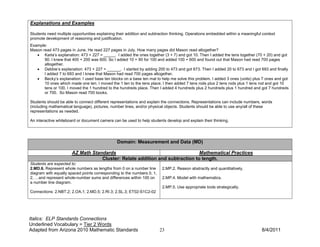
  • 84.
    This standard isstrongly connected to all the standards in this domain. It focuses on students being able to fluently add and subtract numbers to 20. Adding and subtracting fluently refers to knowledge of procedures, knowledge of when and how to use them appropriately, and skill in performing them flexibly, accurately, and efficiently. Mental strategies help students make sense of number relationships as they are adding and subtracting within 20. The ability to calculate mentally with efficiency is very important for all students. Mental strategies may include the following: • Counting on • Making tens (9 + 7 = 10 + 6) • Decomposing a number leading to a ten ( 14 – 6 = 14 – 4 – 2 = 10 – 2 = 8) • Fact families (8 + 5 = 13 is the same as 13 - 8 = 5) • Doubles • Doubles plus one (7 + 8 = 7 + 7 + 1) However, the use of objects, diagrams, or interactive whiteboards, and various strategies will help students develop fluency. Domain: Number and Operations in Base Ten (NBT) AZ Math Standards Mathematical Practices Cluster: Understand place value. Students are expected to: 2.NBT.1. Understand that the three digits of a three-digit number 2.MP.2. Reason abstractly and quantitatively. represent amounts of hundreds, tens, and ones; e.g., 706 equals 7 hundreds, 0 tens, and 6 ones. Understand the following as special cases: 2.MP.7. Look for and make use of structure. i. 100 can be thought of as a bundle of ten tens—called a “hundred.” 2.MP.8. Look for and express regularity in repeated reasoning. j. The numbers 100, 200, 300, 400, 500, 600, 700, 800, 900 refer to one, two, three, four, five, six, seven, eight, or nine hundreds (and 0 tens and 0 ones). Connections: 2.NBT.5; 2.RI.3; 2.RI.4; 2.SL.3; ET02-S1C2-01; ET02- S1C2-01; ET02-S2C1-01 Italics: ELP Standards Connections Underlined Vocabulary = Tier 2 Words Adapted from Arizona 2010 Mathematic Standards 84 8/4/2011
  • 85.
    Explanations and Examples Understandingthat 10 ones make one ten and that 10 tens make one hundred is fundamental to students’ mathematical development. Students need multiple opportunities counting and “bundling” groups of tens in first grade. In second grade, students build on their understanding by making bundles of 100s with or without leftovers using base ten blocks, cubes in towers of 10, ten frames, etc. This emphasis on bundling hundreds will support students’ discovery of place value patterns. As students are representing the various amounts, it is important that emphasis is placed on the language associated with the quantity. For example, 243 can be expressed in multiple ways such as 2 groups of hundred, 4 groups of ten and 3 ones, as well as 24 tens with 3 ones. When students read numbers, they should read in standard form as well as using place value concepts. For example, 243 should be read as “two hundred forty-three” as well as two hundreds, 4 tens, 3 ones. A document camera or interactive whiteboard can also be used to demonstrate “bundling” of objects. This gives students the opportunity to communicate their counting and thinking. 2.NBT.2. Count within 1000; skip-count by 5s, 10s, and 100s. 2.MP.2. Reason abstractly and quantitatively. Connections: 2.NBT.8; ET02-S1C3-01 2.MP.7. Look for and make use of structure. 2.MP.8. Look for and express regularity in repeated reasoning. Explanations and Examples Students need many opportunities counting, up to 1000, from different starting points. They should also have many experiences skip counting by 5s, 10s, and 100s to develop the concept of place value. Examples: • The use of the 100s chart may be helpful for students to identify the counting patterns. • The use of money (nickels, dimes, dollars) or base ten blocks may be helpful visual cues. • The use of an interactive whiteboard may also be used to develop counting skills. The ultimate goal for second graders is to be able to count in multiple ways with no visual support. 2.NBT.3. Read and write numbers to 1000 using base-ten numerals, 2.MP.2. Reason abstractly and quantitatively. number names, and expanded form. 2.MP.7. Look for and make use of structure. Connections: 2.SL.2; 2.RI.3 2.MP.8. Look for and express regularity in repeated reasoning. Italics: ELP Standards Connections Underlined Vocabulary = Tier 2 Words Adapted from Arizona 2010 Mathematic Standards 85 8/4/2011
  • 86.
    Explanations and Examples Studentsneed many opportunities reading and writing numerals in multiple ways. Examples: • Base-ten numerals 637 (standard form) • Number names six hundred thirty seven (written form) • Expanded form 600 + 30 + 7 (expanded notation) When students say the expanded form, it may sound like this: “6 hundreds plus 3 tens plus 7 ones” OR 600 plus 30 plus 7.” Cluster: Use place value understanding and properties of operations to add and subtract. 2.NBT.5. Fluently add and subtract within 100 using strategies based on 2.MP.2. Reason abstractly and quantitatively. place value, properties of operations, and/or the relationship between addition and subtraction. 2.MP.7. Look for and make use of structure. Connections: 2.OA.2; 2.NBT.1; 2.NBT.3; 2.RI.3; 2.W.2; 2.SL.3 2.MP.8. Look for and express regularity in repeated reasoning. Italics: ELP Standards Connections Underlined Vocabulary = Tier 2 Words Adapted from Arizona 2010 Mathematic Standards 86 8/4/2011
  • 87.
    Explanations and Examples Addingand subtracting fluently refers to knowledge of procedures, knowledge of when and how to use them appropriately, and skill in performing them flexibly, accurately, and efficiently. Students should have experiences solving problems written both horizontally and vertically. They need to communicate their thinking and be able to justify their strategies both verbally and with paper and pencil. Addition strategies based on place value for 48 + 37 may include: • Adding by place value: 40 + 30 = 70 and 8 + 7 = 15 and 70 + 15 = 85. • Incremental adding (breaking one number into tens and ones); 48 + 10 = 58, 58 + 10 = 68, 68 + 10 = 78, 78 + 7 = 85 • Compensation (making a friendly number): 48 + 2 = 50, 37 – 2 = 35, 50 + 35 = 85 Subtraction strategies based on place value for 81 - 37 may include: • Adding Up (from smaller number to larger number): 37 + 3 = 40, 40 + 40 = 80, 80 + 1 = 81, and 3 + 40 + 1 = 44. • Incremental subtracting: 81 -10 = 71, 71 – 10 = 61, 61 – 10 = 51, 51 – 7 = 44 • Subtracting by place value: 81 – 30 = 51, 51 – 7 = 44 Properties that students should know and use are: • Commutative property of addition (Example: 3 + 5 = 5 + 3) • Associative property of addition (Example: (2 + 7) + 3 = 2 + (7+3) ) • Identity property of 0 (Example: 8 + 0 = 8) Students in second grade need to communicate their understanding of why some properties work for some operations and not for others. • Commutative Property: In first grade, students investigated whether the commutative property works with subtraction. The intent was for students to recognize that taking 5 from 8 is not the same as taking 8 from 5. Students should also understand that they will be working with numbers in later grades that will allow them to subtract larger numbers from smaller numbers. This exploration of the commutative property continues in second grade. • Associative Property: Recognizing that the associative property does not work for subtraction is difficult for students to consider at this grade level as it is challenging to determine all the possibilities. 2.NBT.6. Add up to four two-digit numbers using strategies based on 2.MP.2. Reason abstractly and quantitatively. place value and properties of operations. 2.MP.7. Look for and make use of structure. Connections: 2.NBT.5; 2.RI.3; 2.W.2; 2.SL.2; ET02-S2C1-01 2.MP.8. Look for and express regularity in repeated reasoning. Italics: ELP Standards Connections Underlined Vocabulary = Tier 2 Words Adapted from Arizona 2010 Mathematic Standards 87 8/4/2011
  • 88.
    Explanations and Examples Studentsdemonstrate addition strategies with up to four two-digit numbers either with or without regrouping. Problems may be written in a story problem format to help develop a stronger understanding of larger numbers and their values. Interactive whiteboards and document cameras may also be used to model and justify student thinking. 2.NBT.7. Add and subtract within 1000, using concrete models or 2.MP.2. Reason abstractly and quantitatively. drawings and strategies based on place value, properties of operations, and/or the relationship between addition and subtraction; relate the 2.MP.4. Model with mathematics. strategy to a written method. Understand that in adding or subtracting three-digit numbers, one adds or subtracts hundreds and hundreds, tens 2.MP.5. Use appropriate tools strategically. and tens, ones and ones; and sometimes it is necessary to compose or decompose tens or hundreds. 2.MP.7. Look for and make use of structure. Connections: 2.NBT.5; 2.NBT.6; 2.RI.3; 2.SL.3; 2.W.2; ET02-S1C2-01; 2.MP.8. Look for and express regularity in repeated reasoning. ET02-S2C1-01 Explanations and Examples There is a strong connection between this standard and place value understanding with addition and subtraction of smaller numbers. Students may use concrete models or drawings to support their addition or subtraction of larger numbers. Strategies are similar to those stated in 2.NBT.5, as students extend their learning to include greater place values moving from tens to hundreds to thousands. Interactive whiteboards and document cameras may also be used to model and justify student thinking. 2.NBT.8. Mentally add 10 or 100 to a given number 100–900, and 2.MP.2. Reason abstractly and quantitatively. mentally subtract 10 or 100 from a given number 100–900. 2.MP.7. Look for and make use of structure. Connections: 2.RI.3; 2.SL.1; 2.SL.2; 2.SL.3;ET02-S2C1-01 2.MP.8. Look for and express regularity in repeated reasoning. Italics: ELP Standards Connections Underlined Vocabulary = Tier 2 Words Adapted from Arizona 2010 Mathematic Standards 88 8/4/2011
  • 89.
    Explanations and Examples Studentsneed many opportunities to practice mental math by adding and subtracting multiples of 10 and 100 up to 900 using different starting points. They can practice this by counting and thinking aloud, finding missing numbers in a sequence, and finding missing numbers on a number line or hundreds chart. Explorations should include looking for relevant patterns. Mental math strategies may include: • counting on; 300, 400, 500, etc. • counting back; 550, 450, 350, etc. Examples: • 100 more than 653 is _____ (753) • 10 less than 87 is ______ (77) • “Start at 248. Count up by 10s until I tell you to stop.” An interactive whiteboard or document camera may be used to help students develop these mental math skills. 2.NBT.9. Explain why addition and subtraction strategies work, using 2.MP.2. Reason abstractly and quantitatively. place value and the properties of operations. (Explanations may be supported by drawings or objects.) 2.MP.3. Construct viable arguments and critique the reasoning of others. Connections: 2.NBT.1; 2.RI.3; 2.RI.4; 2.W.2; 2.SL.2; 2.SL.3; ET02-S2C1-01 2.MP.4. Model with mathematics. *ELP Connection Available 2.MP.5. Use appropriate tools strategically. 2.MP.7. Look for and make use of structure. 2.MP.8. Look for and express regularity in repeated reasoning. Italics: ELP Standards Connections Underlined Vocabulary = Tier 2 Words Adapted from Arizona 2010 Mathematic Standards 89 8/4/2011
  • 90.
    Explanations and Examples Studentsneed multiple opportunities explaining their addition and subtraction thinking. Operations embedded within a meaningful context promote development of reasoning and justification. Example: Mason read 473 pages in June. He read 227 pages in July. How many pages did Mason read altogether? • Karla’s explanation: 473 + 227 = _____. I added the ones together (3 + 7) and got 10. Then I added the tens together (70 + 20) and got 90. I knew that 400 + 200 was 600. So I added 10 + 90 for 100 and added 100 + 600 and found out that Mason had read 700 pages altogether. • Debbie’s explanation: 473 + 227 = ______. I started by adding 200 to 473 and got 673. Then I added 20 to 673 and I got 693 and finally I added 7 to 693 and I knew that Mason had read 700 pages altogether. • Becky’s explanation: I used base ten blocks on a base ten mat to help me solve this problem. I added 3 ones (units) plus 7 ones and got 10 ones which made one ten. I moved the 1 ten to the tens place. I then added 7 tens rods plus 2 tens rods plus 1 tens rod and got 10 tens or 100. I moved the 1 hundred to the hundreds place. Then I added 4 hundreds plus 2 hundreds plus 1 hundred and got 7 hundreds or 700. So Mason read 700 books. Students should be able to connect different representations and explain the connections. Representations can include numbers, words (including mathematical language), pictures, number lines, and/or physical objects. Students should be able to use any/all of these representations as needed. An interactive whiteboard or document camera can be used to help students develop and explain their thinking. Italics: ELP Standards Connections Underlined Vocabulary = Tier 2 Words Adapted from Arizona 2010 Mathematic Standards 90 8/4/2011
  • 91.
    Domain: Measurement andData (MD) AZ Math Standards Mathematical Practices Cluster: Relate addition and subtraction to length. Students are expected to: 2.MD.6. Represent whole numbers as lengths from 0 on a number line 2.MP.2. Reason abstractly and quantitatively. diagram with equally spaced points corresponding to the numbers 0, 1, 2, …, and represent whole-number sums and differences within 100 on 2.MP.4. Model with mathematics. a number line diagram. 2.MP.5. Use appropriate tools strategically. Connections: 2.NBT.2; 2.OA.1; 2.MD.5; 2.RI.3; 2.SL.3; ET02-S1C2-02 Explanations and Examples Students represent their thinking when adding and subtracting within 100 by using a number line. An interactive whiteboard or document camera can be used to help students demonstrate their thinking. Example: 10 – 6 = 4 Cluster: Work with time and money. 2.MD.7. Tell and write time from analog and digital clocks to the 2.MP.5. Use appropriate tools strategically. nearest five minutes, using a.m. and p.m. 2.MP.6. Attend to precision. Connections: 2.NBT.2; 2.RI.3; 2.W.2; 2.SL.2; ET02-S1C2-01; ET02- S1C2-02 *ELP Connection Available Italics: ELP Standards Connections Underlined Vocabulary = Tier 2 Words Adapted from Arizona 2010 Mathematic Standards 91 8/4/2011
  • 92.
    Explanations and Examples Infirst grade, students learned to tell time to the nearest hour and half-hour. Students build on this understanding in second grade by skip- counting by 5 to recognize 5-minute intervals on the clock. They need exposure to both digital and analog clocks. It is important that they can recognize time in both formats and communicate their understanding of time using both numbers and language. Common time phrases include the following: quarter till ___, quarter after ___, ten till ___, ten after ___, and half past ___. Students should understand that there are 2 cycles of 12 hours in a day - a.m. and p.m. Recording their daily actions in a journal would be helpful for making real-world connections and understanding the difference between these two cycles. An interactive whiteboard or document camera may be used to help students demonstrate their thinking. 2.MD.8. Solve word problems involving dollar bills, quarters, dimes, 2.MP.1. Make sense of problems and persevere in solving them. nickels, and pennies, using $ and ¢ symbols appropriately. Example: If you have 2 dimes and 3 pennies, how many cents do you have? 2.MP.2. Reason abstractly and quantitatively. Connections: 2.NBT.1; 2.NBT.5; 2.RI.3; 2.RI.4; 2.W.2; 2.SL.2; ET02- 2.MP.4. Model with mathematics. S1C2-01; ET02-S1C2-02 2.MP.5. Use appropriate tools strategically. *ELP Connection Available 2.MP.8. Look for and express regularity in repeated reasoning. Explanations and Examples Since money is not specifically addressed in kindergarten, first grade, or third grade, students should have multiple opportunities to identify, count, recognize, and use coins and bills in and out of context. They should also experience making equivalent amounts using both coins and bills. “Dollar bills” should include denominations up to one hundred ($1.00, $5.00, $10.00, $20.00, $100.00). Students should solve story problems connecting the different representations. These representations may include objects, pictures, charts, tables, words, and/or numbers. Students should communicate their mathematical thinking and justify their answers. An interactive whiteboard or document camera may be used to help students demonstrate and justify their thinking. Example: Sandra went to the store and received $ 0.76 in change. What are three different sets of coins she could have received? Italics: ELP Standards Connections Underlined Vocabulary = Tier 2 Words Adapted from Arizona 2010 Mathematic Standards 92 8/4/2011
  • 93.
    Domain: Geometry (G) AZ Math Standards Mathematical Practices Cluster: Reason with shapes and their attributes. 2.G.3. Partition circles and rectangles into two, three, or four equal 2.MP.2. Reason abstractly and quantitatively. shares, describe the shares using the words halves, thirds, half of, a third of, etc., and describe the whole as two halves, three thirds, four 2.MP.3. Construct viable arguments and critique the reasoning of fourths. Recognize that equal shares of identical wholes need not have others. the same shape. 2.MP.6. Attend to precision. Connections: 2.RI.3; 2.RI.4; 2.W.2; 2.SL.2; 2.SL.3; ET02-S1C2-02 2.MP.8. Look for and express regularity in repeated reasoning. *ELP Connection Available Italics: ELP Standards Connections Underlined Vocabulary = Tier 2 Words Adapted from Arizona 2010 Mathematic Standards 93 8/4/2011
  • 94.
    Explanations and Examples Thisstandard introduces fractions in an area model. Students need experiences with different sizes, circles, and rectangles. For example, students should recognize that when they cut a circle into three equal pieces, each piece will equal one third of its original whole. In this case, students should describe the whole as three thirds. If a circle is cut into four equal pieces, each piece will equal one fourth of its original whole and the whole is described as four fourths. Students should see circles and rectangles partitioned in multiple ways so they learn to recognize that equal shares can be different shapes within the same whole. An interactive whiteboard may be used to show partitions of shapes. Italics: ELP Standards Connections Underlined Vocabulary = Tier 2 Words Adapted from Arizona 2010 Mathematic Standards 94 8/4/2011
  • 95.
    Isaac School District,No. 5 Mathematics Curriculum Guide: 2nd Grade Unit 8 Partners, Teams, and Paper Clips Addition, Subtraction, and the Number System 4 Big Ideas: Essential Questions: Students will understand that: • A sum can be predicted as even or odd. • What do you notice when you add even and odd numbers? • Familiar combinations can be used to develop unfamiliar • How can you predict if a sum will be odd or even? combinations. • How can you use combinations you know to help solve • A successful problem solver uses efficient methods for adding problems? and subtracting. • How can different equations represent the same problem? • What strategies could you use to solve a problem? Unit Vocabulary: conjecture, diagonal, digit, equal, equation, even, horizontal, odd, open number line, pair, solve, story problems, strategy, sum, vertical, whole Domain: Operations and Algebraic Thinking (OA) AZ Math Standards Mathematical Practices Cluster: Represent and solve problems involving addition and subtraction. Students are expected to: 2.OA.1. Use addition and subtraction within 100 to solve one- and two- 2.MP.1. Make sense of problems and persevere in solving them. step word problems involving situations of adding to, taking from, putting together, taking apart, and comparing, with unknowns in all 2.MP.2. Reason abstractly and quantitatively. positions, e.g., by using drawings and equations with a symbol for the unknown number to represent the problem. (See Table 1.) 2.MP.3. Construct viable arguments and critique the reasoning of others. Connections: 2.NBT.5; 2.RI.3; 2.RI.4; 2.SL.2; ET02-S2C1-01 2.MP.4. Model with mathematics. *ELP Connection Available 2.MP.5. Use appropriate tools strategically. 2.MP.8. Look for and express regularity in repeated reasoning. Italics: ELP Standards Connections Underlined Vocabulary = Tier 2 Words Adapted from Arizona 2010 Mathematic Standards 95 8/4/2011
  • 96.
    Explanations and Examples Wordproblems that are connected to students’ lives can be used to develop fluency with addition and subtraction. Table 1 describes the four different addition and subtraction situations and their relationship to the position of the unknown. Examples: • Take-from example: David had 63 stickers. He gave 37 to Susan. How many stickers does David have now? 63 – 37 = • Add to example: David had $37. His grandpa gave him some money for his birthday. Now he has $63. How much money did David’s grandpa give him? $37 + = $63 • Compare example: David has 63 stickers. Susan has 37 stickers. How many more stickers does David have than Susan? 63 – 37 = o Even though the modeling of the two problems above is different, the equation, 63 - 37 = ?, can represent both situations (How many more do I need to make 63?) • Take-from (Start Unknown) David had some stickers. He gave 37 to Susan. Now he has 26 stickers. How many stickers did David have before? - 37 = 26 It is important to attend to the difficulty level of the problem situations in relation to the position of the unknown. • Result Unknown problems are the least complex for students followed by Total Unknown and Difference Unknown. • The next level of difficulty includes Change Unknown, Addend Unknown, followed by Bigger Unknown. • The most difficult are Start Unknown, Both Addends Unknown, and Smaller Unknown. Second grade students should work on ALL problem types regardless of the level of difficulty. Students can use interactive whiteboard or document camera to demonstrate and justify their thinking. This standard focuses on developing an algebraic representation of a word problem through addition and subtraction --the intent is not to introduce traditional algorithms or rules. Cluster: Add and subtract within 20. 2.OA.2. Fluently add and subtract within 20 using mental strategies. By 2.MP.2. Reason abstractly and quantitatively. end of Grade 2, know from memory all sums of two one-digit numbers. (See standard 1.OA.6 for a list of mental strategies.) 2.MP.7. Look for and make use of structure. Connections: 2.NBT.5; 2.NBT.9; ET02-S2C1-01 2.MP.8. Look for and express regularity in repeated reasoning. Italics: ELP Standards Connections Underlined Vocabulary = Tier 2 Words Adapted from Arizona 2010 Mathematic Standards 96 8/4/2011
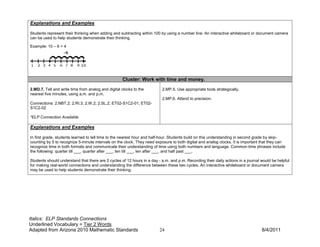
  • 97.
    Explanations and Examples Thisstandard is strongly connected to all the standards in this domain. It focuses on students being able to fluently add and subtract numbers to 20. Adding and subtracting fluently refers to knowledge of procedures, knowledge of when and how to use them appropriately, and skill in performing them flexibly, accurately, and efficiently. Mental strategies help students make sense of number relationships as they are adding and subtracting within 20. The ability to calculate mentally with efficiency is very important for all students. Mental strategies may include the following: • Counting on • Making tens (9 + 7 = 10 + 6) • Decomposing a number leading to a ten ( 14 – 6 = 14 – 4 – 2 = 10 – 2 = 8) • Fact families (8 + 5 = 13 is the same as 13 - 8 = 5) • Doubles • Doubles plus one (7 + 8 = 7 + 7 + 1) However, the use of objects, diagrams, or interactive whiteboards, and various strategies will help students develop fluency. Cluster: Work with equal groups of objects to gain foundations for multiplication. 2.OA.3. Determine whether a group of objects (up to 20) has an odd or 2.MP.2. Reason abstractly and quantitatively. even number of members, e.g., by pairing objects or counting them by 2s; write an equation to express an even number as a sum of two 2.MP.3. Construct viable arguments and critique the reasoning of equal addends. others. Connections: 2.OA.4; 2.RI.3; 2.RI.4; ET02-S1C1-01; ET02-S2C1-01 2.MP.7. Look for and make use of structure. 2.MP.8. Look for and express regularity in repeated reasoning. Italics: ELP Standards Connections Underlined Vocabulary = Tier 2 Words Adapted from Arizona 2010 Mathematic Standards 97 8/4/2011
  • 98.
    Explanations and Examples Studentsexplore odd and even numbers in a variety of ways including the following: students may investigate if a number is odd or even by determining if the number of objects can be divided into two equal sets, arranged into pairs or counted by twos. After the above experiences, students may derive that they only need to look at the digit in the ones place to determine if a number is odd or even since any number of tens will always split into two even groups. Example: Students need opportunities writing equations representing sums of two equal addends, such as: 2 + 2 = 4, 3 + 3 = 6, 5 + 5 = 10, 6 + 6 = 12, or 8 + 8 =16. This understanding will lay the foundation for multiplication and is closely connected to 2.OA.4. The use of objects and/or interactive whiteboards will help students develop and demonstrate various strategies to determine even and odd numbers. Domain: Number and Operations in Base Ten (NBT) AZ Math Standards Mathematical Practices Cluster: Understand place value. Students are expected to: 2.NBT.1. Understand that the three digits of a three-digit number 2.MP.2. Reason abstractly and quantitatively. represent amounts of hundreds, tens, and ones; e.g., 706 equals 7 hundreds, 0 tens, and 6 ones. Understand the following as special 2.MP.7. Look for and make use of structure. cases: k. 100 can be thought of as a bundle of ten tens—called a 2.MP.8. Look for and express regularity in repeated reasoning. “hundred.” l. The numbers 100, 200, 300, 400, 500, 600, 700, 800, 900 refer to one, two, three, four, five, six, seven, eight, or nine hundreds (and 0 tens and 0 ones). Connections: 2.NBT.5; 2.RI.3; 2.RI.4; 2.SL.3; ET02-S1C2-01; ET02- S1C2-01; ET02-S2C1-01 Italics: ELP Standards Connections Underlined Vocabulary = Tier 2 Words Adapted from Arizona 2010 Mathematic Standards 98 8/4/2011
  • 99.
    Explanations and Examples Understandingthat 10 ones make one ten and that 10 tens make one hundred is fundamental to students’ mathematical development. Students need multiple opportunities counting and “bundling” groups of tens in first grade. In second grade, students build on their understanding by making bundles of 100s with or without leftovers using base ten blocks, cubes in towers of 10, ten frames, etc. This emphasis on bundling hundreds will support students’ discovery of place value patterns. As students are representing the various amounts, it is important that emphasis is placed on the language associated with the quantity. For example, 243 can be expressed in multiple ways such as 2 groups of hundred, 4 groups of ten and 3 ones, as well as 24 tens with 3 ones. When students read numbers, they should read in standard form as well as using place value concepts. For example, 243 should be read as “two hundred forty-three” as well as two hundreds, 4 tens, 3 ones. A document camera or interactive whiteboard can also be used to demonstrate “bundling” of objects. This gives students the opportunity to communicate their counting and thinking. 2.NBT.2. Count within 1000; skip-count by 5s, 10s, and 100s. 2.MP.2. Reason abstractly and quantitatively. Connections: 2.NBT.8; ET02-S1C3-01 2.MP.7. Look for and make use of structure. 2.MP.8. Look for and express regularity in repeated reasoning. Explanations and Examples Students need many opportunities counting, up to 1000, from different starting points. They should also have many experiences skip counting by 5s, 10s, and 100s to develop the concept of place value. Examples: • The use of the 100s chart may be helpful for students to identify the counting patterns. • The use of money (nickels, dimes, dollars) or base ten blocks may be helpful visual cues. • The use of an interactive whiteboard may also be used to develop counting skills. The ultimate goal for second graders is to be able to count in multiple ways with no visual support. Italics: ELP Standards Connections Underlined Vocabulary = Tier 2 Words Adapted from Arizona 2010 Mathematic Standards 99 8/4/2011
  • 100.
    2.NBT.3. Read andwrite numbers to 1000 using base-ten numerals, 2.MP.2. Reason abstractly and quantitatively. number names, and expanded form. 2.MP.7. Look for and make use of structure. Connections: 2.SL.2; 2.RI.3 2.MP.8. Look for and express regularity in repeated reasoning. Explanations and Examples Students need many opportunities reading and writing numerals in multiple ways. Examples: • Base-ten numerals 637 (standard form) • Number names six hundred thirty seven (written form) • Expanded form 600 + 30 + 7 (expanded notation) When students say the expanded form, it may sound like this: “6 hundreds plus 3 tens plus 7 ones” OR 600 plus 30 plus 7.” Cluster: Use place value understanding and properties of operations to add and subtract. 2.NBT.5. Fluently add and subtract within 100 using strategies based 2.MP.2. Reason abstractly and quantitatively. on place value, properties of operations, and/or the relationship between addition and subtraction. 2.MP.7. Look for and make use of structure. Connections: 2.OA.2; 2.NBT.1; 2.NBT.3; 2.RI.3; 2.W.2; 2.SL.3 2.MP.8. Look for and express regularity in repeated reasoning. Italics: ELP Standards Connections Underlined Vocabulary = Tier 2 Words Adapted from Arizona 2010 Mathematic Standards 100 8/4/2011
  • 101.
    Explanations and Examples Addingand subtracting fluently refers to knowledge of procedures, knowledge of when and how to use them appropriately, and skill in performing them flexibly, accurately, and efficiently. Students should have experiences solving problems written both horizontally and vertically. They need to communicate their thinking and be able to justify their strategies both verbally and with paper and pencil. Addition strategies based on place value for 48 + 37 may include: • Adding by place value: 40 + 30 = 70 and 8 + 7 = 15 and 70 + 15 = 85. • Incremental adding (breaking one number into tens and ones); 48 + 10 = 58, 58 + 10 = 68, 68 + 10 = 78, 78 + 7 = 85 • Compensation (making a friendly number): 48 + 2 = 50, 37 – 2 = 35, 50 + 35 = 85 Subtraction strategies based on place value for 81 - 37 may include: • Adding Up (from smaller number to larger number): 37 + 3 = 40, 40 + 40 = 80, 80 + 1 = 81, and 3 + 40 + 1 = 44. • Incremental subtracting: 81 -10 = 71, 71 – 10 = 61, 61 – 10 = 51, 51 – 7 = 44 • Subtracting by place value: 81 – 30 = 51, 51 – 7 = 44 Properties that students should know and use are: • Commutative property of addition (Example: 3 + 5 = 5 + 3) • Associative property of addition (Example: (2 + 7) + 3 = 2 + (7+3) ) • Identity property of 0 (Example: 8 + 0 = 8) Students in second grade need to communicate their understanding of why some properties work for some operations and not for others. • Commutative Property: In first grade, students investigated whether the commutative property works with subtraction. The intent was for students to recognize that taking 5 from 8 is not the same as taking 8 from 5. Students should also understand that they will be working with numbers in later grades that will allow them to subtract larger numbers from smaller numbers. This exploration of the commutative property continues in second grade. • Associative Property: Recognizing that the associative property does not work for subtraction is difficult for students to consider at this grade level as it is challenging to determine all the possibilities. 2.NBT.6. Add up to four two-digit numbers using strategies based on 2.MP.2. Reason abstractly and quantitatively. place value and properties of operations. 2.MP.7. Look for and make use of structure. Connections: 2.NBT.5; 2.RI.3; 2.W.2; 2.SL.2; ET02-S2C1-01 2.MP.8. Look for and express regularity in repeated reasoning. Italics: ELP Standards Connections Underlined Vocabulary = Tier 2 Words Adapted from Arizona 2010 Mathematic Standards 101 8/4/2011
  • 102.
    Explanations and Examples Studentsdemonstrate addition strategies with up to four two-digit numbers either with or without regrouping. Problems may be written in a story problem format to help develop a stronger understanding of larger numbers and their values. Interactive whiteboards and document cameras may also be used to model and justify student thinking. 2.NBT.7. Add and subtract within 1000, using concrete models or 2.MP.2. Reason abstractly and quantitatively. drawings and strategies based on place value, properties of operations, and/or the relationship between addition and subtraction; 2.MP.4. Model with mathematics. relate the strategy to a written method. Understand that in adding or subtracting three-digit numbers, one adds or subtracts hundreds and 2.MP.5. Use appropriate tools strategically. hundreds, tens and tens, ones and ones; and sometimes it is necessary to compose or decompose tens or hundreds. 2.MP.7. Look for and make use of structure. Connections: 2.NBT.5; 2.NBT.6; 2.RI.3; 2.SL.3; 2.W.2; ET02-S1C2-01; 2.MP.8. Look for and express regularity in repeated reasoning. ET02-S2C1-01 Explanations and Examples There is a strong connection between this standard and place value understanding with addition and subtraction of smaller numbers. Students may use concrete models or drawings to support their addition or subtraction of larger numbers. Strategies are similar to those stated in 2.NBT.5, as students extend their learning to include greater place values moving from tens to hundreds to thousands. Interactive whiteboards and document cameras may also be used to model and justify student thinking. 2.NBT.8. Mentally add 10 or 100 to a given number 100–900, and 2.MP.2. Reason abstractly and quantitatively. mentally subtract 10 or 100 from a given number 100–900. 2.MP.7. Look for and make use of structure. Connections: 2.RI.3; 2.SL.1; 2.SL.2; 2.SL.3; ET02-S2C1-01 2.MP.8. Look for and express regularity in repeated reasoning. Italics: ELP Standards Connections Underlined Vocabulary = Tier 2 Words Adapted from Arizona 2010 Mathematic Standards 102 8/4/2011
  • 103.
    Explanations and Examples Studentsneed many opportunities to practice mental math by adding and subtracting multiples of 10 and 100 up to 900 using different starting points. They can practice this by counting and thinking aloud, finding missing numbers in a sequence, and finding missing numbers on a number line or hundreds chart. Explorations should include looking for relevant patterns. Mental math strategies may include: • counting on; 300, 400, 500, etc. • counting back; 550, 450, 350, etc. Examples: • 100 more than 653 is _____ (753) • 10 less than 87 is ______ (77) • “Start at 248. Count up by 10s until I tell you to stop.” An interactive whiteboard or document camera may be used to help students develop these mental math skills. 2.NBT.9. Explain why addition and subtraction strategies work, using 2.MP.2. Reason abstractly and quantitatively. place value and the properties of operations. (Explanations may be supported by drawings or objects.) 2.MP.3. Construct viable arguments and critique the reasoning of others. Connections: 2.NBT.1; 2.RI.3; 2.RI.4; 2.W.2; 2.SL.2; 2.SL.3; ET02- S2C1-01 2.MP.4. Model with mathematics. 2.MP.5. Use appropriate tools strategically. *ELP Connection Available 2.MP.7. Look for and make use of structure. 2.MP.8. Look for and express regularity in repeated reasoning. Italics: ELP Standards Connections Underlined Vocabulary = Tier 2 Words Adapted from Arizona 2010 Mathematic Standards 103 8/4/2011
  • 104.
    Explanations and Examples Studentsneed multiple opportunities explaining their addition and subtraction thinking. Operations embedded within a meaningful context promote development of reasoning and justification. Example: Mason read 473 pages in June. He read 227 pages in July. How many pages did Mason read altogether? • Karla’s explanation: 473 + 227 = _____. I added the ones together (3 + 7) and got 10. Then I added the tens together (70 + 20) and got 90. I knew that 400 + 200 was 600. So I added 10 + 90 for 100 and added 100 + 600 and found out that Mason had read 700 pages altogether. • Debbie’s explanation: 473 + 227 = ______. I started by adding 200 to 473 and got 673. Then I added 20 to 673 and I got 693 and finally I added 7 to 693 and I knew that Mason had read 700 pages altogether. • Becky’s explanation: I used base ten blocks on a base ten mat to help me solve this problem. I added 3 ones (units) plus 7 ones and got 10 ones which made one ten. I moved the 1 ten to the tens place. I then added 7 tens rods plus 2 tens rods plus 1 tens rod and got 10 tens or 100. I moved the 1 hundred to the hundreds place. Then I added 4 hundreds plus 2 hundreds plus 1 hundred and got 7 hundreds or 700. So Mason read 700 books. Students should be able to connect different representations and explain the connections. Representations can include numbers, words (including mathematical language), pictures, number lines, and/or physical objects. Students should be able to use any/all of these representations as needed. An interactive whiteboard or document camera can be used to help students develop and explain their thinking. Italics: ELP Standards Connections Underlined Vocabulary = Tier 2 Words Adapted from Arizona 2010 Mathematic Standards 104 8/4/2011
  • 105.
    Domain: Measurement andData (MD) AZ Math Standards Mathematical Practices Cluster: Relate addition and subtraction to length. Students are expected to: 2.MD.6. Represent whole numbers as lengths from 0 on a number line 2.MP.2. Reason abstractly and quantitatively. diagram with equally spaced points corresponding to the numbers 0, 1, 2, …, and represent whole-number sums and differences within 100 on 2.MP.4. Model with mathematics. a number line diagram. 2.MP.5. Use appropriate tools strategically. Connections: 2.NBT.2; 2.OA.1; 2.MD.5; 2.RI.3; 2.SL.3; ET02-S1C2-02 Explanations and Examples Students represent their thinking when adding and subtracting within 100 by using a number line. An interactive whiteboard or document camera can be used to help students demonstrate their thinking. Example: 10 – 6 = 4 Cluster: Work with time and money. 2.MD.7. Tell and write time from analog and digital clocks to the 2.MP.5. Use appropriate tools strategically. nearest five minutes, using a.m. and p.m. 2.MP.6. Attend to precision. Connections: 2.NBT.2; 2.RI.3; 2.W.2; 2.SL.2; ET02-S1C2-01; ET02- S1C2-02 *ELP Connection Available Explanations and Examples In first grade, students learned to tell time to the nearest hour and half-hour. Students build on this understanding in second grade by skip- counting by 5 to recognize 5-minute intervals on the clock. They need exposure to both digital and analog clocks. It is important that they can recognize time in both formats and communicate their understanding of time using both numbers and language. Common time phrases include Italics: ELPquarter till ___, quarter after ___, ten till ___, ten after ___, and half past ___. the following: Standards Connections Underlined Vocabulary =that there are 2 cycles of 12 hours in a day - a.m. and p.m. Recording their daily actions in a journal would be helpful Students should understand Tier 2 Words Adapted from Arizona 2010 Mathematic Standards 105 8/4/2011 for making real-world connections and understanding the difference between these two cycles. An interactive whiteboard or document camera may be used to help students demonstrate their thinking.
  • 106.
    2.MD.8. Solve wordproblems involving dollar bills, quarters, dimes, 2.MP.1. Make sense of problems and persevere in solving them. nickels, and pennies, using $ and ¢ symbols appropriately. Example: If you have 2 dimes and 3 pennies, how many cents do you have? 2.MP.2. Reason abstractly and quantitatively. Connections: 2.NBT.1; 2.NBT.5; 2.RI.3; 2.RI.4; 2.W.2; 2.SL.2; ET02- 2.MP.4. Model with mathematics. S1C2-01; ET02-S1C2-02 2.MP.5. Use appropriate tools strategically. *ELP Connection Available 2.MP.8. Look for and express regularity in repeated reasoning. Explanations and Examples Since money is not specifically addressed in kindergarten, first grade, or third grade, students should have multiple opportunities to identify, count, recognize, and use coins and bills in and out of context. They should also experience making equivalent amounts using both coins and bills. “Dollar bills” should include denominations up to one hundred ($1.00, $5.00, $10.00, $20.00, $100.00). Students should solve story problems connecting the different representations. These representations may include objects, pictures, charts, tables, words, and/or numbers. Students should communicate their mathematical thinking and justify their answers. An interactive whiteboard or document camera may be used to help students demonstrate and justify their thinking. Example: Sandra went to the store and received $ 0.76 in change. What are three different sets of coins she could have received? Italics: ELP Standards Connections Underlined Vocabulary = Tier 2 Words Adapted from Arizona 2010 Mathematic Standards 106 8/4/2011
  • 107.
    Isaac School District,No. 5 Mathematics Curriculum Guide: 2nd Grade Unit 9 Measuring Length and Time Measurement Big Ideas: Essential Questions: Students will understand that: • Different size units yield different counts (the smaller the unit • How are units of measure related? the higher the count). • What determines the choice of a measurement tool? • The choice of measurement tools depends on the measurable • What are some ways times can be represented? attributes and the degree of precision desired. • How do you determine and show duration on a timeline? • Time can be represented as a horizontal sequence. Unit Vocabulary: A.M., accurately, benchmark, centimeter, difference, duration, estimate, foot, foot length, half hour, height, inch, interval, length, measure, measurement, meter, metric system, midnight, noon, P.M., quarter hour, ruler, solution, strategy, tape measure, timeline, unit, width, yard, yardstick Domain: Operations and Algebraic Thinking (OA) AZ Math Standards Mathematical Practices Cluster: Represent and solve problems involving addition and subtraction. Students are expected to: 2.OA.1. Use addition and subtraction within 100 to solve one- and two- 2.MP.1. Make sense of problems and persevere in solving them. step word problems involving situations of adding to, taking from, putting together, taking apart, and comparing, with unknowns in all 2.MP.2. Reason abstractly and quantitatively. positions, e.g., by using drawings and equations with a symbol for the unknown number to represent the problem. (See Table 1.) 2.MP.3. Construct viable arguments and critique the reasoning of others. Connections: 2.NBT.5; 2.RI.3; 2.RI.4; 2.SL.2; ET02-S2C1-01 2.MP.4. Model with mathematics. *ELP Connection Available 2.MP.5. Use appropriate tools strategically. 2.MP.8. Look for and express regularity in repeated reasoning. Italics: ELP Standards Connections Underlined Vocabulary = Tier 2 Words Adapted from Arizona 2010 Mathematic Standards 107 8/4/2011
  • 108.
    Explanations and Examples Wordproblems that are connected to students’ lives can be used to develop fluency with addition and subtraction. Table 1 describes the four different addition and subtraction situations and their relationship to the position of the unknown. Examples: • Take-from example: David had 63 stickers. He gave 37 to Susan. How many stickers does David have now? 63 – 37 = • Add to example: David had $37. His grandpa gave him some money for his birthday. Now he has $63. How much money did David’s grandpa give him? $37 + = $63 • Compare example: David has 63 stickers. Susan has 37 stickers. How many more stickers does David have than Susan? 63 – 37 = o Even though the modeling of the two problems above is different, the equation, 63 - 37 = ?, can represent both situations (How many more do I need to make 63?) • Take-from (Start Unknown) David had some stickers. He gave 37 to Susan. Now he has 26 stickers. How many stickers did David have before? - 37 = 26 It is important to attend to the difficulty level of the problem situations in relation to the position of the unknown. • Result Unknown problems are the least complex for students followed by Total Unknown and Difference Unknown. • The next level of difficulty includes Change Unknown, Addend Unknown, followed by Bigger Unknown. • The most difficult are Start Unknown, Both Addends Unknown, and Smaller Unknown. Second grade students should work on ALL problem types regardless of the level of difficulty. Students can use interactive whiteboard or document camera to demonstrate and justify their thinking. This standard focuses on developing an algebraic representation of a word problem through addition and subtraction --the intent is not to introduce traditional algorithms or rules. Cluster: Add and subtract within 20 2.OA.2. Fluently add and subtract within 20 using mental strategies. By 2.MP.2. Reason abstractly and quantitatively. end of Grade 2, know from memory all sums of two one-digit numbers. (See standard 1.OA.6 for a list of mental strategies.) 2.MP.7. Look for and make use of structure. Connections: 2.NBT.5; 2.NBT.9; ET02-S2C1-01 2.MP.8. Look for and express regularity in repeated reasoning. Italics: ELP Standards Connections Underlined Vocabulary = Tier 2 Words Adapted from Arizona 2010 Mathematic Standards 108 8/4/2011
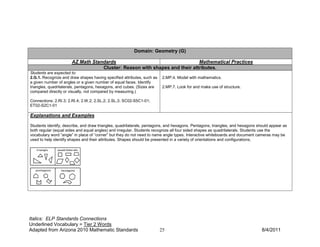
  • 109.
    Explanations and Examples Thisstandard is strongly connected to all the standards in this domain. It focuses on students being able to fluently add and subtract numbers to 20. Adding and subtracting fluently refers to knowledge of procedures, knowledge of when and how to use them appropriately, and skill in performing them flexibly, accurately, and efficiently. Mental strategies help students make sense of number relationships as they are adding and subtracting within 20. The ability to calculate mentally with efficiency is very important for all students. Mental strategies may include the following: • Counting on • Making tens (9 + 7 = 10 + 6) • Decomposing a number leading to a ten ( 14 – 6 = 14 – 4 – 2 = 10 – 2 = 8) • Fact families (8 + 5 = 13 is the same as 13 - 8 = 5) • Doubles • Doubles plus one (7 + 8 = 7 + 7 + 1) However, the use of objects, diagrams, or interactive whiteboards, and various strategies will help students develop fluency. Domain: Number and Operations in Base Ten (NBT) AZ Math Standards Mathematical Practices Cluster: Understand place value Students are expected to: 2.NBT.1. Understand that the three digits of a three-digit number 2.MP.2. Reason abstractly and quantitatively. represent amounts of hundreds, tens, and ones; e.g., 706 equals 7 hundreds, 0 tens, and 6 ones. Understand the following as special 2.MP.7. Look for and make use of structure. cases: m. 100 can be thought of as a bundle of ten tens—called a 2.MP.8. Look for and express regularity in repeated reasoning. “hundred.” n. The numbers 100, 200, 300, 400, 500, 600, 700, 800, 900 refer to one, two, three, four, five, six, seven, eight, or nine hundreds (and 0 tens and 0 ones). Connections: 2.NBT.5; 2.RI.3; 2.RI.4; 2.SL.3; ET02-S1C2-01; ET02- S1C2-01; ET02-S2C1-01 Italics: ELP Standards Connections Underlined Vocabulary = Tier 2 Words Adapted from Arizona 2010 Mathematic Standards 109 8/4/2011
  • 110.
    Explanations and Examples Understandingthat 10 ones make one ten and that 10 tens make one hundred is fundamental to students’ mathematical development. Students need multiple opportunities counting and “bundling” groups of tens in first grade. In second grade, students build on their understanding by making bundles of 100s with or without leftovers using base ten blocks, cubes in towers of 10, ten frames, etc. This emphasis on bundling hundreds will support students’ discovery of place value patterns. As students are representing the various amounts, it is important that emphasis is placed on the language associated with the quantity. For example, 243 can be expressed in multiple ways such as 2 groups of hundred, 4 groups of ten and 3 ones, as well as 24 tens with 3 ones. When students read numbers, they should read in standard form as well as using place value concepts. For example, 243 should be read as “two hundred forty-three” as well as two hundreds, 4 tens, 3 ones. A document camera or interactive whiteboard can also be used to demonstrate “bundling” of objects. This gives students the opportunity to communicate their counting and thinking. 2.NBT.2. Count within 1000; skip-count by 5s, 10s, and 100s. 2.MP.2. Reason abstractly and quantitatively. Connections: 2.NBT.8; ET02-S1C3-01 2.MP.7. Look for and make use of structure. 2.MP.8. Look for and express regularity in repeated reasoning. Explanations and Examples Students need many opportunities counting, up to 1000, from different starting points. They should also have many experiences skip counting by 5s, 10s, and 100s to develop the concept of place value. Examples: • The use of the 100s chart may be helpful for students to identify the counting patterns. • The use of money (nickels, dimes, dollars) or base ten blocks may be helpful visual cues. • The use of an interactive whiteboard may also be used to develop counting skills. The ultimate goal for second graders is to be able to count in multiple ways with no visual support. Italics: ELP Standards Connections Underlined Vocabulary = Tier 2 Words Adapted from Arizona 2010 Mathematic Standards 110 8/4/2011
  • 111.
    2.NBT.3. Read andwrite numbers to 1000 using base-ten numerals, 2.MP.2. Reason abstractly and quantitatively. number names, and expanded form. 2.MP.7. Look for and make use of structure. Connections: 2.SL.2; 2.RI.3 2.MP.8. Look for and express regularity in repeated reasoning. Explanations and Examples Students need many opportunities reading and writing numerals in multiple ways. Examples: • Base-ten numerals 637 (standard form) • Number names six hundred thirty seven (written form) • Expanded form 600 + 30 + 7 (expanded notation) When students say the expanded form, it may sound like this: “6 hundreds plus 3 tens plus 7 ones” OR 600 plus 30 plus 7.” Cluster: Use place value understanding and properties of operations to add and subtract 2.NBT.5. Fluently add and subtract within 100 using strategies based 2.MP.2. Reason abstractly and quantitatively. on place value, properties of operations, and/or the relationship between addition and subtraction. 2.MP.7. Look for and make use of structure. Connections: 2.OA.2; 2.NBT.1; 2.NBT.3; 2.RI.3; 2.W.2; 2.SL.3 2.MP.8. Look for and express regularity in repeated reasoning. Italics: ELP Standards Connections Underlined Vocabulary = Tier 2 Words Adapted from Arizona 2010 Mathematic Standards 111 8/4/2011
  • 112.
    Explanations and Examples Addingand subtracting fluently refers to knowledge of procedures, knowledge of when and how to use them appropriately, and skill in performing them flexibly, accurately, and efficiently. Students should have experiences solving problems written both horizontally and vertically. They need to communicate their thinking and be able to justify their strategies both verbally and with paper and pencil. Addition strategies based on place value for 48 + 37 may include: • Adding by place value: 40 + 30 = 70 and 8 + 7 = 15 and 70 + 15 = 85. • Incremental adding (breaking one number into tens and ones); 48 + 10 = 58, 58 + 10 = 68, 68 + 10 = 78, 78 + 7 = 85 • Compensation (making a friendly number): 48 + 2 = 50, 37 – 2 = 35, 50 + 35 = 85 Subtraction strategies based on place value for 81 - 37 may include: • Adding Up (from smaller number to larger number): 37 + 3 = 40, 40 + 40 = 80, 80 + 1 = 81, and 3 + 40 + 1 = 44. • Incremental subtracting: 81 -10 = 71, 71 – 10 = 61, 61 – 10 = 51, 51 – 7 = 44 • Subtracting by place value: 81 – 30 = 51, 51 – 7 = 44 Properties that students should know and use are: • Commutative property of addition (Example: 3 + 5 = 5 + 3) • Associative property of addition (Example: (2 + 7) + 3 = 2 + (7+3) ) • Identity property of 0 (Example: 8 + 0 = 8) Students in second grade need to communicate their understanding of why some properties work for some operations and not for others. • Commutative Property: In first grade, students investigated whether the commutative property works with subtraction. The intent was for students to recognize that taking 5 from 8 is not the same as taking 8 from 5. Students should also understand that they will be working with numbers in later grades that will allow them to subtract larger numbers from smaller numbers. This exploration of the commutative property continues in second grade. • Associative Property: Recognizing that the associative property does not work for subtraction is difficult for students to consider at this grade level as it is challenging to determine all the possibilities. 2.NBT.6. Add up to four two-digit numbers using strategies based on 2.MP.2. Reason abstractly and quantitatively. place value and properties of operations. 2.MP.7. Look for and make use of structure. Connections: 2.NBT.5; 2.RI.3; 2.W.2; 2.SL.2; ET02-S2C1-01 2.MP.8. Look for and express regularity in repeated reasoning. Italics: ELP Standards Connections Underlined Vocabulary = Tier 2 Words Adapted from Arizona 2010 Mathematic Standards 112 8/4/2011
  • 113.
    Explanations and Examples Studentsdemonstrate addition strategies with up to four two-digit numbers either with or without regrouping. Problems may be written in a story problem format to help develop a stronger understanding of larger numbers and their values. Interactive whiteboards and document cameras may also be used to model and justify student thinking. 2.NBT.7. Add and subtract within 1000, using concrete models or 2.MP.2. Reason abstractly and quantitatively. drawings and strategies based on place value, properties of operations, and/or the relationship between addition and subtraction; 2.MP.4. Model with mathematics. relate the strategy to a written method. Understand that in adding or subtracting three-digit numbers, one adds or subtracts hundreds and 2.MP.5. Use appropriate tools strategically. hundreds, tens and tens, ones and ones; and sometimes it is necessary to compose or decompose tens or hundreds. 2.MP.7. Look for and make use of structure. Connections: 2.NBT.5; 2.NBT.6; 2.RI.3; 2.SL.3; 2.W.2; ET02-S1C2-01; 2.MP.8. Look for and express regularity in repeated reasoning. ET02-S2C1-01 Explanations and Examples There is a strong connection between this standard and place value understanding with addition and subtraction of smaller numbers. Students may use concrete models or drawings to support their addition or subtraction of larger numbers. Strategies are similar to those stated in 2.NBT.5, as students extend their learning to include greater place values moving from tens to hundreds to thousands. Interactive whiteboards and document cameras may also be used to model and justify student thinking. 2.NBT.8. Mentally add 10 or 100 to a given number 100–900, and 2.MP.2. Reason abstractly and quantitatively. mentally subtract 10 or 100 from a given number 100–900. 2.MP.7. Look for and make use of structure. Connections: 2.RI.3; 2.SL.1; 2.SL.2; 2.SL.3; ET02-S2C1-01 2.MP.8. Look for and express regularity in repeated reasoning. Italics: ELP Standards Connections Underlined Vocabulary = Tier 2 Words Adapted from Arizona 2010 Mathematic Standards 113 8/4/2011
  • 114.
    Explanations and Examples Studentsneed many opportunities to practice mental math by adding and subtracting multiples of 10 and 100 up to 900 using different starting points. They can practice this by counting and thinking aloud, finding missing numbers in a sequence, and finding missing numbers on a number line or hundreds chart. Explorations should include looking for relevant patterns. Mental math strategies may include: • counting on; 300, 400, 500, etc. • counting back; 550, 450, 350, etc. Examples: • 100 more than 653 is _____ (753) • 10 less than 87 is ______ (77) • “Start at 248. Count up by 10s until I tell you to stop.” An interactive whiteboard or document camera may be used to help students develop these mental math skills. 2.NBT.9. Explain why addition and subtraction strategies work, using 2.MP.2. Reason abstractly and quantitatively. place value and the properties of operations. (Explanations may be supported by drawings or objects.) 2.MP.3. Construct viable arguments and critique the reasoning of others. Connections: 2.NBT.1; 2.RI.3; 2.RI.4; 2.W.2; 2.SL.2; 2.SL.3; ET02- S2C1-01 2.MP.4. Model with mathematics. 2.MP.5. Use appropriate tools strategically. *ELP Connection Available 2.MP.7. Look for and make use of structure. 2.MP.8. Look for and express regularity in repeated reasoning. Italics: ELP Standards Connections Underlined Vocabulary = Tier 2 Words Adapted from Arizona 2010 Mathematic Standards 114 8/4/2011
  • 115.
    Explanations and Examples Studentsneed multiple opportunities explaining their addition and subtraction thinking. Operations embedded within a meaningful context promote development of reasoning and justification. Example: Mason read 473 pages in June. He read 227 pages in July. How many pages did Mason read altogether? • Karla’s explanation: 473 + 227 = _____. I added the ones together (3 + 7) and got 10. Then I added the tens together (70 + 20) and got 90. I knew that 400 + 200 was 600. So I added 10 + 90 for 100 and added 100 + 600 and found out that Mason had read 700 pages altogether. • Debbie’s explanation: 473 + 227 = ______. I started by adding 200 to 473 and got 673. Then I added 20 to 673 and I got 693 and finally I added 7 to 693 and I knew that Mason had read 700 pages altogether. • Becky’s explanation: I used base ten blocks on a base ten mat to help me solve this problem. I added 3 ones (units) plus 7 ones and got 10 ones which made one ten. I moved the 1 ten to the tens place. I then added 7 tens rods plus 2 tens rods plus 1 tens rod and got 10 tens or 100. I moved the 1 hundred to the hundreds place. Then I added 4 hundreds plus 2 hundreds plus 1 hundred and got 7 hundreds or 700. So Mason read 700 books. Students should be able to connect different representations and explain the connections. Representations can include numbers, words (including mathematical language), pictures, number lines, and/or physical objects. Students should be able to use any/all of these representations as needed. An interactive whiteboard or document camera can be used to help students develop and explain their thinking. Italics: ELP Standards Connections Underlined Vocabulary = Tier 2 Words Adapted from Arizona 2010 Mathematic Standards 115 8/4/2011
  • 116.
    Domain: Measurement andData (MD) AZ Math Standards Mathematical Practices Cluster: Measure and estimate lengths in standard units Students are expected to: 2.MD.1. Measure the length of an object by selecting and using 2.MP.5. Use appropriate tools strategically. appropriate tools such as rulers, yardsticks, meter sticks, and measuring tapes. 2.MP.6. Attend to precision. Connections: 2.SL.3; SC02-S1C2-03 2.MP.7. Look for and make use of structure. Explanations and Examples Students in second grade will build upon what they learned in first grade from measuring length with non-standard units to the new skill of measuring length in metric and U.S. Customary with standard units of measure. They should have many experiences measuring the length of objects with rulers, yardsticks, meter sticks, and tape measures. They will need to be taught how to actually use a ruler appropriately to measure the length of an object especially as to where to begin the measuring. Do you start at the end of the ruler or at the zero? 2.MD.2. Measure the length of an object twice, using length units of 2.MP.2. Reason abstractly and quantitatively. different lengths for the two measurements; describe how the two measurements relate to the size of the unit chosen. 2.MP.3. Construct viable arguments and critique the reasoning of others. Connections: 2.MD.1; 2.MD.3; 2.MD.4; 2.RI.3; 2.RI.4; 2.W.2; 2.SL.3; SC02-S1C2-03; 2.MP.5. Use appropriate tools strategically. ET02-S2C1-02 2.MP.6. Attend to precision. *ELP Connection Available 2.MP.7. Look for and make use of structure. Italics: ELP Standards Connections Underlined Vocabulary = Tier 2 Words Adapted from Arizona 2010 Mathematic Standards 116 8/4/2011
  • 117.
    Explanations and Examples Studentsneed multiple opportunities to measure using different units of measure. They should not be limited to measuring within the same standard unit. Students should have access to tools, both U.S.Customary and metric. The more students work with a specific unit of measure, the better they become at choosing the appropriate tool when measuring. Students measure the length of the same object using different tools (ruler with inches, ruler with centimeters, a yardstick, or meter stick). This will help students learn which tool is more appropriate for measuring a given object. They describe the relationship between the size of the measurement unit and the number of units needed to measure something. For instance, a student might say, “The longer the unit, the fewer I need.” Multiple opportunities to explore provide the foundation for relating metric units to customary units, as well as relating within customary (inches to feet to yards) and within metric (centimeters to meters). 2.MD.3. Estimate lengths using units of inches, feet, centimeters, and 2.MP.5. Use appropriate tools strategically. meters. 2.MP.6. Attend to precision. Connections: 2.MD.1; 2.W.2; 2.SL.3 Italics: ELP Standards Connections Underlined Vocabulary = Tier 2 Words Adapted from Arizona 2010 Mathematic Standards 117 8/4/2011
  • 118.
    Explanations and Examples Estimationhelps develop familiarity with the specific unit of measure being used. To measure the length of a shoe, knowledge of an inch or a centimeter is important so that one can approximate the length in inches or centimeters. Students should begin practicing estimation with items which are familiar to them (length of desk, pencil, favorite book, etc.). Some useful benchmarks for measurement are: • First joint to the tip of a thumb is about an inch • Length from your elbow to your wrist is about a foot • If your arm is held out perpendicular to your body, the length from your nose to the tip of your fingers is about a yard Cluster: Relate addition and subtraction to length 2.MD.5. Use addition and subtraction within 100 to solve word 2.MP.1. Make sense of problems and persevere in solving them. problems involving lengths that are given in the same units, e.g., by using drawings (such as drawings of rulers) and equations with a 2.MP.2. Reason abstractly and quantitatively. symbol for the unknown number to represent the problem. 2.MP.4. Model with mathematics. Connections: 2.OA.1; 2.NBT.5; 2.RI.3; 2.W.2; 2.SL.2; 2.SL.3; ET02- S1C2-02 2.MP.5. Use appropriate tools strategically. 2.MP.8. Look for and express regularity in repeated reasoning. Italics: ELP Standards Connections Underlined Vocabulary = Tier 2 Words Adapted from Arizona 2010 Mathematic Standards 118 8/4/2011
  • 119.
    Explanations and Examples Studentsneed experience working with addition and subtraction to solve word problems which include measures of length. It is important that word problems stay within the same unit of measure. Counting on and/or counting back on a number line will help tie this concept to previous knowledge. Some representations students can use include drawings, rulers, pictures, and/or physical objects. An interactive whiteboard or document camera may be used to help students develop and demonstrate their thinking. Equations include: • 20 + 35 = c • c - 20 = 35 • c – 35 = 20 • 20 + b = 55 • 35 + a = 55 • 55 = a + 35 • 55 = 20 + b Example: • A word problem for 5 – n = 2 could be: Mary is making a dress. She has 5 yards of fabric. She uses some of the fabric and has 2 yards left. How many yards did Mary use? There is a strong connection between this standard and demonstrating fluency of addition and subtraction facts. Addition facts through 10 + 10 and the related subtraction facts should be included. 2.MD.6. Represent whole numbers as lengths from 0 on a number line 2.MP.2. Reason abstractly and quantitatively. diagram with equally spaced points corresponding to the numbers 0, 1, 2, … and represent whole-number sums and differences within 100 on 2.MP.4. Model with mathematics. a number line diagram. 2.MP.5. Use appropriate tools strategically. Connections: 2.NBT.2; 2.OA.1; 2.MD.5; 2.RI.3; 2.SL.3; ET02-S1C2-02 Italics: ELP Standards Connections Underlined Vocabulary = Tier 2 Words Adapted from Arizona 2010 Mathematic Standards 119 8/4/2011
  • 120.
    Explanations and Examples Studentsrepresent their thinking when adding and subtracting within 100 by using a number line. An interactive whiteboard or document camera can be used to help students demonstrate their thinking. Example: 10 – 6 = 4 Cluster: Work with time and money 2.MD.7. Tell and write time from analog and digital clocks to the 2.MP.5. Use appropriate tools strategically. nearest five minutes, using a.m. and p.m. 2.MP.6. Attend to precision. Connections: 2.NBT.2; 2.RI.3; 2.W.2; 2.SL.2; ET02-S1C2-01; ET02 S1C2-02 *ELP Connection Available Explanations and Examples In first grade, students learned to tell time to the nearest hour and half-hour. Students build on this understanding in second grade by skip- counting by 5 to recognize 5-minute intervals on the clock. They need exposure to both digital and analog clocks. It is important that they can recognize time in both formats and communicate their understanding of time using both numbers and language. Common time phrases include the following: quarter till ___, quarter after ___, ten till ___, ten after ___, and half past ___. Students should understand that there are 2 cycles of 12 hours in a day - a.m. and p.m. Recording their daily actions in a journal would be helpful for making real-world connections and understanding the difference between these two cycles. An interactive whiteboard or document camera may be used to help students demonstrate their thinking. Italics: ELP Standards Connections Underlined Vocabulary = Tier 2 Words Adapted from Arizona 2010 Mathematic Standards 120 8/4/2011
  • 121.
    2.MD.8. Solve wordproblems involving dollar bills, quarters, dimes, 2.MP.1. Make sense of problems and persevere in solving them. nickels, and pennies, using $ and ¢ symbols appropriately. Example: If you have 2 dimes and 3 pennies, how many cents do you have? 2.MP.2. Reason abstractly and quantitatively. Connections: 2.NBT.1; 2.NBT.5; 2.RI.3; 2.RI.4; 2.W.2; 2.SL.2; ET02- 2.MP.4. Model with mathematics. S1C2-01; ET02-S1C2-02 2.MP.5. Use appropriate tools strategically. *ELP Connection Available 2.MP.8. Look for and express regularity in repeated reasoning. Italics: ELP Standards Connections Underlined Vocabulary = Tier 2 Words Adapted from Arizona 2010 Mathematic Standards 121 8/4/2011
  • 122.
    Explanations and Examples Sincemoney is not specifically addressed in kindergarten, first grade, or third grade, students should have multiple opportunities to identify, count, recognize, and use coins and bills in and out of context. They should also experience making equivalent amounts using both coins and bills. “Dollar bills” should include denominations up to one hundred ($1.00, $5.00, $10.00, $20.00, $100.00). Students should solve story problems connecting the different representations. These representations may include objects, pictures, charts, tables, words, and/or numbers. Students should communicate their mathematical thinking and justify their answers. An interactive whiteboard or document camera may be used to help students demonstrate and justify their thinking. Example: Sandra went to the store and received $ 0.76 in change. What are three different sets of coins she could have received? Cluster: Represent and interpret data 2.MD.9. Generate measurement data by measuring lengths of several 2.MP.4. Model with mathematics. objects to the nearest whole unit, or by making repeated measurements of the same object. Show the measurements by making 2.MP.5. Use appropriate tools strategically. a line plot, where the horizontal scale is marked off in whole-number units. 2.MP.6. Attend to precision. Connections: 2.RI.3; 2.RI.4; 2.W.2; SC02-S1C2-04; SC02-S1C3-01; 2.MP.8. Look for and express regularity in repeated reasoning. ET02-S2C1-01 Italics: ELP Standards Connections Underlined Vocabulary = Tier 2 Words Adapted from Arizona 2010 Mathematic Standards 122 8/4/2011
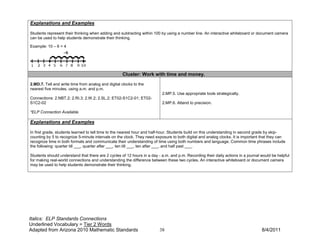
  • 123.
    Explanations and Examples Thisstandard emphasizes representing data using a line plot. Students will use the measurement skills learned in earlier standards to measure objects. Line plots are first introduced in this grade level. A line plot can be thought of as plotting data on a number line. An interactive whiteboard may be used to create and/or model line plots. Italics: ELP Standards Connections Underlined Vocabulary = Tier 2 Words Adapted from Arizona 2010 Mathematic Standards 123 8/4/2011