Maths Strategic Conversations:
findings from the Curee research
project
Michelle Jennings
Key themes
• What are practitioners’ CPD needs?
• How do learners develop Maths skills?
• What specialist Maths knowledge and or skills do vocational
practitioners need to support the contextualisation of GCSE Maths?
• What skills/knowledge will Functional Skills practitioners need in
order to teach GCSE Maths?
The challenges
• more readily available specialist ITT provision
• continuing CPD for existing functional skills practitioners to equip
them to teach GCSE
• more readily available subject specialist CPD programmes that
address the need to help teachers ensure they challenge every
learner
• promoting, modelling and enabling evidence-based good practice
in CPD
• the development of valid and useful real-time evaluations of staff
performance and current skill levels
Recommendations
• The Maths enhancement programme should be continued but
refined to address more in-depth ways of addressing learner diversity
• An English enhancement programme should also be developed
• Further probing of data should be undertaken regarding:
• the balance of access to CPD for vocational and non-vocational
staff
• differences of perception between strategic/middle leaders and
classroom practitioners
• Any substantive resulting differences should be explored via
leadership programmes and, possibly through a national debate
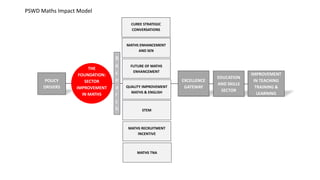
POLICY
DRIVERS
THE
FOUNDATION:
SECTOR
IMPROVEMENT
IN MATHS
FUTURE OF MATHS
ENHANCEMENT
MATHS ENHANCEMENT
AND SEN
CUREE STRATEGIC
CONVERSATIONS
QUALITY IMPROVEMENT
MATHS & ENGLISH
STEM
MATHS RECRUITMENT
INCENTIVE
MATHS TNA
EXCELLENCE
GATEWAY
EDUCATION
AND SKILLS
SECTOR
IMPROVEMENT
IN TEACHING
TRAINING &
LEARNING
PSWD Maths Impact Model
R
e
s
e
a
r
c
h
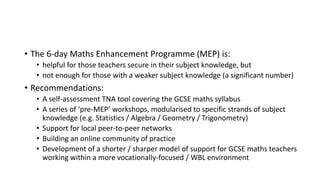
• The 6-day Maths Enhancement Programme (MEP) is:
• helpful for those teachers secure in their subject knowledge, but
• not enough for those with a weaker subject knowledge (a significant number)
• Recommendations:
• A self-assessment TNA tool covering the GCSE maths syllabus
• A series of ‘pre-MEP’ workshops, modularised to specific strands of subject
knowledge (e.g. Statistics / Algebra / Geometry / Trigonometry)
• Support for local peer-to-peer networks
• Building an online community of practice
• Development of a shorter / sharper model of support for GCSE maths teachers
working within a more vocationally-focused / WBL environment
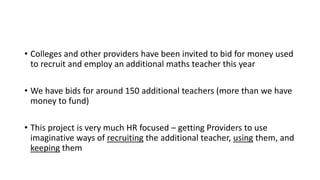
• Colleges and other providers have been invited to bid for money used
to recruit and employ an additional maths teacher this year
• We have bids for around 150 additional teachers (more than we have
money to fund)
• This project is very much HR focused – getting Providers to use
imaginative ways of recruiting the additional teacher, using them, and
keeping them
Mathematics
Mathematics
Mathematics

Maths Strategic Conversations

  • 1.
    Maths Strategic Conversations: findingsfrom the Curee research project Michelle Jennings
  • 3.
    Key themes • Whatare practitioners’ CPD needs? • How do learners develop Maths skills? • What specialist Maths knowledge and or skills do vocational practitioners need to support the contextualisation of GCSE Maths? • What skills/knowledge will Functional Skills practitioners need in order to teach GCSE Maths?
  • 4.
    The challenges • morereadily available specialist ITT provision • continuing CPD for existing functional skills practitioners to equip them to teach GCSE • more readily available subject specialist CPD programmes that address the need to help teachers ensure they challenge every learner • promoting, modelling and enabling evidence-based good practice in CPD • the development of valid and useful real-time evaluations of staff performance and current skill levels
  • 5.
    Recommendations • The Mathsenhancement programme should be continued but refined to address more in-depth ways of addressing learner diversity • An English enhancement programme should also be developed • Further probing of data should be undertaken regarding: • the balance of access to CPD for vocational and non-vocational staff • differences of perception between strategic/middle leaders and classroom practitioners • Any substantive resulting differences should be explored via leadership programmes and, possibly through a national debate
  • 6.
    POLICY DRIVERS THE FOUNDATION: SECTOR IMPROVEMENT IN MATHS FUTURE OFMATHS ENHANCEMENT MATHS ENHANCEMENT AND SEN CUREE STRATEGIC CONVERSATIONS QUALITY IMPROVEMENT MATHS & ENGLISH STEM MATHS RECRUITMENT INCENTIVE MATHS TNA EXCELLENCE GATEWAY EDUCATION AND SKILLS SECTOR IMPROVEMENT IN TEACHING TRAINING & LEARNING PSWD Maths Impact Model R e s e a r c h
  • 7.
    • The 6-dayMaths Enhancement Programme (MEP) is: • helpful for those teachers secure in their subject knowledge, but • not enough for those with a weaker subject knowledge (a significant number) • Recommendations: • A self-assessment TNA tool covering the GCSE maths syllabus • A series of ‘pre-MEP’ workshops, modularised to specific strands of subject knowledge (e.g. Statistics / Algebra / Geometry / Trigonometry) • Support for local peer-to-peer networks • Building an online community of practice • Development of a shorter / sharper model of support for GCSE maths teachers working within a more vocationally-focused / WBL environment
  • 8.
    • Colleges andother providers have been invited to bid for money used to recruit and employ an additional maths teacher this year • We have bids for around 150 additional teachers (more than we have money to fund) • This project is very much HR focused – getting Providers to use imaginative ways of recruiting the additional teacher, using them, and keeping them
  • 9.
  • 10.
  • 11.