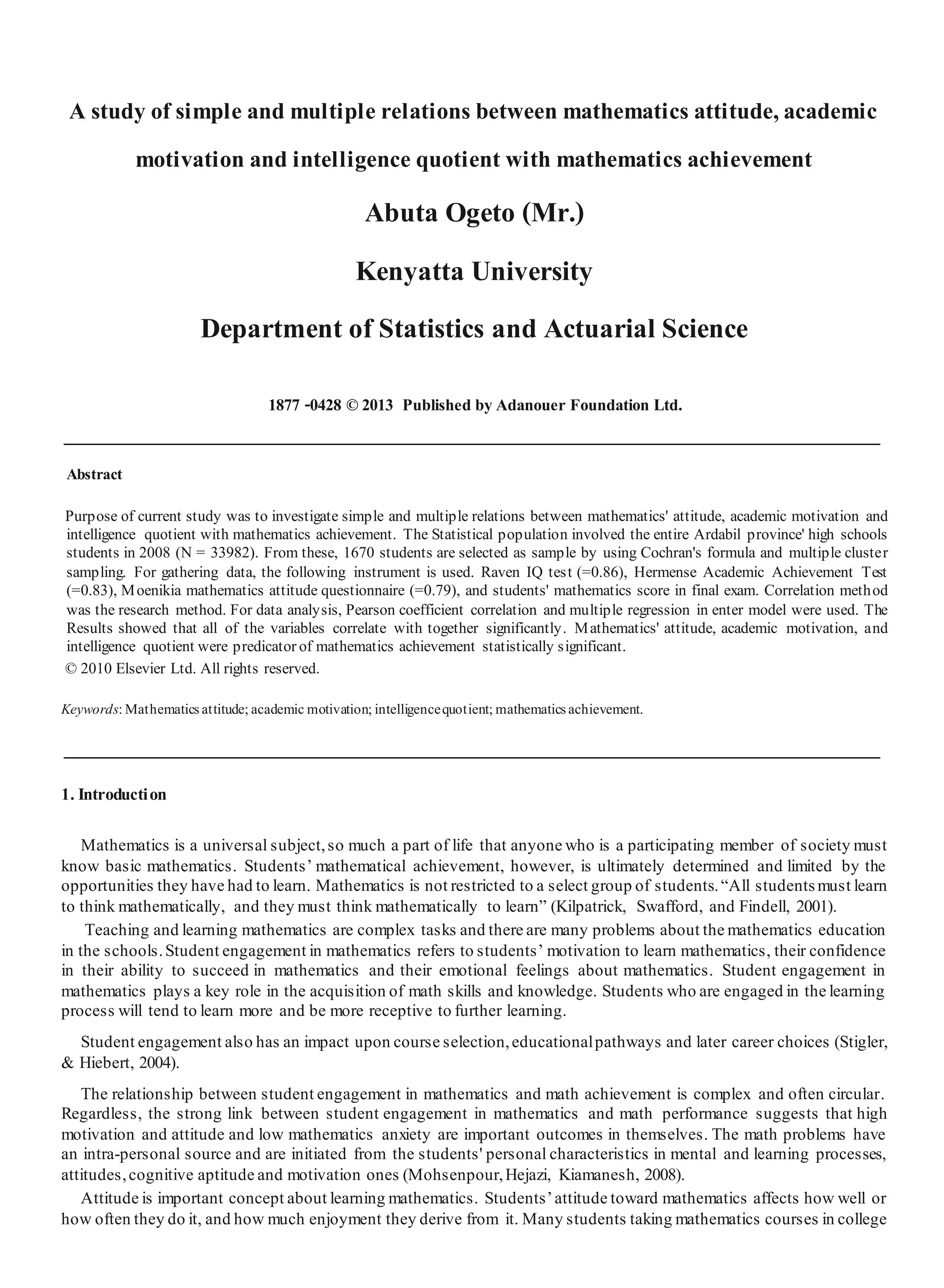
A study of simple and multiple relationsbetween mathematics attitude,academic
motivation and intelligence quotientwith mathematics achievement
Abuta Ogeto (Mr.)
Kenyatta University
Department of Statistics and Actuarial Science
1877 -0428 ©2013 Published byAdanouer Foundation Ltd.
Abstract
Purpose of current study was to investigate simple and multiple relations between mathematics' attitude, academic motivation and
intelligence quotient with mathematics achievement. The Statistical population involved the entire Ardabil province' high schools
students in 2008 (N = 33982). From these, 1670 students are selected as sample by using Cochran's formula and multiple cluster
sampling. For gathering data, the following instrument is used. Raven IQ test (=0.86), Hermense Academic Achievement Test
(=0.83), Moenikia mathematics attitude questionnaire (=0.79), and students' mathematics score in final exam. Correlation method
was the research method. For data analysis, Pearson coefficient correlation and multiple regression in enter model were used. The
Results showed that all of the variables correlate with together significantly. Mathematics' attitude, academic motivation, and
intelligence quotient were predicator of mathematics achievement statistically significant.
© 2010 Elsevier Ltd. All rights reserved.
Keywords: Mathematics attitude; academic motivation; intelligencequotient; mathematics achievement.
1. Introduction
Mathematics is a universal subject,so much a part of life that anyone who is a participating member of society must
know basic mathematics. Students’ mathematical achievement, however, is ultimately determined and limited by the
opportunities they have had to learn. Mathematics is not restricted to a select group of students.“All students must learn
to think mathematically, and they must think mathematically to learn” (Kilpatrick, Swafford, and Findell, 2001).
Teaching and learning mathematics are complex tasks and there are many problems about the mathematics education
in the schools.Student engagement in mathematics refers to students’ motivation to learn mathematics, their confidence
in their ability to succeed in mathematics and their emotional feelings about mathematics. Student engagement in
mathematics plays a key role in the acquisition of math skills and knowledge. Students who are engaged in the learning
process will tend to learn more and be more receptive to further learning.
Student engagement also has an impact upon course selection,educationalpathways and later career choices (Stigler,
& Hiebert, 2004).
The relationship between student engagement in mathematics and math achievement is complex and often circular.
Regardless, the strong link between student engagement in mathematics and math performance suggests that high
motivation and attitude and low mathematics anxiety are important outcomes in themselves. The math problems have
an intra-personal source and are initiated from the students' personal characteristics in mental and learning processes,
attitudes,cognitive aptitude and motivation ones (Mohsenpour,Hejazi, Kiamanesh, 2008).
Attitude is important concept about learning mathematics. Students’attitude toward mathematics affects how well or
how often they do it, and how much enjoyment they derive from it. Many students taking mathematics courses in college
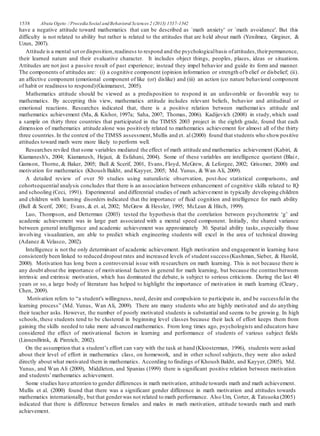
1538 Abuta Ogeto / ProcediaSocial andBehavioral Sciences 2 (2013) 1537–1542
have a negative attitude toward mathematics that can be described as `math anxiety' or `math avoidance'. But this
difficulty is not related to ability but rather is related to the attitudes that are held about math (Yenilmez, Girginer, &
Uzun, 2007).
Attitude is a mental set ordisposition,readiness to respond and the psychologicalbasis ofattitudes,theirpermanence,
their learned nature and their evaluative character. It includes object things, peoples, places, ideas or situations.
Attitudes are not just a passive result of past experience; instead they impel behavior and guide its form and manner.
The components of attitudes are: (i) a cognitive component (opinion information or strength ofb elief or disbelief; (ii).
an affective component (emotional component of like (or) dislike) and (iii) an action (co nature behavioral component
of habit or readiness to respond)(Guimaraest, 2005).
Mathematics attitude should be viewed as a predisposition to respond in an unfavorable or favorable way to
mathematics. By accepting this view, mathematics attitude includes relevant beliefs, behavior and attitudinal or
emotional reactions. Researches indicated that, there is a positive relation between mathemat ics attitude and
mathematics achievement (Ma, & Kishor, 1997a; Saha, 2007; Thomas, 2006). Kadijevich (2008) in study,which used
a sample on thirty three countries that participated in the TIMSS 2003 project in the eighth grade, found that each
dimension of mathematics attitude alone was positively related to mathematics achievement for almost all of the thirty
three countries.In the context of the TIMSS assessment,Mullis and et. al (2000) found that students who showpositive
attitudes toward math were more likely to perform well.
Researches reviled that some variables mediated the effect of math attitude and mathematics achievement (Kabiri, &
Kiamanesh's, 2004; Kiamanesh, Hejazi, & Esfahani, 2004). Some of these variables are intelligence quotient (Blair,
Gamson, Thorne, & Baker, 2005; Bull & Scerif, 2001, Evans, Floyd, McGrew, & Leforgee, 2002; Grissmer, 2000) and
motivation for mathematics (Khoush Bakht, and Kayyer, 2005; Md. Yunus, & Wan Ali, 2009).
A detailed review of over 50 studies using naturalistic observation, post-hoc statistical comparisons, and
cohortsequential analysis concludes that there is an association between enhancement of cognitive skills related to IQ
and schooling (Ceci, 1991). Experimental and differential studies of math achievement in typically developing children
and children with learning disorders indicated that the importance of fluid cognition and intelligence for math ability
(Bull & Scerif, 2001; Evans, & et. al, 2002; McGrew & Hessler, 1995; McLean & Hitch, 1999).
Luo, Thompson, and Detterman (2003) tested the hypothesis that the correlation between psychometric ‘g’ and
academic achievement was in large part associated with a mental speed component. Initially, the shared variance
between general intelligence and academic achievement was approximately 30. Spatial ability tasks, especially those
involving visualization, are able to predict which engineering students will excel in the area of technical drawing
(Adanez & Velasco, 2002).
Intelligence is not the only determinant of academic achievement. High motivation and engagement in learning have
consistently been linked to reduced dropout rates and increased levels of student success (Kushman, Sieber, & Harold,
2000). Motivation has long been a controversial issue with researchers on math learning. This is not because there is
any doubt about the importance of motivational factors in general for math learning, but because the contrast between
intrinsic and extrinsic motivation, which has dominated the debate, is subject to serious criticisms. During the last 40
years or so, a large body of literature has helped to highlight the importance of motivation in math learning (Cleary,
Chen, 2009).
Motivation refers to “a student's willingness, need, desire and compulsion to participate in, and be successfulin the
learning process” (Md. Yunus, Wan Ali, 2009). There are many students who are highly motivated and do anything
their teacher asks. However, the number of poorly motivated students is substantial and seems to be growin g. In high
schools, these students tend to be clustered in beginning level classes because their lack of effort keeps them from
gaining the skills needed to take more advanced mathematics. From long times ago, psychologists and educators have
considered the effect of motivational factors in learning and performance of students of various subject fields
(LinnenBrink, & Pintrich, 2002).
On the assumption that a student’s effort can vary with the task at hand (Kloosterman, 1996), students were asked
about their level of effort in mathematics class, on homework, and in other school subjects, they were also asked
directly about what motivated them in mathematics. According to findings of Khoush Bakht, and Kayyer, (2005), Md.
Yunus, and Wan Ali (2009), Middleton, and Spanias (1999) there is significant positive relation between motivation
and students’mathematics achievement.
Some studies have attention to gender differences in math motivation, attitude towards math and math achievement.
Mullis et al. (2000) found that there was a significant gender difference in math motivation and attitudes towards
mathematics internationally, but that genderwas not related to math performance. Also Um, Corter, & Tatsuoka (2005)
indicated that there is difference between females and males in math motivation, attitude towards math and math
achievement.
So goal ofthe current study was to determine the role of mathematics' attitude,academic motivation and intelligence
quotient on mathematics achievement and compare gender differences in these variables. 2. Method
2.1. Participants
The Statistical population involved the entire Ardabil province's high schools students (N = 33982) to be included
1359 classes in 2008-9 academic year. From these,76 classes included 1670 students are selected as sample by using
Cochran's formula and multistage cluster sampling.
2.2. Materials
The instruments of this research are Raven IQ test (=0.86), Hermense Academic Achievement Test (=0.83),
Moenikia mathematics attitude questionnaire (=0.79), and students' mathematics score in final exam. Several
researches confirmed the validity of the questionnaire (MoeniKia, Abtin, 2006).
2.3. Procedure
Research method was correlation. The questionnaire was distributed among participants and gathered data was
analyzed by using Pearson coefficient correlation and multiple regression in enter model. 3. Results
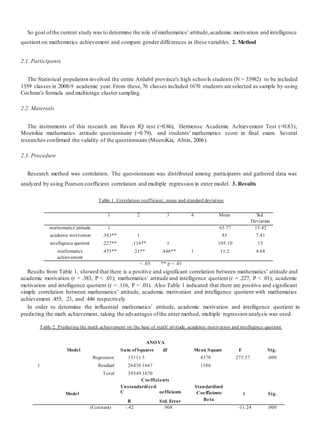
Table 1. Correlation coefficient, mean and standard deviation
1 2 3 4 Mean Std.
Deviation
mathematics' attitude 1 65.77 13.42
academic motivation .383** 1 85 7.41
intelligence quotient .227** .116** 1 105.10 15
mathematics
achievement
.455** .21** .446** 1 11.2 4.68
< .05 ** p < .01
Results from Table 1, showed that there is a positive and significant correlation between mathematics' attitude and
academic motivation (r = .383, P < .01); mathematics' attitude and intelligence quotient (r = .227, P < .01); academic
motivation and intelligence quotient (r = .116, P < .01). Also Table 1 indicated that there are positive and significant
simple correlation between mathematics' attitude, academic motivation and intelligence quotient with mathematics
achievement .455, .21, and .446 respectively.
In order to determine the influential mathematics' attitude, academic motivation and intelligence quotient in
predicting the math achievement, taking the advantages ofthe enter method, multiple regression analysis was used.
Table 2. Predicting the math achievement on the base of math' attitude, academic motivation and intelligence quotient
ANOVA
Model Sum ofSquares df Mean Square F Sig.
Regression 13111 3 4370 275.57 .000
1 Residual 26438 1667 1586
Total 39549 1670
Coefficients
Model
Unstandardized
C
B
oefficients
Std. Error
Standardized
Coefficients
Beta
t Sig.
(Constant) -.42 .908 -11.24 .000
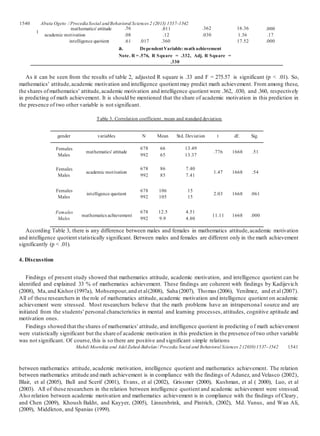
1540 Abuta Ogeto / ProcediaSocial andBehavioral Sciences 2 (2013) 1537–1542
1
mathematics' attitude
academic motivation
.56
.08
.011
.12
.362
.030
16.36
1.36
.000
.17
intelligence quotient .61 .017 .360
a. DependentVariable:math achievement
Note. R = .576, R Square = .332, Adj. R Square =
.330
17.52 .000
As it can be seen from the results of table 2, adjusted R square is .33 and F = 275.57 is significant (p < .01). So,
mathematics' attitude,academic motivation and intelligence quotient may predict math achievement. From among these,
the shares ofmathematics' attitude,academic motivation and intelligence quotient were .362, .030, and .360, respectively
in predicting of math achievement. It is should be mentioned that the share of academic motivation in this prediction in
the presence of two other variable is not significant.
Table 3. Correlation coefficient, mean and standard deviation
gender variables N Mean Std. Deviation t df. Sig.
Females
Males
mathematics' attitude
678
992
66
65
13.49
13.37
.776 1668 .51
Females
Males
academic motivation
678
992
86
85
7.40
7.41
1.47 1668 .54
Females
Males
intelligence quotient
678
992
106
105
15
15
2.03 1668 .061
Females
Males
mathematics achievement
678
992
12.5
9.9
4.51
4.80
11.11 1668 .000
According Table 3, there is any difference between males and females in mathematics attitude,academic motivation
and intelligence quotient statistically significant. Between males and females are different only in the math achievement
significantly (p < .01).
4. Discusstion
Findings of present study showed that mathematics attitude, academic motivation, and intelligence quotient can be
identified and explained 33 % of mathematics achievement. These findings are coherent with findings by Kadijevich
(2008), Ma,and Kishor (1997a), Mohsenpour,and et al(2008), Saha (2007), Thomas (2006), Yenilmez, and et al (2007).
All of these researchers in the role of mathematics attitude, academic motivation and intelligence quotient on academic
achievement were stressed. Most researchers believe that the math problems have an intrapersonal source and are
initiated from the students' personal characteristics in mental and learning processes, attitudes, cognitive aptitude and
motivation ones.
Findings showed that the shares of mathematics' attitude, and intelligence quotient in predicting o f math achievement
were statistically significant but the share of academic motivation in this prediction in the presence of two other variable
was not significant. Of course,this is so there are positive and significant simple relations
Mahdi Moenikia and Adel Zahed-Babelan/ Procedia Social and Behavioral Sciences 2 (2010)1537–1542 1541
between mathematics attitude, academic motivation, intelligence quotient and mathematics achievement. The relation
between mathematics attitude and math achievement is in compliance with the findings of Adanez, and Velasco (2002),
Blair, et al (2005), Bull and Scerif (2001), Evans, et al (2002), Grissmer (2000), Kushman, et al ( 2000), Luo, et al
(2003). All of these researchers in the relation between intelligence quotient and academic achievement were stressed.
Also relation between academic motivation and mathematics achievement is in compliance with the findings of Cleary,
and Chen (2009), Khoush Bakht, and Kayyer, (2005), Linnenbrink, and Pintrich, (2002), Md. Yunus, and Wan Ali,
(2009), Middleton, and Spanias (1999).
In contrast with Mullis et al. (2000) in present research was not found significant genderdifference in math motivation
and attitudes towards mathematics but was found that gender was related to math performance. Also this finding is
consistent with findings of Um, et al (2005) because he indicated that there is difference between females and males in
math motivation, attitude towards math and math achievement.
References
Adanez, G. P., & Velasco, A. D. (2002). Predicting academic success of engineering students in technical drawing from visualization test scores.
Journal for Geometric andGraphics, 6(1),99í109.
Blair, C., Gamson, D., Thorne, S., & Baker, D. (2005). RisingmeanIQ: Cognitive demand of mathematics educationfor youngchildren, population
exposure toformal schooling, andthe neurobiology ofthe prefrontal cortex. Intelligence, 33, 93–106.
Bull, R., & Scerif, G. (2001). Executive functioning as a predictor of children’s mathematics ability: Inhibition, switching, and working memory.
Developmental Neuropsychology,19,273–293.
Ceci, S. (1991). How much does schooling influence general intelligence and its cognitive components? A reassessment of the e vidence.
Developmental Psychology,27(5), 703–722.
Cleary, T. J., Chen,P.P.(2009). Self-regulation, motivation, andmath achievement in middle school: Variations across grade level andmath context.
Journal of School Psychology,47,291–314.
Evans, J., Floyd, R., McGrew, K. S., & LeForgee, M. (2002). The relations between measures of Cattel-Horne-Carroll (CHC) cognitiveabilities and
readingachievement duringchildhoodandadolescence.School PsychologyReview, 31(2), 246-251.
Grissmer, D. W. (2000). Thecontinuinguse andmisuse of SAT scores. Psychology,Public Policy, andLaw, 6, 223–232.
Guimaraest, H. M. (2005) Teachers and students views and attitude towards new mathematics curriculum. Journal of Educational Studies in
Mathematics, 26, 347-365.
Kabiri, M., & Kiamanesh, A.R., (2004). The Role of Self-Efficacy, Anxiety, Attitudes and Previous Math Achievement in Students' Math
Performance.Proceedings of the 3rdInternational BiennialSELF Research Conference, Self-Concept, MotivationandIdentity: Where tofrom
here? Berlin, 4 - 7 July, 2004.
Kadijevich, D. (2008). TIMSS2003: Relatingdimensions ofmathematics attitude to mathematics achievement (MA). RetrievedJune, 14,2009from:
http://www.doiserbia.nb.rs.
Khoush Bakht, F., & Kayyer, M.(2005). A surveyon motivational model of mathlearningin elementary students. Journal of Psychology, 9(1),67-
81.
Kiamanesh, A.R.,Hejazi,E., & Esfahani, Z.N.,(2004).TheRole of MathSelf-Efficacy,MathSelf-Concept, PerceivedUsefulness of
Mathematics andMath Anxietyin MathAchievement. Proceedings of the3rdInternational Biennial SELF ResearchConference, SelfConcept,
MotivationandIdentity: Wheretofromhere? Berlin, 4 - 7 July, 2004.
Kilpatrick, J., Swafford, J., & Findell, B. (2001). The strands of mathematical proficiency. Adding It up: Helping Children Learn Mathematics.
Washington,DC: The National Academies Press.
Kloosterman, P. (1996). Students’ beliefs about knowing and learning mathematics: Implications for motivation. In M. Carr (Ed.), Motivation in
mathematics (pp.131-156). Cresskill,NJ: Hampton.
Kushman, J. W., Sieber, C., & Harold, K. P. (2000).This isn’t the place for me: School dropout. InD. Capuzzi & D. R. Gross (Eds.), Youth at risk:
A preventionresource for counselors, teachers, andparents (3rded., pp.471-507). Alexandria,VA: AmericanCounselingAssociation.
Linenbrink, E.A., & Pintrich, P.R. (2002). Motivationas enabler ofacademic success. School PsychologyReview. 31(3), 313-327.
Luo, D., Thompson, L. A., & Detterman, D. K. (2003). The causal factor underlying the correlation between psychometric g and scholastic
performance. Intelligence,31(1), 67í83.
Ma, X. & Kishor, N. (1997a). Assessing the relationship between attitude toward mathematics and achievement in mathematics: A meta-analysis.
Journal for Researchin Mathematics Education, 28(1), 26-47.
McGrew, K. S., & Hessler, G. L. (1995). Therelationshipbetween theWJ-R GF-GC cognitiveclusters andmathematics achievement across the life
span. Journal of Psychoeducational Assessment, 13,21–38.
McLean, J. F., & Hitch, G. J. (1999).Workingmemory impairments in children withspecific arithmeticlearningdifficulties. Journal ofExperimental
ChildPsychology, 74, 240–260.
Md. Yunus, A. S., Wan Ali, W.Z., (2009).Motivationin the Learningof Mathematics. European Journal ofSocial Sciences , 7(4), 93-101.
Middleton, James A., & Spanias, Photini A. (1999). Motivation for achievement in mathematics: Findings, generalizations, and criticisms of the
research. Journal forResearchin Mathematics Education, 30(1), 65-88.
Moenikia, M., & Abtin, J. (2006). Relation between usingof ICT andpsychological characteristics in Ardabil secondaryschools' students. Iran,
Ardabil, educational organization
Motivation and Autonomy Support 16 from IEA’s Repeat of the Third International Mathematics and Science Study at the Eighth Grade. (The
International Study CenterBostonCollege LynchSchool of Education).
Mohsenpour, M., Hejazi, E., Kiamanesh, A. (2008). The role of self-efficacy, achievement goals, learning strategies and persistence in math
achievement of11thGrade High Schools Students in Tehran.Journal of Educational Innovations, 24,153-172.
Mullis, I.V.S., Martin, M.O., Gonzelez, E.J., Gregory, K.D., Garden, R.A., O’Connor, K.M., Chrostowski, S.J., Smith, T.A., (2000). TIMSS 1999
International Mathematics Report: Findings fromIEA’s Repeat of the ThirdInternational Mathematics andScience Study at the EighthGrade.
(The International Study Center BostonCollege Lynch School of Education)
1542 Abuta Ogeto / ProcediaSocial andBehavioral Sciences 2 (2013) 1537–1542
Saha, S. (2007).A study of Gender Attitude to Mathematics, Cognitivestyle andAchievement in mathematics. Experiments in Education,35, 61-
67.
Stigler, J., & Hiebert, J. (2004). ImprovingMathematics teaching. EducationalLeadership,61,12-17.
Thomas, J. (2006)The effects on student’s achievements andattitudes usingintegratedlearningsystems with co-operative pairs. Journal Educational
Technology Research andDevelopment 45, 51-64.
Um, E. K., Corter, J., & Tatsuoka, K. (2005).Motivation, autonomysupport, andmathematics performance: A structural equation analysis. Retrieved
June, 14, 2009, from: http://cms.tc.columbia.edu
Yenilmez, K., Girginer, N., & Uzun, A O. (2007). Mathematics anxiety and attitude level of students of the faculty of economics and business
administrator; The Turkeymodel. International Mathematical Forum,2, 2007, no. 41,1997 – 202, RetrievedJuly, 14,2009from: http://www.m-
hikari.com.

mathematics and intelligence

  • 1.
    A study ofsimple and multiple relationsbetween mathematics attitude,academic motivation and intelligence quotientwith mathematics achievement Abuta Ogeto (Mr.) Kenyatta University Department of Statistics and Actuarial Science 1877 -0428 ©2013 Published byAdanouer Foundation Ltd. Abstract Purpose of current study was to investigate simple and multiple relations between mathematics' attitude, academic motivation and intelligence quotient with mathematics achievement. The Statistical population involved the entire Ardabil province' high schools students in 2008 (N = 33982). From these, 1670 students are selected as sample by using Cochran's formula and multiple cluster sampling. For gathering data, the following instrument is used. Raven IQ test (=0.86), Hermense Academic Achievement Test (=0.83), Moenikia mathematics attitude questionnaire (=0.79), and students' mathematics score in final exam. Correlation method was the research method. For data analysis, Pearson coefficient correlation and multiple regression in enter model were used. The Results showed that all of the variables correlate with together significantly. Mathematics' attitude, academic motivation, and intelligence quotient were predicator of mathematics achievement statistically significant. © 2010 Elsevier Ltd. All rights reserved. Keywords: Mathematics attitude; academic motivation; intelligencequotient; mathematics achievement. 1. Introduction Mathematics is a universal subject,so much a part of life that anyone who is a participating member of society must know basic mathematics. Students’ mathematical achievement, however, is ultimately determined and limited by the opportunities they have had to learn. Mathematics is not restricted to a select group of students.“All students must learn to think mathematically, and they must think mathematically to learn” (Kilpatrick, Swafford, and Findell, 2001). Teaching and learning mathematics are complex tasks and there are many problems about the mathematics education in the schools.Student engagement in mathematics refers to students’ motivation to learn mathematics, their confidence in their ability to succeed in mathematics and their emotional feelings about mathematics. Student engagement in mathematics plays a key role in the acquisition of math skills and knowledge. Students who are engaged in the learning process will tend to learn more and be more receptive to further learning. Student engagement also has an impact upon course selection,educationalpathways and later career choices (Stigler, & Hiebert, 2004). The relationship between student engagement in mathematics and math achievement is complex and often circular. Regardless, the strong link between student engagement in mathematics and math performance suggests that high motivation and attitude and low mathematics anxiety are important outcomes in themselves. The math problems have an intra-personal source and are initiated from the students' personal characteristics in mental and learning processes, attitudes,cognitive aptitude and motivation ones (Mohsenpour,Hejazi, Kiamanesh, 2008). Attitude is important concept about learning mathematics. Students’attitude toward mathematics affects how well or how often they do it, and how much enjoyment they derive from it. Many students taking mathematics courses in college
  • 2.
    1538 Abuta Ogeto/ ProcediaSocial andBehavioral Sciences 2 (2013) 1537–1542 have a negative attitude toward mathematics that can be described as `math anxiety' or `math avoidance'. But this difficulty is not related to ability but rather is related to the attitudes that are held about math (Yenilmez, Girginer, & Uzun, 2007). Attitude is a mental set ordisposition,readiness to respond and the psychologicalbasis ofattitudes,theirpermanence, their learned nature and their evaluative character. It includes object things, peoples, places, ideas or situations. Attitudes are not just a passive result of past experience; instead they impel behavior and guide its form and manner. The components of attitudes are: (i) a cognitive component (opinion information or strength ofb elief or disbelief; (ii). an affective component (emotional component of like (or) dislike) and (iii) an action (co nature behavioral component of habit or readiness to respond)(Guimaraest, 2005). Mathematics attitude should be viewed as a predisposition to respond in an unfavorable or favorable way to mathematics. By accepting this view, mathematics attitude includes relevant beliefs, behavior and attitudinal or emotional reactions. Researches indicated that, there is a positive relation between mathemat ics attitude and mathematics achievement (Ma, & Kishor, 1997a; Saha, 2007; Thomas, 2006). Kadijevich (2008) in study,which used a sample on thirty three countries that participated in the TIMSS 2003 project in the eighth grade, found that each dimension of mathematics attitude alone was positively related to mathematics achievement for almost all of the thirty three countries.In the context of the TIMSS assessment,Mullis and et. al (2000) found that students who showpositive attitudes toward math were more likely to perform well. Researches reviled that some variables mediated the effect of math attitude and mathematics achievement (Kabiri, & Kiamanesh's, 2004; Kiamanesh, Hejazi, & Esfahani, 2004). Some of these variables are intelligence quotient (Blair, Gamson, Thorne, & Baker, 2005; Bull & Scerif, 2001, Evans, Floyd, McGrew, & Leforgee, 2002; Grissmer, 2000) and motivation for mathematics (Khoush Bakht, and Kayyer, 2005; Md. Yunus, & Wan Ali, 2009). A detailed review of over 50 studies using naturalistic observation, post-hoc statistical comparisons, and cohortsequential analysis concludes that there is an association between enhancement of cognitive skills related to IQ and schooling (Ceci, 1991). Experimental and differential studies of math achievement in typically developing children and children with learning disorders indicated that the importance of fluid cognition and intelligence for math ability (Bull & Scerif, 2001; Evans, & et. al, 2002; McGrew & Hessler, 1995; McLean & Hitch, 1999). Luo, Thompson, and Detterman (2003) tested the hypothesis that the correlation between psychometric ‘g’ and academic achievement was in large part associated with a mental speed component. Initially, the shared variance between general intelligence and academic achievement was approximately 30. Spatial ability tasks, especially those involving visualization, are able to predict which engineering students will excel in the area of technical drawing (Adanez & Velasco, 2002). Intelligence is not the only determinant of academic achievement. High motivation and engagement in learning have consistently been linked to reduced dropout rates and increased levels of student success (Kushman, Sieber, & Harold, 2000). Motivation has long been a controversial issue with researchers on math learning. This is not because there is any doubt about the importance of motivational factors in general for math learning, but because the contrast between intrinsic and extrinsic motivation, which has dominated the debate, is subject to serious criticisms. During the last 40 years or so, a large body of literature has helped to highlight the importance of motivation in math learning (Cleary, Chen, 2009). Motivation refers to “a student's willingness, need, desire and compulsion to participate in, and be successfulin the learning process” (Md. Yunus, Wan Ali, 2009). There are many students who are highly motivated and do anything their teacher asks. However, the number of poorly motivated students is substantial and seems to be growin g. In high schools, these students tend to be clustered in beginning level classes because their lack of effort keeps them from gaining the skills needed to take more advanced mathematics. From long times ago, psychologists and educators have considered the effect of motivational factors in learning and performance of students of various subject fields (LinnenBrink, & Pintrich, 2002). On the assumption that a student’s effort can vary with the task at hand (Kloosterman, 1996), students were asked about their level of effort in mathematics class, on homework, and in other school subjects, they were also asked directly about what motivated them in mathematics. According to findings of Khoush Bakht, and Kayyer, (2005), Md. Yunus, and Wan Ali (2009), Middleton, and Spanias (1999) there is significant positive relation between motivation and students’mathematics achievement. Some studies have attention to gender differences in math motivation, attitude towards math and math achievement. Mullis et al. (2000) found that there was a significant gender difference in math motivation and attitudes towards mathematics internationally, but that genderwas not related to math performance. Also Um, Corter, & Tatsuoka (2005) indicated that there is difference between females and males in math motivation, attitude towards math and math achievement.
  • 3.
    So goal ofthecurrent study was to determine the role of mathematics' attitude,academic motivation and intelligence quotient on mathematics achievement and compare gender differences in these variables. 2. Method 2.1. Participants The Statistical population involved the entire Ardabil province's high schools students (N = 33982) to be included 1359 classes in 2008-9 academic year. From these,76 classes included 1670 students are selected as sample by using Cochran's formula and multistage cluster sampling. 2.2. Materials The instruments of this research are Raven IQ test (=0.86), Hermense Academic Achievement Test (=0.83), Moenikia mathematics attitude questionnaire (=0.79), and students' mathematics score in final exam. Several researches confirmed the validity of the questionnaire (MoeniKia, Abtin, 2006). 2.3. Procedure Research method was correlation. The questionnaire was distributed among participants and gathered data was analyzed by using Pearson coefficient correlation and multiple regression in enter model. 3. Results Table 1. Correlation coefficient, mean and standard deviation 1 2 3 4 Mean Std. Deviation mathematics' attitude 1 65.77 13.42 academic motivation .383** 1 85 7.41 intelligence quotient .227** .116** 1 105.10 15 mathematics achievement .455** .21** .446** 1 11.2 4.68 < .05 ** p < .01 Results from Table 1, showed that there is a positive and significant correlation between mathematics' attitude and academic motivation (r = .383, P < .01); mathematics' attitude and intelligence quotient (r = .227, P < .01); academic motivation and intelligence quotient (r = .116, P < .01). Also Table 1 indicated that there are positive and significant simple correlation between mathematics' attitude, academic motivation and intelligence quotient with mathematics achievement .455, .21, and .446 respectively. In order to determine the influential mathematics' attitude, academic motivation and intelligence quotient in predicting the math achievement, taking the advantages ofthe enter method, multiple regression analysis was used. Table 2. Predicting the math achievement on the base of math' attitude, academic motivation and intelligence quotient ANOVA Model Sum ofSquares df Mean Square F Sig. Regression 13111 3 4370 275.57 .000 1 Residual 26438 1667 1586 Total 39549 1670 Coefficients Model Unstandardized C B oefficients Std. Error Standardized Coefficients Beta t Sig. (Constant) -.42 .908 -11.24 .000
  • 4.
    1540 Abuta Ogeto/ ProcediaSocial andBehavioral Sciences 2 (2013) 1537–1542 1 mathematics' attitude academic motivation .56 .08 .011 .12 .362 .030 16.36 1.36 .000 .17 intelligence quotient .61 .017 .360 a. DependentVariable:math achievement Note. R = .576, R Square = .332, Adj. R Square = .330 17.52 .000 As it can be seen from the results of table 2, adjusted R square is .33 and F = 275.57 is significant (p < .01). So, mathematics' attitude,academic motivation and intelligence quotient may predict math achievement. From among these, the shares ofmathematics' attitude,academic motivation and intelligence quotient were .362, .030, and .360, respectively in predicting of math achievement. It is should be mentioned that the share of academic motivation in this prediction in the presence of two other variable is not significant. Table 3. Correlation coefficient, mean and standard deviation gender variables N Mean Std. Deviation t df. Sig. Females Males mathematics' attitude 678 992 66 65 13.49 13.37 .776 1668 .51 Females Males academic motivation 678 992 86 85 7.40 7.41 1.47 1668 .54 Females Males intelligence quotient 678 992 106 105 15 15 2.03 1668 .061 Females Males mathematics achievement 678 992 12.5 9.9 4.51 4.80 11.11 1668 .000 According Table 3, there is any difference between males and females in mathematics attitude,academic motivation and intelligence quotient statistically significant. Between males and females are different only in the math achievement significantly (p < .01). 4. Discusstion Findings of present study showed that mathematics attitude, academic motivation, and intelligence quotient can be identified and explained 33 % of mathematics achievement. These findings are coherent with findings by Kadijevich (2008), Ma,and Kishor (1997a), Mohsenpour,and et al(2008), Saha (2007), Thomas (2006), Yenilmez, and et al (2007). All of these researchers in the role of mathematics attitude, academic motivation and intelligence quotient on academic achievement were stressed. Most researchers believe that the math problems have an intrapersonal source and are initiated from the students' personal characteristics in mental and learning processes, attitudes, cognitive aptitude and motivation ones. Findings showed that the shares of mathematics' attitude, and intelligence quotient in predicting o f math achievement were statistically significant but the share of academic motivation in this prediction in the presence of two other variable was not significant. Of course,this is so there are positive and significant simple relations Mahdi Moenikia and Adel Zahed-Babelan/ Procedia Social and Behavioral Sciences 2 (2010)1537–1542 1541 between mathematics attitude, academic motivation, intelligence quotient and mathematics achievement. The relation between mathematics attitude and math achievement is in compliance with the findings of Adanez, and Velasco (2002), Blair, et al (2005), Bull and Scerif (2001), Evans, et al (2002), Grissmer (2000), Kushman, et al ( 2000), Luo, et al (2003). All of these researchers in the relation between intelligence quotient and academic achievement were stressed. Also relation between academic motivation and mathematics achievement is in compliance with the findings of Cleary, and Chen (2009), Khoush Bakht, and Kayyer, (2005), Linnenbrink, and Pintrich, (2002), Md. Yunus, and Wan Ali, (2009), Middleton, and Spanias (1999).
  • 5.
    In contrast withMullis et al. (2000) in present research was not found significant genderdifference in math motivation and attitudes towards mathematics but was found that gender was related to math performance. Also this finding is consistent with findings of Um, et al (2005) because he indicated that there is difference between females and males in math motivation, attitude towards math and math achievement. References Adanez, G. P., & Velasco, A. D. (2002). Predicting academic success of engineering students in technical drawing from visualization test scores. Journal for Geometric andGraphics, 6(1),99í109. Blair, C., Gamson, D., Thorne, S., & Baker, D. (2005). RisingmeanIQ: Cognitive demand of mathematics educationfor youngchildren, population exposure toformal schooling, andthe neurobiology ofthe prefrontal cortex. Intelligence, 33, 93–106. Bull, R., & Scerif, G. (2001). Executive functioning as a predictor of children’s mathematics ability: Inhibition, switching, and working memory. Developmental Neuropsychology,19,273–293. Ceci, S. (1991). How much does schooling influence general intelligence and its cognitive components? A reassessment of the e vidence. Developmental Psychology,27(5), 703–722. Cleary, T. J., Chen,P.P.(2009). Self-regulation, motivation, andmath achievement in middle school: Variations across grade level andmath context. Journal of School Psychology,47,291–314. Evans, J., Floyd, R., McGrew, K. S., & LeForgee, M. (2002). The relations between measures of Cattel-Horne-Carroll (CHC) cognitiveabilities and readingachievement duringchildhoodandadolescence.School PsychologyReview, 31(2), 246-251. Grissmer, D. W. (2000). Thecontinuinguse andmisuse of SAT scores. Psychology,Public Policy, andLaw, 6, 223–232. Guimaraest, H. M. (2005) Teachers and students views and attitude towards new mathematics curriculum. Journal of Educational Studies in Mathematics, 26, 347-365. Kabiri, M., & Kiamanesh, A.R., (2004). The Role of Self-Efficacy, Anxiety, Attitudes and Previous Math Achievement in Students' Math Performance.Proceedings of the 3rdInternational BiennialSELF Research Conference, Self-Concept, MotivationandIdentity: Where tofrom here? Berlin, 4 - 7 July, 2004. Kadijevich, D. (2008). TIMSS2003: Relatingdimensions ofmathematics attitude to mathematics achievement (MA). RetrievedJune, 14,2009from: http://www.doiserbia.nb.rs. Khoush Bakht, F., & Kayyer, M.(2005). A surveyon motivational model of mathlearningin elementary students. Journal of Psychology, 9(1),67- 81. Kiamanesh, A.R.,Hejazi,E., & Esfahani, Z.N.,(2004).TheRole of MathSelf-Efficacy,MathSelf-Concept, PerceivedUsefulness of Mathematics andMath Anxietyin MathAchievement. Proceedings of the3rdInternational Biennial SELF ResearchConference, SelfConcept, MotivationandIdentity: Wheretofromhere? Berlin, 4 - 7 July, 2004. Kilpatrick, J., Swafford, J., & Findell, B. (2001). The strands of mathematical proficiency. Adding It up: Helping Children Learn Mathematics. Washington,DC: The National Academies Press. Kloosterman, P. (1996). Students’ beliefs about knowing and learning mathematics: Implications for motivation. In M. Carr (Ed.), Motivation in mathematics (pp.131-156). Cresskill,NJ: Hampton. Kushman, J. W., Sieber, C., & Harold, K. P. (2000).This isn’t the place for me: School dropout. InD. Capuzzi & D. R. Gross (Eds.), Youth at risk: A preventionresource for counselors, teachers, andparents (3rded., pp.471-507). Alexandria,VA: AmericanCounselingAssociation. Linenbrink, E.A., & Pintrich, P.R. (2002). Motivationas enabler ofacademic success. School PsychologyReview. 31(3), 313-327. Luo, D., Thompson, L. A., & Detterman, D. K. (2003). The causal factor underlying the correlation between psychometric g and scholastic performance. Intelligence,31(1), 67í83. Ma, X. & Kishor, N. (1997a). Assessing the relationship between attitude toward mathematics and achievement in mathematics: A meta-analysis. Journal for Researchin Mathematics Education, 28(1), 26-47. McGrew, K. S., & Hessler, G. L. (1995). Therelationshipbetween theWJ-R GF-GC cognitiveclusters andmathematics achievement across the life span. Journal of Psychoeducational Assessment, 13,21–38. McLean, J. F., & Hitch, G. J. (1999).Workingmemory impairments in children withspecific arithmeticlearningdifficulties. Journal ofExperimental ChildPsychology, 74, 240–260. Md. Yunus, A. S., Wan Ali, W.Z., (2009).Motivationin the Learningof Mathematics. European Journal ofSocial Sciences , 7(4), 93-101. Middleton, James A., & Spanias, Photini A. (1999). Motivation for achievement in mathematics: Findings, generalizations, and criticisms of the research. Journal forResearchin Mathematics Education, 30(1), 65-88. Moenikia, M., & Abtin, J. (2006). Relation between usingof ICT andpsychological characteristics in Ardabil secondaryschools' students. Iran, Ardabil, educational organization Motivation and Autonomy Support 16 from IEA’s Repeat of the Third International Mathematics and Science Study at the Eighth Grade. (The International Study CenterBostonCollege LynchSchool of Education). Mohsenpour, M., Hejazi, E., Kiamanesh, A. (2008). The role of self-efficacy, achievement goals, learning strategies and persistence in math achievement of11thGrade High Schools Students in Tehran.Journal of Educational Innovations, 24,153-172. Mullis, I.V.S., Martin, M.O., Gonzelez, E.J., Gregory, K.D., Garden, R.A., O’Connor, K.M., Chrostowski, S.J., Smith, T.A., (2000). TIMSS 1999 International Mathematics Report: Findings fromIEA’s Repeat of the ThirdInternational Mathematics andScience Study at the EighthGrade. (The International Study Center BostonCollege Lynch School of Education)
  • 6.
    1542 Abuta Ogeto/ ProcediaSocial andBehavioral Sciences 2 (2013) 1537–1542 Saha, S. (2007).A study of Gender Attitude to Mathematics, Cognitivestyle andAchievement in mathematics. Experiments in Education,35, 61- 67. Stigler, J., & Hiebert, J. (2004). ImprovingMathematics teaching. EducationalLeadership,61,12-17. Thomas, J. (2006)The effects on student’s achievements andattitudes usingintegratedlearningsystems with co-operative pairs. Journal Educational Technology Research andDevelopment 45, 51-64. Um, E. K., Corter, J., & Tatsuoka, K. (2005).Motivation, autonomysupport, andmathematics performance: A structural equation analysis. Retrieved June, 14, 2009, from: http://cms.tc.columbia.edu Yenilmez, K., Girginer, N., & Uzun, A O. (2007). Mathematics anxiety and attitude level of students of the faculty of economics and business administrator; The Turkeymodel. International Mathematical Forum,2, 2007, no. 41,1997 – 202, RetrievedJuly, 14,2009from: http://www.m- hikari.com.