MATH IN THE NEWS
Issue 96
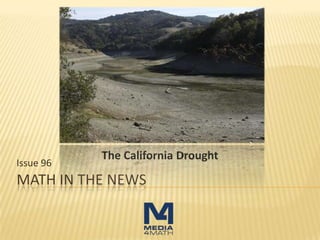
The California Drought
THE CALIFORNIA DROUGHT
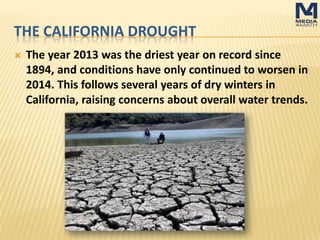
 The year 2013 was the driest year on record since 1894,
and conditions have only continued to worsen in 2014.
This follows several years of dry winters in California,
raising concerns about overall water trends.
THE CALIFORNIA DROUGHT
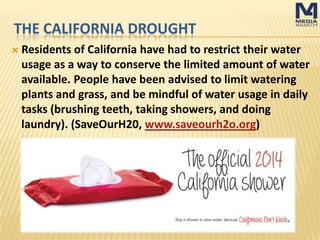
Residents of California have had to restrict their water
usage as a way to conserve the limited amount of water
available. People have been advised to limit watering
plants and grass, and be mindful of water usage in daily
tasks (brushing teeth, taking showers, and doing
laundry). (SaveOurH20, www.saveourh2o.org)
THE CALIFORNIA DROUGHT
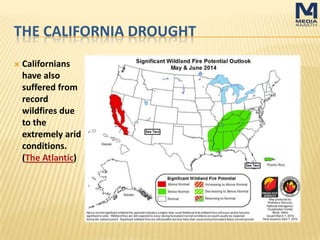
Californians
have also
suffered from
record wildfires
due to the
extremely arid
conditions. (The
Atlantic)
THE CALIFORNIA DROUGHT
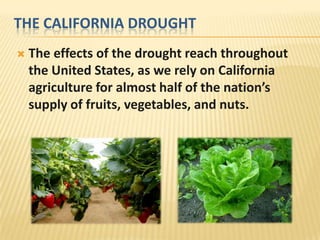
 The effects of the drought reach throughout
the United States, as we rely on California
agriculture for almost half of the nation’s
supply of fruits, vegetables, and nuts.
THE CALIFORNIA DROUGHT
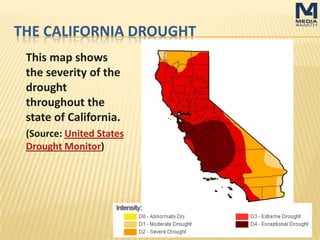
This map shows the
severity of the
drought throughout
the state of
California.
(Source: United States
Drought Monitor)
THE CALIFORNIA DROUGHT
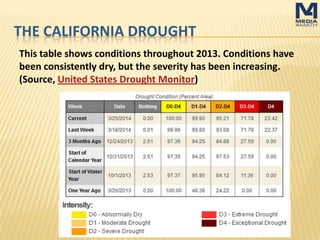
This table shows conditions throughout 2013. Conditions have
been consistently dry, but the severity has been increasing.
(Source, United States Drought Monitor)
THE CALIFORNIA DROUGHT
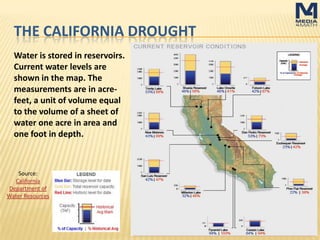
Water is stored in reservoirs.
Current water levels are
shown in the map. The
measurements are in acre-
feet, a unit of volume equal
to the volume of a sheet of
water one acre in area and
one foot in depth.
Source: California
Department of
Water Resources
THE CALIFORNIA DROUGHT
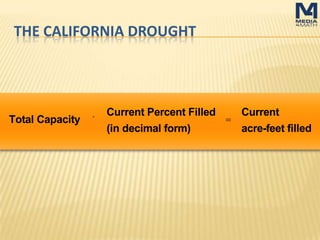
With this information, we can
assess the differences between
current water levels and average
water levels, and current water
levels and capacity.
THE CALIFORNIA DROUGHT
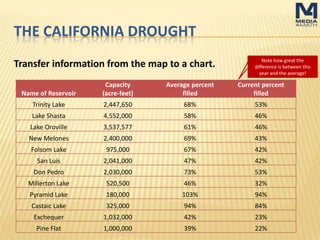
Transfer information from the map to a chart.
Name of Reservoir
Capacity
(acre-feet)
Average percent
filled
Current percent
filled
Trinity Lake 2,447,650 68% 53%
Lake Shasta 4,552,000 58% 46%
Lake Oroville 3,537,577 61% 46%
New Melones 2,400,000 69% 43%
Folsom Lake 975,000 67% 42%
San Luis 2,041,000 47% 42%
Don Pedro 2,030,000 73% 53%
Millerton Lake 520,500 46% 32%
Pyramid Lake 180,000 103% 94%
Castaic Lake 325,000 94% 84%
Exchequer 1,032,000 42% 23%
Pine Flat 1,000,000 39% 22%
Note how great the difference
is between this year and the
average!
THE CALIFORNIA DROUGHT
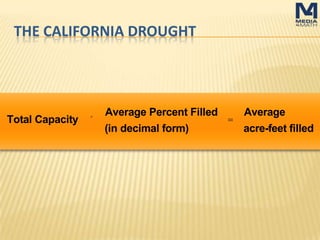
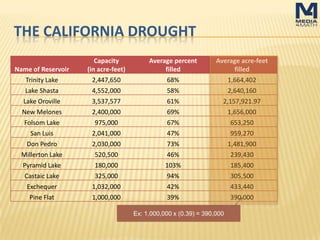
What is the average amount of
acre-feet of water in each
reservoir at this time of year?
THE CALIFORNIA DROUGHT
Name of Reservoir
Capacity
(in acre-feet)
Average percent
filled
Average acre-feet
filled
Trinity Lake 2,447,650 68% 1,664,402
Lake Shasta 4,552,000 58% 2,640,160
Lake Oroville 3,537,577 61% 2,157,921.97
New Melones 2,400,000 69% 1,656,000
Folsom Lake 975,000 67% 653,250
San Luis 2,041,000 47% 959,270
Don Pedro 2,030,000 73% 1,481,900
Millerton Lake 520,500 46% 239,430
Pyramid Lake 180,000 103% 185,400
Castaic Lake 325,000 94% 305,500
Exchequer 1,032,000 42% 433,440
Pine Flat 1,000,000 39% 390,000
Ex: 1,000,000 x (0.39) = 390,000
THE CALIFORNIA DROUGHT
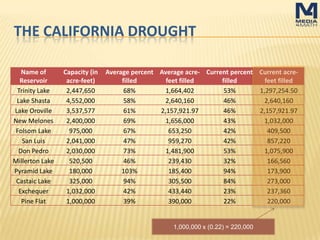
How many acre-feet of water are
currently in the reservoirs?
THE CALIFORNIA DROUGHT
Name of
Reservoir
Capacity (in
acre-feet)
Average
percent filled
Average acre-
feet filled
Current percent
filled
Current acre-
feet filled
Trinity Lake 2,447,650 68% 1,664,402 53% 1,297,254.50
Lake Shasta 4,552,000 58% 2,640,160 46% 2,640,160
Lake Oroville 3,537,577 61% 2,157,921.97 46% 2,157,921.97
New Melones 2,400,000 69% 1,656,000 43% 1,032,000
Folsom Lake 975,000 67% 653,250 42% 409,500
San Luis 2,041,000 47% 959,270 42% 857,220
Don Pedro 2,030,000 73% 1,481,900 53% 1,075,900
Millerton Lake 520,500 46% 239,430 32% 166,560
Pyramid Lake 180,000 103% 185,400 94% 173,900
Castaic Lake 325,000 94% 305,500 84% 273,000
Exchequer 1,032,000 42% 433,440 23% 237,360
Pine Flat 1,000,000 39% 390,000 22% 220,000
1,000,000 x (0.22) = 220,000
THE CALIFORNIA DROUGHT
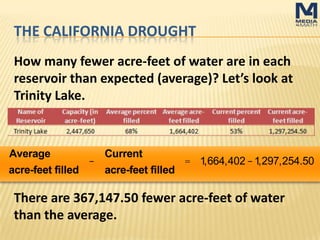
How many fewer acre-feet of water are in each
reservoir than expected (average)? Let’s look at
Trinity Lake.
There are 367,147.50 fewer acre-feet of water than
the average.
THE CALIFORNIA DROUGHT
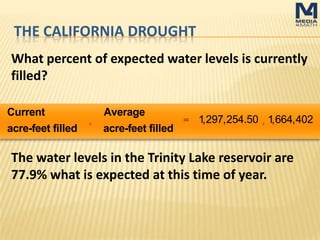
What percent of expected water levels is currently
filled?
The water levels in the Trinity Lake reservoir are
77.9% what is expected at this time of year.
THE CALIFORNIA DROUGHT
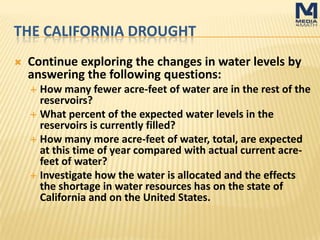
 Continue exploring the changes in water levels by
answering the following questions:
 How many fewer acre-feet of water are in the rest of the
reservoirs?
 What percent of the expected water levels in the reservoirs
is currently filled?
 How many more acre-feet of water, total, are expected at
this time of year compared with actual current acre-feet of
water?
 Investigate how the water is allocated and the effects the
shortage in water resources has on the state of California
and on the United States.

Math in the News: Issue 96

  • 1.
    MATH IN THENEWS Issue 96 The California Drought
  • 2.
    THE CALIFORNIA DROUGHT The year 2013 was the driest year on record since 1894, and conditions have only continued to worsen in 2014. This follows several years of dry winters in California, raising concerns about overall water trends.
  • 3.
    THE CALIFORNIA DROUGHT Residentsof California have had to restrict their water usage as a way to conserve the limited amount of water available. People have been advised to limit watering plants and grass, and be mindful of water usage in daily tasks (brushing teeth, taking showers, and doing laundry). (SaveOurH20, www.saveourh2o.org)
  • 4.
    THE CALIFORNIA DROUGHT Californians havealso suffered from record wildfires due to the extremely arid conditions. (The Atlantic)
  • 5.
    THE CALIFORNIA DROUGHT The effects of the drought reach throughout the United States, as we rely on California agriculture for almost half of the nation’s supply of fruits, vegetables, and nuts.
  • 6.
    THE CALIFORNIA DROUGHT Thismap shows the severity of the drought throughout the state of California. (Source: United States Drought Monitor)
  • 7.
    THE CALIFORNIA DROUGHT Thistable shows conditions throughout 2013. Conditions have been consistently dry, but the severity has been increasing. (Source, United States Drought Monitor)
  • 8.
    THE CALIFORNIA DROUGHT Wateris stored in reservoirs. Current water levels are shown in the map. The measurements are in acre- feet, a unit of volume equal to the volume of a sheet of water one acre in area and one foot in depth. Source: California Department of Water Resources
  • 9.
    THE CALIFORNIA DROUGHT Withthis information, we can assess the differences between current water levels and average water levels, and current water levels and capacity.
  • 10.
    THE CALIFORNIA DROUGHT Transferinformation from the map to a chart. Name of Reservoir Capacity (acre-feet) Average percent filled Current percent filled Trinity Lake 2,447,650 68% 53% Lake Shasta 4,552,000 58% 46% Lake Oroville 3,537,577 61% 46% New Melones 2,400,000 69% 43% Folsom Lake 975,000 67% 42% San Luis 2,041,000 47% 42% Don Pedro 2,030,000 73% 53% Millerton Lake 520,500 46% 32% Pyramid Lake 180,000 103% 94% Castaic Lake 325,000 94% 84% Exchequer 1,032,000 42% 23% Pine Flat 1,000,000 39% 22% Note how great the difference is between this year and the average!
  • 11.
    THE CALIFORNIA DROUGHT Whatis the average amount of acre-feet of water in each reservoir at this time of year?
  • 12.
  • 13.
    THE CALIFORNIA DROUGHT Nameof Reservoir Capacity (in acre-feet) Average percent filled Average acre-feet filled Trinity Lake 2,447,650 68% 1,664,402 Lake Shasta 4,552,000 58% 2,640,160 Lake Oroville 3,537,577 61% 2,157,921.97 New Melones 2,400,000 69% 1,656,000 Folsom Lake 975,000 67% 653,250 San Luis 2,041,000 47% 959,270 Don Pedro 2,030,000 73% 1,481,900 Millerton Lake 520,500 46% 239,430 Pyramid Lake 180,000 103% 185,400 Castaic Lake 325,000 94% 305,500 Exchequer 1,032,000 42% 433,440 Pine Flat 1,000,000 39% 390,000 Ex: 1,000,000 x (0.39) = 390,000
  • 14.
    THE CALIFORNIA DROUGHT Howmany acre-feet of water are currently in the reservoirs?
  • 15.
  • 16.
    THE CALIFORNIA DROUGHT Nameof Reservoir Capacity (in acre-feet) Average percent filled Average acre- feet filled Current percent filled Current acre- feet filled Trinity Lake 2,447,650 68% 1,664,402 53% 1,297,254.50 Lake Shasta 4,552,000 58% 2,640,160 46% 2,640,160 Lake Oroville 3,537,577 61% 2,157,921.97 46% 2,157,921.97 New Melones 2,400,000 69% 1,656,000 43% 1,032,000 Folsom Lake 975,000 67% 653,250 42% 409,500 San Luis 2,041,000 47% 959,270 42% 857,220 Don Pedro 2,030,000 73% 1,481,900 53% 1,075,900 Millerton Lake 520,500 46% 239,430 32% 166,560 Pyramid Lake 180,000 103% 185,400 94% 173,900 Castaic Lake 325,000 94% 305,500 84% 273,000 Exchequer 1,032,000 42% 433,440 23% 237,360 Pine Flat 1,000,000 39% 390,000 22% 220,000 1,000,000 x (0.22) = 220,000
  • 17.
    THE CALIFORNIA DROUGHT Howmany fewer acre-feet of water are in each reservoir than expected (average)? Let’s look at Trinity Lake. There are 367,147.50 fewer acre-feet of water than the average.
  • 18.
    THE CALIFORNIA DROUGHT Whatpercent of expected water levels is currently filled? The water levels in the Trinity Lake reservoir are 77.9% what is expected at this time of year.
  • 19.
    THE CALIFORNIA DROUGHT Continue exploring the changes in water levels by answering the following questions:  How many fewer acre-feet of water are in the rest of the reservoirs?  What percent of the expected water levels in the reservoirs is currently filled?  How many more acre-feet of water, total, are expected at this time of year compared with actual current acre-feet of water?  Investigate how the water is allocated and the effects the shortage in water resources has on the state of California and on the United States.

Editor's Notes

  • #2 Photo credit Reuters/ibtimes http://www.ibtimes.com/current-california-drought-driest-states-history-scientists-fear-megadroughts-their-way-1548912
  • #3 Photo credit AP, information sources from The Guardian, “California drought is ready for a Silicon Valley moment – and futuristic farms,” Mar. 25, 2014, http://www.theguardian.com/commentisfree/2014/mar/25/california-drought-silicon-valley-moment
  • #5 The Atlantic Cities, Place Matters. California's Drought: More Wildfires, Higher Food Prices, March 21,2014. Retrieved from http://www.theatlanticcities.com/jobs-and-economy/2014/03/no-relief-sight-drought-ravished-california/8696/.
  • #6 The Guardian, “California drought is ready for a Silicon Valley moment – and futuristic farms,” Mar. 25, 2014, http://www.theguardian.com/commentisfree/2014/mar/25/california-drought-silicon-valley-moment. Strawberry image - http://www.strawberry-plants.com/about-us.htm,
  • #7 http://droughtmonitor.unl.edu/Home/StateDroughtMonitor.aspx?CA
  • #8 http://droughtmonitor.unl.edu/Home/StateDroughtMonitor.aspx?CA
  • #9 http://cdec.water.ca.gov/cdecapp/resapp/getResGraphsMain.action