Lacsap’s Fraction


                                   Erika Mingo

                                   IB Math SL 1

                           Internal Assessment Type 1


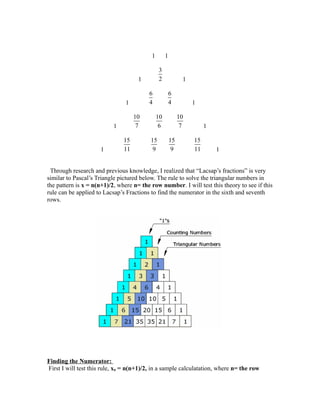
In this task “Lacsap’s Fractions” the following pattern occurs:
1        1

                                               3
                                     1         2             1

                                         6             6
                                1        4             4         1

                                    10        10            10
                           1         7         6             7        1

                               15         15           15        15
                     1         11          9            9        11       1


 Through research and previous knowledge, I realized that “Lacsap’s fractions” is very
similar to Pascal’s Triangle pictured below. The rule to solve the triangular numbers in
the pattern is x = n(n+1)/2, where n= the row number. I will test this theory to see if this
rule can be applied to Lacsap’s Fractions to find the numerator in the sixth and seventh
rows.


Finding the Numerator:
First I will test this rule, xn = n(n+1)/2, in a sample calculatation, where n= the row
number.
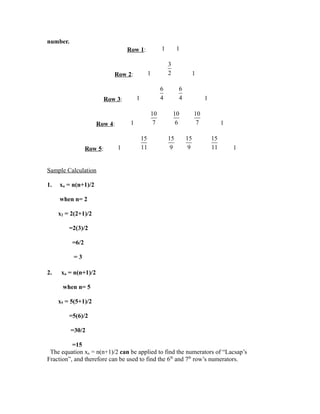
                                   Row 1:             1        1

                                                          3
                             Row 2:              1        2             1

                                                      6        6
                          Row 3:        1             4        4             1

                                                 10           10        10
                      Row 4:        1             7            6         7            1

                                            15            15       15            15
                 Row 5:        1            11             9        9            11       1


Sample Calculation

1.   xn = n(n+1)/2

     when n= 2

     x2 = 2(2+1)/2

         =2(3)/2

          =6/2

           =3

2.    xn = n(n+1)/2

      when n= 5

     x5 = 5(5+1)/2

         =5(6)/2

          =30/2

          =15
 The equation xn = n(n+1)/2 can be applied to find the numerators of “Lacsap’s
Fraction”, and therefore can be used to find the 6th and 7th row’s numerators.
6th Row:
   xn = n(n+1)/2

      when n= 6

    x6 = 6(6+1)/2

        =6(7)/2

         =42/2

        =21
Therefore, sixth row’s numerator is 21.

7th Row:
    xn = n(n+1)/2

      when n= 7

    x6 = 7(7+1)/2

        =7(8)/2

         =56/2

        =28
Therefore, the seventh row’s numerator is 28.


Table 1: This table shows the relationship between the row number and the value of the
numerator
Row Number (n)       Numerator
1                   1
2                   3
3                   6
4                   10
5                   15
6                   21
7                   28
Values of the Numerators
                                         As They Relate to the Row Number

               30
               25
 a lu e s


               20
 V


               15
 e r a t o r


               10
 u m


                5
 N


                0
               row 1         row 2            row 3            row 4          row 5       row 6       row 7

                                                          Row Numbers

               This graph depicts the relationship between row numbers and the values of the
                                                 numerators

Finding the Denominator:
When looking at ‘Lacsap’s Fractions”, I found a pattern between the differences of the
denominator and numerator that is similar to Pascal’s Triangle.

This depicts the pattern of the differences of the denominator and the numerator.

                                               Row 1:            1}0          1}0

                                                                       3
                                         Row 2:            1           2 }1           1

                                                                 6             6
                                Row 3:                1          4 }2          4 }2           1

                                                      10               10             10
                       Row 4:             1            7 }3             6 }4           7 }3       1

                                                15                 15           15        15
                    Row 5:           1          11 } 4              9 }6         9 }6     11 }4       1

This depicts the pattern of the differences of the denominator and the numerator.
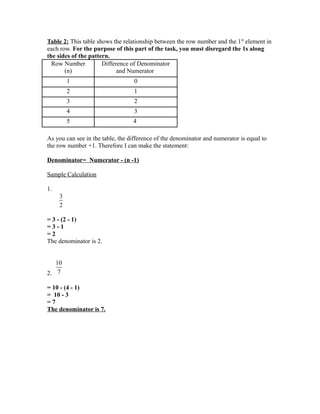
Table 2: This table shows the relationship between the row number and the 1st element in
each row. For the purpose of this part of the task, you must disregard the 1s along
the sides of the pattern.
  Row Number          Difference of Denominator
       (n)                  and Numerator
         1                        0
         2                        1
         3                        2
         4                        3
         5                        4

As you can see in the table, the difference of the denominator and numerator is equal to
the row number +1. Therefore I can make the statement:

Denominator= Numerator - (n -1)

Sample Calculation

1.
     3
     2

= 3 - (2 - 1)
=3-1
=2
The denominator is 2.


   10
2. 7

= 10 - (4 - 1)
= 10 - 3
=7
The denominator is 7.
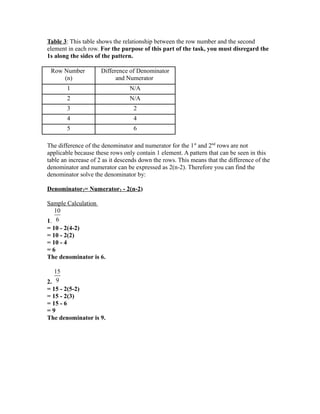
Table 3: This table shows the relationship between the row number and the second
element in each row. For the purpose of this part of the task, you must disregard the
1s along the sides of the pattern.

 Row Number          Difference of Denominator
     (n)                   and Numerator
        1                        N/A
        2                        N/A
        3                         2
        4                         4
        5                         6

The difference of the denominator and numerator for the 1st and 2nd rows are not
applicable because these rows only contain 1 element. A pattern that can be seen in this
table an increase of 2 as it descends down the rows. This means that the difference of the
denominator and numerator can be expressed as 2(n-2). Therefore you can find the
denominator solve the denominator by:

Denominator2= Numerator2 - 2(n-2)

Sample Calculation
   10
1. 6
= 10 - 2(4-2)
= 10 - 2(2)
= 10 - 4
=6
The denominator is 6.

   15
2. 9
= 15 - 2(5-2)
= 15 - 2(3)
= 15 - 6
=9
The denominator is 9.
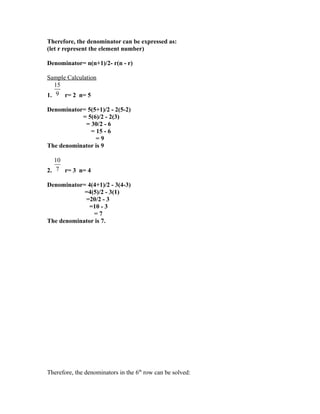
Therefore, the denominator can be expressed as:
(let r represent the element number)

Denominator= n(n+1)/2- r(n - r)

Sample Calculation
   15
1. 9 r= 2 n= 5

Denominator= 5(5+1)/2 - 2(5-2)
           = 5(6)/2 - 2(3)
            = 30/2 - 6
              = 15 - 6
                =9
The denominator is 9

   10
2. 7 r= 3 n= 4

Denominator= 4(4+1)/2 - 3(4-3)
            =4(5)/2 - 3(1)
            =20/2 - 3
              =10 - 3
               =7
The denominator is 7.


Therefore, the denominators in the 6th row can be solved:
1st Element Denominator1= 6(6+1)/2- 1(6 - 1)
                           =6(7)/2 -1(5)
                            =42/2 - 5
                            = 21- 5
                            = 16
    nd
   2 Element Denominator2= 6(6+1)/2- 2(6 - 2)
                          =6(7)/2 -2(4)
                            =42/2 - 8
                            = 21- 8
                            = 13
    rd
   3 Element Denominator3= 6(6+1)/2- 3(6 - 3)
                          =6(7)/2 -3(3)
                            =42/2 - 9
                            = 21- 9
                            = 12
    th
   4 Element Denominator4= 6(6+1)/2- 4(6 - 4)
                          =6(7)/2 -4(2)
                            =42/2 - 8
                            = 21- 8
                             = 13
    th
   5 Element Denominator5= 6(6+1)/2- 5(6 - 5)
                          =6(7)/2 -5(1)
                            =42/2 - 5
                            = 21- 5
                            = 16

                                           21 21 21 21 21
Therefore, the pattern for the 6th row is: 16 , 13 , 12 , 13 , 16
Math ia

Math ia

  • 1.
    Lacsap’s Fraction Erika Mingo IB Math SL 1 Internal Assessment Type 1 In this task “Lacsap’s Fractions” the following pattern occurs:
  • 2.
    1 1 3 1 2 1 6 6 1 4 4 1 10 10 10 1 7 6 7 1 15 15 15 15 1 11 9 9 11 1 Through research and previous knowledge, I realized that “Lacsap’s fractions” is very similar to Pascal’s Triangle pictured below. The rule to solve the triangular numbers in the pattern is x = n(n+1)/2, where n= the row number. I will test this theory to see if this rule can be applied to Lacsap’s Fractions to find the numerator in the sixth and seventh rows. Finding the Numerator: First I will test this rule, xn = n(n+1)/2, in a sample calculatation, where n= the row
  • 3.
    number. Row 1: 1 1 3 Row 2: 1 2 1 6 6 Row 3: 1 4 4 1 10 10 10 Row 4: 1 7 6 7 1 15 15 15 15 Row 5: 1 11 9 9 11 1 Sample Calculation 1. xn = n(n+1)/2 when n= 2 x2 = 2(2+1)/2 =2(3)/2 =6/2 =3 2. xn = n(n+1)/2 when n= 5 x5 = 5(5+1)/2 =5(6)/2 =30/2 =15 The equation xn = n(n+1)/2 can be applied to find the numerators of “Lacsap’s Fraction”, and therefore can be used to find the 6th and 7th row’s numerators.
  • 4.
    6th Row: xn = n(n+1)/2 when n= 6 x6 = 6(6+1)/2 =6(7)/2 =42/2 =21 Therefore, sixth row’s numerator is 21. 7th Row: xn = n(n+1)/2 when n= 7 x6 = 7(7+1)/2 =7(8)/2 =56/2 =28 Therefore, the seventh row’s numerator is 28. Table 1: This table shows the relationship between the row number and the value of the numerator Row Number (n) Numerator 1 1 2 3 3 6 4 10 5 15 6 21 7 28
  • 5.
    Values of theNumerators As They Relate to the Row Number 30 25 a lu e s 20 V 15 e r a t o r 10 u m 5 N 0 row 1 row 2 row 3 row 4 row 5 row 6 row 7 Row Numbers This graph depicts the relationship between row numbers and the values of the numerators Finding the Denominator: When looking at ‘Lacsap’s Fractions”, I found a pattern between the differences of the denominator and numerator that is similar to Pascal’s Triangle. This depicts the pattern of the differences of the denominator and the numerator. Row 1: 1}0 1}0 3 Row 2: 1 2 }1 1 6 6 Row 3: 1 4 }2 4 }2 1 10 10 10 Row 4: 1 7 }3 6 }4 7 }3 1 15 15 15 15 Row 5: 1 11 } 4 9 }6 9 }6 11 }4 1 This depicts the pattern of the differences of the denominator and the numerator.
  • 6.
    Table 2: Thistable shows the relationship between the row number and the 1st element in each row. For the purpose of this part of the task, you must disregard the 1s along the sides of the pattern. Row Number Difference of Denominator (n) and Numerator 1 0 2 1 3 2 4 3 5 4 As you can see in the table, the difference of the denominator and numerator is equal to the row number +1. Therefore I can make the statement: Denominator= Numerator - (n -1) Sample Calculation 1. 3 2 = 3 - (2 - 1) =3-1 =2 The denominator is 2. 10 2. 7 = 10 - (4 - 1) = 10 - 3 =7 The denominator is 7.
  • 7.
    Table 3: Thistable shows the relationship between the row number and the second element in each row. For the purpose of this part of the task, you must disregard the 1s along the sides of the pattern. Row Number Difference of Denominator (n) and Numerator 1 N/A 2 N/A 3 2 4 4 5 6 The difference of the denominator and numerator for the 1st and 2nd rows are not applicable because these rows only contain 1 element. A pattern that can be seen in this table an increase of 2 as it descends down the rows. This means that the difference of the denominator and numerator can be expressed as 2(n-2). Therefore you can find the denominator solve the denominator by: Denominator2= Numerator2 - 2(n-2) Sample Calculation 10 1. 6 = 10 - 2(4-2) = 10 - 2(2) = 10 - 4 =6 The denominator is 6. 15 2. 9 = 15 - 2(5-2) = 15 - 2(3) = 15 - 6 =9 The denominator is 9.
  • 8.
    Therefore, the denominatorcan be expressed as: (let r represent the element number) Denominator= n(n+1)/2- r(n - r) Sample Calculation 15 1. 9 r= 2 n= 5 Denominator= 5(5+1)/2 - 2(5-2) = 5(6)/2 - 2(3) = 30/2 - 6 = 15 - 6 =9 The denominator is 9 10 2. 7 r= 3 n= 4 Denominator= 4(4+1)/2 - 3(4-3) =4(5)/2 - 3(1) =20/2 - 3 =10 - 3 =7 The denominator is 7. Therefore, the denominators in the 6th row can be solved:
  • 9.
    1st Element Denominator1=6(6+1)/2- 1(6 - 1) =6(7)/2 -1(5) =42/2 - 5 = 21- 5 = 16 nd 2 Element Denominator2= 6(6+1)/2- 2(6 - 2) =6(7)/2 -2(4) =42/2 - 8 = 21- 8 = 13 rd 3 Element Denominator3= 6(6+1)/2- 3(6 - 3) =6(7)/2 -3(3) =42/2 - 9 = 21- 9 = 12 th 4 Element Denominator4= 6(6+1)/2- 4(6 - 4) =6(7)/2 -4(2) =42/2 - 8 = 21- 8 = 13 th 5 Element Denominator5= 6(6+1)/2- 5(6 - 5) =6(7)/2 -5(1) =42/2 - 5 = 21- 5 = 16 21 21 21 21 21 Therefore, the pattern for the 6th row is: 16 , 13 , 12 , 13 , 16