Preston Fernandez                 IB Math SL Internal Assessment                       March 26, 2011


Aim: In this task, individuals will consider a set of numbers that are presented in a symmetrical
pattern. This pattern is known as LACSAP’s Fraction and is presented below.


Introduction: LACSAP’s Fractions is an array of numbers that are situated symmetrically based upon
a constant and repeating pattern. Based upon other symmetrical number arrays such as Pascal’s
triangle, it can be identified that the formation of symmetrical arrays are due to a constant and
repeating patterns between rows. This suggests that the LACSAP’s Fractions array has a constant
pattern between the rows and thus an equation of the array can be derived.

Finding the 6th and 7th row using patterns

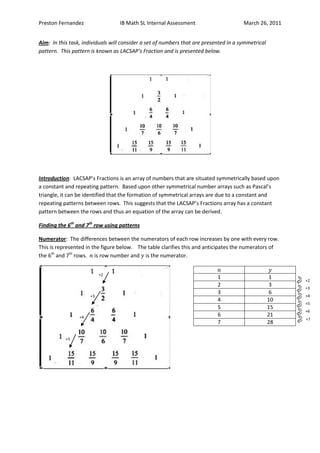
Numerator: The differences between the numerators of each row increases by one with every row.
This is represented in the figure below. The table clarifies this and anticipates the numerators of
the 6th and 7th rows. is row number and is the numerator.


                           +2
                                                                            1                        1   +2
                                                                            2                        3   +3
                                                                            3                        6
                      +3                                                                                 +4
                                                                            4                       10
                                                                                                         +5
                                                                            5                       15
                                                                                                         +6
                 +4                                                         6                       21
                                                                                                         +7
                                                                            7                       28

           +5
Preston Fernandez                         IB Math SL Internal Assessment                      March 26, 2011


Denominator: Like the pattern of the numerators, the difference between each row increases by
one, however for denominator it is through elements (the pattern, than with successive rows
because denominators change within rows unlike the numerators. This is shown below.

                                                                                Element Number
                                                                         0 1 2 3 4 5 6 7
                                                                    5 1 11 9 9 11 1
                                                                    P        +5 +4 +3 +2
                                                                    6 1 16 13 12 13 16 1
                            +2                                      P        +6 +5 +4 +3 +2
                                                                    7 1 22 18 16 16 18 22 1
                                                                    The table above attempts to continue the
                       +3            +2                             pattern left off from the figure to the left.
                                                                      is row number, and P shows how the
                +4
                                                                    pattern would affect the denominator
                            +3             +2
                                                                    between elements of different rows.


Continuing the pattern of these the 6th and 7th rows come out to be


Deriving the Equation for the Numerator
                                                                           th
Let      , where     is row number and           is the numerator of the        row

By allowing        the relationship between row number and the numerator of that row can be
identified. The table below represents this relationship.


                                    1                 1
                                    2                 3
                                    3                 6
                                    4                10
                                    5                15
Patterns: Relationship between Row Number and Numerator

There is a geometric relationship between the rows and the numerators. As row number increases,
the number multiplied for it to become equal to the numerator increases by 0.5 each individual row.
This is shown in the table below. Let be equivalent to the amount that multiplies to equal .


                                 1                         .0                     1
                                 2                                                3
                                 3                                                6
                                 4                                               10
                                 5                                               15
Preston Fernandez                 IB Math SL Internal Assessment                       March 26, 2011


Another pattern was derived from the pattern previously investigated. It found that when was
doubled, and then was multiplied by , the value of was twice as great. An equation that
represents this more clearly is           . More importantly, it was identified that 2 is also
equivalent to       . An equation that represents this is          . This is expressed in the table
below.

             1           .0        1                     1        2                      2
             2                     3                     2        3                      6
             3                     6                     3        4                     12
             4                     10                    4        5                     20
             5                     15                    5        6                     30

                                                                  +1

So because             and                  ,   can be substituted in for   . This gives the equation
of                which can be further simplified into             .

           is the equation used to find the numerator.

Validating the Equation for the Numerator Using Patterns and Graphs

The equation used to find the numerator can also be found by plotting the data points and finding
the line of best fit.

Patterns: Relationship between Numerators of Successive Rows
The differences between numerators does not remain constant between each row; rather, the
difference of numerators between each row is increased by one. The difference between row two
and row one is two, the difference between row three and row two is three, the difference between
row four and row three is four and so on. This is more explicitly shown in the table below.


                                        1                     1
                                                                             +2
                                        2                     3
                                                                             +3
                                        3                     6
                                                                             +4
                                        4                    10
                                                                             +5
                                        5                    15


To derive the equation from the graph that this pattern plots, more data points will be needed, so
based on this pattern the sequence will be continued and then graphed when there is a reasonable
amount of data points. This ensures that the equation derived earlier applies to all of the array and
the pattern, and not just the given section.
Preston Fernandez                    IB Math SL Internal Assessment                           March 26, 2011


Row         Numerator
        1           1                                      Row Vs. Numerator
        2           3
        3           6                          350
        4         10                           300       y = 0.5x2 + 0.5x - 2E-13
                                                                  R² = 1
        5         15                           250


                                   Numerator
        6         21                           200
        7         28                           150                                              Numerator
        8         36                           100
                                                                                                Poly. (Numerator)
        9         45                           50
       10         55                             0
       11         66                                 0       10            20            30
       12         78
                                                              Row Number
       13         91
       14        105
       15        120
                                 The graph above represents how row number affects the numerator. As
       16        136
                                 row increases, so does it numerator, however it is not in a linear fashion.
       17        153
                                 The difference from one row to another increases the row count gets
       18        171
                                 larger.
       19        190
       20        210             The equation calculated from the graph is identical to the equation
       21        231             derived however this equation shows the y-intercept.
       22        253
       23        276             The equation 0.5x2 0.5x is the same equation as               however has
       24        300
                                 been simplified out to 0.5x2 0.5x.
       25        325
                                 This validates and supports the derived equation.
Validating the Equation for the Numerator by Plugging In

The equation can be validated by plugging in given numbers, which pertain to the first 5 rows of the
LACSAP Fractions array. This is done by substituting numbers from the given information into the
equation to see if the end product and the given numerators are equal. Plugging in for validation is
given below, where is row number and is the numerator of that row.

                                                          Given Information
                             1                                                      1
                             2                                                      3
                             3                                                      6
                             4                                                      10
                             5                                                      15

When the given information is substituted into the equation, it is seen that the end solution is
equivalent to that of the numerator which suggests that this equation can be used to find the
numerator of each row.
Preston Fernandez                 IB Math SL Internal Assessment                           March 26, 2011


Deriving the Equation for the Denominator

Let’s compare the numerator and denominator of the second element in each row.

In the table below is the row number, is the value of the numerator, is the element number
and is the denominator. Note* that the first term in each row is    .


                  1                      1                   1                         1
                  2                      3                   1                         2
                  3                      6                   1                         4
                  4                     10                   1                         7
                  5                     15                   1                        11

From this table a pattern was seen that                   . This is verified below.


                  1        1        1                                            1
                  3        2        1                                            2
                  6        3        1                                            4
                 10        4        1                                            7
                 15        5        1                                           11


Although the algebra is true, this equation only is fit for , the first element. This is verified
below when the equation applies to the second element or the third term of the row.


                  3        2        2                                            3
                  6        3        2                                            4
                 10        4        2                                            6
                 15        5        2                                            9


Then it was questioned why the formula had worked for the first element (2nd term) and not the
second element (3rd term), so the values plugged into the formula were reevaluated and looked at
more closely to determine why the formula worked for the first element and not the others. In this
reassessment,        was looked at as a single unit rather than the difference of two values. This was
done to assure nothing had been overlooked as well as identify any new patterns which may have
been applicable.
Preston Fernandez                 IB Math SL Internal Assessment                     March 26, 2011


In the table below let           , as mentioned previously this is done to assure nothing had been
overlooked as well as identify any new patterns which may be applicable.


   3        2         2                                                                       3
   6        3         2                                                                       4
  10        4         2                                                                       6
  15        5         2                                                                       9


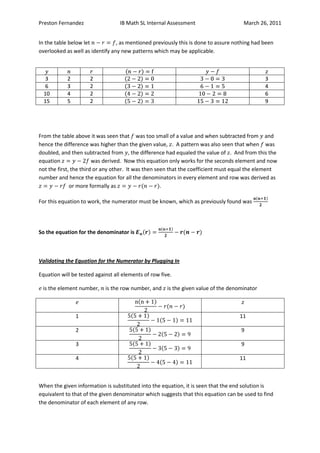
From the table above it was seen that was too small of a value and when subtracted from and
hence the difference was higher than the given value, . A pattern was also seen that when was
doubled, and then subtracted from , the difference had equaled the value of . And from this the
equation                was derived. Now this equation only works for the seconds element and now
not the first, the third or any other. It was then seen that the coefficient must equal the element
number and hence the equation for all the denominators in every element and row was derived as
              or more formally as                    .

For this equation to work, the numerator must be known, which as previously found was


So the equation for the denominator is


Validating the Equation for the Numerator by Plugging In

Equation will be tested against all elements of row five.

 is the element number,     is the row number, and is the given value of the denominator


                1                                                                  11

                2                                                                   9

                3                                                                   9

                4                                                                  11


When the given information is substituted into the equation, it is seen that the end solution is
equivalent to that of the given denominator which suggests that this equation can be used to find
the denominator of each element of any row.
Preston Fernandez                    IB Math SL Internal Assessment                     March 26, 2011


Finding additional rows using the derived equations


                is the equation for both numerator and denominator of a term.


       n    r      0      1      2       3      4      5      6       7      8      9        10
       1           1      1
       2           1             1

       3           1                     1

       4           1                            1

       5           1                                   1

       6           1                                          1

       7           1                                                  1

       8           1                                                         1

       9           1                                                                1

       10          1                                                                         1


The table above shows the first 10 terms in LACSAP’s Fractions Array. The equation

was used to get all the values above, and also validates and verifies the formula derived.
Preston Fernandez                IB Math SL Internal Assessment                      March 26, 2011


Scope and Limitations of the General Statement


  must be greater than 0 at all times. If were not greater than 0, the solution or denominator of
an element maybe undefined. As well there cannot be a “0th” row in the pattern as it cannot exist.


If were a negative, and substituted into the equation, the answer would become positive, where it
would actually need to be negative. For these two reasons, the equation restricts from being less
than 0, and hence for the equation to work must be greater than 0. As well rows cannot be
negative because there cannot be “negative rows”.


  Must be greater than 0 has there cannot be 0 elements in a pattern. For a pattern to be a pattern,
there must be a range, if there are 0 elements, there are 0 numbers.


  must be a real number, and not a fraction. There cannot be “half” elements and hence must be
a real number. must also be positive as there cannot be negative elements.

Ao k math - math ia

  • 1.
    Preston Fernandez IB Math SL Internal Assessment March 26, 2011 Aim: In this task, individuals will consider a set of numbers that are presented in a symmetrical pattern. This pattern is known as LACSAP’s Fraction and is presented below. Introduction: LACSAP’s Fractions is an array of numbers that are situated symmetrically based upon a constant and repeating pattern. Based upon other symmetrical number arrays such as Pascal’s triangle, it can be identified that the formation of symmetrical arrays are due to a constant and repeating patterns between rows. This suggests that the LACSAP’s Fractions array has a constant pattern between the rows and thus an equation of the array can be derived. Finding the 6th and 7th row using patterns Numerator: The differences between the numerators of each row increases by one with every row. This is represented in the figure below. The table clarifies this and anticipates the numerators of the 6th and 7th rows. is row number and is the numerator. +2 1 1 +2 2 3 +3 3 6 +3 +4 4 10 +5 5 15 +6 +4 6 21 +7 7 28 +5
  • 2.
    Preston Fernandez IB Math SL Internal Assessment March 26, 2011 Denominator: Like the pattern of the numerators, the difference between each row increases by one, however for denominator it is through elements (the pattern, than with successive rows because denominators change within rows unlike the numerators. This is shown below. Element Number 0 1 2 3 4 5 6 7 5 1 11 9 9 11 1 P +5 +4 +3 +2 6 1 16 13 12 13 16 1 +2 P +6 +5 +4 +3 +2 7 1 22 18 16 16 18 22 1 The table above attempts to continue the +3 +2 pattern left off from the figure to the left. is row number, and P shows how the +4 pattern would affect the denominator +3 +2 between elements of different rows. Continuing the pattern of these the 6th and 7th rows come out to be Deriving the Equation for the Numerator th Let , where is row number and is the numerator of the row By allowing the relationship between row number and the numerator of that row can be identified. The table below represents this relationship. 1 1 2 3 3 6 4 10 5 15 Patterns: Relationship between Row Number and Numerator There is a geometric relationship between the rows and the numerators. As row number increases, the number multiplied for it to become equal to the numerator increases by 0.5 each individual row. This is shown in the table below. Let be equivalent to the amount that multiplies to equal . 1 .0 1 2 3 3 6 4 10 5 15
  • 3.
    Preston Fernandez IB Math SL Internal Assessment March 26, 2011 Another pattern was derived from the pattern previously investigated. It found that when was doubled, and then was multiplied by , the value of was twice as great. An equation that represents this more clearly is . More importantly, it was identified that 2 is also equivalent to . An equation that represents this is . This is expressed in the table below. 1 .0 1 1 2 2 2 3 2 3 6 3 6 3 4 12 4 10 4 5 20 5 15 5 6 30 +1 So because and , can be substituted in for . This gives the equation of which can be further simplified into . is the equation used to find the numerator. Validating the Equation for the Numerator Using Patterns and Graphs The equation used to find the numerator can also be found by plotting the data points and finding the line of best fit. Patterns: Relationship between Numerators of Successive Rows The differences between numerators does not remain constant between each row; rather, the difference of numerators between each row is increased by one. The difference between row two and row one is two, the difference between row three and row two is three, the difference between row four and row three is four and so on. This is more explicitly shown in the table below. 1 1 +2 2 3 +3 3 6 +4 4 10 +5 5 15 To derive the equation from the graph that this pattern plots, more data points will be needed, so based on this pattern the sequence will be continued and then graphed when there is a reasonable amount of data points. This ensures that the equation derived earlier applies to all of the array and the pattern, and not just the given section.
  • 4.
    Preston Fernandez IB Math SL Internal Assessment March 26, 2011 Row Numerator 1 1 Row Vs. Numerator 2 3 3 6 350 4 10 300 y = 0.5x2 + 0.5x - 2E-13 R² = 1 5 15 250 Numerator 6 21 200 7 28 150 Numerator 8 36 100 Poly. (Numerator) 9 45 50 10 55 0 11 66 0 10 20 30 12 78 Row Number 13 91 14 105 15 120 The graph above represents how row number affects the numerator. As 16 136 row increases, so does it numerator, however it is not in a linear fashion. 17 153 The difference from one row to another increases the row count gets 18 171 larger. 19 190 20 210 The equation calculated from the graph is identical to the equation 21 231 derived however this equation shows the y-intercept. 22 253 23 276 The equation 0.5x2 0.5x is the same equation as however has 24 300 been simplified out to 0.5x2 0.5x. 25 325 This validates and supports the derived equation. Validating the Equation for the Numerator by Plugging In The equation can be validated by plugging in given numbers, which pertain to the first 5 rows of the LACSAP Fractions array. This is done by substituting numbers from the given information into the equation to see if the end product and the given numerators are equal. Plugging in for validation is given below, where is row number and is the numerator of that row. Given Information 1 1 2 3 3 6 4 10 5 15 When the given information is substituted into the equation, it is seen that the end solution is equivalent to that of the numerator which suggests that this equation can be used to find the numerator of each row.
  • 5.
    Preston Fernandez IB Math SL Internal Assessment March 26, 2011 Deriving the Equation for the Denominator Let’s compare the numerator and denominator of the second element in each row. In the table below is the row number, is the value of the numerator, is the element number and is the denominator. Note* that the first term in each row is . 1 1 1 1 2 3 1 2 3 6 1 4 4 10 1 7 5 15 1 11 From this table a pattern was seen that . This is verified below. 1 1 1 1 3 2 1 2 6 3 1 4 10 4 1 7 15 5 1 11 Although the algebra is true, this equation only is fit for , the first element. This is verified below when the equation applies to the second element or the third term of the row. 3 2 2 3 6 3 2 4 10 4 2 6 15 5 2 9 Then it was questioned why the formula had worked for the first element (2nd term) and not the second element (3rd term), so the values plugged into the formula were reevaluated and looked at more closely to determine why the formula worked for the first element and not the others. In this reassessment, was looked at as a single unit rather than the difference of two values. This was done to assure nothing had been overlooked as well as identify any new patterns which may have been applicable.
  • 6.
    Preston Fernandez IB Math SL Internal Assessment March 26, 2011 In the table below let , as mentioned previously this is done to assure nothing had been overlooked as well as identify any new patterns which may be applicable. 3 2 2 3 6 3 2 4 10 4 2 6 15 5 2 9 From the table above it was seen that was too small of a value and when subtracted from and hence the difference was higher than the given value, . A pattern was also seen that when was doubled, and then subtracted from , the difference had equaled the value of . And from this the equation was derived. Now this equation only works for the seconds element and now not the first, the third or any other. It was then seen that the coefficient must equal the element number and hence the equation for all the denominators in every element and row was derived as or more formally as . For this equation to work, the numerator must be known, which as previously found was So the equation for the denominator is Validating the Equation for the Numerator by Plugging In Equation will be tested against all elements of row five. is the element number, is the row number, and is the given value of the denominator 1 11 2 9 3 9 4 11 When the given information is substituted into the equation, it is seen that the end solution is equivalent to that of the given denominator which suggests that this equation can be used to find the denominator of each element of any row.
  • 7.
    Preston Fernandez IB Math SL Internal Assessment March 26, 2011 Finding additional rows using the derived equations is the equation for both numerator and denominator of a term. n r 0 1 2 3 4 5 6 7 8 9 10 1 1 1 2 1 1 3 1 1 4 1 1 5 1 1 6 1 1 7 1 1 8 1 1 9 1 1 10 1 1 The table above shows the first 10 terms in LACSAP’s Fractions Array. The equation was used to get all the values above, and also validates and verifies the formula derived.
  • 8.
    Preston Fernandez IB Math SL Internal Assessment March 26, 2011 Scope and Limitations of the General Statement must be greater than 0 at all times. If were not greater than 0, the solution or denominator of an element maybe undefined. As well there cannot be a “0th” row in the pattern as it cannot exist. If were a negative, and substituted into the equation, the answer would become positive, where it would actually need to be negative. For these two reasons, the equation restricts from being less than 0, and hence for the equation to work must be greater than 0. As well rows cannot be negative because there cannot be “negative rows”. Must be greater than 0 has there cannot be 0 elements in a pattern. For a pattern to be a pattern, there must be a range, if there are 0 elements, there are 0 numbers. must be a real number, and not a fraction. There cannot be “half” elements and hence must be a real number. must also be positive as there cannot be negative elements.