| Sir Neil
| Sir Neil
Grade 6 (Music) Module
Objective: Identifies the values of the notes and rests used in a song. (MU6RH-Ia-1)
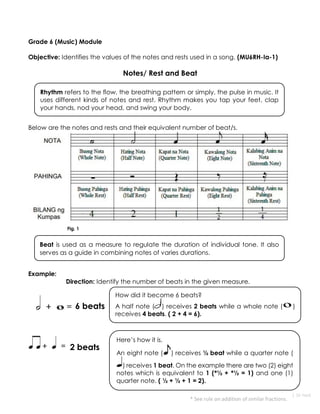
Notes/ Rest and Beat
Below are the notes and rests and their equivalent number of beat/s.
Fig. 1
Example:
Direction: Identify the number of beats in the given measure.
6 beats
2 beats
Rhythm refers to the flow, the breathing pattern or simply, the pulse in music. It
uses different kinds of notes and rest. Rhythm makes you tap your feet, clap
your hands, nod your head, and swing your body.
Beat is used as a measure to regulate the duration of individual tone. It also
serves as a guide in combining notes of varies durations.
How did it become 6 beats?
A half note ( ) receives 2 beats while a whole note ( )
receives 4 beats. ( 2 + 4 = 6).
Here’s how it is.
An eight note ( ) receives ½ beat while a quarter note (
) receives 1 beat. On the example there are two (2) eight
notes which is equivalent to 1 (*½ + *½ = 1) and one (1)
quarter note. ( ½ + ½ + 1 = 2).
* See rule on addition of similar fractions.
| Sir Neil
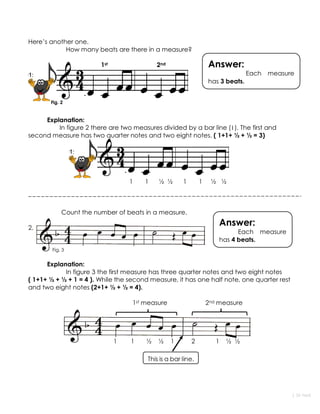
Here’s another one.
How many beats are there in a measure?
1st 2nd
Fig. 2
Explanation:
In figure 2 there are two measures divided by a bar line ( ). The first and
second measure has two quarter notes and two eight notes. ( 1+1+ ½ + ½ = 3)
1 1 ½ ½ 1 1 ½ ½
Count the number of beats in a measure.
2.
Fig. 3
Explanation:
In figure 3 the first measure has three quarter notes and two eight notes
( 1+1+ ½ + ½ + 1 = 4 ). While the second measure, it has one half note, one quarter rest
and two eight notes (2+1+ ½ + ½ = 4).
1st measure 2nd measure
1 1 ½ ½ 1 2 1 ½ ½
Answer:
Each measure
has 3 beats.
Answer:
Each measure
has 4 beats.
This is a bar line.
| Sir Neil
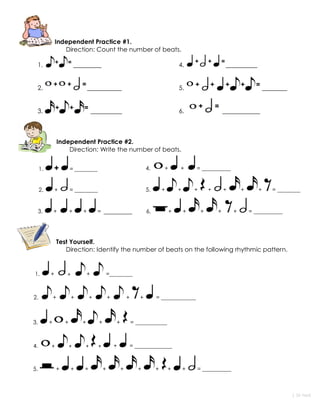
Independent Practice #1.
Direction: Count the number of beats.
1. _________ 4. __________
2. ___________ 5. ________
3. __________ 6. ____________
Independent Practice #2.
Direction: Write the number of beats.
Test Yourself.
Direction: Identify the number of beats on the following rhythmic pattern.
1. + = ________
2. + = ________
3. + + + = __________
4. + + = __________
5. + + + + + + + = ________
6. + + + + + = __________
5. + + + + + + + + + = __________
1. + + + =________
2. + + + + + + = ____________
3. + + + + + = ___________
4. + + + + + = _____________
| Sir Neil
Grade 6 (Music) Module
Objective: Differentiates aurally among 2/4, ¾, 4/4 and 6/8 time signatures. (MU6RH-
Ib-e-2)
Time Signatures
𝟐
𝟒
In 2/4, ¾, and 4/4 time signature a note that receives one beat is the quarter
note/rest because the equivalent number of beat/s by a quarter note is 1, while in a
6/8-time signature a note that receives one beat is eight note/rest.
𝟑
𝟒
𝟒
𝟒
𝟔
𝟖
Visit youtube: https://youtu.be/6IJbhPnpHBI?t=145
Time Signature are the numbers written at the beginning of the staff. The upper
number tells the number of beats in a measure, while the lower number tells
what kind of note receives one beat.
The upper number tells how many beats in a measure
The lower number tells what note receives one beat.
There are three beats in a measure
A quarter note/rest will receive one beat in a measure
There are four beats in a measure
A quarter note/rest will receive one beat in a measure
There are six beats in a measure
An eight note/rest will receive one beat in a measure
| Sir Neil
Look at the difference between ¾ , 4/4and 6/8 time signatures as used in a song.
Visit youtube for the audio (https://youtu.be/A-WKQyyPiyI).
Fig. 1
The song “Paru-Parong Bukid” uses a 2/4 time signature. A measure should
have three (3) beats and the note that will receive one beat is a quarter note. Look at
the measures below;
1st 2nd 3rd 4th 5th 6th
1 ½ ½ ½ ½ 2 1 1 1 1 1 ½ ½ 1 1 ½ ½ ½ ½ 2 1
| Sir Neil
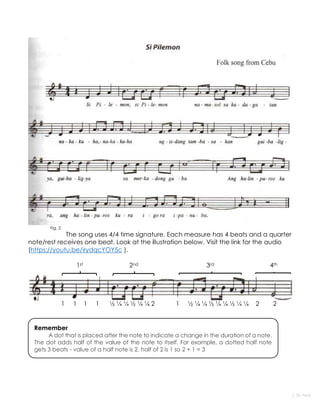
Fig. 2
The song uses 4/4 time signature. Each measure has 4 beats and a quarter
note/rest receives one beat. Look at the illustration below. Visit the link for the audio
(https://youtu.be/irydqcYOY5c ).
1st 2nd 3rd 4th
1 1 1 1 ½ ¼ ¼ ½ ¼ ¼ 2 1 ½ ¼ ¼ ½ ¼ ¼ ½ ¼ ¼ 2 2
Remember
A dot that is placed after the note to indicate a change in the duration of a note.
The dot adds half of the value of the note to itself. For example, a dotted half note
gets 3 beats - value of a half note is 2, half of 2 is 1 so 2 + 1 = 3
| Sir Neil
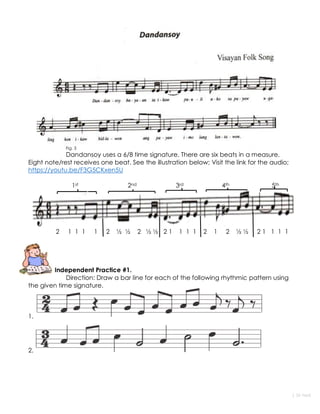
Fig. 3
Dandansoy uses a 6/8 time signature. There are six beats in a measure.
Eight note/rest receives one beat. See the illustration below; Visit the link for the audio;
https://youtu.be/F3G5CKxen5U
1st 2nd 3rd 4th 5th
2 1 1 1 1 2 ½ ½ 2 ½ ½ 2 1 1 1 1 2 1 2 ½ ½ 2 1 1 1 1
Independent Practice #1.
Direction: Draw a bar line for each of the following rhythmic pattern using
the given time signature.
1.
2.
| Sir Neil
3.
4.
5.
Independent Practice #2.
Direction: Listen to the rhythmic pattern to be played by the teacher.
Identify the time signature used in the pattern. Encircle your answer.
1. 2. 3.
4. 5.
Test Yourself.
Direction: Using the given illustration differentiate the following time
signatures. Write your answer on the box below the illustration.
1. and
| Sir Neil
2. and
| Sir Neil
Grade 6 (Music) Module
Objective: Demonstrates the conducting gestures in time signatures of: 2/4, ¾, 4/4 and
6/8. (MURH-1b-e-3)
Conducting Time Signature/s
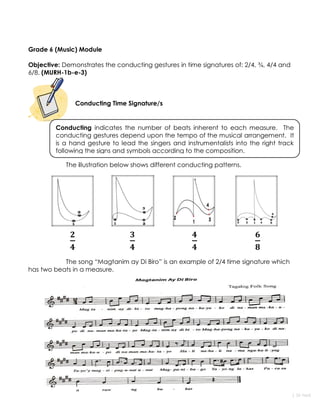
The illustration below shows different conducting patterns.
𝟐
𝟒
𝟑
𝟒
𝟒
𝟒
𝟔
𝟖
The song “Magtanim ay Di Biro” is an example of 2/4 time signature which
has two beats in a measure.
Conducting indicates the number of beats inherent to each measure. The
conducting gestures depend upon the tempo of the musical arrangement. It
is a hand gesture to lead the singers and instrumentalists into the right track
following the signs and symbols according to the composition.
| Sir Neil
Independent Practice #1.
Direction: Visit youtube and listen to the song “Paru-parong Bukid”.
Identify the time signature used and practice its corresponding conducting gesture.
Draw the conducting gesture on the box. Explain why it used the conducting gesture
as stated in your drawing.
Independent Practice #2.
Direction: Listen to the song “Lupang Hinirang’ in youtube.
Demonstrate the conducting gesture of the National Anthem in its corresponding time
signature.
Test Yourself.
Direction: Visit youtube and listen to the song “Si Pilemon”. Conduct while
listening to the song. Identify first the time signature used to be able to conduct the
song properly.
What can you say about the activity?
___________________________________________________________________________
___________________________________________________________________________
___________________________________________________________________________
Which part of the activity did you enjoy the most?
__________________________________________________________________________
__________________________________________________________________________
__________________________________________________________________________
| Sir Neil
Grade 6 (Music) Module
Objective: Creates rhythmic patterns in time signatures of 2/4, ¾,, 4/4 and 6/8. (MURH-
Ig-h-5)
Rhythmic Patterns
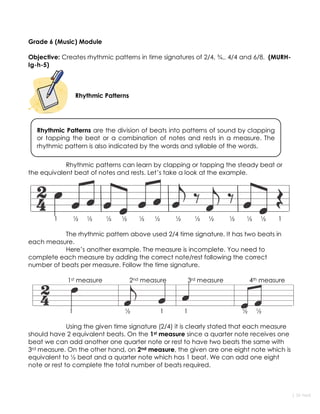
Rhythmic patterns can learn by clapping or tapping the steady beat or
the equivalent beat of notes and rests. Let’s take a look at the example.
1 ½ ½ ½ ½ ½ ½ ½ ½ ½ ½ ½ ½ 1
The rhythmic pattern above used 2/4 time signature. It has two beats in
each measure.
Here’s another example. The measure is incomplete. You need to
complete each measure by adding the correct note/rest following the correct
number of beats per measure. Follow the time signature.
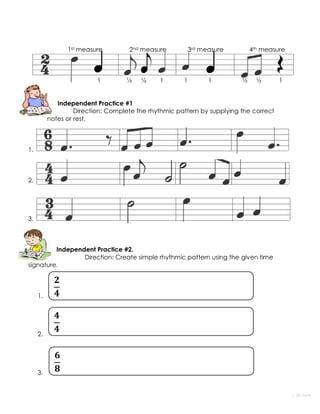
1st measure 2nd measure 3rd measure 4th measure
1 ½ 1 1 ½ ½
Using the given time signature (2/4) it is clearly stated that each measure
should have 2 equivalent beats. On the 1st measure since a quarter note receives one
beat we can add another one quarter note or rest to have two beats the same with
3rd measure. On the other hand, on 2nd measure, the given are one eight note which is
equivalent to ½ beat and a quarter note which has 1 beat. We can add one eight
note or rest to complete the total number of beats required.
Rhythmic Patterns are the division of beats into patterns of sound by clapping
or tapping the beat or a combination of notes and rests in a measure. The
rhythmic pattern is also indicated by the words and syllable of the words.
| Sir Neil
1st measure 2nd measure 3rd measure 4th measure
1 1 ½ ½ 1 1 1 ½ ½ 1
Independent Practice #1
Direction: Complete the rhythmic pattern by supplying the correct
notes or rest.
1.
2.
3.
Independent Practice #2.
Direction: Create simple rhythmic pattern using the given time
signature.
1.
2.
3.
𝟐
𝟒
𝟒
𝟒
𝟔
𝟖
| Sir Neil
Test Yourself.
Direction: Create your own rhythmic pattern. Watch out with the
given time signature.
1.
2.
3.
| Sir Neil
References
The 21st Century MAPEH in Action by Ligaya Bautista Garcia-Quinitio, Eduardo V.
Cipriano, Eliseo P. Buhain, Juliet H. Brioso, Dian Alcoba-Lacia, Almira Alcoba-Alonzo,
Gernalyn Andres-Solano, Ferdilyn C. Lacia-Series Coordinator.
www.musicfun.com.au
https://www.google.com/search?q=notes+and+rest&safe=active&rlz=1C1GGRV_enPH901PH901&sxsrf=ALeKk0
2NfrgsGRopIS4HgEn14iVy9LuR4Q:1590630896887&source=lnms&tbm=isch&sa=X&ved=2ahUKEwjz7s7sudXpAh
W9KqYKHUXzCRIQ_AUoAXoECBMQAw&biw=1366&bih=625#imgrc=kFphyFsQjYwmDM
https://www.google.com/search?q=number+of+beats+in+music+notes+worksheet&safe=active&sxsrf=ALeKk03
u8qNBGmuEPlrol31k967s7mqDOg:1590630669784&source=lnms&tbm=isch&sa=X&ved=2ahUKEwjB5KmAudXp
AhXFwosBHTfgBMsQ_AUoAXoECA0QAw&biw=1366&bih=625#imgrc=oxHkr15koje67M
http://www.superteacherworksheets.com/
https://www.pinterest.ph/pin/441282463486646325/

Music 6 module

  • 1.
  • 2.
    | Sir Neil Grade6 (Music) Module Objective: Identifies the values of the notes and rests used in a song. (MU6RH-Ia-1) Notes/ Rest and Beat Below are the notes and rests and their equivalent number of beat/s. Fig. 1 Example: Direction: Identify the number of beats in the given measure. 6 beats 2 beats Rhythm refers to the flow, the breathing pattern or simply, the pulse in music. It uses different kinds of notes and rest. Rhythm makes you tap your feet, clap your hands, nod your head, and swing your body. Beat is used as a measure to regulate the duration of individual tone. It also serves as a guide in combining notes of varies durations. How did it become 6 beats? A half note ( ) receives 2 beats while a whole note ( ) receives 4 beats. ( 2 + 4 = 6). Here’s how it is. An eight note ( ) receives ½ beat while a quarter note ( ) receives 1 beat. On the example there are two (2) eight notes which is equivalent to 1 (*½ + *½ = 1) and one (1) quarter note. ( ½ + ½ + 1 = 2). * See rule on addition of similar fractions.
  • 3.
    | Sir Neil Here’sanother one. How many beats are there in a measure? 1st 2nd Fig. 2 Explanation: In figure 2 there are two measures divided by a bar line ( ). The first and second measure has two quarter notes and two eight notes. ( 1+1+ ½ + ½ = 3) 1 1 ½ ½ 1 1 ½ ½ Count the number of beats in a measure. 2. Fig. 3 Explanation: In figure 3 the first measure has three quarter notes and two eight notes ( 1+1+ ½ + ½ + 1 = 4 ). While the second measure, it has one half note, one quarter rest and two eight notes (2+1+ ½ + ½ = 4). 1st measure 2nd measure 1 1 ½ ½ 1 2 1 ½ ½ Answer: Each measure has 3 beats. Answer: Each measure has 4 beats. This is a bar line.
  • 4.
    | Sir Neil IndependentPractice #1. Direction: Count the number of beats. 1. _________ 4. __________ 2. ___________ 5. ________ 3. __________ 6. ____________ Independent Practice #2. Direction: Write the number of beats. Test Yourself. Direction: Identify the number of beats on the following rhythmic pattern. 1. + = ________ 2. + = ________ 3. + + + = __________ 4. + + = __________ 5. + + + + + + + = ________ 6. + + + + + = __________ 5. + + + + + + + + + = __________ 1. + + + =________ 2. + + + + + + = ____________ 3. + + + + + = ___________ 4. + + + + + = _____________
  • 5.
    | Sir Neil Grade6 (Music) Module Objective: Differentiates aurally among 2/4, ¾, 4/4 and 6/8 time signatures. (MU6RH- Ib-e-2) Time Signatures 𝟐 𝟒 In 2/4, ¾, and 4/4 time signature a note that receives one beat is the quarter note/rest because the equivalent number of beat/s by a quarter note is 1, while in a 6/8-time signature a note that receives one beat is eight note/rest. 𝟑 𝟒 𝟒 𝟒 𝟔 𝟖 Visit youtube: https://youtu.be/6IJbhPnpHBI?t=145 Time Signature are the numbers written at the beginning of the staff. The upper number tells the number of beats in a measure, while the lower number tells what kind of note receives one beat. The upper number tells how many beats in a measure The lower number tells what note receives one beat. There are three beats in a measure A quarter note/rest will receive one beat in a measure There are four beats in a measure A quarter note/rest will receive one beat in a measure There are six beats in a measure An eight note/rest will receive one beat in a measure
  • 6.
    | Sir Neil Lookat the difference between ¾ , 4/4and 6/8 time signatures as used in a song. Visit youtube for the audio (https://youtu.be/A-WKQyyPiyI). Fig. 1 The song “Paru-Parong Bukid” uses a 2/4 time signature. A measure should have three (3) beats and the note that will receive one beat is a quarter note. Look at the measures below; 1st 2nd 3rd 4th 5th 6th 1 ½ ½ ½ ½ 2 1 1 1 1 1 ½ ½ 1 1 ½ ½ ½ ½ 2 1
  • 7.
    | Sir Neil Fig.2 The song uses 4/4 time signature. Each measure has 4 beats and a quarter note/rest receives one beat. Look at the illustration below. Visit the link for the audio (https://youtu.be/irydqcYOY5c ). 1st 2nd 3rd 4th 1 1 1 1 ½ ¼ ¼ ½ ¼ ¼ 2 1 ½ ¼ ¼ ½ ¼ ¼ ½ ¼ ¼ 2 2 Remember A dot that is placed after the note to indicate a change in the duration of a note. The dot adds half of the value of the note to itself. For example, a dotted half note gets 3 beats - value of a half note is 2, half of 2 is 1 so 2 + 1 = 3
  • 8.
    | Sir Neil Fig.3 Dandansoy uses a 6/8 time signature. There are six beats in a measure. Eight note/rest receives one beat. See the illustration below; Visit the link for the audio; https://youtu.be/F3G5CKxen5U 1st 2nd 3rd 4th 5th 2 1 1 1 1 2 ½ ½ 2 ½ ½ 2 1 1 1 1 2 1 2 ½ ½ 2 1 1 1 1 Independent Practice #1. Direction: Draw a bar line for each of the following rhythmic pattern using the given time signature. 1. 2.
  • 9.
    | Sir Neil 3. 4. 5. IndependentPractice #2. Direction: Listen to the rhythmic pattern to be played by the teacher. Identify the time signature used in the pattern. Encircle your answer. 1. 2. 3. 4. 5. Test Yourself. Direction: Using the given illustration differentiate the following time signatures. Write your answer on the box below the illustration. 1. and
  • 10.
  • 11.
    | Sir Neil Grade6 (Music) Module Objective: Demonstrates the conducting gestures in time signatures of: 2/4, ¾, 4/4 and 6/8. (MURH-1b-e-3) Conducting Time Signature/s The illustration below shows different conducting patterns. 𝟐 𝟒 𝟑 𝟒 𝟒 𝟒 𝟔 𝟖 The song “Magtanim ay Di Biro” is an example of 2/4 time signature which has two beats in a measure. Conducting indicates the number of beats inherent to each measure. The conducting gestures depend upon the tempo of the musical arrangement. It is a hand gesture to lead the singers and instrumentalists into the right track following the signs and symbols according to the composition.
  • 12.
    | Sir Neil IndependentPractice #1. Direction: Visit youtube and listen to the song “Paru-parong Bukid”. Identify the time signature used and practice its corresponding conducting gesture. Draw the conducting gesture on the box. Explain why it used the conducting gesture as stated in your drawing. Independent Practice #2. Direction: Listen to the song “Lupang Hinirang’ in youtube. Demonstrate the conducting gesture of the National Anthem in its corresponding time signature. Test Yourself. Direction: Visit youtube and listen to the song “Si Pilemon”. Conduct while listening to the song. Identify first the time signature used to be able to conduct the song properly. What can you say about the activity? ___________________________________________________________________________ ___________________________________________________________________________ ___________________________________________________________________________ Which part of the activity did you enjoy the most? __________________________________________________________________________ __________________________________________________________________________ __________________________________________________________________________
  • 13.
    | Sir Neil Grade6 (Music) Module Objective: Creates rhythmic patterns in time signatures of 2/4, ¾,, 4/4 and 6/8. (MURH- Ig-h-5) Rhythmic Patterns Rhythmic patterns can learn by clapping or tapping the steady beat or the equivalent beat of notes and rests. Let’s take a look at the example. 1 ½ ½ ½ ½ ½ ½ ½ ½ ½ ½ ½ ½ 1 The rhythmic pattern above used 2/4 time signature. It has two beats in each measure. Here’s another example. The measure is incomplete. You need to complete each measure by adding the correct note/rest following the correct number of beats per measure. Follow the time signature. 1st measure 2nd measure 3rd measure 4th measure 1 ½ 1 1 ½ ½ Using the given time signature (2/4) it is clearly stated that each measure should have 2 equivalent beats. On the 1st measure since a quarter note receives one beat we can add another one quarter note or rest to have two beats the same with 3rd measure. On the other hand, on 2nd measure, the given are one eight note which is equivalent to ½ beat and a quarter note which has 1 beat. We can add one eight note or rest to complete the total number of beats required. Rhythmic Patterns are the division of beats into patterns of sound by clapping or tapping the beat or a combination of notes and rests in a measure. The rhythmic pattern is also indicated by the words and syllable of the words.
  • 14.
    | Sir Neil 1stmeasure 2nd measure 3rd measure 4th measure 1 1 ½ ½ 1 1 1 ½ ½ 1 Independent Practice #1 Direction: Complete the rhythmic pattern by supplying the correct notes or rest. 1. 2. 3. Independent Practice #2. Direction: Create simple rhythmic pattern using the given time signature. 1. 2. 3. 𝟐 𝟒 𝟒 𝟒 𝟔 𝟖
  • 15.
    | Sir Neil TestYourself. Direction: Create your own rhythmic pattern. Watch out with the given time signature. 1. 2. 3.
  • 16.
    | Sir Neil References The21st Century MAPEH in Action by Ligaya Bautista Garcia-Quinitio, Eduardo V. Cipriano, Eliseo P. Buhain, Juliet H. Brioso, Dian Alcoba-Lacia, Almira Alcoba-Alonzo, Gernalyn Andres-Solano, Ferdilyn C. Lacia-Series Coordinator. www.musicfun.com.au https://www.google.com/search?q=notes+and+rest&safe=active&rlz=1C1GGRV_enPH901PH901&sxsrf=ALeKk0 2NfrgsGRopIS4HgEn14iVy9LuR4Q:1590630896887&source=lnms&tbm=isch&sa=X&ved=2ahUKEwjz7s7sudXpAh W9KqYKHUXzCRIQ_AUoAXoECBMQAw&biw=1366&bih=625#imgrc=kFphyFsQjYwmDM https://www.google.com/search?q=number+of+beats+in+music+notes+worksheet&safe=active&sxsrf=ALeKk03 u8qNBGmuEPlrol31k967s7mqDOg:1590630669784&source=lnms&tbm=isch&sa=X&ved=2ahUKEwjB5KmAudXp AhXFwosBHTfgBMsQ_AUoAXoECA0QAw&biw=1366&bih=625#imgrc=oxHkr15koje67M http://www.superteacherworksheets.com/ https://www.pinterest.ph/pin/441282463486646325/