1
Math for Smart Kids
Math for Smart Kids
Grade 1
Textbook

Philippine Copyright 2010 by DIWA LEARNING SYSTEMS INC
All rights reserved. Printed in the Philippines


Editorial, design, and layout by University Press of First Asia


No part of this publication may be reproduced or transmitted in any form or by any means electronic or
mechanical, including photocopying, recording, or any information storage and retrieval systems, without
permission in writing from the copyright owner.

        Exclusively distributed by
        DIWA LEARNING SYSTEMS INC
        4/F SEDCCO 1 Bldg.
        120 Thailand corner Legazpi Streets
        Legaspi Village, 1229 Makati City, Philippines
        Tel. No.: (632) 893-8501 * Fax: (632) 817-8700

	       ISBN 978-971-46-0115-4


The Editorial Board
Authors
Dr. Estrella P. Mercado finished her PhD in Educational Management (with honor) and MA in Education at Manuel
L. Quezon University. She also holds an MEd in Special Education degree and a BS in Elementary Education degree
from the Philippine Normal University (PNU). She has been a classroom teacher, an Education supervisor, and
assistant chief of the Elementary Division of the Department of Education, Culture and Sports (DECS-NCR). She was
awarded as Outstanding Female Educator in 1998 by the Filipino Chinese Women Federation. She presently heads the
Special Education Department at PNU.
Jasmin Iris F. Sallegue graduated cum laude from PNU with a degree in Bachelor of Secondary Education major
in Mathematics. She is currently a grade school Mathematics teacher at De La Salle Santiago Zobel School in Ayala
Alabang. She has trained students of De La Salle Santiago Zobel School for various mathematics competitions, like
the annual Metrobank-MTAP-DepEd Math competition. She is a member of the Mathematics Teachers Association
of the Philippines (MTAP).
Consultant-Reviewer
Luzviminda M. Sibbaluca holds a master’s degree in Mathematics Education and a bachelor’s degree in Elementary
Mathematics Education (cum laude) both from the University of the Philippines-Diliman. She is one of the top ten
successful examinees of the Licensure Examination for Teachers (LET) for Elementary in 2003. She is currently an
assistant professor at the Mathematics Department of the University of the Philippines Integrated School (UPIS).
Preface
     Math for Smart Kids is a series of textbooks in Mathematics for
grade school, which is designed to help pupils develop appreciation
and love for mathematics. This series also aims to help the learners
acquire the skills they need to become computationally literate.
     The lessons in each textbook present mathematics concepts and
principles that are anchored on the competencies prescribed by the
Department of Education. Each lesson starts with Let’s Do Math,
where mathematics concepts and principles are introduced through
problems, stories, games, or puzzles. This section is followed by Let’s
Look Back, which lists questions that will help the pupils to think
critically on what has been introduced in the lesson and will allow
them to discover things on their own. For easy recall of important
points or concepts taken up in a lesson, the section Let’s Remember
Our Learning has been included. Multilevel exercises are provided in
Let’s Practice and Let’s Test Our Learning that will assess how much
the pupils have learned from the lesson. The exercises will also
determine if the pupils are ready to learn new mathematics skills. The
development of the multiple intelligences of an individual is reflected
in the different activities that the pupils will perform—from concrete
to semi-concrete, and from semi-abstract to abstract kind of learning.
Situations and real-life problems are provided in Let’s Look Forward to
give the pupils opportunities to apply what they have learned to their
daily life experiences.
     This series of textbooks gives the learners the opportunity to
explore and enjoy Mathematics. Let’s have fun learning together!

                                                          The Authors
Table of Contents
Unit	1		 Whole	Numbers	and	Beyond
Chapter 1 Sizes, Lengths, and Patterns
Lesson    1 Sizes of Objects................................................... 2
          2 Lengths and Heights of Objects ........................... 6
          3 Patterns ........................................................... 11

Chapter 2 Sets and Whole Numbers
Lesson    1 Numbers 0 to 100 ............................................. 16
          2 Comparing Sets and Numbers Up to 100 ........... 20
          3 Ordering Sets and Numbers Up to 100 .............. 24
          4 Reading and Writing Numbers Up to 100 .......... 30
          5 Ordinal Numbers.............................................. 35
          6 Place Values Up to Thousands .......................... 39
          7 Reading and Writing Numbers Up
            to Thousands .................................................... 42
          8 Comparing and Ordering Numbers Up
            to Thousands .................................................... 48
          9 Skip Counting through Hundreds ...................... 52
         10 Philippine Coins and Bills ................................. 56

Unit	2	 Operations	on	Whole	Numbers
Chapter 3 Addition and Subtraction of Whole Numbers
Lesson    1   Adding One-digit Numbers ............................... 62
          2   Properties of Addition ....................................... 68
          3   Adding Two-digit Numbers ............................... 74
          4   Adding Three-digit Numbers............................. 78
5 Adding Whole Numbers with Sums Up
            to Thousands .................................................... 83
          6 Solving Word Problems on Addition
            of Whole Numbers ........................................... 88
          7 Subtracting One- to Two-digit Numbers ............ 92
          8 Subtracting Three-digit Numbers ...................... 96
          9 Subtracting Four-digit Numbers .......................101
         10 Solving Word Problems on Subtraction
            of Whole Numbers ..........................................105
         11 Solving Two-step Word Problems ....................111

Chapter 4 Multiplication and Division
          of Whole Numbers
Lesson    1   Understanding Multiplication ..........................116
          2   Multiplying Numbers by 0, 1, and 2.................122
          3   Multiplying Numbers by 3, 4, 5, and 10 ...........126
          4   Understanding Division ...................................131
          5   Dividing Numbers by 1, 2, and 3 .....................137
          6   Dividing Numbers by 4, 5, and 10 ...................141

Unit	3		 Fractions	and	Geometry
Chapter 5 Fractions
Lesson    1 Parts of a Whole ..............................................146
          2 Parts of a Set ...................................................152
          3 More on Parts of a Whole ................................157
          4 More on Parts of a Set......................................161
          5 More on Fractions  1 and 1  .......................168
                                   9            10 
          6 Fractional Part of a Set.....................................173
          7 Comparing Fractions .......................................178
Chapter 6 Geometry
Lesson       1    Points, Lines, and Plane Figures .......................184
             2    Polygons and Circles........................................189
             3    Symmetry ........................................................194
             4    Solid or Space Figures ......................................197

Unit 4		 Measurement,	Time,	and	Graphs
Chapter 7 Measurement
Lesson       1    Nonstandard Units of Linear Measurement ......202
             2    Standard Units of Linear Measurement ............205
             3    Perimeter .........................................................210
             4    Area ................................................................216
             5    Area of a Rectangle and a Square .....................221
             6    Mass ................................................................226
             7    Capacity ..........................................................231

Chapter 8 Time
Lesson       1    Telling Time ....................................................237
             2    More on Time Measurement ............................241
             3    Days of the Week ............................................246
             4    Months of the Year ..........................................249

Chapter 9 Graphs
Lesson       1 Pictograph .......................................................253
             2 Collecting and Organizing Data ........................258
             3 Making a Pictograph ........................................263

Bibliography ........................................................................266
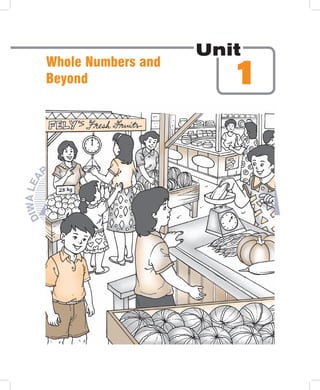
Unit
                       1
Whole Numbers and
Beyond


   kg
Chapter 1
                  Sizes, Lengths, and Patterns

     Lesson 1                                    Sizes of Objects


       The stuffed toys are arranged from smallest to biggest.


       The balls are arranged from biggest to smallest.


     1. Which is the biggest stuffed toy?
     2. Which is the smallest ball?

       Sizes of objects can be compared.
       An object can be bigger or smaller than another object.
       The teddy bear is bigger than the rabbit stuffed toy.
       The golf ball is the smallest ball.

	       Math	for	Smart	Kids	1
Objects come in different sizes.
        Some objects are small while others are big.
        Sizes of objects can be compared using the words bigger,
    biggest, smaller, and smallest.
        Objects can be arranged from smallest to biggest, or from
    biggest to smallest.


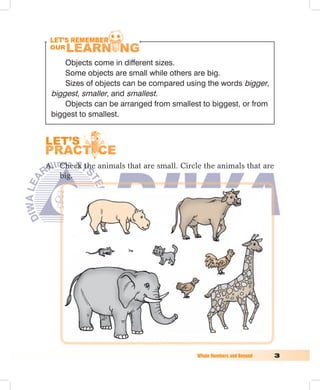
A. Check the animals that are small. Circle the animals that are
   big.


	                                           Whole	Numbers	and	Beyond
B. Compare the animal on the left with that on the right. Circle
    the correct word.

     1.                               bigger
                                      smaller


     2.                               bigger
                                      smaller


                                      bigger
     3.
                                      smaller


     Draw a star () on the blank space if the objects are
 arranged correctly.
 _______ 1. smallest to biggest


 _______ 2. biggest to smallest


	        Math	for	Smart	Kids	1
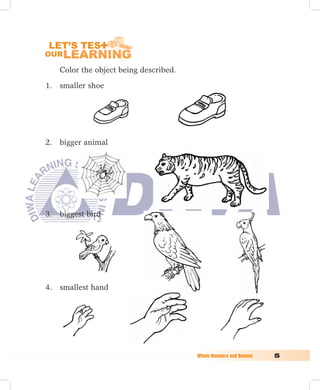
Color the object being described.

1. smaller shoe


2. bigger animal


3. biggest bird


4. smallest hand


	                                       Whole	Numbers	and	Beyond
Lesson 2                    Lengths and Heights of Objects


    Look at the family. What can you say
 about their heights?


     1. Who is the tallest in the family?
     2. Who is the shortest in the family?
     3. Who is taller, the father or the mother?


       Objects can be arranged from shortest to longest.


       Objects can be arranged from longest to shortest.


	       Math	for	Smart	Kids	1
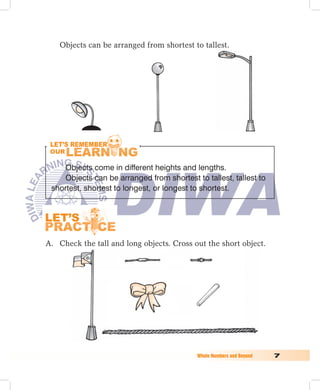
Objects can be arranged from shortest to tallest.


        Objects come in different heights and lengths.
        Objects can be arranged from shortest to tallest, tallest to
    shortest, shortest to longest, or longest to shortest.


A. Check the tall and long objects. Cross out the short object.


	                                              Whole	Numbers	and	Beyond
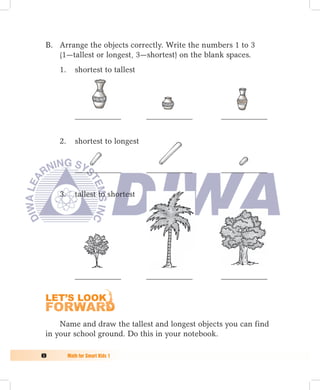
B. Arrange the objects correctly. Write the numbers 1 to 3
    (1—tallest or longest, 3—shortest) on the blank spaces.
     1.      shortest to tallest


             _____________         _____________   _____________


     2.      shortest to longest


             _____________         _____________   _____________


     3.      tallest to shortest


             _____________         _____________   _____________


     Name and draw the tallest and longest objects you can find
 in your school ground. Do this in your notebook.

	        Math	for	Smart	Kids	1
A. Study each set of pictures. Answer the question by putting a
   check (P) on the correct picture.
    1.   Which vehicle is the longest?


    2.   Which building is the tallest?


    3.   Which animal is the tallest?


	                                         Whole	Numbers	and	Beyond
4.      Which hair is shorter?


      5.      Which skirt is shorter?


 B. Identify the following pupils in your class. Write their
    names on the blank spaces.
      1.      tallest pupil in your class    __________________________
      2.      shortest pupil in your class   __________________________
      3.      pupil with the shortest hair   __________________________
      4.      pupil with the longest hair    __________________________


10	        Math	for	Smart	Kids	1
Lesson 3                                                 Patterns


      Study these different patterns.
Single pattern


Double pattern


Triple pattern


Complex pattern


    1. How many objects repeat in a single pattern? in a double
       pattern? in a triple pattern?
    2. How many objects repeat in a complex pattern?


	                                          Whole	Numbers	and	Beyond	   11
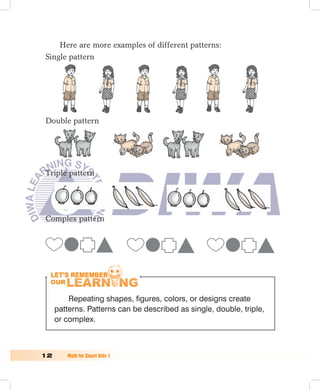
Here are more examples of different patterns:
 Single pattern


 Double pattern


 Triple pattern


 Complex pattern


          Repeating shapes, figures, colors, or designs create
      patterns. Patterns can be described as single, double, triple,
      or complex.


1	      Math	for	Smart	Kids	1
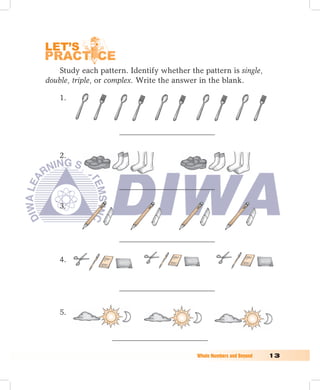
Study each pattern. Identify whether the pattern is single,
double, triple, or complex. Write the answer in the blank.

    1.


                     ___________________________


    2.


                     ___________________________

    3.


                     ___________________________

    4.


                     ___________________________


    5.


                   ___________________________

	                                          Whole	Numbers	and	Beyond	   1
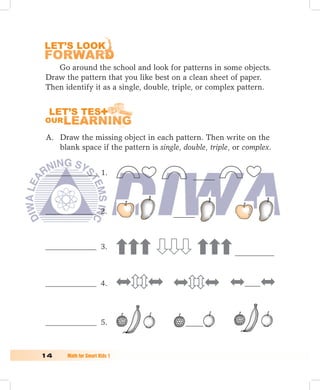
Go around the school and look for patterns in some objects.
 Draw the pattern that you like best on a clean sheet of paper.
 Then identify it as a single, double, triple, or complex pattern.


 A. Draw the missing object in each pattern. Then write on the
    blank space if the pattern is single, double, triple, or complex.


 _____________ 1.
                                             ______


 _____________ 2.                      ______


 _____________ 3.
                                                          ___________


 _____________ 4.                                            _____


 _____________ 5.                          _____


1	    Math	for	Smart	Kids	1
B. Complete the pattern. Draw the missing object in the
   pattern.


    1.
                                          ______


    2.                                                                  _____


    3.
               ______


    4.
                                 ______


    5.


                        ______


	                                           Whole	Numbers	and	Beyond	      1

Math for Smart Kids Gr.1

  • 1.
  • 2.
    Math for SmartKids Grade 1 Textbook Philippine Copyright 2010 by DIWA LEARNING SYSTEMS INC All rights reserved. Printed in the Philippines Editorial, design, and layout by University Press of First Asia No part of this publication may be reproduced or transmitted in any form or by any means electronic or mechanical, including photocopying, recording, or any information storage and retrieval systems, without permission in writing from the copyright owner. Exclusively distributed by DIWA LEARNING SYSTEMS INC 4/F SEDCCO 1 Bldg. 120 Thailand corner Legazpi Streets Legaspi Village, 1229 Makati City, Philippines Tel. No.: (632) 893-8501 * Fax: (632) 817-8700 ISBN 978-971-46-0115-4 The Editorial Board Authors Dr. Estrella P. Mercado finished her PhD in Educational Management (with honor) and MA in Education at Manuel L. Quezon University. She also holds an MEd in Special Education degree and a BS in Elementary Education degree from the Philippine Normal University (PNU). She has been a classroom teacher, an Education supervisor, and assistant chief of the Elementary Division of the Department of Education, Culture and Sports (DECS-NCR). She was awarded as Outstanding Female Educator in 1998 by the Filipino Chinese Women Federation. She presently heads the Special Education Department at PNU. Jasmin Iris F. Sallegue graduated cum laude from PNU with a degree in Bachelor of Secondary Education major in Mathematics. She is currently a grade school Mathematics teacher at De La Salle Santiago Zobel School in Ayala Alabang. She has trained students of De La Salle Santiago Zobel School for various mathematics competitions, like the annual Metrobank-MTAP-DepEd Math competition. She is a member of the Mathematics Teachers Association of the Philippines (MTAP). Consultant-Reviewer Luzviminda M. Sibbaluca holds a master’s degree in Mathematics Education and a bachelor’s degree in Elementary Mathematics Education (cum laude) both from the University of the Philippines-Diliman. She is one of the top ten successful examinees of the Licensure Examination for Teachers (LET) for Elementary in 2003. She is currently an assistant professor at the Mathematics Department of the University of the Philippines Integrated School (UPIS).
  • 3.
    Preface Math for Smart Kids is a series of textbooks in Mathematics for grade school, which is designed to help pupils develop appreciation and love for mathematics. This series also aims to help the learners acquire the skills they need to become computationally literate. The lessons in each textbook present mathematics concepts and principles that are anchored on the competencies prescribed by the Department of Education. Each lesson starts with Let’s Do Math, where mathematics concepts and principles are introduced through problems, stories, games, or puzzles. This section is followed by Let’s Look Back, which lists questions that will help the pupils to think critically on what has been introduced in the lesson and will allow them to discover things on their own. For easy recall of important points or concepts taken up in a lesson, the section Let’s Remember Our Learning has been included. Multilevel exercises are provided in Let’s Practice and Let’s Test Our Learning that will assess how much the pupils have learned from the lesson. The exercises will also determine if the pupils are ready to learn new mathematics skills. The development of the multiple intelligences of an individual is reflected in the different activities that the pupils will perform—from concrete to semi-concrete, and from semi-abstract to abstract kind of learning. Situations and real-life problems are provided in Let’s Look Forward to give the pupils opportunities to apply what they have learned to their daily life experiences. This series of textbooks gives the learners the opportunity to explore and enjoy Mathematics. Let’s have fun learning together! The Authors
  • 4.
    Table of Contents Unit 1 Whole Numbers and Beyond Chapter 1 Sizes, Lengths, and Patterns Lesson 1 Sizes of Objects................................................... 2 2 Lengths and Heights of Objects ........................... 6 3 Patterns ........................................................... 11 Chapter 2 Sets and Whole Numbers Lesson 1 Numbers 0 to 100 ............................................. 16 2 Comparing Sets and Numbers Up to 100 ........... 20 3 Ordering Sets and Numbers Up to 100 .............. 24 4 Reading and Writing Numbers Up to 100 .......... 30 5 Ordinal Numbers.............................................. 35 6 Place Values Up to Thousands .......................... 39 7 Reading and Writing Numbers Up to Thousands .................................................... 42 8 Comparing and Ordering Numbers Up to Thousands .................................................... 48 9 Skip Counting through Hundreds ...................... 52 10 Philippine Coins and Bills ................................. 56 Unit 2 Operations on Whole Numbers Chapter 3 Addition and Subtraction of Whole Numbers Lesson 1 Adding One-digit Numbers ............................... 62 2 Properties of Addition ....................................... 68 3 Adding Two-digit Numbers ............................... 74 4 Adding Three-digit Numbers............................. 78
  • 5.
    5 Adding WholeNumbers with Sums Up to Thousands .................................................... 83 6 Solving Word Problems on Addition of Whole Numbers ........................................... 88 7 Subtracting One- to Two-digit Numbers ............ 92 8 Subtracting Three-digit Numbers ...................... 96 9 Subtracting Four-digit Numbers .......................101 10 Solving Word Problems on Subtraction of Whole Numbers ..........................................105 11 Solving Two-step Word Problems ....................111 Chapter 4 Multiplication and Division of Whole Numbers Lesson 1 Understanding Multiplication ..........................116 2 Multiplying Numbers by 0, 1, and 2.................122 3 Multiplying Numbers by 3, 4, 5, and 10 ...........126 4 Understanding Division ...................................131 5 Dividing Numbers by 1, 2, and 3 .....................137 6 Dividing Numbers by 4, 5, and 10 ...................141 Unit 3 Fractions and Geometry Chapter 5 Fractions Lesson 1 Parts of a Whole ..............................................146 2 Parts of a Set ...................................................152 3 More on Parts of a Whole ................................157 4 More on Parts of a Set......................................161 5 More on Fractions  1 and 1  .......................168 9 10  6 Fractional Part of a Set.....................................173 7 Comparing Fractions .......................................178
  • 6.
    Chapter 6 Geometry Lesson 1 Points, Lines, and Plane Figures .......................184 2 Polygons and Circles........................................189 3 Symmetry ........................................................194 4 Solid or Space Figures ......................................197 Unit 4 Measurement, Time, and Graphs Chapter 7 Measurement Lesson 1 Nonstandard Units of Linear Measurement ......202 2 Standard Units of Linear Measurement ............205 3 Perimeter .........................................................210 4 Area ................................................................216 5 Area of a Rectangle and a Square .....................221 6 Mass ................................................................226 7 Capacity ..........................................................231 Chapter 8 Time Lesson 1 Telling Time ....................................................237 2 More on Time Measurement ............................241 3 Days of the Week ............................................246 4 Months of the Year ..........................................249 Chapter 9 Graphs Lesson 1 Pictograph .......................................................253 2 Collecting and Organizing Data ........................258 3 Making a Pictograph ........................................263 Bibliography ........................................................................266
  • 7.
    Unit 1 Whole Numbers and Beyond kg
  • 8.
    Chapter 1 Sizes, Lengths, and Patterns Lesson 1 Sizes of Objects The stuffed toys are arranged from smallest to biggest. The balls are arranged from biggest to smallest. 1. Which is the biggest stuffed toy? 2. Which is the smallest ball? Sizes of objects can be compared. An object can be bigger or smaller than another object. The teddy bear is bigger than the rabbit stuffed toy. The golf ball is the smallest ball. Math for Smart Kids 1
  • 9.
    Objects come indifferent sizes. Some objects are small while others are big. Sizes of objects can be compared using the words bigger, biggest, smaller, and smallest. Objects can be arranged from smallest to biggest, or from biggest to smallest. A. Check the animals that are small. Circle the animals that are big. Whole Numbers and Beyond
  • 10.
    B. Compare theanimal on the left with that on the right. Circle the correct word. 1. bigger smaller 2. bigger smaller bigger 3. smaller Draw a star () on the blank space if the objects are arranged correctly. _______ 1. smallest to biggest _______ 2. biggest to smallest Math for Smart Kids 1
  • 11.
    Color the objectbeing described. 1. smaller shoe 2. bigger animal 3. biggest bird 4. smallest hand Whole Numbers and Beyond
  • 12.
    Lesson 2 Lengths and Heights of Objects Look at the family. What can you say about their heights? 1. Who is the tallest in the family? 2. Who is the shortest in the family? 3. Who is taller, the father or the mother? Objects can be arranged from shortest to longest. Objects can be arranged from longest to shortest. Math for Smart Kids 1
  • 13.
    Objects can bearranged from shortest to tallest. Objects come in different heights and lengths. Objects can be arranged from shortest to tallest, tallest to shortest, shortest to longest, or longest to shortest. A. Check the tall and long objects. Cross out the short object. Whole Numbers and Beyond
  • 14.
    B. Arrange theobjects correctly. Write the numbers 1 to 3 (1—tallest or longest, 3—shortest) on the blank spaces. 1. shortest to tallest _____________ _____________ _____________ 2. shortest to longest _____________ _____________ _____________ 3. tallest to shortest _____________ _____________ _____________ Name and draw the tallest and longest objects you can find in your school ground. Do this in your notebook. Math for Smart Kids 1
  • 15.
    A. Study eachset of pictures. Answer the question by putting a check (P) on the correct picture. 1. Which vehicle is the longest? 2. Which building is the tallest? 3. Which animal is the tallest? Whole Numbers and Beyond
  • 16.
    4. Which hair is shorter? 5. Which skirt is shorter? B. Identify the following pupils in your class. Write their names on the blank spaces. 1. tallest pupil in your class __________________________ 2. shortest pupil in your class __________________________ 3. pupil with the shortest hair __________________________ 4. pupil with the longest hair __________________________ 10 Math for Smart Kids 1
  • 17.
    Lesson 3 Patterns Study these different patterns. Single pattern Double pattern Triple pattern Complex pattern 1. How many objects repeat in a single pattern? in a double pattern? in a triple pattern? 2. How many objects repeat in a complex pattern? Whole Numbers and Beyond 11
  • 18.
    Here are moreexamples of different patterns: Single pattern Double pattern Triple pattern Complex pattern Repeating shapes, figures, colors, or designs create patterns. Patterns can be described as single, double, triple, or complex. 1 Math for Smart Kids 1
  • 19.
    Study each pattern.Identify whether the pattern is single, double, triple, or complex. Write the answer in the blank. 1. ___________________________ 2. ___________________________ 3. ___________________________ 4. ___________________________ 5. ___________________________ Whole Numbers and Beyond 1
  • 20.
    Go around theschool and look for patterns in some objects. Draw the pattern that you like best on a clean sheet of paper. Then identify it as a single, double, triple, or complex pattern. A. Draw the missing object in each pattern. Then write on the blank space if the pattern is single, double, triple, or complex. _____________ 1. ______ _____________ 2. ______ _____________ 3. ___________ _____________ 4. _____ _____________ 5. _____ 1 Math for Smart Kids 1
  • 21.
    B. Complete thepattern. Draw the missing object in the pattern. 1. ______ 2. _____ 3. ______ 4. ______ 5. ______ Whole Numbers and Beyond 1