Data Collection
christine.rafols@deped.gov.ph
Types of Sampling
A. Probability Sampling is a sampling
technique in which the probability of
getting any particular sample maybe
calculated.
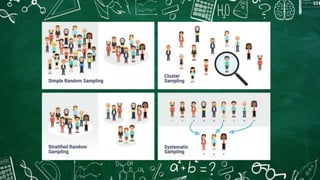
1. In simple random sampling, each
member of the population has an equality
likely chance of being selected. The
members of the sample are chosen
independently of each other.
2. In a stratified random sampling, the
population is divided into subgroups, so
that each population member is in only one
subgroup. In here, individuals are chosen
randomly from each subgroup.
3. A cluster sampling, is a sample that
consists of items in a group such as a
neighborhood or a household. The group
may be chosen at random.
4. A systematic sampling is obtained using
an ordered list of the population, thus
selecting members systematically from the
list.
Example
Situation: A Mathematics teacher plans to
choose four students from the Math Club to
be in a publicity photo.
1. The teacher mixed the names of the
boys and chose two from the group. The
teacher does the same for the girls.
2. The Math Teacher put the names of all
the students in a box, mix the names
without looking.
3. The math teacher chooses the first
student in row 1, the second student in row
2, the third student in row 3, and so on.
4. The Math Teacher choose a group of
four students in the corner of the last row.
Types of Sampling
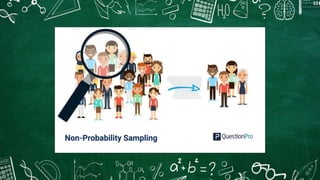
B. Non-Probability Sampling is a sampling
technique where the samples are gathered
in a process that does not give all the
individuals in the population equal chances
of being selected.
1. In convenience sampling, the samples
are selected because they are accessible to
the researcher. Subjects are chosen simply
because they are easy to recruit.
2. Snowball sampling is usually done when
there is a very small population size. In this
type of sampling, the researcher asks the
initial subject to identify another potential
subject who also meets the criteria of the
research.
3. Judgemental sampling or purposive
sampling is where the researcher chooses
the sample based on who they think would
be appropriate for the study.
4. Quota sampling is a technique wherein
the assembled sample has the same
proportion of individuals as the entire
population with respect to the known
characteristics, traits, or focused
phenomenon.
Identify the type of sampling used for
each given scenarios.
1. Every 100th mango that goes into a
sorting machine is picked for pest
inspection until 20 samples are reached.
2. A researcher divided the whole NCR by
city. He then chose all high school principals
in Metro Manila to determine the progress
of the K-12 curriculum of the whole NCR.
3. 10 participants were chosen from a
hundred entries via randomly picking their
assigned numbers from a mixed box.
4. A member of Congress wishes to
determine her constituency’s opinion
regarding estate taxes. She divides her
constituency into three income classes:
low-income households, middle-income
households, and upper-income households.
She then takes a random sample of
households from each income class.
5. In a large school district, all teachers
from two buildings are interviewed to
determine whether they believe the
students have less homework to do now
than in previous years.
6. Every 110th hamburger manufactured is
checked to determine its fat content.
7. Every seventh customer entering a
shopping mall is asked to select his or her
favorite store.
8. To avoid working late, the quality control
manager inspects the last 10 items
produced that day.
9. Nursing supervisors are selected using
random number in order to determine
annual salaries.
10. The names of 70 contestants are written
on 70 cards. The cards are placed in a bag,
and three names are picked from the bag.

Math 7 - 4th Quarter: Types of Sampling

  • 1.
  • 2.
    Types of Sampling A.Probability Sampling is a sampling technique in which the probability of getting any particular sample maybe calculated.
  • 4.
    1. In simplerandom sampling, each member of the population has an equality likely chance of being selected. The members of the sample are chosen independently of each other.
  • 5.
    2. In astratified random sampling, the population is divided into subgroups, so that each population member is in only one subgroup. In here, individuals are chosen randomly from each subgroup.
  • 6.
    3. A clustersampling, is a sample that consists of items in a group such as a neighborhood or a household. The group may be chosen at random.
  • 7.
    4. A systematicsampling is obtained using an ordered list of the population, thus selecting members systematically from the list.
  • 8.
    Example Situation: A Mathematicsteacher plans to choose four students from the Math Club to be in a publicity photo.
  • 9.
    1. The teachermixed the names of the boys and chose two from the group. The teacher does the same for the girls. 2. The Math Teacher put the names of all the students in a box, mix the names without looking.
  • 10.
    3. The mathteacher chooses the first student in row 1, the second student in row 2, the third student in row 3, and so on. 4. The Math Teacher choose a group of four students in the corner of the last row.
  • 11.
    Types of Sampling B.Non-Probability Sampling is a sampling technique where the samples are gathered in a process that does not give all the individuals in the population equal chances of being selected.
  • 13.
    1. In conveniencesampling, the samples are selected because they are accessible to the researcher. Subjects are chosen simply because they are easy to recruit.
  • 14.
    2. Snowball samplingis usually done when there is a very small population size. In this type of sampling, the researcher asks the initial subject to identify another potential subject who also meets the criteria of the research.
  • 15.
    3. Judgemental samplingor purposive sampling is where the researcher chooses the sample based on who they think would be appropriate for the study.
  • 16.
    4. Quota samplingis a technique wherein the assembled sample has the same proportion of individuals as the entire population with respect to the known characteristics, traits, or focused phenomenon.
  • 17.
    Identify the typeof sampling used for each given scenarios. 1. Every 100th mango that goes into a sorting machine is picked for pest inspection until 20 samples are reached.
  • 18.
    2. A researcherdivided the whole NCR by city. He then chose all high school principals in Metro Manila to determine the progress of the K-12 curriculum of the whole NCR. 3. 10 participants were chosen from a hundred entries via randomly picking their assigned numbers from a mixed box.
  • 19.
    4. A memberof Congress wishes to determine her constituency’s opinion regarding estate taxes. She divides her constituency into three income classes: low-income households, middle-income households, and upper-income households. She then takes a random sample of households from each income class.
  • 20.
    5. In alarge school district, all teachers from two buildings are interviewed to determine whether they believe the students have less homework to do now than in previous years. 6. Every 110th hamburger manufactured is checked to determine its fat content.
  • 21.
    7. Every seventhcustomer entering a shopping mall is asked to select his or her favorite store. 8. To avoid working late, the quality control manager inspects the last 10 items produced that day.
  • 22.
    9. Nursing supervisorsare selected using random number in order to determine annual salaries. 10. The names of 70 contestants are written on 70 cards. The cards are placed in a bag, and three names are picked from the bag.

Editor's Notes

  • #17 is a non-probability sampling technique wherein the researcher ensures equal or proportionate representation of subjects depending on which trait is considered as basis of the quota. For example, if basis of the quota is college year level and the researcher needs equal representation, with a sample size of 100, he must select 25 1st year students, another 25 2nd year students, 25 3rd year and 25 4th year students. The bases of the quota are usually age, gender, education, race, religion and socioeconomic status.
  • #18 Systematic Sampling
  • #19 Cluster Sampling Simple Random Sampling
  • #20 Stratified Sampling