SCHOOL OF RESEARCH AND POSTGRADUATE STUDIES
FACULTY OF MECHANICAL AND INDUSTRIAL ENGINEERING
MSC
contents
 Introduction
 Background
 Statement of the problem
 Objectives
 Significance of the study
 Scope of the study
 Literature review
 Methodology
 Work plan
 Budget plan
 Reference
1.Introduction
 Waste is defined as unwanted and unusable materials and is regarded as a
substance that is of no use.
 Commonly waste is classified into two types: Biodegradable and Non-
biodegradable waste.
1. Biodegradable waste: Biodegradable wastes decompose themselves over some
time depending on the material.
2. Non-biodegradable waste: Non-biodegradable wastes do not decompose by
themselves and hence are major pollutants.
Cont…
 Sources of waste can be broadly classified into four types:
1. Industrial: These are the wastes created in factories and industries.
2. Commercial: Commercial wastes are produced in schools, colleges, shops, and
offices.
3. Domestic: The different household wastes which are collected during household
activities like cooking, cleaning, etc. and
4. Agricultural: Various wastes produced in the agricultural field are known as
agricultural wastes.
2.Background
 Waste grows with the increase of the economic system and human life.
 There is a generation of 2.01 billion tons of municipal solid waste per year at the global
level.
 These numbers have a great effect on our society and the ecology as a whole. So
wastes have to be managed properly.
 Recycling waste products is very important as this process helps in processing
waste or used products into useful or new products.
Cont…
 Importance of waste segregation
1. Lower waste cost: Mixing waste streams can be costly.
2. Increased recycling rate: if waste is appropriately sorted then the recycling rate
of recyclable wastes also increase.
3. Potential revenue streams: Waste segregation enables you to identify valuable
materials such as metals, cardboard, and plastics
4. Reduced landfilled impact: reduces your overall impact on the environment.
3.Statement of the problem
 Due to the growing population and economy in Bahir Dar city, the amount of waste
generated per each year is increasing.
 Currently in Bahir Dar city waste is segregated manually by using inspection. This
can cause a lot of problems in the workers related to health issues like an increased
risk of pulmonary disorders and gastrointestinal problems, and due to high
concentrations of total airborne dust, bacteria, fecal coliform bacteria, and fungal
spores, they could experience adverse health effects.
 In addition, a high incidence of lower back injuries, probably due to heavy lifting
during work, and it takes too much time to sort each waste on each bin.
 The workers work all day to sort each waste (a tedious process).so we need to
develop semi-automated waste sorting machine that can eliminate all the above
problems.
4.Objectives of the study
4.1 general objective
The main objective of this paper is to
develop the design and control of a semi-
automated waste sorting machine using an
Arduino microcontroller.
Cont…
4.2 Specific Objective
 To design and model the sorting mechanism
 To design a conveyor system for the transportation of wastes
 To develop the control system
 To evaluate the performance of the system
 To simulate and validate the system
5.Significance of the study
 To decrease the environmental pollution.
 For efficient reuse and recycling of wastes.
 To save time and money.
 To reduce human power involved in the sorting system.
 To reduce health issues related to workers.
 To improve waste segregation system.
6.Scope of the study
 The scope of this study is to develop the design and control of a semi-automated
waste sorting machine using an Arduino microcontroller. This machine uses a
vibrating discharge hopper ,conveyor , IR sensor, inductive proximity sensor, E3S-R
sensor to sense glasses, laser, and LDR to differentiate plastic and paper, industrial
level sensor to sense the fullness of each bin, weight sensor to analyze how much
waste is segregated on each bin, hydraulic cylinder to push each waste towards its
specific bin and motor to drive the conveyor and pump.
7.Literature review
 Related research on automatic waste sorting machines
 (Thaku, 2016)This paper reports the development of a robotic mobile manipulation
system for the automated sorting of useful recyclables from MSW. The developed
robot is equipped with a thermal imaging camera, proximity sensor, and a 5-DOF
robotic arm.
 (Wang, 2016) The paper provides a novel waste disposal mode that builds a semi-
automatic sorting gadget inside the resident location to obtain the aim of waste
sorting on the source.
Cont…
 (Hassan, 2019) This paper proposes an Automatic Waste Segregator and
Monitoring System which is designed to sort the wet waste, paper, plastic, and
aluminum material into each bin respectively.
 (Gepilano, 2021)This research project aimed to develop an automated plastic
collector with an improvised pyrolysis system as an innovative solution to free-
plastic waste towards a greener school environment.
8.Methodology
Main Components
 ARDUINO UNO microcontroller
 IR sensor
 Metal sensor(inductive proximity sensor)
 Glass sensor (E3S-R Transparent Material Detection Sensor)
 Laser LDR sensor
 Weight sensor
 Level sensor(industrial level sensor)
 Hydraulic cylinder
 Motor to drive the conveyor and Power supply to drive the motor and other electrical
components
Cont…
 Block diagram for semi-automated waste sorting machine
Cont…
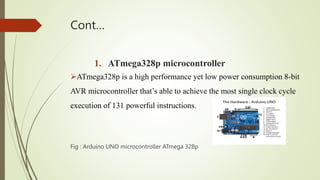
1. ATmega328p microcontroller
ATmega328p is a high performance yet low power consumption 8-bit
AVR microcontroller that’s able to achieve the most single clock cycle
execution of 131 powerful instructions.
Fig : Arduino UNO microcontroller ATmega 328p
Cont…
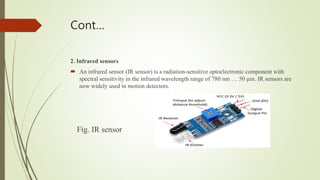
2. Infrared sensors
 An infrared sensor (IR sensor) is a radiation-sensitive optoelectronic component with
spectral sensitivity in the infrared wavelength range of 780 nm … 50 µm. IR sensors are
now widely used in motion detectors.
Fig. IR sensor
Cont…
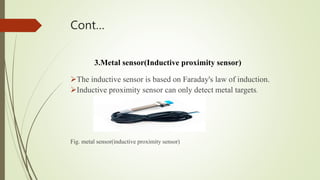
3.Metal sensor(Inductive proximity sensor)
The inductive sensor is based on Faraday's law of induction.
Inductive proximity sensor can only detect metal targets.
Fig. metal sensor(inductive proximity sensor)
Cont…
4 Glass Sensor
 E3S-R Transparent Material Detection Sensor: It has an inbuilt DC amplifier circuit,
able to detect transparent material in Light mode as well as dark mode. It has a
maximum response time of about 1 ms max. It has a sensing distance in a range of
10–30cm.
Fig. E3S-R Transparent Material Detection Sensor
Cont…
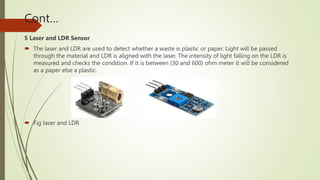
5 Laser and LDR Sensor
 The laser and LDR are used to detect whether a waste is plastic or paper. Light will be passed
through the material and LDR is aligned with the laser. The intensity of light falling on the LDR is
measured and checks the condition. If it is between (30 and 600) ohm meter it will be considered
as a paper else a plastic.
 Fig laser and LDR
Cont…
5 Weight Sensor
 Mini Weight Module HX711 Sensor 24 Bits Weighing Pressure Sensor. The load cell is a
transducer that transforms force or pressure into electrical output.
Fig . Load cell and weight sensor
Cont…
6. Level sensor
 an industrial ultrasonic sensor is used to detect the levels of bulk materials. They work by emitting
and receiving ultrasonic waves, at the range of frequency from 20 to 200 kHz.
 They have no moving parts, are compact and cost-effective, reliable, and non-invasive.
Fig . Industrial ultrasonic level sensor
Cont…
7. Double acting hydraulic cylinder
 Used to push each waste towards its specified bin.
Fig. double acting hydraulic cylinder
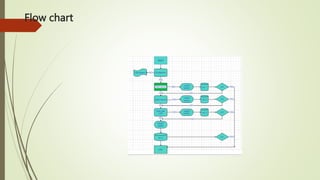
Flow chart
Cont….
9.Work plan
10.Budget plan
11. Reference
 A.K.Aslila, S. K. (2017). The effectiveness of segregation recyclable materials by automated Motorized Bin. journal of advanced manufacturing
technology.
 Aleena v.j, k. b. (2016). automatic waste segregator and monitoring system. journal of microcontroller engineering and applications.
 Cardoso, J. S. (2019). Automation of Waste Sorting with Deep Learning. https://ieeexplore.ieee.org/xpl/conhome/8869702/proceeding.
 Gepilano, M. T. (2021). Automated Plastic Collector (Autoplastor) with an improvised pyrolysis system as an innovative solution to free-plastic waste
towards a greener school environment. IJISET - International Journal of Innovative Science, Engineering & Technology, 8.
 Hassan, N. H. (2019). Development of Automatic Waste Segregator with the monitoring system. 2019 4th international conference on information
technology, information system, and electrical engineering(ICITISEE).
 Kamran Rousta 1, I. O. (2017). Support for designing waste sorting systems: a mini-review. journals.sage pub.
 Mahmudul Hasan Russel 1*, M. H. (2013). Development of Automatic Smart Waste Sorter Machine. International Conference on Mechanical, Industrial
and Materials Engineering 2013 (ICMIME2013). Bangladesh.
 Myra G. Flores, J. B. (n.d.). Literature Review of Automated Waste Segregation System using Machine Literature Review of Automated Waste
Segregation System using Machine. Technological Institute of the Philippines, Manila, Philippines.
 Praveen Kumar Gupta, V. S. (2019). The Use of Modern Technology in Smart Waste Management and Recycling: Artificial Intelligence and Machine
Learning. Springer Nature Switzerland AG 2019.
 Ruveena Singh, D. B. (DEC. 2015). Design and Development of Smart Waste Sorting System. IJRECE, VOL. 3.
 Samann, F. E. (2017). The Design and Implementation of Smart Trash. Academic Journal of Nawroz University (AJNU), volume 6.
Thank you

research ppt.pptx

  • 1.
    SCHOOL OF RESEARCHAND POSTGRADUATE STUDIES FACULTY OF MECHANICAL AND INDUSTRIAL ENGINEERING MSC
  • 2.
    contents  Introduction  Background Statement of the problem  Objectives  Significance of the study  Scope of the study  Literature review  Methodology  Work plan  Budget plan  Reference
  • 3.
    1.Introduction  Waste isdefined as unwanted and unusable materials and is regarded as a substance that is of no use.  Commonly waste is classified into two types: Biodegradable and Non- biodegradable waste. 1. Biodegradable waste: Biodegradable wastes decompose themselves over some time depending on the material. 2. Non-biodegradable waste: Non-biodegradable wastes do not decompose by themselves and hence are major pollutants.
  • 4.
    Cont…  Sources ofwaste can be broadly classified into four types: 1. Industrial: These are the wastes created in factories and industries. 2. Commercial: Commercial wastes are produced in schools, colleges, shops, and offices. 3. Domestic: The different household wastes which are collected during household activities like cooking, cleaning, etc. and 4. Agricultural: Various wastes produced in the agricultural field are known as agricultural wastes.
  • 5.
    2.Background  Waste growswith the increase of the economic system and human life.  There is a generation of 2.01 billion tons of municipal solid waste per year at the global level.  These numbers have a great effect on our society and the ecology as a whole. So wastes have to be managed properly.  Recycling waste products is very important as this process helps in processing waste or used products into useful or new products.
  • 6.
    Cont…  Importance ofwaste segregation 1. Lower waste cost: Mixing waste streams can be costly. 2. Increased recycling rate: if waste is appropriately sorted then the recycling rate of recyclable wastes also increase. 3. Potential revenue streams: Waste segregation enables you to identify valuable materials such as metals, cardboard, and plastics 4. Reduced landfilled impact: reduces your overall impact on the environment.
  • 7.
    3.Statement of theproblem  Due to the growing population and economy in Bahir Dar city, the amount of waste generated per each year is increasing.  Currently in Bahir Dar city waste is segregated manually by using inspection. This can cause a lot of problems in the workers related to health issues like an increased risk of pulmonary disorders and gastrointestinal problems, and due to high concentrations of total airborne dust, bacteria, fecal coliform bacteria, and fungal spores, they could experience adverse health effects.  In addition, a high incidence of lower back injuries, probably due to heavy lifting during work, and it takes too much time to sort each waste on each bin.  The workers work all day to sort each waste (a tedious process).so we need to develop semi-automated waste sorting machine that can eliminate all the above problems.
  • 8.
    4.Objectives of thestudy 4.1 general objective The main objective of this paper is to develop the design and control of a semi- automated waste sorting machine using an Arduino microcontroller.
  • 9.
    Cont… 4.2 Specific Objective To design and model the sorting mechanism  To design a conveyor system for the transportation of wastes  To develop the control system  To evaluate the performance of the system  To simulate and validate the system
  • 10.
    5.Significance of thestudy  To decrease the environmental pollution.  For efficient reuse and recycling of wastes.  To save time and money.  To reduce human power involved in the sorting system.  To reduce health issues related to workers.  To improve waste segregation system.
  • 11.
    6.Scope of thestudy  The scope of this study is to develop the design and control of a semi-automated waste sorting machine using an Arduino microcontroller. This machine uses a vibrating discharge hopper ,conveyor , IR sensor, inductive proximity sensor, E3S-R sensor to sense glasses, laser, and LDR to differentiate plastic and paper, industrial level sensor to sense the fullness of each bin, weight sensor to analyze how much waste is segregated on each bin, hydraulic cylinder to push each waste towards its specific bin and motor to drive the conveyor and pump.
  • 12.
    7.Literature review  Relatedresearch on automatic waste sorting machines  (Thaku, 2016)This paper reports the development of a robotic mobile manipulation system for the automated sorting of useful recyclables from MSW. The developed robot is equipped with a thermal imaging camera, proximity sensor, and a 5-DOF robotic arm.  (Wang, 2016) The paper provides a novel waste disposal mode that builds a semi- automatic sorting gadget inside the resident location to obtain the aim of waste sorting on the source.
  • 13.
    Cont…  (Hassan, 2019)This paper proposes an Automatic Waste Segregator and Monitoring System which is designed to sort the wet waste, paper, plastic, and aluminum material into each bin respectively.  (Gepilano, 2021)This research project aimed to develop an automated plastic collector with an improvised pyrolysis system as an innovative solution to free- plastic waste towards a greener school environment.
  • 14.
    8.Methodology Main Components  ARDUINOUNO microcontroller  IR sensor  Metal sensor(inductive proximity sensor)  Glass sensor (E3S-R Transparent Material Detection Sensor)  Laser LDR sensor  Weight sensor  Level sensor(industrial level sensor)  Hydraulic cylinder  Motor to drive the conveyor and Power supply to drive the motor and other electrical components
  • 15.
    Cont…  Block diagramfor semi-automated waste sorting machine
  • 16.
    Cont… 1. ATmega328p microcontroller ATmega328pis a high performance yet low power consumption 8-bit AVR microcontroller that’s able to achieve the most single clock cycle execution of 131 powerful instructions. Fig : Arduino UNO microcontroller ATmega 328p
  • 17.
    Cont… 2. Infrared sensors An infrared sensor (IR sensor) is a radiation-sensitive optoelectronic component with spectral sensitivity in the infrared wavelength range of 780 nm … 50 µm. IR sensors are now widely used in motion detectors. Fig. IR sensor
  • 18.
    Cont… 3.Metal sensor(Inductive proximitysensor) The inductive sensor is based on Faraday's law of induction. Inductive proximity sensor can only detect metal targets. Fig. metal sensor(inductive proximity sensor)
  • 19.
    Cont… 4 Glass Sensor E3S-R Transparent Material Detection Sensor: It has an inbuilt DC amplifier circuit, able to detect transparent material in Light mode as well as dark mode. It has a maximum response time of about 1 ms max. It has a sensing distance in a range of 10–30cm. Fig. E3S-R Transparent Material Detection Sensor
  • 20.
    Cont… 5 Laser andLDR Sensor  The laser and LDR are used to detect whether a waste is plastic or paper. Light will be passed through the material and LDR is aligned with the laser. The intensity of light falling on the LDR is measured and checks the condition. If it is between (30 and 600) ohm meter it will be considered as a paper else a plastic.  Fig laser and LDR
  • 21.
    Cont… 5 Weight Sensor Mini Weight Module HX711 Sensor 24 Bits Weighing Pressure Sensor. The load cell is a transducer that transforms force or pressure into electrical output. Fig . Load cell and weight sensor
  • 22.
    Cont… 6. Level sensor an industrial ultrasonic sensor is used to detect the levels of bulk materials. They work by emitting and receiving ultrasonic waves, at the range of frequency from 20 to 200 kHz.  They have no moving parts, are compact and cost-effective, reliable, and non-invasive. Fig . Industrial ultrasonic level sensor
  • 23.
    Cont… 7. Double actinghydraulic cylinder  Used to push each waste towards its specified bin. Fig. double acting hydraulic cylinder
  • 24.
  • 25.
  • 26.
  • 27.
  • 28.
    11. Reference  A.K.Aslila,S. K. (2017). The effectiveness of segregation recyclable materials by automated Motorized Bin. journal of advanced manufacturing technology.  Aleena v.j, k. b. (2016). automatic waste segregator and monitoring system. journal of microcontroller engineering and applications.  Cardoso, J. S. (2019). Automation of Waste Sorting with Deep Learning. https://ieeexplore.ieee.org/xpl/conhome/8869702/proceeding.  Gepilano, M. T. (2021). Automated Plastic Collector (Autoplastor) with an improvised pyrolysis system as an innovative solution to free-plastic waste towards a greener school environment. IJISET - International Journal of Innovative Science, Engineering & Technology, 8.  Hassan, N. H. (2019). Development of Automatic Waste Segregator with the monitoring system. 2019 4th international conference on information technology, information system, and electrical engineering(ICITISEE).  Kamran Rousta 1, I. O. (2017). Support for designing waste sorting systems: a mini-review. journals.sage pub.  Mahmudul Hasan Russel 1*, M. H. (2013). Development of Automatic Smart Waste Sorter Machine. International Conference on Mechanical, Industrial and Materials Engineering 2013 (ICMIME2013). Bangladesh.  Myra G. Flores, J. B. (n.d.). Literature Review of Automated Waste Segregation System using Machine Literature Review of Automated Waste Segregation System using Machine. Technological Institute of the Philippines, Manila, Philippines.  Praveen Kumar Gupta, V. S. (2019). The Use of Modern Technology in Smart Waste Management and Recycling: Artificial Intelligence and Machine Learning. Springer Nature Switzerland AG 2019.  Ruveena Singh, D. B. (DEC. 2015). Design and Development of Smart Waste Sorting System. IJRECE, VOL. 3.  Samann, F. E. (2017). The Design and Implementation of Smart Trash. Academic Journal of Nawroz University (AJNU), volume 6.
  • 29.