Prepared by…
Aynul Haque
MS in Theriogenology
Department of Surgery and obstetrics
Faculty of veterinary Science
Bangladesh Agricultural University,
Mymensingh-2202
Factors Affecting Milk
Production in Cow
Overview
• Introduction
• Factors affecting milk yield
• Factors affecting milk quality
• Conclusion
Introduction
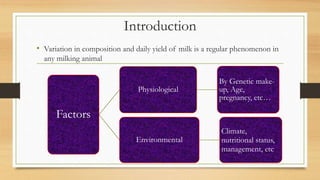
• Variation in composition and daily yield of milk is a regular phenomenon in
any milking animal
Factors
Physiological
By Genetic make-
up, Age,
pregnancy, etc…
Environmental
Climate,
nutritional status,
management, etc
Introduction
• The dairyman has hardly got any control over the physiological factors
• But has some control over the environmental factors
• A thorough understanding of the factors of dairy cattle may has advantages
• Can be used to take advantages of some of the changes in milk composition
• Also increasing milk yield that occur during a normal lactation
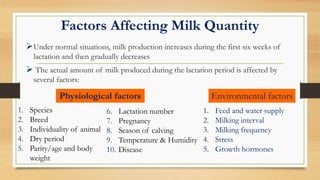
Factors Affecting Milk Quantity
Under normal situations, milk production increases during the first six weeks of
lactation and then gradually decreases
 The actual amount of milk produced during the lactation period is affected by
several factors:
1. Feed and water supply
2. Milking interval
3. Milking frequency
4. Stress
5. Growth hormones
1. Species
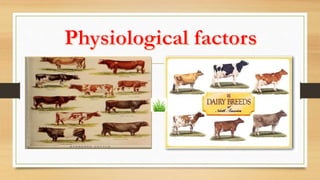
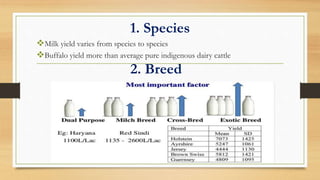
2. Breed
3. Individuality of animal
4. Dry period
5. Parity/age and body
weight
6. Lactation number
7. Pregnancy
8. Season of calving
9. Temperature & Humidity
10. Disease
Physiological factors Environmental factors
1. Species
Milk yield varies from species to species
Buffalo yield more than average pure indigenous dairy cattle
2. Breed
3. Individuality of animal
The strain and individuality of cow within a breed also are different in
producing total yield
Larger cow normally secrete more milk
 A cow can secrete milk daily upto 8% of their body weight
4. Dry period
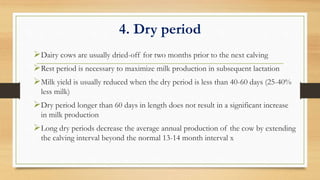
Dairy cows are usually dried-off for two months prior to the next calving
Rest period is necessary to maximize milk production in subsequent lactation
Milk yield is usually reduced when the dry period is less than 40-60 days (25-40%
less milk)
Dry period longer than 60 days in length does not result in a significant increase
in milk production
Long dry periods decrease the average annual production of the cow by extending
the calving interval beyond the normal 13-14 month interval x
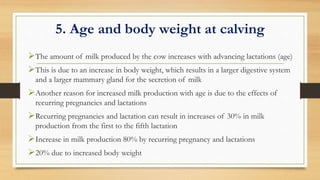
5. Age and body weight at calving
The amount of milk produced by the cow increases with advancing lactations (age)
This is due to an increase in body weight, which results in a larger digestive system
and a larger mammary gland for the secretion of milk
Another reason for increased milk production with age is due to the effects of
recurring pregnancies and lactations
Recurring pregnancies and lactation can result in increases of 30% in milk
production from the first to the fifth lactation
Increase in milk production 80% by recurring pregnancy and lactations
20% due to increased body weight
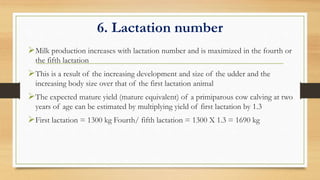
6. Lactation number
Milk production increases with lactation number and is maximized in the fourth or
the fifth lactation
This is a result of the increasing development and size of the udder and the
increasing body size over that of the first lactation animal
The expected mature yield (mature equivalent) of a primiparous cow calving at two
years of age can be estimated by multiplying yield of first lactation by 1.3
First lactation = 1300 kg Fourth/ fifth lactation = 1300 X 1.3 = 1690 kg
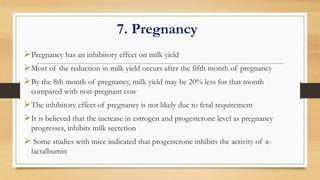
7. Pregnancy
Pregnancy has an inhibitory effect on milk yield
Most of the reduction in milk yield occurs after the fifth month of pregnancy
By the 8th month of pregnancy, milk yield may be 20% less for that month
compared with non-pregnant cow
The inhibitory effect of pregnancy is not likely due to fetal requirement
It is believed that the increase in estrogen and progesterone level as pregnancy
progresses, inhibits milk secretion
 Some studies with mice indicated that progesterone inhibits the activity of α-
lactalbumin
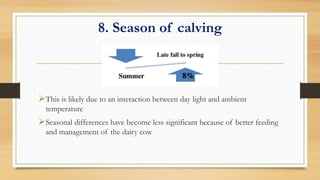
8. Season of calving
This is likely due to an interaction between day light and ambient
temperature
Seasonal differences have become less significant because of better feeding
and management of the dairy cow
9. Temperature & Humidity
No effect on milk production in Comfort Zone
The effect of ambient temperature on milk yield is dependent upon the breed
Holsteins and the other larger breeds are more tolerant to lower temperatures,
whereas the smaller breeds particularly the Jersey, are much more tolerant to high
temperatures
The optimum temperature for the Holstein cow is about 10 °C. Milk production
declines when environmental temperature exceeds 27 °C
The reduction in milk yield is largely due to drop in feed intake
High temperature affect high producing cows more than low producers and it is
particularly harmful during the peak of lactation
10. Disease
The main disease that affect milk yield of dairy cows is mastitis
It impairs the ability of secretory tissue synthesize milk components and
destroys the secretory tissues and consequently lowering milk yield
 A decrease in production persists after the disappearance of the clinical signs
of mastitis due to a destruction in the secretory tissues
1. Feed and water supply
Inadequate feed nutrients probably limit the secretion of milk
 Galactopoisis is closely related to an adequate feed intake by the lactating animal
The most dramatic effect is brought about by shortage of water as the cow has
no means of storing water.
Withholding access to water, or insufficient supply of water for few hours will
result in a rapid drop in milk yield.
2. Milking intervals
Cows are usually milked at equal intervals (12-h interval for 2 x milking)
Cows milked at unequal intervals produce less milk than those milked at equal
intervals
The reduction in milk yield is more in high producing cows than in low producing
ones
Incomplete milking for several consecutive days can permanently reduce milk yield
for the entire lactation
Milking time for most cows is 5-6 minutes per cow
3. Milking frequency
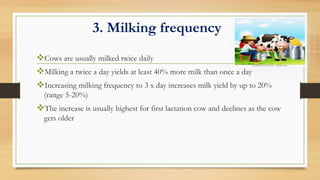
Cows are usually milked twice daily
Milking a twice a day yields at least 40% more milk than once a day
Increasing milking frequency to 3 x day increases milk yield by up to 20%
(range 5-20%)
The increase is usually highest for first lactation cow and declines as the cow
gets older
Milking frequency(Cont.)
Reasons for increased milk production as frequency of milking increases are
1. Less intramammary pressure generated with frequent milking
2. Increased stimulation of hormone activity favorable of milk production
3. Less negative feedback on the secretory cells due to the accumulation of milk components.
There are several problems associated with 3 x per day milking
It may increase the incidence of mastitis as the cows get exposed to the milking machine
more often
The practice is also not recommended for poorly managed herds as existing problems will be
aggravated
More management cost
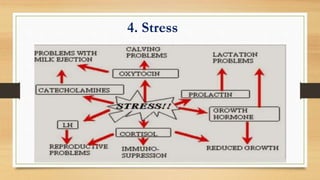
4. Stress
5. Growth hormones (BST)
• There is a positive correlation between milk production of cows and the level of
growth hormone in their blood
• Growth hormone causes redistribution of nutrient within the cow’s body to favor
nutrient utilization towards milk production
• However, growth hormone is not directly involved in milk secretion process
Factors Affecting Milk Quality
 A. Microbiological quality
 B. Milk composition
 C. Milk somatic cell count
 D. Antibiotic residues
A. Factors affecting microbiological quality
of milk
1. Endogenous sources (the cow itself)
2. Exogenous sources, such as
a. Environment (soil, water, manure or human contact)
b. Collection and processing equipment
c. Human milk handlers on the farm and in the factory
B. Factors affecting milk composition
In cattle, fat is the most variable component while minerals and lactose are
the least variable
Milk protein to milk fat ratio ranges from 0.78 to 0.85 depending on breed
type and other factors
Factors contributing to variations in milk composition include
1. Genetic differences within species
2. Breed difference
3. Stage of lactation
4. Change in milk composition during milking
5. Seasonal variations
6. Diseases
7. Nutrition
1. Genetic differences
Heritability is defined as the ratio of genetic variance to total phenotypic
ratio
The concentrations (%) of the three major milk constituents are genetically
controlled to a considerable extent
Heritiabilities of fat, protein, and lactose contents average 0.58, 0.49, and 0.5,
respectively, while that of milk yield average 0.27
Some milk constituents are strongly correlated
2. Breed differences
Milk from Holstein cows has a lower milk fat % than milk from Jersey or Guernsey
Fat droplets also differ among breeds. Holstein has the smallest fat droplet while Guernsey
has the largest
Milk of Jersey cows also has a higher total solids than milk from other dairy cattle breeds
Differences in milk composition among individual with a breed are often larger than
differences among breeds
Milk colour is also affected by breed type. Milk from Guernsey and Jersey is yellowish in
colour
This is because these two breeds convert much less carotene (yellow pigments) to vitamin A
than other breeds of dairy cattle
3. Stage of lactation
Colostrum, the first mammary secretion after parturition differs greatly from
normal milk. Cow's colostrum contains more minerals, protein and less lactose ,
K than milk
The most remarkable difference between colostrums and milk is the extremely
high levels of Ig content of colostrum
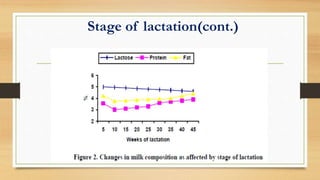
Normal milk changes in composition occur during the first few days but at
reduced rate for about 5 weeks of lactation
Fat and protein % then rises gradually and Lactose decreases while mineral
concentration increases slightly
Stage of lactation(cont.)
4. Change in milk composition during
milking
Milk fat % increases continuously during the milking process
First drawn milk may contain only 1-2% fat, whereas, at the end of milking, fat %
may be 5-10%
This is because of the tendency of the fat globules to cluster and be trapped in
the alveoli
Thus after incomplete milking, milk fat content will be lower than normal
Residual milk (milk remains in the udder after milking) may contain up to 20% fat
5. Seasonal variations
Seasonal variations in milk composition are commonly observed with dairy cattle in
temperate regions
In general, milk fat and solid-not-fat percentages are highest in winter and lowest in
summer
Milk fat and protein percentages are lower by 0.2-0.4% in summer than winter
Cows calving in the fall or winter produce more fat and solid- not-fat than cows
calving in the spring and summer
Considerable variations in milk composition can also be observed in dairy cows
raised in pasture
6. Diseases
Infection of the udder (mastitis) greatly influences milk composition
Concentrations of fat, solids-not-fat, lactose, casein, β- lactogolbulin and α-
lactalbumin are lowered and concentrations of blood of blood serum albumin, Igs,
sodium, and chloride are increased
In severe mastitis, the casein content may be below the normal limit of 78% of total
protein and the chloride content may rise above the normal maximum level of 0.12%
Mastitis is also responsible for differences observed in milk composition from
different quarters of the udder
7. Effects of nutrition on milk composition
Of all milk components, milk fat is the most influenced by dietary manipulations
Most of changes in milk composition due to dietary manipulation are related to changes in
ruminal acetate : propionate ratio
Several nutritional factors can influence milk composition. These include
A. Plane of nutrition: Underfeeding reduces lactose % and increases fat %. Imbalance rations
(e.g. low energy : protein ratio) may reduce milk fat and protein percentages
B. Forage : Concentrate ratio: As the proportion of the concentrate in the ration increases
(above 50-60% of the ration), milk fat % tends to decline
C. Forage quality (e.g. particle size): Feeding finely chopped forages has a negative impact on
milk fat % and may cause milk fat depression syndrome
D. Level and type of dietary fat: As the level of starch ion in the ration increases, the level of
acetate is decreased while that of propionate is increased causeing a reduction in milk fat %.
Feeding polyunsaturated fat may reduce milk fat % whereas feeding protected fat tend to
increase milk fat %
C. Milk somatic cell count
1. One of the quality parameter of raw milk
2. High somatic cell counts (SCC) present in milk are the main indicators of
mammary gland infection, caused by specific and non specific micro-
organisms
3. Normally, in milk from a healthy mammary gland, the SCC is lower than
100,000 cells/mL
4. While bacterial infection can cause it to increase to above 1,000,000 SCC/mL
5. An elevated SCC in milk has a negative influence on the quality of raw milk
C. Milk somatic cell count
The largest negative consequences of the presence of SCC are
1. Low production
2. Shorter shelf time
3. Less sensory content or un-desirable organo-leptic characteristics of the final
product, due to enzymatic activities from somatic cells (Töpel, 2004)
4. The high presence of SCC in milk affects the activity of yogurt fermentation
(Tamime and Robinson, 1999) and can even stop this process
Reference
N. Sharma, N. K. Singh and M. S. Bhadwal, 2011, Relationship of Somatic Cell
Count and Mastitis: An Overview, Asian-Aust. J. Anim. Sci. 24(3) : 429 – 438.

Hysen Bytyqi, Urs Zaugg, Kurtesh Sherififi, Afrim Hamidi, Muje Gjonbalaj, Skender
Muji and Hajrip Mehmeti, 2010, Influence of management and physiological factors
on somatic cell count in raw cow milk in Kosova Veterinarski arhiv, 80 (2), 173-183.
Thomas C. K., Sastry N. S. R. and Ravikiran G., 2012. Dairy bovine production,
Kalyani publishers, p- 624.
Larson B. L. and Smith V. R. 1974. Lactation, a comprehensive treatise, Academic
press, New York.
Falconer I. R. 1971. Lactation, Butter worths, Landon.
THANK YOU

Factors affecting milk production

  • 1.
    Prepared by… Aynul Haque MSin Theriogenology Department of Surgery and obstetrics Faculty of veterinary Science Bangladesh Agricultural University, Mymensingh-2202 Factors Affecting Milk Production in Cow
  • 2.
    Overview • Introduction • Factorsaffecting milk yield • Factors affecting milk quality • Conclusion
  • 3.
    Introduction • Variation incomposition and daily yield of milk is a regular phenomenon in any milking animal Factors Physiological By Genetic make- up, Age, pregnancy, etc… Environmental Climate, nutritional status, management, etc
  • 4.
    Introduction • The dairymanhas hardly got any control over the physiological factors • But has some control over the environmental factors • A thorough understanding of the factors of dairy cattle may has advantages • Can be used to take advantages of some of the changes in milk composition • Also increasing milk yield that occur during a normal lactation
  • 5.
    Factors Affecting MilkQuantity Under normal situations, milk production increases during the first six weeks of lactation and then gradually decreases  The actual amount of milk produced during the lactation period is affected by several factors: 1. Feed and water supply 2. Milking interval 3. Milking frequency 4. Stress 5. Growth hormones 1. Species 2. Breed 3. Individuality of animal 4. Dry period 5. Parity/age and body weight 6. Lactation number 7. Pregnancy 8. Season of calving 9. Temperature & Humidity 10. Disease Physiological factors Environmental factors
  • 7.
    1. Species Milk yieldvaries from species to species Buffalo yield more than average pure indigenous dairy cattle 2. Breed
  • 8.
    3. Individuality ofanimal The strain and individuality of cow within a breed also are different in producing total yield Larger cow normally secrete more milk  A cow can secrete milk daily upto 8% of their body weight
  • 9.
    4. Dry period Dairycows are usually dried-off for two months prior to the next calving Rest period is necessary to maximize milk production in subsequent lactation Milk yield is usually reduced when the dry period is less than 40-60 days (25-40% less milk) Dry period longer than 60 days in length does not result in a significant increase in milk production Long dry periods decrease the average annual production of the cow by extending the calving interval beyond the normal 13-14 month interval x
  • 10.
    5. Age andbody weight at calving The amount of milk produced by the cow increases with advancing lactations (age) This is due to an increase in body weight, which results in a larger digestive system and a larger mammary gland for the secretion of milk Another reason for increased milk production with age is due to the effects of recurring pregnancies and lactations Recurring pregnancies and lactation can result in increases of 30% in milk production from the first to the fifth lactation Increase in milk production 80% by recurring pregnancy and lactations 20% due to increased body weight
  • 11.
    6. Lactation number Milkproduction increases with lactation number and is maximized in the fourth or the fifth lactation This is a result of the increasing development and size of the udder and the increasing body size over that of the first lactation animal The expected mature yield (mature equivalent) of a primiparous cow calving at two years of age can be estimated by multiplying yield of first lactation by 1.3 First lactation = 1300 kg Fourth/ fifth lactation = 1300 X 1.3 = 1690 kg
  • 12.
    7. Pregnancy Pregnancy hasan inhibitory effect on milk yield Most of the reduction in milk yield occurs after the fifth month of pregnancy By the 8th month of pregnancy, milk yield may be 20% less for that month compared with non-pregnant cow The inhibitory effect of pregnancy is not likely due to fetal requirement It is believed that the increase in estrogen and progesterone level as pregnancy progresses, inhibits milk secretion  Some studies with mice indicated that progesterone inhibits the activity of α- lactalbumin
  • 13.
    8. Season ofcalving This is likely due to an interaction between day light and ambient temperature Seasonal differences have become less significant because of better feeding and management of the dairy cow
  • 14.
    9. Temperature &Humidity No effect on milk production in Comfort Zone The effect of ambient temperature on milk yield is dependent upon the breed Holsteins and the other larger breeds are more tolerant to lower temperatures, whereas the smaller breeds particularly the Jersey, are much more tolerant to high temperatures The optimum temperature for the Holstein cow is about 10 °C. Milk production declines when environmental temperature exceeds 27 °C The reduction in milk yield is largely due to drop in feed intake High temperature affect high producing cows more than low producers and it is particularly harmful during the peak of lactation
  • 15.
    10. Disease The maindisease that affect milk yield of dairy cows is mastitis It impairs the ability of secretory tissue synthesize milk components and destroys the secretory tissues and consequently lowering milk yield  A decrease in production persists after the disappearance of the clinical signs of mastitis due to a destruction in the secretory tissues
  • 17.
    1. Feed andwater supply Inadequate feed nutrients probably limit the secretion of milk  Galactopoisis is closely related to an adequate feed intake by the lactating animal The most dramatic effect is brought about by shortage of water as the cow has no means of storing water. Withholding access to water, or insufficient supply of water for few hours will result in a rapid drop in milk yield.
  • 18.
    2. Milking intervals Cowsare usually milked at equal intervals (12-h interval for 2 x milking) Cows milked at unequal intervals produce less milk than those milked at equal intervals The reduction in milk yield is more in high producing cows than in low producing ones Incomplete milking for several consecutive days can permanently reduce milk yield for the entire lactation Milking time for most cows is 5-6 minutes per cow
  • 19.
    3. Milking frequency Cowsare usually milked twice daily Milking a twice a day yields at least 40% more milk than once a day Increasing milking frequency to 3 x day increases milk yield by up to 20% (range 5-20%) The increase is usually highest for first lactation cow and declines as the cow gets older
  • 20.
    Milking frequency(Cont.) Reasons forincreased milk production as frequency of milking increases are 1. Less intramammary pressure generated with frequent milking 2. Increased stimulation of hormone activity favorable of milk production 3. Less negative feedback on the secretory cells due to the accumulation of milk components. There are several problems associated with 3 x per day milking It may increase the incidence of mastitis as the cows get exposed to the milking machine more often The practice is also not recommended for poorly managed herds as existing problems will be aggravated More management cost
  • 21.
  • 23.
    5. Growth hormones(BST) • There is a positive correlation between milk production of cows and the level of growth hormone in their blood • Growth hormone causes redistribution of nutrient within the cow’s body to favor nutrient utilization towards milk production • However, growth hormone is not directly involved in milk secretion process
  • 24.
    Factors Affecting MilkQuality  A. Microbiological quality  B. Milk composition  C. Milk somatic cell count  D. Antibiotic residues
  • 25.
    A. Factors affectingmicrobiological quality of milk 1. Endogenous sources (the cow itself) 2. Exogenous sources, such as a. Environment (soil, water, manure or human contact) b. Collection and processing equipment c. Human milk handlers on the farm and in the factory
  • 26.
    B. Factors affectingmilk composition In cattle, fat is the most variable component while minerals and lactose are the least variable Milk protein to milk fat ratio ranges from 0.78 to 0.85 depending on breed type and other factors Factors contributing to variations in milk composition include 1. Genetic differences within species 2. Breed difference 3. Stage of lactation 4. Change in milk composition during milking 5. Seasonal variations 6. Diseases 7. Nutrition
  • 27.
    1. Genetic differences Heritabilityis defined as the ratio of genetic variance to total phenotypic ratio The concentrations (%) of the three major milk constituents are genetically controlled to a considerable extent Heritiabilities of fat, protein, and lactose contents average 0.58, 0.49, and 0.5, respectively, while that of milk yield average 0.27 Some milk constituents are strongly correlated
  • 28.
    2. Breed differences Milkfrom Holstein cows has a lower milk fat % than milk from Jersey or Guernsey Fat droplets also differ among breeds. Holstein has the smallest fat droplet while Guernsey has the largest Milk of Jersey cows also has a higher total solids than milk from other dairy cattle breeds Differences in milk composition among individual with a breed are often larger than differences among breeds Milk colour is also affected by breed type. Milk from Guernsey and Jersey is yellowish in colour This is because these two breeds convert much less carotene (yellow pigments) to vitamin A than other breeds of dairy cattle
  • 29.
    3. Stage oflactation Colostrum, the first mammary secretion after parturition differs greatly from normal milk. Cow's colostrum contains more minerals, protein and less lactose , K than milk The most remarkable difference between colostrums and milk is the extremely high levels of Ig content of colostrum Normal milk changes in composition occur during the first few days but at reduced rate for about 5 weeks of lactation Fat and protein % then rises gradually and Lactose decreases while mineral concentration increases slightly
  • 30.
  • 31.
    4. Change inmilk composition during milking Milk fat % increases continuously during the milking process First drawn milk may contain only 1-2% fat, whereas, at the end of milking, fat % may be 5-10% This is because of the tendency of the fat globules to cluster and be trapped in the alveoli Thus after incomplete milking, milk fat content will be lower than normal Residual milk (milk remains in the udder after milking) may contain up to 20% fat
  • 32.
    5. Seasonal variations Seasonalvariations in milk composition are commonly observed with dairy cattle in temperate regions In general, milk fat and solid-not-fat percentages are highest in winter and lowest in summer Milk fat and protein percentages are lower by 0.2-0.4% in summer than winter Cows calving in the fall or winter produce more fat and solid- not-fat than cows calving in the spring and summer Considerable variations in milk composition can also be observed in dairy cows raised in pasture
  • 33.
    6. Diseases Infection ofthe udder (mastitis) greatly influences milk composition Concentrations of fat, solids-not-fat, lactose, casein, β- lactogolbulin and α- lactalbumin are lowered and concentrations of blood of blood serum albumin, Igs, sodium, and chloride are increased In severe mastitis, the casein content may be below the normal limit of 78% of total protein and the chloride content may rise above the normal maximum level of 0.12% Mastitis is also responsible for differences observed in milk composition from different quarters of the udder
  • 34.
    7. Effects ofnutrition on milk composition Of all milk components, milk fat is the most influenced by dietary manipulations Most of changes in milk composition due to dietary manipulation are related to changes in ruminal acetate : propionate ratio Several nutritional factors can influence milk composition. These include A. Plane of nutrition: Underfeeding reduces lactose % and increases fat %. Imbalance rations (e.g. low energy : protein ratio) may reduce milk fat and protein percentages B. Forage : Concentrate ratio: As the proportion of the concentrate in the ration increases (above 50-60% of the ration), milk fat % tends to decline C. Forage quality (e.g. particle size): Feeding finely chopped forages has a negative impact on milk fat % and may cause milk fat depression syndrome D. Level and type of dietary fat: As the level of starch ion in the ration increases, the level of acetate is decreased while that of propionate is increased causeing a reduction in milk fat %. Feeding polyunsaturated fat may reduce milk fat % whereas feeding protected fat tend to increase milk fat %
  • 35.
    C. Milk somaticcell count 1. One of the quality parameter of raw milk 2. High somatic cell counts (SCC) present in milk are the main indicators of mammary gland infection, caused by specific and non specific micro- organisms 3. Normally, in milk from a healthy mammary gland, the SCC is lower than 100,000 cells/mL 4. While bacterial infection can cause it to increase to above 1,000,000 SCC/mL 5. An elevated SCC in milk has a negative influence on the quality of raw milk
  • 36.
    C. Milk somaticcell count The largest negative consequences of the presence of SCC are 1. Low production 2. Shorter shelf time 3. Less sensory content or un-desirable organo-leptic characteristics of the final product, due to enzymatic activities from somatic cells (Töpel, 2004) 4. The high presence of SCC in milk affects the activity of yogurt fermentation (Tamime and Robinson, 1999) and can even stop this process
  • 37.
    Reference N. Sharma, N.K. Singh and M. S. Bhadwal, 2011, Relationship of Somatic Cell Count and Mastitis: An Overview, Asian-Aust. J. Anim. Sci. 24(3) : 429 – 438. Hysen Bytyqi, Urs Zaugg, Kurtesh Sherififi, Afrim Hamidi, Muje Gjonbalaj, Skender Muji and Hajrip Mehmeti, 2010, Influence of management and physiological factors on somatic cell count in raw cow milk in Kosova Veterinarski arhiv, 80 (2), 173-183. Thomas C. K., Sastry N. S. R. and Ravikiran G., 2012. Dairy bovine production, Kalyani publishers, p- 624. Larson B. L. and Smith V. R. 1974. Lactation, a comprehensive treatise, Academic press, New York. Falconer I. R. 1971. Lactation, Butter worths, Landon.
  • 38.