Knowledgebased Driver Assistance Systems Traffic
Situation Description And Situation Feature
Relevance 1st Edition Michael Huelsen Auth
download
https://ebookbell.com/product/knowledgebased-driver-assistance-
systems-traffic-situation-description-and-situation-feature-
relevance-1st-edition-michael-huelsen-auth-4697768
Explore and download more ebooks at ebookbell.com
Here are some recommended products that we believe you will be
interested in. You can click the link to download.
Industry University And Government Partnerships For The Sustainable
Development Of Knowledgebased Society Drivers Models And Examples In
Us Norway Singapore And Qatar 1st Ed 2020 Waqas Nawaz
https://ebookbell.com/product/industry-university-and-government-
partnerships-for-the-sustainable-development-of-knowledgebased-
society-drivers-models-and-examples-in-us-norway-singapore-and-
qatar-1st-ed-2020-waqas-nawaz-10799034
Simulationdriven Design By Knowledgebased Response Correction
Techniques 1st Edition Slawomir Koziel
https://ebookbell.com/product/simulationdriven-design-by-
knowledgebased-response-correction-techniques-1st-edition-slawomir-
koziel-5483820
Transforming Clothing Production Into A Demanddriven Knowledgebased
Hightech Industry The Leapfrog Paradigm 1st Edition Lutz Walter
https://ebookbell.com/product/transforming-clothing-production-into-a-
demanddriven-knowledgebased-hightech-industry-the-leapfrog-
paradigm-1st-edition-lutz-walter-1772408
Objectbased Image Analysis Spatial Concepts For Knowledgedriven Remote
Sensing Applications Lecture Notes In Geoinformation And Cartography
1st Edition Thomas Blaschke
https://ebookbell.com/product/objectbased-image-analysis-spatial-
concepts-for-knowledgedriven-remote-sensing-applications-lecture-
notes-in-geoinformation-and-cartography-1st-edition-thomas-
blaschke-2140452
Knowledgebased Software Engineering 2022 Proceedings Of The 14th
International Joint Conference On Knowledgebased Software Engineering
Maria Virvou
https://ebookbell.com/product/knowledgebased-software-
engineering-2022-proceedings-of-the-14th-international-joint-
conference-on-knowledgebased-software-engineering-maria-
virvou-49152282
Knowledge Based Automated Software Engineering Ivan Stanev Katalina
Grigorova
https://ebookbell.com/product/knowledge-based-automated-software-
engineering-ivan-stanev-katalina-grigorova-50372008
Knowledge Based Development Ii Knowledge Cities Fransisco Javier
Carrillo
https://ebookbell.com/product/knowledge-based-development-ii-
knowledge-cities-fransisco-javier-carrillo-51335964
Knowledgebased And Intelligent Information And Engineering Systems
14th International Conference Kes 2010 Cardiff Uk September 810 2010
Proceedings Part Ii 1st Edition Jiali Yun
https://ebookbell.com/product/knowledgebased-and-intelligent-
information-and-engineering-systems-14th-international-conference-
kes-2010-cardiff-uk-september-810-2010-proceedings-part-ii-1st-
edition-jiali-yun-2022796
Knowledgebased Intelligent Information And Engineering Systems 12th
International Conference Kes 2008 Zagreb Croatia September 35 2008
Proceedings Part Ii 1st Edition Mirko Ficko
https://ebookbell.com/product/knowledgebased-intelligent-information-
and-engineering-systems-12th-international-conference-kes-2008-zagreb-
croatia-september-35-2008-proceedings-part-ii-1st-edition-mirko-
ficko-2039722
Knowledge-Based Driver
Assistance Systems
Michael Huelsen
Knowledge-Based Driver
Assistance Systems
Traffic Situation Description
and Situation Feature Relevance
Michael Huelsen
Karlsruhe, Germany
Also PhD Thesis Karlsruhe Institute of Technology (KIT), Germany, 2013
ISBN 978-3-658-05749-7 ISBN 978-3-658-05750-3 (eBook)
DOI 10.1007/978-3-658-05750-3
The Deutsche Nationalbibliothek lists this publication in the Deutsche Nationalbibliografie;
detailed bibliographic data are available in the Internet at http://dnb.d-nb.de.
Library of Congress Control Number: 2014938109
Springer Vieweg
© Springer Fachmedien Wiesbaden 2014
This work is subject to copyright. All rights are reserved by the Publisher, whether the whole
or part of the material is concerned, specifically the rights of translation, reprinting, reuse of
illustrations, recitation, broadcasting, reproduction on microfilms or in any other physical
way, and transmission or information storage and retrieval, electronic adaptation, compu-
ter software, or by similar or dissimilar methodology now known or hereafter developed.
Exempted from this legal reservation are brief excerpts in connection with reviews or schol-
arly analysis or material supplied specifically for the purpose of being entered and executed
on a computer system, for exclusive use by the purchaser of the work. Duplication of this
publication or parts thereof is permitted only under the provisions of the Copyright Law of
the Publisher’s location, in its current version, and permission for use must always be obtained
from Springer. Permissions for use may be obtained through RightsLink at the Copyright
Clearance Center. Violations are liable to prosecution under the respective Copyright Law.
The use of general descriptive names, registered names, trademarks, service marks, etc. in this
publication does not imply, even in the absence of a specific statement, that such names are
exempt from the relevant protective laws and regulations and therefore free for general use.
While the advice and information in this book are believed to be true and accurate at the date
of publication, neither the authors nor the editors nor the publisher can accept any legal re-
sponsibility for any errors or omissions that may be made. The publisher makes no warranty,
express or implied, with respect to the material contained herein.
Printed on acid-free paper
Springer Vieweg is a brand of Springer DE.
Springer DE is part of Springer Science+Business Media.
www.springer-vieweg.de
Acknowledgment
This thesis was created under the roof of a fruitful cooperation with KIT Karlsruhe Institute of
Technology, Faculty of Informatics and Robert Bosch GmbH, Leonberg.
In the first place I would like to thank Prof. Dr. Marius Zöllner for his support and supervi-
sion of this thesis and his whole team for the consecutive and sustainable availability for
stimulating research discussions and guidance throughout the process of creation of this the-
sis. Furthermore, many thanks go to Prof. Dr. Rudi Studer for acting as second examiner. Par-
ticular thanks also go to Dr. Marcus Strand, Thomas Schamm, Dennis Nienhüser, Tobias Bär,
Thomas Gumpp, Sebastian Brechtel and many more.
I equally appreciate the cooperation within the Robert Bosch GmbH, particularly the depart-
ment of radar-based driver assistance systems within the division Chassis Control Systems.
This cooperation not only enabled deep insight into real world systems and data and the test
and development of new methods based on such, but also to extend scientific and pragmatic
exchange to the industry and frontier of product development. Many thanks therefore particu-
larly go to Ulrich Sailer, Lars Berding, Dr. Christian Weiß, Dr. Ulrike Ahlrichs, Stephanie
Arramon, Esther Wenzel, Dr. Joachim Börger, Dr. Jürgen Häring, Dr. Björn Fassbender,
Christian Niebuhr, Jacek Kaminski, Michael Egert, Heiko Kirn, Raphael van Uffelen, Andres
Grimm, Stephane Preau and many more.
Jakob Spinda, Johannes Hesser and Nino Häberlein significantly supported this work with
their theses and internship for implementation and testing of methods and algorithms devel-
oped with this thesis.
My utmost thanks go to Venelin Staynov and Robert Scholz for their everlasting and motivat-
ing friendship, through even harsh times.
Last but certainly above all, I appreciate my family to always have been there with and for
me, for enabling my comprehensive studies, for supporting my work and my aims and to offer
their open hand, when needed.
Michael Huelsen
Abstract
The comprehension of a traffic situation plays a major role in driving a vehicle. It transforms
perceived raw information into interpretable information. This forms a basis for future projec-
tion, decision making and action performing, such as navigating, maneuvering and driving
control, within the driving control loop.
The aim of this thesis is to provide a generic traffic situation description capable of supplying
various ADAS with relevant information about the current driving and traffic situation of the
ego vehicle and its environment. With this information ADAS should be able to perform rea-
sonable functions and actions and approach visionary goals such as injury and accident free
driving, substantial assistance in arbitrary situations up to even autonomous driving.
Knowledge-based Traffic Situation Description
Most complex traffic situations seem to be those at intersections. Their understanding is influ-
enced by a variety of object and relation types such as intersecting roads with lanes and mark-
ings, allowed and forbidden paths, vehicles coming from different directions and different
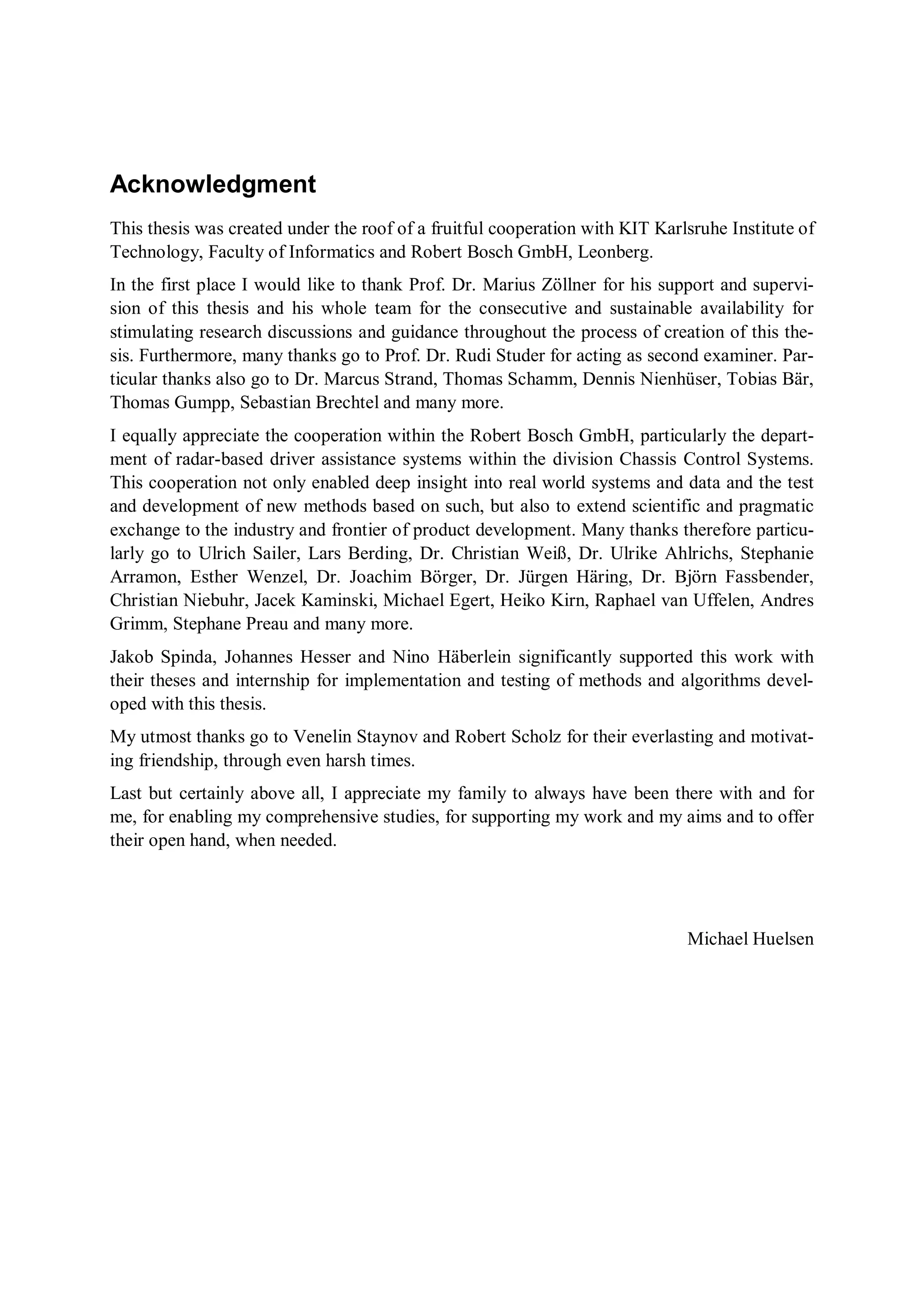
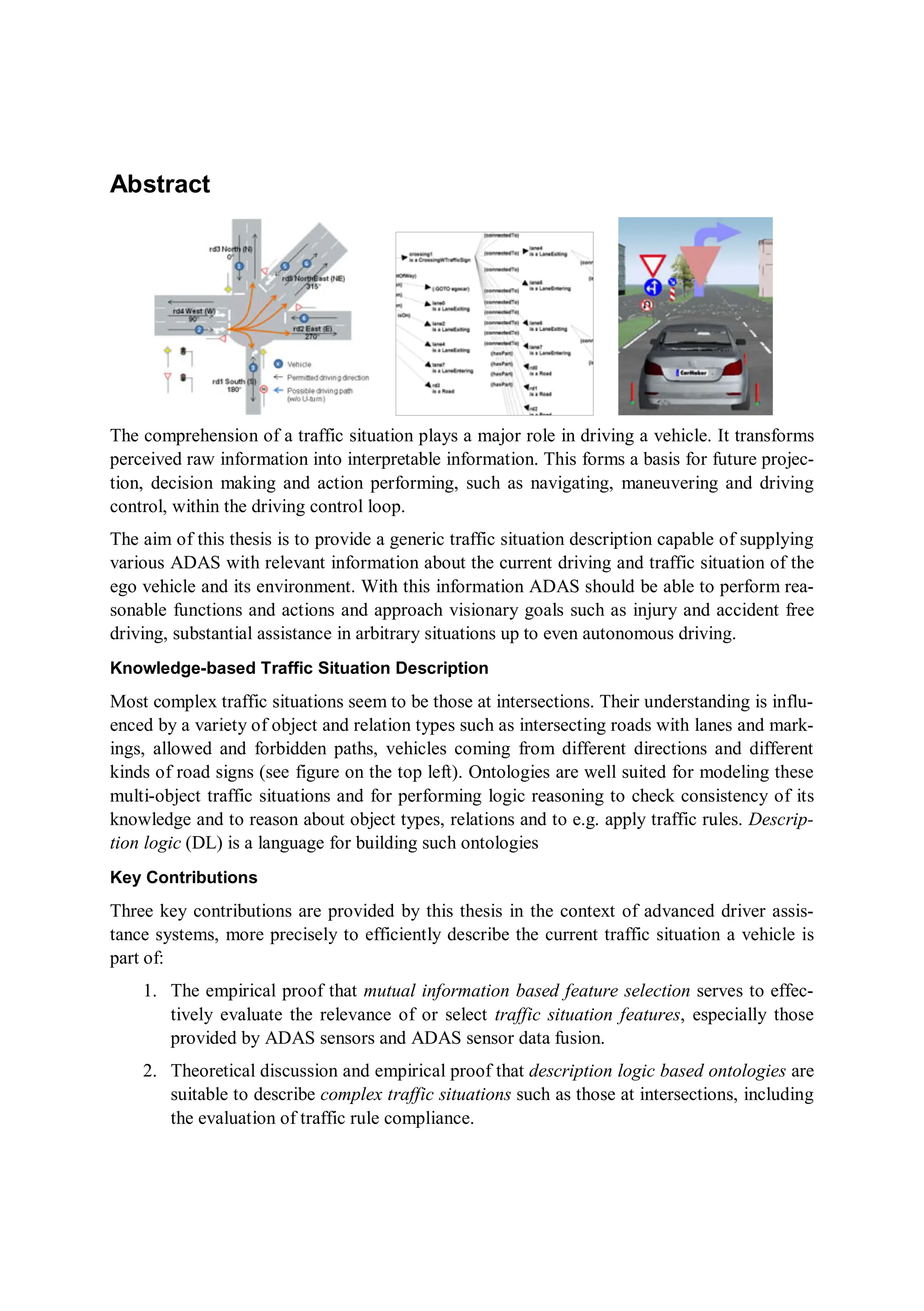
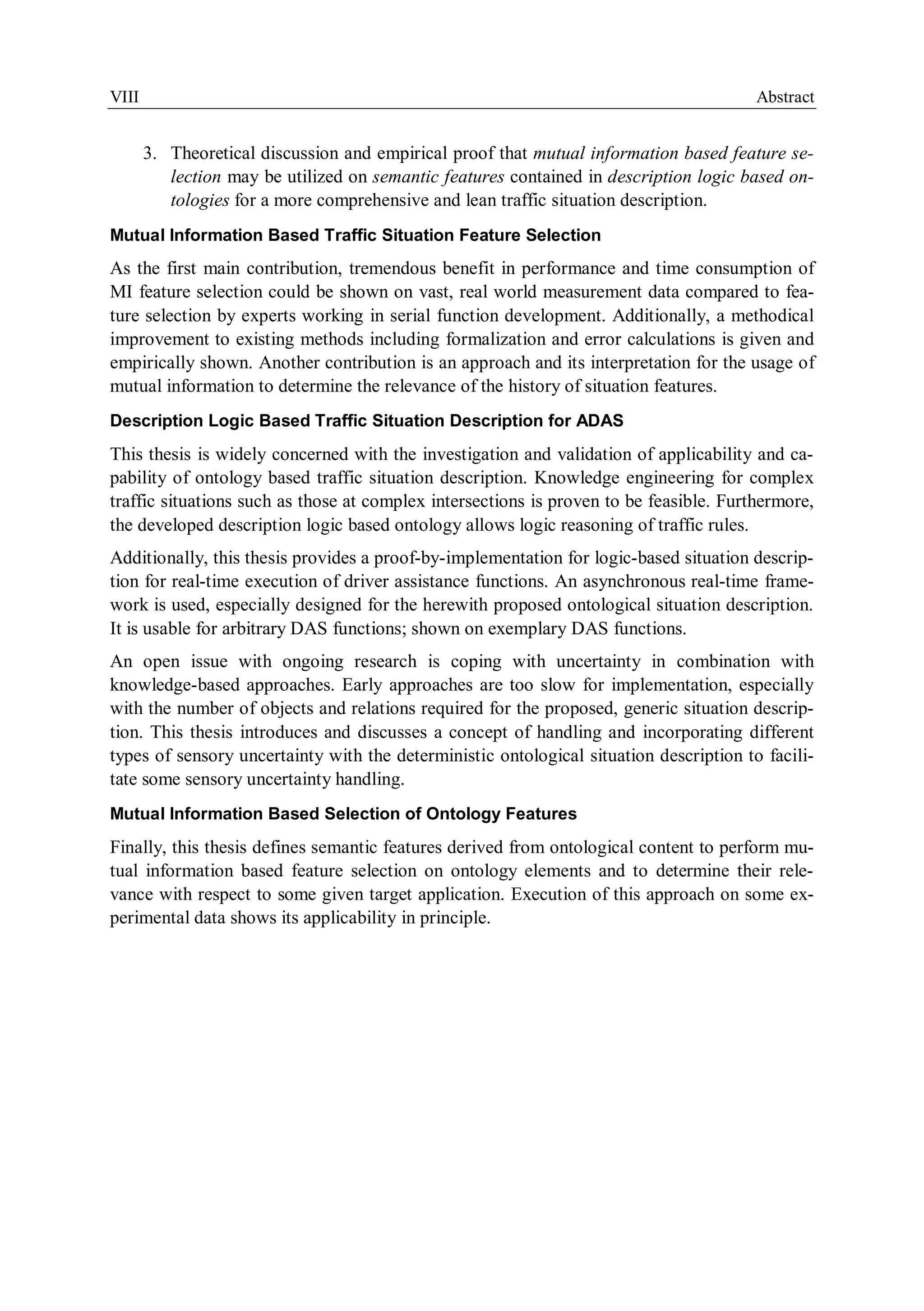
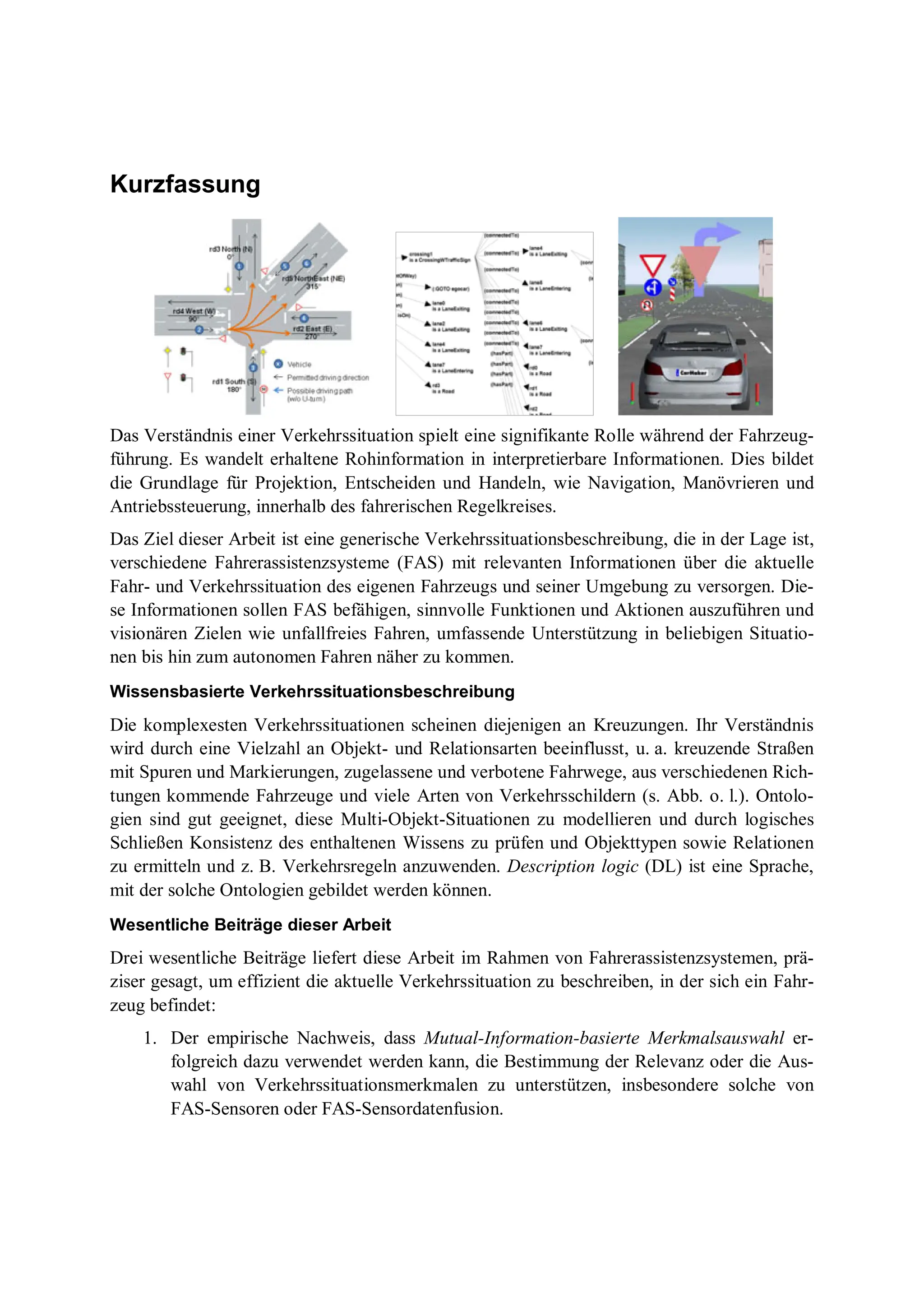
kinds of road signs (see figure on the top left). Ontologies are well suited for modeling these
multi-object traffic situations and for performing logic reasoning to check consistency of its
knowledge and to reason about object types, relations and to e.g. apply traffic rules. Descrip-
tion logic (DL) is a language for building such ontologies
Key Contributions
Three key contributions are provided by this thesis in the context of advanced driver assis-
tance systems, more precisely to efficiently describe the current traffic situation a vehicle is
part of:
1. The empirical proof that mutual information based feature selection serves to effec-
tively evaluate the relevance of or select traffic situation features, especially those
provided by ADAS sensors and ADAS sensor data fusion.
2. Theoretical discussion and empirical proof that description logic based ontologies are
suitable to describe complex traffic situations such as those at intersections, including
the evaluation of traffic rule compliance.
VIII Abstract
3. Theoretical discussion and empirical proof that mutual information based feature se-
lection may be utilized on semantic features contained in description logic based on-
tologies for a more comprehensive and lean traffic situation description.
Mutual Information Based Traffic Situation Feature Selection
As the first main contribution, tremendous benefit in performance and time consumption of
MI feature selection could be shown on vast, real world measurement data compared to fea-
ture selection by experts working in serial function development. Additionally, a methodical
improvement to existing methods including formalization and error calculations is given and
empirically shown. Another contribution is an approach and its interpretation for the usage of
mutual information to determine the relevance of the history of situation features.
Description Logic Based Traffic Situation Description for ADAS
This thesis is widely concerned with the investigation and validation of applicability and ca-
pability of ontology based traffic situation description. Knowledge engineering for complex
traffic situations such as those at complex intersections is proven to be feasible. Furthermore,
the developed description logic based ontology allows logic reasoning of traffic rules.
Additionally, this thesis provides a proof-by-implementation for logic-based situation descrip-
tion for real-time execution of driver assistance functions. An asynchronous real-time frame-
work is used, especially designed for the herewith proposed ontological situation description.
It is usable for arbitrary DAS functions; shown on exemplary DAS functions.
An open issue with ongoing research is coping with uncertainty in combination with
knowledge-based approaches. Early approaches are too slow for implementation, especially
with the number of objects and relations required for the proposed, generic situation descrip-
tion. This thesis introduces and discusses a concept of handling and incorporating different
types of sensory uncertainty with the deterministic ontological situation description to facili-
tate some sensory uncertainty handling.
Mutual Information Based Selection of Ontology Features
Finally, this thesis defines semantic features derived from ontological content to perform mu-
tual information based feature selection on ontology elements and to determine their rele-
vance with respect to some given target application. Execution of this approach on some ex-
perimental data shows its applicability in principle.
Kurzfassung
Das Verständnis einer Verkehrssituation spielt eine signifikante Rolle während der Fahrzeug-
führung. Es wandelt erhaltene Rohinformation in interpretierbare Informationen. Dies bildet
die Grundlage für Projektion, Entscheiden und Handeln, wie Navigation, Manövrieren und
Antriebssteuerung, innerhalb des fahrerischen Regelkreises.
Das Ziel dieser Arbeit ist eine generische Verkehrssituationsbeschreibung, die in der Lage ist,
verschiedene Fahrerassistenzsysteme (FAS) mit relevanten Informationen über die aktuelle
Fahr- und Verkehrssituation des eigenen Fahrzeugs und seiner Umgebung zu versorgen. Die-
se Informationen sollen FAS befähigen, sinnvolle Funktionen und Aktionen auszuführen und
visionären Zielen wie unfallfreies Fahren, umfassende Unterstützung in beliebigen Situatio-
nen bis hin zum autonomen Fahren näher zu kommen.
Wissensbasierte Verkehrssituationsbeschreibung
Die komplexesten Verkehrssituationen scheinen diejenigen an Kreuzungen. Ihr Verständnis
wird durch eine Vielzahl an Objekt- und Relationsarten beeinflusst, u. a. kreuzende Straßen
mit Spuren und Markierungen, zugelassene und verbotene Fahrwege, aus verschiedenen Rich-
tungen kommende Fahrzeuge und viele Arten von Verkehrsschildern (s. Abb. o. l.). Ontolo-
gien sind gut geeignet, diese Multi-Objekt-Situationen zu modellieren und durch logisches
Schließen Konsistenz des enthaltenen Wissens zu prüfen und Objekttypen sowie Relationen
zu ermitteln und z. B. Verkehrsregeln anzuwenden. Description logic (DL) ist eine Sprache,
mit der solche Ontologien gebildet werden können.
Wesentliche Beiträge dieser Arbeit
Drei wesentliche Beiträge liefert diese Arbeit im Rahmen von Fahrerassistenzsystemen, prä-
ziser gesagt, um effizient die aktuelle Verkehrssituation zu beschreiben, in der sich ein Fahr-
zeug befindet:
1. Der empirische Nachweis, dass Mutual-Information-basierte Merkmalsauswahl er-
folgreich dazu verwendet werden kann, die Bestimmung der Relevanz oder die Aus-
wahl von Verkehrssituationsmerkmalen zu unterstützen, insbesondere solche von
FAS-Sensoren oder FAS-Sensordatenfusion.
X Kurzfassung
2. Theoretische Diskussion und empirischer Nachweis, dass DL-basierte Ontologien ge-
eignet sind, komplexe Verkehrssituationen zu beschreiben, z. B. an Kreuzungen, ein-
schließlich Auswertung von Verkehrsregeln und deren Einhaltung.
3. Theoretische Diskussion und empirischer Nachweis, dass Mutual-Information-
basierte Merkmalsauswahl auf semantische Merkmale aus DL-basierten Ontologien
für eine verbesserte Situationsbeschreibung angewendet werden kann.
Mutual-Information-basierte Auswahl von Verkehrssituationsmerkmalen
Als erster wesentlicher Beitrag konnten enorme Vorteile in Ergebnis und Geschwindigkeit
von MI-Merkmalsauswahl gegenüber Auswahl durch Experten aus der automobilen Serien-
funktionsentwicklung auf große Mengen realer Messdaten gezeigt werden. Darüber hinaus
wird eine methodische Verbesserung bestehender Methoden einschließlich Formalisierung
und Fehlerberechnungen gegeben und empirisch gezeigt. Ein zusätzlicher Beitrag ist ein An-
satz und seine Interpretation für die Benutzung von Mutual Information, um die Relevanz der
Historie von Situationsmerkmalen zu bestimmen.
Description-Logic-basierte Verkehrssituationsbeschreibung für FAS
Diese Arbeit befasst sich ausführlich mit der Untersuchung und Validierung der Anwendbar-
keit und Leistungsfähigkeit von ontologiebasierter Verkehrssituationsbeschreibung. Es wird
gezeigt, dass Wissensverarbeitung für komplexe Verkehrssituationen wie z. B. an komplexen
Kreuzungen realisierbar ist. Darüber hinaus ermöglicht die entwickelte DL-basierte Ontologie
logisches Schlussfolgern von Verkehrsregeln.
Weitergehend bietet diese Arbeit einen praktischen Machbarkeitsnachweis für logikbasierte
Situationsbeschreibung für die Echtzeitanwendung von FAS. Es wird ein asynchrones Echt-
zeit-Framework verwendet, das speziell für die hier vorgestellte ontologische Situationsbe-
schreibung entwickelt wurde. Es lässt sich für beliebige FAS-Funktionen einsetzen, wie an
beispielhaften FAS-Funktionen veranschaulicht wird.
Eine offene Frage der laufenden Forschung ist die Bewältigung von Unsicherheiten in Ver-
bindung mit wissensbasierten Ansätzen. Frühe Ansätze sind zu langsam für die Umsetzung,
vor allem für die Anzahl von Objekten und Relationen, die für die vorgestellte generische Si-
tuationsbeschreibung notwendig sind. Diese Arbeit diskutiert ein Konzept zur Einbindung
von verschiedenen Arten von Sensorunsicherheiten in die deterministische ontologische Situ-
ationsbeschreibung, um deren Behandlung teilweise zu ermöglichen.
Mutual-Information-basierte Auswahl von Ontologiemerkmalen
Abschließend definiert diese Arbeit semantische Merkmale, abgeleitet aus ontologischem
Wissen, um eine Mutual-Information-basierte Auswahl von Ontologieelementen durchzufüh-
ren und dabei deren Relevanz bezüglich einer Zielanwendung zu bestimmen. Die Ausführung
auf experimentelle Daten zeigt deren grundsätzliche Anwendbarkeit.
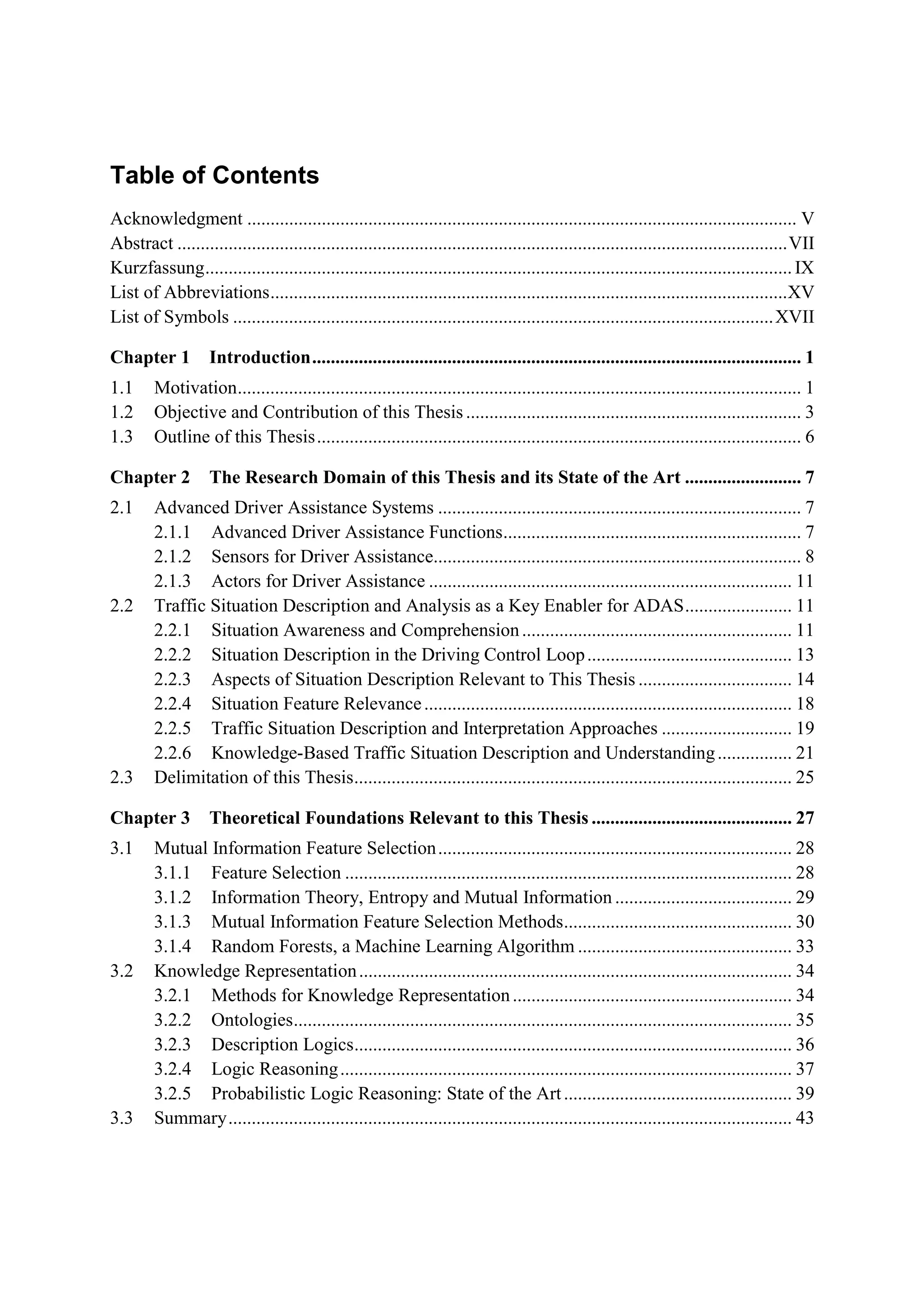
Table of Contents
Acknowledgment ...................................................................................................................... V
Abstract ...................................................................................................................................VII
Kurzfassung.............................................................................................................................. IX
List ofAbbreviations...............................................................................................................xv
List ofSymbols ....................................................................................................................XVII
Chapter 1 Introduction......................................................................................................... 1
1.1 Motivation......................................................................................................................... 1
1.2 Objective and Contribution ofthis Thesis ........................................................................ 3
1.3 Outline ofthis Thesis........................................................................................................ 6
Chapter 2 The Research DomaIn of th1s Thesis and Its State ofthe Art ......................... 7
2.1 Advanced Driver Assistance Systems .............................................................................. 7
2.1.1 Advanced Driver Assistance Functions................................................................ 7
2.1.2 Sensors for Driver Assistance............................................................................... 8
2.1.3 Actors for Driver Assistance .............................................................................. 11
2.2 Traffic Sitoation Description and Analysis as a Key Enabler for ADAS....................... 11
2.2.1 Situation Awareness and Comprehension.......................................................... 11
2.2.2 Sitoation Description in the Driving Control Loop............................................ 13
2.2.3 Aspects ofSituation Description Relevant to This Thesis ................................. 14
2.2.4 SitoationFeatoreRe1evance............................................................................... 18
2.2.5 Traffic Sitoation Description and Interpretation Approaches ............................ 19
2.2.6 Knowledge-Based Traffic Sitoation Description and Understaoding ................ 21
2.3 Delimitation ofthis Thesis.............................................................................................. 25
Chapter 3 Theoretical Foundations Relevant to this Thesis ........................................... 27
3.1 Mutoallnformation Featore Selection............................................................................ 28
3.1.1 Featore Selection ................................................................................................ 28
3.1.2 Information Theory, Entropy and Mutoallnformation...................................... 29
3.1.3 Mutoallnformation Featore Selection Methods................................................. 30
3.1.4 Random Forests, a Machine Learning Algoritlun .............................................. 33
3.2 Knowledge Represeototion............................................................................................. 34
3.2.1 Methods for Knowledge Representotion ............................................................ 34
3.2.2 Onto1ogies........................................................................................................... 35
3.2.3 Description Logics.............................................................................................. 36
3.2.4 Logic Reasoning................................................................................................. 37
3.2.5 Probabilistic Logic Reasooing: Stote ofthe Art................................................. 39
3.3 Summary......................................................................................................................... 43
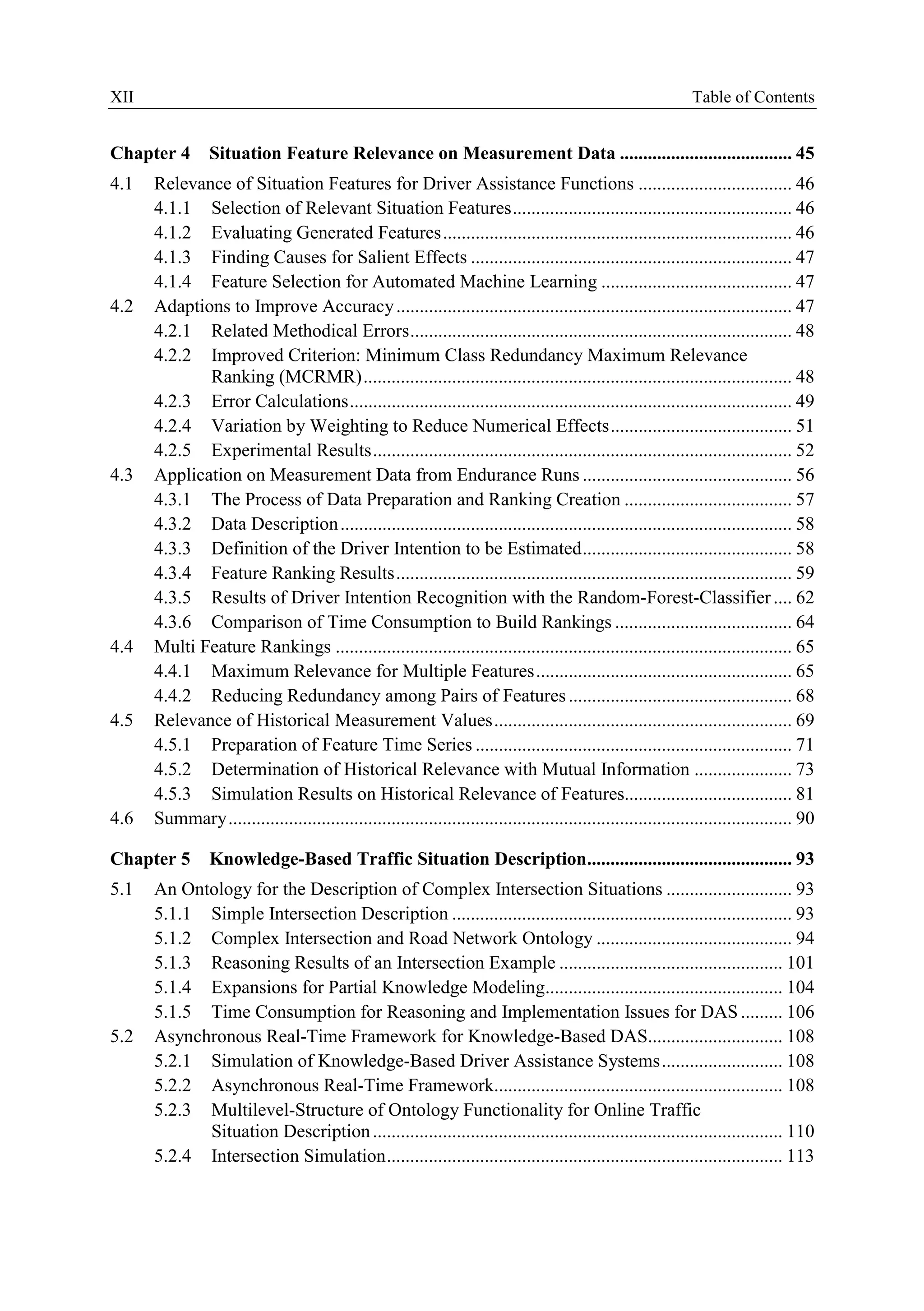
XII Table ofContents
Chapter 4 Situation Feature Relevance on Measurement Data ..................................... 4S
4.1 Relevance ofSituation Features for Driver Assistance Functions ................................. 46
4.1.1 Selection ofRelevant Situation Features............................................................ 46
4.1.2 Evaluating Generated Features........................................................................... 46
4.1.3 Finding Causes for Salient Effects ..................................................................... 47
4.1.4 Feature Selection for Automated Machine Learning ......................................... 47
4.2 Adaptions to Improve Accuracy..................................................................................... 47
4.2.1 Related Methodical Errors.................................................................................. 48
4.2.2 Improved Criterion: Minimum Class Redundancy Maximum Relevance
Ranking (MCRMR)............................................................................................ 48
4.2.3 Error Calculationa............................................................................................... 49
4.2.4 Variation by Weighting to Reduce Numerical Effects....................................... 51
4.2.5 Experimental Results .......................................................................................... 52
4.3 Application on Measurement Data from Endurance Runs ............................................. 56
4.3.1 The Process ofData Preparation and Ranking Creation .................................... 57
4.3.2 Data Description................................................................................................. 58
4.3.3 Definition ofthe Driver Intention to be Estimated............................................. 58
4.3.4 Feature Ranking Results ..................................................................................... 59
4.3.5 Results ofDriver Intention Recogoition with the Random-Forest-Classifier.... 62
4.3.6 Comparison ofTime Consumption to Build Rankings ...................................... 64
4.4 Multi Feature Rankings .................................................................................................. 65
4.4.1 Maximum Relevance for Multiple Features....................................................... 65
4.4.2 Reducing Redundancy among Pairs ofFeatures ................................................ 68
4.5 Relevance ofllistorical Measurement Values................................................................ 69
4.5.1 Preparation ofFeature Time Series .................................................................... 71
4.5.2 Determination ofHistorical Relevance with Mutoa1lnformation ..................... 73
4.5.3 Simulation Results on Historical Relevance ofFeatures.................................... 81
4.6 Summary......................................................................................................................... 90
Chapter 5 Knowledge-Based Traffic Situation Description............................................ 93
5.1 An Ontology for the Description ofComplex Intersection Situations ........................... 93
5.1.1 Simple Intersection Description ......................................................................... 93
5.1.2 Complex Intersection aod Road Network Ontology .......................................... 94
5.1.3 Reasooing Results of an Intersection Example ................................................ 101
5.1.4 Expansions for Partial Knowledge Modeling................................................... 104
5.1.5 Time Consumption for Reasoning and Implementation Issues for DAS ......... 106
5.2 Asynchronous Real-Time Framework for Knowledgo-Based DAS............................. 108
5.2.1 Simulation ofKnowledge-Based Driver Assistance Systems.......................... 108
5.2.2 Asynchronous Real-Time Framework.............................................................. 108
5.2.3 Multilevel-S1ructure ofOntology Functionality for Ontine Traffic
Situation Description........................................................................................ 110
5.2.4 Intersection Simu1ation..................................................................................... 113
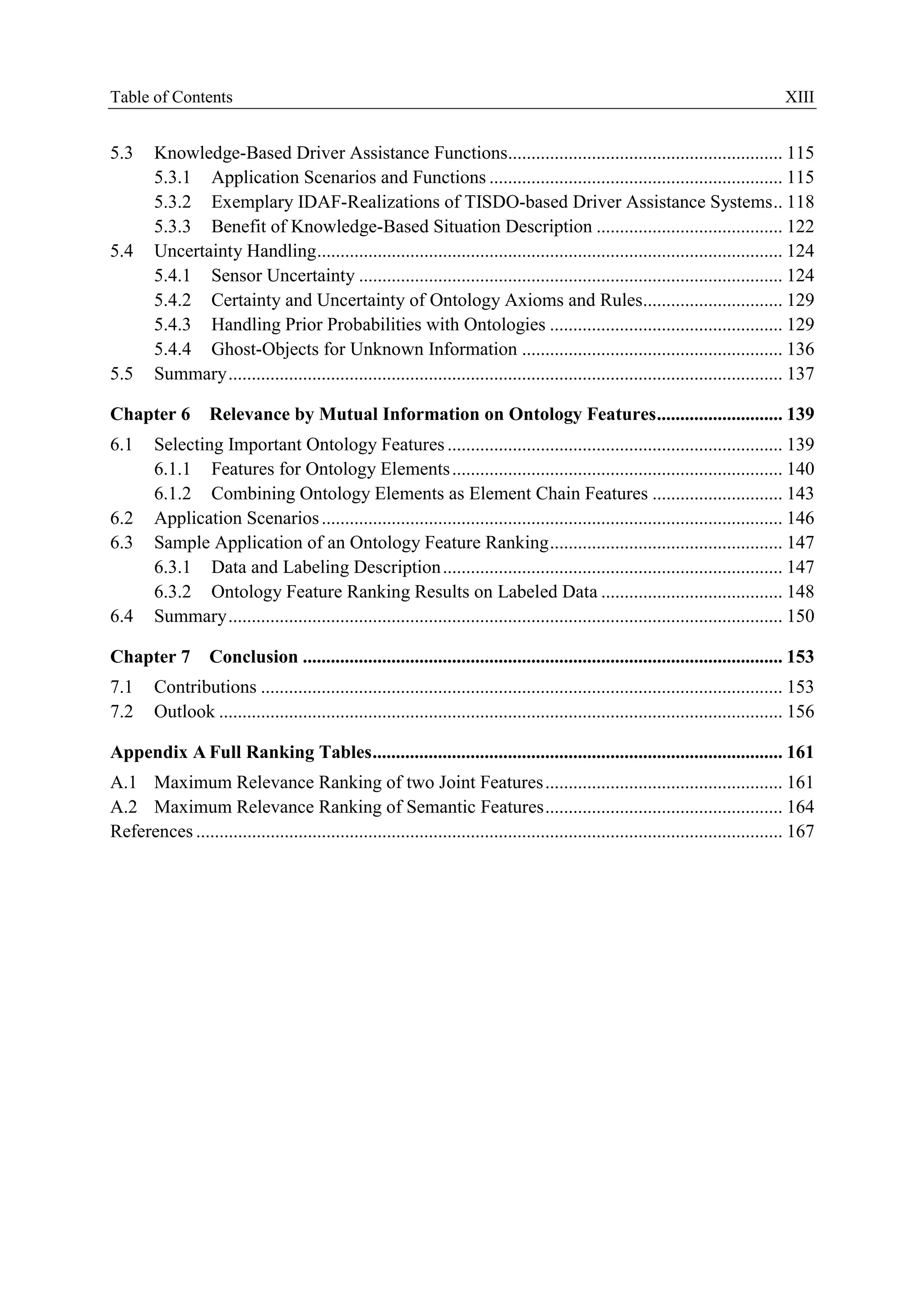
Table ofContents XIII
5.3 Knowledge-Based Driver Assistance Functions........................................................... 115
5.3.1 Application Scenarios and Functions ............................................................... 115
5.3.2 Exemplary IDAF-Realizations ofTISDO-based Driver Assistance Systems.. 118
5.3.3 Benefit ofKnowledge-Based Situation Descriptioo ........................................ 122
5.4 Unoertainty Handling.................................................................................................... 124
5.4.1 Seosor Unoertainty ........................................................................................... 124
5.4.2 Certainty and Uncertainty of Ontology Axioms and Rules.............................. 129
5.4.3 Handling Prior Probabilities with Ontologies .................................................. 129
5.4.4 Ghost-Objects for Unknown Infonnation ........................................................ 136
5.5 Summary....................................................................................................................... 137
Chapter 6 Relevance by Mutual Information on Ontology Features........................... 139
6.1 Seleedng important Ontology Featores ........................................................................ 139
6.1.1 Features for Ontology Elemeots ....................................................................... 140
6.1.2 Combining Ontology Elements as Element Chain Features ............................ 143
6.2 Application Scenarios ................................................................................................... 146
6.3 Sample Application of an Ontology Feature Ranking.................................................. 147
6.3.1 Data and LabelingDescriptioo......................................................................... 147
6.3.2 Ontology Feature Ranking Results on Labeled Data ....................................... 148
6.4 Summary....................................................................................................................... ISO
Chapter 7 Conclusion ....................................................................................................... 153
7.1 Contributiooa ................................................................................................................ 153
7.2 Ontlook ......................................................................................................................... 156
Appendix A Full Ranking T.bles........................................................................................ 161
A.l Maximum. Relevance Ranking oftwo Joint Features................................................... 161
A.2 Maximum Relevance Ranking ofSemantic Features................................................... 164
References .............................................................................................................................. 167
List of Abbreviations
ABox............... Assertional Box
ABS ................ Anti Blocking System
ACC................ Adaptive Cruise Control
ADAS ............. Advanced Driver Assistance System
AI.................... Artificial Intelligence
ASIL ............... Automotive Safety Integrity Level
BN................... Bayes Network, Belief Network
CAN................ Controller Area Network
CG................... Conceptual Graph
CNF ................ Conjunctive Normal Form
CPU ................ Central / Computational Processing Unit
CWA............... Closed World Assumption
DARPA........... Defense Advanced Research Projects Agency
DAS ................ Driver Assistance System
DL................... Description Logic
ECU ................ Electronic Control Unit
ESP ................. Electronic Stability Control
FL ................... Fuzzy Logic
FOL................. First Order Logic
FOPL .............. First Order Probabilistic Languages
GPS................. Global Positioning System
GPU ................ Graphical Processing Unit
HMI ................ Human Machine Interface
HMM .............. Hidden Markov Model
I2I ................... Infrastructure to Infrastructure
ICA ................. Independent Component Analysis
IDAF............... Interface and Driver Assistance Module
JDL DFG......... Joint Directors of Laboratories Data Fusion Group
JMI.................. Joint Mutual Information (ranking)
LCWA............. Local Closed World Assumption
MaxRel ........... Maximum Relevance ranking
MCMC............ Markov Chain Monte Carlo
MCRMR ......... Minimum Class Redundancy Maximum Relevance ranking
MI ................... Mutual Information
MIFS............... Mutual Information Feature Selection
MLN ............... Markov Logic Network
MRF................ Markov Random Field
MRMR............ Minimum Redundancy Maximum Relevance ranking
NHTSA........... National Highway Traffic Safety Administration
NN .................. Neural Network
XVI List of Abbreviations
norm................ normalized (in formula)
OOBN............. Object Oriented Bayesian Network
OPRM............. Object Oriented Probabilistic Relational Model
OWA............... Open World Assumption
OWL ............... Web Ontology Language
PCA ................ Principal Component Analysis
POMDP........... Partially Observable Markov Decision Process
RCC ................ Region Connection Calculus
RDF ................ Resource Definition Framework
rel.................... relative (in formula)
RF ................... Random Forests classifier
RNDF.............. Road Network Definition File
RSAP .............. Road Safety Action Programme
SA, SAW ........ Situation Awareness
SDF................. Sensor Data Fusion
SGT................. Situation Graph Tree
SM .................. State Machine
SVM................ Support Vector Machine
TBox............... Terminological Box
TCP................. Transmission Control Protocol
TISDO............. Traffic Intersection Situation Description Ontology
TTC................. Time To Collision
TTI.................. Time To Intersection
UV .................. Unmanned Vehicle
V2V ................ Vehicle to Vehicle
V2I.................. Vehicle to Infrastructure (and vice versa)
List of Symbols
Symbol Unit Description
‫ܪ‬ [bit] Entropy
‫݌‬, ܲ [1] Probability of distribution, of single event
‫ܫ‬ [bit] Mutual information
ܺ, ܻ, ܼ [ܽ݊‫ݕ‬] Arbitrary random variables
‫ܨ‬, ‫ܥ‬ [ܽ݊‫ݕ‬] Random variable of feature / class
‫܁‬, ۴, ۱ [{ }] Set of random variables
Ȱ [1] Decision function
݊ [1] Quantity
‫ݐ‬, ܶ, ߠ, ȣ [‫ݏ‬] Time
݂, ܿ [ܽ݊‫ݕ‬] Signal of feature / class
‫ܥ‬, ܴ, ܴ௔ [ ] Ontological concept, role, attribute role
‫ܣ‬ [ܽ݊‫ݕ‬] Ontological attribute
ܿ [ ] Ontological object
‫ݎ‬ [ ] Ontological relation
‫ݔ‬, ݁ [ ] Ontological object or relation
ࣛ [{ }] Ontological ABox
‫ܖ‬ [{1}] Quantity vector
‫۾‬ [{1}] Probability matrix
‫ܫ‬ [{ }] Attribute interval
‫ܩ‬ [{ }] Group of ontological elements (objects, relations)
For the notation of ontologies kindly refer to Table 1 and Table 2 on page 37.
Chapter 1
Introduction
1.1 Motivation
The declared objective of the European Commission was to halve the number of traffic fatali-
ties in the period from 2001 to 2010 [European Commission, 2001]. With a decrease of 44%
this goal could not completely be achieved (see Fig. 1). Consequently, the goal was renewed
and adjusted for the period from 2011 to 2020 in [European Commission, 2010] and new stra-
tegic objects based on the current “3rd
road safety action programme” (RSAP) are derived to
propose new actions for the subsequent RSAP. The aim for 2020 is to “halve the overall
number of road deaths in the European Union by 2020 starting from 2010”.
To pursue the reduction of the number of accidents, automotive manufacturers and suppliers
are conducting intensive research on Driver Assistance Systems (DAS). These systems sup-
port the driver in critical situations or intervene in the driving process to avoid accidents or to
reduce their severity. In addition, comfort assistance functions, which make driving more
convenient, are an important buying criterion to customers.
This research on ADAS is supported by [European Commission, 2010] with the main objec-
tives n°4 “Safe vehicles” and n°5 “Promote the use of modern technology to increase road
safety”. On objective n°4, actions of the [European Commission, 2010] especially include to
“make proposals to encourage progress on the active and passive safety of vehicles
[…]” and to “further assess the impact and benefits of co-operative systems to iden-
tify most beneficial applications and recommend the relevant measures for their
synchronized deployment.”
Actions on the objective n°5 include to
“evaluate the feasibility of retrofitting commercial vehicles and private cars with
Advanced Driver Assistance Systems” and to “notably propose technical specifica-
tions necessary to exchange data and information between vehicles (V2V1
), between
vehicles and infrastructure (V2I2
) and between infrastructures (I2I3
). The possibility
of extending the implementation of Advanced Driver Assistance Systems (ADAS)
such as Lane Departure Warning, Anti Collision Warning or Pedestrian Recognition
systems by retrofitting them to existing commercial and/or private vehicles should
also be further assessed”.
1
Vehicle to Vehicle
2
Vehicle to Infrastructure
3
Infrastructure to Infrastructure
M. Huelsen, Knowledge-Based Driver Assistance Systems,
DOI 10.1007/978-3-658-05750-3_1, © Springer Fachmedien Wiesbaden 2014
2 1 Introduction
The National Highway Traffic Safety Administration (NHTSA) in the U.S. pursues similar
goals. A concrete plan for the years 2014 to 2020 is still under development. However, priori-
ty research fields and other significant projects with large benefits for traffic safety are,
amongst others, named with forward collision avoidance and mitigation, vehicle communica-
tions, (driver) distraction, lane departure prevention, blind spot detection and pedestrian de-
tection [NHTSA (National Highway Traffic Safety Administration), 2011].
Related projects exist, funded by the European Union, and can be found at the European
Commission under the area “Road Safety Projects” within the “Transport” policy and under
the “eSafety” activity within the “Information Society” department. Current examples are
ADVISORS (Action for advanced Driver assistance and Vehicle control systems Implementa-
tion, Standardisation, Optimum use of the Road network and Safety), APROSYS (Advanced
Protection Systems) and PReVENT (Preventive and Active Safety Applications Integrated
Project) [European Commission – Information Society Technologies, 2008], the latter includ-
ing INTERSAFE, WILLWARN, SAFELANE, APALACI, COMPOSE, ProFusion and more.
As a successor of INTERSAFE, the INTERSAFE-2 project [INTERSAFE-2, 2011] was
launched.
Advanced driver assistance systems (ADAS) being in research focus help the driver with in-
formation or by performing supportive or autonomous actions. This demands an extensive
comprehension of the vehicle environment and complex situations, potentially even unknown
situations. Therefore, for further situation interpretation, a generic method for situation de-
scription is needed.
Intersection assistance belongs to the field of ADAS yet to be developed, especially for in-
vehicle application. Various approaches to model intersection infrastructure, geometry and
dynamics exist, e.g. knowledge-based scene description, graph based methods with map data
up to holistic intersection handling with state machines and trajectory planning. However, to
the highest extent its complexity of situation description, real-time issues and the lack of suf-
ficient sensory information (e.g. detailed map data, sensor accuracy and field of view) impede
the start of a widely spread serial implementation in ongoing automotive development. Since
Fig. 1: Development of road traffic fatalities until 2009 (2010 estimation).
[European Commission, 2010]
1.2 Objective and Contribution of this Thesis 3
intersection accidents, depending on the region, accumulate 30 to 60% of injury and up to one
3rd of fatal accidents, interest in this kind of assistance remains high [INTERSAFE-2, 2011].
1.2 Objective and Contribution of this Thesis
The comprehension of a traffic situation plays a major role in driving a vehicle. It transforms
perceived raw information into interpretable information. Within the driving control loop, this
forms a basis for future projection, decision making and action performing, such as navi-
gating, maneuvering and driving control. Perception, situation comprehension and projection
as well as decision making and action performing can be mapped on dynamic decision mak-
ing as delineated in the model of situation awareness by [Endsley, 2000]. This applies for
human decision making investigated by Endsley as well as for substantial advanced driver
assistance systems (ADAS).
The aim of this thesis is to provide a generic traffic situation description capable of supplying
various ADAS with relevant information about the current driving and traffic situation of the
ego vehicle and its environment. With this information ADAS should be able to perform rea-
sonable functions and actions and approach visionary goals such as injury and accident free
driving, substantial assistance in arbitrary situations up to even autonomous driving.
This requires assessing more complex situations compared to state of the art assistance sys-
tems, potentially including even unknown situations demanding for extensive comprehension
of the vehicle environment and the current situation.
Specific goals for the situation description are modularity and hierarchy, expandability, ex-
changeability and scalability for different variants and combinations of ADAS in vehicle ap-
plications as well as determinism and correctness.
Situation Feature Selection
As part of describing a situation, it is of interest, what information is actually relevant to tar-
get applications. For ADAS, a number of partially redundant sensors is used to generate a va-
riety of measurement signals. These signals – or features – are then further processed, adding
new features. With this high level data complexity and manifoldness, an interpretation and
determination of the most relevant features becomes unwieldy. However, selecting relevant
information is already asked for by Endsley concerning the perception and comprehension
layers in situation awareness.
Mutual Information (MI) is a well-established tool for feature selection and feature compari-
son, for example, to support image classification methods or computer aided diagnosis. As an
advantage, it does not preliminarily need a classifier or other machine learning algorithms for
relevance calculation.
Knowledge-based Traffic Situation Description
Most complex traffic situations seem to be those at intersections. Their understanding is influ-
enced by a variety of object and relation types such as intersecting roads with lanes and mark-
4 1 Introduction
ings, allowed and forbidden paths, vehicles coming from different directions and different
kinds of road signs. Their constellation directly influences traffic rules which apply and, ac-
cordingly, the assessment of allowed actions, expected behavior and impact of traffic partici-
pants among each other.
Ontologies are a foundation for knowledge representation and provide a formalism to struc-
ture objects, their relations and attributes and for performing logic reasoning with them.
Therefore ontologies are well suited for modeling the kind of described multi-object traffic
situations and for performing logic reasoning to check satisfiability of the situation ontology,
to check consistency of input data and to reason about object types, relations and to e.g. apply
traffic rules.
Description logic (DL) is a language for building ontologies and in most cases, depending on
the dialect applied, it allows for decidable, complete and terminating algorithms.
Key Research Contributions within this Thesis
Three key contributions are provided by this thesis in the context of advanced driver assis-
tance systems, more precisely to efficiently describe the current traffic situation a vehicle is
part of:
1. The empirical proof that mutual information based feature selection serves to effec-
tively evaluate the relevance of or select traffic situation features, especially those
provided by ADAS sensors and ADAS sensor data fusion.
2. Theoretical discussion and empirical proof that description logic based ontologies are
suitable to describe complex traffic situations such as those at intersections, including
the evaluation of traffic rule compliance.
3. Theoretical discussion and empirical proof that mutual information based feature se-
lection may be utilized on semantic features contained in description logic based on-
tologies for a more comprehensive and lean traffic situation description.
Previous work concerning contribution 1 barely exists with respect to vast real world meas-
urement data and driver assistance. Previous work on contribution 2 does not exist when traf-
fic rules are to be included in ontology reasoning or when real-time capability is to be shown.
Previous work on contribution 3 does not exist. Existing work, the context and aspects con-
cerning the first two contributions will be discussed throughout Chapter 2.
The following three subsections further explain the three above stated contributions of this
thesis to provide a brief overview. Contribution 1 is discussed in detail in Chapter 4, contribu-
tion 2 in Chapter 5 and contribution 3 in Chapter 6.
Contribution 1: Mutual Information Based Traffic Situation Feature Selection
Initially, it is discussed how to use and interpret mutual information feature selection and
what applications in the context of advanced driver assistance function development it may be
used for. A methodical improvement to existing methods including formalization and error
calculations is given and empirically shown with this thesis.
Another Random Document on
Scribd Without Any Related Topics
Sometimes, however, it is obliged to build in spots where it can
find neither rocks nor buildings, and in such cases it builds on trees,
and, like the heron, is sociable in its nesting, a whole community
residing in a clump of trees. It is not very particular about the kind
of tree, provided that it be tolerably tall, and strong enough to bear
the weight of its enormous nest; and the reader will at once see that
the fir-trees are peculiarly fitted to be the houses for the Stork.
As may be expected from the localities chosen by the Stork for its
breeding-place, its nest is very large and heavy. It is constructed
with very little skill, and is scarcely more than a huge quantity of
sticks, reeds, and similar substances, heaped together, and having in
the middle a slight depression in which the eggs are laid. These eggs
are usually three, or perhaps four in number, and now and then a
fifth is seen, and are of a very pale buff or cream colour.
As is the case with the heron, the young of the Stork are quite
helpless when hatched, and are most ungainly little beings, with
their long legs doubled under them, unable to sustain their round
and almost naked bodies, while their large beaks are ever gaping for
food. Those of my readers who have had young birds of any kind
must have noticed the extremely grotesque appearance which they
possess when they hold up their heads and cry for food, with their
bills open to an almost incredible extent. In such birds as the Stork,
the heron, and others of the tribe, the grotesque appearance is
exaggerated in proportion to the length and gape of the bill.
The Stork is noted for being a peculiarly kind and loving parent to
its young, in that point fully deserving the derivation of its Hebrew
name, though its love manifests itself towards the young, and not
towards the parent.
The Rev. H. B. Tristram mentions from personal experience an
instance of the watchful care exercised by the Stork over its young.
The writer was once in camp near an old ruined tower in the plains
of Zana, south of the Atlas, where a pair of storks had their nest.
The four young might often be seen from a little distance, surveying
the prospect from their lonely height, but whenever any of the
human party happened to stroll near the tower, one of the old
storks, invisible before, would instantly appear, and, lighting on the
nest, put its feet gently on the necks of all the young, so as to hold
them down out of sight till the stranger had passed, snapping its bill
meanwhile, and assuming a grotesque air of indifference, as if
unconscious of there being anything under its charge.
The snapping noise which is here mentioned is the only sound
produced by the Stork, which is an absolutely silent bird, as far as
voice is concerned.
There is another species of Stork found in Palestine, to which the
fir-trees are especially a home. This is the Black Stork (Ciconia
nigra), which in some parts of the country is even more plentiful
than its white relative, which it resembles in almost every particular,
except that it has a dark head and back, the feathers being glossed
with purple and green like those of the magpie. This species, which
is undoubtedly included in the Hebrew word chasidah, always makes
its nest on trees whenever it can find them, and in some of the more
densely wooded parts of Palestine is in consequence plentiful,
placing its nest in the deepest parts of the forests. When it cannot
obtain trees, it will build its nest on rocky ledges. It lays two or three
eggs of a greenish white colour.
Like the preceding species, the Black Stork is easily domesticated.
Colonel Montague kept one which was very tame, and would follow
its keeper like a dog. Its tameness enabled its proceedings to be
closely watched, and its mode of feeding was thereby investigated.
It was fond of examining the rank grass and mud for food, and while
doing so always kept its bill a little open, so as to pounce down at
once on any insect or reptile that it might disturb.
Eels were its favourite food, and it was such an adept at catching
them that it was never seen to miss one, no matter how small or
quick it might be. As soon as it had caught one of these active fish,
it went to some dry place, and then disabled its prey by shaking and
beating it against the ground before swallowing it, whereas many
birds that feed on fish swallow their prey as soon as it is caught. The
Stork was never seen to swim as the heron sometimes does, but it
would wade as long as it could place its feet on the bed of the
stream, and would strain its head and the whole of its neck under
water in searching for fish.
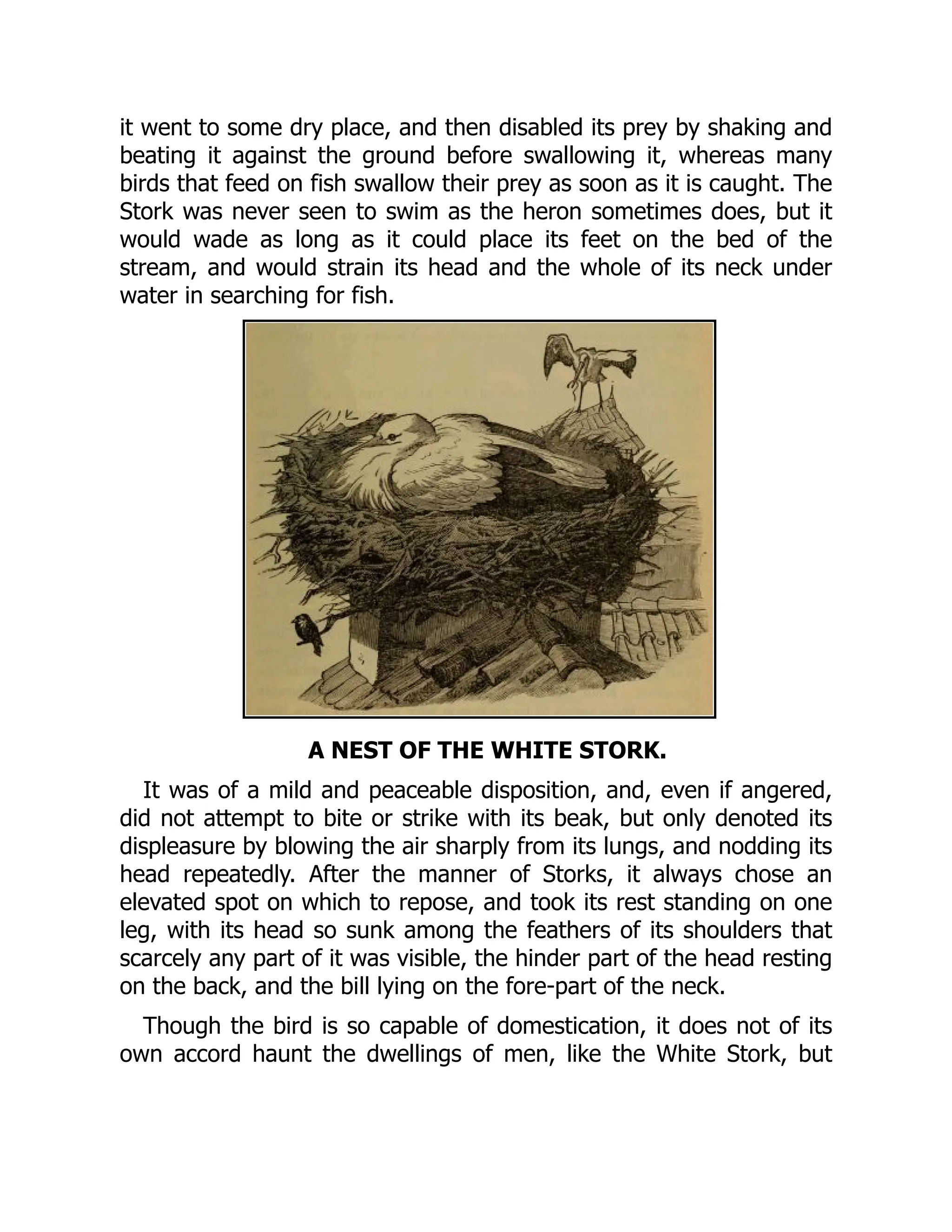
A NEST OF THE WHITE STORK.
It was of a mild and peaceable disposition, and, even if angered,
did not attempt to bite or strike with its beak, but only denoted its
displeasure by blowing the air sharply from its lungs, and nodding its
head repeatedly. After the manner of Storks, it always chose an
elevated spot on which to repose, and took its rest standing on one
leg, with its head so sunk among the feathers of its shoulders that
scarcely any part of it was visible, the hinder part of the head resting
on the back, and the bill lying on the fore-part of the neck.
Though the bird is so capable of domestication, it does not of its
own accord haunt the dwellings of men, like the White Stork, but
avoids the neighbourhood of houses, and lives in the most retired
places it can find.
THE SWAN.
Signification of the word Tinshemeth—The Gallinule and the Ibis—
Appearance and habits of the Hyacinthine Gallinule—A strange use for
the bird—The White or Sacred Ibis.
In the two parallel chapters of Lev. xi. 18 and Deut. xiv. 16, the
Hebrew word tinshemeth is found, and evidently signifies some kind
of bird which was forbidden as food. After stating (Lev. xi. 13) that
these are they which ye shall have in abomination among the fowls;
they shall not be eaten, they are an abomination, the sacred
lawgiver proceeds to enumerate a number of birds, nearly all of
which have already been described. Among them occurs the name
of tinshemeth, between the great owl and the pelican.
What was the precise species of bird which was signified by this
name it is impossible to say, but there is no doubt that it could not
have been the Swan, according to the rendering of the Authorized
Version. The Swan is far too rare a bird in Palestine to have been
specially mentioned in the law of Moses, and in all probability it was
totally unknown to the generality of the Israelites. Even had it been
known to them, and tolerably common, there seems to be no reason
why it should have been reckoned among the list of unclean birds.
On turning to the Hebrew Bible, we find that the word is left
untranslated, and simply given in its Hebrew form, thereby signifying
that the translators could form no opinion whatever of the proper
rendering of the word. The Septuagint translates the Tinshemeth as
the Porphyrio or Ibis, and the Vulgate follows the same rendering.
Later naturalists have agreed that the Septuagint and Vulgate have
the far more probable reading; and, as two birds are there
mentioned, they will be both described.
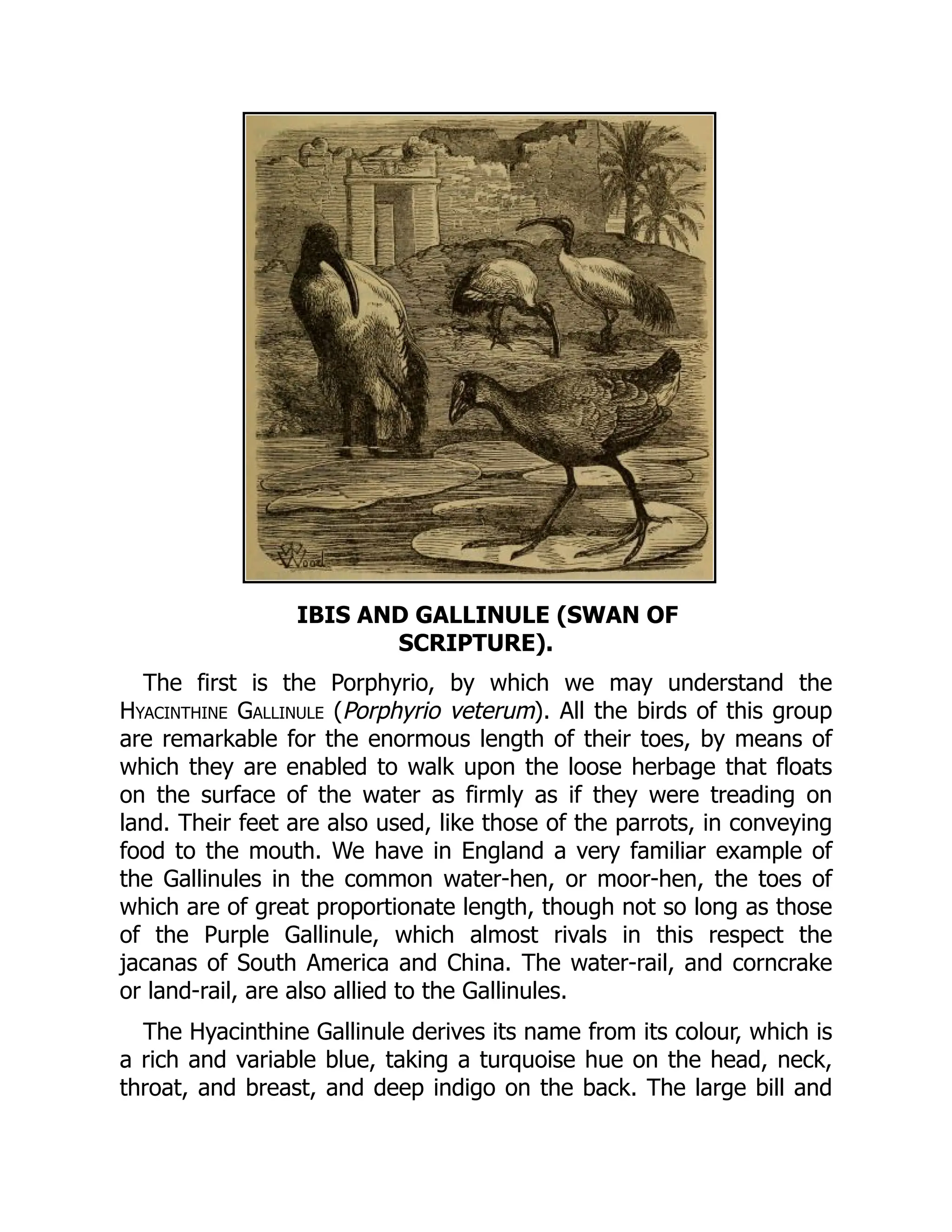
IBIS AND GALLINULE (SWAN OF
SCRIPTURE).
The first is the Porphyrio, by which we may understand the
Hyacinthine Gallinule (Porphyrio veterum). All the birds of this group
are remarkable for the enormous length of their toes, by means of
which they are enabled to walk upon the loose herbage that floats
on the surface of the water as firmly as if they were treading on
land. Their feet are also used, like those of the parrots, in conveying
food to the mouth. We have in England a very familiar example of
the Gallinules in the common water-hen, or moor-hen, the toes of
which are of great proportionate length, though not so long as those
of the Purple Gallinule, which almost rivals in this respect the
jacanas of South America and China. The water-rail, and corncrake
or land-rail, are also allied to the Gallinules.
The Hyacinthine Gallinule derives its name from its colour, which is
a rich and variable blue, taking a turquoise hue on the head, neck,
throat, and breast, and deep indigo on the back. The large bill and
the legs are red. Like many other birds, however, it varies much in
colour according to age.
It has a very wide geographical range, being found in many parts
of Europe, Asia, and Africa, and is common in the marshy districts of
Palestine, where its rich blue plumage and its large size, equalling
that of a duck, render it very conspicuous. The large and powerful
bill of this bird betokens the nature of its food, which consists almost
entirely of hard vegetable substances, the seeds of aquatic herbage
forming a large portion of its diet. When it searches for food on the
seashore, it eats the marine vegetation, mixing with this diet other
articles of an animal nature, such as molluscs and small reptiles.
Though apparently a clumsy bird, it moves with wonderful speed,
running not only swiftly but gracefully, its large feet being no
hindrance to the rapidity of its movements. It is mostly found in
shallow marshes, where the construction of its feet enables it to
traverse both the soft muddy ground and the patches of firm earth
with equal ease. Its wings, however, are by no means equal to its
legs either in power or activity; and, like most of the rail tribe, it
never takes to the air unless absolutely obliged to do so.
The nest of the Hyacinthine Gallinule is made on the sedge-
patches which dot the marshes, much like that of the coot. The nest,
too, resembles that of the coot, being composed of reeds, sedges,
and other aquatic plants. The eggs are three or four in number,
white in colour, and nearly spherical in form.
As the Ibis has an equal claim to the title of Tinshemeth we will
devote a few lines to a description of the bird. The particular species
which would be signified by the word tinshemeth would undoubtedly
be the White or Sacred Ibis (Ibis religiosa), a bird which derives its
name of Sacred from the reverence with which it was held by the
ancient Egyptians, and the frequency with which its figure occurs in
the monumental sculptures. It was also thought worthy of being
embalmed, and many mummies of the Ibis have been found in the
old Egyptian burial-places, having been preserved for some three
thousand years.
It is about as large as an ordinary hen, and, as its name imports,
has the greater part of its plumage white, the ends of the wing-
feathers and the coverts being black, with violet reflections. The long
neck is black and bare, and has a most curious aspect, looking as if
it were made of an old black kid glove, very much crumpled, but still
retaining its gloss.
The reason for the extreme veneration with which the bird was
regarded by the ancient Egyptians seems rather obscure. It is
probable, however, that the partial migration of the bird was
connected in their minds with the rise of the Nile, a river as sacred
to the old Egyptians as the Ganges to the modern Hindoo. As soon
as the water begins to rise, the Ibis makes its appearance,
sometimes alone, and sometimes in small troops. It haunts the
banks of the river, and marshy places in general, diligently searching
for food by the aid of its long bill. It can fly well and strongly, and it
utters at intervals a rather loud cry, dipping its head at every
utterance.
THE CORMORANT.
The word Shâlâk and its signification—Habits of the Cormorant—The bird
trained to catch fish—Mode of securing its prey—Nests and eggs of the
Cormorant—Nesting in fir-trees—Flesh of the bird.
Although in the Authorized Version of the Scriptures the word
Cormorant occurs three times, there is no doubt that in two of the
passages the Hebrew word ought to have been rendered as Pelican,
as we shall see when we come presently to the description of that
bird.
In the two parallel passages, Lev. xi. 17 and Deut. xiv. 17, a
creature called the Shâlâk is mentioned in the list of prohibited
meats. That the Shâlâk must be a bird is evident from the context,
and we are therefore only left to discover what sort of bird it may
be. On looking at the etymology of the word we find that it is
derived from a root which signifies hurling or casting down, and we
may therefore presume that the bird is one which plunges or sweeps
down upon its prey.
Weighing, carefully, the opinions of the various Hebraists and
naturalists, we may safely determine that the word shâlâk has been
rightly translated in the Authorized Version. The Hebrew Bible gives
the same reading, and does not affix the mark of doubt to the word,
though there are very few of the long list of animals in Lev. xi. and
Deut. xiv. which are not either distinguished by the mark of doubt,
or, like the Tinshemeth, are left untranslated.
The Cormorant belongs to the family of the pelicans, the
relationship between them being evident to the most unpractised
eye; and the whole structure of the bird shows its admirable
adaptation for the life which it leads.
Its long beak enables it to seize even a large fish, while the hook
at the end prevents the slippery prey from escaping. The long
snake-like neck gives the bird the power of darting its beak with
great rapidity, and at the same time allows it to seize prey
immediately to the right or left of its course. Its strong, closely-
feathered wings enable it to fly with tolerable speed, while at the
same time they can be closed so tightly to the body that they do not
hinder the progress of the bird through the water; while the tail
serves equally when spread to direct its course through the air, and
when partially or entirely closed to act as a rudder in the water.
Lastly, its short powerful legs, with their broadly-webbed feet, act as
paddles, by which the bird urges itself through the water with such
wonderful speed that it can overtake and secure the fishes even in
their own element. Besides these outward characteristics, we find
that the bird is able to make a very long stay under water, the lungs
being adapted so as to contain a wonderful amount of air.
The Cormorant has been trained to play the same part in the
water as the falcon in the air, and has been taught to catch fish, and
bring them ashore for its master. So adroit are they, that if one of
them should catch a fish which is too heavy for it, another bird will
come to its assistance, and the two together will bring the struggling
prey to land. Trained birds of this description have been employed in
China from time immemorial.
In order to prevent it from swallowing the fish which it takes, each
bird has a ring or ligature passed round its neck.
The Cormorant is a most voracious bird, swallowing a considerable
weight of fish at a meal, and digesting them so rapidly that it is soon
ready for another supply. Although it is essentially a marine bird,
hunger often takes it inland, especially to places where there are
lakes or large rivers.
While the ducks and teal and widgeons may be stationary on the
pool, the cormorant is seen swimming to and fro, as if in quest of
something. First raising his body nearly perpendicular, down he
plunges into the deep, and, after staying there a considerable time,
he is sure to bring up a fish, which he invariably swallows head
foremost. Sometimes half an hour elapses before he can manage to
accommodate a large eel quietly in his stomach.
You see him straining violently with repeated efforts to gulp it; and
when you fancy that the slippery mouthful is successfully disposed
of, all on a sudden the eel retrogrades upwards from its dismal
sepulchre, struggling violently to escape. The cormorant swallows it
again, and up again it comes, and shows its tail a foot or more out
of its destroyer's mouth. At length, worn out with ineffectual
writhings and slidings, the eel is gulped down into the cormorant's
stomach for the last time, there to meet its dreaded and inevitable
fate.
Mr. Fortune gives a very interesting account of the feeding of tame
Cormorants in China. The birds preferred eels to all other food, and,
in spite of the difficulty in swallowing the slippery and active
creature, would not touch another fish as long as an eel was left.
The bird is so completely at home in the water that it does not need,
like the heron and other aquatic birds, to bring its prey ashore in
order to swallow it, but can eat fish in the water as well as catch
them. It always seizes the fish crosswise, and is therefore obliged to
turn it before it can swallow the prey with the head downwards.
Sometimes it contrives to turn the fish while still under water, but, if
it should fail in so doing, it brings its prey to the surface, and shifts it
about in its bill, making a series of little snatches at it until the head
is in the right direction. When it seizes a very large fish, the bird
shakes its prey just as a dog shakes a rat, and so disables it. It is
said to eat its own weight of fish in a single day.
Sometimes, when it has been very successful or exceptionally
hungry, it loads itself with food to such an extent that it becomes
almost insensible during the process of digestion, and, although
naturally a keen-eyed and wary bird, allows itself to be captured by
hand.
The nest of the Cormorant is always upon a rocky ledge, and
generally on a spot which is inaccessible except by practised
climbers furnished with ropes, poles, hooks, and other
appurtenances. Mr. Waterton mentions that when he descended the
Raincliff, a precipice some four hundred feet in height, he saw
numbers of the nests and eggs, but could not get at them except by
swinging himself boldly off the face of the cliff, so as to be brought
by the return swing into the recesses chosen by the birds.
The nests are mostly placed in close proximity to each other, and
are made of sticks and seaweeds, and, as is usual with such nests,
are very inartificially constructed. The eggs are of a greenish white
on the outside, and green on the inside. When found in the nest,
they are covered with a sort of chalky crust, so that the true colour
is not perceptible until the crust is scraped off. Two to four eggs are
generally laid in, or rather on, each nest. As may be imagined from
the character of the birds' food, the odour of the nesting-place is
most horrible.
Sometimes, when rocks cannot be found, the Cormorant is obliged
to select other spots for its nest. It is mentioned in the Proceedings
of the Zoological Society, that upon an island in the midst of a large
lake there were a number of Scotch fir-trees, upon the branches of
which were about eighty nests of the Cormorant.
The flesh of the Cormorant is very seldom eaten, as it has a fishy
flavour which is far from agreeable. To eat an old Cormorant is
indeed almost impossible, but the young birds may be rendered
edible by taking them as soon as killed, skinning them, removing the
whole of the interior, wrapping them in cloths, and burying them for
some time in the ground.
THE PELICAN.
The Pelican of the wilderness—Attitudes of the bird—Its love of solitude—
Mode of feeding the young—Fables regarding the Pelican—Breeding-
places of the bird—The object of its wide wings and large pouch—Colour
of the Pelican.
It has been mentioned that in two passages of Scripture, the word
which is translated in the Authorized Version as Cormorant, ought to
have been rendered as Pelican. These, however, are not the first
passages in which we meet with the word kaath. The name occurs
in the two parallel passages of Lev. xi. and Deut. xiv. among the list
of birds which are proscribed as food. Passing over them, we next
come to Ps. cii. 6. In this passage, the sacred writer is lamenting his
misery: By reason of the voice of my groaning my bones cleave to
my skin.
I am like a pelican of the wilderness: I am like an owl of the
desert.
In these sentences, we see that the Kaath was a bird of solitude
that was to be found in the wilderness, i.e. far from the habitations
of man. This is one of the characteristics of the Pelican, which loves
not the neighbourhood of human beings, and is fond of resorting to
broad, uncultivated lands, where it will not be disturbed.
In them it makes its nest and hatches its young, and to them it
retires after feeding, in order to digest in quiet the ample meal which
it has made. Mr. Tristram well suggests that the metaphor of the
Psalmist may allude to the habit common to the Pelican and its kin,
of sitting motionless for hours after it has gorged itself with food, its
head sunk on its shoulders, and its bill resting on its breast.
This is but one of the singular, and often grotesque, attitudes in
which the Pelican is in the habit of indulging.
THE PELICAN.
There are before me a number of sketches made of the Pelicans
at the Zoological Gardens, and in no two cases does one attitude in
the least resemble another. In one sketch the bird is sitting in the
attitude which has just been described. In another it is walking, or
rather staggering, along, with its head on one side, and its beak so
closed that hardly a vestige of its enormous pouch can be seen.
Another sketch shows the same bird as it appeared when angry with
a companion, and scolding its foe in impotent rage; while another
shows it basking in the sun, with its magnificent wings spread and
shaking in the warm beams, and its pouch hanging in folds from its
chin.
One of the most curious of these sketches shows the bird
squatting on the ground, with its head drawn back as far as possible,
and sunk so far among the feathers of the back and shoulders that
only a portion of the head itself can be seen, while the long beak is
hidden, except an inch or two of the end. In this attitude it might
easily be mistaken at a little distance for an oval white stone.
The derivation of the Hebrew word kaath is a very curious one. It
is taken from a verb signifying to vomit, and this derivation has
been explained in different ways.
The early writers, who were comparatively ignorant of natural
history, thought that the Pelican lived chiefly on molluscs, and that,
after digesting the animals, it rejected their shells, just as the owl
and the hawk reject the bones, fur, and feathers of their prey.
They thought that the Pelican was a bird of a hot temperament,
and that the molluscs were quickly digested by the heat of the
stomach.
At the present day, however, knowing as we do the habits of the
Pelican, we find that, although the reasons just given are faulty, and
that the Pelican lives essentially on fish, and not on molluscs, the
derivation of the word is really a good one, and that those who gave
the bird the name of Kaath, or the vomiter, were well acquainted
with its habits.
The bird certainly does eat molluscs, but the principal part of its
diet is composed of fish, which it catches dexterously by a sort of
sidelong snatch of its enormous bill. The skin under the lower part of
the beak is so modified that it can form, when distended, an
enormous pouch, capable of holding a great quantity of fish, though,
as long as it is not wanted, the pouch is so contracted into
longitudinal folds as to be scarcely perceptible. When it has filled the
pouch, it usually retires from the water, and flies to a retired spot,
often many miles inland, where it can sit and digest at its ease the
enormous meal which it has made.
As it often chooses its breeding-places in similar spots, far from
the water, it has to carry the food with which it nourishes its young
for many miles. For this purpose it is furnished, not only with the
pouch which has been just mentioned, but with long, wide, and very
powerful wings, often measuring from twelve to thirteen feet from
tip to tip. No one, on looking at a Pelican as it waddles about or sits
at rest, would imagine the gigantic dimensions of the wings, which
seem, as the bird spreads them, to have almost as unlimited a
power of expansion as the pouch.
In these two points the true Pelicans present a strong contrast to
the cormorants, though birds closely allied. The cormorant has its
home close by the sea, and therefore needs not to carry its food for
any distance. Consequently, it needs no pouch, and has none.
Neither does it require the great expanse of wing which is needful
for the Pelican, that has to carry such a weight of fish through the
air. Accordingly, the wings, though strong enough to enable the bird
to carry for a short distance a single fish of somewhat large size, are
comparatively short and closely feathered, and the flight of the
cormorant possesses neither the grace nor the power which
distinguishes that of the Pelican.
When the Pelican feeds its young, it does so by pressing its beak
against its breast, so as to force out of it the enclosed fish. Now the
tip of the beak is armed, like that of the cormorant, with a sharply-
curved hook, only, in the case of the Pelican, the hook is of a bright
scarlet colour, looking, when the bird presses the beak against the
white feathers of the breast, like a large drop of blood. Hence arose
the curious legend respecting the Pelican, which represented it as
feeding its young with its own blood, and tearing open its breast
with its hooked bill. We find that this legend is exemplified by the
oft-recurring symbol of the Pelican feeding its young in
ecclesiastical art, as an emblem of Divine love.
This is one of the many instances in which the inventive, poetical,
inaccurate Oriental mind has seized some peculiarity of form, and
based upon it a whole series of fabulous legends. As long as they
restricted themselves to the appearance and habits of the animals
with which they were familiarly acquainted, the old writers were
curiously full, exact, and precise in their details. But as soon as they
came to any creature of whose mode of life they were entirely or
partially ignorant, they allowed their inventive faculties full scope,
and put forward as zoological facts statements which were the mere
creation of their own fancy. We have already seen several examples
of this propensity, and shall find more as we proceed with the
zoology of the Scriptures.
The fabulous legends of the Pelican are too numerous to be even
mentioned, but there is one which deserves notice, because it is
made the basis of an old Persian fable.
The writer of the legend evidently had some partial knowledge of
the bird. He knew that it had a large pouch which could hold fish
and water; that it had large and powerful wings; and that it was in
the habit of flying far inland, either for the purpose of digesting its
food or nourishing its young. Knowing that the Pelican is in the habit
of choosing solitary spots in which it may bring up its young in
safety, but not knowing the precise mode of its nesting, the writer in
question has trusted to his imagination, and put forward his theories
as facts.
Knowing that the bird dwells in the wilderness, he has assumed
that the wilderness in question is a sandy, arid desert, far from
water, and consequently from vegetation. Such being the case, the
nurture of the Pelican's young is evidently a difficult question. Being
aquatic birds, the young must needs require water for drink and
bathing, as well as fish for food; and, though a supply of both these
necessaries could be brought in the ample pouches of the parents,
they would be wasted unless some mode of storing were employed.
Accordingly, the parent birds were said to make their nest in a
hollow tree, and to line it with clay, or to build it altogether of clay,
so as to leave a deep basin. This basin the parent birds were said to
use as a sort of store-pond, bringing home supplies of fish and water
in their pouches, and pouring them into the pond. The wild beasts
who lived in the desert were said to be acquainted with these nests,
and to resort to them daily in order to quench their thirst, repaying
their entertainers by protecting their homes.
In real fact, the Pelican mostly breeds near water, and is fond of
selecting little rocky islands where it cannot be approached without
danger. The nest is made on the ground, and is formed in a most
inartificial manner of reeds and grass, the general mass of the nest
being made of the reeds, and the lining being formed of grass. The
eggs are white, of nearly the same shape at both ends, and are from
two to five in number. On an average, however, each nest will
contain about two eggs.
The parent birds are very energetic in defence of their eggs or
young, and, according to Le Vaillant, when approached they are like
furious harpies let loose against us, and their cries rendered us
almost deaf. They often flew so near us that they flapped their wings
in our faces, and, though we fired our pieces repeatedly, we were
not able to frighten them. When the well-known naturalist Sonnerat
tried to drive a female Pelican from her nest, she appeared not to be
frightened, but angry. She would not move from her nest, and when
he tried to push her off, she struck at him with her long bill and
uttered cries of rage.
In order to aid the bird in carrying the heavy weights with which it
loads itself, the whole skeleton is permeated with air, and is
exceedingly light. Beside this, the whole cellular system of the bird is
honeycombed with air-cells, so that the bulk of the bird can be
greatly increased, while its weight remains practically unaltered, and
the Pelican becomes a sort of living balloon.
The habit of conveying its food inland before eating it is so
characteristic of the Pelican that other birds take advantage of it. In
some countries there is a large hawk which robs the Pelican, just as
the bald-headed eagle of America robs the osprey. Knowing
instinctively that when a Pelican is flying inland slowly and heavily
and with a distended pouch it is carrying a supply of food to its
home, the hawk dashes at it, and frightens it so that the poor bird
opens its beak, and gives up to the assailant the fish which it was
bearing homewards.
It is evident that the wings which are needed for supporting such
weights, and which, as we have seen, exceed twelve feet in length
from tip to tip, would be useless in the water, and would hinder
rather than aid the bird if it attempted to dive as the close-winged
cormorant does. Accordingly, we find that the Pelican is not a diver,
and, instead of chasing its finny prey under water, after the manner
of the cormorant, it contents itself with scooping up in its beak the
fishes which come to the surface of the water. The very buoyancy of
its body would prevent it from diving as does the cormorant, and,
although it often plunges into the water so fairly as to be for a
moment submerged, it almost immediately rises, and pursues its
course on the surface of the water, and not beneath it. Like the
cormorant, the Pelican can perch on trees, though it does not select
such spots for its roosting-places, and prefers rocks to branches. In
one case, however, when some young Pelicans had been captured
and tied to a stake, their mother used to bring them food during the
day, and at night was accustomed to roost in the branches of a tree
above them.
Though under some circumstances a thoroughly social bird, it is
yet fond of retiring to the most solitary spots in order to consume at
peace the prey that it has captured; and, as it sits motionless and
alone for hours, more like a white stone than a bird, it may well be
accepted as a type of solitude and desolation.
The colour of the common Pelican is white, with a very slight
pinky tinge, which is most conspicuous in the breeding season. The
feathers of the crest are yellow, and the quill feathers of the wings
are jetty black, contrasting well with the white plumage of the body.
The pouch is yellow, and the upper part of the beak bluish grey, with
a red line running across the middle, and a bright red hook at the
tip. This plumage belongs only to the adult bird, that of the young
being ashen grey, and four or five years are required before the bird
puts on its full beauty. There is no difference in the appearance of
the sexes. The illustration represents a fine old male Crested Pelican.
The general colour is a greyish white, with a slight yellowish tint on
the breast. The pouch is bright orange, and the crest is formed of
curling feathers.
REPTILES.
THE TORTOISE.
The Tzab of the Scriptures, translated as Tortoise—Flesh and eggs of the
Tortoise—Its slow movements—Hibernation dependent on temperature—
The Water-Tortoises—Their food and voracity—Their eggs—Their odour
terrifying the horses—The Dhubb lizard and its legends—Its food, and
localities which it prefers.
We now come to a different class of animated beings. In Levit. xi.
29, there occurs among the list of unclean beasts a word which is
translated in the Authorized Version as tortoise. The word is Tzab,
and is rendered in the Hebrew Bible as lizard, but with the mark of
doubt affixed to it. As the correct translation of the word is very
dubious, we shall examine it in both these senses.
The common Tortoise is very common in Palestine, and is so
plentiful that it would certainly have been used by the Israelites as
food, had it not been prohibited by law. At the present day it is
cooked and eaten by the inhabitants of the country who are not
Jews, and its eggs are in as great request as those of the fowl.
These eggs are hard, nearly spherical, thick-shelled, and covered
with minute punctures, giving them a roughness like that of a file. In
captivity the Tortoise is very careless about the mode in which they
are deposited, and I have seen a large yard almost covered with
eggs laid by Tortoises and abandoned. The white or albumen of the
egg is so stiff and gelatinous that to empty one of them without
breaking the shell is a difficult task, and the yolk is very dark, and
covered with minute spots of black. When fresh the eggs are as
good as those of the fowl, and many persons even think them
better; the only drawback being that their small size and thick shell
cause considerable trouble in eating them.
Welcome to our website – the perfect destination for book lovers and
knowledge seekers. We believe that every book holds a new world,
offering opportunities for learning, discovery, and personal growth.
That’s why we are dedicated to bringing you a diverse collection of
books, ranging from classic literature and specialized publications to
self-development guides and children's books.
More than just a book-buying platform, we strive to be a bridge
connecting you with timeless cultural and intellectual values. With an
elegant, user-friendly interface and a smart search system, you can
quickly find the books that best suit your interests. Additionally,
our special promotions and home delivery services help you save time
and fully enjoy the joy of reading.
Join us on a journey of knowledge exploration, passion nurturing, and
personal growth every day!
ebookbell.com

Knowledgebased Driver Assistance Systems Traffic Situation Description And Situation Feature Relevance 1st Edition Michael Huelsen Auth

  • 1.
    Knowledgebased Driver AssistanceSystems Traffic Situation Description And Situation Feature Relevance 1st Edition Michael Huelsen Auth download https://ebookbell.com/product/knowledgebased-driver-assistance- systems-traffic-situation-description-and-situation-feature- relevance-1st-edition-michael-huelsen-auth-4697768 Explore and download more ebooks at ebookbell.com
  • 2.
    Here are somerecommended products that we believe you will be interested in. You can click the link to download. Industry University And Government Partnerships For The Sustainable Development Of Knowledgebased Society Drivers Models And Examples In Us Norway Singapore And Qatar 1st Ed 2020 Waqas Nawaz https://ebookbell.com/product/industry-university-and-government- partnerships-for-the-sustainable-development-of-knowledgebased- society-drivers-models-and-examples-in-us-norway-singapore-and- qatar-1st-ed-2020-waqas-nawaz-10799034 Simulationdriven Design By Knowledgebased Response Correction Techniques 1st Edition Slawomir Koziel https://ebookbell.com/product/simulationdriven-design-by- knowledgebased-response-correction-techniques-1st-edition-slawomir- koziel-5483820 Transforming Clothing Production Into A Demanddriven Knowledgebased Hightech Industry The Leapfrog Paradigm 1st Edition Lutz Walter https://ebookbell.com/product/transforming-clothing-production-into-a- demanddriven-knowledgebased-hightech-industry-the-leapfrog- paradigm-1st-edition-lutz-walter-1772408 Objectbased Image Analysis Spatial Concepts For Knowledgedriven Remote Sensing Applications Lecture Notes In Geoinformation And Cartography 1st Edition Thomas Blaschke https://ebookbell.com/product/objectbased-image-analysis-spatial- concepts-for-knowledgedriven-remote-sensing-applications-lecture- notes-in-geoinformation-and-cartography-1st-edition-thomas- blaschke-2140452
  • 3.
    Knowledgebased Software Engineering2022 Proceedings Of The 14th International Joint Conference On Knowledgebased Software Engineering Maria Virvou https://ebookbell.com/product/knowledgebased-software- engineering-2022-proceedings-of-the-14th-international-joint- conference-on-knowledgebased-software-engineering-maria- virvou-49152282 Knowledge Based Automated Software Engineering Ivan Stanev Katalina Grigorova https://ebookbell.com/product/knowledge-based-automated-software- engineering-ivan-stanev-katalina-grigorova-50372008 Knowledge Based Development Ii Knowledge Cities Fransisco Javier Carrillo https://ebookbell.com/product/knowledge-based-development-ii- knowledge-cities-fransisco-javier-carrillo-51335964 Knowledgebased And Intelligent Information And Engineering Systems 14th International Conference Kes 2010 Cardiff Uk September 810 2010 Proceedings Part Ii 1st Edition Jiali Yun https://ebookbell.com/product/knowledgebased-and-intelligent- information-and-engineering-systems-14th-international-conference- kes-2010-cardiff-uk-september-810-2010-proceedings-part-ii-1st- edition-jiali-yun-2022796 Knowledgebased Intelligent Information And Engineering Systems 12th International Conference Kes 2008 Zagreb Croatia September 35 2008 Proceedings Part Ii 1st Edition Mirko Ficko https://ebookbell.com/product/knowledgebased-intelligent-information- and-engineering-systems-12th-international-conference-kes-2008-zagreb- croatia-september-35-2008-proceedings-part-ii-1st-edition-mirko- ficko-2039722
  • 6.
  • 7.
    Michael Huelsen Knowledge-Based Driver AssistanceSystems Traffic Situation Description and Situation Feature Relevance
  • 8.
    Michael Huelsen Karlsruhe, Germany AlsoPhD Thesis Karlsruhe Institute of Technology (KIT), Germany, 2013 ISBN 978-3-658-05749-7 ISBN 978-3-658-05750-3 (eBook) DOI 10.1007/978-3-658-05750-3 The Deutsche Nationalbibliothek lists this publication in the Deutsche Nationalbibliografie; detailed bibliographic data are available in the Internet at http://dnb.d-nb.de. Library of Congress Control Number: 2014938109 Springer Vieweg © Springer Fachmedien Wiesbaden 2014 This work is subject to copyright. All rights are reserved by the Publisher, whether the whole or part of the material is concerned, specifically the rights of translation, reprinting, reuse of illustrations, recitation, broadcasting, reproduction on microfilms or in any other physical way, and transmission or information storage and retrieval, electronic adaptation, compu- ter software, or by similar or dissimilar methodology now known or hereafter developed. Exempted from this legal reservation are brief excerpts in connection with reviews or schol- arly analysis or material supplied specifically for the purpose of being entered and executed on a computer system, for exclusive use by the purchaser of the work. Duplication of this publication or parts thereof is permitted only under the provisions of the Copyright Law of the Publisher’s location, in its current version, and permission for use must always be obtained from Springer. Permissions for use may be obtained through RightsLink at the Copyright Clearance Center. Violations are liable to prosecution under the respective Copyright Law. The use of general descriptive names, registered names, trademarks, service marks, etc. in this publication does not imply, even in the absence of a specific statement, that such names are exempt from the relevant protective laws and regulations and therefore free for general use. While the advice and information in this book are believed to be true and accurate at the date of publication, neither the authors nor the editors nor the publisher can accept any legal re- sponsibility for any errors or omissions that may be made. The publisher makes no warranty, express or implied, with respect to the material contained herein. Printed on acid-free paper Springer Vieweg is a brand of Springer DE. Springer DE is part of Springer Science+Business Media. www.springer-vieweg.de
  • 9.
    Acknowledgment This thesis wascreated under the roof of a fruitful cooperation with KIT Karlsruhe Institute of Technology, Faculty of Informatics and Robert Bosch GmbH, Leonberg. In the first place I would like to thank Prof. Dr. Marius Zöllner for his support and supervi- sion of this thesis and his whole team for the consecutive and sustainable availability for stimulating research discussions and guidance throughout the process of creation of this the- sis. Furthermore, many thanks go to Prof. Dr. Rudi Studer for acting as second examiner. Par- ticular thanks also go to Dr. Marcus Strand, Thomas Schamm, Dennis Nienhüser, Tobias Bär, Thomas Gumpp, Sebastian Brechtel and many more. I equally appreciate the cooperation within the Robert Bosch GmbH, particularly the depart- ment of radar-based driver assistance systems within the division Chassis Control Systems. This cooperation not only enabled deep insight into real world systems and data and the test and development of new methods based on such, but also to extend scientific and pragmatic exchange to the industry and frontier of product development. Many thanks therefore particu- larly go to Ulrich Sailer, Lars Berding, Dr. Christian Weiß, Dr. Ulrike Ahlrichs, Stephanie Arramon, Esther Wenzel, Dr. Joachim Börger, Dr. Jürgen Häring, Dr. Björn Fassbender, Christian Niebuhr, Jacek Kaminski, Michael Egert, Heiko Kirn, Raphael van Uffelen, Andres Grimm, Stephane Preau and many more. Jakob Spinda, Johannes Hesser and Nino Häberlein significantly supported this work with their theses and internship for implementation and testing of methods and algorithms devel- oped with this thesis. My utmost thanks go to Venelin Staynov and Robert Scholz for their everlasting and motivat- ing friendship, through even harsh times. Last but certainly above all, I appreciate my family to always have been there with and for me, for enabling my comprehensive studies, for supporting my work and my aims and to offer their open hand, when needed. Michael Huelsen
  • 10.
    Abstract The comprehension ofa traffic situation plays a major role in driving a vehicle. It transforms perceived raw information into interpretable information. This forms a basis for future projec- tion, decision making and action performing, such as navigating, maneuvering and driving control, within the driving control loop. The aim of this thesis is to provide a generic traffic situation description capable of supplying various ADAS with relevant information about the current driving and traffic situation of the ego vehicle and its environment. With this information ADAS should be able to perform rea- sonable functions and actions and approach visionary goals such as injury and accident free driving, substantial assistance in arbitrary situations up to even autonomous driving. Knowledge-based Traffic Situation Description Most complex traffic situations seem to be those at intersections. Their understanding is influ- enced by a variety of object and relation types such as intersecting roads with lanes and mark- ings, allowed and forbidden paths, vehicles coming from different directions and different kinds of road signs (see figure on the top left). Ontologies are well suited for modeling these multi-object traffic situations and for performing logic reasoning to check consistency of its knowledge and to reason about object types, relations and to e.g. apply traffic rules. Descrip- tion logic (DL) is a language for building such ontologies Key Contributions Three key contributions are provided by this thesis in the context of advanced driver assis- tance systems, more precisely to efficiently describe the current traffic situation a vehicle is part of: 1. The empirical proof that mutual information based feature selection serves to effec- tively evaluate the relevance of or select traffic situation features, especially those provided by ADAS sensors and ADAS sensor data fusion. 2. Theoretical discussion and empirical proof that description logic based ontologies are suitable to describe complex traffic situations such as those at intersections, including the evaluation of traffic rule compliance.
  • 11.
    VIII Abstract 3. Theoreticaldiscussion and empirical proof that mutual information based feature se- lection may be utilized on semantic features contained in description logic based on- tologies for a more comprehensive and lean traffic situation description. Mutual Information Based Traffic Situation Feature Selection As the first main contribution, tremendous benefit in performance and time consumption of MI feature selection could be shown on vast, real world measurement data compared to fea- ture selection by experts working in serial function development. Additionally, a methodical improvement to existing methods including formalization and error calculations is given and empirically shown. Another contribution is an approach and its interpretation for the usage of mutual information to determine the relevance of the history of situation features. Description Logic Based Traffic Situation Description for ADAS This thesis is widely concerned with the investigation and validation of applicability and ca- pability of ontology based traffic situation description. Knowledge engineering for complex traffic situations such as those at complex intersections is proven to be feasible. Furthermore, the developed description logic based ontology allows logic reasoning of traffic rules. Additionally, this thesis provides a proof-by-implementation for logic-based situation descrip- tion for real-time execution of driver assistance functions. An asynchronous real-time frame- work is used, especially designed for the herewith proposed ontological situation description. It is usable for arbitrary DAS functions; shown on exemplary DAS functions. An open issue with ongoing research is coping with uncertainty in combination with knowledge-based approaches. Early approaches are too slow for implementation, especially with the number of objects and relations required for the proposed, generic situation descrip- tion. This thesis introduces and discusses a concept of handling and incorporating different types of sensory uncertainty with the deterministic ontological situation description to facili- tate some sensory uncertainty handling. Mutual Information Based Selection of Ontology Features Finally, this thesis defines semantic features derived from ontological content to perform mu- tual information based feature selection on ontology elements and to determine their rele- vance with respect to some given target application. Execution of this approach on some ex- perimental data shows its applicability in principle.
  • 12.
    Kurzfassung Das Verständnis einerVerkehrssituation spielt eine signifikante Rolle während der Fahrzeug- führung. Es wandelt erhaltene Rohinformation in interpretierbare Informationen. Dies bildet die Grundlage für Projektion, Entscheiden und Handeln, wie Navigation, Manövrieren und Antriebssteuerung, innerhalb des fahrerischen Regelkreises. Das Ziel dieser Arbeit ist eine generische Verkehrssituationsbeschreibung, die in der Lage ist, verschiedene Fahrerassistenzsysteme (FAS) mit relevanten Informationen über die aktuelle Fahr- und Verkehrssituation des eigenen Fahrzeugs und seiner Umgebung zu versorgen. Die- se Informationen sollen FAS befähigen, sinnvolle Funktionen und Aktionen auszuführen und visionären Zielen wie unfallfreies Fahren, umfassende Unterstützung in beliebigen Situatio- nen bis hin zum autonomen Fahren näher zu kommen. Wissensbasierte Verkehrssituationsbeschreibung Die komplexesten Verkehrssituationen scheinen diejenigen an Kreuzungen. Ihr Verständnis wird durch eine Vielzahl an Objekt- und Relationsarten beeinflusst, u. a. kreuzende Straßen mit Spuren und Markierungen, zugelassene und verbotene Fahrwege, aus verschiedenen Rich- tungen kommende Fahrzeuge und viele Arten von Verkehrsschildern (s. Abb. o. l.). Ontolo- gien sind gut geeignet, diese Multi-Objekt-Situationen zu modellieren und durch logisches Schließen Konsistenz des enthaltenen Wissens zu prüfen und Objekttypen sowie Relationen zu ermitteln und z. B. Verkehrsregeln anzuwenden. Description logic (DL) ist eine Sprache, mit der solche Ontologien gebildet werden können. Wesentliche Beiträge dieser Arbeit Drei wesentliche Beiträge liefert diese Arbeit im Rahmen von Fahrerassistenzsystemen, prä- ziser gesagt, um effizient die aktuelle Verkehrssituation zu beschreiben, in der sich ein Fahr- zeug befindet: 1. Der empirische Nachweis, dass Mutual-Information-basierte Merkmalsauswahl er- folgreich dazu verwendet werden kann, die Bestimmung der Relevanz oder die Aus- wahl von Verkehrssituationsmerkmalen zu unterstützen, insbesondere solche von FAS-Sensoren oder FAS-Sensordatenfusion.
  • 13.
    X Kurzfassung 2. TheoretischeDiskussion und empirischer Nachweis, dass DL-basierte Ontologien ge- eignet sind, komplexe Verkehrssituationen zu beschreiben, z. B. an Kreuzungen, ein- schließlich Auswertung von Verkehrsregeln und deren Einhaltung. 3. Theoretische Diskussion und empirischer Nachweis, dass Mutual-Information- basierte Merkmalsauswahl auf semantische Merkmale aus DL-basierten Ontologien für eine verbesserte Situationsbeschreibung angewendet werden kann. Mutual-Information-basierte Auswahl von Verkehrssituationsmerkmalen Als erster wesentlicher Beitrag konnten enorme Vorteile in Ergebnis und Geschwindigkeit von MI-Merkmalsauswahl gegenüber Auswahl durch Experten aus der automobilen Serien- funktionsentwicklung auf große Mengen realer Messdaten gezeigt werden. Darüber hinaus wird eine methodische Verbesserung bestehender Methoden einschließlich Formalisierung und Fehlerberechnungen gegeben und empirisch gezeigt. Ein zusätzlicher Beitrag ist ein An- satz und seine Interpretation für die Benutzung von Mutual Information, um die Relevanz der Historie von Situationsmerkmalen zu bestimmen. Description-Logic-basierte Verkehrssituationsbeschreibung für FAS Diese Arbeit befasst sich ausführlich mit der Untersuchung und Validierung der Anwendbar- keit und Leistungsfähigkeit von ontologiebasierter Verkehrssituationsbeschreibung. Es wird gezeigt, dass Wissensverarbeitung für komplexe Verkehrssituationen wie z. B. an komplexen Kreuzungen realisierbar ist. Darüber hinaus ermöglicht die entwickelte DL-basierte Ontologie logisches Schlussfolgern von Verkehrsregeln. Weitergehend bietet diese Arbeit einen praktischen Machbarkeitsnachweis für logikbasierte Situationsbeschreibung für die Echtzeitanwendung von FAS. Es wird ein asynchrones Echt- zeit-Framework verwendet, das speziell für die hier vorgestellte ontologische Situationsbe- schreibung entwickelt wurde. Es lässt sich für beliebige FAS-Funktionen einsetzen, wie an beispielhaften FAS-Funktionen veranschaulicht wird. Eine offene Frage der laufenden Forschung ist die Bewältigung von Unsicherheiten in Ver- bindung mit wissensbasierten Ansätzen. Frühe Ansätze sind zu langsam für die Umsetzung, vor allem für die Anzahl von Objekten und Relationen, die für die vorgestellte generische Si- tuationsbeschreibung notwendig sind. Diese Arbeit diskutiert ein Konzept zur Einbindung von verschiedenen Arten von Sensorunsicherheiten in die deterministische ontologische Situ- ationsbeschreibung, um deren Behandlung teilweise zu ermöglichen. Mutual-Information-basierte Auswahl von Ontologiemerkmalen Abschließend definiert diese Arbeit semantische Merkmale, abgeleitet aus ontologischem Wissen, um eine Mutual-Information-basierte Auswahl von Ontologieelementen durchzufüh- ren und dabei deren Relevanz bezüglich einer Zielanwendung zu bestimmen. Die Ausführung auf experimentelle Daten zeigt deren grundsätzliche Anwendbarkeit.
  • 14.
    Table of Contents Acknowledgment...................................................................................................................... V Abstract ...................................................................................................................................VII Kurzfassung.............................................................................................................................. IX List ofAbbreviations...............................................................................................................xv List ofSymbols ....................................................................................................................XVII Chapter 1 Introduction......................................................................................................... 1 1.1 Motivation......................................................................................................................... 1 1.2 Objective and Contribution ofthis Thesis ........................................................................ 3 1.3 Outline ofthis Thesis........................................................................................................ 6 Chapter 2 The Research DomaIn of th1s Thesis and Its State ofthe Art ......................... 7 2.1 Advanced Driver Assistance Systems .............................................................................. 7 2.1.1 Advanced Driver Assistance Functions................................................................ 7 2.1.2 Sensors for Driver Assistance............................................................................... 8 2.1.3 Actors for Driver Assistance .............................................................................. 11 2.2 Traffic Sitoation Description and Analysis as a Key Enabler for ADAS....................... 11 2.2.1 Situation Awareness and Comprehension.......................................................... 11 2.2.2 Sitoation Description in the Driving Control Loop............................................ 13 2.2.3 Aspects ofSituation Description Relevant to This Thesis ................................. 14 2.2.4 SitoationFeatoreRe1evance............................................................................... 18 2.2.5 Traffic Sitoation Description and Interpretation Approaches ............................ 19 2.2.6 Knowledge-Based Traffic Sitoation Description and Understaoding ................ 21 2.3 Delimitation ofthis Thesis.............................................................................................. 25 Chapter 3 Theoretical Foundations Relevant to this Thesis ........................................... 27 3.1 Mutoallnformation Featore Selection............................................................................ 28 3.1.1 Featore Selection ................................................................................................ 28 3.1.2 Information Theory, Entropy and Mutoallnformation...................................... 29 3.1.3 Mutoallnformation Featore Selection Methods................................................. 30 3.1.4 Random Forests, a Machine Learning Algoritlun .............................................. 33 3.2 Knowledge Represeototion............................................................................................. 34 3.2.1 Methods for Knowledge Representotion ............................................................ 34 3.2.2 Onto1ogies........................................................................................................... 35 3.2.3 Description Logics.............................................................................................. 36 3.2.4 Logic Reasoning................................................................................................. 37 3.2.5 Probabilistic Logic Reasooing: Stote ofthe Art................................................. 39 3.3 Summary......................................................................................................................... 43
  • 15.
    XII Table ofContents Chapter4 Situation Feature Relevance on Measurement Data ..................................... 4S 4.1 Relevance ofSituation Features for Driver Assistance Functions ................................. 46 4.1.1 Selection ofRelevant Situation Features............................................................ 46 4.1.2 Evaluating Generated Features........................................................................... 46 4.1.3 Finding Causes for Salient Effects ..................................................................... 47 4.1.4 Feature Selection for Automated Machine Learning ......................................... 47 4.2 Adaptions to Improve Accuracy..................................................................................... 47 4.2.1 Related Methodical Errors.................................................................................. 48 4.2.2 Improved Criterion: Minimum Class Redundancy Maximum Relevance Ranking (MCRMR)............................................................................................ 48 4.2.3 Error Calculationa............................................................................................... 49 4.2.4 Variation by Weighting to Reduce Numerical Effects....................................... 51 4.2.5 Experimental Results .......................................................................................... 52 4.3 Application on Measurement Data from Endurance Runs ............................................. 56 4.3.1 The Process ofData Preparation and Ranking Creation .................................... 57 4.3.2 Data Description................................................................................................. 58 4.3.3 Definition ofthe Driver Intention to be Estimated............................................. 58 4.3.4 Feature Ranking Results ..................................................................................... 59 4.3.5 Results ofDriver Intention Recogoition with the Random-Forest-Classifier.... 62 4.3.6 Comparison ofTime Consumption to Build Rankings ...................................... 64 4.4 Multi Feature Rankings .................................................................................................. 65 4.4.1 Maximum Relevance for Multiple Features....................................................... 65 4.4.2 Reducing Redundancy among Pairs ofFeatures ................................................ 68 4.5 Relevance ofllistorical Measurement Values................................................................ 69 4.5.1 Preparation ofFeature Time Series .................................................................... 71 4.5.2 Determination ofHistorical Relevance with Mutoa1lnformation ..................... 73 4.5.3 Simulation Results on Historical Relevance ofFeatures.................................... 81 4.6 Summary......................................................................................................................... 90 Chapter 5 Knowledge-Based Traffic Situation Description............................................ 93 5.1 An Ontology for the Description ofComplex Intersection Situations ........................... 93 5.1.1 Simple Intersection Description ......................................................................... 93 5.1.2 Complex Intersection aod Road Network Ontology .......................................... 94 5.1.3 Reasooing Results of an Intersection Example ................................................ 101 5.1.4 Expansions for Partial Knowledge Modeling................................................... 104 5.1.5 Time Consumption for Reasoning and Implementation Issues for DAS ......... 106 5.2 Asynchronous Real-Time Framework for Knowledgo-Based DAS............................. 108 5.2.1 Simulation ofKnowledge-Based Driver Assistance Systems.......................... 108 5.2.2 Asynchronous Real-Time Framework.............................................................. 108 5.2.3 Multilevel-S1ructure ofOntology Functionality for Ontine Traffic Situation Description........................................................................................ 110 5.2.4 Intersection Simu1ation..................................................................................... 113
  • 16.
    Table ofContents XIII 5.3Knowledge-Based Driver Assistance Functions........................................................... 115 5.3.1 Application Scenarios and Functions ............................................................... 115 5.3.2 Exemplary IDAF-Realizations ofTISDO-based Driver Assistance Systems.. 118 5.3.3 Benefit ofKnowledge-Based Situation Descriptioo ........................................ 122 5.4 Unoertainty Handling.................................................................................................... 124 5.4.1 Seosor Unoertainty ........................................................................................... 124 5.4.2 Certainty and Uncertainty of Ontology Axioms and Rules.............................. 129 5.4.3 Handling Prior Probabilities with Ontologies .................................................. 129 5.4.4 Ghost-Objects for Unknown Infonnation ........................................................ 136 5.5 Summary....................................................................................................................... 137 Chapter 6 Relevance by Mutual Information on Ontology Features........................... 139 6.1 Seleedng important Ontology Featores ........................................................................ 139 6.1.1 Features for Ontology Elemeots ....................................................................... 140 6.1.2 Combining Ontology Elements as Element Chain Features ............................ 143 6.2 Application Scenarios ................................................................................................... 146 6.3 Sample Application of an Ontology Feature Ranking.................................................. 147 6.3.1 Data and LabelingDescriptioo......................................................................... 147 6.3.2 Ontology Feature Ranking Results on Labeled Data ....................................... 148 6.4 Summary....................................................................................................................... ISO Chapter 7 Conclusion ....................................................................................................... 153 7.1 Contributiooa ................................................................................................................ 153 7.2 Ontlook ......................................................................................................................... 156 Appendix A Full Ranking T.bles........................................................................................ 161 A.l Maximum. Relevance Ranking oftwo Joint Features................................................... 161 A.2 Maximum Relevance Ranking ofSemantic Features................................................... 164 References .............................................................................................................................. 167
  • 17.
    List of Abbreviations ABox...............Assertional Box ABS ................ Anti Blocking System ACC................ Adaptive Cruise Control ADAS ............. Advanced Driver Assistance System AI.................... Artificial Intelligence ASIL ............... Automotive Safety Integrity Level BN................... Bayes Network, Belief Network CAN................ Controller Area Network CG................... Conceptual Graph CNF ................ Conjunctive Normal Form CPU ................ Central / Computational Processing Unit CWA............... Closed World Assumption DARPA........... Defense Advanced Research Projects Agency DAS ................ Driver Assistance System DL................... Description Logic ECU ................ Electronic Control Unit ESP ................. Electronic Stability Control FL ................... Fuzzy Logic FOL................. First Order Logic FOPL .............. First Order Probabilistic Languages GPS................. Global Positioning System GPU ................ Graphical Processing Unit HMI ................ Human Machine Interface HMM .............. Hidden Markov Model I2I ................... Infrastructure to Infrastructure ICA ................. Independent Component Analysis IDAF............... Interface and Driver Assistance Module JDL DFG......... Joint Directors of Laboratories Data Fusion Group JMI.................. Joint Mutual Information (ranking) LCWA............. Local Closed World Assumption MaxRel ........... Maximum Relevance ranking MCMC............ Markov Chain Monte Carlo MCRMR ......... Minimum Class Redundancy Maximum Relevance ranking MI ................... Mutual Information MIFS............... Mutual Information Feature Selection MLN ............... Markov Logic Network MRF................ Markov Random Field MRMR............ Minimum Redundancy Maximum Relevance ranking NHTSA........... National Highway Traffic Safety Administration NN .................. Neural Network
  • 18.
    XVI List ofAbbreviations norm................ normalized (in formula) OOBN............. Object Oriented Bayesian Network OPRM............. Object Oriented Probabilistic Relational Model OWA............... Open World Assumption OWL ............... Web Ontology Language PCA ................ Principal Component Analysis POMDP........... Partially Observable Markov Decision Process RCC ................ Region Connection Calculus RDF ................ Resource Definition Framework rel.................... relative (in formula) RF ................... Random Forests classifier RNDF.............. Road Network Definition File RSAP .............. Road Safety Action Programme SA, SAW ........ Situation Awareness SDF................. Sensor Data Fusion SGT................. Situation Graph Tree SM .................. State Machine SVM................ Support Vector Machine TBox............... Terminological Box TCP................. Transmission Control Protocol TISDO............. Traffic Intersection Situation Description Ontology TTC................. Time To Collision TTI.................. Time To Intersection UV .................. Unmanned Vehicle V2V ................ Vehicle to Vehicle V2I.................. Vehicle to Infrastructure (and vice versa)
  • 19.
    List of Symbols SymbolUnit Description ‫ܪ‬ [bit] Entropy ‫݌‬, ܲ [1] Probability of distribution, of single event ‫ܫ‬ [bit] Mutual information ܺ, ܻ, ܼ [ܽ݊‫ݕ‬] Arbitrary random variables ‫ܨ‬, ‫ܥ‬ [ܽ݊‫ݕ‬] Random variable of feature / class ‫܁‬, ۴, ۱ [{ }] Set of random variables Ȱ [1] Decision function ݊ [1] Quantity ‫ݐ‬, ܶ, ߠ, ȣ [‫ݏ‬] Time ݂, ܿ [ܽ݊‫ݕ‬] Signal of feature / class ‫ܥ‬, ܴ, ܴ௔ [ ] Ontological concept, role, attribute role ‫ܣ‬ [ܽ݊‫ݕ‬] Ontological attribute ܿ [ ] Ontological object ‫ݎ‬ [ ] Ontological relation ‫ݔ‬, ݁ [ ] Ontological object or relation ࣛ [{ }] Ontological ABox ‫ܖ‬ [{1}] Quantity vector ‫۾‬ [{1}] Probability matrix ‫ܫ‬ [{ }] Attribute interval ‫ܩ‬ [{ }] Group of ontological elements (objects, relations) For the notation of ontologies kindly refer to Table 1 and Table 2 on page 37.
  • 20.
    Chapter 1 Introduction 1.1 Motivation Thedeclared objective of the European Commission was to halve the number of traffic fatali- ties in the period from 2001 to 2010 [European Commission, 2001]. With a decrease of 44% this goal could not completely be achieved (see Fig. 1). Consequently, the goal was renewed and adjusted for the period from 2011 to 2020 in [European Commission, 2010] and new stra- tegic objects based on the current “3rd road safety action programme” (RSAP) are derived to propose new actions for the subsequent RSAP. The aim for 2020 is to “halve the overall number of road deaths in the European Union by 2020 starting from 2010”. To pursue the reduction of the number of accidents, automotive manufacturers and suppliers are conducting intensive research on Driver Assistance Systems (DAS). These systems sup- port the driver in critical situations or intervene in the driving process to avoid accidents or to reduce their severity. In addition, comfort assistance functions, which make driving more convenient, are an important buying criterion to customers. This research on ADAS is supported by [European Commission, 2010] with the main objec- tives n°4 “Safe vehicles” and n°5 “Promote the use of modern technology to increase road safety”. On objective n°4, actions of the [European Commission, 2010] especially include to “make proposals to encourage progress on the active and passive safety of vehicles […]” and to “further assess the impact and benefits of co-operative systems to iden- tify most beneficial applications and recommend the relevant measures for their synchronized deployment.” Actions on the objective n°5 include to “evaluate the feasibility of retrofitting commercial vehicles and private cars with Advanced Driver Assistance Systems” and to “notably propose technical specifica- tions necessary to exchange data and information between vehicles (V2V1 ), between vehicles and infrastructure (V2I2 ) and between infrastructures (I2I3 ). The possibility of extending the implementation of Advanced Driver Assistance Systems (ADAS) such as Lane Departure Warning, Anti Collision Warning or Pedestrian Recognition systems by retrofitting them to existing commercial and/or private vehicles should also be further assessed”. 1 Vehicle to Vehicle 2 Vehicle to Infrastructure 3 Infrastructure to Infrastructure M. Huelsen, Knowledge-Based Driver Assistance Systems, DOI 10.1007/978-3-658-05750-3_1, © Springer Fachmedien Wiesbaden 2014
  • 21.
    2 1 Introduction TheNational Highway Traffic Safety Administration (NHTSA) in the U.S. pursues similar goals. A concrete plan for the years 2014 to 2020 is still under development. However, priori- ty research fields and other significant projects with large benefits for traffic safety are, amongst others, named with forward collision avoidance and mitigation, vehicle communica- tions, (driver) distraction, lane departure prevention, blind spot detection and pedestrian de- tection [NHTSA (National Highway Traffic Safety Administration), 2011]. Related projects exist, funded by the European Union, and can be found at the European Commission under the area “Road Safety Projects” within the “Transport” policy and under the “eSafety” activity within the “Information Society” department. Current examples are ADVISORS (Action for advanced Driver assistance and Vehicle control systems Implementa- tion, Standardisation, Optimum use of the Road network and Safety), APROSYS (Advanced Protection Systems) and PReVENT (Preventive and Active Safety Applications Integrated Project) [European Commission – Information Society Technologies, 2008], the latter includ- ing INTERSAFE, WILLWARN, SAFELANE, APALACI, COMPOSE, ProFusion and more. As a successor of INTERSAFE, the INTERSAFE-2 project [INTERSAFE-2, 2011] was launched. Advanced driver assistance systems (ADAS) being in research focus help the driver with in- formation or by performing supportive or autonomous actions. This demands an extensive comprehension of the vehicle environment and complex situations, potentially even unknown situations. Therefore, for further situation interpretation, a generic method for situation de- scription is needed. Intersection assistance belongs to the field of ADAS yet to be developed, especially for in- vehicle application. Various approaches to model intersection infrastructure, geometry and dynamics exist, e.g. knowledge-based scene description, graph based methods with map data up to holistic intersection handling with state machines and trajectory planning. However, to the highest extent its complexity of situation description, real-time issues and the lack of suf- ficient sensory information (e.g. detailed map data, sensor accuracy and field of view) impede the start of a widely spread serial implementation in ongoing automotive development. Since Fig. 1: Development of road traffic fatalities until 2009 (2010 estimation). [European Commission, 2010]
  • 22.
    1.2 Objective andContribution of this Thesis 3 intersection accidents, depending on the region, accumulate 30 to 60% of injury and up to one 3rd of fatal accidents, interest in this kind of assistance remains high [INTERSAFE-2, 2011]. 1.2 Objective and Contribution of this Thesis The comprehension of a traffic situation plays a major role in driving a vehicle. It transforms perceived raw information into interpretable information. Within the driving control loop, this forms a basis for future projection, decision making and action performing, such as navi- gating, maneuvering and driving control. Perception, situation comprehension and projection as well as decision making and action performing can be mapped on dynamic decision mak- ing as delineated in the model of situation awareness by [Endsley, 2000]. This applies for human decision making investigated by Endsley as well as for substantial advanced driver assistance systems (ADAS). The aim of this thesis is to provide a generic traffic situation description capable of supplying various ADAS with relevant information about the current driving and traffic situation of the ego vehicle and its environment. With this information ADAS should be able to perform rea- sonable functions and actions and approach visionary goals such as injury and accident free driving, substantial assistance in arbitrary situations up to even autonomous driving. This requires assessing more complex situations compared to state of the art assistance sys- tems, potentially including even unknown situations demanding for extensive comprehension of the vehicle environment and the current situation. Specific goals for the situation description are modularity and hierarchy, expandability, ex- changeability and scalability for different variants and combinations of ADAS in vehicle ap- plications as well as determinism and correctness. Situation Feature Selection As part of describing a situation, it is of interest, what information is actually relevant to tar- get applications. For ADAS, a number of partially redundant sensors is used to generate a va- riety of measurement signals. These signals – or features – are then further processed, adding new features. With this high level data complexity and manifoldness, an interpretation and determination of the most relevant features becomes unwieldy. However, selecting relevant information is already asked for by Endsley concerning the perception and comprehension layers in situation awareness. Mutual Information (MI) is a well-established tool for feature selection and feature compari- son, for example, to support image classification methods or computer aided diagnosis. As an advantage, it does not preliminarily need a classifier or other machine learning algorithms for relevance calculation. Knowledge-based Traffic Situation Description Most complex traffic situations seem to be those at intersections. Their understanding is influ- enced by a variety of object and relation types such as intersecting roads with lanes and mark-
  • 23.
    4 1 Introduction ings,allowed and forbidden paths, vehicles coming from different directions and different kinds of road signs. Their constellation directly influences traffic rules which apply and, ac- cordingly, the assessment of allowed actions, expected behavior and impact of traffic partici- pants among each other. Ontologies are a foundation for knowledge representation and provide a formalism to struc- ture objects, their relations and attributes and for performing logic reasoning with them. Therefore ontologies are well suited for modeling the kind of described multi-object traffic situations and for performing logic reasoning to check satisfiability of the situation ontology, to check consistency of input data and to reason about object types, relations and to e.g. apply traffic rules. Description logic (DL) is a language for building ontologies and in most cases, depending on the dialect applied, it allows for decidable, complete and terminating algorithms. Key Research Contributions within this Thesis Three key contributions are provided by this thesis in the context of advanced driver assis- tance systems, more precisely to efficiently describe the current traffic situation a vehicle is part of: 1. The empirical proof that mutual information based feature selection serves to effec- tively evaluate the relevance of or select traffic situation features, especially those provided by ADAS sensors and ADAS sensor data fusion. 2. Theoretical discussion and empirical proof that description logic based ontologies are suitable to describe complex traffic situations such as those at intersections, including the evaluation of traffic rule compliance. 3. Theoretical discussion and empirical proof that mutual information based feature se- lection may be utilized on semantic features contained in description logic based on- tologies for a more comprehensive and lean traffic situation description. Previous work concerning contribution 1 barely exists with respect to vast real world meas- urement data and driver assistance. Previous work on contribution 2 does not exist when traf- fic rules are to be included in ontology reasoning or when real-time capability is to be shown. Previous work on contribution 3 does not exist. Existing work, the context and aspects con- cerning the first two contributions will be discussed throughout Chapter 2. The following three subsections further explain the three above stated contributions of this thesis to provide a brief overview. Contribution 1 is discussed in detail in Chapter 4, contribu- tion 2 in Chapter 5 and contribution 3 in Chapter 6. Contribution 1: Mutual Information Based Traffic Situation Feature Selection Initially, it is discussed how to use and interpret mutual information feature selection and what applications in the context of advanced driver assistance function development it may be used for. A methodical improvement to existing methods including formalization and error calculations is given and empirically shown with this thesis.
  • 24.
    Another Random Documenton Scribd Without Any Related Topics
  • 25.
    Sometimes, however, itis obliged to build in spots where it can find neither rocks nor buildings, and in such cases it builds on trees, and, like the heron, is sociable in its nesting, a whole community residing in a clump of trees. It is not very particular about the kind of tree, provided that it be tolerably tall, and strong enough to bear the weight of its enormous nest; and the reader will at once see that the fir-trees are peculiarly fitted to be the houses for the Stork. As may be expected from the localities chosen by the Stork for its breeding-place, its nest is very large and heavy. It is constructed with very little skill, and is scarcely more than a huge quantity of sticks, reeds, and similar substances, heaped together, and having in the middle a slight depression in which the eggs are laid. These eggs are usually three, or perhaps four in number, and now and then a fifth is seen, and are of a very pale buff or cream colour. As is the case with the heron, the young of the Stork are quite helpless when hatched, and are most ungainly little beings, with their long legs doubled under them, unable to sustain their round and almost naked bodies, while their large beaks are ever gaping for food. Those of my readers who have had young birds of any kind must have noticed the extremely grotesque appearance which they possess when they hold up their heads and cry for food, with their bills open to an almost incredible extent. In such birds as the Stork, the heron, and others of the tribe, the grotesque appearance is exaggerated in proportion to the length and gape of the bill. The Stork is noted for being a peculiarly kind and loving parent to its young, in that point fully deserving the derivation of its Hebrew name, though its love manifests itself towards the young, and not towards the parent. The Rev. H. B. Tristram mentions from personal experience an instance of the watchful care exercised by the Stork over its young. The writer was once in camp near an old ruined tower in the plains of Zana, south of the Atlas, where a pair of storks had their nest. The four young might often be seen from a little distance, surveying the prospect from their lonely height, but whenever any of the
  • 26.
    human party happenedto stroll near the tower, one of the old storks, invisible before, would instantly appear, and, lighting on the nest, put its feet gently on the necks of all the young, so as to hold them down out of sight till the stranger had passed, snapping its bill meanwhile, and assuming a grotesque air of indifference, as if unconscious of there being anything under its charge. The snapping noise which is here mentioned is the only sound produced by the Stork, which is an absolutely silent bird, as far as voice is concerned. There is another species of Stork found in Palestine, to which the fir-trees are especially a home. This is the Black Stork (Ciconia nigra), which in some parts of the country is even more plentiful than its white relative, which it resembles in almost every particular, except that it has a dark head and back, the feathers being glossed with purple and green like those of the magpie. This species, which is undoubtedly included in the Hebrew word chasidah, always makes its nest on trees whenever it can find them, and in some of the more densely wooded parts of Palestine is in consequence plentiful, placing its nest in the deepest parts of the forests. When it cannot obtain trees, it will build its nest on rocky ledges. It lays two or three eggs of a greenish white colour. Like the preceding species, the Black Stork is easily domesticated. Colonel Montague kept one which was very tame, and would follow its keeper like a dog. Its tameness enabled its proceedings to be closely watched, and its mode of feeding was thereby investigated. It was fond of examining the rank grass and mud for food, and while doing so always kept its bill a little open, so as to pounce down at once on any insect or reptile that it might disturb. Eels were its favourite food, and it was such an adept at catching them that it was never seen to miss one, no matter how small or quick it might be. As soon as it had caught one of these active fish,
  • 27.
    it went tosome dry place, and then disabled its prey by shaking and beating it against the ground before swallowing it, whereas many birds that feed on fish swallow their prey as soon as it is caught. The Stork was never seen to swim as the heron sometimes does, but it would wade as long as it could place its feet on the bed of the stream, and would strain its head and the whole of its neck under water in searching for fish. A NEST OF THE WHITE STORK. It was of a mild and peaceable disposition, and, even if angered, did not attempt to bite or strike with its beak, but only denoted its displeasure by blowing the air sharply from its lungs, and nodding its head repeatedly. After the manner of Storks, it always chose an elevated spot on which to repose, and took its rest standing on one leg, with its head so sunk among the feathers of its shoulders that scarcely any part of it was visible, the hinder part of the head resting on the back, and the bill lying on the fore-part of the neck. Though the bird is so capable of domestication, it does not of its own accord haunt the dwellings of men, like the White Stork, but
  • 28.
    avoids the neighbourhoodof houses, and lives in the most retired places it can find.
  • 29.
    THE SWAN. Signification ofthe word Tinshemeth—The Gallinule and the Ibis— Appearance and habits of the Hyacinthine Gallinule—A strange use for the bird—The White or Sacred Ibis. In the two parallel chapters of Lev. xi. 18 and Deut. xiv. 16, the Hebrew word tinshemeth is found, and evidently signifies some kind of bird which was forbidden as food. After stating (Lev. xi. 13) that these are they which ye shall have in abomination among the fowls; they shall not be eaten, they are an abomination, the sacred lawgiver proceeds to enumerate a number of birds, nearly all of which have already been described. Among them occurs the name of tinshemeth, between the great owl and the pelican. What was the precise species of bird which was signified by this name it is impossible to say, but there is no doubt that it could not have been the Swan, according to the rendering of the Authorized Version. The Swan is far too rare a bird in Palestine to have been specially mentioned in the law of Moses, and in all probability it was totally unknown to the generality of the Israelites. Even had it been known to them, and tolerably common, there seems to be no reason why it should have been reckoned among the list of unclean birds. On turning to the Hebrew Bible, we find that the word is left untranslated, and simply given in its Hebrew form, thereby signifying that the translators could form no opinion whatever of the proper rendering of the word. The Septuagint translates the Tinshemeth as the Porphyrio or Ibis, and the Vulgate follows the same rendering. Later naturalists have agreed that the Septuagint and Vulgate have the far more probable reading; and, as two birds are there mentioned, they will be both described.
  • 30.
    IBIS AND GALLINULE(SWAN OF SCRIPTURE). The first is the Porphyrio, by which we may understand the Hyacinthine Gallinule (Porphyrio veterum). All the birds of this group are remarkable for the enormous length of their toes, by means of which they are enabled to walk upon the loose herbage that floats on the surface of the water as firmly as if they were treading on land. Their feet are also used, like those of the parrots, in conveying food to the mouth. We have in England a very familiar example of the Gallinules in the common water-hen, or moor-hen, the toes of which are of great proportionate length, though not so long as those of the Purple Gallinule, which almost rivals in this respect the jacanas of South America and China. The water-rail, and corncrake or land-rail, are also allied to the Gallinules. The Hyacinthine Gallinule derives its name from its colour, which is a rich and variable blue, taking a turquoise hue on the head, neck, throat, and breast, and deep indigo on the back. The large bill and
  • 31.
    the legs arered. Like many other birds, however, it varies much in colour according to age. It has a very wide geographical range, being found in many parts of Europe, Asia, and Africa, and is common in the marshy districts of Palestine, where its rich blue plumage and its large size, equalling that of a duck, render it very conspicuous. The large and powerful bill of this bird betokens the nature of its food, which consists almost entirely of hard vegetable substances, the seeds of aquatic herbage forming a large portion of its diet. When it searches for food on the seashore, it eats the marine vegetation, mixing with this diet other articles of an animal nature, such as molluscs and small reptiles. Though apparently a clumsy bird, it moves with wonderful speed, running not only swiftly but gracefully, its large feet being no hindrance to the rapidity of its movements. It is mostly found in shallow marshes, where the construction of its feet enables it to traverse both the soft muddy ground and the patches of firm earth with equal ease. Its wings, however, are by no means equal to its legs either in power or activity; and, like most of the rail tribe, it never takes to the air unless absolutely obliged to do so. The nest of the Hyacinthine Gallinule is made on the sedge- patches which dot the marshes, much like that of the coot. The nest, too, resembles that of the coot, being composed of reeds, sedges, and other aquatic plants. The eggs are three or four in number, white in colour, and nearly spherical in form. As the Ibis has an equal claim to the title of Tinshemeth we will devote a few lines to a description of the bird. The particular species which would be signified by the word tinshemeth would undoubtedly be the White or Sacred Ibis (Ibis religiosa), a bird which derives its name of Sacred from the reverence with which it was held by the ancient Egyptians, and the frequency with which its figure occurs in the monumental sculptures. It was also thought worthy of being embalmed, and many mummies of the Ibis have been found in the old Egyptian burial-places, having been preserved for some three thousand years.
  • 32.
    It is aboutas large as an ordinary hen, and, as its name imports, has the greater part of its plumage white, the ends of the wing- feathers and the coverts being black, with violet reflections. The long neck is black and bare, and has a most curious aspect, looking as if it were made of an old black kid glove, very much crumpled, but still retaining its gloss. The reason for the extreme veneration with which the bird was regarded by the ancient Egyptians seems rather obscure. It is probable, however, that the partial migration of the bird was connected in their minds with the rise of the Nile, a river as sacred to the old Egyptians as the Ganges to the modern Hindoo. As soon as the water begins to rise, the Ibis makes its appearance, sometimes alone, and sometimes in small troops. It haunts the banks of the river, and marshy places in general, diligently searching for food by the aid of its long bill. It can fly well and strongly, and it utters at intervals a rather loud cry, dipping its head at every utterance.
  • 33.
    THE CORMORANT. The wordShâlâk and its signification—Habits of the Cormorant—The bird trained to catch fish—Mode of securing its prey—Nests and eggs of the Cormorant—Nesting in fir-trees—Flesh of the bird. Although in the Authorized Version of the Scriptures the word Cormorant occurs three times, there is no doubt that in two of the passages the Hebrew word ought to have been rendered as Pelican, as we shall see when we come presently to the description of that bird. In the two parallel passages, Lev. xi. 17 and Deut. xiv. 17, a creature called the Shâlâk is mentioned in the list of prohibited meats. That the Shâlâk must be a bird is evident from the context, and we are therefore only left to discover what sort of bird it may be. On looking at the etymology of the word we find that it is derived from a root which signifies hurling or casting down, and we may therefore presume that the bird is one which plunges or sweeps down upon its prey. Weighing, carefully, the opinions of the various Hebraists and naturalists, we may safely determine that the word shâlâk has been rightly translated in the Authorized Version. The Hebrew Bible gives the same reading, and does not affix the mark of doubt to the word, though there are very few of the long list of animals in Lev. xi. and Deut. xiv. which are not either distinguished by the mark of doubt, or, like the Tinshemeth, are left untranslated. The Cormorant belongs to the family of the pelicans, the relationship between them being evident to the most unpractised eye; and the whole structure of the bird shows its admirable adaptation for the life which it leads.
  • 34.
    Its long beakenables it to seize even a large fish, while the hook at the end prevents the slippery prey from escaping. The long snake-like neck gives the bird the power of darting its beak with great rapidity, and at the same time allows it to seize prey immediately to the right or left of its course. Its strong, closely- feathered wings enable it to fly with tolerable speed, while at the same time they can be closed so tightly to the body that they do not hinder the progress of the bird through the water; while the tail serves equally when spread to direct its course through the air, and when partially or entirely closed to act as a rudder in the water. Lastly, its short powerful legs, with their broadly-webbed feet, act as paddles, by which the bird urges itself through the water with such wonderful speed that it can overtake and secure the fishes even in their own element. Besides these outward characteristics, we find that the bird is able to make a very long stay under water, the lungs being adapted so as to contain a wonderful amount of air. The Cormorant has been trained to play the same part in the water as the falcon in the air, and has been taught to catch fish, and bring them ashore for its master. So adroit are they, that if one of them should catch a fish which is too heavy for it, another bird will come to its assistance, and the two together will bring the struggling prey to land. Trained birds of this description have been employed in China from time immemorial. In order to prevent it from swallowing the fish which it takes, each bird has a ring or ligature passed round its neck. The Cormorant is a most voracious bird, swallowing a considerable weight of fish at a meal, and digesting them so rapidly that it is soon ready for another supply. Although it is essentially a marine bird, hunger often takes it inland, especially to places where there are lakes or large rivers.
  • 35.
    While the ducksand teal and widgeons may be stationary on the pool, the cormorant is seen swimming to and fro, as if in quest of something. First raising his body nearly perpendicular, down he plunges into the deep, and, after staying there a considerable time, he is sure to bring up a fish, which he invariably swallows head foremost. Sometimes half an hour elapses before he can manage to accommodate a large eel quietly in his stomach. You see him straining violently with repeated efforts to gulp it; and when you fancy that the slippery mouthful is successfully disposed of, all on a sudden the eel retrogrades upwards from its dismal sepulchre, struggling violently to escape. The cormorant swallows it again, and up again it comes, and shows its tail a foot or more out of its destroyer's mouth. At length, worn out with ineffectual writhings and slidings, the eel is gulped down into the cormorant's stomach for the last time, there to meet its dreaded and inevitable fate. Mr. Fortune gives a very interesting account of the feeding of tame Cormorants in China. The birds preferred eels to all other food, and, in spite of the difficulty in swallowing the slippery and active creature, would not touch another fish as long as an eel was left. The bird is so completely at home in the water that it does not need, like the heron and other aquatic birds, to bring its prey ashore in order to swallow it, but can eat fish in the water as well as catch them. It always seizes the fish crosswise, and is therefore obliged to turn it before it can swallow the prey with the head downwards. Sometimes it contrives to turn the fish while still under water, but, if it should fail in so doing, it brings its prey to the surface, and shifts it about in its bill, making a series of little snatches at it until the head is in the right direction. When it seizes a very large fish, the bird shakes its prey just as a dog shakes a rat, and so disables it. It is said to eat its own weight of fish in a single day. Sometimes, when it has been very successful or exceptionally hungry, it loads itself with food to such an extent that it becomes almost insensible during the process of digestion, and, although
  • 36.
    naturally a keen-eyedand wary bird, allows itself to be captured by hand. The nest of the Cormorant is always upon a rocky ledge, and generally on a spot which is inaccessible except by practised climbers furnished with ropes, poles, hooks, and other appurtenances. Mr. Waterton mentions that when he descended the Raincliff, a precipice some four hundred feet in height, he saw numbers of the nests and eggs, but could not get at them except by swinging himself boldly off the face of the cliff, so as to be brought by the return swing into the recesses chosen by the birds. The nests are mostly placed in close proximity to each other, and are made of sticks and seaweeds, and, as is usual with such nests, are very inartificially constructed. The eggs are of a greenish white on the outside, and green on the inside. When found in the nest, they are covered with a sort of chalky crust, so that the true colour is not perceptible until the crust is scraped off. Two to four eggs are generally laid in, or rather on, each nest. As may be imagined from the character of the birds' food, the odour of the nesting-place is most horrible. Sometimes, when rocks cannot be found, the Cormorant is obliged to select other spots for its nest. It is mentioned in the Proceedings of the Zoological Society, that upon an island in the midst of a large lake there were a number of Scotch fir-trees, upon the branches of which were about eighty nests of the Cormorant. The flesh of the Cormorant is very seldom eaten, as it has a fishy flavour which is far from agreeable. To eat an old Cormorant is indeed almost impossible, but the young birds may be rendered edible by taking them as soon as killed, skinning them, removing the whole of the interior, wrapping them in cloths, and burying them for some time in the ground.
  • 37.
    THE PELICAN. The Pelicanof the wilderness—Attitudes of the bird—Its love of solitude— Mode of feeding the young—Fables regarding the Pelican—Breeding- places of the bird—The object of its wide wings and large pouch—Colour of the Pelican. It has been mentioned that in two passages of Scripture, the word which is translated in the Authorized Version as Cormorant, ought to have been rendered as Pelican. These, however, are not the first passages in which we meet with the word kaath. The name occurs in the two parallel passages of Lev. xi. and Deut. xiv. among the list of birds which are proscribed as food. Passing over them, we next come to Ps. cii. 6. In this passage, the sacred writer is lamenting his misery: By reason of the voice of my groaning my bones cleave to my skin. I am like a pelican of the wilderness: I am like an owl of the desert. In these sentences, we see that the Kaath was a bird of solitude that was to be found in the wilderness, i.e. far from the habitations of man. This is one of the characteristics of the Pelican, which loves not the neighbourhood of human beings, and is fond of resorting to broad, uncultivated lands, where it will not be disturbed. In them it makes its nest and hatches its young, and to them it retires after feeding, in order to digest in quiet the ample meal which it has made. Mr. Tristram well suggests that the metaphor of the Psalmist may allude to the habit common to the Pelican and its kin, of sitting motionless for hours after it has gorged itself with food, its head sunk on its shoulders, and its bill resting on its breast. This is but one of the singular, and often grotesque, attitudes in which the Pelican is in the habit of indulging.
  • 38.
    THE PELICAN. There arebefore me a number of sketches made of the Pelicans at the Zoological Gardens, and in no two cases does one attitude in the least resemble another. In one sketch the bird is sitting in the attitude which has just been described. In another it is walking, or rather staggering, along, with its head on one side, and its beak so closed that hardly a vestige of its enormous pouch can be seen. Another sketch shows the same bird as it appeared when angry with a companion, and scolding its foe in impotent rage; while another shows it basking in the sun, with its magnificent wings spread and shaking in the warm beams, and its pouch hanging in folds from its chin. One of the most curious of these sketches shows the bird squatting on the ground, with its head drawn back as far as possible, and sunk so far among the feathers of the back and shoulders that only a portion of the head itself can be seen, while the long beak is
  • 39.
    hidden, except aninch or two of the end. In this attitude it might easily be mistaken at a little distance for an oval white stone. The derivation of the Hebrew word kaath is a very curious one. It is taken from a verb signifying to vomit, and this derivation has been explained in different ways. The early writers, who were comparatively ignorant of natural history, thought that the Pelican lived chiefly on molluscs, and that, after digesting the animals, it rejected their shells, just as the owl and the hawk reject the bones, fur, and feathers of their prey. They thought that the Pelican was a bird of a hot temperament, and that the molluscs were quickly digested by the heat of the stomach. At the present day, however, knowing as we do the habits of the Pelican, we find that, although the reasons just given are faulty, and that the Pelican lives essentially on fish, and not on molluscs, the derivation of the word is really a good one, and that those who gave the bird the name of Kaath, or the vomiter, were well acquainted with its habits. The bird certainly does eat molluscs, but the principal part of its diet is composed of fish, which it catches dexterously by a sort of sidelong snatch of its enormous bill. The skin under the lower part of the beak is so modified that it can form, when distended, an enormous pouch, capable of holding a great quantity of fish, though, as long as it is not wanted, the pouch is so contracted into longitudinal folds as to be scarcely perceptible. When it has filled the pouch, it usually retires from the water, and flies to a retired spot, often many miles inland, where it can sit and digest at its ease the enormous meal which it has made. As it often chooses its breeding-places in similar spots, far from the water, it has to carry the food with which it nourishes its young for many miles. For this purpose it is furnished, not only with the pouch which has been just mentioned, but with long, wide, and very powerful wings, often measuring from twelve to thirteen feet from
  • 40.
    tip to tip.No one, on looking at a Pelican as it waddles about or sits at rest, would imagine the gigantic dimensions of the wings, which seem, as the bird spreads them, to have almost as unlimited a power of expansion as the pouch. In these two points the true Pelicans present a strong contrast to the cormorants, though birds closely allied. The cormorant has its home close by the sea, and therefore needs not to carry its food for any distance. Consequently, it needs no pouch, and has none. Neither does it require the great expanse of wing which is needful for the Pelican, that has to carry such a weight of fish through the air. Accordingly, the wings, though strong enough to enable the bird to carry for a short distance a single fish of somewhat large size, are comparatively short and closely feathered, and the flight of the cormorant possesses neither the grace nor the power which distinguishes that of the Pelican. When the Pelican feeds its young, it does so by pressing its beak against its breast, so as to force out of it the enclosed fish. Now the tip of the beak is armed, like that of the cormorant, with a sharply- curved hook, only, in the case of the Pelican, the hook is of a bright scarlet colour, looking, when the bird presses the beak against the white feathers of the breast, like a large drop of blood. Hence arose the curious legend respecting the Pelican, which represented it as feeding its young with its own blood, and tearing open its breast with its hooked bill. We find that this legend is exemplified by the oft-recurring symbol of the Pelican feeding its young in ecclesiastical art, as an emblem of Divine love. This is one of the many instances in which the inventive, poetical, inaccurate Oriental mind has seized some peculiarity of form, and based upon it a whole series of fabulous legends. As long as they restricted themselves to the appearance and habits of the animals with which they were familiarly acquainted, the old writers were curiously full, exact, and precise in their details. But as soon as they came to any creature of whose mode of life they were entirely or partially ignorant, they allowed their inventive faculties full scope,
  • 41.
    and put forwardas zoological facts statements which were the mere creation of their own fancy. We have already seen several examples of this propensity, and shall find more as we proceed with the zoology of the Scriptures. The fabulous legends of the Pelican are too numerous to be even mentioned, but there is one which deserves notice, because it is made the basis of an old Persian fable. The writer of the legend evidently had some partial knowledge of the bird. He knew that it had a large pouch which could hold fish and water; that it had large and powerful wings; and that it was in the habit of flying far inland, either for the purpose of digesting its food or nourishing its young. Knowing that the Pelican is in the habit of choosing solitary spots in which it may bring up its young in safety, but not knowing the precise mode of its nesting, the writer in question has trusted to his imagination, and put forward his theories as facts. Knowing that the bird dwells in the wilderness, he has assumed that the wilderness in question is a sandy, arid desert, far from water, and consequently from vegetation. Such being the case, the nurture of the Pelican's young is evidently a difficult question. Being aquatic birds, the young must needs require water for drink and bathing, as well as fish for food; and, though a supply of both these necessaries could be brought in the ample pouches of the parents, they would be wasted unless some mode of storing were employed. Accordingly, the parent birds were said to make their nest in a hollow tree, and to line it with clay, or to build it altogether of clay, so as to leave a deep basin. This basin the parent birds were said to use as a sort of store-pond, bringing home supplies of fish and water in their pouches, and pouring them into the pond. The wild beasts who lived in the desert were said to be acquainted with these nests, and to resort to them daily in order to quench their thirst, repaying their entertainers by protecting their homes.
  • 42.
    In real fact,the Pelican mostly breeds near water, and is fond of selecting little rocky islands where it cannot be approached without danger. The nest is made on the ground, and is formed in a most inartificial manner of reeds and grass, the general mass of the nest being made of the reeds, and the lining being formed of grass. The eggs are white, of nearly the same shape at both ends, and are from two to five in number. On an average, however, each nest will contain about two eggs. The parent birds are very energetic in defence of their eggs or young, and, according to Le Vaillant, when approached they are like furious harpies let loose against us, and their cries rendered us almost deaf. They often flew so near us that they flapped their wings in our faces, and, though we fired our pieces repeatedly, we were not able to frighten them. When the well-known naturalist Sonnerat tried to drive a female Pelican from her nest, she appeared not to be frightened, but angry. She would not move from her nest, and when he tried to push her off, she struck at him with her long bill and uttered cries of rage. In order to aid the bird in carrying the heavy weights with which it loads itself, the whole skeleton is permeated with air, and is exceedingly light. Beside this, the whole cellular system of the bird is honeycombed with air-cells, so that the bulk of the bird can be greatly increased, while its weight remains practically unaltered, and the Pelican becomes a sort of living balloon. The habit of conveying its food inland before eating it is so characteristic of the Pelican that other birds take advantage of it. In some countries there is a large hawk which robs the Pelican, just as the bald-headed eagle of America robs the osprey. Knowing instinctively that when a Pelican is flying inland slowly and heavily and with a distended pouch it is carrying a supply of food to its home, the hawk dashes at it, and frightens it so that the poor bird opens its beak, and gives up to the assailant the fish which it was bearing homewards.
  • 43.
    It is evidentthat the wings which are needed for supporting such weights, and which, as we have seen, exceed twelve feet in length from tip to tip, would be useless in the water, and would hinder rather than aid the bird if it attempted to dive as the close-winged cormorant does. Accordingly, we find that the Pelican is not a diver, and, instead of chasing its finny prey under water, after the manner of the cormorant, it contents itself with scooping up in its beak the fishes which come to the surface of the water. The very buoyancy of its body would prevent it from diving as does the cormorant, and, although it often plunges into the water so fairly as to be for a moment submerged, it almost immediately rises, and pursues its course on the surface of the water, and not beneath it. Like the cormorant, the Pelican can perch on trees, though it does not select such spots for its roosting-places, and prefers rocks to branches. In one case, however, when some young Pelicans had been captured and tied to a stake, their mother used to bring them food during the day, and at night was accustomed to roost in the branches of a tree above them. Though under some circumstances a thoroughly social bird, it is yet fond of retiring to the most solitary spots in order to consume at peace the prey that it has captured; and, as it sits motionless and alone for hours, more like a white stone than a bird, it may well be accepted as a type of solitude and desolation. The colour of the common Pelican is white, with a very slight pinky tinge, which is most conspicuous in the breeding season. The feathers of the crest are yellow, and the quill feathers of the wings are jetty black, contrasting well with the white plumage of the body. The pouch is yellow, and the upper part of the beak bluish grey, with a red line running across the middle, and a bright red hook at the tip. This plumage belongs only to the adult bird, that of the young being ashen grey, and four or five years are required before the bird puts on its full beauty. There is no difference in the appearance of the sexes. The illustration represents a fine old male Crested Pelican. The general colour is a greyish white, with a slight yellowish tint on
  • 44.
    the breast. Thepouch is bright orange, and the crest is formed of curling feathers.
  • 46.
  • 47.
    THE TORTOISE. The Tzabof the Scriptures, translated as Tortoise—Flesh and eggs of the Tortoise—Its slow movements—Hibernation dependent on temperature— The Water-Tortoises—Their food and voracity—Their eggs—Their odour terrifying the horses—The Dhubb lizard and its legends—Its food, and localities which it prefers. We now come to a different class of animated beings. In Levit. xi. 29, there occurs among the list of unclean beasts a word which is translated in the Authorized Version as tortoise. The word is Tzab, and is rendered in the Hebrew Bible as lizard, but with the mark of doubt affixed to it. As the correct translation of the word is very dubious, we shall examine it in both these senses. The common Tortoise is very common in Palestine, and is so plentiful that it would certainly have been used by the Israelites as food, had it not been prohibited by law. At the present day it is cooked and eaten by the inhabitants of the country who are not Jews, and its eggs are in as great request as those of the fowl. These eggs are hard, nearly spherical, thick-shelled, and covered with minute punctures, giving them a roughness like that of a file. In captivity the Tortoise is very careless about the mode in which they are deposited, and I have seen a large yard almost covered with eggs laid by Tortoises and abandoned. The white or albumen of the egg is so stiff and gelatinous that to empty one of them without breaking the shell is a difficult task, and the yolk is very dark, and covered with minute spots of black. When fresh the eggs are as good as those of the fowl, and many persons even think them better; the only drawback being that their small size and thick shell cause considerable trouble in eating them.
  • 48.
    Welcome to ourwebsite – the perfect destination for book lovers and knowledge seekers. We believe that every book holds a new world, offering opportunities for learning, discovery, and personal growth. That’s why we are dedicated to bringing you a diverse collection of books, ranging from classic literature and specialized publications to self-development guides and children's books. More than just a book-buying platform, we strive to be a bridge connecting you with timeless cultural and intellectual values. With an elegant, user-friendly interface and a smart search system, you can quickly find the books that best suit your interests. Additionally, our special promotions and home delivery services help you save time and fully enjoy the joy of reading. Join us on a journey of knowledge exploration, passion nurturing, and personal growth every day! ebookbell.com