Administration Essentials
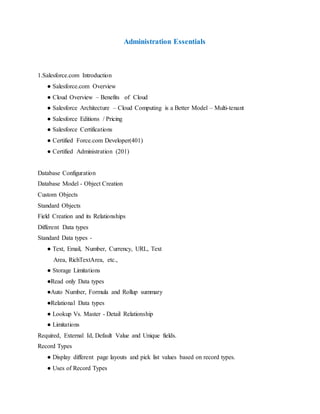
1.Salesforce.com Introduction
● Salesforce.com Overview
● Cloud Overview – Benefits of Cloud
● Salesforce Architecture – Cloud Computing is a Better Model – Multi-tenant
● Salesforce Editions / Pricing
● Salesforce Certifications
● Certified Force.com Developer(401)
● Certified Administration (201)
Database Configuration
Database Model - Object Creation
Custom Objects
Standard Objects
Field Creation and its Relationships
Different Data types
Standard Data types -
● Text, Email, Number, Currency, URL, Text
Area, RichTextArea, etc.,
● Storage Limitations
●Read only Data types
●Auto Number, Formula and Rollup summary
●Relational Data types
● Lookup Vs. Master - Detail Relationship
● Limitations
Required, External Id, Default Value and Unique fields.
Record Types
● Display different page layouts and pick list values based on record types.
● Uses of Record Types
Field Dependencies
● Controlling field/Dependent field?
● Making dependent pick list fields.
Validation Rules
● Defining Sales force Data Validation.
● Creating Custom Validation Rules.
Users, Roles and Profiles
● Creating Users
● User Licenses Overview
● Understanding Record Ownership and Access
● Role Hierarchy
● Profiles
Overview and different profiles
User Permissions
AppExchange
● Installing an App
● Uninstalling an App
Data Utilities
● Import using Application Import Wizard
● Import Wizard Vs Data Loader
● Data Loader Operations Insert/ Update/ Delete/ Upsert / export / exportall /
delete / delete all
Report Types, Reports and Dashboards, Home page Components
● Report Types, Reports & Dashboard Overview
● Different Reports
● Defining Custom Reports
● Advanced Filters
● Defining Dashboards
● Home page Components
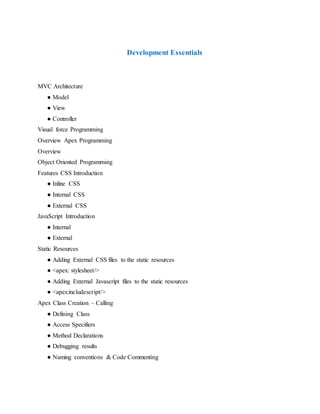
Development Essentials
MVC Architecture
● Model
● View
● Controller
Visual force Programming
Overview Apex Programming
Overview
Object Oriented Programming
Features CSS Introduction
● Inline CSS
● Internal CSS
● External CSS
JavaScript Introduction
● Internal
● External
Static Resources
● Adding External CSS files to the static resources
● <apex: stylesheet/>
● Adding External Javascript files to the static resources
● <apex:includescript/>
Apex Class Creation – Calling
● Defining Class
● Access Specifiers
● Method Declarations
● Debugging results
● Naming conventions & Code Commenting
Data Types
● Primitives
● Collections (List, Set and Map)
● Sobject
Standard Controller
● Record set var
● Standard Save
Controller
● Custom Save Functionality
● With Sharing class Vs. without Sharing Class
Extensions
● Save - Standard controller with extension samples
HTML
● Using HTML Components on VF page
Developer Console
● DML Operations on Single record from Developer console
● DML Operations on Multiple records from Developer console
● Multitenant Architecture & Governing limits – Overview
Output Link Usage
● Page navigation with output links
Command Link Usage
● Command link usage
● Param tag to pass the Ids
Pagereference Class Usage
● Page navigation using page reference class
Wrapper Classes
● Display multi object data
● Adding check boxes to the data and perform related operations
Triggers
● Trigger Overview
● Defining Triggers in Salesforce
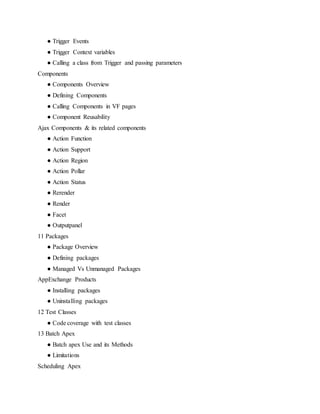
● Trigger Events
● Trigger Context variables
● Calling a class from Trigger and passing parameters
Components
● Components Overview
● Defining Components
● Calling Components in VF pages
● Component Reusability
Ajax Components & its related components
● Action Function
● Action Support
● Action Region
● Action Pollar
● Action Status
● Rerender
● Render
● Facet
● Outputpanel
11 Packages
● Package Overview
● Defining packages
● Managed Vs Unmanaged Packages
AppExchange Products
● Installing packages
● Uninstalling packages
12 Test Classes
● Code coverage with test classes
13 Batch Apex
● Batch apex Use and its Methods
● Limitations
Scheduling Apex
● Scheduling apex Use and its Methods
● Limitations
14 Force.com IDE
● Deployment with Eclipse
● Different sandboxes
● Sandbox Vs. Production Environments Change sets
● Limitations
15 Web services
HTTP Callouts
SOAP API
REST API
View State

Salesforce couse content

  • 1.
    Administration Essentials 1.Salesforce.com Introduction ●Salesforce.com Overview ● Cloud Overview – Benefits of Cloud ● Salesforce Architecture – Cloud Computing is a Better Model – Multi-tenant ● Salesforce Editions / Pricing ● Salesforce Certifications ● Certified Force.com Developer(401) ● Certified Administration (201) Database Configuration Database Model - Object Creation Custom Objects Standard Objects Field Creation and its Relationships Different Data types Standard Data types - ● Text, Email, Number, Currency, URL, Text Area, RichTextArea, etc., ● Storage Limitations ●Read only Data types ●Auto Number, Formula and Rollup summary ●Relational Data types ● Lookup Vs. Master - Detail Relationship ● Limitations Required, External Id, Default Value and Unique fields. Record Types ● Display different page layouts and pick list values based on record types. ● Uses of Record Types
  • 2.
    Field Dependencies ● Controllingfield/Dependent field? ● Making dependent pick list fields. Validation Rules ● Defining Sales force Data Validation. ● Creating Custom Validation Rules. Users, Roles and Profiles ● Creating Users ● User Licenses Overview ● Understanding Record Ownership and Access ● Role Hierarchy ● Profiles Overview and different profiles User Permissions AppExchange ● Installing an App ● Uninstalling an App Data Utilities ● Import using Application Import Wizard ● Import Wizard Vs Data Loader ● Data Loader Operations Insert/ Update/ Delete/ Upsert / export / exportall / delete / delete all Report Types, Reports and Dashboards, Home page Components ● Report Types, Reports & Dashboard Overview ● Different Reports ● Defining Custom Reports ● Advanced Filters ● Defining Dashboards ● Home page Components
  • 3.
    Development Essentials MVC Architecture ●Model ● View ● Controller Visual force Programming Overview Apex Programming Overview Object Oriented Programming Features CSS Introduction ● Inline CSS ● Internal CSS ● External CSS JavaScript Introduction ● Internal ● External Static Resources ● Adding External CSS files to the static resources ● <apex: stylesheet/> ● Adding External Javascript files to the static resources ● <apex:includescript/> Apex Class Creation – Calling ● Defining Class ● Access Specifiers ● Method Declarations ● Debugging results ● Naming conventions & Code Commenting
  • 4.
    Data Types ● Primitives ●Collections (List, Set and Map) ● Sobject Standard Controller ● Record set var ● Standard Save Controller ● Custom Save Functionality ● With Sharing class Vs. without Sharing Class Extensions ● Save - Standard controller with extension samples HTML ● Using HTML Components on VF page Developer Console ● DML Operations on Single record from Developer console ● DML Operations on Multiple records from Developer console ● Multitenant Architecture & Governing limits – Overview Output Link Usage ● Page navigation with output links Command Link Usage ● Command link usage ● Param tag to pass the Ids Pagereference Class Usage ● Page navigation using page reference class Wrapper Classes ● Display multi object data ● Adding check boxes to the data and perform related operations Triggers ● Trigger Overview ● Defining Triggers in Salesforce
  • 5.
    ● Trigger Events ●Trigger Context variables ● Calling a class from Trigger and passing parameters Components ● Components Overview ● Defining Components ● Calling Components in VF pages ● Component Reusability Ajax Components & its related components ● Action Function ● Action Support ● Action Region ● Action Pollar ● Action Status ● Rerender ● Render ● Facet ● Outputpanel 11 Packages ● Package Overview ● Defining packages ● Managed Vs Unmanaged Packages AppExchange Products ● Installing packages ● Uninstalling packages 12 Test Classes ● Code coverage with test classes 13 Batch Apex ● Batch apex Use and its Methods ● Limitations Scheduling Apex
  • 6.
    ● Scheduling apexUse and its Methods ● Limitations 14 Force.com IDE ● Deployment with Eclipse ● Different sandboxes ● Sandbox Vs. Production Environments Change sets ● Limitations 15 Web services HTTP Callouts SOAP API REST API View State