MASS MEDIA
Ana
Andreia
Rosa
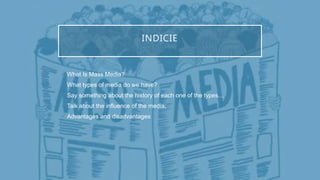
INDICIE
 What Is Mass Media?
 What types of media do we have?
 Say something about the history of each one of the types…
 Talk about the influence of the media;
 Advantages and disadvantages
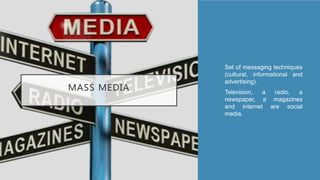
MASS MEDIA
• Set of messaging techniques
(cultural, informational and
advertising).
• Television, a radio, a
newspaper, a magazines
and internet are social
media.
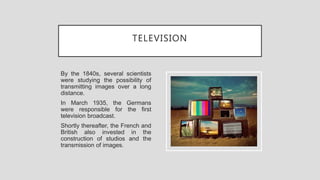
TELEVISION
By the 1840s, several scientists
were studying the possibility of
transmitting images over a long
distance.
In March 1935, the Germans
were responsible for the first
television broadcast.
Shortly thereafter, the French and
British also invested in the
construction of studios and the
transmission of images.
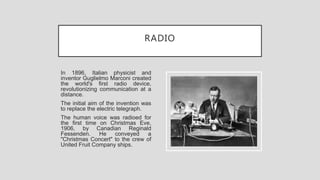
RADIO
In 1896, Italian physicist and
inventor Guglielmo Marconi created
the world's first radio device,
revolutionizing communication at a
distance.
The initial aim of the invention was
to replace the electric telegraph.
The human voice was radioed for
the first time on Christmas Eve,
1906, by Canadian Reginald
Fessenden. He conveyed a
"Christmas Concert" to the crew of
United Fruit Company ships.
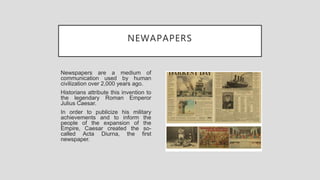
NEWAPAPERS
Newspapers are a medium of
communication used by human
civilization over 2,000 years ago.
Historians attribute this invention to
the legendary Roman Emperor
Julius Caesar.
In order to publicize his military
achievements and to inform the
people of the expansion of the
Empire, Caesar created the so-
called Acta Diurna, the first
newspaper.
MAGAZINES
The first magazine appeared in Germany
in 1663, and had such a long name, it
certainly took a lot of work to be
embedded in the cover: Erbauliche
Monaths-Unterredungen, something like
"Edificant Monthly Discussions.“
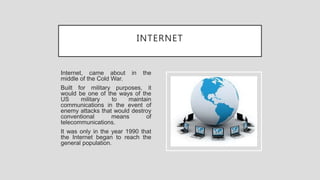
INTERNET
Internet, came about in the
middle of the Cold War.
Built for military purposes, it
would be one of the ways of the
US military to maintain
communications in the event of
enemy attacks that would destroy
conventional means of
telecommunications.
It was only in the year 1990 that
the Internet began to reach the
general population.
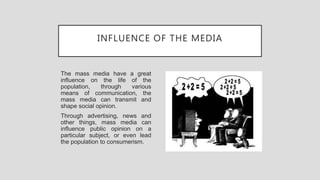
INFLUENCE OF THE MEDIA
The mass media have a great
influence on the life of the
population, through various
means of communication, the
mass media can transmit and
shape social opinion.
Through advertising, news and
other things, mass media can
influence public opinion on a
particular subject, or even lead
the population to consumerism.
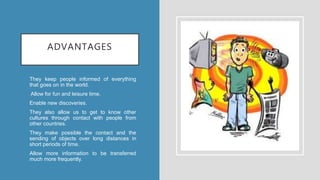
ADVANTAGES
• They keep people informed of everything
that goes on in the world.
• Allow for fun and leisure time.
• Enable new discoveries.
• They also allow us to get to know other
cultures through contact with people from
other countries.
• They make possible the contact and the
sending of objects over long distances in
short periods of time.
• Allow more information to be transferred
much more frequently.
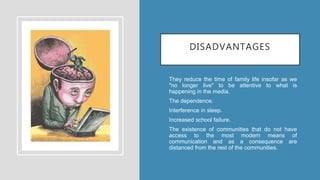
DISADVANTAGES
• They reduce the time of family life insofar as we
"no longer live" to be attentive to what is
happening in the media.
• The dependence.
• Interference in sleep.
• Increased school failure.
• The existence of communities that do not have
access to the most modern means of
communication and as a consequence are
distanced from the rest of the communities.

Mass media

  • 1.
  • 2.
    INDICIE  What IsMass Media?  What types of media do we have?  Say something about the history of each one of the types…  Talk about the influence of the media;  Advantages and disadvantages
  • 3.
    MASS MEDIA • Setof messaging techniques (cultural, informational and advertising). • Television, a radio, a newspaper, a magazines and internet are social media.
  • 4.
    TELEVISION By the 1840s,several scientists were studying the possibility of transmitting images over a long distance. In March 1935, the Germans were responsible for the first television broadcast. Shortly thereafter, the French and British also invested in the construction of studios and the transmission of images.
  • 5.
    RADIO In 1896, Italianphysicist and inventor Guglielmo Marconi created the world's first radio device, revolutionizing communication at a distance. The initial aim of the invention was to replace the electric telegraph. The human voice was radioed for the first time on Christmas Eve, 1906, by Canadian Reginald Fessenden. He conveyed a "Christmas Concert" to the crew of United Fruit Company ships.
  • 6.
    NEWAPAPERS Newspapers are amedium of communication used by human civilization over 2,000 years ago. Historians attribute this invention to the legendary Roman Emperor Julius Caesar. In order to publicize his military achievements and to inform the people of the expansion of the Empire, Caesar created the so- called Acta Diurna, the first newspaper.
  • 7.
    MAGAZINES The first magazineappeared in Germany in 1663, and had such a long name, it certainly took a lot of work to be embedded in the cover: Erbauliche Monaths-Unterredungen, something like "Edificant Monthly Discussions.“
  • 8.
    INTERNET Internet, came aboutin the middle of the Cold War. Built for military purposes, it would be one of the ways of the US military to maintain communications in the event of enemy attacks that would destroy conventional means of telecommunications. It was only in the year 1990 that the Internet began to reach the general population.
  • 9.
    INFLUENCE OF THEMEDIA The mass media have a great influence on the life of the population, through various means of communication, the mass media can transmit and shape social opinion. Through advertising, news and other things, mass media can influence public opinion on a particular subject, or even lead the population to consumerism.
  • 10.
    ADVANTAGES • They keeppeople informed of everything that goes on in the world. • Allow for fun and leisure time. • Enable new discoveries. • They also allow us to get to know other cultures through contact with people from other countries. • They make possible the contact and the sending of objects over long distances in short periods of time. • Allow more information to be transferred much more frequently.
  • 11.
    DISADVANTAGES • They reducethe time of family life insofar as we "no longer live" to be attentive to what is happening in the media. • The dependence. • Interference in sleep. • Increased school failure. • The existence of communities that do not have access to the most modern means of communication and as a consequence are distanced from the rest of the communities.