Students:
Isac Cosmin
Cornea Maria Cristiana
Pisica Rares
Iancu Alexandru
Ilie Georgiana
Teacher:
Tanasescu Gabriela-Violeta
“Traian” Highschool
Constanta, Romania
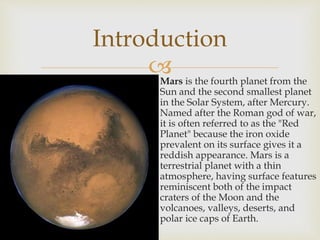
 Mars is the fourth planet from the
Sun and the second smallest planet
in the Solar System, after Mercury.
Named after the Roman god of war,
it is often referred to as the "Red
Planet" because the iron oxide
prevalent on its surface gives it a
reddish appearance. Mars is a
terrestrial planet with a thin
atmosphere, having surface features
reminiscent both of the impact
craters of the Moon and the
volcanoes, valleys, deserts, and
polar ice caps of Earth.
Introduction

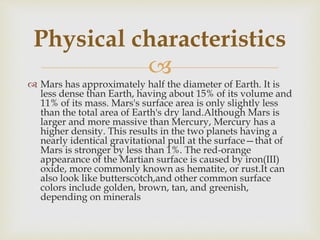
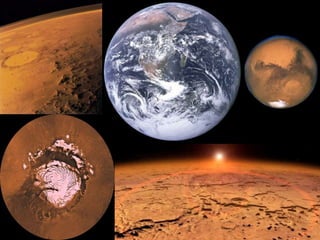
 Mars has approximately half the diameter of Earth. It is
less dense than Earth, having about 15% of its volume and
11% of its mass. Mars's surface area is only slightly less
than the total area of Earth's dry land.Although Mars is
larger and more massive than Mercury, Mercury has a
higher density. This results in the two planets having a
nearly identical gravitational pull at the surface—that of
Mars is stronger by less than 1%. The red-orange
appearance of the Martian surface is caused by iron(III)
oxide, more commonly known as hematite, or rust.It can
also look like butterscotch,and other common surface
colors include golden, brown, tan, and greenish,
depending on minerals
Physical characteristics


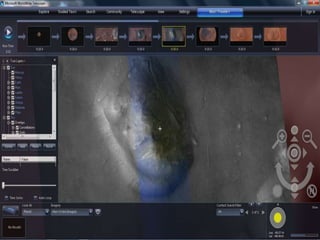
 Cydonia was first imaged in detail by the Viking 1
and Viking 2 orbiters. Eighteen images of the
Cydonia region were taken by the orbiters, of which
seven have resolutions better than 250 m/pixel
(820 ft/pixel). The other eleven images have
resolutions that are worse than 550 m/pixel
(1800 ft/pixel) and are of limited use for studying
surface features. Of the seven good images, the
lighting and time at which two pairs of images were
taken are so close as to reduce the number to five
distinct images
Face on Mars


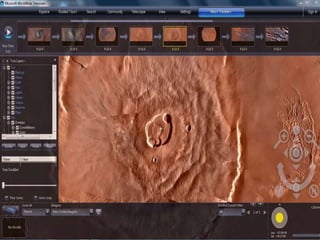
 Olympus Mons (Latin for Mount Olympus) is a very
large shield volcano on the planet Mars. By one measure,
it has a height of nearly 25 km (16 mi). Olympus Mons
stands almost three times as tall as Mount Everest's height
above sea level. It is the youngest of the large volcanoes
on Mars, having formed during Mars's Amazonia Period.
It is currently the biggest discovered Volcano in the Solar
System, and had been known to astronomers since the
late 19th century as the albedo feature Nix Olympica
(Latin for "Olympic Snow"). Its mountainous nature was
suspected well before space probes confirmed its identity
as a mountain.
Olympus Mons


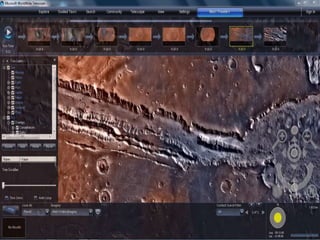
 Valles Marineris (Latin for Mariner Valleys, named after the Mariner
9 Mars orbiter of 1971–72 which discovered it) is a system of canyons
that runs along the Martian surface east of the Tharsis region.At
more than 4,000 km (2,500 mi) long, 200 km (120 mi) wide and up to
7 km (23,000 ft) deep,the Valles Marineris rift system is one of the
larger canyons of the Solar System, surpassed only by the rift valleys
of Earth.
 Valles Marineris stretches over 4,000 km (2,500 mi) across Mars,
mostly east-west just below the equator, as seen in this Viking 1
orbiter image mosaic. The three Tharsis Montes are at left; towards
the top, an ancient outflow channel stretches northward from Echus
Chasma to Kasei Valles. Similar outflow channels extend from the
east end of Valles Marineris towards Mars's northern lowlands.
Valles Marineris

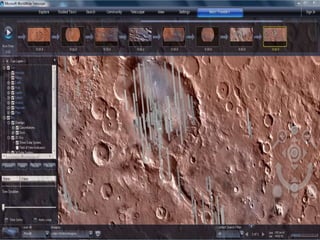
 Gusev is a crater on the planet Mars and is located at 14.5°S 175.4°E. The crater is
about 166 kilometers in diameter and formed approximately three to four billion
years ago. It was named after Russian astronomer Matvei Gusev (1826–1866) in
1976.
 A channel system named Ma'adim Vallis drains into it that probably carried
liquid water, or water and ice, at some point in Mars' past. The crater appears to be
an old crater lake bed, filled with sediments up to 3000 feet thick.Some exposed
outcrops appear to show faint layering, and some researchers also believe that
landforms visible in images of the mouth of Ma'adim Vallis where it enters Gusev
resemble landforms seen in some terrestrial river deltas. Deltas of this nature can
take tens or hundreds of thousands of years to form on Earth, suggesting that the
water flows may have lasted for long periods. Orbital images indicate that there
may once have been a very large lake near the source of Ma'adim Vallis that could
have provided the source of this water. It is not known whether this flow was
slow and continuous, punctuated by sporadic large outbursts, or some
combination of these patterns.
Gusev Crater


Mars travelers-again, Mars - A project for humanity

  • 1.
    Students: Isac Cosmin Cornea MariaCristiana Pisica Rares Iancu Alexandru Ilie Georgiana Teacher: Tanasescu Gabriela-Violeta “Traian” Highschool Constanta, Romania
  • 2.
     Mars isthe fourth planet from the Sun and the second smallest planet in the Solar System, after Mercury. Named after the Roman god of war, it is often referred to as the "Red Planet" because the iron oxide prevalent on its surface gives it a reddish appearance. Mars is a terrestrial planet with a thin atmosphere, having surface features reminiscent both of the impact craters of the Moon and the volcanoes, valleys, deserts, and polar ice caps of Earth. Introduction
  • 3.
      Mars hasapproximately half the diameter of Earth. It is less dense than Earth, having about 15% of its volume and 11% of its mass. Mars's surface area is only slightly less than the total area of Earth's dry land.Although Mars is larger and more massive than Mercury, Mercury has a higher density. This results in the two planets having a nearly identical gravitational pull at the surface—that of Mars is stronger by less than 1%. The red-orange appearance of the Martian surface is caused by iron(III) oxide, more commonly known as hematite, or rust.It can also look like butterscotch,and other common surface colors include golden, brown, tan, and greenish, depending on minerals Physical characteristics
  • 4.
  • 5.
      Cydonia wasfirst imaged in detail by the Viking 1 and Viking 2 orbiters. Eighteen images of the Cydonia region were taken by the orbiters, of which seven have resolutions better than 250 m/pixel (820 ft/pixel). The other eleven images have resolutions that are worse than 550 m/pixel (1800 ft/pixel) and are of limited use for studying surface features. Of the seven good images, the lighting and time at which two pairs of images were taken are so close as to reduce the number to five distinct images Face on Mars
  • 6.
  • 7.
      Olympus Mons(Latin for Mount Olympus) is a very large shield volcano on the planet Mars. By one measure, it has a height of nearly 25 km (16 mi). Olympus Mons stands almost three times as tall as Mount Everest's height above sea level. It is the youngest of the large volcanoes on Mars, having formed during Mars's Amazonia Period. It is currently the biggest discovered Volcano in the Solar System, and had been known to astronomers since the late 19th century as the albedo feature Nix Olympica (Latin for "Olympic Snow"). Its mountainous nature was suspected well before space probes confirmed its identity as a mountain. Olympus Mons
  • 8.
  • 9.
      Valles Marineris(Latin for Mariner Valleys, named after the Mariner 9 Mars orbiter of 1971–72 which discovered it) is a system of canyons that runs along the Martian surface east of the Tharsis region.At more than 4,000 km (2,500 mi) long, 200 km (120 mi) wide and up to 7 km (23,000 ft) deep,the Valles Marineris rift system is one of the larger canyons of the Solar System, surpassed only by the rift valleys of Earth.  Valles Marineris stretches over 4,000 km (2,500 mi) across Mars, mostly east-west just below the equator, as seen in this Viking 1 orbiter image mosaic. The three Tharsis Montes are at left; towards the top, an ancient outflow channel stretches northward from Echus Chasma to Kasei Valles. Similar outflow channels extend from the east end of Valles Marineris towards Mars's northern lowlands. Valles Marineris
  • 10.
  • 11.
     Gusev isa crater on the planet Mars and is located at 14.5°S 175.4°E. The crater is about 166 kilometers in diameter and formed approximately three to four billion years ago. It was named after Russian astronomer Matvei Gusev (1826–1866) in 1976.  A channel system named Ma'adim Vallis drains into it that probably carried liquid water, or water and ice, at some point in Mars' past. The crater appears to be an old crater lake bed, filled with sediments up to 3000 feet thick.Some exposed outcrops appear to show faint layering, and some researchers also believe that landforms visible in images of the mouth of Ma'adim Vallis where it enters Gusev resemble landforms seen in some terrestrial river deltas. Deltas of this nature can take tens or hundreds of thousands of years to form on Earth, suggesting that the water flows may have lasted for long periods. Orbital images indicate that there may once have been a very large lake near the source of Ma'adim Vallis that could have provided the source of this water. It is not known whether this flow was slow and continuous, punctuated by sporadic large outbursts, or some combination of these patterns. Gusev Crater
  • 12.