University Health and Medical Librarians
Group, 9th
March 2009
Introduction and Strategic Overview
Alex Markham
Research Capability Programme - SRO
Research Capability Programme
Recent news:
• HM Revenue and Customs loses CD with millions of
records…….
• Home Office loses personal details of prison officers…..
• Ministry of Defence hard disc with 100,000 servicemen’s
detailed records disappears……..
• 722,000 DNA samples added to National Database which
now covers 4million people…….
[44,000 DNA samples identified at crime scenes…]
Recent Reports discussing access to
Personal Information
• “Better Use of Personal Information: Opportunities and Risks” (2005),
http://www2.cst.gov.uk/cst/reports/files/personal-information/report.pdf;
• “Personal Data for Public Good: using Health Information in Medical
Research” (2006), http://www.acmedsci.ac.uk/images/project/Personal.pdf;
• “UKCRC R&D Advisory Group to Connecting for Health: Report of
Research Simulations” (2007), http://www.ukcrc.org/pdf/CfH%20report
%20June%2007%20full.pdf;
• “Towards Consensus in the use of Electronic Patient Records for
Research in General Practice” (2008), the Wellcome Trust;
• The “Health Informatics Review” (2008),
http://www.dh.gov.uk/en/Publicationsandstatistics/Publications; and
• The “Data Sharing Review” (2008),
http://www.justice.gov.uk/docs/data-sharing-review.pdf.
Also, a variety of changes in relevant legislation……
Background
• Dec 2005 – Chancellor’s commitment
• Jan 2006 – DH strategy Best Research for Best Health
• July 2006 – R&D advisory group to NHS CFH
established by UKCRC
• June 2007 – UKCRC R&D advisory group report
• August 2007 – CRDB SUS working group report
• August 2007 – Research Capability Programme initiated
• September 2007 – Health Select Committee Report
Guide to Acronyms
UKCRC – United Kingdom Clinical Research Collaboration
CRDB – Care Record Development Board
NIGB – National Information Governance Board
NHS CRS – NHS Care Records Service
SCR – Summary Care Record
DCR – Detailed Care Record
SUS – Secondary Uses Service
R&D – Research and Development
What is the Research
Capability Programme?
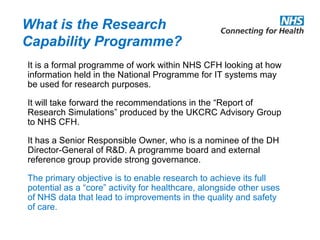
It is a formal programme of work within NHS CFH looking at how
information held in the National Programme for IT systems may
be used for research purposes.
It will take forward the recommendations in the “Report of
Research Simulations” produced by the UKCRC Advisory Group
to NHS CFH.
It has a Senior Responsible Owner, who is a nominee of the DH
Director-General of R&D. A programme board and external
reference group provide strong governance.
The primary objective is to enable research to achieve its full
potential as a “core” activity for healthcare, alongside other uses
of NHS data that lead to improvements in the quality and safety
of care.
Research Capability Programme
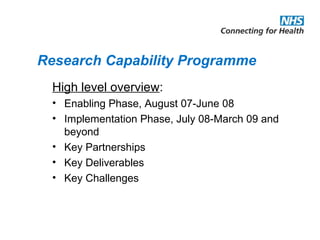
High level overview:
• Enabling Phase, August 07-June 08
• Implementation Phase, July 08-March 09 and
beyond
• Key Partnerships
• Key Deliverables
• Key Challenges
Enabling Phase
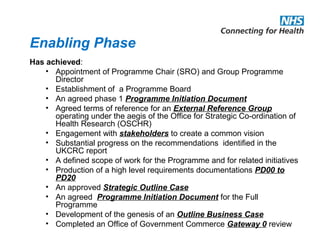
Has achieved:
• Appointment of Programme Chair (SRO) and Group Programme
Director
• Establishment of a Programme Board
• An agreed phase 1 Programme Initiation Document
• Agreed terms of reference for an External Reference Group
operating under the aegis of the Office for Strategic Co-ordination of
Health Research (OSCHR)
• Engagement with stakeholders to create a common vision
• Substantial progress on the recommendations identified in the
UKCRC report
• A defined scope of work for the Programme and for related initiatives
• Production of a high level requirements documentations PD00 to
PD20
• An approved Strategic Outline Case
• An agreed Programme Initiation Document for the Full
Programme
• Development of the genesis of an Outline Business Case
• Completed an Office of Government Commerce Gateway 0 review
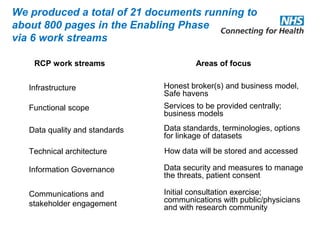
We produced a total of 21 documents running to
about 800 pages in the Enabling Phase
via 6 work streams
Infrastructure
Functional scope
Data quality and standards
Technical architecture
Information Governance
RCP work streams
Communications and
stakeholder engagement
Areas of focus
How data will be stored and accessed
Services to be provided centrally;
business models
Data standards, terminologies, options
for linkage of datasets
Data security and measures to manage
the threats, patient consent
Honest broker(s) and business model,
Safe havens
Initial consultation exercise;
communications with public/physicians
and with research community
RCP Data Sources?
• Assessing feasibility of:
• Demographic Data (NHS patient index)
• Vital events (births, deaths)
• Primary care clinical records (GP system extracts, research
collections)
• Secondary care clinical records (Hospital system extracts,
research collections)
• NHS National Data Collections (HES/MHMDS)
• NHS CRS National Systems (Summary Care Record, Choose
and Book, Electronic Prescription Service)
• Disease Registries (National and Regional)
• Diagnostic data (Laboratory tests)
• NHS Specialist Collections (Clinical Audit)
• Other data collections (research datasets, education, social
care, deprivation, socio-economic)
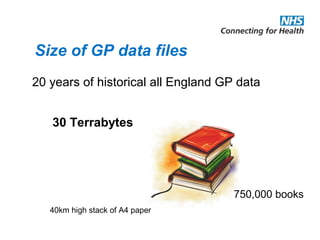
Size of GP data files
20 years of historical all England GP data
750,000 books
40km high stack of A4 paper
30 Terrabytes
The only common identifiers found in Hospital xx Systems are the Hospital
Unique ID and in addition in some Trusts, the NHS number.
The patient's name may be entered differently and there is no order or xx
number that is exported from the xx system that might enable an
alternative link to be made with other databases.
The Hospital Unique ID cannot, moreover, be used alone as the common
identifier. This is because the same Hospital Unique ID numbering
system will almost certainly be used by a different hospital with the same
PAS system thereby creating duplicate IDs for different patients.
This is further compounded by in some cases the unique ID only being
relevant to a single admission or episode.
This means that a patient may have different hospital unique IDs depending
on which hospital they go to, and may even have different IDs within the
same hospital for different admissions.
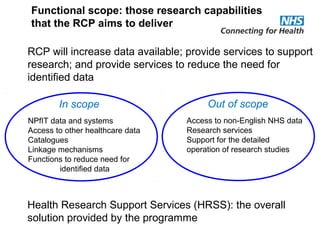
RCP will increase data available; provide services to support
research; and provide services to reduce the need for
identified data
Functional scope: those research capabilities
that the RCP aims to deliver
Health Research Support Services (HRSS): the overall
solution provided by the programme
In scope Out of scope
NPfIT data and systems
Access to other healthcare data
Catalogues
Linkage mechanisms
Functions to reduce need for
identified data
Access to non-English NHS data
Research services
Support for the detailed
operation of research studies
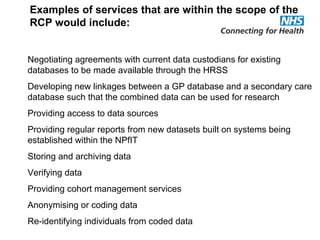
Negotiating agreements with current data custodians for existing
databases to be made available through the HRSS
Developing new linkages between a GP database and a secondary care
database such that the combined data can be used for research
Providing access to data sources
Providing regular reports from new datasets built on systems being
established within the NPfIT
Storing and archiving data
Verifying data
Providing cohort management services
Anonymising or coding data
Re-identifying individuals from coded data
Examples of services that are within the scope of the
RCP would include:
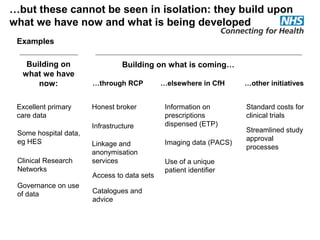
…but these cannot be seen in isolation: they build upon
what we have now and what is being developed
Building on
what we have
now:
Excellent primary
care data
Some hospital data,
eg HES
Honest broker
Linkage and
anonymisation
services
Information on
prescriptions
dispensed (ETP)
Access to data sets
Imaging data (PACS)
Examples
Clinical Research
Networks
Governance on use
of data
Building on what is coming…
…through RCP …elsewhere in CfH …other initiatives
Catalogues and
advice
Infrastructure
Use of a unique
patient identifier
Standard costs for
clinical trials
Streamlined study
approval
processes
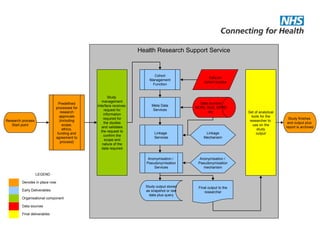
Research process
Start point
Study finishes
and output plus
report is archived
Predefined
processes for
research
approvals
(including
scope,
ethics,
funding and
agreement to
proceed)
Health Research Support Service
Study
management
interface receives
request for
information
required for
the studies
and validates
the request to
confirm the
scope and
nature of the
data required
Cohort
Management
Function
Meta Data
Services
Linkage
Services
Anonymisation /
Pseudonymisation
Services
Study output stored
as snapshot or raw
data plus query
Data sources
NCRS, SUS, GPRD
etc
Linkage
Mechanism
Anonymisation /
Pseudonymisation
mechanism
Set of analytical
tools for the
researcher to
use on the
study
output
Data on
cohort studies
Final output to the
researcher
LEGEND
Denotes in place now
Early Deliverables
Organisational component
Data sources
Final deliverables
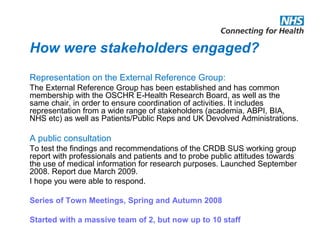
How were stakeholders engaged?
Representation on the External Reference Group:
The External Reference Group has been established and has common
membership with the OSCHR E-Health Research Board, as well as the
same chair, in order to ensure coordination of activities. It includes
representation from a wide range of stakeholders (academia, ABPI, BIA,
NHS etc) as well as Patients/Public Reps and UK Devolved Administrations.
A public consultation
To test the findings and recommendations of the CRDB SUS working group
report with professionals and patients and to probe public attitudes towards
the use of medical information for research purposes. Launched September
2008. Report due March 2009.
I hope you were able to respond.
Series of Town Meetings, Spring and Autumn 2008
Started with a massive team of 2, but now up to 10 staff
Research Capability Programme
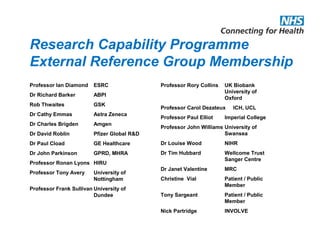
External Reference Group Membership
Professor Ian Diamond ESRC
Dr Richard Barker ABPI
Rob Thwaites GSK
Dr Cathy Emmas Astra Zeneca
Dr Charles Brigden Amgen
Dr David Roblin Pfizer Global R&D
Dr Paul Cload GE Healthcare
Dr John Parkinson GPRD, MHRA
Professor Ronan Lyons HIRU
Professor Tony Avery University of
Nottingham
Professor Frank Sullivan University of
Dundee
Professor Rory Collins UK Biobank
University of
Oxford
Professor Carol Dezateux ICH, UCL
Professor Paul Elliot Imperial College
Professor John Williams University of
Swansea
Dr Louise Wood NIHR
Dr Tim Hubbard Wellcome Trust
Sanger Centre
Dr Janet Valentine MRC
Christine Vial Patient / Public
Member
Tony Sargeant Patient / Public
Member
Nick Partridge INVOLVE
Research Capability Programme
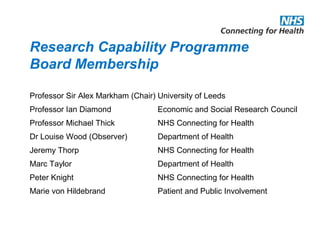
Board Membership
Professor Sir Alex Markham (Chair) University of Leeds
Professor Ian Diamond Economic and Social Research Council
Professor Michael Thick NHS Connecting for Health
Dr Louise Wood (Observer) Department of Health
Jeremy Thorp NHS Connecting for Health
Marc Taylor Department of Health
Peter Knight NHS Connecting for Health
Marie von Hildebrand Patient and Public Involvement
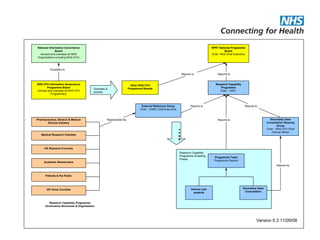
National Information Governance
Board
Advises and oversees all NHS
Organisations including NHS CFH)
NHS CFH Information Governance
Programme Board
Advises and oversees all NHS CFH
Programmes)
Other NHS CFH
Programme Boards
External Reference Group
Chair – ESRC Chief Executive
Secondary Uses
Consultation Steering
Group
Chair - NHS CFH Chief
Clinical Officer
Research Capability
Programme
Chair – SRO
NPfIT National Programme
Board
Chair- NHS Chief Executive
Oversees &
advises
Pharmaceutical, Biotech & Medical
Devices Industry
Medical Research Charities
UK Research Councils
Academic Researchers
Patients & the Public
UK Home Counties
Programme Team
Programme Director
Various sub-
projects
Secondary Uses
Consultation
Research Capability
Programme (Enabling
Phase)
Advis
es&
assur
es
Represented By
Reports to Reports to
Reports to
Reports to
Reports to
Steered by
Escalates to
Research Capability Programme
Governance Structures & Organisation
Version 0.3 11/09/08
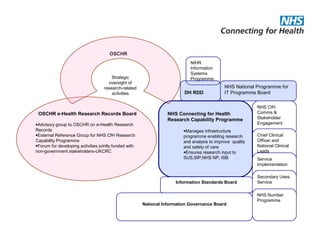
NIHR
Information
Systems
Programme
NHS CfH
Comms &
Stakeholder
Engagement
Chief Clinical
Officer and
National Clinical
Leads
Strategic
oversight of
research-related
activities
NIGB
OSCHR e-Health Research Records Board
•Advisory group to OSCHR on e-Health Research
Records
•External Reference Group for NHS CfH Research
Capability Programme
•Forum for developing activities jointly funded with
non-government stakeholders-UKCRC
NHS Connecting for Health
Research Capability Programme
•Manages infrastructure
programme enabling research
and analysis to improve quality
and safety of care
•Ensures research input to
SUS,SIP,NHS NP, ISB
Information Standards Board
Service
Implementation
Secondary Uses
Service
NHS Number
Programme
OSCHR
NHS National Programme for
IT Programme BoardDH RDD
National Information Governance Board
Full Programme Stages
Implementation Programme
• Stage 1 – Procurement, Pilot and Proof of Concept
• Stage 2 – Mobilisation
• Stage 3 – Building the infrastructure
• Stage 4 – Federating data sources
• Stage 5 – Transfer to Business as usual
• Stage 6 – Programme closure and benefits realisation
RCP Implementation Phase
• Strategic Outline Case
• Outline Business Case
• Output Based Specification 1
• Output Based Specification 2
• Full Business Case
• Office of Government Commerce, Gateway Reviews
• Financial Approval Processes: NHS CFH, Department of Health, HM
Treasury
• Pilot Studies
• Procurement
• Ongoing role for ERG/OSCHR E-Health Records Research Board
• Funders’ Forum
• Continuing engagement with the research community
RCP – Full Programme Stage 1
The Programme structure:
• Business Cases and Procurement Project
• Commissioning of the IG Services Programme
• Pilot Programme
• Public Consultation Project
• Programme Communication
• Programme Assurance
RCP Key Partnerships
Established Players (in no particular order):
• Other NHS CFH Programmes
• NIHR IT Programme
• UK Biobank
• Secondary Uses Service
• The Information Centre for Health and Social Care
• GP Research Database/MHRA
• QResearch and other primary care datasets
• GP Extraction Service (Information Centre for Health and Social Care)
• Office for National Statistics/Registrar General
• Public Health Observatories
• National Cancer Intelligence Network
• Janet/N3 Forum
………and many, many others…….
Including University Health and Medical Librarians Group, please.
RCP Key Partnerships
The Research Communities
• Public Health Researchers
• Observational Epidemiologists
• Clinical Trialists
• Health Services Researchers
• Pharmaco-”vigilantes”
Data
Collection
Clinical
trial design
Recruitment
Analysis &
reporting
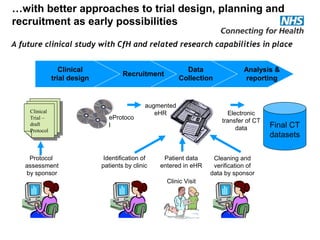
…with better approaches to trial design, planning and
recruitment as early possibilities
Clinic Visit
Patient data
entered in eHR
Final CT
datasets
Clinical
Trial –
draft
Protocol
Clinical
Trial –
draft
Protocol
eProtoco
l
augmented
eHR
Cleaning and
verification of
data by sponsor
Protocol
assessment
by sponsor
Identification of
patients by clinic
Electronic
transfer of CT
data
A future clinical study with CfH and related research capabilities in place
What challenges do we face?
• Ensuring the opportunities are maximised
• Developing better linkage between new and existing databases
• Data quality and standards
• Information Governance:
– Patient confidentiality;
– Access – who, when, where, what, how, why;
– Pseudonymisation / anonymisation; and
– Patient consent and “consent for consent”.
• Consolidating different stakeholder views e.g. professional vs
patient groups or across different professional groups
RCP Key Challenges
Concepts that several colleagues in this area are
addressing:
• Honest Brokers
• Safe Havens
• Trusted Third Parties
……..changing the terminology might help
RCP Key Challenges
INFORMATION GOVERNANCE
• National Information Governance Board (NIGB)/PIAG
• DH Information Policy Unit
• Information Commissioner
• General Medical Council
• British Medical Association
• Medical Insurers
• Caldicott Guardians
• SHA Chief Information Officers
• Public Health Observatories
• NHS CFH Information Governance Board
• DH Information Director
• Director, NPfIT
• Chief Statistician etc, etc, etc
…all set against a bewildering assortment of legislation….. and Parliamentary
Statements as to what the laws are supposed to mean…..and conflicting views as to how the
Parliamentary Statements are then to be interpreted
Research Capability Programme Key
Challenges
• This is not going to be easy!!
• Essential to maintain stakeholder support and
momentum
• Thank you for your invitation and in
anticipation of your support in the future.
Credit Crunch, what Credit Crunch???

Markham2009

  • 1.
    University Health andMedical Librarians Group, 9th March 2009 Introduction and Strategic Overview Alex Markham Research Capability Programme - SRO Research Capability Programme
  • 2.
    Research Capability Programme Recentnews: • HM Revenue and Customs loses CD with millions of records……. • Home Office loses personal details of prison officers….. • Ministry of Defence hard disc with 100,000 servicemen’s detailed records disappears…….. • 722,000 DNA samples added to National Database which now covers 4million people……. [44,000 DNA samples identified at crime scenes…]
  • 3.
    Recent Reports discussingaccess to Personal Information • “Better Use of Personal Information: Opportunities and Risks” (2005), http://www2.cst.gov.uk/cst/reports/files/personal-information/report.pdf; • “Personal Data for Public Good: using Health Information in Medical Research” (2006), http://www.acmedsci.ac.uk/images/project/Personal.pdf; • “UKCRC R&D Advisory Group to Connecting for Health: Report of Research Simulations” (2007), http://www.ukcrc.org/pdf/CfH%20report %20June%2007%20full.pdf; • “Towards Consensus in the use of Electronic Patient Records for Research in General Practice” (2008), the Wellcome Trust; • The “Health Informatics Review” (2008), http://www.dh.gov.uk/en/Publicationsandstatistics/Publications; and • The “Data Sharing Review” (2008), http://www.justice.gov.uk/docs/data-sharing-review.pdf. Also, a variety of changes in relevant legislation……
  • 4.
    Background • Dec 2005– Chancellor’s commitment • Jan 2006 – DH strategy Best Research for Best Health • July 2006 – R&D advisory group to NHS CFH established by UKCRC • June 2007 – UKCRC R&D advisory group report • August 2007 – CRDB SUS working group report • August 2007 – Research Capability Programme initiated • September 2007 – Health Select Committee Report
  • 5.
    Guide to Acronyms UKCRC– United Kingdom Clinical Research Collaboration CRDB – Care Record Development Board NIGB – National Information Governance Board NHS CRS – NHS Care Records Service SCR – Summary Care Record DCR – Detailed Care Record SUS – Secondary Uses Service R&D – Research and Development
  • 6.
    What is theResearch Capability Programme? It is a formal programme of work within NHS CFH looking at how information held in the National Programme for IT systems may be used for research purposes. It will take forward the recommendations in the “Report of Research Simulations” produced by the UKCRC Advisory Group to NHS CFH. It has a Senior Responsible Owner, who is a nominee of the DH Director-General of R&D. A programme board and external reference group provide strong governance. The primary objective is to enable research to achieve its full potential as a “core” activity for healthcare, alongside other uses of NHS data that lead to improvements in the quality and safety of care.
  • 7.
    Research Capability Programme Highlevel overview: • Enabling Phase, August 07-June 08 • Implementation Phase, July 08-March 09 and beyond • Key Partnerships • Key Deliverables • Key Challenges
  • 8.
    Enabling Phase Has achieved: •Appointment of Programme Chair (SRO) and Group Programme Director • Establishment of a Programme Board • An agreed phase 1 Programme Initiation Document • Agreed terms of reference for an External Reference Group operating under the aegis of the Office for Strategic Co-ordination of Health Research (OSCHR) • Engagement with stakeholders to create a common vision • Substantial progress on the recommendations identified in the UKCRC report • A defined scope of work for the Programme and for related initiatives • Production of a high level requirements documentations PD00 to PD20 • An approved Strategic Outline Case • An agreed Programme Initiation Document for the Full Programme • Development of the genesis of an Outline Business Case • Completed an Office of Government Commerce Gateway 0 review
  • 9.
    We produced atotal of 21 documents running to about 800 pages in the Enabling Phase via 6 work streams Infrastructure Functional scope Data quality and standards Technical architecture Information Governance RCP work streams Communications and stakeholder engagement Areas of focus How data will be stored and accessed Services to be provided centrally; business models Data standards, terminologies, options for linkage of datasets Data security and measures to manage the threats, patient consent Honest broker(s) and business model, Safe havens Initial consultation exercise; communications with public/physicians and with research community
  • 10.
    RCP Data Sources? •Assessing feasibility of: • Demographic Data (NHS patient index) • Vital events (births, deaths) • Primary care clinical records (GP system extracts, research collections) • Secondary care clinical records (Hospital system extracts, research collections) • NHS National Data Collections (HES/MHMDS) • NHS CRS National Systems (Summary Care Record, Choose and Book, Electronic Prescription Service) • Disease Registries (National and Regional) • Diagnostic data (Laboratory tests) • NHS Specialist Collections (Clinical Audit) • Other data collections (research datasets, education, social care, deprivation, socio-economic)
  • 11.
    Size of GPdata files 20 years of historical all England GP data 750,000 books 40km high stack of A4 paper 30 Terrabytes
  • 12.
    The only commonidentifiers found in Hospital xx Systems are the Hospital Unique ID and in addition in some Trusts, the NHS number. The patient's name may be entered differently and there is no order or xx number that is exported from the xx system that might enable an alternative link to be made with other databases. The Hospital Unique ID cannot, moreover, be used alone as the common identifier. This is because the same Hospital Unique ID numbering system will almost certainly be used by a different hospital with the same PAS system thereby creating duplicate IDs for different patients. This is further compounded by in some cases the unique ID only being relevant to a single admission or episode. This means that a patient may have different hospital unique IDs depending on which hospital they go to, and may even have different IDs within the same hospital for different admissions.
  • 13.
    RCP will increasedata available; provide services to support research; and provide services to reduce the need for identified data Functional scope: those research capabilities that the RCP aims to deliver Health Research Support Services (HRSS): the overall solution provided by the programme In scope Out of scope NPfIT data and systems Access to other healthcare data Catalogues Linkage mechanisms Functions to reduce need for identified data Access to non-English NHS data Research services Support for the detailed operation of research studies
  • 14.
    Negotiating agreements withcurrent data custodians for existing databases to be made available through the HRSS Developing new linkages between a GP database and a secondary care database such that the combined data can be used for research Providing access to data sources Providing regular reports from new datasets built on systems being established within the NPfIT Storing and archiving data Verifying data Providing cohort management services Anonymising or coding data Re-identifying individuals from coded data Examples of services that are within the scope of the RCP would include:
  • 15.
    …but these cannotbe seen in isolation: they build upon what we have now and what is being developed Building on what we have now: Excellent primary care data Some hospital data, eg HES Honest broker Linkage and anonymisation services Information on prescriptions dispensed (ETP) Access to data sets Imaging data (PACS) Examples Clinical Research Networks Governance on use of data Building on what is coming… …through RCP …elsewhere in CfH …other initiatives Catalogues and advice Infrastructure Use of a unique patient identifier Standard costs for clinical trials Streamlined study approval processes
  • 16.
    Research process Start point Studyfinishes and output plus report is archived Predefined processes for research approvals (including scope, ethics, funding and agreement to proceed) Health Research Support Service Study management interface receives request for information required for the studies and validates the request to confirm the scope and nature of the data required Cohort Management Function Meta Data Services Linkage Services Anonymisation / Pseudonymisation Services Study output stored as snapshot or raw data plus query Data sources NCRS, SUS, GPRD etc Linkage Mechanism Anonymisation / Pseudonymisation mechanism Set of analytical tools for the researcher to use on the study output Data on cohort studies Final output to the researcher LEGEND Denotes in place now Early Deliverables Organisational component Data sources Final deliverables
  • 17.
    How were stakeholdersengaged? Representation on the External Reference Group: The External Reference Group has been established and has common membership with the OSCHR E-Health Research Board, as well as the same chair, in order to ensure coordination of activities. It includes representation from a wide range of stakeholders (academia, ABPI, BIA, NHS etc) as well as Patients/Public Reps and UK Devolved Administrations. A public consultation To test the findings and recommendations of the CRDB SUS working group report with professionals and patients and to probe public attitudes towards the use of medical information for research purposes. Launched September 2008. Report due March 2009. I hope you were able to respond. Series of Town Meetings, Spring and Autumn 2008 Started with a massive team of 2, but now up to 10 staff
  • 18.
    Research Capability Programme ExternalReference Group Membership Professor Ian Diamond ESRC Dr Richard Barker ABPI Rob Thwaites GSK Dr Cathy Emmas Astra Zeneca Dr Charles Brigden Amgen Dr David Roblin Pfizer Global R&D Dr Paul Cload GE Healthcare Dr John Parkinson GPRD, MHRA Professor Ronan Lyons HIRU Professor Tony Avery University of Nottingham Professor Frank Sullivan University of Dundee Professor Rory Collins UK Biobank University of Oxford Professor Carol Dezateux ICH, UCL Professor Paul Elliot Imperial College Professor John Williams University of Swansea Dr Louise Wood NIHR Dr Tim Hubbard Wellcome Trust Sanger Centre Dr Janet Valentine MRC Christine Vial Patient / Public Member Tony Sargeant Patient / Public Member Nick Partridge INVOLVE
  • 19.
    Research Capability Programme BoardMembership Professor Sir Alex Markham (Chair) University of Leeds Professor Ian Diamond Economic and Social Research Council Professor Michael Thick NHS Connecting for Health Dr Louise Wood (Observer) Department of Health Jeremy Thorp NHS Connecting for Health Marc Taylor Department of Health Peter Knight NHS Connecting for Health Marie von Hildebrand Patient and Public Involvement
  • 20.
    National Information Governance Board Advisesand oversees all NHS Organisations including NHS CFH) NHS CFH Information Governance Programme Board Advises and oversees all NHS CFH Programmes) Other NHS CFH Programme Boards External Reference Group Chair – ESRC Chief Executive Secondary Uses Consultation Steering Group Chair - NHS CFH Chief Clinical Officer Research Capability Programme Chair – SRO NPfIT National Programme Board Chair- NHS Chief Executive Oversees & advises Pharmaceutical, Biotech & Medical Devices Industry Medical Research Charities UK Research Councils Academic Researchers Patients & the Public UK Home Counties Programme Team Programme Director Various sub- projects Secondary Uses Consultation Research Capability Programme (Enabling Phase) Advis es& assur es Represented By Reports to Reports to Reports to Reports to Reports to Steered by Escalates to Research Capability Programme Governance Structures & Organisation Version 0.3 11/09/08
  • 21.
    NIHR Information Systems Programme NHS CfH Comms & Stakeholder Engagement ChiefClinical Officer and National Clinical Leads Strategic oversight of research-related activities NIGB OSCHR e-Health Research Records Board •Advisory group to OSCHR on e-Health Research Records •External Reference Group for NHS CfH Research Capability Programme •Forum for developing activities jointly funded with non-government stakeholders-UKCRC NHS Connecting for Health Research Capability Programme •Manages infrastructure programme enabling research and analysis to improve quality and safety of care •Ensures research input to SUS,SIP,NHS NP, ISB Information Standards Board Service Implementation Secondary Uses Service NHS Number Programme OSCHR NHS National Programme for IT Programme BoardDH RDD National Information Governance Board
  • 22.
    Full Programme Stages ImplementationProgramme • Stage 1 – Procurement, Pilot and Proof of Concept • Stage 2 – Mobilisation • Stage 3 – Building the infrastructure • Stage 4 – Federating data sources • Stage 5 – Transfer to Business as usual • Stage 6 – Programme closure and benefits realisation
  • 23.
    RCP Implementation Phase •Strategic Outline Case • Outline Business Case • Output Based Specification 1 • Output Based Specification 2 • Full Business Case • Office of Government Commerce, Gateway Reviews • Financial Approval Processes: NHS CFH, Department of Health, HM Treasury • Pilot Studies • Procurement • Ongoing role for ERG/OSCHR E-Health Records Research Board • Funders’ Forum • Continuing engagement with the research community
  • 24.
    RCP – FullProgramme Stage 1 The Programme structure: • Business Cases and Procurement Project • Commissioning of the IG Services Programme • Pilot Programme • Public Consultation Project • Programme Communication • Programme Assurance
  • 25.
    RCP Key Partnerships EstablishedPlayers (in no particular order): • Other NHS CFH Programmes • NIHR IT Programme • UK Biobank • Secondary Uses Service • The Information Centre for Health and Social Care • GP Research Database/MHRA • QResearch and other primary care datasets • GP Extraction Service (Information Centre for Health and Social Care) • Office for National Statistics/Registrar General • Public Health Observatories • National Cancer Intelligence Network • Janet/N3 Forum ………and many, many others……. Including University Health and Medical Librarians Group, please.
  • 26.
    RCP Key Partnerships TheResearch Communities • Public Health Researchers • Observational Epidemiologists • Clinical Trialists • Health Services Researchers • Pharmaco-”vigilantes”
  • 27.
    Data Collection Clinical trial design Recruitment Analysis & reporting …withbetter approaches to trial design, planning and recruitment as early possibilities Clinic Visit Patient data entered in eHR Final CT datasets Clinical Trial – draft Protocol Clinical Trial – draft Protocol eProtoco l augmented eHR Cleaning and verification of data by sponsor Protocol assessment by sponsor Identification of patients by clinic Electronic transfer of CT data A future clinical study with CfH and related research capabilities in place
  • 28.
    What challenges dowe face? • Ensuring the opportunities are maximised • Developing better linkage between new and existing databases • Data quality and standards • Information Governance: – Patient confidentiality; – Access – who, when, where, what, how, why; – Pseudonymisation / anonymisation; and – Patient consent and “consent for consent”. • Consolidating different stakeholder views e.g. professional vs patient groups or across different professional groups
  • 29.
    RCP Key Challenges Conceptsthat several colleagues in this area are addressing: • Honest Brokers • Safe Havens • Trusted Third Parties ……..changing the terminology might help
  • 30.
    RCP Key Challenges INFORMATIONGOVERNANCE • National Information Governance Board (NIGB)/PIAG • DH Information Policy Unit • Information Commissioner • General Medical Council • British Medical Association • Medical Insurers • Caldicott Guardians • SHA Chief Information Officers • Public Health Observatories • NHS CFH Information Governance Board • DH Information Director • Director, NPfIT • Chief Statistician etc, etc, etc …all set against a bewildering assortment of legislation….. and Parliamentary Statements as to what the laws are supposed to mean…..and conflicting views as to how the Parliamentary Statements are then to be interpreted
  • 31.
    Research Capability ProgrammeKey Challenges • This is not going to be easy!! • Essential to maintain stakeholder support and momentum • Thank you for your invitation and in anticipation of your support in the future. Credit Crunch, what Credit Crunch???

Editor's Notes

  • #29 <number>