m-Learning for the NHS Workforce:
research findings and the
NHS South Central experience
Helen Bingham, Library & eLearning Resources Manager
helen.bingham@nesc.nhs.uk
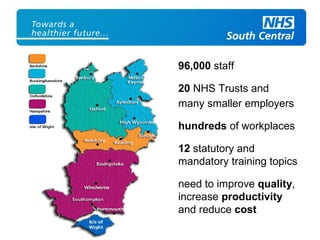
96,000 staff
20 NHS Trusts and
many smaller employers
hundreds of workplaces
12 statutory and
mandatory training topics
need to improve quality,
increase productivity
and reduce cost
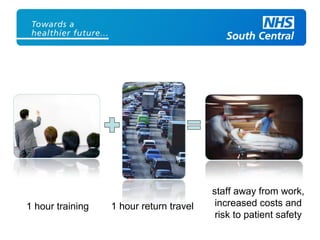
1 hour training 1 hour return travel
staff away from work,
increased costs and
risk to patient safety
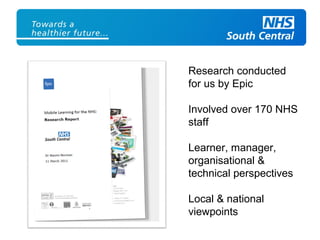
Research conducted
for us by Epic
Involved over 170 NHS
staff
Learner, manager,
organisational &
technical perspectives
Local & national
viewpoints
27 benefits of
mobile learning
for the NHS
22 challenges for
mobile learning in
the NHS
Convenience
Choice
Control
Context
Confidence
Cost-effectiveness
Favoured by 80% managers and 75% practitioners
Younger staff most positive, older staff positive too
100% of respondents had a personal mobile phone,
62% had one issued by the NHS
Particular benefits for statutory and
mandatory training and assessment......
facts, principles and procedures
testing before, after, or instead of training
potential for updates and reminders
Comments from peer reviewers:
“This is an issue of real relevance because of the
massive increase in usability and uptake of mobile
devices....”
“These findings take us considerably further than
before in the professional and organisational
context of the NHS....”
“With mobile phone ownership nearly universal,
attitudes and expectations of mobile learning
being driven not by those inside organisations, but
by those of the wider social world – and
organisations must take this into account....”
Chris Davies, Head of
eLearning Research,
University of Oxford
John Traxler, Professor
of eLearning, University
of Wolverhampton
• Via online survey, focus groups & app store
• Some pointers for things to do differently BUT
• All users see benefits
• Many suggestions for other topics
• Much interest from other organisations
• Overwhelmingly positive feedback
• 40,000 downloads
Feedback
“This is BRILLIANT!!”
“A great app tackling an important subject in healthcare”
“Easy to navigate, clear graphics and explanations - I'm
really impressed! “
“There are so many apps out there which are just books in
electronic format, but this is interactive and engaging”
“If this is the future of learning, then I'm hooked!”
Feedback
Challenges – what challenges?
Feedback so far
High number of downloads
but
Low uptake of assessments in
pilot Trust
So where is
the NHS
going with
this?
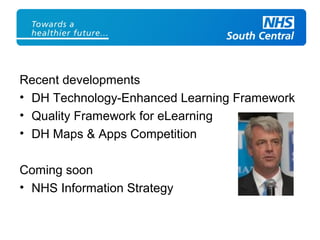
Recent developments
• DH Technology-Enhanced Learning Framework
• Quality Framework for eLearning
• DH Maps & Apps Competition
Coming soon
• NHS Information Strategy
And what will
NHS South
Central do
next?
Conclusions:
• Mobile learning will be important part of blend
• Mobile assessment has a clear role
• Potential for all staff, not just community based
• Challenges complex but not insurmountable
• Upfront costs but savings could be significant
• HUGE appetite!
Thank you!
helen.bingham@nesc.nhs.uk
research report and links for our apps available at:
www.workforce.southcentral.nhs.uk/libraries__elearning/e-learning.aspx

Bingham2012

  • 1.
    m-Learning for theNHS Workforce: research findings and the NHS South Central experience Helen Bingham, Library & eLearning Resources Manager helen.bingham@nesc.nhs.uk
  • 2.
    96,000 staff 20 NHSTrusts and many smaller employers hundreds of workplaces 12 statutory and mandatory training topics need to improve quality, increase productivity and reduce cost
  • 3.
    1 hour training1 hour return travel staff away from work, increased costs and risk to patient safety
  • 4.
    Research conducted for usby Epic Involved over 170 NHS staff Learner, manager, organisational & technical perspectives Local & national viewpoints
  • 5.
    27 benefits of mobilelearning for the NHS 22 challenges for mobile learning in the NHS
  • 6.
  • 7.
    Favoured by 80%managers and 75% practitioners Younger staff most positive, older staff positive too 100% of respondents had a personal mobile phone, 62% had one issued by the NHS
  • 8.
    Particular benefits forstatutory and mandatory training and assessment...... facts, principles and procedures testing before, after, or instead of training potential for updates and reminders
  • 13.
    Comments from peerreviewers: “This is an issue of real relevance because of the massive increase in usability and uptake of mobile devices....” “These findings take us considerably further than before in the professional and organisational context of the NHS....” “With mobile phone ownership nearly universal, attitudes and expectations of mobile learning being driven not by those inside organisations, but by those of the wider social world – and organisations must take this into account....” Chris Davies, Head of eLearning Research, University of Oxford John Traxler, Professor of eLearning, University of Wolverhampton
  • 17.
    • Via onlinesurvey, focus groups & app store • Some pointers for things to do differently BUT • All users see benefits • Many suggestions for other topics • Much interest from other organisations • Overwhelmingly positive feedback • 40,000 downloads Feedback
  • 18.
    “This is BRILLIANT!!” “Agreat app tackling an important subject in healthcare” “Easy to navigate, clear graphics and explanations - I'm really impressed! “ “There are so many apps out there which are just books in electronic format, but this is interactive and engaging” “If this is the future of learning, then I'm hooked!” Feedback
  • 19.
  • 21.
    Feedback so far Highnumber of downloads but Low uptake of assessments in pilot Trust
  • 22.
    So where is theNHS going with this?
  • 23.
    Recent developments • DHTechnology-Enhanced Learning Framework • Quality Framework for eLearning • DH Maps & Apps Competition Coming soon • NHS Information Strategy
  • 24.
    And what will NHSSouth Central do next?
  • 26.
    Conclusions: • Mobile learningwill be important part of blend • Mobile assessment has a clear role • Potential for all staff, not just community based • Challenges complex but not insurmountable • Upfront costs but savings could be significant • HUGE appetite!
  • 27.
    Thank you! helen.bingham@nesc.nhs.uk research reportand links for our apps available at: www.workforce.southcentral.nhs.uk/libraries__elearning/e-learning.aspx

Editor's Notes

  • #2 Different emphasis and perspective Focus of my presentation is about potential of learning via mobile device for NHS workforce – clinical education, leadership and management skills development, and, especially, stat/mand training Focus is not students - HEI colleagues – nor mobile access to point of care information/evidence/information about library services (though NHS libraries are getting involved in those areas) I have been invited to talk about results of research we commissioned, and our experience of developing apps Because students work with and become staff, no clear dividing line between apps for learning and information, and because our research firmly in context of NHS with which HEIs interface, hope will nevertheless be of interest
  • #3 Map of SC – facts and figures which explain why we are so interested in potential of mobile learning..... Large, mobile & diverse workforce Need to improve quality, increase productivity and reduce costs Burden of statutory and mandatory training Competence not attendance eLearning only part of the solution
  • #5 Research involved 130 randomly sampled practitioners and managers in 6 different job roles in 3 different Trusts, phone interviews/focus groups with strategic leads/technical experts, literature search, and review of existing NHS initiatives which use mobile devices
  • #6 Benefits for individuals and for organisations: For learners - flexibility, choice, convenience, wide reach and appeal, control of own learning, best use of time For clinical staff – timeliness, immediacy, opportunity to access learning via the same devices increasingly used for clinical tasks and point-of-care information For the NHS – efficiency, consistency, cost savings, improved care
  • #7 Convenience - Any time, including during down time – waiting for clinic, queuing for coffee Control – used to technology, no barrier – switched on, can take initiative Context – in relevant setting, at point of need Confidence – chunking down, in context, double-checking – mastery, retention
  • #9 We asked the researchers to look specifically at stat/mand training and assessment.....SC has S&M Training Framework and has recently developed competence assessments in each of areas.... facts, principles and procedures Good for multiple choice questions, audio and visual learning, immediate feedback Refresher training Testing knowledge prior to or after training Potential for communication - updates, reminders, remediation Evidence collection Cost saving for NHS, time-saving for staff
  • #10 Identified 22 challenges for mobile learning in the NHS, including: Lack of familiarity with using mobile devices for learning Small screen size, input limitations Security issues, devices easy to lose or steal Poor experience of eLearning converted to mobile learning Challenges – gaining buy-in, preventing cheating, tracking, keeping costs down Technical support and interfacing issues – platforms used in NHS, Wi-Fi limitations And made recommendations in relation to each of these.... Recommendations include, eg Design for small screen, design with offline capability and with learning assets on devices, provide training in use of devices, provide devices on loan, develop supportive HR policies, make available in PC format as welletc
  • #11 Identified 22 challenges for mobile learning in the NHS, including: Lack of familiarity with using mobile devices for learning Small screen size, input limitations Security issues, devices easy to lose or steal Poor experience of eLearning converted to mobile learning Challenges – gaining buy-in, preventing cheating, tracking, keeping costs down Technical support and interfacing issues – platforms used in NHS, Wi-Fi limitations And made recommendations in relation to each of these.... Recommendations include, eg Design for small screen, design with offline capability and with learning assets on devices, provide training in use of devices, provide devices on loan, develop supportive HR policies, make available in PC format as welletc
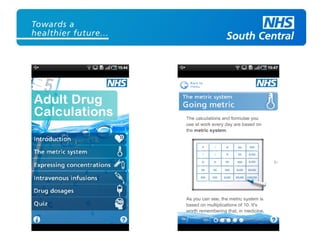
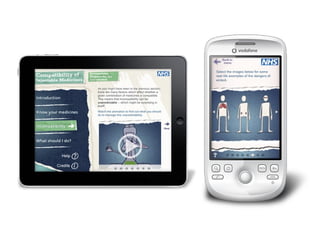
  • #15 Proof of concept project Important topics – reduction in medication errors Lend themselves to this type of learning – factual, revision, dip in and out Used previously developed content – quick production time Aimed primarily at nurses – esp newly qualified, returning to practice, adapting to practice in the UK Developed iPhone, iPad and Android versions – free to download
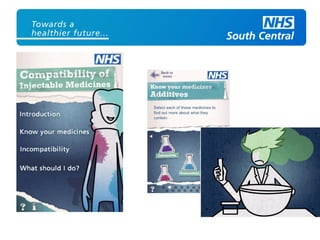
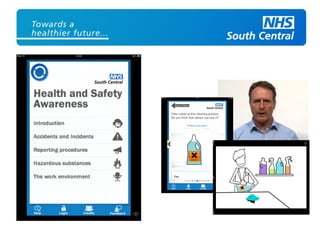
  • #16 40 mins learning, videos and quizzes COIM – graphics and animations
  • #18 Key points of feedback Make for blackberries please Record that we have done this Design tips – chunk down, trim text, think about revision cards (tap deeper), minimise downwards scrolling Keeping costs down – Blackberries (RIM op system), HTC (Android op system), iPhones (iOS
  • #20 Next project – stat mand – one of our key driver, re-inforced by user feedback – also wanted mobile learning to count, i.e. results to be tracked
  • #21 Much bigger challenge Starting point with content Need for engagement with variety of experts 40 mins learning – engaging, interactive – quizzes, graphics etc – videos, this time with real expert Plus assessment questions – bank for randomisation, testing all outcomes Plus tracking – two opportunities to pass – recorded on individual learning record on LMS Production challenges much greater Low uptake, despite publicity and interest – lack of smart phones (though library), patchy wireless, alternatives still available, lack of confidence
  • #24 Fast paced, fast growing and very crowded Tech advances, pilots turn into products, Trusts have more freedom over system implementations Most interest in Consumer e-health Mobile health working Regulation of the exploding number of apps NHS Choices, Mumsnet, charities like Macmillan, inform and empower patients with long-term conditions, find services, get fit, measure own blood pressure, access own data, etc - GPs prescribing apps Clinical decision support Mobile apps will be at the heart of the strategy – expected in Spring – Giles Wilmore, SRO
  • #26 Induction Performance support Decision support Dementia safeguarding
  • #27 I(especially in relation to tracking of completions and results)