Going Forwards: Realising the Potential
of M-Health Innovation
Dr Henry W W Potts
Centre for Health Informatics
& Multiprofessional
Education (CHIME), Institute
of Epidemiology & Health
Care, UCL
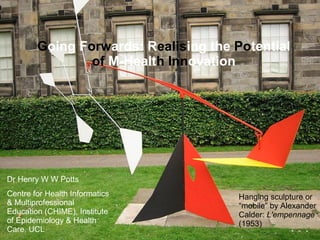
Hanging sculpture or
“mobile” by Alexander
Calder: L'empennage
(1953)
Mobile is here
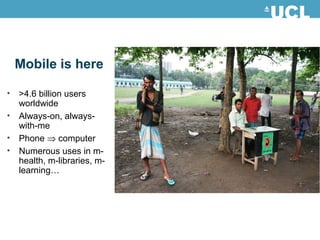
• >4.6 billion users
worldwide
• Always-on, always-
with-me
• Phone ⇒ computer
• Numerous uses in m-
health, m-libraries, m-
learning…
Participant
recruitment

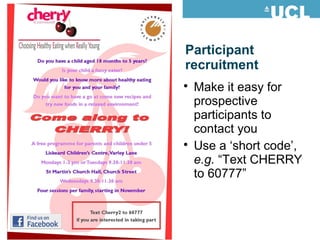
Make it easy for
prospective
participants to
contact you

Use a ‘short code’,
e.g. “Text CHERRY
to 60777”
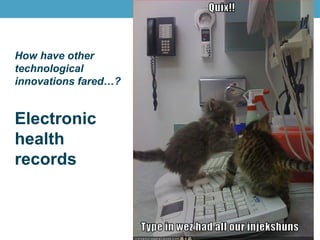
How have other
technological
innovations fared…?
Electronic
health
records
NHS Connecting for Health
Biggest civilian IT project in the world ever; many successes, however…
“few successful
deployments of
the scheme's
two main
hospital
systems […]”
“The delays are despite
the programme's having
spent £2.4bn by March
2007”
“Seven years after the launch of
the National Programme for IT in
the NHS, essential technology
does not meet the needs of
doctors, local cost estimates
are unreliable, many NHS staff
remain unenthusiastic, and the
programme’s future is far from
certain.”
“An NHS trust at
the forefront of
work on the £12.7bn
NHS IT scheme has
called in police
after a breach of
smartcard security
compromised the
confidentiality of
hundreds of
electronic
records.”
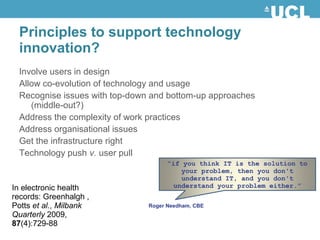
Involve users in design
Allow co-evolution of technology and usage
Recognise issues with top-down and bottom-up approaches
(middle-out?)
Address the complexity of work practices
Address organisational issues
Get the infrastructure right
Technology push v. user pull
Principles to support technology
innovation?
Roger Needham, CBE
“if you think IT is the solution to
your problem, then you don't
understand IT, and you don't
understand your problem either.”In electronic health
records: Greenhalgh ,
Potts et al., Milbank
Quarterly 2009,
87(4):729-88
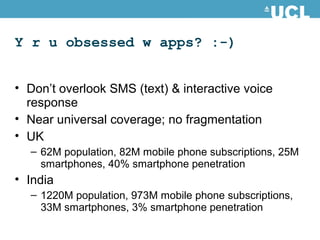
Y r u obsessed w apps? :-)
• Don’t overlook SMS (text) & interactive voice
response
• Near universal coverage; no fragmentation
• UK
– 62M population, 82M mobile phone subscriptions, 25M
smartphones, 40% smartphone penetration
• India
– 1220M population, 973M mobile phone subscriptions,
33M smartphones, 3% smartphone penetration
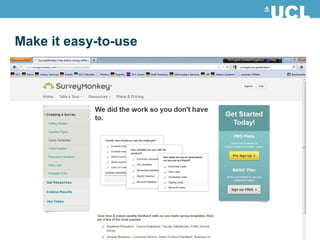
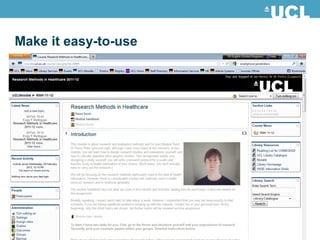
Make it easy-to-use
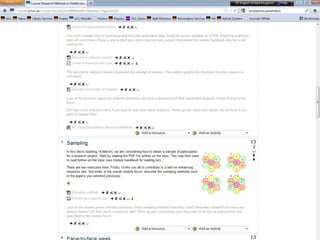
Make it easy-to-use
Money
• Unlike Internet, most mobile activities have to be
paid for
• What does the end user pay? What does the
institution pay?
• Long tail of usage
Guess the date
Advert in California newspaper that a certain
doctor “wishes to inform his patients and the public
that he may be summoned or consulted through
the telephone either by night or day. The
communication is made through the American
Speaking Telephone Company, and is absolutely
private and confidential.”
July 1878
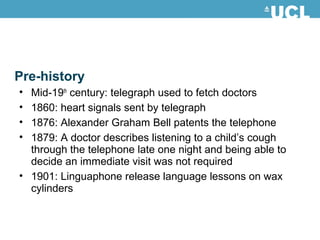
Pre-history
• Mid-19th
century: telegraph used to fetch doctors
• 1860: heart signals sent by telegraph
• 1876: Alexander Graham Bell patents the telephone
• 1879: A doctor describes listening to a child’s cough
through the telephone late one night and being able to
decide an immediate visit was not required
• 1901: Linguaphone release language lessons on wax
cylinders
Thank you
Dr Henry Potts: h.potts@ucl.ac.uk

Potts2012

  • 1.
    Going Forwards: Realisingthe Potential of M-Health Innovation Dr Henry W W Potts Centre for Health Informatics & Multiprofessional Education (CHIME), Institute of Epidemiology & Health Care, UCL Hanging sculpture or “mobile” by Alexander Calder: L'empennage (1953)
  • 2.
    Mobile is here •>4.6 billion users worldwide • Always-on, always- with-me • Phone ⇒ computer • Numerous uses in m- health, m-libraries, m- learning…
  • 3.
    Participant recruitment  Make it easyfor prospective participants to contact you  Use a ‘short code’, e.g. “Text CHERRY to 60777”
  • 4.
    How have other technological innovationsfared…? Electronic health records
  • 5.
    NHS Connecting forHealth Biggest civilian IT project in the world ever; many successes, however… “few successful deployments of the scheme's two main hospital systems […]” “The delays are despite the programme's having spent £2.4bn by March 2007” “Seven years after the launch of the National Programme for IT in the NHS, essential technology does not meet the needs of doctors, local cost estimates are unreliable, many NHS staff remain unenthusiastic, and the programme’s future is far from certain.” “An NHS trust at the forefront of work on the £12.7bn NHS IT scheme has called in police after a breach of smartcard security compromised the confidentiality of hundreds of electronic records.”
  • 6.
    Involve users indesign Allow co-evolution of technology and usage Recognise issues with top-down and bottom-up approaches (middle-out?) Address the complexity of work practices Address organisational issues Get the infrastructure right Technology push v. user pull Principles to support technology innovation? Roger Needham, CBE “if you think IT is the solution to your problem, then you don't understand IT, and you don't understand your problem either.”In electronic health records: Greenhalgh , Potts et al., Milbank Quarterly 2009, 87(4):729-88
  • 7.
    Y r uobsessed w apps? :-) • Don’t overlook SMS (text) & interactive voice response • Near universal coverage; no fragmentation • UK – 62M population, 82M mobile phone subscriptions, 25M smartphones, 40% smartphone penetration • India – 1220M population, 973M mobile phone subscriptions, 33M smartphones, 3% smartphone penetration
  • 8.
  • 9.
  • 11.
    Money • Unlike Internet,most mobile activities have to be paid for • What does the end user pay? What does the institution pay? • Long tail of usage
  • 12.
    Guess the date Advertin California newspaper that a certain doctor “wishes to inform his patients and the public that he may be summoned or consulted through the telephone either by night or day. The communication is made through the American Speaking Telephone Company, and is absolutely private and confidential.” July 1878
  • 13.
    Pre-history • Mid-19th century: telegraphused to fetch doctors • 1860: heart signals sent by telegraph • 1876: Alexander Graham Bell patents the telephone • 1879: A doctor describes listening to a child’s cough through the telephone late one night and being able to decide an immediate visit was not required • 1901: Linguaphone release language lessons on wax cylinders
  • 14.
    Thank you Dr HenryPotts: h.potts@ucl.ac.uk

Editor's Notes

  • #3 … but I’m sceptical. We’ve seen many interesting applications today, but grandiose, techno-utopian claims often fail to come true. I come from a background in health informatics and for many, many years we’ve heard grand claims for “e-health” and now for “m-health”, but let’s consider what’s happened.
  • #6 And I could tell you many more dramatic failures. Why is m-health/m-learning/m-libraries going to be any better? But I’m also relaxed because…
  • #7 Technology developers have worked from their assumptions (or policymakers' assumptions) and not understood what really happens in healthcare Imposed top-down solutions rather than working with clinical stakeholders with a bottom-up approach Failure to understand the necessary co-evolution of tech. innovation and work practices