HLISD
Health Library and Information
Services Directory
Julie Ryder March 2006
The Project
This initiative involves three
interested parties:
 HLG - Directory 11th
Edition 2002/3
 RCN - ‘Libraries for Nurses’ website
 NLH - My Library project
Coverage
Agreed that coverage would be the
same as the HLG Directory:
 All UK
 Republic of Ireland
 All sectors
Who is the Directory for?
It is for Library and Information Service Staff
It is for nurses and the whole range of people
working within the health sector
But also as a website it will be available to the
public, among whom will be the above groups,
maybe accessing remotely
Phase 1
 Inputting data from the two
directories
 Deletion of duplicates
 Establishment of a potential
network of editors
 Agreement on editing model
Phase 2
 Agreeing the data model
 Agreeing the branding and design of
front end
 Populating the database
 Rolling out editing to Network
Editors
 Going live
Summary Record – Web view
 Name of library
 Name of organisation
 Address; tel; fax; email
 Home page
 Sector
 Access Policy
 Opening times
 Directions
 Subject coverage
 Resources Overview
 Special Collections
 Additional Services
Show Full Record – Web view
 Key Contacts
 Classification
 Library Management
System
 Collaborative Networks
 Branches
 Library Code
 ILL Code
 (Athens ID not on web
view)
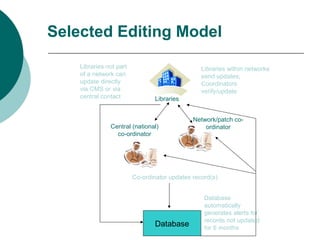
Selected Editing Model
Libraries
Co-ordinator updates record(s)
Database
Database
automatically
generates alerts for
records not updated
for 6 months
Libraries within networks
send updates;
Coordinators
verify/update
Libraries not part
of a network can
update directly
via CMS or via
central contact
Central (national)
co-ordinator
Network/patch co-
ordinator
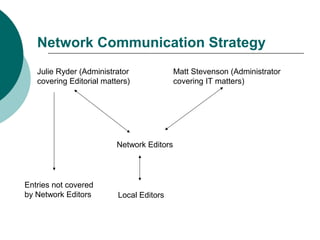
Network Communication Strategy
Julie Ryder (Administrator
covering Editorial matters)
Matt Stevenson (Administrator
covering IT matters)
Network Editors
Local Editors
Entries not covered
by Network Editors
Implementation working group
established
Pilot established with three
networks
 NHS Kent, Surrey, Sussex
 NHS North West
 NHS London
Current Stage
 Entries being allocated to
Networks
 Editors’ log ins arranged
 Entries to be rolled out to editors
 Editors to update entries on the
system
Allocating Entries
There are four elements to this:
• Comparing the pre-cursor database
with network directories
• New entries from your directories
• Negotiations on those entries in our
directory but not in yours
• Duplicates where entries are on two
of yours
Stages for data entry
Stage 1
 Basic fields from the old print
directory and the ‘Libraries for
nurses’ website will be added to the
entry: library name, organisation,
post code, address, tel, fax, email,
weblinks and Athens ID. Editors will
be asked to update those fields and
then the entry can go live
Stage 2
 The rest of the fields to be added
when possible
Editing Screens - currently
The Web view and Front end are in
development at present.
We will be moving into the Sharepoint
Environment in April.
Various search options will be
available – including keyword, map
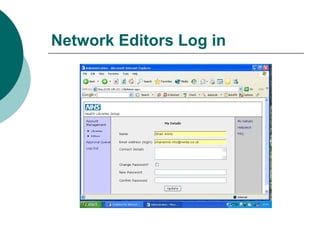
Network Editors Log in
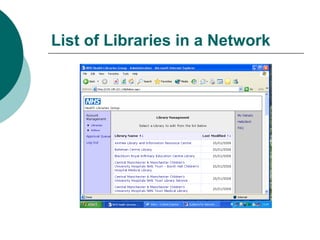
List of Libraries in a Network
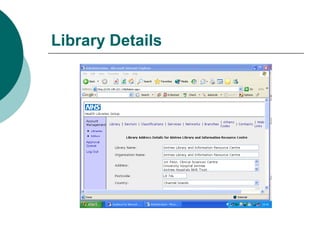
Library Details
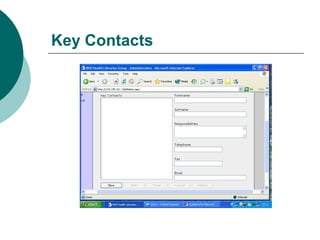
Key Contacts
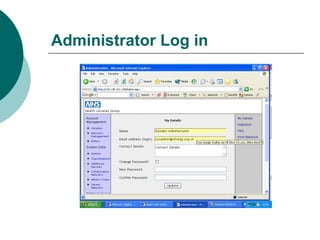
Administrator Log in
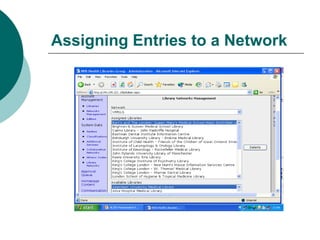
Assigning Entries to a Network
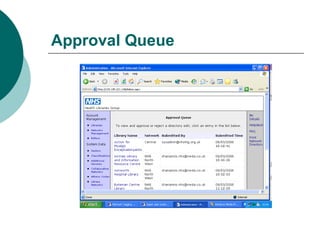
Approval Queue
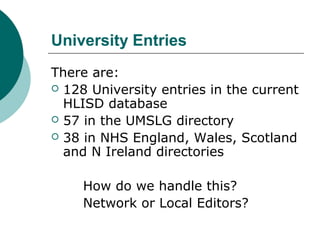
University Entries
There are:
 128 University entries in the current
HLISD database
 57 in the UMSLG directory
 38 in NHS England, Wales, Scotland
and N Ireland directories
How do we handle this?
Network or Local Editors?
To sum up
We’ve discussed :
 Who the Directory is for
 The workflow for Editors
 The allocation of entries
 Questions to be resolved for
University entries

Ryder2006

  • 1.
    HLISD Health Library andInformation Services Directory Julie Ryder March 2006
  • 2.
    The Project This initiativeinvolves three interested parties:  HLG - Directory 11th Edition 2002/3  RCN - ‘Libraries for Nurses’ website  NLH - My Library project
  • 3.
    Coverage Agreed that coveragewould be the same as the HLG Directory:  All UK  Republic of Ireland  All sectors
  • 4.
    Who is theDirectory for? It is for Library and Information Service Staff It is for nurses and the whole range of people working within the health sector But also as a website it will be available to the public, among whom will be the above groups, maybe accessing remotely
  • 5.
    Phase 1  Inputtingdata from the two directories  Deletion of duplicates  Establishment of a potential network of editors  Agreement on editing model
  • 6.
    Phase 2  Agreeingthe data model  Agreeing the branding and design of front end  Populating the database  Rolling out editing to Network Editors  Going live
  • 7.
    Summary Record –Web view  Name of library  Name of organisation  Address; tel; fax; email  Home page  Sector  Access Policy  Opening times  Directions  Subject coverage  Resources Overview  Special Collections  Additional Services
  • 8.
    Show Full Record– Web view  Key Contacts  Classification  Library Management System  Collaborative Networks  Branches  Library Code  ILL Code  (Athens ID not on web view)
  • 9.
    Selected Editing Model Libraries Co-ordinatorupdates record(s) Database Database automatically generates alerts for records not updated for 6 months Libraries within networks send updates; Coordinators verify/update Libraries not part of a network can update directly via CMS or via central contact Central (national) co-ordinator Network/patch co- ordinator
  • 10.
    Network Communication Strategy JulieRyder (Administrator covering Editorial matters) Matt Stevenson (Administrator covering IT matters) Network Editors Local Editors Entries not covered by Network Editors
  • 11.
    Implementation working group established Pilotestablished with three networks  NHS Kent, Surrey, Sussex  NHS North West  NHS London
  • 12.
    Current Stage  Entriesbeing allocated to Networks  Editors’ log ins arranged  Entries to be rolled out to editors  Editors to update entries on the system
  • 13.
    Allocating Entries There arefour elements to this: • Comparing the pre-cursor database with network directories • New entries from your directories • Negotiations on those entries in our directory but not in yours • Duplicates where entries are on two of yours
  • 14.
    Stages for dataentry Stage 1  Basic fields from the old print directory and the ‘Libraries for nurses’ website will be added to the entry: library name, organisation, post code, address, tel, fax, email, weblinks and Athens ID. Editors will be asked to update those fields and then the entry can go live Stage 2  The rest of the fields to be added when possible
  • 15.
    Editing Screens -currently The Web view and Front end are in development at present. We will be moving into the Sharepoint Environment in April. Various search options will be available – including keyword, map
  • 16.
  • 17.
    List of Librariesin a Network
  • 18.
  • 19.
  • 20.
  • 21.
  • 22.
  • 23.
    University Entries There are: 128 University entries in the current HLISD database  57 in the UMSLG directory  38 in NHS England, Wales, Scotland and N Ireland directories How do we handle this? Network or Local Editors?
  • 24.
    To sum up We’vediscussed :  Who the Directory is for  The workflow for Editors  The allocation of entries  Questions to be resolved for University entries

Editor's Notes

  • #5 The printed directory was for LIS staff. Libraries for Nurses website obviously for nurses Now it will be visible to anyone, so we needed to think about the implications of that.
  • #8 The fields were agreed at two workshops in March last year. We decided that, rather than having different views for different users, we would have one view for all. But that we’d have a summary record which will be effectively page 1 for the general fields. To get to the more librariany fields you would go to the full record
  • #11 This is the internal communication strategy. We will also publicize the directory to HLIS staff. Thought needs to be given later on about publicizing beyond that.
  • #13 Entries to be allocated to pilots – London, KSS, North West – February/March. The rest by March, maybe a few earlier. May be in tranches- obvious first. Once editors know, if you wish you can start gathering updated info. We have produced a form. Anticipated thatby March the Editors’ Log in will be arranged, entries lists will be sent and editors will be able to update basic fields. New entries/Full Records will be added from March/April and will be ongoing
  • #14 I’ve been doing a lot of work on this. 1st – where there’s a match the entry will be allocated to the network for updating 2nd – New entries will be added by a Super User and allocated to you 3rd – If entries don’t fit anywhere a Super User will take responsibility for them. 4th – Overlaps in two directories (Sometimes in 1 directory!) Often NHS covering academic entries. An initial allocation will be made but it will not be set in stone.
  • #15 We will transfer basic contact details and they could be updated first. Then the entry can go live. After that the rest can be added at any time.
  • #25 Sum up …. Now we can have a look at the basic system that has been developed. It’s dummy data so safe to play with!