
Taking forward
Information Sharing
Health Insights June – July 2106
David Waller
Interoperability Engagement Lead, NHS England
Strategic context
Breaking down “interoperability”
What this means for professionals and citizens
Current priorities
Working in conjunction with localities and the market
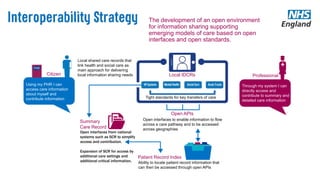
The development of an open environment
for information sharing supporting
emerging models of care based on open
interfaces and open standards.
Open APIs
Open interfaces to enable information to flow
across a care pathway and to be accessed
across geographies
Local shared care records that
link health and social care as
main approach for delivering
local information sharing needs
Tight standards for key transfers of care
Local IDCRs Professional
Through my system I can
directly access and
contribute to summary and
detailed care information
Citizen
Using my PHR I can
access care information
about myself and
contribute information
PHR
Patient Record Index
Ability to locate patient record information that
can then be accessed through open APIs
Open interfaces from national
systems such as SCR to simplify
access and contribution.
Expansion of SCR for access by
additional care settings and
additional critical information.
Summary
Care Record
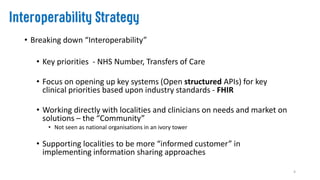
• Breaking down “Interoperability”
• Key priorities - NHS Number, Transfers of Care
• Focus on opening up key systems (Open structured APIs) for key
clinical priorities based upon industry standards - FHIR
• Working directly with localities and clinicians on needs and market on
solutions – the “Community”
• Not seen as national organisations in an ivory tower
• Supporting localities to be more “informed customer” in
implementing information sharing approaches
4
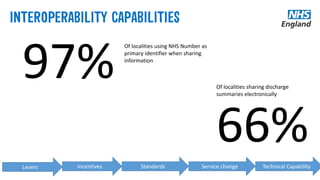
97%
Of localities using NHS Number as
primary identifier when sharing
information
66%
Of localities sharing discharge
summaries electronically
StandardsLevers Incentives Service change Technical Capability
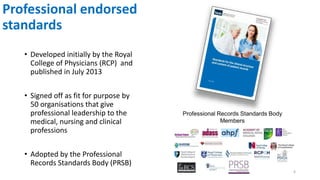
Professional endorsed
standards
• Developed initially by the Royal
College of Physicians (RCP) and
published in July 2013
• Signed off as fit for purpose by
50 organisations that give
professional leadership to the
medical, nursing and clinical
professions
• Adopted by the Professional
Records Standards Body (PRSB)
6
7
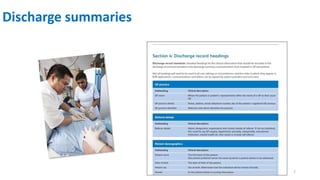
Discharge summaries
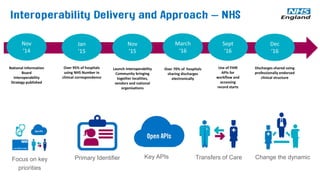
Nov
2015
March
‘16
National Information
Board
Interoperability
Strategy published
Over 95% of hospitals
using NHS Number in
clinical correspondence
Launch Interoperability
Community bringing
together localities,
vendors and national
organisations
Over 70% of hospitals
sharing discharges
electronically
Use of FHIR
APIs for
workflow and
accessing
record starts
Discharges shared using
professionally endorsed
clinical structure
Key APIs Transfers of CarePrimary IdentifierFocus on key
priorities
Change the dynamic
Nov
‘15
Jan
‘15
Nov
‘14
Sept
‘16
Dec
‘16
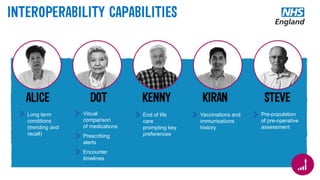
End of life
care
prompting key
preferences
Vaccinations and
immunisations
history
Visual
comparison
of medications
Prescribing
alerts
Encounter
timelines
Long term
conditions
(trending and
recall)
Pre-population
of pre-operative
assessment
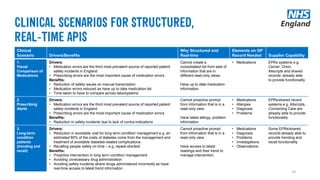
Clinical
Scenario Drivers/Benefits
Why Structured and
Real-time
Elements on GP
Record Needed Supplier Capability
1.
Visual
Comparison of
Medications
Drivers:
• Medication errors are the third most prevalent source of reported patient
safety incidents in England
• Prescribing errors are the most important cause of medication errors
Benefits:
• Reduction of safety issues on manual transcription
• Medication errors reduced as have up to date medication list
• Time taken to have to compare across tabs/systems
Cannot create a
consolidated list from sets of
information that are in
different read-only views.
Have up to date medication
information.
• Medications EPRs systems e.g.
Cerner, Orion,
Allscripts and shared
records already able
to provide functionality
2.
Prescribing
Alerts
Drivers:
• Medication errors are the third most prevalent source of reported patient
safety incidents in England
• Prescribing errors are the most important cause of medication errors
Benefits:
• Reduction in safety incidents due to lack of contra-indications
Cannot proactive prompt
from information that is in a
read-only view.
Have latest allergy, problem
information
• Medications
• Allergies
• Diagnosis
• Problems
EPRs/shared record
systems e.g. Allscripts,
Connecting Care are
already able to provide
functionality
3.
Long-term
condition
patients
(trending and
recall)
Drivers:
• Reduction in avoidable cost for long term condition management e.g. an
estimated 80% of the costs of diabetes come from the management and
treatment of avoidable diabetes-related complications
• Recalling people safely on time – e.g. repeat obs/test
Benefits:
• Proactive intervention in long term condition management
• Avoiding unnecessary drug administration
• Avoiding safety incidents where drugs administered incorrectly as have
real-time access to latest trend information
Cannot proactive prompt
from information that is in a
read-only view.
Have access to latest
readings and their trend to
manage intervention.
• Medications
• Diagnosis
• Problems
• Investigations
• Observations
Some EPRs/shared
records already able to
provide trending and
recall functionality
10
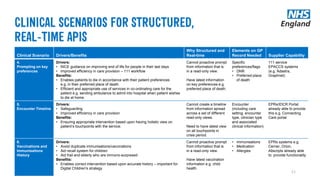
Clinical Scenario Drivers/Benefits
Why Structured and
Real-time
Elements on GP
Record Needed Supplier Capability
4.
Prompting on key
preferences
Drivers:
• NICE guidance on improving end of life for people in their last days
• Improved efficiency in care provision – 111 workflow
Benefits:
• Enables patients to die in accordance with their patient preferences
e.g. in their preferred place of death.
• Efficient and appropriate use of services in co-ordinating care for the
patient e.g. sending ambulance to admit into hospital when patient wishes
to die at home.
Cannot proactive prompt
from information that is
in a read-only view.
Have latest information
on key preferences e.g.
preferred place of death.
Specific
preferences/flags
• DNR
• Preferred place
of death
111 service
EPACCS systems
(e.g. Adastra,
Graphnet)
5.
Encounter Timeline
Drivers:
• Safeguarding
• Improved efficiency in care provision
Benefits:
• Ensuring appropriate intervention based upon having holistic view on
patient’s touchpoints with the service.
Cannot create a timeline
from information spread
across a set of different
read-only views.
Need to have latest view
on all touchpoints in
crisis period.
Encounter
(including care
setting, encounter
type, clinician type
and associated
clinical information)
EPRs/IDCR Portal
already able to provide
this e.g. Connecting
Care portal
6.
Vaccinations and
Immunisations
History
Drivers:
• Avoid duplicate immunisations/vaccinations
• Aid recall system for children
• Aid frail and elderly who are immuno-surpresed
Benefits:
• Enables correct intervention based upon accurate history – important for
Digital Children's strategy
Cannot proactive prompt
from information that is
in a read-only view.
Have latest vaccination
information e.g. child
health.
• Immunisations
• Medication
• Allergies
EPRs systems e.g.
Cerner, Orion,
Allscripts already able
to provide functionality
11
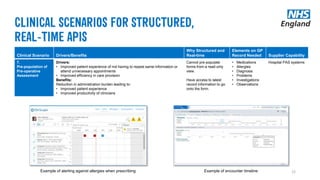
Clinical Scenario Drivers/Benefits
Why Structured and
Real-time
Elements on GP
Record Needed Supplier Capability
7.
Pre-population of
Pre-operative
Assessment
Drivers:
• Improved patient experience of not having to repeat same information or
attend unnecessary appointments
• Improved efficiency in care provision
Benefits:
Reduction in administration burden leading to:
• Improved patient experience
• Improved productivity of clinicians
Cannot pre-populate
forms from a read-only
view.
Have access to latest
record information to go
onto the form.
• Medications
• Allergies
• Diagnosis
• Problems
• Investigations
• Observations
Hospital PAS systems
Example of alerting against allergies when prescribing Example of encounter timeline 12
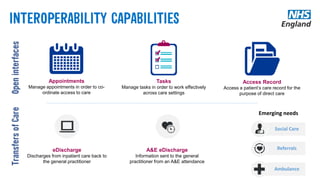
Appointments
Manage appointments in order to co-
ordinate access to care
Access Record
Access a patient’s care record for the
purpose of direct care
Tasks
Manage tasks in order to work effectively
across care settings
eDischarge
Discharges from inpatient care back to
the general practitioner
A&E eDischarge
Information sent to the general
practitioner from an A&E attendance
Ambulance
Social Care
Referrals
Emerging needs
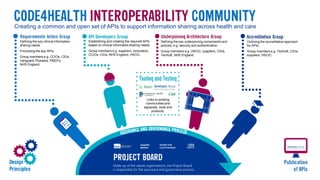
Creating a common and open set of APIs to support information sharing across health and care
Defining the key clinical information
sharing needs.
Prioritising the key APIs.
Group members e.g. CCIOs, CIOs,
Vanguard, Pioneers, PMCFs,
NHS England.
Outlining the accreditation approach
for APIs.
Group members e.g. TechUK, CIOs,
suppliers, HSCIC.
Defining the key underpinning components and
policies, e.g. security and authentication.
Group members e.g. HSCIC, suppliers, CIOs,
TechUK, NHS England.
Establishing and creating the required APIs
based on clinical information sharing needs.
Group members e.g. suppliers, innovators,
CCIOs, CIOs, NHS England, HSCIC.
Made up of the above organisations, the Project Board
is responsible for the assurance and governance process.
Links to existing
communities and
signposts tools and
products.
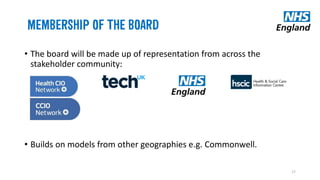
• The board will be made up of representation from across the
stakeholder community:
• Builds on models from other geographies e.g. Commonwell.
17
David Waller Interoperability Engagement Lead, NHS England

David Waller Interoperability Engagement Lead, NHS England

  • 1.
    Taking forward Information Sharing HealthInsights June – July 2106 David Waller Interoperability Engagement Lead, NHS England
  • 2.
    Strategic context Breaking down“interoperability” What this means for professionals and citizens Current priorities Working in conjunction with localities and the market
  • 3.
    The development ofan open environment for information sharing supporting emerging models of care based on open interfaces and open standards. Open APIs Open interfaces to enable information to flow across a care pathway and to be accessed across geographies Local shared care records that link health and social care as main approach for delivering local information sharing needs Tight standards for key transfers of care Local IDCRs Professional Through my system I can directly access and contribute to summary and detailed care information Citizen Using my PHR I can access care information about myself and contribute information PHR Patient Record Index Ability to locate patient record information that can then be accessed through open APIs Open interfaces from national systems such as SCR to simplify access and contribution. Expansion of SCR for access by additional care settings and additional critical information. Summary Care Record
  • 4.
    • Breaking down“Interoperability” • Key priorities - NHS Number, Transfers of Care • Focus on opening up key systems (Open structured APIs) for key clinical priorities based upon industry standards - FHIR • Working directly with localities and clinicians on needs and market on solutions – the “Community” • Not seen as national organisations in an ivory tower • Supporting localities to be more “informed customer” in implementing information sharing approaches 4
  • 5.
    97% Of localities usingNHS Number as primary identifier when sharing information 66% Of localities sharing discharge summaries electronically StandardsLevers Incentives Service change Technical Capability
  • 6.
    Professional endorsed standards • Developedinitially by the Royal College of Physicians (RCP) and published in July 2013 • Signed off as fit for purpose by 50 organisations that give professional leadership to the medical, nursing and clinical professions • Adopted by the Professional Records Standards Body (PRSB) 6
  • 7.
  • 8.
    Nov 2015 March ‘16 National Information Board Interoperability Strategy published Over95% of hospitals using NHS Number in clinical correspondence Launch Interoperability Community bringing together localities, vendors and national organisations Over 70% of hospitals sharing discharges electronically Use of FHIR APIs for workflow and accessing record starts Discharges shared using professionally endorsed clinical structure Key APIs Transfers of CarePrimary IdentifierFocus on key priorities Change the dynamic Nov ‘15 Jan ‘15 Nov ‘14 Sept ‘16 Dec ‘16
  • 9.
    End of life care promptingkey preferences Vaccinations and immunisations history Visual comparison of medications Prescribing alerts Encounter timelines Long term conditions (trending and recall) Pre-population of pre-operative assessment
  • 10.
    Clinical Scenario Drivers/Benefits Why Structuredand Real-time Elements on GP Record Needed Supplier Capability 1. Visual Comparison of Medications Drivers: • Medication errors are the third most prevalent source of reported patient safety incidents in England • Prescribing errors are the most important cause of medication errors Benefits: • Reduction of safety issues on manual transcription • Medication errors reduced as have up to date medication list • Time taken to have to compare across tabs/systems Cannot create a consolidated list from sets of information that are in different read-only views. Have up to date medication information. • Medications EPRs systems e.g. Cerner, Orion, Allscripts and shared records already able to provide functionality 2. Prescribing Alerts Drivers: • Medication errors are the third most prevalent source of reported patient safety incidents in England • Prescribing errors are the most important cause of medication errors Benefits: • Reduction in safety incidents due to lack of contra-indications Cannot proactive prompt from information that is in a read-only view. Have latest allergy, problem information • Medications • Allergies • Diagnosis • Problems EPRs/shared record systems e.g. Allscripts, Connecting Care are already able to provide functionality 3. Long-term condition patients (trending and recall) Drivers: • Reduction in avoidable cost for long term condition management e.g. an estimated 80% of the costs of diabetes come from the management and treatment of avoidable diabetes-related complications • Recalling people safely on time – e.g. repeat obs/test Benefits: • Proactive intervention in long term condition management • Avoiding unnecessary drug administration • Avoiding safety incidents where drugs administered incorrectly as have real-time access to latest trend information Cannot proactive prompt from information that is in a read-only view. Have access to latest readings and their trend to manage intervention. • Medications • Diagnosis • Problems • Investigations • Observations Some EPRs/shared records already able to provide trending and recall functionality 10
  • 11.
    Clinical Scenario Drivers/Benefits WhyStructured and Real-time Elements on GP Record Needed Supplier Capability 4. Prompting on key preferences Drivers: • NICE guidance on improving end of life for people in their last days • Improved efficiency in care provision – 111 workflow Benefits: • Enables patients to die in accordance with their patient preferences e.g. in their preferred place of death. • Efficient and appropriate use of services in co-ordinating care for the patient e.g. sending ambulance to admit into hospital when patient wishes to die at home. Cannot proactive prompt from information that is in a read-only view. Have latest information on key preferences e.g. preferred place of death. Specific preferences/flags • DNR • Preferred place of death 111 service EPACCS systems (e.g. Adastra, Graphnet) 5. Encounter Timeline Drivers: • Safeguarding • Improved efficiency in care provision Benefits: • Ensuring appropriate intervention based upon having holistic view on patient’s touchpoints with the service. Cannot create a timeline from information spread across a set of different read-only views. Need to have latest view on all touchpoints in crisis period. Encounter (including care setting, encounter type, clinician type and associated clinical information) EPRs/IDCR Portal already able to provide this e.g. Connecting Care portal 6. Vaccinations and Immunisations History Drivers: • Avoid duplicate immunisations/vaccinations • Aid recall system for children • Aid frail and elderly who are immuno-surpresed Benefits: • Enables correct intervention based upon accurate history – important for Digital Children's strategy Cannot proactive prompt from information that is in a read-only view. Have latest vaccination information e.g. child health. • Immunisations • Medication • Allergies EPRs systems e.g. Cerner, Orion, Allscripts already able to provide functionality 11
  • 12.
    Clinical Scenario Drivers/Benefits WhyStructured and Real-time Elements on GP Record Needed Supplier Capability 7. Pre-population of Pre-operative Assessment Drivers: • Improved patient experience of not having to repeat same information or attend unnecessary appointments • Improved efficiency in care provision Benefits: Reduction in administration burden leading to: • Improved patient experience • Improved productivity of clinicians Cannot pre-populate forms from a read-only view. Have access to latest record information to go onto the form. • Medications • Allergies • Diagnosis • Problems • Investigations • Observations Hospital PAS systems Example of alerting against allergies when prescribing Example of encounter timeline 12
  • 13.
    Appointments Manage appointments inorder to co- ordinate access to care Access Record Access a patient’s care record for the purpose of direct care Tasks Manage tasks in order to work effectively across care settings eDischarge Discharges from inpatient care back to the general practitioner A&E eDischarge Information sent to the general practitioner from an A&E attendance Ambulance Social Care Referrals Emerging needs
  • 14.
    Creating a commonand open set of APIs to support information sharing across health and care Defining the key clinical information sharing needs. Prioritising the key APIs. Group members e.g. CCIOs, CIOs, Vanguard, Pioneers, PMCFs, NHS England. Outlining the accreditation approach for APIs. Group members e.g. TechUK, CIOs, suppliers, HSCIC. Defining the key underpinning components and policies, e.g. security and authentication. Group members e.g. HSCIC, suppliers, CIOs, TechUK, NHS England. Establishing and creating the required APIs based on clinical information sharing needs. Group members e.g. suppliers, innovators, CCIOs, CIOs, NHS England, HSCIC. Made up of the above organisations, the Project Board is responsible for the assurance and governance process. Links to existing communities and signposts tools and products.
  • 15.
    • The boardwill be made up of representation from across the stakeholder community: • Builds on models from other geographies e.g. Commonwell. 17

Editor's Notes

  • #4 Strategy supports emerging models of care (care is the important bit) with an OPEN environment based on OPEN interfaces and OPEN standards. At the core sits local shared records for health and social care. (IDCR - Integrated Digital Care Record) Tight standards for transfers of care. Open APIs for information flow across care pathways and geographies, function and location. (API – Application Programming Interface) Shared records need to be found, hence the Patient Record Index. ‘Local’ is crucial but it’s not all there is. National systems are still relevant, e.g. SCR is being expanded, Child Protection and FGM flags. Open interfaces will enable them to contribute into local systems. It’s not all about technology though. If it’s not used then it’s a waste. Professionals access and contribute, build knowledge, inform decisions. Patients access and contribute, build knowledge, inform decisions. (PHR Personal Health Record)
  • #5 Key priorities NHS Number is the primary identifier Transfers of care is a crucial use of shared information Opening key systems STRUCTURED APIs for consistency, efficiency in systems development and use Standards such as FHIR (FHIR – Fast Healthcare Interoperability Resources from HL7 Health Level 7) Working as a community Localities and clinicians for needs, market for solutions, all in a fluid process. This isn’t shuttle diplomacy bwtween two sides. Sharing the knowledge so we all become better informed customers.
  • #6 Where we sit at the moment. Numbers from the Digital Maturity assessments. 97% using NHS number as the primary identifier. But only 66% using electronic discharge summaries. What does this need? Levers – NHS Standard Contract Incentives – funding, central support Standards Service Change – Vanguards, Pioneers, etc. Technical Capability – ther market, in-house development
  • #7 Association of Medical Royal Colleges (AoMRC) Standards These are clinical, not technical standards, created by the clinical professions. PRSB members cover a wide span of experience.
  • #8 AoMRC discharge summary headings are a practical example of the standards in use. By 1st December 2016 the inpatient and daycase summaries must be aligned with AoMRC headers (the lever of the National Contract) because this raises the quality of the information shared on discharge, with all the patient safety and experience and productivity benefits this will deliver.
  • #9 Timeline – here’s what we’ve delivered to March 16 95% hospitals use NHS number in their clinical correspondence 70% hospitals sharing discharges electronically Expectations to come – FHIR for workflow, AoMRC headers in discharge summaries. The approach that underlies it Focus – NIB Primary identifier – NHS Number Key APIs Transfers of Care Change the dynamic – patient involvement, models of care, informed customers
  • #10 When it comes to identifying needs, storyboards help set the context and define the use-cases. We’ve developed a number of patient stories to inject a bit of reality into the process of selecting the APIs. E.G. Dot gets admitted with a chest infection. Without shared info, her allergy to the anti-biotic isn’t spotted until too late. With shared info, it is.
  • #11 I appreciate you can’t read these next slides at the back of the room. Points to note are: The scenario – Visual comparison of meds, Dot and her anti-biotic. Driver – why something must be done, meds errors Why structured? – to make a consolidated list Elements – meds, we don’t need everything every time Capability – who can do this now
  • #12 Other scenarios from the stories
  • #13 A couple of screen-shots to illustrate the capability.
  • #16 Open interfaces – where we’re working Appointments – patient apps, referrals Tasks – workflow, handovers Access – making informed clinical decisions Transfers of care eDischarge, already mentioned inpatient and Daycase summaries, AoMRC headings A&E discharge, in this year’s Standard Contract Emerging needs Social care, we all know it’s about health and social care these days, we have to ‘interop’ with non-NHS bodies Referrals, integrated care, handovers between providers on the patient pathway Ambulance, knowing the patient in urgent care, sharing in a wider patch than the localities.
  • #17 The Community has been up since Nov 15 and is growing. It’s got various groups within it. Requirements – spotting the needs, identifying the priorities Developers – creating the APIs that meet the needs Architecture – the underpinning components and policies Accreditation – maintaining the quality It’s where we collaborate on design principles and publish APIs. It links out to other communities to spread the sharing.
  • #18 We’re keen that the Community is run by the community. The Board that controls it is made up from a wide variety of stakeholders. It’s chaired by a CIO, Luke Readman.
  • #19 As it says, to find out more, follow the link. Please take the opportunity to have a look and register. The more people who join in, the better the results. Thank you.