Marketing Strategy
ITTEHAD CHEMICALS
GROW YOUR
BUSINESS
1
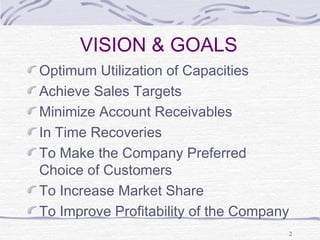
VISION & GOALS
Optimum Utilization of Capacities
Achieve Sales Targets
Minimize Account Receivables
In Time Recoveries
To Make the Company Preferred
Choice of Customers
To Increase Market Share
To Improve Profitability of the Company
2
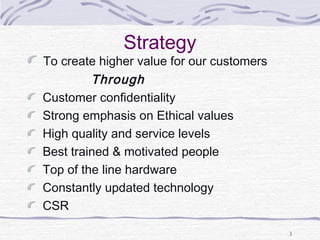
Strategy
To create higher value for our customers
Through
Customer confidentiality
Strong emphasis on Ethical values
High quality and service levels
Best trained & motivated people
Top of the line hardware
Constantly updated technology
CSR
3
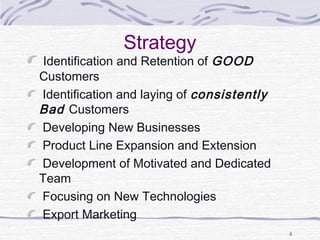
Strategy
Identification and Retention of GOOD
Customers
Identification and laying of consistently
Bad Customers
Developing New Businesses
Product Line Expansion and Extension
Development of Motivated and Dedicated
Team
Focusing on New Technologies
Export Marketing
4
Strategy
Strong Relationship Building with Customers
and Suppliers
Meeting the Delivery Commitments
Meeting the Quality Parameters
Extensive knowledge of Market
Awareness of Competitor Activities
Training and Grooming of Marketing & Sales
Team
5
Growth Strategy
The most fruitful growth area is often to increase
product usage within the existing product market,
where assets and competencies are in place and
only need to be leveraged. Growth within a product
market can involve adding product features, new-
generation products, expansion of the product scope,
or new products
Developing new products, a second route to growth,
can involve line extensions, expanded product scope,
or new generation products.
6
Growth Strategy
• A third growth route, market development, involves
expanding the market either geographically or by
targeting new market segments
• A key consideration of any growth strategy is how to
achieve synergy by leveraging current assets and
competencies
• Vertical integration, another growth direction, can
provide access to supply or demand, control of the
quality of the product or service, and entry into an
attractive business area. It also, however, introduces
the risks of managing a very different business and
reducing strategy flexibility 7
Growth Strategy
• Outsourcing rather than vertical integration makes it
easier to change strategic direction in response to
threats and pressures for the market.
• Growth can be achieved with incremental growth
strategies, significant growth initiatives, or big ideas.
All businesses should strive to uncover and
implement big ideas, because they are usually the
source of breakthrough strategies.
8
Good Customers
In time Payment
Recognition of Partnership Concept
Regular ordering and lifting of Materials
Appreciative of Support of Supplier
9
Planned Growth
New markets are selected strategically
New employees are planned in
anticipation of new markets
New lines of business are not started
unless they meet with stated plans and
goals
Owner manager focus on leadership &
entrepreneurship
10
Planned Growth
• Business has expanding sales and
profits
• Business has enough cash at the end
of each month
• Customer orders always delivered on
time
• Inventory levels are appropriate for
service levels
11
principal growth directions a business should
take through marketing strategies
Market Penetration: sell more of the same products in
existing markets, either by way of increasing market
share or product usage.
Market Development: sell more of the same products
to markets locally or abroad. When aim for new markets,
either focus on untapped segments in existing markets, or
on new markets.
Product Development: sell new products to existing
markets. This entails developing new products or refining /
upgrading existing products.
Product Diversification – sell new products to new
markets, typically by setting up a new business or taking
stake in an existing business.
12
main sources of thrust that drive business
growth
To drive growth, a business strategy emphasizes on:
(a) Differentiation: The business aims at expanding
sales by distinguishing one’s offer more clearly from
competing substitutes, e.g., branding product to give it
some special features that make it unique in the eyes of
the customers.
(b) Focus: The business aims at expanding sales by (re)
positioning one’s offer in a particular market segment
thought of as highly attractive, e.g., entering a high
potential export market with existing product.
(c) Cost: Business aim at expanding sales by
undercutting prices of competitors. The option requires to
have a cost advantage.
13
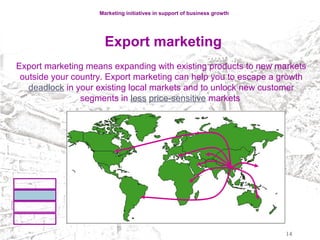
Marketing initiatives in support of business growth
Export marketing
Export marketing means expanding with existing products to new markets
outside your country. Export marketing can help you to escape a growth
deadlock in your existing local markets and to unlock new customer
segments in less price-sensitive markets
14
The Most valuable assets of
the 21st
c. institution will be
the knowledge worker and
their productivity
15
“Drive the business or it will drive
thee.”
- Benjamin Franklin
“The risk of a wrong decision is
preferable to the terror of
indecision.”
- Maimondies
16

Marketing Strategy - ICL

  • 1.
  • 2.
    VISION & GOALS OptimumUtilization of Capacities Achieve Sales Targets Minimize Account Receivables In Time Recoveries To Make the Company Preferred Choice of Customers To Increase Market Share To Improve Profitability of the Company 2
  • 3.
    Strategy To create highervalue for our customers Through Customer confidentiality Strong emphasis on Ethical values High quality and service levels Best trained & motivated people Top of the line hardware Constantly updated technology CSR 3
  • 4.
    Strategy Identification and Retentionof GOOD Customers Identification and laying of consistently Bad Customers Developing New Businesses Product Line Expansion and Extension Development of Motivated and Dedicated Team Focusing on New Technologies Export Marketing 4
  • 5.
    Strategy Strong Relationship Buildingwith Customers and Suppliers Meeting the Delivery Commitments Meeting the Quality Parameters Extensive knowledge of Market Awareness of Competitor Activities Training and Grooming of Marketing & Sales Team 5
  • 6.
    Growth Strategy The mostfruitful growth area is often to increase product usage within the existing product market, where assets and competencies are in place and only need to be leveraged. Growth within a product market can involve adding product features, new- generation products, expansion of the product scope, or new products Developing new products, a second route to growth, can involve line extensions, expanded product scope, or new generation products. 6
  • 7.
    Growth Strategy • Athird growth route, market development, involves expanding the market either geographically or by targeting new market segments • A key consideration of any growth strategy is how to achieve synergy by leveraging current assets and competencies • Vertical integration, another growth direction, can provide access to supply or demand, control of the quality of the product or service, and entry into an attractive business area. It also, however, introduces the risks of managing a very different business and reducing strategy flexibility 7
  • 8.
    Growth Strategy • Outsourcingrather than vertical integration makes it easier to change strategic direction in response to threats and pressures for the market. • Growth can be achieved with incremental growth strategies, significant growth initiatives, or big ideas. All businesses should strive to uncover and implement big ideas, because they are usually the source of breakthrough strategies. 8
  • 9.
    Good Customers In timePayment Recognition of Partnership Concept Regular ordering and lifting of Materials Appreciative of Support of Supplier 9
  • 10.
    Planned Growth New marketsare selected strategically New employees are planned in anticipation of new markets New lines of business are not started unless they meet with stated plans and goals Owner manager focus on leadership & entrepreneurship 10
  • 11.
    Planned Growth • Businesshas expanding sales and profits • Business has enough cash at the end of each month • Customer orders always delivered on time • Inventory levels are appropriate for service levels 11
  • 12.
    principal growth directionsa business should take through marketing strategies Market Penetration: sell more of the same products in existing markets, either by way of increasing market share or product usage. Market Development: sell more of the same products to markets locally or abroad. When aim for new markets, either focus on untapped segments in existing markets, or on new markets. Product Development: sell new products to existing markets. This entails developing new products or refining / upgrading existing products. Product Diversification – sell new products to new markets, typically by setting up a new business or taking stake in an existing business. 12
  • 13.
    main sources ofthrust that drive business growth To drive growth, a business strategy emphasizes on: (a) Differentiation: The business aims at expanding sales by distinguishing one’s offer more clearly from competing substitutes, e.g., branding product to give it some special features that make it unique in the eyes of the customers. (b) Focus: The business aims at expanding sales by (re) positioning one’s offer in a particular market segment thought of as highly attractive, e.g., entering a high potential export market with existing product. (c) Cost: Business aim at expanding sales by undercutting prices of competitors. The option requires to have a cost advantage. 13
  • 14.
    Marketing initiatives insupport of business growth Export marketing Export marketing means expanding with existing products to new markets outside your country. Export marketing can help you to escape a growth deadlock in your existing local markets and to unlock new customer segments in less price-sensitive markets 14
  • 15.
    The Most valuableassets of the 21st c. institution will be the knowledge worker and their productivity 15
  • 16.
    “Drive the businessor it will drive thee.” - Benjamin Franklin “The risk of a wrong decision is preferable to the terror of indecision.” - Maimondies 16