BEN Investability 2011

  Sales & Marketing


  Greville Commins
Overview

 What is Marketing?
    Marketing content in the business plan
 Developing your Marketing Strategy & Marketing Plan
    How will you take you product to market?
    What does a marketing plan look like?
    What mix of activities should you define in your marketing plan?
    What should you look out for when investing?
 Developing your sales activity
    Definition of the sales process – for your marketplace
    What sales methodologies can you consider?
    How does a well defined sales process help the investment decision?
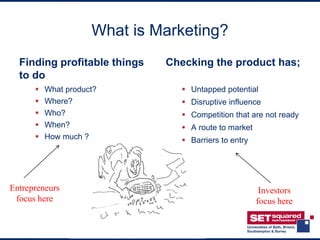
What is Marketing?
  Finding profitable things   Checking the product has;
  to do
         What product?          Untapped potential
         Where?                 Disruptive influence
         Who?                   Competition that are not ready
         When?                  A route to market
         How much ?             Barriers to entry


Entrepreneurs                                          Investors
 focus here                                           focus here
Why is Marketing important?
 To discover and define a need or problem a customer has


 To research and quantify markets with potential customers


 To promote the product in the eyes of your customer….to
  generate demand


 Good marketing is needed by all businesses…..and investors
Make sure you do some market
                research
 Talk to/survey potential customers
 Research the web, dig deep
 Analyse announcements from potential competitors
 Gather information from independent sources


 Don’t forget your experience, of the market, is valuable too


 You will always learn something of value from research
 Enables the building of a well defined target market.
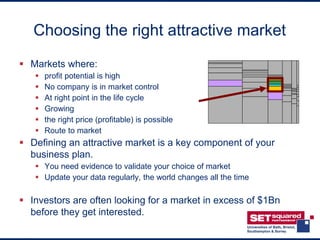
Choosing the right attractive market
 Markets where:
      profit potential is high
      No company is in market control
      At right point in the life cycle
      Growing
      the right price (profitable) is possible
      Route to market
 Defining an attractive market is a key component of your
  business plan.
    You need evidence to validate your choice of market
    Update your data regularly, the world changes all the time

 Investors are often looking for a market in excess of $1Bn
  before they get interested.
Product price position in market…
 Formulation of price/value positioning
    Examine similar products
    Study/analyse competition
    Look at customers behaviour and buying power
    Define price that reflects the value delivered….not a cost of delivery
 Who appropriates value out of the product…
    Assess value to end customer (what will they pay?)
    Value added by others
    Customer vs Consumer
 Consider costs of different levels of distribution
    Direct sales, Distributors, Wholesalers, Retailers
    Internet sales, Mail order
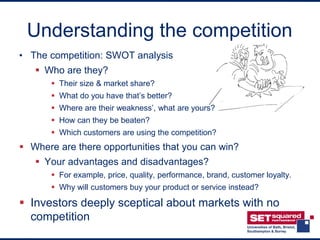
Understanding the competition
• The competition: SWOT analysis
    Who are they?
        Their size & market share?
        What do you have that’s better?
        Where are their weakness’, what are yours?
        How can they be beaten?
        Which customers are using the competition?
 Where are there opportunities that you can win?
    Your advantages and disadvantages?
        For example, price, quality, performance, brand, customer loyalty.
        Why will customers buy your product or service instead?

 Investors deeply sceptical about markets with no
  competition
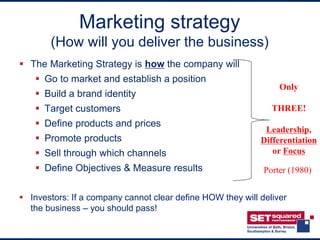
Marketing strategy
       (How will you deliver the business)
 The Marketing Strategy is how the company will
     Go to market and establish a position
                                                                 Only
     Build a brand identity
     Target customers                                         THREE!
     Define products and prices
                                                             Leadership,
     Promote products                                      Differentiation
     Sell through which channels                              or Focus
     Define Objectives & Measure results                    Porter (1980)


 Investors: If a company cannot clear define HOW they will deliver
  the business – you should pass!
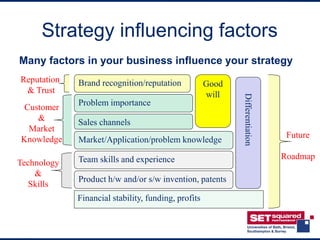
Strategy influencing factors
Many factors in your business influence your strategy
Reputation   Brand recognition/reputation            Good
 & Trust                                             will


                                                            Differentiation
             Problem importance
 Customer
    &        Sales channels
  Market
Knowledge                                                                      Future
             Market/Application/problem knowledge

             Team skills and experience                                       Roadmap
Technology
    &
             Product h/w and/or s/w invention, patents
   Skills
             Financial stability, funding, profits
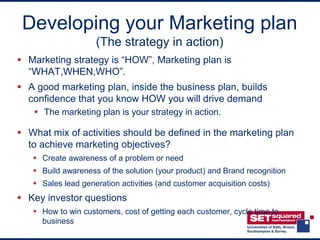
Developing your Marketing plan
                    (The strategy in action)
 Marketing strategy is “HOW”, Marketing plan is
  “WHAT,WHEN,WHO”.
 A good marketing plan, inside the business plan, builds
  confidence that you know HOW you will drive demand
    The marketing plan is your strategy in action.

 What mix of activities should be defined in the marketing plan
  to achieve marketing objectives?
    Create awareness of a problem or need
    Build awareness of the solution (your product) and Brand recognition
    Sales lead generation activities (and customer acquisition costs)
 Key investor questions
    How to win customers, cost of getting each customer, cycle time to
     business
Marketing communications
            (what you say and how you say it)
 Various activities
    Brand building, Logos, market positioning
    Web presence – targeting who?
    Social networking plan, blogs / Facebook / Twitter
        More in skill session 3, Social Media for marketing, 1 st Nov

 Product and/or Brand launch plans
    Launch timing/location
    analysts meetings, briefings before launch
    press launches, stimulate articles
    PR (Press release) activities
 Sales tools, flyers, brochures, datasheets
    Support sales demand
Developing your Sales strategy
 The sales strategy is how the business objectives are
  delivered in sales terms
        Sales leads generated by Marketing activities or Sales activities
        Selling brings in today's orders
    To which targeted customers (your focus of efforts)
        Who will you contact first?
        Why should they buy?
        How will they buy?
        How will you support them?
    Through which sales channels
        Direct, Distributors, Tele sales, Web/internet, mail order
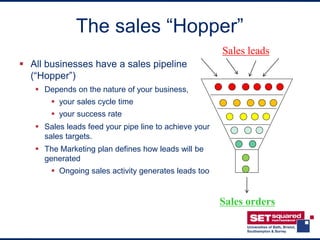
The sales “Hopper”
                                                       Sales leads
 All businesses have a sales pipeline
  (“Hopper”)
    Depends on the nature of your business,
        your sales cycle time
        your success rate
    Sales leads feed your pipe line to achieve your
     sales targets.
    The Marketing plan defines how leads will be
     generated
        Ongoing sales activity generates leads too


                                                       Sales orders
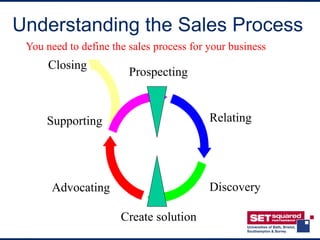
Selling is a process
 In Business to Business selling
    as opposed to retail sales
 Rarely (maybe never) does anyone in business buy at the first
  meeting.
 Need to understand your customer(s) buying behaviour
    Large companies / organisation structures take time
    Counterparts have different roles & responsibilities
    Personalities & Behaviours
    Experience (of you and them)
 Even web sales need to observe a sales process
 Investors need to understand each companies sales process,
  it affects cost of business, growth, profitability, risk, return….
Understanding the Sales Process
 You need to define the sales process for your business
      Closing
                        Prospecting


     Supporting                           Relating


      Advocating                          Discovery

                      Create solution
What do we do with this
              process?
 Need to understand each stage in the selling process
    It’s all about them NOT you!
 Define what key messages to convey at each stage
    Prospecting         Relating, etc
 Marketing tools support each stage of the process
    Assisting in transitions between stages
 Track the process
    use feedback to fine tune to suit your marketplace


 How you will sell to customers needs to be defined in your
  business plan
Conclusion: Focus on
        What, When, Who, How
 In your business plan Sales & Marketing section be clear and
  specific about;


    What you will do
    How you will do it
    When will you do it
    Who will be responsible
Thank You

BEN Investability Greville Commins

  • 1.
    BEN Investability 2011 Sales & Marketing Greville Commins
  • 2.
    Overview  What isMarketing?  Marketing content in the business plan  Developing your Marketing Strategy & Marketing Plan  How will you take you product to market?  What does a marketing plan look like?  What mix of activities should you define in your marketing plan?  What should you look out for when investing?  Developing your sales activity  Definition of the sales process – for your marketplace  What sales methodologies can you consider?  How does a well defined sales process help the investment decision?
  • 3.
    What is Marketing? Finding profitable things Checking the product has; to do  What product?  Untapped potential  Where?  Disruptive influence  Who?  Competition that are not ready  When?  A route to market  How much ?  Barriers to entry Entrepreneurs Investors focus here focus here
  • 4.
    Why is Marketingimportant?  To discover and define a need or problem a customer has  To research and quantify markets with potential customers  To promote the product in the eyes of your customer….to generate demand  Good marketing is needed by all businesses…..and investors
  • 5.
    Make sure youdo some market research  Talk to/survey potential customers  Research the web, dig deep  Analyse announcements from potential competitors  Gather information from independent sources  Don’t forget your experience, of the market, is valuable too  You will always learn something of value from research  Enables the building of a well defined target market.
  • 6.
    Choosing the rightattractive market  Markets where:  profit potential is high  No company is in market control  At right point in the life cycle  Growing  the right price (profitable) is possible  Route to market  Defining an attractive market is a key component of your business plan.  You need evidence to validate your choice of market  Update your data regularly, the world changes all the time  Investors are often looking for a market in excess of $1Bn before they get interested.
  • 7.
    Product price positionin market…  Formulation of price/value positioning  Examine similar products  Study/analyse competition  Look at customers behaviour and buying power  Define price that reflects the value delivered….not a cost of delivery  Who appropriates value out of the product…  Assess value to end customer (what will they pay?)  Value added by others  Customer vs Consumer  Consider costs of different levels of distribution  Direct sales, Distributors, Wholesalers, Retailers  Internet sales, Mail order
  • 8.
    Understanding the competition •The competition: SWOT analysis  Who are they?  Their size & market share?  What do you have that’s better?  Where are their weakness’, what are yours?  How can they be beaten?  Which customers are using the competition?  Where are there opportunities that you can win?  Your advantages and disadvantages?  For example, price, quality, performance, brand, customer loyalty.  Why will customers buy your product or service instead?  Investors deeply sceptical about markets with no competition
  • 9.
    Marketing strategy (How will you deliver the business)  The Marketing Strategy is how the company will  Go to market and establish a position Only  Build a brand identity  Target customers THREE!  Define products and prices Leadership,  Promote products Differentiation  Sell through which channels or Focus  Define Objectives & Measure results Porter (1980)  Investors: If a company cannot clear define HOW they will deliver the business – you should pass!
  • 10.
    Strategy influencing factors Manyfactors in your business influence your strategy Reputation Brand recognition/reputation Good & Trust will Differentiation Problem importance Customer & Sales channels Market Knowledge Future Market/Application/problem knowledge Team skills and experience Roadmap Technology & Product h/w and/or s/w invention, patents Skills Financial stability, funding, profits
  • 11.
    Developing your Marketingplan (The strategy in action)  Marketing strategy is “HOW”, Marketing plan is “WHAT,WHEN,WHO”.  A good marketing plan, inside the business plan, builds confidence that you know HOW you will drive demand  The marketing plan is your strategy in action.  What mix of activities should be defined in the marketing plan to achieve marketing objectives?  Create awareness of a problem or need  Build awareness of the solution (your product) and Brand recognition  Sales lead generation activities (and customer acquisition costs)  Key investor questions  How to win customers, cost of getting each customer, cycle time to business
  • 12.
    Marketing communications (what you say and how you say it)  Various activities  Brand building, Logos, market positioning  Web presence – targeting who?  Social networking plan, blogs / Facebook / Twitter  More in skill session 3, Social Media for marketing, 1 st Nov  Product and/or Brand launch plans  Launch timing/location  analysts meetings, briefings before launch  press launches, stimulate articles  PR (Press release) activities  Sales tools, flyers, brochures, datasheets  Support sales demand
  • 13.
    Developing your Salesstrategy  The sales strategy is how the business objectives are delivered in sales terms  Sales leads generated by Marketing activities or Sales activities  Selling brings in today's orders  To which targeted customers (your focus of efforts)  Who will you contact first?  Why should they buy?  How will they buy?  How will you support them?  Through which sales channels  Direct, Distributors, Tele sales, Web/internet, mail order
  • 14.
    The sales “Hopper” Sales leads  All businesses have a sales pipeline (“Hopper”)  Depends on the nature of your business,  your sales cycle time  your success rate  Sales leads feed your pipe line to achieve your sales targets.  The Marketing plan defines how leads will be generated  Ongoing sales activity generates leads too Sales orders
  • 15.
    Selling is aprocess  In Business to Business selling  as opposed to retail sales  Rarely (maybe never) does anyone in business buy at the first meeting.  Need to understand your customer(s) buying behaviour  Large companies / organisation structures take time  Counterparts have different roles & responsibilities  Personalities & Behaviours  Experience (of you and them)  Even web sales need to observe a sales process  Investors need to understand each companies sales process, it affects cost of business, growth, profitability, risk, return….
  • 16.
    Understanding the SalesProcess You need to define the sales process for your business Closing Prospecting Supporting Relating Advocating Discovery Create solution
  • 17.
    What do wedo with this process?  Need to understand each stage in the selling process  It’s all about them NOT you!  Define what key messages to convey at each stage  Prospecting Relating, etc  Marketing tools support each stage of the process  Assisting in transitions between stages  Track the process  use feedback to fine tune to suit your marketplace  How you will sell to customers needs to be defined in your business plan
  • 18.
    Conclusion: Focus on What, When, Who, How  In your business plan Sales & Marketing section be clear and specific about;  What you will do  How you will do it  When will you do it  Who will be responsible
  • 19.