Welcome to Unit 3 Marketing
What is Marketing? It is all about identifying, anticipating and satisfying customer needs.
We Already Know That….. Objectives  set the targets for all organisations. A  strategy  is a plan devised to achieve these objectives. But where do marketing objectives come from?
Strategic Marketing Objectives The  strategic objectives  that relate specifically to marketing include: increasing sales increasing market share increasing product awareness gaining a unique selling point
Tactical Marketing Objectives These are outlined through the marketing mix. The Marketing Mix looks at all aspects of marketing including; Product (features), Price, Place (where it is sold) and Promotion (advertising).
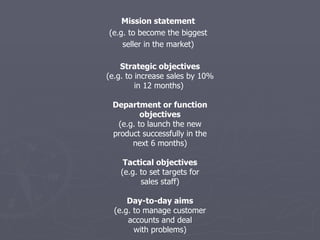
Mission statement (e.g. to become the biggest seller in the market) Strategic objectives (e.g. to increase sales by 10% in 12 months)  Department or function objectives (e.g. to launch the new product successfully in the next 6 months) Tactical objectives (e.g. to set targets for sales staff) Day-to-day aims (e.g. to manage customer accounts and deal with problems)
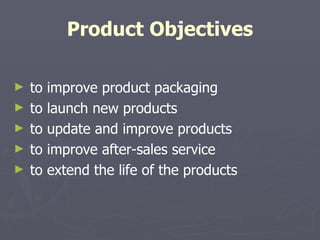
Product Objectives to improve product packaging to launch new products to update and improve products to improve after-sales service to extend the life of the products
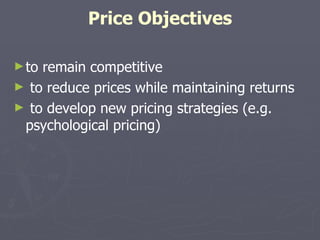
Price Objectives to remain competitive to reduce prices while maintaining returns to develop new pricing strategies (e.g.  psychological pricing)
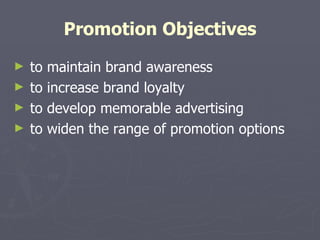
Promotion Objectives to maintain brand awareness to increase brand loyalty to develop memorable advertising to widen the range of promotion options
Place Objectives to increase product availability to improve product delivery times
Marketing Strategy Needs to be devised to achieve the objectives described previously. Again, this can be described in terms of the marketing mix
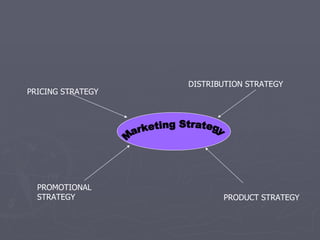
Marketing Strategy PRICING STRATEGY PROMOTIONAL STRATEGY PRODUCT STRATEGY DISTRIBUTION STRATEGY
Product Strategy Firms should carry out ongoing market research to ensure that they stay in touch with the wishes of their customers. Marketing departments must work closely with production and research and development (R&D) to ensure that new products in demand can be produced effectively.
Pricing Strategy Every decision to change a price should be taken as part of an overall strategic plan. Pricing strategies are many and varied. Any desire to remain competitive is likely to be reflected in a price-based strategy.
Promotional Strategy Raising the profile of the product through a range of promotional activities. A  campaign for a product is often run at the same time as some other promotion activity, such as a competition or free gift idea.
Place and Distribution Strategy This strategy identifies a choice of suitable environment for the sale of the goods. From the internet, vending machines and retail outlets.
Cadbury Snaps

Introduction to Marketing

  • 1.
    Welcome to Unit3 Marketing
  • 2.
    What is Marketing?It is all about identifying, anticipating and satisfying customer needs.
  • 3.
    We Already KnowThat….. Objectives set the targets for all organisations. A strategy is a plan devised to achieve these objectives. But where do marketing objectives come from?
  • 4.
    Strategic Marketing ObjectivesThe strategic objectives that relate specifically to marketing include: increasing sales increasing market share increasing product awareness gaining a unique selling point
  • 5.
    Tactical Marketing ObjectivesThese are outlined through the marketing mix. The Marketing Mix looks at all aspects of marketing including; Product (features), Price, Place (where it is sold) and Promotion (advertising).
  • 6.
    Mission statement (e.g.to become the biggest seller in the market) Strategic objectives (e.g. to increase sales by 10% in 12 months) Department or function objectives (e.g. to launch the new product successfully in the next 6 months) Tactical objectives (e.g. to set targets for sales staff) Day-to-day aims (e.g. to manage customer accounts and deal with problems)
  • 7.
    Product Objectives toimprove product packaging to launch new products to update and improve products to improve after-sales service to extend the life of the products
  • 8.
    Price Objectives toremain competitive to reduce prices while maintaining returns to develop new pricing strategies (e.g. psychological pricing)
  • 9.
    Promotion Objectives tomaintain brand awareness to increase brand loyalty to develop memorable advertising to widen the range of promotion options
  • 10.
    Place Objectives toincrease product availability to improve product delivery times
  • 11.
    Marketing Strategy Needsto be devised to achieve the objectives described previously. Again, this can be described in terms of the marketing mix
  • 12.
    Marketing Strategy PRICINGSTRATEGY PROMOTIONAL STRATEGY PRODUCT STRATEGY DISTRIBUTION STRATEGY
  • 13.
    Product Strategy Firmsshould carry out ongoing market research to ensure that they stay in touch with the wishes of their customers. Marketing departments must work closely with production and research and development (R&D) to ensure that new products in demand can be produced effectively.
  • 14.
    Pricing Strategy Everydecision to change a price should be taken as part of an overall strategic plan. Pricing strategies are many and varied. Any desire to remain competitive is likely to be reflected in a price-based strategy.
  • 15.
    Promotional Strategy Raisingthe profile of the product through a range of promotional activities. A campaign for a product is often run at the same time as some other promotion activity, such as a competition or free gift idea.
  • 16.
    Place and DistributionStrategy This strategy identifies a choice of suitable environment for the sale of the goods. From the internet, vending machines and retail outlets.
  • 17.