CHAPTER ELEVEN Formulating Marketing Strategy
The Significance of Marketing Strategy The Plan/Instrument for Value Delivery Helps Realise the Unit’s Marketing Objectives Example of Dabur Foods; To become a leading, integrated players in Indian fruit processing marketing. To make its fruit juice brands Real, activ, major contestants in their segment. To Achive a total sales turnover of Rs 500 crore by 2010. Chapter 11 :   Formulating Marketing Strategy
The Significance of Marketing Strategy In Particular, Helps Realise the Targeted Income and Profit Specifies the Position the Unit will Seek in its Industry and How it   will Compete Therein What Market Segments to Serve? And What Products to Offer? Who are the Firm’s Competitors? Whom to Compete, Whom to   Avoid? The Growth Path: Market Penetration? Market Development? Product   Development? Chapter 11 :   Formulating Marketing Strategy
The Significance of Marketing Strategy On What Differentiation Strength to Compete? On What Competitive Advantages Will the Fight be Based? What are Resources?  Chapter 11 :   Formulating Marketing Strategy Formulating the Marketing Strategy The ‘STP Plus Marketing Mix’ Approach The ‘STP’  Segmentation of the Market Targeting (picking the appropriate segments) What part of the market do we serve? What part we choose not to serve Positioning the offer STP
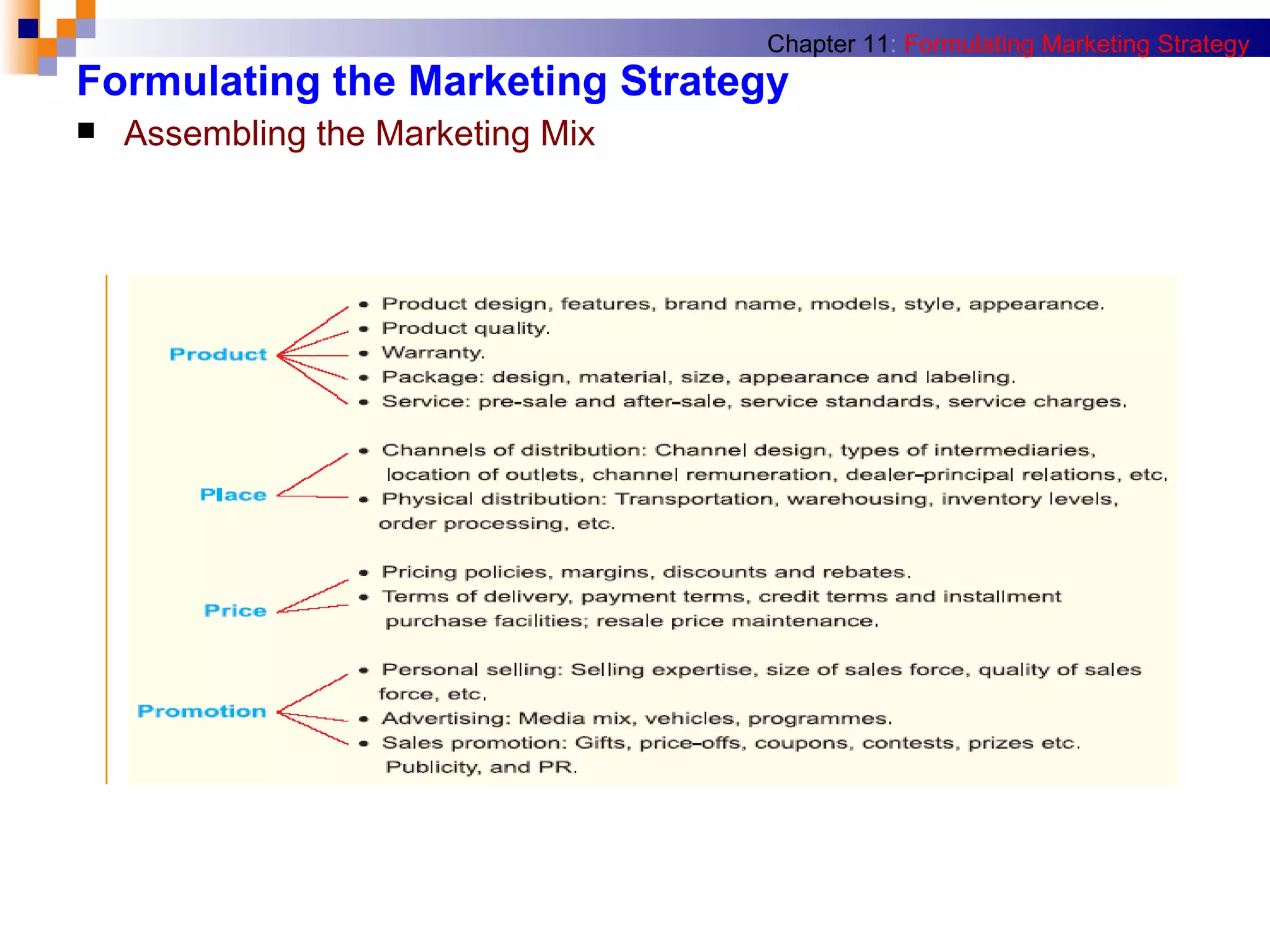
Formulating the Marketing Strategy Assembling the Marketing Mix Chapter 11 :   Formulating Marketing Strategy
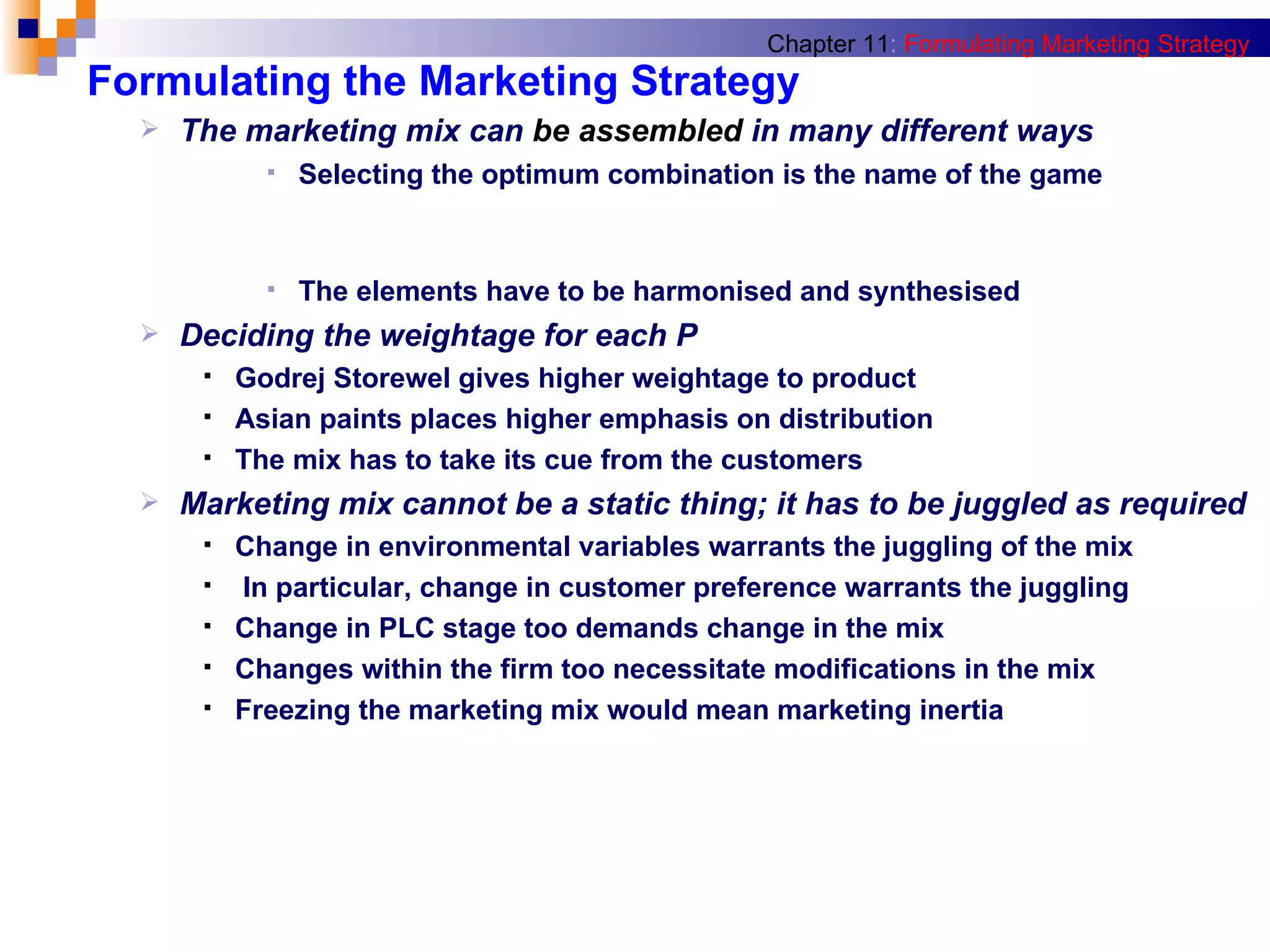
Formulating the Marketing Strategy The marketing mix can  be assembled  in many different ways Selecting the optimum combination is the name of the game The elements have to be harmonised and synthesised Deciding the weightage for each P Godrej Storewel gives higher weightage to product Asian paints places higher emphasis on distribution The mix has to take its cue from the customers Marketing mix cannot be a static thing; it has to be juggled as required Change in environmental variables warrants the juggling of the mix In particular, change in customer preference warrants the juggling Change in PLC stage too demands change in the mix Changes within the firm too necessitate modifications in the mix Freezing the marketing mix would mean marketing inertia Chapter 11 :   Formulating Marketing Strategy
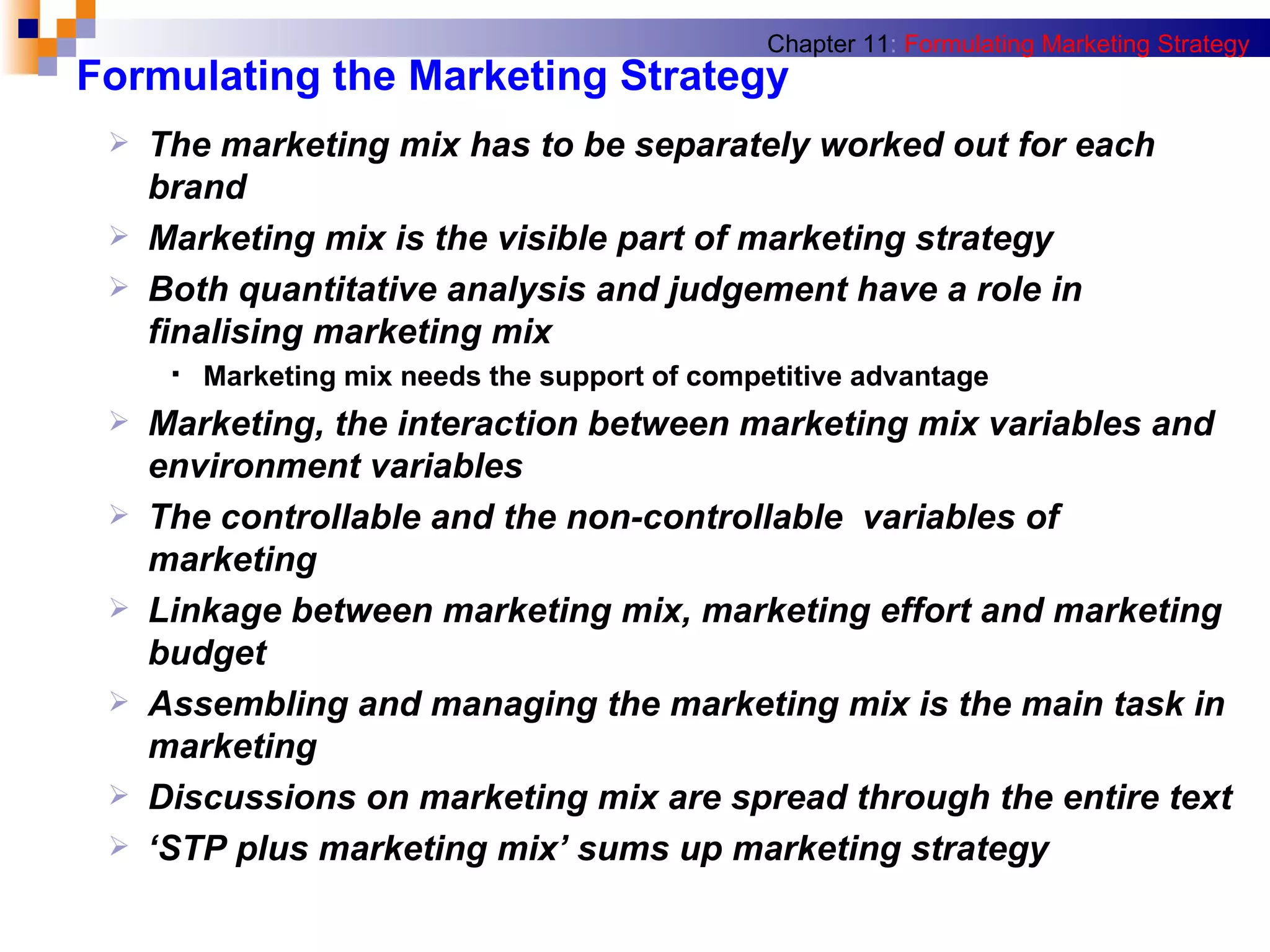
Formulating the Marketing Strategy The marketing mix has to be separately worked out for each brand Marketing mix is the visible part of marketing strategy Both quantitative analysis and judgement have a role in finalising marketing mix Marketing mix needs the support of competitive advantage Marketing, the interaction between marketing mix variables and environment variables The controllable and the non-controllable  variables of marketing Linkage between marketing mix, marketing effort and marketing budget Assembling and managing the marketing mix is the main task in marketing Discussions on marketing mix are spread through the entire text ‘ STP plus marketing mix’ sums up marketing strategy Chapter 11 :   Formulating Marketing Strategy
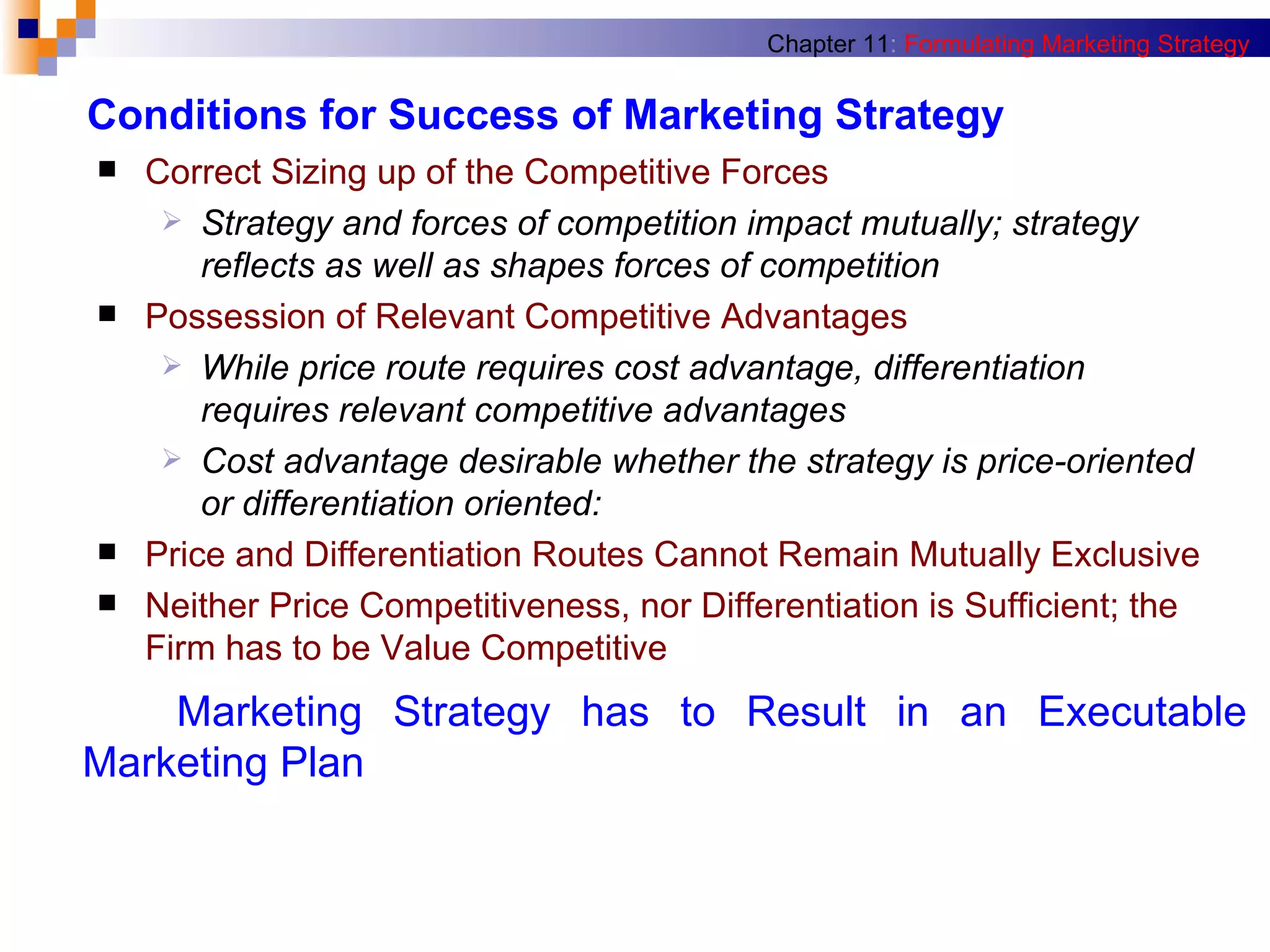
Conditions for Success of Marketing Strategy Correct Sizing up of the Competitive Forces Strategy and forces of competition impact mutually; strategy reflects as well as shapes forces of competition Possession of Relevant Competitive Advantages While price route requires cost advantage, differentiation requires relevant competitive advantages Cost advantage desirable whether the strategy is price-oriented or differentiation oriented: Price and Differentiation Routes Cannot Remain Mutually Exclusive Neither Price Competitiveness, nor Differentiation is Sufficient; the Firm has to be Value Competitive Chapter 11 :   Formulating Marketing Strategy Marketing Strategy has to Result in an Executable   Marketing Plan

Ch11 formulating marketing_strategy

  • 1.
    CHAPTER ELEVEN FormulatingMarketing Strategy
  • 2.
    The Significance ofMarketing Strategy The Plan/Instrument for Value Delivery Helps Realise the Unit’s Marketing Objectives Example of Dabur Foods; To become a leading, integrated players in Indian fruit processing marketing. To make its fruit juice brands Real, activ, major contestants in their segment. To Achive a total sales turnover of Rs 500 crore by 2010. Chapter 11 : Formulating Marketing Strategy
  • 3.
    The Significance ofMarketing Strategy In Particular, Helps Realise the Targeted Income and Profit Specifies the Position the Unit will Seek in its Industry and How it will Compete Therein What Market Segments to Serve? And What Products to Offer? Who are the Firm’s Competitors? Whom to Compete, Whom to Avoid? The Growth Path: Market Penetration? Market Development? Product Development? Chapter 11 : Formulating Marketing Strategy
  • 4.
    The Significance ofMarketing Strategy On What Differentiation Strength to Compete? On What Competitive Advantages Will the Fight be Based? What are Resources? Chapter 11 : Formulating Marketing Strategy Formulating the Marketing Strategy The ‘STP Plus Marketing Mix’ Approach The ‘STP’ Segmentation of the Market Targeting (picking the appropriate segments) What part of the market do we serve? What part we choose not to serve Positioning the offer STP
  • 5.
    Formulating the MarketingStrategy Assembling the Marketing Mix Chapter 11 : Formulating Marketing Strategy
  • 6.
    Formulating the MarketingStrategy The marketing mix can be assembled in many different ways Selecting the optimum combination is the name of the game The elements have to be harmonised and synthesised Deciding the weightage for each P Godrej Storewel gives higher weightage to product Asian paints places higher emphasis on distribution The mix has to take its cue from the customers Marketing mix cannot be a static thing; it has to be juggled as required Change in environmental variables warrants the juggling of the mix In particular, change in customer preference warrants the juggling Change in PLC stage too demands change in the mix Changes within the firm too necessitate modifications in the mix Freezing the marketing mix would mean marketing inertia Chapter 11 : Formulating Marketing Strategy
  • 7.
    Formulating the MarketingStrategy The marketing mix has to be separately worked out for each brand Marketing mix is the visible part of marketing strategy Both quantitative analysis and judgement have a role in finalising marketing mix Marketing mix needs the support of competitive advantage Marketing, the interaction between marketing mix variables and environment variables The controllable and the non-controllable variables of marketing Linkage between marketing mix, marketing effort and marketing budget Assembling and managing the marketing mix is the main task in marketing Discussions on marketing mix are spread through the entire text ‘ STP plus marketing mix’ sums up marketing strategy Chapter 11 : Formulating Marketing Strategy
  • 8.
    Conditions for Successof Marketing Strategy Correct Sizing up of the Competitive Forces Strategy and forces of competition impact mutually; strategy reflects as well as shapes forces of competition Possession of Relevant Competitive Advantages While price route requires cost advantage, differentiation requires relevant competitive advantages Cost advantage desirable whether the strategy is price-oriented or differentiation oriented: Price and Differentiation Routes Cannot Remain Mutually Exclusive Neither Price Competitiveness, nor Differentiation is Sufficient; the Firm has to be Value Competitive Chapter 11 : Formulating Marketing Strategy Marketing Strategy has to Result in an Executable Marketing Plan

Editor's Notes