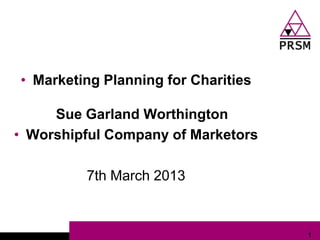
• Marketing Planning for Charities

     Sue Garland Worthington
• Worshipful Company of Marketors

         7th March 2013


                                     1
2
3
Session Objectives

By the end of this session you should:

• Understand the function of marketing and its
  role in not-for-profit organisations
• Know more about the Marketing Planning
  process, to improve the effectiveness and
  efficiency of your organisation and its resources
• Understand more about managing relationships
  with clients, donors, sponsors and other key
  stakeholders

                                                      4
Definition and Development
of Marketing – A Whistle-stop Tour

How would YOU define marketing…?


                                     5
CIM Definition


  “The management process responsible for
anticipating, identifying and satisfying customer
             requirements profitably”


                   Chartered Institute of Marketing


                                                      6
Meet Professor Kotler…


 'satisfying needs and wants through an
             exchange process'

                               Philip Kotler


                                               7
Our Definition at the Marketors‟ Company


   Charity Marketing is the management
  process of anticipating, identifying and
 satisfying clients’ and donors’ wants and
   needs, with an exchange of value that
        mutually satisfies all parties.

                                                     Peter Rees
                 Marketing Planning - A Guide for Charities and
                              Not-for-profit Organisations 2012


                                                                  8
Marketing Evolution
Production era – Customised then Mass production
(following industrialisation).


       „Any colour you like…as long as it‟s black!‟

                                                      9
Marketing Evolution
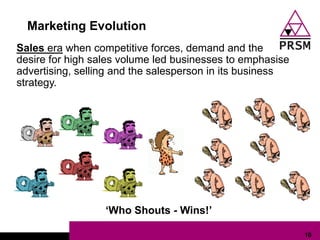
Sales era when competitive forces, demand and the
desire for high sales volume led businesses to emphasise
advertising, selling and the salesperson in its business
strategy.


                  „Who Shouts - Wins!‟

                                                           10
Marketing Evolution

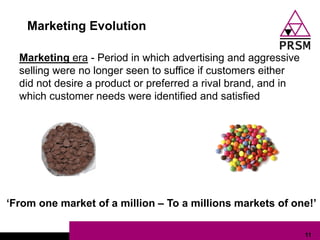
  Marketing era - Period in which advertising and aggressive
  selling were no longer seen to suffice if customers either
  did not desire a product or preferred a rival brand, and in
  which customer needs were identified and satisfied


„From one market of a million – To a millions markets of one!‟

                                                                11
Marketing Evolution
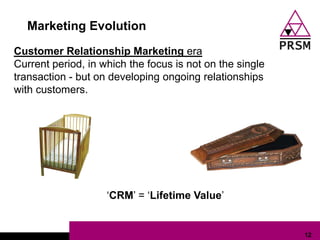
Customer Relationship Marketing era
Current period, in which the focus is not on the single
transaction - but on developing ongoing relationships
with customers.


                    „CRM‟ = „Lifetime Value‟


                                                          12
Role of Marketing


       Once you accept that Marketing is about
     „… the management process of Satisfying,
   Identifying and Satisfying Clients’ and Donors’
               wants and needs etc….’
  as we have previously seen, then it also follows that
    Marketing encapsulates and covers pretty much
     everything that a charity is „in business‟ to do.


                                                          13
Marketing Orientation

A holistic approach
• Puts client and donor (C&D) wants and needs first
• A focus on value exchange
• Adding things that add value to and are valued by the
  C&D
• A focus on delighting both groups
• Everyone in the organisation understands their role in
  serving C&D


                                                           14
Marketing Planning


   There is no right way to write a Marketing Plan!

   All Marketing Plans address six basic questions


      There is an easy way to remember these
                     SOSTAC©
           A model created by PR Smith


                                                      15
SOSTAC© - A Proven Planning Approach
                 What is it?


• A structure for market analysis & planning
• A set of processes to accelerate business growth
• A tool for optimising business resources
• Highly scalable – fitting organisations and teams
  of all sizes
• A basis upon which you can control your
  business


                                                      16
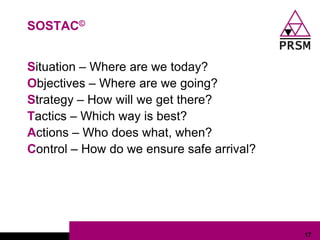
SOSTAC©


Situation – Where are we today?
Objectives – Where are we going?
Strategy – How will we get there?
Tactics – Which way is best?
Actions – Who does what, when?
Control – How do we ensure safe arrival?


                                           17
Situation
  DON‟T BELIEVE YOUR OWN
       PROPAGANDA!

        Meet 3 Greeks….


Macro         Meso        Micro


                                  18
Macro Factors – Affect Everyone


  Socio-Cultural
  Technological
  Economic
  Environmental
  Political
  Legal
  Ethical


                                  19
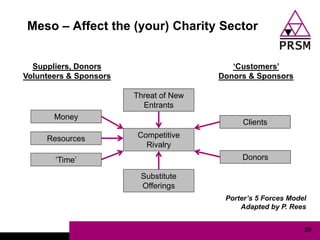
Meso – Affect the (your) Charity Sector


  Suppliers, Donors                        „Customers‟
Volunteers & Sponsors                   Donors & Sponsors

                        Threat of New
                          Entrants
       Money
                                             Clients

     Resources           Competitive
                           Rivalry
       „Time‟                                Donors

                         Substitute
                         Offerings
                                         Porter’s 5 Forces Model
                                             Adapted by P. Rees


                                                               20
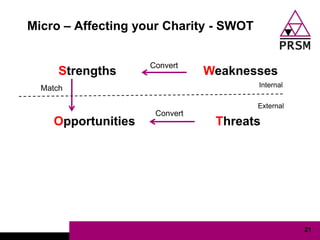
Micro – Affecting your Charity - SWOT


                    Convert
      Strengths                Weaknesses
  Match                                 Internal

                                        External
                     Convert
    Opportunities               Threats


                                                   21
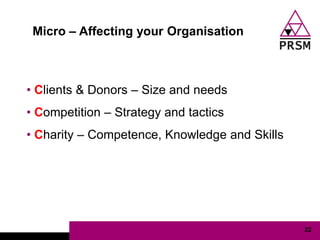
Micro – Affecting your Organisation


• Clients & Donors – Size and needs
• Competition – Strategy and tactics
• Charity – Competence, Knowledge and Skills


                                               22
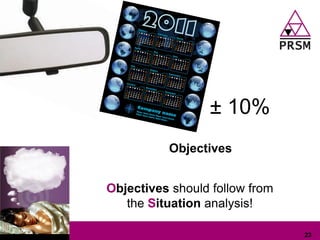
± 10%
          Objectives


Objectives should follow from
   the Situation analysis!

                                23
SMART Objectives


• Specific – stated in precise terms for everything
  important
• Measurable – numerical and quantifiable
• Achievable – if it cannot be achieved there is little
  point in setting it
• Realistic – Needs to make sense within the context
  of the charity
• Timely – there should be a point defined by when
  each objective should be achieved

                                                          24
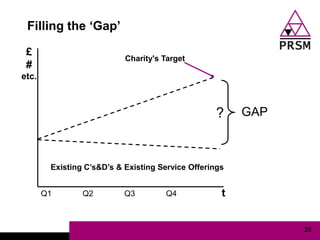
Filling the „Gap‟

 £
                           Charity's Target
 #
etc.


                                                  ?     GAP


        Existing C‟s&D‟s & Existing Service Offerings


       Q1       Q2         Q3         Q4            t


                                                              25
Strategy
            Four Important Questions - 1

1. How is our Charity better and different from its
   „competition‟, in ways that are valued by and add value
   to our Clients‟ and Donors, that can‟t easily be copied?
This is THE most important question
Marketers have to answer!


                                                              26
Four Important Questions - 2


2. What „business‟ are we in?


                                27
Four Important Questions - 3


3. What resources do we have and do we need to achieve
   the answer to Question1?

    •   Physical resources,
    •   Assets,
    •   Money,
    •   Knowledge and expertise
This also follows from our Objectives – what do we need
to achieve these?


                                                          28
Four Important Questions - 4

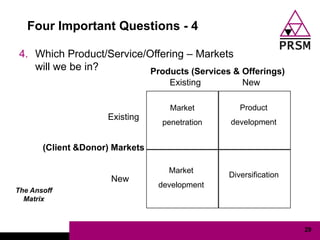
 4. Which Product/Service/Offering – Markets
    will we be in?         Products (Services & Offerings)
                                   Existing        New

                                   Market         Product
                     Existing
                                 penetration   development


       (Client &Donor) Markets

                                   Market
                                               Diversification
                      New
                                 development
The Ansoff
  Matrix


                                                                 29
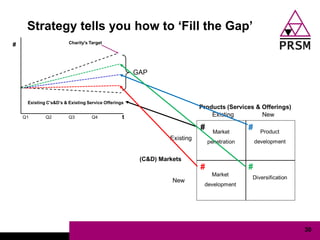
Strategy tells you how to „Fill the Gap‟


                              #        #


                              #        #


                                           30
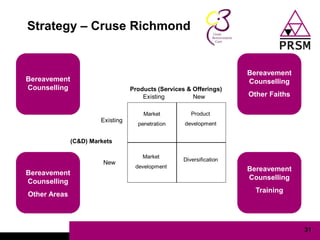
Strategy – Cruse Richmond


                            Bereavement
Bereavement                 Counselling
Counselling
                            Other Faiths


                            Bereavement
Bereavement
                            Counselling
Counselling
                              Training
Other Areas


                                           31
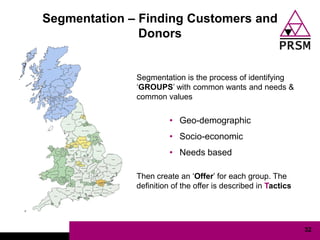
Segmentation – Finding Customers and
               Donors


              Segmentation is the process of identifying
              „GROUPS‟ with common wants and needs &
              common values


                        • Geo-demographic
                        • Socio-economic
                        • Needs based

              Then create an „Offer‟ for each group. The
              definition of the offer is described in Tactics


                                                                32
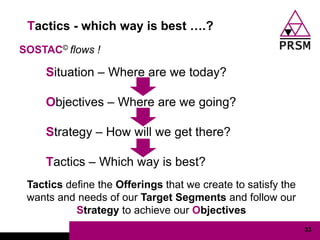
Tactics - which way is best ….?
SOSTAC© flows !

     Situation – Where are we today?

     Objectives – Where are we going?

     Strategy – How will we get there?

     Tactics – Which way is best?
 Tactics define the Offerings that we create to satisfy the
 wants and needs of our Target Segments and follow our
           Strategy to achieve our Objectives
                                                              33
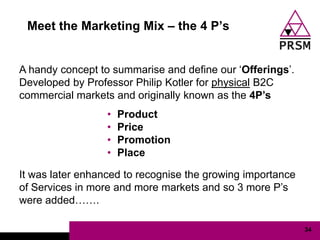
Meet the Marketing Mix – the 4 P‟s


A handy concept to summarise and define our „Offerings‟.
Developed by Professor Philip Kotler for physical B2C
commercial markets and originally known as the 4P‟s
                  •   Product
                  •   Price
                  •   Promotion
                  •   Place

It was later enhanced to recognise the growing importance
of Services in more and more markets and so 3 more P‟s
were added…….

                                                            34
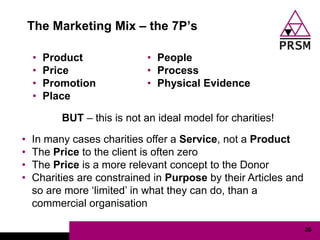
The Marketing Mix – the 7P‟s

    •   Product              • People
    •   Price                • Process
    •   Promotion            • Physical Evidence
    •   Place

           BUT – this is not an ideal model for charities!
•   In many cases charities offer a Service, not a Product
•   The Price to the client is often zero
•   The Price is a more relevant concept to the Donor
•   Charities are constrained in Purpose by their Articles and
    so are more „limited‟ in what they can do, than a
    commercial organisation

                                                                 35
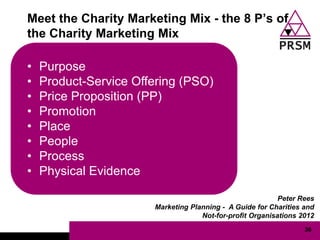
Meet the Charity Marketing Mix - the 8 P‟s of
the Charity Marketing Mix

•   Purpose
•   Product-Service Offering (PSO)
•   Price Proposition (PP)
•   Promotion
•   Place
•   People
•   Process
•   Physical Evidence

                                                           Peter Rees
                       Marketing Planning - A Guide for Charities and
                                    Not-for-profit Organisations 2012
                                                                  36
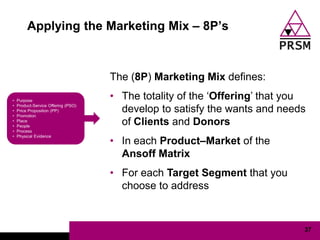
Applying the Marketing Mix – 8P‟s


             The (8P) Marketing Mix defines:
             • The totality of the „Offering‟ that you
               develop to satisfy the wants and needs
               of Clients and Donors
             • In each Product–Market of the
               Ansoff Matrix
             • For each Target Segment that you
               choose to address


                                                     37
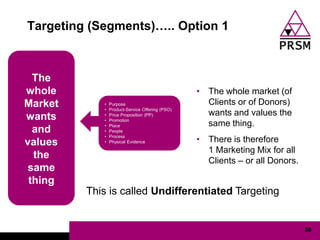
Targeting (Segments)….. Option 1


  The
whole                           • The whole market (of
Market                            Clients or of Donors)
wants                             wants and values the
                                  same thing.
  and
values                          • There is therefore
                                  1 Marketing Mix for all
  the                             Clients – or all Donors.
 same
 thing
         This is called Undifferentiated Targeting


                                                             38
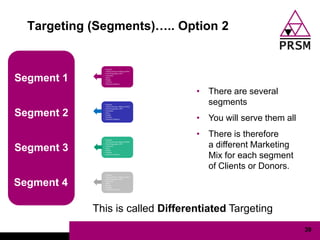
Targeting (Segments)….. Option 2


Segment 1
                                  • There are several
                                    segments
Segment 2                         • You will serve them all
                                  • There is therefore
Segment 3                           a different Marketing
                                    Mix for each segment
                                    of Clients or Donors.
Segment 4

            This is called Differentiated Targeting
                                                              39
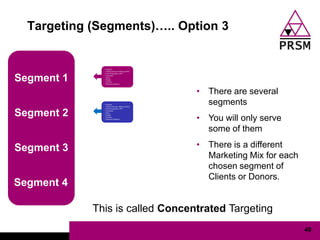
Targeting (Segments)….. Option 3


Segment 1
                                 • There are several
                                   segments
Segment 2                        • You will only serve
                                   some of them

Segment 3                        • There is a different
                                   Marketing Mix for each
                                   chosen segment of
                                   Clients or Donors.
Segment 4

            This is called Concentrated Targeting
                                                            40
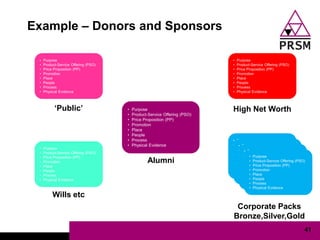
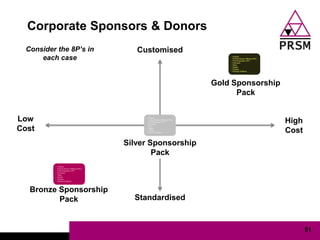
Example – Donors and Sponsors


    „Public‟                    High Net Worth


                 Alumni


   Wills etc
                                 Corporate Packs
                                Bronze,Silver,Gold
                                                 41
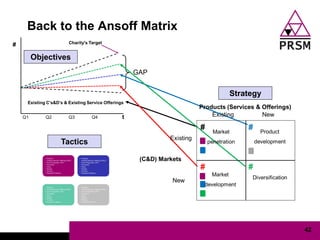
Back to the Ansoff Matrix

Objectives


                                Strategy


                            #       #
       Tactics


                            #       #


                                           42
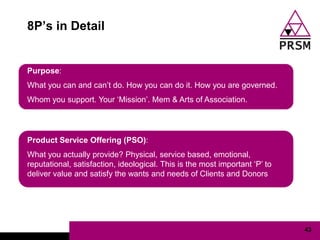
8P‟s in Detail


Purpose:
What you can and can‟t do. How you can do it. How you are governed.
Whom you support. Your „Mission‟. Mem & Arts of Association.


Product Service Offering (PSO):
What you actually provide? Physical, service based, emotional,
reputational, satisfaction, ideological. This is the most important „P‟ to
deliver value and satisfy the wants and needs of Clients and Donors


                                                                             43
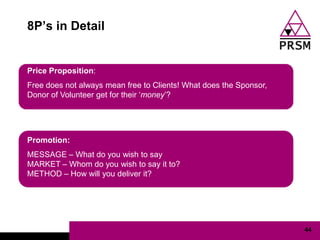
8P‟s in Detail


Price Proposition:
Free does not always mean free to Clients! What does the Sponsor,
Donor of Volunteer get for their „money‟?


Promotion:
MESSAGE – What do you wish to say
MARKET – Whom do you wish to say it to?
METHOD – How will you deliver it?


                                                                    44
8P‟s in Detail


Place:
Where is your Product Service Offering delivered and / or where can it
be booked or bought? Consider Clients, Donors and Volunteers.


People:
Primarily to do with Product Service Offering delivery. Attracting,
developing and retaining: Staff, Volunteers, Supporters, Donors,
Sponsors, Resource providers.


                                                                         45
8P‟s in Detail


Process:
Is Product Service Offering delivery and all interactions with
stakeholders delivered to a consistently high quality – that always meets
and exceeds expectations?


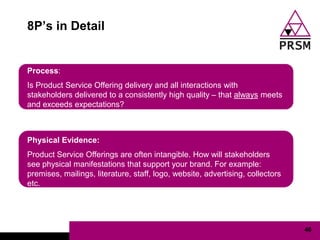
Physical Evidence:
Product Service Offerings are often intangible. How will stakeholders
see physical manifestations that support your brand. For example:
premises, mailings, literature, staff, logo, website, advertising, collectors
etc.


                                                                                46
It is interesting to note…..

                                   Advertising
                                   PR
S       Purpose                    Speeches
                                   Lobbying
O       PSO                        Conferences
        PP            Message      email
S       Promotion     Market
                                   website
                                   Direct Mail
T       Place         Method       Tele-calls
                                   Collectors

A       People                     Literature
                                   Letter
        Process                    Report
C       Physical Evidence          Social Media
                                                  Facebook
                                                  Twitter
                                                  YouTube

                                                        47
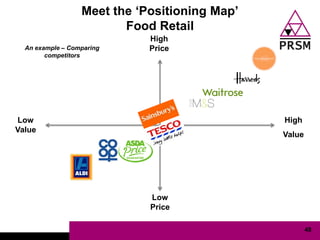
Meet the „Positioning Map‟
                         Food Retail
                             High
  An example – Comparing     Price
        competitors


Low                                            High
Value
                                               Value


                             Low
                             Price

                                                       48
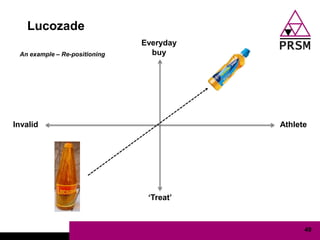
Lucozade
                               Everyday
 An example – Re-positioning     buy


Invalid                                   Athlete


                                „Treat‟


                                                49
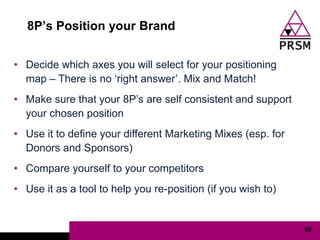
8P‟s Position your Brand


• Decide which axes you will select for your positioning
  map – There is no „right answer‟. Mix and Match!
• Make sure that your 8P‟s are self consistent and support
  your chosen position
• Use it to define your different Marketing Mixes (esp. for
  Donors and Sponsors)
• Compare yourself to your competitors
• Use it as a tool to help you re-position (if you wish to)


                                                              50
Corporate Sponsors & Donors
  Consider the 8P’s in      Customised
      each case


                                              Gold Sponsorship
                                                    Pack


Low                                                              High
Cost                                                             Cost
                         Silver Sponsorship
                                 Pack


   Bronze Sponsorship
          Pack             Standardised


                                                                        51
Managing your Brand – 8P‟s


  My firm belief is that a brand is a cluster of
functional and emotional values that enables an
organisation to make a promise about a unique
    and welcomed stakeholder experience.
   Ultimately brand management is promise
                 management.


                                       Prof. Leslie de Chernatony


                                                               52
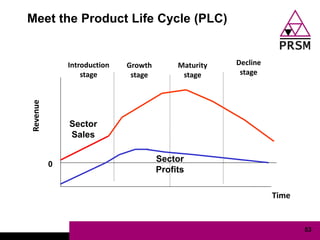
Meet the Product Life Cycle (PLC)


              Introduction   Growth        Maturity   Decline
                  stage       stage         stage      stage
Revenue


              Sector
              Sales

                                      Sector
          0
                                      Profits

                                                                Time


                                                                       53
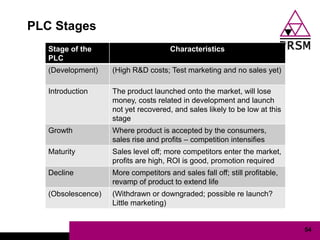
PLC Stages
   Stage of the                       Characteristics
   PLC
   (Development)    (High R&D costs; Test marketing and no sales yet)

   Introduction     The product launched onto the market, will lose
                    money, costs related in development and launch
                    not yet recovered, and sales likely to be low at this
                    stage
   Growth           Where product is accepted by the consumers,
                    sales rise and profits – competition intensifies
   Maturity         Sales level off; more competitors enter the market,
                    profits are high, ROI is good, promotion required
   Decline          More competitors and sales fall off; still profitable,
                    revamp of product to extend life
   (Obsolescence)   (Withdrawn or downgraded; possible re launch?
                    Little marketing)


                                                                             54
Actions
       General Marketing Planning Timetable
• Annual Process
• Starts at -3 months from financial year start
• Hold a workshop to produce Version1
• Month -2 review Version1 and agree amendments Version2
• Month -1 circulate Version2 to all relevant parties
• Plan resources
• Setup review process
• Manage with appropriate periodic reviews and reports
• Take corrctive action see Control section following
                                                           55
General Marketing Planning Approach

• It‟s Project Management
• Who does what and when?
• Circulate minutes of meetings!
• Hold people accountable! (Even volunteers)
• Create a timetable or roadmap: Communications, PSO
  development, Donations, Client Engagements, Volunteer
  recruitment, Key milestones etc…
• Put a measurement system in place for all your Objectives


                                                          56
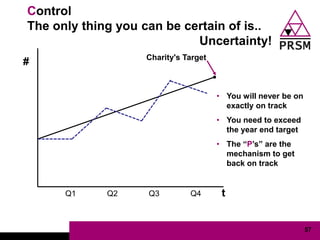
Control
The only thing you can be certain of is..
                            Uncertainty!
                   Charity's Target
#


                                      • You will never be on
                                        exactly on track
                                      • You need to exceed
                                        the year end target
                                      • The “P‟s” are the
                                        mechanism to get
                                        back on track


      Q1     Q2     Q3        Q4       t


                                                               57
Control – Ensuring safe arrival

• Put a measurement system in place for all your Objectives
• Act quickly to correct under–performance – use the P‟s
• Never change Objectives mid year! Accept success
  (or failure)


• You must have Trustee support (and ideally leadership)
      – in order for Marketing Planning to work successfully!


                                                            58
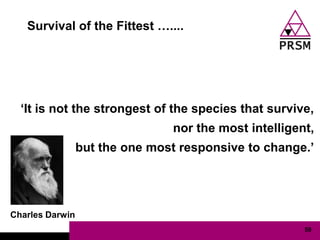
Survival of the Fittest …....


  „It is not the strongest of the species that survive,
                                nor the most intelligent,
                 but the one most responsive to change.‟


Charles Darwin
                                                       59
Thank you!


             60

Marketing planning

  • 1.
    • Marketing Planningfor Charities Sue Garland Worthington • Worshipful Company of Marketors 7th March 2013 1
  • 2.
  • 3.
  • 4.
    Session Objectives By theend of this session you should: • Understand the function of marketing and its role in not-for-profit organisations • Know more about the Marketing Planning process, to improve the effectiveness and efficiency of your organisation and its resources • Understand more about managing relationships with clients, donors, sponsors and other key stakeholders 4
  • 5.
    Definition and Development ofMarketing – A Whistle-stop Tour How would YOU define marketing…? 5
  • 6.
    CIM Definition “The management process responsible for anticipating, identifying and satisfying customer requirements profitably” Chartered Institute of Marketing 6
  • 7.
    Meet Professor Kotler… 'satisfying needs and wants through an exchange process' Philip Kotler 7
  • 8.
    Our Definition atthe Marketors‟ Company Charity Marketing is the management process of anticipating, identifying and satisfying clients’ and donors’ wants and needs, with an exchange of value that mutually satisfies all parties. Peter Rees Marketing Planning - A Guide for Charities and Not-for-profit Organisations 2012 8
  • 9.
    Marketing Evolution Production era– Customised then Mass production (following industrialisation). „Any colour you like…as long as it‟s black!‟ 9
  • 10.
    Marketing Evolution Sales erawhen competitive forces, demand and the desire for high sales volume led businesses to emphasise advertising, selling and the salesperson in its business strategy. „Who Shouts - Wins!‟ 10
  • 11.
    Marketing Evolution Marketing era - Period in which advertising and aggressive selling were no longer seen to suffice if customers either did not desire a product or preferred a rival brand, and in which customer needs were identified and satisfied „From one market of a million – To a millions markets of one!‟ 11
  • 12.
    Marketing Evolution Customer RelationshipMarketing era Current period, in which the focus is not on the single transaction - but on developing ongoing relationships with customers. „CRM‟ = „Lifetime Value‟ 12
  • 13.
    Role of Marketing Once you accept that Marketing is about „… the management process of Satisfying, Identifying and Satisfying Clients’ and Donors’ wants and needs etc….’ as we have previously seen, then it also follows that Marketing encapsulates and covers pretty much everything that a charity is „in business‟ to do. 13
  • 14.
    Marketing Orientation A holisticapproach • Puts client and donor (C&D) wants and needs first • A focus on value exchange • Adding things that add value to and are valued by the C&D • A focus on delighting both groups • Everyone in the organisation understands their role in serving C&D 14
  • 15.
    Marketing Planning There is no right way to write a Marketing Plan! All Marketing Plans address six basic questions There is an easy way to remember these SOSTAC© A model created by PR Smith 15
  • 16.
    SOSTAC© - AProven Planning Approach What is it? • A structure for market analysis & planning • A set of processes to accelerate business growth • A tool for optimising business resources • Highly scalable – fitting organisations and teams of all sizes • A basis upon which you can control your business 16
  • 17.
    SOSTAC© Situation – Whereare we today? Objectives – Where are we going? Strategy – How will we get there? Tactics – Which way is best? Actions – Who does what, when? Control – How do we ensure safe arrival? 17
  • 18.
    Situation DON‟TBELIEVE YOUR OWN PROPAGANDA! Meet 3 Greeks…. Macro Meso Micro 18
  • 19.
    Macro Factors –Affect Everyone Socio-Cultural Technological Economic Environmental Political Legal Ethical 19
  • 20.
    Meso – Affectthe (your) Charity Sector Suppliers, Donors „Customers‟ Volunteers & Sponsors Donors & Sponsors Threat of New Entrants Money Clients Resources Competitive Rivalry „Time‟ Donors Substitute Offerings Porter’s 5 Forces Model Adapted by P. Rees 20
  • 21.
    Micro – Affectingyour Charity - SWOT Convert Strengths Weaknesses Match Internal External Convert Opportunities Threats 21
  • 22.
    Micro – Affectingyour Organisation • Clients & Donors – Size and needs • Competition – Strategy and tactics • Charity – Competence, Knowledge and Skills 22
  • 23.
    ± 10% Objectives Objectives should follow from the Situation analysis! 23
  • 24.
    SMART Objectives • Specific– stated in precise terms for everything important • Measurable – numerical and quantifiable • Achievable – if it cannot be achieved there is little point in setting it • Realistic – Needs to make sense within the context of the charity • Timely – there should be a point defined by when each objective should be achieved 24
  • 25.
    Filling the „Gap‟ £ Charity's Target # etc. ? GAP Existing C‟s&D‟s & Existing Service Offerings Q1 Q2 Q3 Q4 t 25
  • 26.
    Strategy Four Important Questions - 1 1. How is our Charity better and different from its „competition‟, in ways that are valued by and add value to our Clients‟ and Donors, that can‟t easily be copied? This is THE most important question Marketers have to answer! 26
  • 27.
    Four Important Questions- 2 2. What „business‟ are we in? 27
  • 28.
    Four Important Questions- 3 3. What resources do we have and do we need to achieve the answer to Question1? • Physical resources, • Assets, • Money, • Knowledge and expertise This also follows from our Objectives – what do we need to achieve these? 28
  • 29.
    Four Important Questions- 4 4. Which Product/Service/Offering – Markets will we be in? Products (Services & Offerings) Existing New Market Product Existing penetration development (Client &Donor) Markets Market Diversification New development The Ansoff Matrix 29
  • 30.
    Strategy tells youhow to „Fill the Gap‟ # # # # 30
  • 31.
    Strategy – CruseRichmond Bereavement Bereavement Counselling Counselling Other Faiths Bereavement Bereavement Counselling Counselling Training Other Areas 31
  • 32.
    Segmentation – FindingCustomers and Donors Segmentation is the process of identifying „GROUPS‟ with common wants and needs & common values • Geo-demographic • Socio-economic • Needs based Then create an „Offer‟ for each group. The definition of the offer is described in Tactics 32
  • 33.
    Tactics - whichway is best ….? SOSTAC© flows ! Situation – Where are we today? Objectives – Where are we going? Strategy – How will we get there? Tactics – Which way is best? Tactics define the Offerings that we create to satisfy the wants and needs of our Target Segments and follow our Strategy to achieve our Objectives 33
  • 34.
    Meet the MarketingMix – the 4 P‟s A handy concept to summarise and define our „Offerings‟. Developed by Professor Philip Kotler for physical B2C commercial markets and originally known as the 4P‟s • Product • Price • Promotion • Place It was later enhanced to recognise the growing importance of Services in more and more markets and so 3 more P‟s were added……. 34
  • 35.
    The Marketing Mix– the 7P‟s • Product • People • Price • Process • Promotion • Physical Evidence • Place BUT – this is not an ideal model for charities! • In many cases charities offer a Service, not a Product • The Price to the client is often zero • The Price is a more relevant concept to the Donor • Charities are constrained in Purpose by their Articles and so are more „limited‟ in what they can do, than a commercial organisation 35
  • 36.
    Meet the CharityMarketing Mix - the 8 P‟s of the Charity Marketing Mix • Purpose • Product-Service Offering (PSO) • Price Proposition (PP) • Promotion • Place • People • Process • Physical Evidence Peter Rees Marketing Planning - A Guide for Charities and Not-for-profit Organisations 2012 36
  • 37.
    Applying the MarketingMix – 8P‟s The (8P) Marketing Mix defines: • The totality of the „Offering‟ that you develop to satisfy the wants and needs of Clients and Donors • In each Product–Market of the Ansoff Matrix • For each Target Segment that you choose to address 37
  • 38.
    Targeting (Segments)….. Option1 The whole • The whole market (of Market Clients or of Donors) wants wants and values the same thing. and values • There is therefore 1 Marketing Mix for all the Clients – or all Donors. same thing This is called Undifferentiated Targeting 38
  • 39.
    Targeting (Segments)….. Option2 Segment 1 • There are several segments Segment 2 • You will serve them all • There is therefore Segment 3 a different Marketing Mix for each segment of Clients or Donors. Segment 4 This is called Differentiated Targeting 39
  • 40.
    Targeting (Segments)….. Option3 Segment 1 • There are several segments Segment 2 • You will only serve some of them Segment 3 • There is a different Marketing Mix for each chosen segment of Clients or Donors. Segment 4 This is called Concentrated Targeting 40
  • 41.
    Example – Donorsand Sponsors „Public‟ High Net Worth Alumni Wills etc Corporate Packs Bronze,Silver,Gold 41
  • 42.
    Back to theAnsoff Matrix Objectives Strategy # # Tactics # # 42
  • 43.
    8P‟s in Detail Purpose: Whatyou can and can‟t do. How you can do it. How you are governed. Whom you support. Your „Mission‟. Mem & Arts of Association. Product Service Offering (PSO): What you actually provide? Physical, service based, emotional, reputational, satisfaction, ideological. This is the most important „P‟ to deliver value and satisfy the wants and needs of Clients and Donors 43
  • 44.
    8P‟s in Detail PriceProposition: Free does not always mean free to Clients! What does the Sponsor, Donor of Volunteer get for their „money‟? Promotion: MESSAGE – What do you wish to say MARKET – Whom do you wish to say it to? METHOD – How will you deliver it? 44
  • 45.
    8P‟s in Detail Place: Whereis your Product Service Offering delivered and / or where can it be booked or bought? Consider Clients, Donors and Volunteers. People: Primarily to do with Product Service Offering delivery. Attracting, developing and retaining: Staff, Volunteers, Supporters, Donors, Sponsors, Resource providers. 45
  • 46.
    8P‟s in Detail Process: IsProduct Service Offering delivery and all interactions with stakeholders delivered to a consistently high quality – that always meets and exceeds expectations? Physical Evidence: Product Service Offerings are often intangible. How will stakeholders see physical manifestations that support your brand. For example: premises, mailings, literature, staff, logo, website, advertising, collectors etc. 46
  • 47.
    It is interestingto note….. Advertising PR S Purpose Speeches Lobbying O PSO Conferences PP Message email S Promotion Market website Direct Mail T Place Method Tele-calls Collectors A People Literature Letter Process Report C Physical Evidence Social Media Facebook Twitter YouTube 47
  • 48.
    Meet the „PositioningMap‟ Food Retail High An example – Comparing Price competitors Low High Value Value Low Price 48
  • 49.
    Lucozade Everyday An example – Re-positioning buy Invalid Athlete „Treat‟ 49
  • 50.
    8P‟s Position yourBrand • Decide which axes you will select for your positioning map – There is no „right answer‟. Mix and Match! • Make sure that your 8P‟s are self consistent and support your chosen position • Use it to define your different Marketing Mixes (esp. for Donors and Sponsors) • Compare yourself to your competitors • Use it as a tool to help you re-position (if you wish to) 50
  • 51.
    Corporate Sponsors &Donors Consider the 8P’s in Customised each case Gold Sponsorship Pack Low High Cost Cost Silver Sponsorship Pack Bronze Sponsorship Pack Standardised 51
  • 52.
    Managing your Brand– 8P‟s My firm belief is that a brand is a cluster of functional and emotional values that enables an organisation to make a promise about a unique and welcomed stakeholder experience. Ultimately brand management is promise management. Prof. Leslie de Chernatony 52
  • 53.
    Meet the ProductLife Cycle (PLC) Introduction Growth Maturity Decline stage stage stage stage Revenue Sector Sales Sector 0 Profits Time 53
  • 54.
    PLC Stages Stage of the Characteristics PLC (Development) (High R&D costs; Test marketing and no sales yet) Introduction The product launched onto the market, will lose money, costs related in development and launch not yet recovered, and sales likely to be low at this stage Growth Where product is accepted by the consumers, sales rise and profits – competition intensifies Maturity Sales level off; more competitors enter the market, profits are high, ROI is good, promotion required Decline More competitors and sales fall off; still profitable, revamp of product to extend life (Obsolescence) (Withdrawn or downgraded; possible re launch? Little marketing) 54
  • 55.
    Actions General Marketing Planning Timetable • Annual Process • Starts at -3 months from financial year start • Hold a workshop to produce Version1 • Month -2 review Version1 and agree amendments Version2 • Month -1 circulate Version2 to all relevant parties • Plan resources • Setup review process • Manage with appropriate periodic reviews and reports • Take corrctive action see Control section following 55
  • 56.
    General Marketing PlanningApproach • It‟s Project Management • Who does what and when? • Circulate minutes of meetings! • Hold people accountable! (Even volunteers) • Create a timetable or roadmap: Communications, PSO development, Donations, Client Engagements, Volunteer recruitment, Key milestones etc… • Put a measurement system in place for all your Objectives 56
  • 57.
    Control The only thingyou can be certain of is.. Uncertainty! Charity's Target # • You will never be on exactly on track • You need to exceed the year end target • The “P‟s” are the mechanism to get back on track Q1 Q2 Q3 Q4 t 57
  • 58.
    Control – Ensuringsafe arrival • Put a measurement system in place for all your Objectives • Act quickly to correct under–performance – use the P‟s • Never change Objectives mid year! Accept success (or failure) • You must have Trustee support (and ideally leadership) – in order for Marketing Planning to work successfully! 58
  • 59.
    Survival of theFittest ….... „It is not the strongest of the species that survive, nor the most intelligent, but the one most responsive to change.‟ Charles Darwin 59
  • 60.