Marketing Mix Models in a Changing Environment This webinar will address what needs to be different in Marketing Mix Models to continue to improve marketing performance including:  Lower cost media to encourage product trials and repeat purchases Non-CPG companies developing Marketing Mix Models even though their business environment is far different to CPG Competitive and external factors can change and affect the guidance that results from a model when the model was built using historical data
Marketing Mix Models in a Changing Environment Instructor:  Don Holtz Phoenix Marketing International
Don has over 30 years experience providing clients with analytics-based solutions to complex business problems. Former Executive Vice President and Chief Technology Officer for Yankelovich Partners, Don Holtz was responsible for the creation and implementation of systems and supporting mathematics necessary for client companies to understand and implement “Customer Driven, Information Based” marketing strategies and applications.  Don is a frequent guest lecturer at a number of universities and teaches AMA classes on marketing ROI and Marketing ANALYTICS. Don earned his BSE in Industrial Engineering and his MBA from the University of Michigan.   Resume Defense Systems Laboratory  Management Science/Operations Research, Automotive Director Marketing Systems, Pharmaceuticals Salesman to Sr VP General Manager, Computer Timesharing Venture Capital-backed Firms Portable Computing Technology Electronic Funds Transfer Integrated Database Marketing Founded AIM Marketing in 1995 Sold to Yankelovich Partners in 1998 Founded Benchmarketing Analytics in 2001 Founded Interlocking Analytics in 2008 Group President – Phoenix Marketing Industries Cable CPG Financial Services Hospitality Manufacturing Online Pharmaceutical Publishing Real Estate Retail Services Technology Telecommunications Trucking Utilities Don Holtz
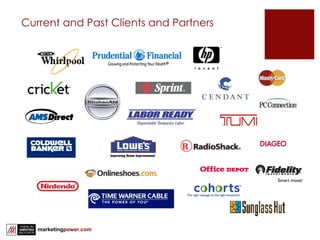
Current and Past Clients and Partners
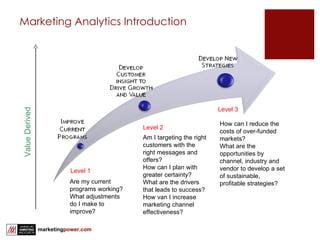
Marketing Analytics Introduction Level 1 Level 2 Level 3 Value Derived Are my current programs working? What adjustments do I make to improve? Am I targeting the right customers with the right messages and offers? How can I plan with greater certainty?  What are the drivers that leads to success? How van I increase marketing channel effectiveness? How can I reduce the costs of over-funded markets? What are the opportunities by channel, industry and vendor to develop a set of sustainable, profitable strategies?
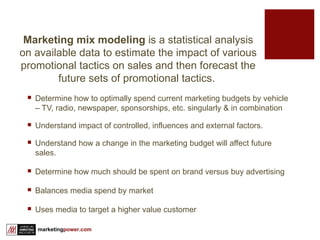
Determine how to optimally spend current marketing budgets by vehicle – TV, radio, newspaper, sponsorships, etc. singularly & in combination Understand impact of controlled, influences and external factors. Understand how a change in the marketing budget will affect future sales.  Determine how much should be spent on brand versus buy advertising Balances media spend by market Uses media to target a higher value customer Marketing mix modeling  is a statistical analysis on available data to estimate the impact of various promotional tactics on sales and then forecast the future sets of promotional tactics.
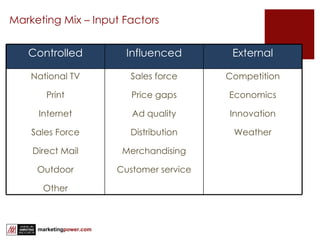
Marketing Mix – Input Factors Controlled Influenced External National TV Print Internet Sales Force Direct Mail Outdoor Other Sales force Price gaps Ad quality Distribution Merchandising Customer service Competition Economics Innovation Weather
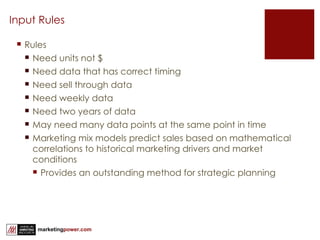
Input Rules Rules Need units not $ Need data that has correct timing Need sell through data Need weekly data Need two years of data May need many data points at the same point in time Marketing mix models predict sales based on mathematical correlations to historical marketing drivers and market conditions Provides an outstanding method for strategic planning
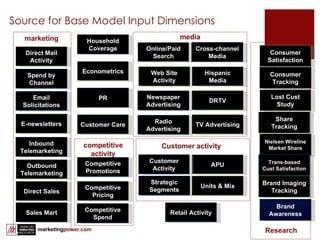
Source for Base Model Input Dimensions Household Coverage Econometrics Direct Mail Activity Spend by Channel Email Solicitations E-newsletters Inbound Telemarketing Outbound Telemarketing Direct Sales Sales Mart Competitive Promotions Competitive Pricing Competitive Spend Online/Paid Search Web Site Activity Newspaper Advertising Radio Advertising TV Advertising Cross-channel Media Hispanic Media DRTV PR Retail Activity Consumer Satisfaction Consumer Tracking Lost Cust Study Share Tracking Nielsen Wireline Market Share Trans-based Cust Satisfaction Brand Imaging Tracking Brand Awareness APU Customer Care Customer Activity Strategic Segments Units & Mix marketing media Customer activity competitive activity market research Research
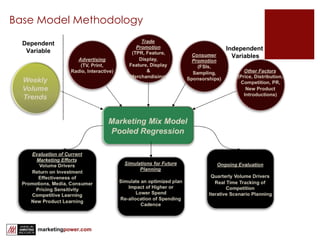
Base Model Methodology Dependent Variable Independent  Variables
Base Marketing Mix Model
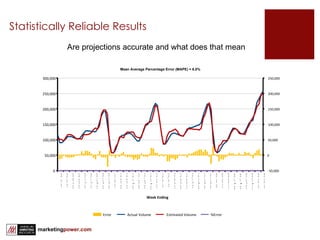
Statistically Reliable Results Are projections accurate and what does that mean - 50,000 0 50,000 100,000 150,000 200,000 250,000 0 50,000 100,000 150,000 200,000 250,000 300,000 0 9 - J u - 0 6 3 0 - J u l - 0 6 2 0 - A u g - 0 6 1 0 - S e p - 0 6 0 1 - O c t - 0 6 2 2 - O c t - 0 6 1 2 - N o v - 0 6 0 3 - D e c - 0 6 2 4 - D e c - 0 6 1 4 - J a n - 0 7 0 4 - F e b - 0 7 2 5 - F e b - 0 7 1 8 - M a r - 0 7 0 8 - A p r - 0 7 2 9 - A p r - 0 7 2 0 - M a y - 0 7 1 0 - J u n - 0 7 0 1 - J u l - 0 7 2 2 - J u l - 0 7 1 2 - A u g - 0 7 0 2 - S e p - 0 7 2 3 - S e p - 0 7 1 4 - O c t - 0 7 0 4 - N o v - 0 7 2 5 - N o v - 0 7 1 6 - D e c - 0 7 0 6 - J a n - 0 8 2 7 - J a n - 0 8 1 7 - F e b - 0 8 0 9 - M a r - 0 8 3 0 - M a r - 0 8 2 0 - A p r - 0 8 1 1 - M a y - 0 8 0 1 - J u n - 0 8 2 2 - J u n - 0 8 Week Ending Error Actual Volume Estimated Volume %Error Mean Average Percentage Error (MAPE) = 6.0%
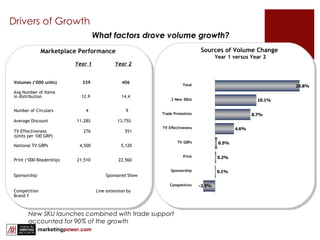
Drivers of Growth  Sources of Volume Change  Year 1 versus Year 2 Year 2 Year 1 Volumes (‘000 units)   339   406 Avg Number of Items  in distribution   12.9   14.4 Number of Circulars   4   9  Average Discount   11.28%   13.75% TV Effectiveness    276   551 (Units per 100 GRP) National TV GRPs   4,500   5,120 Print (‘000 Readership)   21,510  22,560 Sponsorship Sponsored Show Competition Line extension by Brand Y Marketplace Performance What factors drove volume growth? New SKU launches combined with trade support accounted for 90% of the growth
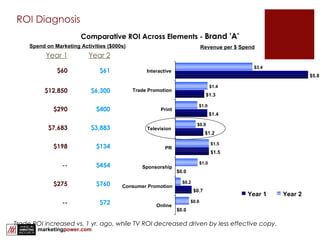
ROI Diagnosis Revenue per $ Spend Spend on Marketing Activities ($000s) Comparative ROI Across Elements -  Brand 'A' $0.0 $0.7 $0.0 $1.5 $1.2 $1.4 $1.3 $5.8 $0.6 $0.2 $1.0 $1.5 $0.9 $1.0 $1.4 $3.4 Online Consumer Promotion Sponsorship PR Television Print Trade Promotion Interactive Year 1 Year 2 Trade ROI increased vs. 1 yr. ago, while TV ROI decreased driven by less effective copy. Year 1 Year 2 $60 $61 $12,850 $6,300 $290 $400 $7,683 $3,883 $198 $134 -- $454 $275 $760 -- $72
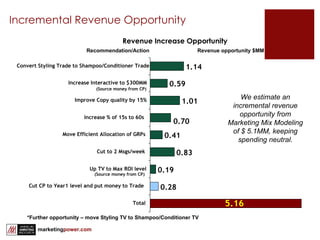
Incremental Revenue Opportunity Revenue Increase Opportunity Revenue opportunity $MM Recommendation/Action (Source money from CP) (Source money from CP) *Further opportunity – move Styling TV to Shampoo/Conditioner TV 0.19 0.83 0.41 0.70 1.01 0.59 1.14 0.28 5.16 Total Cut CP to Year1 level and put money to Trade Up TV to Max ROI level Cut to 2 Msgs/week Move Efficient Allocation of GRPs Increase % of 15s to 60s Improve Copy quality by 15% Increase Interactive to $300MM Convert Styling Trade to Shampoo/Conditioner Trade We estimate an incremental revenue opportunity from Marketing Mix Modeling of $ 5.1MM, keeping spending neutral.
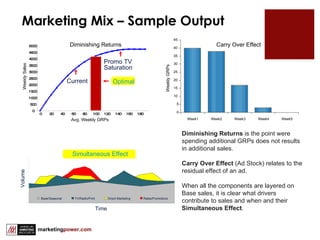
Marketing Mix – Sample Output Volume Time 0 5 10 15 20 25 30 35 40 45 Week1 Week2 Week3 Week4 Week5 Weekly GRPs Carry Over Effect Base/Seasonal TV/Radio/Print Direct Marketing Rates/Promotions Simultaneous Effect Diminishing Returns Diminishing Returns  is the point were spending additional GRPs does not results in additional sales. Carry Over Effect  (Ad Stock) relates to the residual effect of an ad. When all the components are layered on Base sales, it is clear what drivers contribute to sales and when and their  Simultaneous Effect . Promo TV Saturation Avg. Weekly GRPs  Weekly Sales Optimal Current 0 500 1000 1500 2000 2500 3000 3500 4000 4500 5000 0 20 40 60 80 100 120 140 160 180
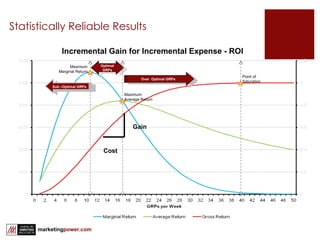
Statistically Reliable Results Incremental Gain for Incremental Expense - ROI Cost Gain Over  Optimal GRPs Optimal GRPs Sub –Optimal GRPs Maximum Marginal Return Maximum Average Return Point of Saturation
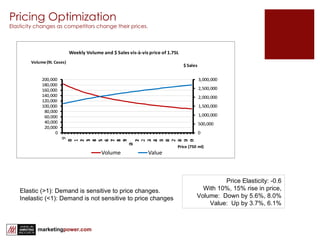
Pricing Optimization Elasticity changes as competitors change their prices. Price Elasticity: -0.6 With 10%, 15% rise in price, Volume:  Down by 5.6%, 8.0% Value:  Up by 3.7%, 6.1% Elastic (>1): Demand is sensitive to price changes. Inelastic (<1): Demand is not sensitive to price changes
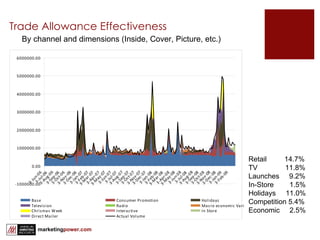
Trade Allowance Effectiveness Retail  14.7% TV  11.8% Launches  9.2% In-Store  1.5% Holidays  11.0% Competition 5.4% Economic  2.5% By channel and dimensions (Inside, Cover, Picture, etc.)
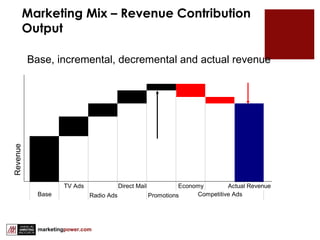
Marketing Mix – Revenue Contribution Output Base, incremental, decremental and actual revenue Revenue
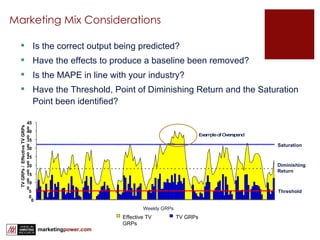
Marketing Mix Considerations Is the correct output being predicted?  Have the effects to produce a baseline been removed? Is the MAPE in line with your industry? Have the Threshold, Point of Diminishing Return and the Saturation Point been identified? 0 50 100 150 200 250 300 350 400 450 TV GRPs /  Effective TV GRPs Saturation Threshold Diminishing Return Example of Overspend Effective TV GRPs TV GRPs Weekly GRPs
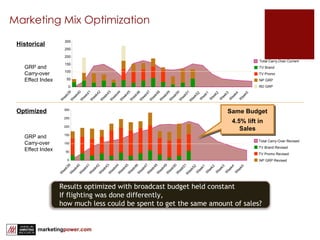
Marketing Mix Optimization Marketing Mix Optimization Historical Optimized GRP and Carry-over Effect Index GRP and Carry-over Effect Index Total Carry-Over Current TV Brand TV Promo NP GRP RD GRP 0 50 100 150 200 250 300 Week39 Week40 Week41 Week42 Week43 Week44 Week45 Week46 Week47 Week48 Week49 Week50 Week51 Week52  Week1 Week2 Week3 Week4 Week5 0 50 100 150 200 250 300 Week39 Week40 Week41 Week42 Week43 Week44 Week45 Week46 Week47 Week48 Week49 Week50 Week51 Week52  Week1 Week2 Week3 Week4 Week5 Total Carry-Over Revised TV Brand Revised TV Promo Revised NP GRP Revised Same Budget 4.5% lift in Sales Results optimized with broadcast budget held constant If flighting was done differently,  how much less could be spent to get the same amount of sales?
Marketing Mix Model Scenario Tool Tool supports different types of planning Run high level “What-If” scenarios to compare marketing options for specific tactics Project sales activity within a specified time period based on inputs of marketing and other drivers Marketing program planning with detailed weekly inputs on all dimensions and what-if scenarios Assess and revise budget allocation with re-allocations across different marketing channels Prepare a competitive response based on updated external factor inputs and performance goals Use outputs of advanced ROI analytics to prioritize budget allocations based on opportunities, channel optimization, effectiveness improvements, and incremental ROI
Increased Depth of Marketing Mix Analyses Halo affects so that the product that is most profitable is in the market more frequently Price/offer elasticity and its influence on sales Ad copy effectiveness TV ad length (30second versus 15 second ad effectiveness) TV ad execution wear-out curves Diminishing return curves The marketing mix model can provide additional insights beyond changing the allocation of marketing resources. This insight is used to improve the marketing organization’s understanding of marketing performance and to guide more precise decisions beyond just allocating budget into marketing channels.
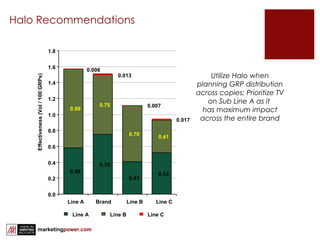
Halo Recommendations 0.58 0.75 0.41 0.52 0.99 0.75 0.70 0.41 0.017 0.007 0.013 0.006 0.0 0.2 0.4 0.6 0.8 1.0 1.2 1.4 1.6 1.8 Line A Brand Line B Line C Effectiveness (Vol / 100 GRPs) Line A Line B Line C Utilize Halo when planning GRP distribution across copies; Prioritize TV on Sub Line A as it  has maximum impact across the entire brand
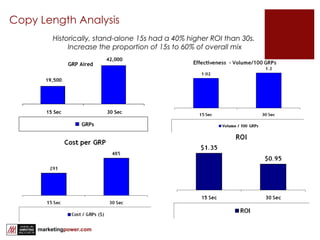
Copy Length Analysis GRP Aired 19,500 42,000 15 Sec 30 Sec GRPs Historically, stand-alone 15s had a 40% higher ROI than 30s.  Increase the proportion of 15s to 60% of overall mix
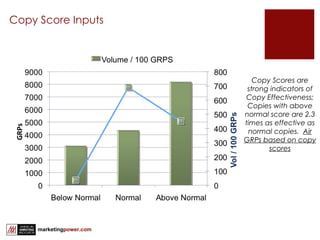
Copy Score Inputs Copy Scores are strong indicators of Copy Effectiveness; Copies with above normal score are 2.3 times as effective as normal copies.  Air GRPs based on copy scores
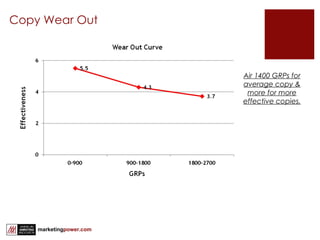
Copy Wear Out Air 1400 GRPs for average copy & more for more effective copies.
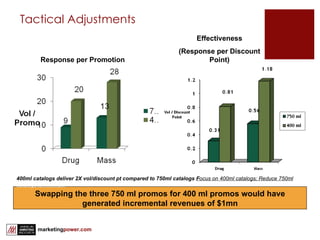
Tactical Adjustments Response per Promotion Effectiveness (Response per Discount Point) Swapping the three 750 ml promos for 400 ml promos would have generated incremental revenues of $1mn 400ml catalogs deliver 2X vol/discount pt compared to 750ml catalogs  F ocus on 400ml catalogs; Reduce 750ml  catalogs to minimum
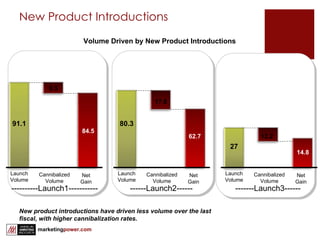
New Product Introductions 91.1 6.5 84.5 Launch Volume Cannibalized Volume Net Gain 80.3 17.6 62.7 Launch Volume Cannibalized Volume Net Gain 27 12.2 14.8 Launch Volume Cannibalized Volume Net Gain ----------Launch1----------- ------Launch2------ -------Launch3------ Volume Driven by New Product Introductions New product introductions have driven less volume over the last fiscal, with higher cannibalization rates.
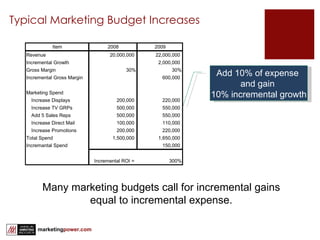
Typical Marketing Budget Increases Many marketing budgets call for incremental gains equal to incremental expense. Add 10% of expense  and gain  10% incremental growth
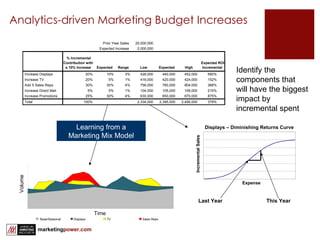
Analytics-driven Marketing Budget Increases Displays – Diminishing Returns Curve Expense Incremental Sales Last Year This Year Identify the components that  will have the biggest impact by incremental spent Learning from a Marketing Mix Model Volume Time Base/Seasonal Displays TV Sales Reps
MMM CPG  Marketing Mix Models have been used in Consumer Packaged Goods for a long time The 3 P’s (Product, Price, Promotion, Position) Goal is: Trial  (buy for the first time) Repeat Purchase (But it again; Family expectations) Habituation (buy every week, month, quarter, year) Dominant Position (Own the shelf) real estate Add on SKUs Profitability stability (standardizes product volume) Well know formulas Move the mix increase share and profits pretty reliably
MMM CPG Changes TV and print dominate trial – Very Expensive Slotting costs – Very Expensive Targeting Economics Traditional cost per thousand to reach millions Awareness Consideration Trial Online and Mobile Targeted E-mails Social Networking Web Coupons Can CPG companies drive sufficient trial with likely repeat purchasers to have a better ROI then traditional models Retail partner profit issues
MMM Non-CPG Cost of Trial Frequency of Purchase Customer CLV Concentration SKU Purchase Timing Profitability Cost of Broad Based vs Targeted Communication
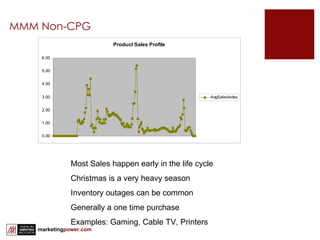
MMM Non-CPG Most Sales happen early in the life cycle Christmas is a very heavy season Inventory outages can be common Generally a one time purchase Examples: Gaming, Cable TV, Printers
Competitive & External Factors What happens when the competition innovates? iTunes Movie Rentals What happens when a competitor invades a market? What happens in different economic times? Legal changes Price wars Will the model be valid after it is developed?
Non-CPG Guidelines Need to have many similar markets so that the resultant model is not expected to handle too wide a variety of situations and has a high degree of accuracy The dependent (outcome) variable needs to be well thought through to meet the right goal. I.e. What is a sale? Is a great result due to marketing or a non-marketing factor. I.e. Does a unique event drive sales (i.e., new bundle) or is it the volume of GRPs? Has the recent success been with low value customers?  If so, the model needs to be constructed to NOT maximize this outcome. Has the competitive structure changed in a non-incremental manner. How does that effect efficiency and effectiveness in a new environment? Does the company have a knowable customer base?  If so, how does the change in the base affect marketing ROI and targeting How does the “cost of trial” in an infrequent purchase process affect marketing efficiency and effectiveness
Phoenix Marketing International 55 Walls Drive Suite 205 Fairfield, CT 06824 Don Holtz Group President (203) 254-8311 [email_address]

Marketing Mix Models In a Changing Environment

  • 1.
    Marketing Mix Modelsin a Changing Environment This webinar will address what needs to be different in Marketing Mix Models to continue to improve marketing performance including: Lower cost media to encourage product trials and repeat purchases Non-CPG companies developing Marketing Mix Models even though their business environment is far different to CPG Competitive and external factors can change and affect the guidance that results from a model when the model was built using historical data
  • 2.
    Marketing Mix Modelsin a Changing Environment Instructor: Don Holtz Phoenix Marketing International
  • 3.
    Don has over30 years experience providing clients with analytics-based solutions to complex business problems. Former Executive Vice President and Chief Technology Officer for Yankelovich Partners, Don Holtz was responsible for the creation and implementation of systems and supporting mathematics necessary for client companies to understand and implement “Customer Driven, Information Based” marketing strategies and applications. Don is a frequent guest lecturer at a number of universities and teaches AMA classes on marketing ROI and Marketing ANALYTICS. Don earned his BSE in Industrial Engineering and his MBA from the University of Michigan.   Resume Defense Systems Laboratory Management Science/Operations Research, Automotive Director Marketing Systems, Pharmaceuticals Salesman to Sr VP General Manager, Computer Timesharing Venture Capital-backed Firms Portable Computing Technology Electronic Funds Transfer Integrated Database Marketing Founded AIM Marketing in 1995 Sold to Yankelovich Partners in 1998 Founded Benchmarketing Analytics in 2001 Founded Interlocking Analytics in 2008 Group President – Phoenix Marketing Industries Cable CPG Financial Services Hospitality Manufacturing Online Pharmaceutical Publishing Real Estate Retail Services Technology Telecommunications Trucking Utilities Don Holtz
  • 4.
    Current and PastClients and Partners
  • 5.
    Marketing Analytics IntroductionLevel 1 Level 2 Level 3 Value Derived Are my current programs working? What adjustments do I make to improve? Am I targeting the right customers with the right messages and offers? How can I plan with greater certainty? What are the drivers that leads to success? How van I increase marketing channel effectiveness? How can I reduce the costs of over-funded markets? What are the opportunities by channel, industry and vendor to develop a set of sustainable, profitable strategies?
  • 6.
    Determine how tooptimally spend current marketing budgets by vehicle – TV, radio, newspaper, sponsorships, etc. singularly & in combination Understand impact of controlled, influences and external factors. Understand how a change in the marketing budget will affect future sales. Determine how much should be spent on brand versus buy advertising Balances media spend by market Uses media to target a higher value customer Marketing mix modeling is a statistical analysis on available data to estimate the impact of various promotional tactics on sales and then forecast the future sets of promotional tactics.
  • 7.
    Marketing Mix –Input Factors Controlled Influenced External National TV Print Internet Sales Force Direct Mail Outdoor Other Sales force Price gaps Ad quality Distribution Merchandising Customer service Competition Economics Innovation Weather
  • 8.
    Input Rules RulesNeed units not $ Need data that has correct timing Need sell through data Need weekly data Need two years of data May need many data points at the same point in time Marketing mix models predict sales based on mathematical correlations to historical marketing drivers and market conditions Provides an outstanding method for strategic planning
  • 9.
    Source for BaseModel Input Dimensions Household Coverage Econometrics Direct Mail Activity Spend by Channel Email Solicitations E-newsletters Inbound Telemarketing Outbound Telemarketing Direct Sales Sales Mart Competitive Promotions Competitive Pricing Competitive Spend Online/Paid Search Web Site Activity Newspaper Advertising Radio Advertising TV Advertising Cross-channel Media Hispanic Media DRTV PR Retail Activity Consumer Satisfaction Consumer Tracking Lost Cust Study Share Tracking Nielsen Wireline Market Share Trans-based Cust Satisfaction Brand Imaging Tracking Brand Awareness APU Customer Care Customer Activity Strategic Segments Units & Mix marketing media Customer activity competitive activity market research Research
  • 10.
    Base Model MethodologyDependent Variable Independent Variables
  • 11.
  • 12.
    Statistically Reliable ResultsAre projections accurate and what does that mean - 50,000 0 50,000 100,000 150,000 200,000 250,000 0 50,000 100,000 150,000 200,000 250,000 300,000 0 9 - J u - 0 6 3 0 - J u l - 0 6 2 0 - A u g - 0 6 1 0 - S e p - 0 6 0 1 - O c t - 0 6 2 2 - O c t - 0 6 1 2 - N o v - 0 6 0 3 - D e c - 0 6 2 4 - D e c - 0 6 1 4 - J a n - 0 7 0 4 - F e b - 0 7 2 5 - F e b - 0 7 1 8 - M a r - 0 7 0 8 - A p r - 0 7 2 9 - A p r - 0 7 2 0 - M a y - 0 7 1 0 - J u n - 0 7 0 1 - J u l - 0 7 2 2 - J u l - 0 7 1 2 - A u g - 0 7 0 2 - S e p - 0 7 2 3 - S e p - 0 7 1 4 - O c t - 0 7 0 4 - N o v - 0 7 2 5 - N o v - 0 7 1 6 - D e c - 0 7 0 6 - J a n - 0 8 2 7 - J a n - 0 8 1 7 - F e b - 0 8 0 9 - M a r - 0 8 3 0 - M a r - 0 8 2 0 - A p r - 0 8 1 1 - M a y - 0 8 0 1 - J u n - 0 8 2 2 - J u n - 0 8 Week Ending Error Actual Volume Estimated Volume %Error Mean Average Percentage Error (MAPE) = 6.0%
  • 13.
    Drivers of Growth Sources of Volume Change Year 1 versus Year 2 Year 2 Year 1 Volumes (‘000 units) 339 406 Avg Number of Items in distribution 12.9 14.4 Number of Circulars 4 9 Average Discount 11.28% 13.75% TV Effectiveness 276 551 (Units per 100 GRP) National TV GRPs 4,500 5,120 Print (‘000 Readership) 21,510 22,560 Sponsorship Sponsored Show Competition Line extension by Brand Y Marketplace Performance What factors drove volume growth? New SKU launches combined with trade support accounted for 90% of the growth
  • 14.
    ROI Diagnosis Revenueper $ Spend Spend on Marketing Activities ($000s) Comparative ROI Across Elements - Brand 'A' $0.0 $0.7 $0.0 $1.5 $1.2 $1.4 $1.3 $5.8 $0.6 $0.2 $1.0 $1.5 $0.9 $1.0 $1.4 $3.4 Online Consumer Promotion Sponsorship PR Television Print Trade Promotion Interactive Year 1 Year 2 Trade ROI increased vs. 1 yr. ago, while TV ROI decreased driven by less effective copy. Year 1 Year 2 $60 $61 $12,850 $6,300 $290 $400 $7,683 $3,883 $198 $134 -- $454 $275 $760 -- $72
  • 15.
    Incremental Revenue OpportunityRevenue Increase Opportunity Revenue opportunity $MM Recommendation/Action (Source money from CP) (Source money from CP) *Further opportunity – move Styling TV to Shampoo/Conditioner TV 0.19 0.83 0.41 0.70 1.01 0.59 1.14 0.28 5.16 Total Cut CP to Year1 level and put money to Trade Up TV to Max ROI level Cut to 2 Msgs/week Move Efficient Allocation of GRPs Increase % of 15s to 60s Improve Copy quality by 15% Increase Interactive to $300MM Convert Styling Trade to Shampoo/Conditioner Trade We estimate an incremental revenue opportunity from Marketing Mix Modeling of $ 5.1MM, keeping spending neutral.
  • 16.
    Marketing Mix –Sample Output Volume Time 0 5 10 15 20 25 30 35 40 45 Week1 Week2 Week3 Week4 Week5 Weekly GRPs Carry Over Effect Base/Seasonal TV/Radio/Print Direct Marketing Rates/Promotions Simultaneous Effect Diminishing Returns Diminishing Returns is the point were spending additional GRPs does not results in additional sales. Carry Over Effect (Ad Stock) relates to the residual effect of an ad. When all the components are layered on Base sales, it is clear what drivers contribute to sales and when and their Simultaneous Effect . Promo TV Saturation Avg. Weekly GRPs Weekly Sales Optimal Current 0 500 1000 1500 2000 2500 3000 3500 4000 4500 5000 0 20 40 60 80 100 120 140 160 180
  • 17.
    Statistically Reliable ResultsIncremental Gain for Incremental Expense - ROI Cost Gain Over Optimal GRPs Optimal GRPs Sub –Optimal GRPs Maximum Marginal Return Maximum Average Return Point of Saturation
  • 18.
    Pricing Optimization Elasticitychanges as competitors change their prices. Price Elasticity: -0.6 With 10%, 15% rise in price, Volume: Down by 5.6%, 8.0% Value: Up by 3.7%, 6.1% Elastic (>1): Demand is sensitive to price changes. Inelastic (<1): Demand is not sensitive to price changes
  • 19.
    Trade Allowance EffectivenessRetail 14.7% TV 11.8% Launches 9.2% In-Store 1.5% Holidays 11.0% Competition 5.4% Economic 2.5% By channel and dimensions (Inside, Cover, Picture, etc.)
  • 20.
    Marketing Mix –Revenue Contribution Output Base, incremental, decremental and actual revenue Revenue
  • 21.
    Marketing Mix ConsiderationsIs the correct output being predicted? Have the effects to produce a baseline been removed? Is the MAPE in line with your industry? Have the Threshold, Point of Diminishing Return and the Saturation Point been identified? 0 50 100 150 200 250 300 350 400 450 TV GRPs / Effective TV GRPs Saturation Threshold Diminishing Return Example of Overspend Effective TV GRPs TV GRPs Weekly GRPs
  • 22.
    Marketing Mix OptimizationMarketing Mix Optimization Historical Optimized GRP and Carry-over Effect Index GRP and Carry-over Effect Index Total Carry-Over Current TV Brand TV Promo NP GRP RD GRP 0 50 100 150 200 250 300 Week39 Week40 Week41 Week42 Week43 Week44 Week45 Week46 Week47 Week48 Week49 Week50 Week51 Week52 Week1 Week2 Week3 Week4 Week5 0 50 100 150 200 250 300 Week39 Week40 Week41 Week42 Week43 Week44 Week45 Week46 Week47 Week48 Week49 Week50 Week51 Week52 Week1 Week2 Week3 Week4 Week5 Total Carry-Over Revised TV Brand Revised TV Promo Revised NP GRP Revised Same Budget 4.5% lift in Sales Results optimized with broadcast budget held constant If flighting was done differently, how much less could be spent to get the same amount of sales?
  • 23.
    Marketing Mix ModelScenario Tool Tool supports different types of planning Run high level “What-If” scenarios to compare marketing options for specific tactics Project sales activity within a specified time period based on inputs of marketing and other drivers Marketing program planning with detailed weekly inputs on all dimensions and what-if scenarios Assess and revise budget allocation with re-allocations across different marketing channels Prepare a competitive response based on updated external factor inputs and performance goals Use outputs of advanced ROI analytics to prioritize budget allocations based on opportunities, channel optimization, effectiveness improvements, and incremental ROI
  • 24.
    Increased Depth ofMarketing Mix Analyses Halo affects so that the product that is most profitable is in the market more frequently Price/offer elasticity and its influence on sales Ad copy effectiveness TV ad length (30second versus 15 second ad effectiveness) TV ad execution wear-out curves Diminishing return curves The marketing mix model can provide additional insights beyond changing the allocation of marketing resources. This insight is used to improve the marketing organization’s understanding of marketing performance and to guide more precise decisions beyond just allocating budget into marketing channels.
  • 25.
    Halo Recommendations 0.580.75 0.41 0.52 0.99 0.75 0.70 0.41 0.017 0.007 0.013 0.006 0.0 0.2 0.4 0.6 0.8 1.0 1.2 1.4 1.6 1.8 Line A Brand Line B Line C Effectiveness (Vol / 100 GRPs) Line A Line B Line C Utilize Halo when planning GRP distribution across copies; Prioritize TV on Sub Line A as it has maximum impact across the entire brand
  • 26.
    Copy Length AnalysisGRP Aired 19,500 42,000 15 Sec 30 Sec GRPs Historically, stand-alone 15s had a 40% higher ROI than 30s. Increase the proportion of 15s to 60% of overall mix
  • 27.
    Copy Score InputsCopy Scores are strong indicators of Copy Effectiveness; Copies with above normal score are 2.3 times as effective as normal copies. Air GRPs based on copy scores
  • 28.
    Copy Wear OutAir 1400 GRPs for average copy & more for more effective copies.
  • 29.
    Tactical Adjustments Responseper Promotion Effectiveness (Response per Discount Point) Swapping the three 750 ml promos for 400 ml promos would have generated incremental revenues of $1mn 400ml catalogs deliver 2X vol/discount pt compared to 750ml catalogs F ocus on 400ml catalogs; Reduce 750ml catalogs to minimum
  • 30.
    New Product Introductions91.1 6.5 84.5 Launch Volume Cannibalized Volume Net Gain 80.3 17.6 62.7 Launch Volume Cannibalized Volume Net Gain 27 12.2 14.8 Launch Volume Cannibalized Volume Net Gain ----------Launch1----------- ------Launch2------ -------Launch3------ Volume Driven by New Product Introductions New product introductions have driven less volume over the last fiscal, with higher cannibalization rates.
  • 31.
    Typical Marketing BudgetIncreases Many marketing budgets call for incremental gains equal to incremental expense. Add 10% of expense and gain 10% incremental growth
  • 32.
    Analytics-driven Marketing BudgetIncreases Displays – Diminishing Returns Curve Expense Incremental Sales Last Year This Year Identify the components that will have the biggest impact by incremental spent Learning from a Marketing Mix Model Volume Time Base/Seasonal Displays TV Sales Reps
  • 33.
    MMM CPG Marketing Mix Models have been used in Consumer Packaged Goods for a long time The 3 P’s (Product, Price, Promotion, Position) Goal is: Trial (buy for the first time) Repeat Purchase (But it again; Family expectations) Habituation (buy every week, month, quarter, year) Dominant Position (Own the shelf) real estate Add on SKUs Profitability stability (standardizes product volume) Well know formulas Move the mix increase share and profits pretty reliably
  • 34.
    MMM CPG ChangesTV and print dominate trial – Very Expensive Slotting costs – Very Expensive Targeting Economics Traditional cost per thousand to reach millions Awareness Consideration Trial Online and Mobile Targeted E-mails Social Networking Web Coupons Can CPG companies drive sufficient trial with likely repeat purchasers to have a better ROI then traditional models Retail partner profit issues
  • 35.
    MMM Non-CPG Costof Trial Frequency of Purchase Customer CLV Concentration SKU Purchase Timing Profitability Cost of Broad Based vs Targeted Communication
  • 36.
    MMM Non-CPG MostSales happen early in the life cycle Christmas is a very heavy season Inventory outages can be common Generally a one time purchase Examples: Gaming, Cable TV, Printers
  • 37.
    Competitive & ExternalFactors What happens when the competition innovates? iTunes Movie Rentals What happens when a competitor invades a market? What happens in different economic times? Legal changes Price wars Will the model be valid after it is developed?
  • 38.
    Non-CPG Guidelines Needto have many similar markets so that the resultant model is not expected to handle too wide a variety of situations and has a high degree of accuracy The dependent (outcome) variable needs to be well thought through to meet the right goal. I.e. What is a sale? Is a great result due to marketing or a non-marketing factor. I.e. Does a unique event drive sales (i.e., new bundle) or is it the volume of GRPs? Has the recent success been with low value customers? If so, the model needs to be constructed to NOT maximize this outcome. Has the competitive structure changed in a non-incremental manner. How does that effect efficiency and effectiveness in a new environment? Does the company have a knowable customer base? If so, how does the change in the base affect marketing ROI and targeting How does the “cost of trial” in an infrequent purchase process affect marketing efficiency and effectiveness
  • 39.
    Phoenix Marketing International55 Walls Drive Suite 205 Fairfield, CT 06824 Don Holtz Group President (203) 254-8311 [email_address]

Editor's Notes

  • #6 Go through the 3 levels Describe the potential return from each level and how it is generated.
  • #7 Use diageo example
  • #9 Not for copy or distribution without written permission from Lenskold Group
  • #10 Not for copy or distribution without written permission from Lenskold Group
  • #11 Not for copy or distribution without written permission from Lenskold Group
  • #12 Not for copy or distribution without written permission from Lenskold Group
  • #17 Not for copy or distribution without written permission from Lenskold Group
  • #19 Describe 10% increase I price provides a 5.6% decrease in volume but an increase in profits. Draw curves on the flip chart
  • #21 Not for copy or distribution without written permission from Lenskold Group
  • #24 Not for copy or distribution without written permission from Lenskold Group
  • #25 Not for copy or distribution without written permission from Lenskold Group
  • #32 Show how incremental marketing doesn’t work as well as analytical based decisions
  • #33 Knowing what the return is in detail can put together a much more robust plan for the same funding.