Seatwork: Consolidated Questions for Chapters1-9 Ma. Alexandria Bulaon December 30,2011
Chapter 1:  Defining Marketing for the 21st Century 10 Learning Questions Rex Sandoval
1. What does “wants” and “buying power” results into? Need Satisfaction Necessity Demand Require
1. Wants become _____ When a consumer also has the buying power. Need Satisfaction Necessity Demand Require
Core Marketing Concepts Needs, wants, and demands Target markets, positioning, segmentation Offerings and brands Value and satisfaction Marketing Channels Supply Chain Competition Marketing Environment
Demand This is the wants for specific product backed by an ability to pay
1. What does “wants” and “buying power” results into? Need Satisfaction Necessity Demand Require
1. Wants become _____ When a consumer also has the buying power. Need Satisfaction Necessity Demand Require
Chapter 2: Developing Marketing Strategies and Plans 10 Learning Questions Belinda Anne Tamayo
A holistic marketing orientation can help capture customer value.  The holistic framework is designed to address three key management questions. Which concept below addresses the concern on how a company can identify new value opportunities? http://beltamayo.blogspot.com/ QUESTION 1 Value Exploration Value Creation Value Delivery None of the above
1.  A holistic marketing orientation can help capture customer value. The holistic framework is designed to address three key management questions. Which concept below addresses the concern on how a company can identify new value opportunities? A. Value Exploration that addresses the concern that delivers the new value offerings.  B. Value Delivery that addresses the concern on how can a company use its capabilities and infrastructure. C. Value Exploration that addresses the concern on how can a company identify new value opportunities.  E. Value Creation that addresses the concern on how can a company efficiently create more promising new value offerings. F. None of the above.
Concepts Value Exploration – Addresses the concern on  how can a company identify new value opportunities Value Creation – Addresses the concern on  how can a company efficiently create more promising new value offerings Value Delivery – Addresses the concern on  how can a company use its capabilities and infrastructure to deliver the new value offerings more efficiently http://beltamayo.blogspot.com/
Concepts
A holistic marketing orientation can help capture customer value.  The holistic framework is designed to address three key management questions. Which concept below addresses the concern on how a company can identify new value opportunities? http://beltamayo.blogspot.com/ QUESTION 1 Value Exploration Value Creation Value Delivery None of the above
1.  A holistic marketing orientation can help capture customer value. The holistic framework is designed to address three key management questions. Which concept below addresses the concern on how a company can identify new value opportunities? A. Value Exploration that addresses the concern that delivers the new value offerings.  B. Value Delivery that addresses the concern on how can a company use its capabilities and infrastructure. C. Value Exploration that addresses the concern on how can a company identify new value opportunities.  E. Value Creation that addresses the concern on how can a company efficiently create more promising new value offerings. F. None of the above.
Top 10 Learning Questions for Chapter 3 : Gathering Information and Scanning the Environment Nyel Berroya December 15, 2011 http://www.slideshare.net/rochedeluta
1. A _________ relies on internal company records, marketing intelligence activities and marketing research. A. Marketing Research System B. Marketing Decision Support System C. Marketing Information System D. Marketing Intelligence System E. None of the Above
1. A_________relies on internal company records,marketing intelligence  activities and marketing research. A. Marketing Information B. Marketing Information System  C. Managed Information System  D. Marketing Intelligence Records  E. Marketing Intelligence System
What is Marketing Information System (MIS)? Marketing Information System (MIS) – consists of people, equipment, and procedures to gather, sort, analyze, evaluate, and distribute needed, timely and accurate information to marketing decision makers.
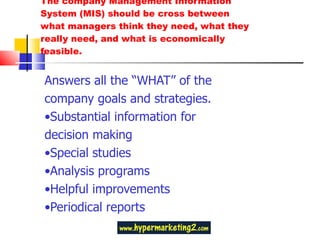
The company Management Information System (MIS) should be cross between what managers think they need, what they really need, and what is economically feasible. Answers all the “WHAT” of the company goals and strategies. • Substantial information for decision making • Special studies • Analysis programs • Helpful improvements • Periodical reports
1. A _________ relies on internal company records, marketing intelligence activities and marketing research. A. Marketing Research System B. Marketing Decision Support System C. Marketing Information System D. Marketing Intelligence System E. None of the Above
1. A_________relies on internal company records,marketing intelligence  activities and marketing research. A. Marketing Information B. Marketing Information System  C. Managed Information System  D. Marketing Intelligence Records  E. Marketing Intelligence System
TOP 10 Learning Questions for Ch 4: Conducting  Marketing Research and Forecasting Demand Ma Alexandria Bulaon December 16, 2011
1.  The first step in the marketing research process is _____.  develop the research plan define the problem and research objectives collect the information present the data make the decision
1. The first step in the marketing research process is _____.  A. Defining the budget necessary to conduct the marketing research. B. Defining the problem.  C. Defining the need for marketing research. D. Defining approval from top management.  E. Defining an appropriate marketing firm to carry out the research project.
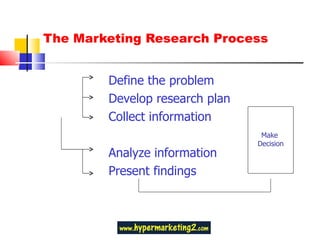
The Marketing Research Process Define the problem Develop research plan Collect information Analyze information Present findings Make  Decision
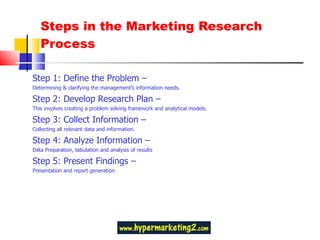
Steps in the Marketing Research Process Step 1: Define the Problem –  Determining & clarifying the management’s information needs. Step 2: Develop Research Plan –  This involves creating a problem solving framework and analytical models. Step 3: Collect Information –  Collecting all relevant data and information. Step 4: Analyze Information –  Data Preparation, tabulation and analysis of results Step 5: Present Findings –  Presentation and report generation
Defining the Problem The starting phase is always identifying the reason or problem for which research is to be conducted. This includes collecting of relevant initial information and how this information will affect decision making process.
1.  The first step in the marketing research process is _____.  develop the research plan define the problem and research objectives collect the information present the data make the decision
1. The first step in the marketing research process is _____.  A. Defining the budget necessary to conduct the marketing research. B. Defining the problem.  C. Defining the need for marketing research. D. Defining approval from top management.  E. Defining an appropriate marketing firm to carry out the research project.
TOP 10 Learning Questions for Chapter 6 Analyzing Consumer Markets Valderas, Cristina Krastle December 15, 2011
1. ____ is the study of how individuals select, buy, use and dispose of goods and services to satisfy their needs and wants. Consumer Behaviourism Consumer Attitude Consumer Market Market Research Market Demand
1. ____ is the study of how individuals select, buy, use and dispose of goods and services to satisfy their needs and wants. A. Consumer Rights  B. Consumer Focus C. Consumer Behavior  D. Consumer Ways E. Consumer Attitude
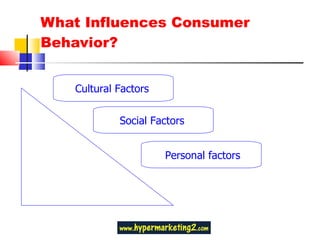
What Influences Consumer Behavior? Cultural Factors Social Factors Personal factors
Consumer Behaviourism -  the study of how individuals, groups, and organizations select, buy, use and dispose of goods, services, ideas, or experience to satisfy their needs and wants.
1. ____ is the study of how individuals select, buy, use and dispose of goods and services to satisfy their needs and wants. Consumer Behaviourism Consumer Attitude Consumer Market Market Research Market Demand
1. ____ is the study of how individuals select, buy, use and dispose of goods and services to satisfy their needs and wants. A. Consumer Rights  B. Consumer Focus C. Consumer Behavior  D. Consumer Ways E. Consumer Attitude
TOP 10 Learning Questions for Chapter 6: Analyzing Consumer Markets   Jem Caraig December 16, 2011 For use  in the Marketing Management Class of  Prof. Remigio Joseph De Ungria http://jemcaraig.blogspot.com
1. In the three factors that influence on consumer behavior, which is the factor that exerts the broadest and deepest influence? Social Factors Cultural Factors Subcultural Factors Psychological Factors Personal Factors http://jemcaraig.blogspot.com
1. In the three factors that influence on consumer behavior, which is the factor that exerts the broadest and deepest influence? A. Personality and self-concept, lifestyle and values significantly influences a buyer's decision.  B. Culture, subculture, and social class affect the consumer behavior.  C. Buyer's age and stage in the lifecycle influences the buyer's decision.  D. One's occupation and economic circumstances affect the consumer behavior.  E. Reference groups, family, and social roles greatly affect our buying behavior.
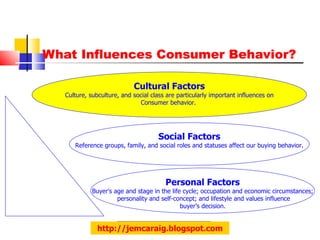
What Influences Consumer Behavior? Cultural Factors Culture, subculture, and social class are particularly important influences on Consumer behavior.  Social Factors Reference groups, family, and social roles and statuses affect our buying behavior. Personal Factors Buyer's age and stage in the life cycle; occupation and economic circumstances; personality and self-concept; and lifestyle and values influence buyer’s decision. http://jemcaraig.blogspot.com
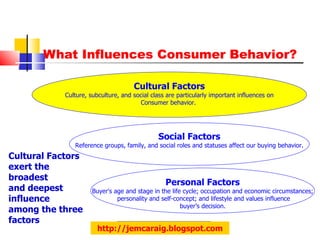
What Influences Consumer Behavior? Cultural Factors Culture, subculture, and social class are particularly important influences on Consumer behavior.  Social Factors Reference groups, family, and social roles and statuses affect our buying behavior. Personal Factors Buyer's age and stage in the life cycle; occupation and economic circumstances; personality and self-concept; and lifestyle and values influence buyer’s decision. Cultural Factors exert the broadest and deepest influence among the three factors  http://jemcaraig.blogspot.com
1. In the three factors that influence on consumer behavior, which is the factor that exerts the broadest and deepest influence? Social Factors Cultural Factors Subcultural Factors Psychological Factors Personal Factors http://jemcaraig.blogspot.com
1. In the three factors that influence on consumer behavior, which is the factor that exerts the broadest and deepest influence? A. Personality and self-concept, lifestyle and values significantly influences a buyer's decision.  B. Culture, subculture, and social class affect the consumer behavior.  C. Buyer's age and stage in the lifecycle influences the buyer's decision.  D. One's occupation and economic circumstances affect the consumer behavior.  E. Reference groups, family, and social roles greatly affect our buying behavior.
Top 10 Questions for (Chapter #7) Marika Chavez December 15, 2011 Chapter 7 Marketing Management, Kotler 14 th  ed
3. In the Buying Center, who are the people who define specifications and provide information for evaluating alternatives? Initiators Influencers Deciders Buyers Approvers
3. In the Buying Center, who are the people who define specifications and provide information for evaluating alternatives? A. People who have the power to prevent information or sellers from reaching the members.  B. People who authorize the proposed action for the deciders and buyers.  C. People who use the product or service.  D. People who influence the buying decision.  E. People who decides the product requirements for suppliers.
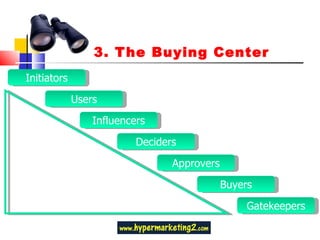
3. The Buying Center Initiators Users Influencers Deciders Approvers Buyers Gatekeepers
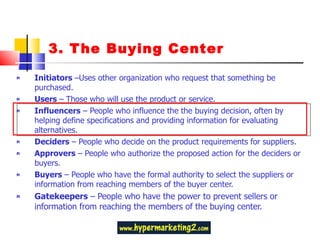
3. The Buying Center Initiators  –Uses other organization who request that something be purchased. Users  – Those who will use the product or service. Influencers  – People who influence the the buying decision, often by helping define specifications and providing information for evaluating alternatives. Deciders  – People who decide on the product requirements for suppliers.  Approvers  – People who authorize the proposed action for the deciders or buyers. Buyers  – People who have the formal authority to select the suppliers or information from reaching members of the buyer center. Gatekeepers  – People who have the power to prevent sellers or information from reaching the members of the buying center.
3. In the Buying Center, who are the people who define specifications and provide information for evaluating alternatives? Initiators Influencers Deciders Buyers Approvers
3. In the Buying Center, who are the people who define specifications and provide information for evaluating alternatives? A. People who have the power to prevent information or sellers from reaching the members.  B. People who authorize the proposed action for the deciders and buyers.  C. People who use the product or service.  D. People who influence the buying decision.  E. People who decides the product requirements for suppliers.
TOP 10 Learning Questions for (Chapter 8- Identifying Market Segments and Targets)  Nailah P. Cristobal December 16, 2011 http://nailah08.blogspot.com Marketing Management Class of  Prof. Remigio Joseph De Ungria Colorful Me
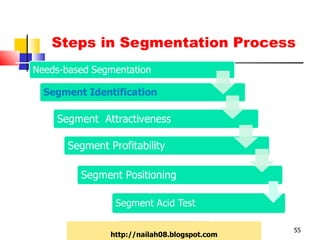
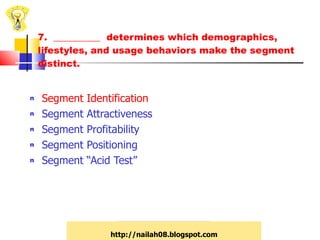
7.  __________  determines which demographics, lifestyles, and usage behaviors make the segment distinct. Segment Identification Segment Attractiveness Segment Profitability Segment Positioning Segment “Acid Test” http://nailah08.blogspot.com
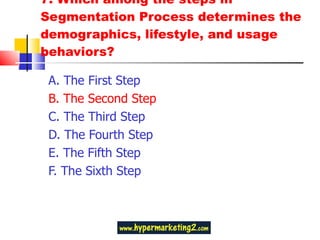
7. Which among the steps in Segmentation Process determines the demographics, lifestyle, and usage behaviors?  A. The First Step  B. The Second Step  C. The Third Step  D. The Fourth Step  E. The Fifth Step  F. The Sixth Step
Steps in Segmentation Process http://nailah08.blogspot.com
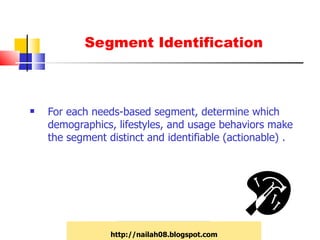
Segment Identification For each needs-based segment, determine which demographics, lifestyles, and usage behaviors make the segment distinct and identifiable (actionable) .  http://nailah08.blogspot.com
7.  __________  determines which demographics, lifestyles, and usage behaviors make the segment distinct. Segment Identification Segment Attractiveness Segment Profitability Segment Positioning Segment “Acid Test” http://nailah08.blogspot.com
7. Which among the steps in Segmentation Process determines the demographics, lifestyle, and usage behaviors?  A. The First Step  B. The Second Step  C. The Third Step  D. The Fourth Step  E. The Fifth Step  F. The Sixth Step
Top 10 Learning Questions for Chapter 9 Creating Brand Equity Roche Deluta December 15, 2011 V56 Marketing Class of Prof. Remigio Joseph De Ungria Chapter 9 Marketing Management, Kotler 14 th  ed http://www.slideshare.net/rochedeluta
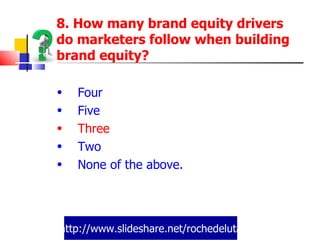
http://www.slideshare.net/rochedeluta 8. How many brand equity drivers do marketers follow when building brand equity? Four Five Three Two None of the above.
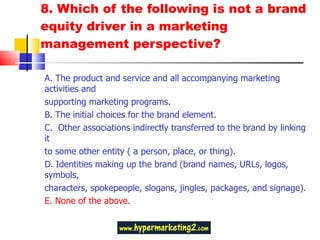
8. Which of the following is not a brand equity driver in a marketing management perspective?  A. The product and service and all accompanying marketing activities and supporting marketing programs. B. The initial choices for the brand element.  C.  Other associations indirectly transferred to the brand by linking it to some other entity ( a person, place, or thing). D. Identities making up the brand (brand names, URLs, logos, symbols, characters, spokepeople, slogans, jingles, packages, and signage). E. None of the above.
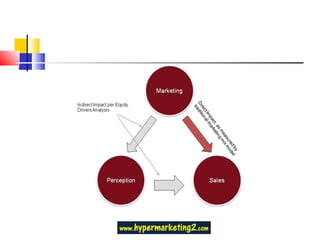
http://www.slideshare.net/rochedeluta 8. From a marketing management perspective, there are three main sets of brand equity drivers:  The initial choices for the brand element or identities making up the brand (brand names, URLs, logos, symbols, characters, spokespeople, slogans, jingles, packages, and signage). The product and service and all accompanying marketing activities and supporting marketing programs. Other associations indirectly transferred to the brand by linking it to some other entity ( a person, place, or thing).
 
http://www.slideshare.net/rochedeluta 8. How many brand equity drivers do marketers follow when building brand equity? Four Five Three Two None of the above.
8. Which of the following is not a brand equity driver in a marketing management perspective?  A. The product and service and all accompanying marketing activities and supporting marketing programs. B. The initial choices for the brand element.  C.  Other associations indirectly transferred to the brand by linking it to some other entity ( a person, place, or thing). D. Identities making up the brand (brand names, URLs, logos, symbols, characters, spokepeople, slogans, jingles, packages, and signage). E. None of the above.
Seatwork: Consolidated Questions for Chapters1-9 Ma. Alexandria Bulaon December 30,2011

Seatwork: Consolidated Questions (CH 1-9)

  • 1.
    Seatwork: Consolidated Questionsfor Chapters1-9 Ma. Alexandria Bulaon December 30,2011
  • 2.
    Chapter 1: Defining Marketing for the 21st Century 10 Learning Questions Rex Sandoval
  • 3.
    1. What does“wants” and “buying power” results into? Need Satisfaction Necessity Demand Require
  • 4.
    1. Wants become_____ When a consumer also has the buying power. Need Satisfaction Necessity Demand Require
  • 5.
    Core Marketing ConceptsNeeds, wants, and demands Target markets, positioning, segmentation Offerings and brands Value and satisfaction Marketing Channels Supply Chain Competition Marketing Environment
  • 6.
    Demand This isthe wants for specific product backed by an ability to pay
  • 7.
    1. What does“wants” and “buying power” results into? Need Satisfaction Necessity Demand Require
  • 8.
    1. Wants become_____ When a consumer also has the buying power. Need Satisfaction Necessity Demand Require
  • 9.
    Chapter 2: DevelopingMarketing Strategies and Plans 10 Learning Questions Belinda Anne Tamayo
  • 10.
    A holistic marketingorientation can help capture customer value. The holistic framework is designed to address three key management questions. Which concept below addresses the concern on how a company can identify new value opportunities? http://beltamayo.blogspot.com/ QUESTION 1 Value Exploration Value Creation Value Delivery None of the above
  • 11.
    1. Aholistic marketing orientation can help capture customer value. The holistic framework is designed to address three key management questions. Which concept below addresses the concern on how a company can identify new value opportunities? A. Value Exploration that addresses the concern that delivers the new value offerings. B. Value Delivery that addresses the concern on how can a company use its capabilities and infrastructure. C. Value Exploration that addresses the concern on how can a company identify new value opportunities. E. Value Creation that addresses the concern on how can a company efficiently create more promising new value offerings. F. None of the above.
  • 12.
    Concepts Value Exploration– Addresses the concern on how can a company identify new value opportunities Value Creation – Addresses the concern on how can a company efficiently create more promising new value offerings Value Delivery – Addresses the concern on how can a company use its capabilities and infrastructure to deliver the new value offerings more efficiently http://beltamayo.blogspot.com/
  • 13.
  • 14.
    A holistic marketingorientation can help capture customer value. The holistic framework is designed to address three key management questions. Which concept below addresses the concern on how a company can identify new value opportunities? http://beltamayo.blogspot.com/ QUESTION 1 Value Exploration Value Creation Value Delivery None of the above
  • 15.
    1. Aholistic marketing orientation can help capture customer value. The holistic framework is designed to address three key management questions. Which concept below addresses the concern on how a company can identify new value opportunities? A. Value Exploration that addresses the concern that delivers the new value offerings. B. Value Delivery that addresses the concern on how can a company use its capabilities and infrastructure. C. Value Exploration that addresses the concern on how can a company identify new value opportunities. E. Value Creation that addresses the concern on how can a company efficiently create more promising new value offerings. F. None of the above.
  • 16.
    Top 10 LearningQuestions for Chapter 3 : Gathering Information and Scanning the Environment Nyel Berroya December 15, 2011 http://www.slideshare.net/rochedeluta
  • 17.
    1. A _________relies on internal company records, marketing intelligence activities and marketing research. A. Marketing Research System B. Marketing Decision Support System C. Marketing Information System D. Marketing Intelligence System E. None of the Above
  • 18.
    1. A_________relies oninternal company records,marketing intelligence activities and marketing research. A. Marketing Information B. Marketing Information System C. Managed Information System D. Marketing Intelligence Records E. Marketing Intelligence System
  • 19.
    What is MarketingInformation System (MIS)? Marketing Information System (MIS) – consists of people, equipment, and procedures to gather, sort, analyze, evaluate, and distribute needed, timely and accurate information to marketing decision makers.
  • 20.
    The company ManagementInformation System (MIS) should be cross between what managers think they need, what they really need, and what is economically feasible. Answers all the “WHAT” of the company goals and strategies. • Substantial information for decision making • Special studies • Analysis programs • Helpful improvements • Periodical reports
  • 21.
    1. A _________relies on internal company records, marketing intelligence activities and marketing research. A. Marketing Research System B. Marketing Decision Support System C. Marketing Information System D. Marketing Intelligence System E. None of the Above
  • 22.
    1. A_________relies oninternal company records,marketing intelligence activities and marketing research. A. Marketing Information B. Marketing Information System C. Managed Information System D. Marketing Intelligence Records E. Marketing Intelligence System
  • 23.
    TOP 10 LearningQuestions for Ch 4: Conducting Marketing Research and Forecasting Demand Ma Alexandria Bulaon December 16, 2011
  • 24.
    1. Thefirst step in the marketing research process is _____. develop the research plan define the problem and research objectives collect the information present the data make the decision
  • 25.
    1. The firststep in the marketing research process is _____. A. Defining the budget necessary to conduct the marketing research. B. Defining the problem. C. Defining the need for marketing research. D. Defining approval from top management. E. Defining an appropriate marketing firm to carry out the research project.
  • 26.
    The Marketing ResearchProcess Define the problem Develop research plan Collect information Analyze information Present findings Make Decision
  • 27.
    Steps in theMarketing Research Process Step 1: Define the Problem – Determining & clarifying the management’s information needs. Step 2: Develop Research Plan – This involves creating a problem solving framework and analytical models. Step 3: Collect Information – Collecting all relevant data and information. Step 4: Analyze Information – Data Preparation, tabulation and analysis of results Step 5: Present Findings – Presentation and report generation
  • 28.
    Defining the ProblemThe starting phase is always identifying the reason or problem for which research is to be conducted. This includes collecting of relevant initial information and how this information will affect decision making process.
  • 29.
    1. Thefirst step in the marketing research process is _____. develop the research plan define the problem and research objectives collect the information present the data make the decision
  • 30.
    1. The firststep in the marketing research process is _____. A. Defining the budget necessary to conduct the marketing research. B. Defining the problem. C. Defining the need for marketing research. D. Defining approval from top management. E. Defining an appropriate marketing firm to carry out the research project.
  • 31.
    TOP 10 LearningQuestions for Chapter 6 Analyzing Consumer Markets Valderas, Cristina Krastle December 15, 2011
  • 32.
    1. ____ isthe study of how individuals select, buy, use and dispose of goods and services to satisfy their needs and wants. Consumer Behaviourism Consumer Attitude Consumer Market Market Research Market Demand
  • 33.
    1. ____ isthe study of how individuals select, buy, use and dispose of goods and services to satisfy their needs and wants. A. Consumer Rights B. Consumer Focus C. Consumer Behavior D. Consumer Ways E. Consumer Attitude
  • 34.
    What Influences ConsumerBehavior? Cultural Factors Social Factors Personal factors
  • 35.
    Consumer Behaviourism - the study of how individuals, groups, and organizations select, buy, use and dispose of goods, services, ideas, or experience to satisfy their needs and wants.
  • 36.
    1. ____ isthe study of how individuals select, buy, use and dispose of goods and services to satisfy their needs and wants. Consumer Behaviourism Consumer Attitude Consumer Market Market Research Market Demand
  • 37.
    1. ____ isthe study of how individuals select, buy, use and dispose of goods and services to satisfy their needs and wants. A. Consumer Rights B. Consumer Focus C. Consumer Behavior D. Consumer Ways E. Consumer Attitude
  • 38.
    TOP 10 LearningQuestions for Chapter 6: Analyzing Consumer Markets Jem Caraig December 16, 2011 For use in the Marketing Management Class of Prof. Remigio Joseph De Ungria http://jemcaraig.blogspot.com
  • 39.
    1. In thethree factors that influence on consumer behavior, which is the factor that exerts the broadest and deepest influence? Social Factors Cultural Factors Subcultural Factors Psychological Factors Personal Factors http://jemcaraig.blogspot.com
  • 40.
    1. In thethree factors that influence on consumer behavior, which is the factor that exerts the broadest and deepest influence? A. Personality and self-concept, lifestyle and values significantly influences a buyer's decision. B. Culture, subculture, and social class affect the consumer behavior. C. Buyer's age and stage in the lifecycle influences the buyer's decision. D. One's occupation and economic circumstances affect the consumer behavior. E. Reference groups, family, and social roles greatly affect our buying behavior.
  • 41.
    What Influences ConsumerBehavior? Cultural Factors Culture, subculture, and social class are particularly important influences on Consumer behavior. Social Factors Reference groups, family, and social roles and statuses affect our buying behavior. Personal Factors Buyer's age and stage in the life cycle; occupation and economic circumstances; personality and self-concept; and lifestyle and values influence buyer’s decision. http://jemcaraig.blogspot.com
  • 42.
    What Influences ConsumerBehavior? Cultural Factors Culture, subculture, and social class are particularly important influences on Consumer behavior. Social Factors Reference groups, family, and social roles and statuses affect our buying behavior. Personal Factors Buyer's age and stage in the life cycle; occupation and economic circumstances; personality and self-concept; and lifestyle and values influence buyer’s decision. Cultural Factors exert the broadest and deepest influence among the three factors http://jemcaraig.blogspot.com
  • 43.
    1. In thethree factors that influence on consumer behavior, which is the factor that exerts the broadest and deepest influence? Social Factors Cultural Factors Subcultural Factors Psychological Factors Personal Factors http://jemcaraig.blogspot.com
  • 44.
    1. In thethree factors that influence on consumer behavior, which is the factor that exerts the broadest and deepest influence? A. Personality and self-concept, lifestyle and values significantly influences a buyer's decision. B. Culture, subculture, and social class affect the consumer behavior. C. Buyer's age and stage in the lifecycle influences the buyer's decision. D. One's occupation and economic circumstances affect the consumer behavior. E. Reference groups, family, and social roles greatly affect our buying behavior.
  • 45.
    Top 10 Questionsfor (Chapter #7) Marika Chavez December 15, 2011 Chapter 7 Marketing Management, Kotler 14 th ed
  • 46.
    3. In theBuying Center, who are the people who define specifications and provide information for evaluating alternatives? Initiators Influencers Deciders Buyers Approvers
  • 47.
    3. In theBuying Center, who are the people who define specifications and provide information for evaluating alternatives? A. People who have the power to prevent information or sellers from reaching the members. B. People who authorize the proposed action for the deciders and buyers. C. People who use the product or service. D. People who influence the buying decision. E. People who decides the product requirements for suppliers.
  • 48.
    3. The BuyingCenter Initiators Users Influencers Deciders Approvers Buyers Gatekeepers
  • 49.
    3. The BuyingCenter Initiators –Uses other organization who request that something be purchased. Users – Those who will use the product or service. Influencers – People who influence the the buying decision, often by helping define specifications and providing information for evaluating alternatives. Deciders – People who decide on the product requirements for suppliers. Approvers – People who authorize the proposed action for the deciders or buyers. Buyers – People who have the formal authority to select the suppliers or information from reaching members of the buyer center. Gatekeepers – People who have the power to prevent sellers or information from reaching the members of the buying center.
  • 50.
    3. In theBuying Center, who are the people who define specifications and provide information for evaluating alternatives? Initiators Influencers Deciders Buyers Approvers
  • 51.
    3. In theBuying Center, who are the people who define specifications and provide information for evaluating alternatives? A. People who have the power to prevent information or sellers from reaching the members. B. People who authorize the proposed action for the deciders and buyers. C. People who use the product or service. D. People who influence the buying decision. E. People who decides the product requirements for suppliers.
  • 52.
    TOP 10 LearningQuestions for (Chapter 8- Identifying Market Segments and Targets) Nailah P. Cristobal December 16, 2011 http://nailah08.blogspot.com Marketing Management Class of Prof. Remigio Joseph De Ungria Colorful Me
  • 53.
    7. __________ determines which demographics, lifestyles, and usage behaviors make the segment distinct. Segment Identification Segment Attractiveness Segment Profitability Segment Positioning Segment “Acid Test” http://nailah08.blogspot.com
  • 54.
    7. Which amongthe steps in Segmentation Process determines the demographics, lifestyle, and usage behaviors? A. The First Step B. The Second Step C. The Third Step D. The Fourth Step E. The Fifth Step F. The Sixth Step
  • 55.
    Steps in SegmentationProcess http://nailah08.blogspot.com
  • 56.
    Segment Identification Foreach needs-based segment, determine which demographics, lifestyles, and usage behaviors make the segment distinct and identifiable (actionable) . http://nailah08.blogspot.com
  • 57.
    7. __________ determines which demographics, lifestyles, and usage behaviors make the segment distinct. Segment Identification Segment Attractiveness Segment Profitability Segment Positioning Segment “Acid Test” http://nailah08.blogspot.com
  • 58.
    7. Which amongthe steps in Segmentation Process determines the demographics, lifestyle, and usage behaviors? A. The First Step B. The Second Step C. The Third Step D. The Fourth Step E. The Fifth Step F. The Sixth Step
  • 59.
    Top 10 LearningQuestions for Chapter 9 Creating Brand Equity Roche Deluta December 15, 2011 V56 Marketing Class of Prof. Remigio Joseph De Ungria Chapter 9 Marketing Management, Kotler 14 th ed http://www.slideshare.net/rochedeluta
  • 60.
    http://www.slideshare.net/rochedeluta 8. Howmany brand equity drivers do marketers follow when building brand equity? Four Five Three Two None of the above.
  • 61.
    8. Which ofthe following is not a brand equity driver in a marketing management perspective? A. The product and service and all accompanying marketing activities and supporting marketing programs. B. The initial choices for the brand element. C. Other associations indirectly transferred to the brand by linking it to some other entity ( a person, place, or thing). D. Identities making up the brand (brand names, URLs, logos, symbols, characters, spokepeople, slogans, jingles, packages, and signage). E. None of the above.
  • 62.
    http://www.slideshare.net/rochedeluta 8. Froma marketing management perspective, there are three main sets of brand equity drivers: The initial choices for the brand element or identities making up the brand (brand names, URLs, logos, symbols, characters, spokespeople, slogans, jingles, packages, and signage). The product and service and all accompanying marketing activities and supporting marketing programs. Other associations indirectly transferred to the brand by linking it to some other entity ( a person, place, or thing).
  • 63.
  • 64.
    http://www.slideshare.net/rochedeluta 8. Howmany brand equity drivers do marketers follow when building brand equity? Four Five Three Two None of the above.
  • 65.
    8. Which ofthe following is not a brand equity driver in a marketing management perspective? A. The product and service and all accompanying marketing activities and supporting marketing programs. B. The initial choices for the brand element. C. Other associations indirectly transferred to the brand by linking it to some other entity ( a person, place, or thing). D. Identities making up the brand (brand names, URLs, logos, symbols, characters, spokepeople, slogans, jingles, packages, and signage). E. None of the above.
  • 66.
    Seatwork: Consolidated Questionsfor Chapters1-9 Ma. Alexandria Bulaon December 30,2011