1
© 2025 Jayanti Rajdevendra Pande | ProNotesJRP. For educational purposes only. Unauthorized use or misuse is not the creator’s responsibility.
BBA Sem 2 NEP
Business Law
Unit 2 : Negotiable Instruments Act 1881
Common Introduction for all Answers
The Negotiable Instruments Act, 1881 was
enacted on 1st March 1882 to regulate the
use of negotiable instruments such as
promissory notes, bills of exchange, and
cheques in India. These instruments are
widely used in business and banking for
smooth financial transactions, ensuring
easy transferability and legal security. The
Act defines the rights, duties, and liabilities
of parties involved, providing a structured
framework for handling payments,
endorsements, and dishonor of
instruments. It plays a crucial role in
promoting trust and certainty in
commercial dealings by offering legal
remedies in case of fraud, dishonor, or
disputes. Over time, amendments have
been made to the Act to address modern
financial challenges, ensuring its continued
relevance in the banking and business
sectors.
Types of Negotiable Instruments
1. Instruments Negotiable by Statute –
These include promissory notes, bills of
exchange, and cheques, which are
legally recognized under the
Negotiable Instruments Act, 1881.
2. Instruments Negotiable by Custom or
Usage – These are not mentioned in
the Act but are widely accepted in
trade, such as government promissory
notes, banknotes, and railway receipts.
3. Inland Instruments (Section 11) – These
are instruments drawn and payable
within India or drawn in India upon a
person residing in India, making them
subject to Indian law.
Essential Characteristics of Negotiable
Instruments
1. Writing and Signature – A negotiable
instrument must be written and signed
by the maker or drawer to be valid.
2. Transferable – The instrument must be
transferable to another person,
allowing the holder to transfer the
rights to someone else.
3. Money – It must be payable in money,
ensuring it represents a sum of money.
4. Title of Holder and Defects – The holder
obtains the title to the instrument, and
despite any profound defects in the
instrument, the holder’s title is
protected.
5. Presumption and Popularity – The
instrument carries a legal presumption
of validity and is widely accepted in
business, making it reliable evidence in
transactions.
Presumptions as to Negotiable Instruments
(Sections 118 and 119)
Presumption means assuming certain facts
about a negotiable instrument to be true
unless proven wrong. This helps in easily
trusting and using the instrument in legal
and business matters.
1. Consideration and Date – There is a
presumption that the instrument is
made for valid consideration and has a
legitimate date of issue.
2. Time, Acceptance, and Transfer – The
time of transfer and acceptance is
presumed, making it clear that the
instrument was accepted on the
agreed date.
3. Order of Endorsement and Stamp – The
order of endorsement is presumed to
be in proper sequence, and stamp duty
is presumed to be properly paid.
4. Holder in Due Course – The holder is
presumed to be a holder in due course,
meaning they have a valid title to the
instrument without defects.
5. Proof of Protest – If necessary, proof of
protest (formal declaration of non-
payment) is presumed to have been
duly made.
2
© 2025 Jayanti Rajdevendra Pande | ProNotesJRP. For educational purposes only. Unauthorized use or misuse is not the creator’s responsibility.
Promissory Note
A promissory note is a written promise by
one party to pay a specific sum of money
to another party, either on demand or at a
future date. As per Section 4 of the
Negotiable Instruments Act, 1881, a
promissory note is a written instrument
containing an unconditional promise,
made by one person to another, to pay a
certain sum of money.
Example: If A writes, "I promise to pay B
₹10,000 after three months," this is a
promissory note.
Essential Elements of a Promissory Note
1. Written Instrument: A promissory note
must be in writing; oral promises are
not valid.
2. Unconditional Promise to Pay: The
promise must be absolute and not
dependent on any condition.
3. Certain Amount: The amount to be
paid must be specific and not
uncertain.
4. Payable in Money Only: The note must
promise payment in currency, not
goods or services.
5. Definite Payee: The person who is to
receive the payment must be clearly
mentioned.
6. Time of Payment: The note must
specify if the payment is on demand or
after a fixed period.
7. Signature of Maker: The person making
the promise must sign the note for it to
be valid.
Parties to a Promissory Note
1. Maker: The person who promises to
pay the amount.
2. Payee: The person to whom the
payment is to be made.
3. Holder: The person in possession of the
note who can claim payment.
Bills of Exchange
A bill of exchange is a written order used in
financial transactions, directing one party
to pay a specific amount of money to
another party at a future date or on
demand.
As per Section 5 of the Negotiable
Instruments Act, 1881, a bill of exchange is
a written instrument containing an
unconditional order, signed by the maker,
directing a person to pay a certain sum of
money to another person either on
demand or at a future date.
Characteristics of Bills of Exchange
1. Must Be in Writing: A bill of exchange
must be in written form, and oral
orders are not valid.
2. Order to Pay: It contains an
unconditional order to pay a specified
amount of money.
3. Drawee: The person on whom the bill
is drawn and who is ordered to make
the payment.
4. Signature of Drawee: The drawee must
accept the bill by signing it to validate
the transaction.
5. Unconditional Order: The order to pay
must be absolute and not dependent
on any conditions.
6. Parties Involved: The bill involves three
parties—the drawer, drawee, and
payee.
7. Certainty of Amount: The amount to be
paid must be certain and clearly
stated.
8. Payment in Kind is Not Valid: A bill of
exchange cannot be used to promise
payment in goods or services, only in
money.
9. Stamping: It must be properly stamped
according to the legal requirements.
10. Cannot Be Made Payable to Bearer on
Demand: A bill of exchange cannot be
made payable to the bearer on
demand.
Parties to Bills of Exchange
1. Drawer: The person who writes the bill
of exchange and orders payment.
2. Drawee: The person who is directed to
pay the amount specified in the bill.
3
© 2025 Jayanti Rajdevendra Pande | ProNotesJRP. For educational purposes only. Unauthorized use or misuse is not the creator’s responsibility.
3. Payee: The person to whom the money
is to be paid, as specified in the bill.
Cheque
A cheque is a written order instructing a
bank to pay a specific amount of money
from the drawer's account to the payee. It
is a widely used negotiable instrument for
making payments
Characteristics of a Cheque
1. In Writing A cheque must be in written
form, either handwritten or printed.
2. Express Order to Pay It contains a
direct order to the bank to pay a
certain amount.
3. Definite and Unconditional Order The
order to pay must be absolute and not
based on conditions.
4. Signed by the Drawer The person
issuing the cheque must sign it to
make it valid.
5. Order to Pay a Certain Sum The cheque
must specify a fixed amount of money.
6. Order to Pay Money Only A cheque
cannot be used to transfer goods or
services, only money.
Parties to a Cheque
1. Drawer The person who issues the
cheque.
2. Drawee The bank on which the cheque
is drawn.
3. Payee The person or entity to whom
the cheque is payable.
Types of Cheques
1. Open Cheque A cheque that can be
encashed at the bank counter without
restrictions.
2. Crossed Cheque A cheque with two
parallel lines on the top left, restricting
encashment to a bank account only.
3. Mirror Cheque A duplicate or identical
cheque used for reference.
4. Order Cheque A cheque that is payable
only to the person named on it.
5. Other Types of Cheques
o Multilatered Cheque A cheque with
multiple layers of security.
o Stale Cheque A cheque that is not
presented within the validity period
(usually 3 months).
o Ante-Dated Cheque A cheque with a
date earlier than the current date.
o Post-Dated Cheque A cheque issued
with a future date for payment.
Special Rules for Cheques
1. Date The cheque must have a valid
date.
2. Name of the Payee The payee's name
must be clearly mentioned.
3. Account Number The drawer's account
number must be present.
4. Minimum Balance The account must
have sufficient funds.
5. Crossing and Overwriting Any
corrections must be authenticated by
the drawer.
6. Condition of the Cheque The cheque
must be in good physical condition,
without damage.
7. Signature The drawer’s signature must
match the bank records.
8. Amount of the Cheque The amount
must be written clearly in words and
figures.
Crossing of a Cheque
Crossing of a cheque refers to the practice
of marking two parallel lines across the
face of the cheque, which limits its
encashment to a bank account only. This
ensures the security of the cheque.
Types of Crossing and Their Effects
1. General Crossing
A cheque is crossed with two parallel
lines, and it may or may not have the
words "and Company" or "Account
Payee" written between them. The
effect of general crossing is that the
cheque can only be deposited in a
bank account and cannot be cashed at
the counter.
2. Special Crossing
In special crossing, the name of a
specific bank is mentioned between
the parallel lines. The cheque can only
4
© 2025 Jayanti Rajdevendra Pande | ProNotesJRP. For educational purposes only. Unauthorized use or misuse is not the creator’s responsibility.
be deposited in the specified bank’s
account. This type provides more
security to the cheque holder.
3. Restrictive Crossing
A restrictive crossing includes the
words "Account Payee" or "Account
Payee Only." This limits the cheque to
being deposited only into the account
of the person whose name is
mentioned on the cheque, ensuring
further security and preventing misuse.
Who May Cross a Cheque?
1. Drawer The person who writes and
issues the cheque.
2. Holder The person who holds the
cheque and has the right to negotiate
it.
3. Banker A banker can cross a cheque
to make it safer and limit its
encashment.
Bouncing or Dishonour of a Cheque
The bouncing or dishonour of a cheque
occurs when a bank refuses to honour a
cheque due to reasons such as insufficient
funds, an invalid signature, or a stop-
payment request. This action leads to legal
consequences for the drawer.
Legal Procedure for Dishonour of a Cheque
1. Issuance of Notice
The payee or holder must issue a
notice to the drawer of the
dishonoured cheque within 30 days of
the return.
2. Failure to Respond
If the drawer fails to make payment
within 15 days after receiving the
notice, the payee may file a case under
the Negotiable Instruments Act.
3. Filing a Case
The payee can file a criminal complaint
against the drawer for dishonouring
the cheque, which may result in fines
or imprisonment if the drawer is found
guilty.
Obligations of Drawee on Cheque (Section
31)
1. Sufficient Funds – The bank must clear
a cheque if the drawer has enough
money; otherwise, it will be
dishonoured.
2. Legally Payable Amount – Funds should
be available for withdrawal and not
under legal restrictions.
3. Legal Obligation to Pay – The bank
must honour the cheque unless there
is a valid reason to refuse payment.
Obligations of Banker for Dishonour of
Cheque
1. Compensation for Wrongful Dishonour
– The bank must compensate the
customer if it wrongly dishonours a
cheque.
2. Contractual Duty – The bank has a legal
duty to honour valid cheques from
customers.
3. Issuing Cheque Return Memo – If a
cheque is dishonoured, the bank must
issue a memo stating the reason.
When a Banker Must Refuse Payment of a
Cheque
1. Stop Payment Order – The drawer
instructs the bank to stop payment.
2. Garnishee Order – A court freezes the
account due to legal disputes.
3. Death of Account Holder – Transactions
stop after the drawer’s death.
4. Insolvency or Bankruptcy – If the
drawer is insolvent, the cheque is
dishonoured.
5. Mental Incapacity – If the drawer is
declared mentally unfit, payments are
stopped.
6. Loss of Cheque – The bank must not
process a lost cheque if informed.
7. Material Alteration – If any
unauthorized changes are made to a
cheque, it is rejected.
8. Closure of Account – Cheques from a
closed account will not be processed.
5
© 2025 Jayanti Rajdevendra Pande | ProNotesJRP. For educational purposes only. Unauthorized use or misuse is not the creator’s responsibility.
9. Irregular Endorsement – If a cheque is
not properly signed, the bank must
reject it.
When a Banker May Refuse Payment of a
Customer's Cheque
1. Insufficient Funds – If the account lacks
enough money, the cheque will
bounce.
2. Funds Not Applicable – If funds are
locked in a fixed deposit or restricted
account, payment is denied.
3. Different Branch Presentment – If
presented at a non-home branch, the
bank may reject it.
4. Presented After Banking Hours –
Cheques submitted after closing hours
are processed the next day.
5. Stale Cheque – Cheques older than six
months are considered invalid.
6. Post-Dated Cheque – If presented
before the mentioned date, the bank
will refuse payment.
7. Undated Cheque – If a cheque lacks a
date, the bank may reject it.
Parties to a Negotiable Instrument
1. Drawer – The person who issues the
negotiable instrument (e.g., writes a
cheque).
2. Drawee – The party on whom the
instrument is drawn (e.g., the bank in
case of a cheque).
3. Payee – The person to whom the
payment is to be made.
4. Holder – The person in possession of
the instrument with the right to claim
payment.
5. Endorser – The person who transfers
the instrument by signing it.
6. Endorsee – The person to whom the
instrument is transferred.
7. Acceptor – The drawee who accepts
the instrument (applicable in bills of
exchange).
8. Maker – The person who promises to
pay a certain sum in a promissory note.
9. Bearer – The person holding a bearer
instrument, entitled to receive
payment.
Liabilities of Parties to a Negotiable
Instrument
Liabilities of parties to a negotiable
instrument refer to their legal obligation to
pay or ensure payment as per the
instrument's terms.
1. Drawer's Liability – The drawer is liable
to the payee or holder if the
instrument is dishonoured. They must
compensate if the bank refuses
payment due to insufficient funds or
other reasons.
2. Drawee's Liability – The drawee
(usually a bank) has no liability unless it
accepts the instrument. Once
accepted, the drawee is legally bound
to make the payment.
3. Payee's Liability – The payee does not
have any liability but has the right to
claim the amount mentioned in the
instrument.
4. Maker's Liability – In a promissory note,
the maker is primarily liable and must
pay the specified amount to the
holder.
5. Acceptor's Liability – Once the drawee
accepts a bill of exchange, they are
liable for its payment on the due date.
6. Endorser's Liability – The endorser
guarantees payment to subsequent
holders if the instrument is
dishonoured, provided due notice is
given.
7. Holder's Liability – A holder has no
liability unless they endorse the
instrument, making them responsible
for payment if dishonoured.
8. Bearer's Liability – A bearer has no
liability but is entitled to receive
payment. If transferred, they must
ensure its validity.
Presentation of Negotiable Instruments
Presentation of a negotiable instrument
means showing it to the concerned party
6
© 2025 Jayanti Rajdevendra Pande | ProNotesJRP. For educational purposes only. Unauthorized use or misuse is not the creator’s responsibility.
for acceptance, sight, or payment. Proper
presentation is necessary to claim
payment or acceptance.
Purposes of Presentation
 Bill for Acceptance – A bill of exchange
must be presented to the drawee for
acceptance to confirm payment on the
due date.
 Promissory Note for Sight – If payable
"after sight," it must be presented to
the maker to fix the payment due date.
 Instrument for Payment – A cheque,
bill, or promissory note must be
presented to the correct party for
payment within the specified time.
Rules for Presentation
 Proper Time – Must be presented
within the validity period (e.g., cheques
within three months).
 Proper Place – Should be presented at
the correct location (e.g., a cheque at
the bank).
 Proper Manner – Must follow legal
procedures.
 Proper Party – Should be given to the
correct person (e.g., drawee, acceptor,
or banker).
Consequences of Non-Presentation
 Loss of Rights – The holder may lose
the right to claim payment.
 Discharge of Liability – The drawer or
drawee may no longer be responsible
for payment.
 Legal Consequences – Dishonour may
lead to legal action.
Dishonour of a Negotiable Instrument
Dishonour occurs when a negotiable
instrument is not accepted or paid upon
presentation, affecting the issuer’s
credibility and leading to legal action
under the Negotiable Instruments Act,
1881.
Types of Dishonour
1. Dishonour by Non-Acceptance – When
the drawee refuses to accept a bill of
exchange.
2. Dishonour by Non-Payment – When
the drawee or acceptor refuses to pay
on the due date.
Causes of Dishonour
 Insufficient funds – The drawer’s
account lacks the required balance.
 Signature mismatch – The bank rejects
the instrument due to an incorrect
signature.
 Post-dated or expired instrument –
Presented before its date or after
validity.
 Alteration or tampering – Unauthorized
modifications make the instrument
invalid.
 Account closure or frozen account –
The drawer’s account is closed or
legally frozen.
Consequences of Dishonour
 Notice of Dishonour – The holder must
notify the drawer or endorsers.
 Legal Action (Section 138 of the
Negotiable Instruments Act) – The
payee can file a case, leading to fines
or imprisonment.
 Loss of Creditworthiness – Frequent
dishonours damage financial
reputation.
Noting and Protest
 Noting (Section 99) – A notary public
records dishonour details as legal
proof.
 Protest (Section 100) – A formal
certificate issued for serious
dishonours, mainly for foreign bills.
Example: If Amit’s cheque to Sunil bounces
due to insufficient funds, Sunil can send a
legal notice. If Amit does not pay within 15
days, Sunil can file a case under Section
138.
Discharge of a Negotiable Instrument and
Parties
Discharge of a Negotiable Instrument
A negotiable instrument is discharged
when it becomes invalid for future claims.
This can happen through:
7
© 2025 Jayanti Rajdevendra Pande | ProNotesJRP. For educational purposes only. Unauthorized use or misuse is not the creator’s responsibility.
 Payment in Due Course – Full payment
to the rightful holder.
 Cancellation – The holder intentionally
destroys or marks the instrument as
"cancelled."
 Party Primarily Liable Becoming the
Holder – The instrument returns to the
issuer.
 Express Waiver – The holder voluntarily
gives up their right to payment.
 Discharge of a Simple Contract – If the
contract linked to the instrument is
cancelled, the instrument also
becomes void.
Discharge of Parties from Liabilities
Even if an instrument remains valid,
specific parties may be released from
liability through:
 Payment – The primary party settles
the full amount, releasing all others.
 Cancellation – A party’s name is
intentionally removed.
 Release – The holder voluntarily frees a
party from payment obligations.
 Delay in Acceptance (Bills of Exchange)
– If the drawee is given more than 48
hours to accept, the drawer and
endorsers are discharged.
 Material Alterations – Unauthorized
changes (e.g., amount, date, or payee
name) make the instrument void.
 Delay in Presenting a Cheque – If not
presented within three months, the
bank may refuse payment, discharging
the drawer.
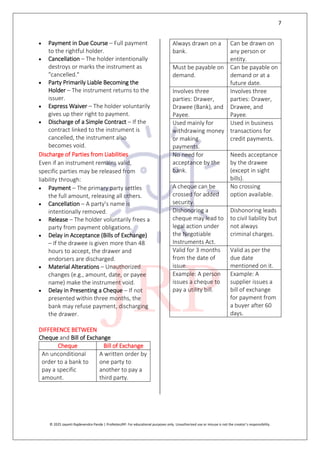
DIFFERENCE BETWEEN
Cheque and Bill of Exchange
Cheque Bill of Exchange
An unconditional
order to a bank to
pay a specific
amount.
A written order by
one party to
another to pay a
third party.
Always drawn on a
bank.
Can be drawn on
any person or
entity.
Must be payable on
demand.
Can be payable on
demand or at a
future date.
Involves three
parties: Drawer,
Drawee (Bank), and
Payee.
Involves three
parties: Drawer,
Drawee, and
Payee.
Used mainly for
withdrawing money
or making
payments.
Used in business
transactions for
credit payments.
No need for
acceptance by the
bank.
Needs acceptance
by the drawee
(except in sight
bills).
A cheque can be
crossed for added
security.
No crossing
option available.
Dishonoring a
cheque may lead to
legal action under
the Negotiable
Instruments Act.
Dishonoring leads
to civil liability but
not always
criminal charges.
Valid for 3 months
from the date of
issue.
Valid as per the
due date
mentioned on it.
Example: A person
issues a cheque to
pay a utility bill.
Example: A
supplier issues a
bill of exchange
for payment from
a buyer after 60
days.
8
© 2025 Jayanti Rajdevendra Pande | ProNotesJRP. For educational purposes only. Unauthorized use or misuse is not the creator’s responsibility.
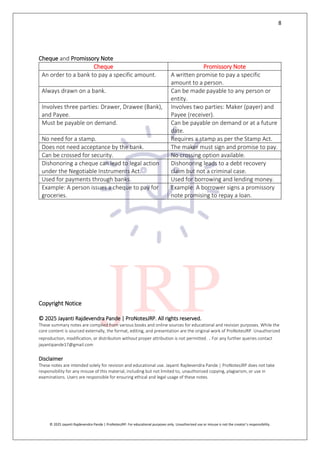
Cheque and Promissory Note
Cheque Promissory Note
An order to a bank to pay a specific amount. A written promise to pay a specific
amount to a person.
Always drawn on a bank. Can be made payable to any person or
entity.
Involves three parties: Drawer, Drawee (Bank),
and Payee.
Involves two parties: Maker (payer) and
Payee (receiver).
Must be payable on demand. Can be payable on demand or at a future
date.
No need for a stamp. Requires a stamp as per the Stamp Act.
Does not need acceptance by the bank. The maker must sign and promise to pay.
Can be crossed for security. No crossing option available.
Dishonoring a cheque can lead to legal action
under the Negotiable Instruments Act.
Dishonoring leads to a debt recovery
claim but not a criminal case.
Used for payments through banks. Used for borrowing and lending money.
Example: A person issues a cheque to pay for
groceries.
Example: A borrower signs a promissory
note promising to repay a loan.
Copyright Notice
© 2025 Jayanti Rajdevendra Pande | ProNotesJRP. All rights reserved.
These summary notes are compiled from various books and online sources for educational and revision purposes. While the
core content is sourced externally, the format, editing, and presentation are the original work of ProNotesJRP. Unauthorized
reproduction, modification, or distribution without proper attribution is not permitted. . For any further queries contact
jayantipande17@gmail.com
Disclaimer
These notes are intended solely for revision and educational use. Jayanti Rajdevendra Pande | ProNotesJRP does not take
responsibility for any misuse of this material, including but not limited to, unauthorized copying, plagiarism, or use in
examinations. Users are responsible for ensuring ethical and legal usage of these notes.

BBA Business Law Unit 2 Summary Notes.pdf

  • 1.
    1 © 2025 JayantiRajdevendra Pande | ProNotesJRP. For educational purposes only. Unauthorized use or misuse is not the creator’s responsibility. BBA Sem 2 NEP Business Law Unit 2 : Negotiable Instruments Act 1881 Common Introduction for all Answers The Negotiable Instruments Act, 1881 was enacted on 1st March 1882 to regulate the use of negotiable instruments such as promissory notes, bills of exchange, and cheques in India. These instruments are widely used in business and banking for smooth financial transactions, ensuring easy transferability and legal security. The Act defines the rights, duties, and liabilities of parties involved, providing a structured framework for handling payments, endorsements, and dishonor of instruments. It plays a crucial role in promoting trust and certainty in commercial dealings by offering legal remedies in case of fraud, dishonor, or disputes. Over time, amendments have been made to the Act to address modern financial challenges, ensuring its continued relevance in the banking and business sectors. Types of Negotiable Instruments 1. Instruments Negotiable by Statute – These include promissory notes, bills of exchange, and cheques, which are legally recognized under the Negotiable Instruments Act, 1881. 2. Instruments Negotiable by Custom or Usage – These are not mentioned in the Act but are widely accepted in trade, such as government promissory notes, banknotes, and railway receipts. 3. Inland Instruments (Section 11) – These are instruments drawn and payable within India or drawn in India upon a person residing in India, making them subject to Indian law. Essential Characteristics of Negotiable Instruments 1. Writing and Signature – A negotiable instrument must be written and signed by the maker or drawer to be valid. 2. Transferable – The instrument must be transferable to another person, allowing the holder to transfer the rights to someone else. 3. Money – It must be payable in money, ensuring it represents a sum of money. 4. Title of Holder and Defects – The holder obtains the title to the instrument, and despite any profound defects in the instrument, the holder’s title is protected. 5. Presumption and Popularity – The instrument carries a legal presumption of validity and is widely accepted in business, making it reliable evidence in transactions. Presumptions as to Negotiable Instruments (Sections 118 and 119) Presumption means assuming certain facts about a negotiable instrument to be true unless proven wrong. This helps in easily trusting and using the instrument in legal and business matters. 1. Consideration and Date – There is a presumption that the instrument is made for valid consideration and has a legitimate date of issue. 2. Time, Acceptance, and Transfer – The time of transfer and acceptance is presumed, making it clear that the instrument was accepted on the agreed date. 3. Order of Endorsement and Stamp – The order of endorsement is presumed to be in proper sequence, and stamp duty is presumed to be properly paid. 4. Holder in Due Course – The holder is presumed to be a holder in due course, meaning they have a valid title to the instrument without defects. 5. Proof of Protest – If necessary, proof of protest (formal declaration of non- payment) is presumed to have been duly made.
  • 2.
    2 © 2025 JayantiRajdevendra Pande | ProNotesJRP. For educational purposes only. Unauthorized use or misuse is not the creator’s responsibility. Promissory Note A promissory note is a written promise by one party to pay a specific sum of money to another party, either on demand or at a future date. As per Section 4 of the Negotiable Instruments Act, 1881, a promissory note is a written instrument containing an unconditional promise, made by one person to another, to pay a certain sum of money. Example: If A writes, "I promise to pay B ₹10,000 after three months," this is a promissory note. Essential Elements of a Promissory Note 1. Written Instrument: A promissory note must be in writing; oral promises are not valid. 2. Unconditional Promise to Pay: The promise must be absolute and not dependent on any condition. 3. Certain Amount: The amount to be paid must be specific and not uncertain. 4. Payable in Money Only: The note must promise payment in currency, not goods or services. 5. Definite Payee: The person who is to receive the payment must be clearly mentioned. 6. Time of Payment: The note must specify if the payment is on demand or after a fixed period. 7. Signature of Maker: The person making the promise must sign the note for it to be valid. Parties to a Promissory Note 1. Maker: The person who promises to pay the amount. 2. Payee: The person to whom the payment is to be made. 3. Holder: The person in possession of the note who can claim payment. Bills of Exchange A bill of exchange is a written order used in financial transactions, directing one party to pay a specific amount of money to another party at a future date or on demand. As per Section 5 of the Negotiable Instruments Act, 1881, a bill of exchange is a written instrument containing an unconditional order, signed by the maker, directing a person to pay a certain sum of money to another person either on demand or at a future date. Characteristics of Bills of Exchange 1. Must Be in Writing: A bill of exchange must be in written form, and oral orders are not valid. 2. Order to Pay: It contains an unconditional order to pay a specified amount of money. 3. Drawee: The person on whom the bill is drawn and who is ordered to make the payment. 4. Signature of Drawee: The drawee must accept the bill by signing it to validate the transaction. 5. Unconditional Order: The order to pay must be absolute and not dependent on any conditions. 6. Parties Involved: The bill involves three parties—the drawer, drawee, and payee. 7. Certainty of Amount: The amount to be paid must be certain and clearly stated. 8. Payment in Kind is Not Valid: A bill of exchange cannot be used to promise payment in goods or services, only in money. 9. Stamping: It must be properly stamped according to the legal requirements. 10. Cannot Be Made Payable to Bearer on Demand: A bill of exchange cannot be made payable to the bearer on demand. Parties to Bills of Exchange 1. Drawer: The person who writes the bill of exchange and orders payment. 2. Drawee: The person who is directed to pay the amount specified in the bill.
  • 3.
    3 © 2025 JayantiRajdevendra Pande | ProNotesJRP. For educational purposes only. Unauthorized use or misuse is not the creator’s responsibility. 3. Payee: The person to whom the money is to be paid, as specified in the bill. Cheque A cheque is a written order instructing a bank to pay a specific amount of money from the drawer's account to the payee. It is a widely used negotiable instrument for making payments Characteristics of a Cheque 1. In Writing A cheque must be in written form, either handwritten or printed. 2. Express Order to Pay It contains a direct order to the bank to pay a certain amount. 3. Definite and Unconditional Order The order to pay must be absolute and not based on conditions. 4. Signed by the Drawer The person issuing the cheque must sign it to make it valid. 5. Order to Pay a Certain Sum The cheque must specify a fixed amount of money. 6. Order to Pay Money Only A cheque cannot be used to transfer goods or services, only money. Parties to a Cheque 1. Drawer The person who issues the cheque. 2. Drawee The bank on which the cheque is drawn. 3. Payee The person or entity to whom the cheque is payable. Types of Cheques 1. Open Cheque A cheque that can be encashed at the bank counter without restrictions. 2. Crossed Cheque A cheque with two parallel lines on the top left, restricting encashment to a bank account only. 3. Mirror Cheque A duplicate or identical cheque used for reference. 4. Order Cheque A cheque that is payable only to the person named on it. 5. Other Types of Cheques o Multilatered Cheque A cheque with multiple layers of security. o Stale Cheque A cheque that is not presented within the validity period (usually 3 months). o Ante-Dated Cheque A cheque with a date earlier than the current date. o Post-Dated Cheque A cheque issued with a future date for payment. Special Rules for Cheques 1. Date The cheque must have a valid date. 2. Name of the Payee The payee's name must be clearly mentioned. 3. Account Number The drawer's account number must be present. 4. Minimum Balance The account must have sufficient funds. 5. Crossing and Overwriting Any corrections must be authenticated by the drawer. 6. Condition of the Cheque The cheque must be in good physical condition, without damage. 7. Signature The drawer’s signature must match the bank records. 8. Amount of the Cheque The amount must be written clearly in words and figures. Crossing of a Cheque Crossing of a cheque refers to the practice of marking two parallel lines across the face of the cheque, which limits its encashment to a bank account only. This ensures the security of the cheque. Types of Crossing and Their Effects 1. General Crossing A cheque is crossed with two parallel lines, and it may or may not have the words "and Company" or "Account Payee" written between them. The effect of general crossing is that the cheque can only be deposited in a bank account and cannot be cashed at the counter. 2. Special Crossing In special crossing, the name of a specific bank is mentioned between the parallel lines. The cheque can only
  • 4.
    4 © 2025 JayantiRajdevendra Pande | ProNotesJRP. For educational purposes only. Unauthorized use or misuse is not the creator’s responsibility. be deposited in the specified bank’s account. This type provides more security to the cheque holder. 3. Restrictive Crossing A restrictive crossing includes the words "Account Payee" or "Account Payee Only." This limits the cheque to being deposited only into the account of the person whose name is mentioned on the cheque, ensuring further security and preventing misuse. Who May Cross a Cheque? 1. Drawer The person who writes and issues the cheque. 2. Holder The person who holds the cheque and has the right to negotiate it. 3. Banker A banker can cross a cheque to make it safer and limit its encashment. Bouncing or Dishonour of a Cheque The bouncing or dishonour of a cheque occurs when a bank refuses to honour a cheque due to reasons such as insufficient funds, an invalid signature, or a stop- payment request. This action leads to legal consequences for the drawer. Legal Procedure for Dishonour of a Cheque 1. Issuance of Notice The payee or holder must issue a notice to the drawer of the dishonoured cheque within 30 days of the return. 2. Failure to Respond If the drawer fails to make payment within 15 days after receiving the notice, the payee may file a case under the Negotiable Instruments Act. 3. Filing a Case The payee can file a criminal complaint against the drawer for dishonouring the cheque, which may result in fines or imprisonment if the drawer is found guilty. Obligations of Drawee on Cheque (Section 31) 1. Sufficient Funds – The bank must clear a cheque if the drawer has enough money; otherwise, it will be dishonoured. 2. Legally Payable Amount – Funds should be available for withdrawal and not under legal restrictions. 3. Legal Obligation to Pay – The bank must honour the cheque unless there is a valid reason to refuse payment. Obligations of Banker for Dishonour of Cheque 1. Compensation for Wrongful Dishonour – The bank must compensate the customer if it wrongly dishonours a cheque. 2. Contractual Duty – The bank has a legal duty to honour valid cheques from customers. 3. Issuing Cheque Return Memo – If a cheque is dishonoured, the bank must issue a memo stating the reason. When a Banker Must Refuse Payment of a Cheque 1. Stop Payment Order – The drawer instructs the bank to stop payment. 2. Garnishee Order – A court freezes the account due to legal disputes. 3. Death of Account Holder – Transactions stop after the drawer’s death. 4. Insolvency or Bankruptcy – If the drawer is insolvent, the cheque is dishonoured. 5. Mental Incapacity – If the drawer is declared mentally unfit, payments are stopped. 6. Loss of Cheque – The bank must not process a lost cheque if informed. 7. Material Alteration – If any unauthorized changes are made to a cheque, it is rejected. 8. Closure of Account – Cheques from a closed account will not be processed.
  • 5.
    5 © 2025 JayantiRajdevendra Pande | ProNotesJRP. For educational purposes only. Unauthorized use or misuse is not the creator’s responsibility. 9. Irregular Endorsement – If a cheque is not properly signed, the bank must reject it. When a Banker May Refuse Payment of a Customer's Cheque 1. Insufficient Funds – If the account lacks enough money, the cheque will bounce. 2. Funds Not Applicable – If funds are locked in a fixed deposit or restricted account, payment is denied. 3. Different Branch Presentment – If presented at a non-home branch, the bank may reject it. 4. Presented After Banking Hours – Cheques submitted after closing hours are processed the next day. 5. Stale Cheque – Cheques older than six months are considered invalid. 6. Post-Dated Cheque – If presented before the mentioned date, the bank will refuse payment. 7. Undated Cheque – If a cheque lacks a date, the bank may reject it. Parties to a Negotiable Instrument 1. Drawer – The person who issues the negotiable instrument (e.g., writes a cheque). 2. Drawee – The party on whom the instrument is drawn (e.g., the bank in case of a cheque). 3. Payee – The person to whom the payment is to be made. 4. Holder – The person in possession of the instrument with the right to claim payment. 5. Endorser – The person who transfers the instrument by signing it. 6. Endorsee – The person to whom the instrument is transferred. 7. Acceptor – The drawee who accepts the instrument (applicable in bills of exchange). 8. Maker – The person who promises to pay a certain sum in a promissory note. 9. Bearer – The person holding a bearer instrument, entitled to receive payment. Liabilities of Parties to a Negotiable Instrument Liabilities of parties to a negotiable instrument refer to their legal obligation to pay or ensure payment as per the instrument's terms. 1. Drawer's Liability – The drawer is liable to the payee or holder if the instrument is dishonoured. They must compensate if the bank refuses payment due to insufficient funds or other reasons. 2. Drawee's Liability – The drawee (usually a bank) has no liability unless it accepts the instrument. Once accepted, the drawee is legally bound to make the payment. 3. Payee's Liability – The payee does not have any liability but has the right to claim the amount mentioned in the instrument. 4. Maker's Liability – In a promissory note, the maker is primarily liable and must pay the specified amount to the holder. 5. Acceptor's Liability – Once the drawee accepts a bill of exchange, they are liable for its payment on the due date. 6. Endorser's Liability – The endorser guarantees payment to subsequent holders if the instrument is dishonoured, provided due notice is given. 7. Holder's Liability – A holder has no liability unless they endorse the instrument, making them responsible for payment if dishonoured. 8. Bearer's Liability – A bearer has no liability but is entitled to receive payment. If transferred, they must ensure its validity. Presentation of Negotiable Instruments Presentation of a negotiable instrument means showing it to the concerned party
  • 6.
    6 © 2025 JayantiRajdevendra Pande | ProNotesJRP. For educational purposes only. Unauthorized use or misuse is not the creator’s responsibility. for acceptance, sight, or payment. Proper presentation is necessary to claim payment or acceptance. Purposes of Presentation  Bill for Acceptance – A bill of exchange must be presented to the drawee for acceptance to confirm payment on the due date.  Promissory Note for Sight – If payable "after sight," it must be presented to the maker to fix the payment due date.  Instrument for Payment – A cheque, bill, or promissory note must be presented to the correct party for payment within the specified time. Rules for Presentation  Proper Time – Must be presented within the validity period (e.g., cheques within three months).  Proper Place – Should be presented at the correct location (e.g., a cheque at the bank).  Proper Manner – Must follow legal procedures.  Proper Party – Should be given to the correct person (e.g., drawee, acceptor, or banker). Consequences of Non-Presentation  Loss of Rights – The holder may lose the right to claim payment.  Discharge of Liability – The drawer or drawee may no longer be responsible for payment.  Legal Consequences – Dishonour may lead to legal action. Dishonour of a Negotiable Instrument Dishonour occurs when a negotiable instrument is not accepted or paid upon presentation, affecting the issuer’s credibility and leading to legal action under the Negotiable Instruments Act, 1881. Types of Dishonour 1. Dishonour by Non-Acceptance – When the drawee refuses to accept a bill of exchange. 2. Dishonour by Non-Payment – When the drawee or acceptor refuses to pay on the due date. Causes of Dishonour  Insufficient funds – The drawer’s account lacks the required balance.  Signature mismatch – The bank rejects the instrument due to an incorrect signature.  Post-dated or expired instrument – Presented before its date or after validity.  Alteration or tampering – Unauthorized modifications make the instrument invalid.  Account closure or frozen account – The drawer’s account is closed or legally frozen. Consequences of Dishonour  Notice of Dishonour – The holder must notify the drawer or endorsers.  Legal Action (Section 138 of the Negotiable Instruments Act) – The payee can file a case, leading to fines or imprisonment.  Loss of Creditworthiness – Frequent dishonours damage financial reputation. Noting and Protest  Noting (Section 99) – A notary public records dishonour details as legal proof.  Protest (Section 100) – A formal certificate issued for serious dishonours, mainly for foreign bills. Example: If Amit’s cheque to Sunil bounces due to insufficient funds, Sunil can send a legal notice. If Amit does not pay within 15 days, Sunil can file a case under Section 138. Discharge of a Negotiable Instrument and Parties Discharge of a Negotiable Instrument A negotiable instrument is discharged when it becomes invalid for future claims. This can happen through:
  • 7.
    7 © 2025 JayantiRajdevendra Pande | ProNotesJRP. For educational purposes only. Unauthorized use or misuse is not the creator’s responsibility.  Payment in Due Course – Full payment to the rightful holder.  Cancellation – The holder intentionally destroys or marks the instrument as "cancelled."  Party Primarily Liable Becoming the Holder – The instrument returns to the issuer.  Express Waiver – The holder voluntarily gives up their right to payment.  Discharge of a Simple Contract – If the contract linked to the instrument is cancelled, the instrument also becomes void. Discharge of Parties from Liabilities Even if an instrument remains valid, specific parties may be released from liability through:  Payment – The primary party settles the full amount, releasing all others.  Cancellation – A party’s name is intentionally removed.  Release – The holder voluntarily frees a party from payment obligations.  Delay in Acceptance (Bills of Exchange) – If the drawee is given more than 48 hours to accept, the drawer and endorsers are discharged.  Material Alterations – Unauthorized changes (e.g., amount, date, or payee name) make the instrument void.  Delay in Presenting a Cheque – If not presented within three months, the bank may refuse payment, discharging the drawer. DIFFERENCE BETWEEN Cheque and Bill of Exchange Cheque Bill of Exchange An unconditional order to a bank to pay a specific amount. A written order by one party to another to pay a third party. Always drawn on a bank. Can be drawn on any person or entity. Must be payable on demand. Can be payable on demand or at a future date. Involves three parties: Drawer, Drawee (Bank), and Payee. Involves three parties: Drawer, Drawee, and Payee. Used mainly for withdrawing money or making payments. Used in business transactions for credit payments. No need for acceptance by the bank. Needs acceptance by the drawee (except in sight bills). A cheque can be crossed for added security. No crossing option available. Dishonoring a cheque may lead to legal action under the Negotiable Instruments Act. Dishonoring leads to civil liability but not always criminal charges. Valid for 3 months from the date of issue. Valid as per the due date mentioned on it. Example: A person issues a cheque to pay a utility bill. Example: A supplier issues a bill of exchange for payment from a buyer after 60 days.
  • 8.
    8 © 2025 JayantiRajdevendra Pande | ProNotesJRP. For educational purposes only. Unauthorized use or misuse is not the creator’s responsibility. Cheque and Promissory Note Cheque Promissory Note An order to a bank to pay a specific amount. A written promise to pay a specific amount to a person. Always drawn on a bank. Can be made payable to any person or entity. Involves three parties: Drawer, Drawee (Bank), and Payee. Involves two parties: Maker (payer) and Payee (receiver). Must be payable on demand. Can be payable on demand or at a future date. No need for a stamp. Requires a stamp as per the Stamp Act. Does not need acceptance by the bank. The maker must sign and promise to pay. Can be crossed for security. No crossing option available. Dishonoring a cheque can lead to legal action under the Negotiable Instruments Act. Dishonoring leads to a debt recovery claim but not a criminal case. Used for payments through banks. Used for borrowing and lending money. Example: A person issues a cheque to pay for groceries. Example: A borrower signs a promissory note promising to repay a loan. Copyright Notice © 2025 Jayanti Rajdevendra Pande | ProNotesJRP. All rights reserved. These summary notes are compiled from various books and online sources for educational and revision purposes. While the core content is sourced externally, the format, editing, and presentation are the original work of ProNotesJRP. Unauthorized reproduction, modification, or distribution without proper attribution is not permitted. . For any further queries contact jayantipande17@gmail.com Disclaimer These notes are intended solely for revision and educational use. Jayanti Rajdevendra Pande | ProNotesJRP does not take responsibility for any misuse of this material, including but not limited to, unauthorized copying, plagiarism, or use in examinations. Users are responsible for ensuring ethical and legal usage of these notes.