1
© 2025 Jayanti Rajdevendra Pande | ProNotesJRP. For educational purposes only. Unauthorized use or misuse is not the creator’s responsibility.
BBA Sem 2 NEP
Business Law
Unit 1: Indian Contract Act 1872
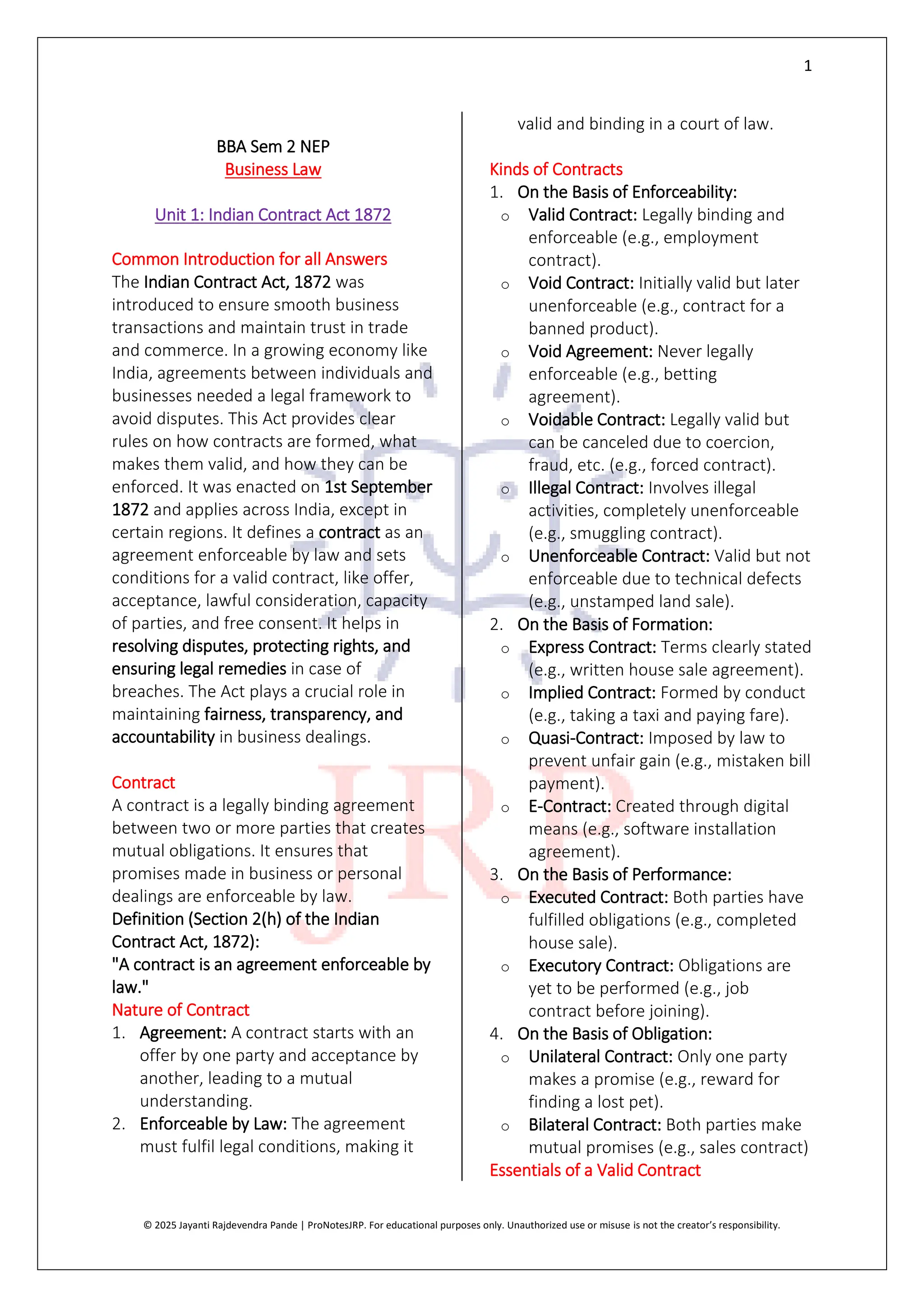
Common Introduction for all Answers
The Indian Contract Act, 1872 was
introduced to ensure smooth business
transactions and maintain trust in trade
and commerce. In a growing economy like
India, agreements between individuals and
businesses needed a legal framework to
avoid disputes. This Act provides clear
rules on how contracts are formed, what
makes them valid, and how they can be
enforced. It was enacted on 1st September
1872 and applies across India, except in
certain regions. It defines a contract as an
agreement enforceable by law and sets
conditions for a valid contract, like offer,
acceptance, lawful consideration, capacity
of parties, and free consent. It helps in
resolving disputes, protecting rights, and
ensuring legal remedies in case of
breaches. The Act plays a crucial role in
maintaining fairness, transparency, and
accountability in business dealings.
Contract
A contract is a legally binding agreement
between two or more parties that creates
mutual obligations. It ensures that
promises made in business or personal
dealings are enforceable by law.
Definition (Section 2(h) of the Indian
Contract Act, 1872):
"A contract is an agreement enforceable by
law."
Nature of Contract
1. Agreement: A contract starts with an
offer by one party and acceptance by
another, leading to a mutual
understanding.
2. Enforceable by Law: The agreement
must fulfil legal conditions, making it
valid and binding in a court of law.
Kinds of Contracts
1. On the Basis of Enforceability:
o Valid Contract: Legally binding and
enforceable (e.g., employment
contract).
o Void Contract: Initially valid but later
unenforceable (e.g., contract for a
banned product).
o Void Agreement: Never legally
enforceable (e.g., betting
agreement).
o Voidable Contract: Legally valid but
can be canceled due to coercion,
fraud, etc. (e.g., forced contract).
o Illegal Contract: Involves illegal
activities, completely unenforceable
(e.g., smuggling contract).
o Unenforceable Contract: Valid but not
enforceable due to technical defects
(e.g., unstamped land sale).
2. On the Basis of Formation:
o Express Contract: Terms clearly stated
(e.g., written house sale agreement).
o Implied Contract: Formed by conduct
(e.g., taking a taxi and paying fare).
o Quasi-Contract: Imposed by law to
prevent unfair gain (e.g., mistaken bill
payment).
o E-Contract: Created through digital
means (e.g., software installation
agreement).
3. On the Basis of Performance:
o Executed Contract: Both parties have
fulfilled obligations (e.g., completed
house sale).
o Executory Contract: Obligations are
yet to be performed (e.g., job
contract before joining).
4. On the Basis of Obligation:
o Unilateral Contract: Only one party
makes a promise (e.g., reward for
finding a lost pet).
o Bilateral Contract: Both parties make
mutual promises (e.g., sales contract)
Essentials of a Valid Contract
2
© 2025 Jayanti Rajdevendra Pande | ProNotesJRP. For educational purposes only. Unauthorized use or misuse is not the creator’s responsibility.
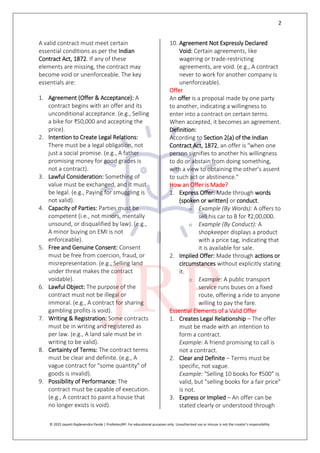
A valid contract must meet certain
essential conditions as per the Indian
Contract Act, 1872. If any of these
elements are missing, the contract may
become void or unenforceable. The key
essentials are:
1. Agreement (Offer & Acceptance): A
contract begins with an offer and its
unconditional acceptance. (e.g., Selling
a bike for ₹50,000 and accepting the
price).
2. Intention to Create Legal Relations:
There must be a legal obligation, not
just a social promise. (e.g., A father
promising money for good grades is
not a contract).
3. Lawful Consideration: Something of
value must be exchanged, and it must
be legal. (e.g., Paying for smuggling is
not valid).
4. Capacity of Parties: Parties must be
competent (i.e., not minors, mentally
unsound, or disqualified by law). (e.g.,
A minor buying on EMI is not
enforceable).
5. Free and Genuine Consent: Consent
must be free from coercion, fraud, or
misrepresentation. (e.g., Selling land
under threat makes the contract
voidable).
6. Lawful Object: The purpose of the
contract must not be illegal or
immoral. (e.g., A contract for sharing
gambling profits is void).
7. Writing & Registration: Some contracts
must be in writing and registered as
per law. (e.g., A land sale must be in
writing to be valid).
8. Certainty of Terms: The contract terms
must be clear and definite. (e.g., A
vague contract for "some quantity" of
goods is invalid).
9. Possibility of Performance: The
contract must be capable of execution.
(e.g., A contract to paint a house that
no longer exists is void).
10. Agreement Not Expressly Declared
Void: Certain agreements, like
wagering or trade-restricting
agreements, are void. (e.g., A contract
never to work for another company is
unenforceable).
Offer
An offer is a proposal made by one party
to another, indicating a willingness to
enter into a contract on certain terms.
When accepted, it becomes an agreement.
Definition:
According to Section 2(a) of the Indian
Contract Act, 1872, an offer is "when one
person signifies to another his willingness
to do or abstain from doing something,
with a view to obtaining the other’s assent
to such act or abstinence."
How an Offer is Made?
1. Express Offer: Made through words
(spoken or written) or conduct.
o Example (By Words): A offers to
sell his car to B for ₹2,00,000.
o Example (By Conduct): A
shopkeeper displays a product
with a price tag, indicating that
it is available for sale.
2. Implied Offer: Made through actions or
circumstances without explicitly stating
it.
o Example: A public transport
service runs buses on a fixed
route, offering a ride to anyone
willing to pay the fare.
Essential Elements of a Valid Offer
1. Creates Legal Relationship – The offer
must be made with an intention to
form a contract.
Example: A friend promising to call is
not a contract.
2. Clear and Definite – Terms must be
specific, not vague.
Example: "Selling 10 books for ₹500" is
valid, but "selling books for a fair price"
is not.
3. Express or Implied – An offer can be
stated clearly or understood through
3
© 2025 Jayanti Rajdevendra Pande | ProNotesJRP. For educational purposes only. Unauthorized use or misuse is not the creator’s responsibility.
actions.
Example: Picking items at a store
implies an offer to buy at the listed
price.
4. Not an Invitation to Offer – An offer is a
firm proposal, unlike an invitation to
negotiate.
Example: A shop displaying "50% off" is
not an offer but an invitation.
5. Specific or General – It can be made to
a person or the public.
Example: A reward for finding a lost
pet is a general offer.
6. Must Be Communicated – The offeree
must know about the offer.
Example: An offer made in a hidden
letter is not valid unless read.
7. Seeks Acceptance – The offer should
aim at getting consent.
Example: Selling a car for ₹50,000
requires the buyer’s agreement.
8. Can Be Conditional – Some offers come
with conditions.
Example: "I will sell my bike only if you
pay ₹5,000 in advance."
9. No Automatic Acceptance – Silence or
inaction cannot mean acceptance.
Example: If A offers to sell his phone
and B stays silent, it is not acceptance.
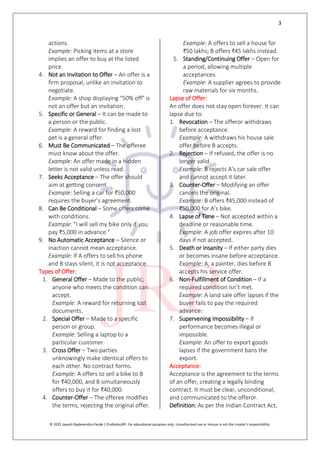
Types of Offer:
1. General Offer – Made to the public;
anyone who meets the condition can
accept.
Example: A reward for returning lost
documents.
2. Special Offer – Made to a specific
person or group.
Example: Selling a laptop to a
particular customer.
3. Cross Offer – Two parties
unknowingly make identical offers to
each other. No contract forms.
Example: A offers to sell a bike to B
for ₹40,000, and B simultaneously
offers to buy it for ₹40,000.
4. Counter-Offer – The offeree modifies
the terms, rejecting the original offer.
Example: A offers to sell a house for
₹50 lakhs; B offers ₹45 lakhs instead.
5. Standing/Continuing Offer – Open for
a period, allowing multiple
acceptances.
Example: A supplier agrees to provide
raw materials for six months.
Lapse of Offer:
An offer does not stay open forever. It can
lapse due to:
1. Revocation – The offeror withdraws
before acceptance.
Example: A withdraws his house sale
offer before B accepts.
2. Rejection – If refused, the offer is no
longer valid.
Example: B rejects A’s car sale offer
and cannot accept it later.
3. Counter-Offer – Modifying an offer
cancels the original.
Example: B offers ₹45,000 instead of
₹50,000 for A’s bike.
4. Lapse of Time – Not accepted within a
deadline or reasonable time.
Example: A job offer expires after 10
days if not accepted.
5. Death or Insanity – If either party dies
or becomes insane before acceptance.
Example: A, a painter, dies before B
accepts his service offer.
6. Non-Fulfillment of Condition – If a
required condition isn’t met.
Example: A land sale offer lapses if the
buyer fails to pay the required
advance.
7. Supervening Impossibility – If
performance becomes illegal or
impossible.
Example: An offer to export goods
lapses if the government bans the
export.
Acceptance:
Acceptance is the agreement to the terms
of an offer, creating a legally binding
contract. It must be clear, unconditional,
and communicated to the offeror.
Definition: As per the Indian Contract Act,
4
© 2025 Jayanti Rajdevendra Pande | ProNotesJRP. For educational purposes only. Unauthorized use or misuse is not the creator’s responsibility.
1872, "Every promise and every set of
promises forming the consideration for
each other is an agreement."
Who Can Accept an Offer?
1. Specific Offeree: Only the intended
recipient can accept a specific offer.
2. General Public: Anyone who fulfills
the conditions of a general offer can
accept it.
Essentials of Valid Acceptance:
1. Absolute and Unqualified: Acceptance
must match the offer’s terms without
changes.
2. Communicated to Offeror: Silence is
not acceptance; it must be expressed.
3. After the Offer: Acceptance must
follow a valid offer.
4. By the Intended Person: Only the
offeree can accept, unless authorized.
5. Prescribed Mode: If a method is
specified, it must be followed.
6. Within Time Limit: Must be accepted
within the given or reasonable time.
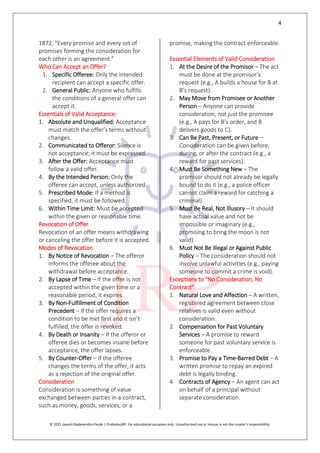
Revocation of Offer
Revocation of an offer means withdrawing
or canceling the offer before it is accepted.
Modes of Revocation
1. By Notice of Revocation – The offeror
informs the offeree about the
withdrawal before acceptance.
2. By Lapse of Time – If the offer is not
accepted within the given time or a
reasonable period, it expires.
3. By Non-Fulfillment of Condition
Precedent – If the offer requires a
condition to be met first and it isn’t
fulfilled, the offer is revoked.
4. By Death or Insanity – If the offeror or
offeree dies or becomes insane before
acceptance, the offer lapses.
5. By Counter-Offer – If the offeree
changes the terms of the offer, it acts
as a rejection of the original offer.
Consideration
Consideration is something of value
exchanged between parties in a contract,
such as money, goods, services, or a
promise, making the contract enforceable.
Essential Elements of Valid Consideration
1. At the Desire of the Promisor – The act
must be done at the promisor’s
request (e.g., A builds a house for B at
B’s request).
2. May Move from Promisee or Another
Person – Anyone can provide
consideration, not just the promisee
(e.g., A pays for B’s order, and B
delivers goods to C).
3. Can Be Past, Present, or Future –
Consideration can be given before,
during, or after the contract (e.g., a
reward for past services).
4. Must Be Something New – The
promisor should not already be legally
bound to do it (e.g., a police officer
cannot claim a reward for catching a
criminal).
5. Must Be Real, Not Illusory – It should
have actual value and not be
impossible or imaginary (e.g.,
promising to bring the moon is not
valid).
6. Must Not Be Illegal or Against Public
Policy – The consideration should not
involve unlawful activities (e.g., paying
someone to commit a crime is void).
Exceptions to "No Consideration, No
Contract"
1. Natural Love and Affection – A written,
registered agreement between close
relatives is valid even without
consideration.
2. Compensation for Past Voluntary
Services – A promise to reward
someone for past voluntary service is
enforceable.
3. Promise to Pay a Time-Barred Debt – A
written promise to repay an expired
debt is legally binding.
4. Contracts of Agency – An agent can act
on behalf of a principal without
separate consideration.
5
© 2025 Jayanti Rajdevendra Pande | ProNotesJRP. For educational purposes only. Unauthorized use or misuse is not the creator’s responsibility.
5. Charitable Pledges and Gifts – A
donation promise becomes binding if
the recipient takes action based on it.
Situations When Consideration or Object is
Unlawful (Section 23)
1. Forbidden by Law – If an act is legally
banned, the contract is void (e.g.,
selling illegal drugs).
2. Defeats Legal Provisions – Any
agreement that tries to bypass the law
is unlawful (e.g., using fake documents
to avoid taxes).
3. Fraudulent – If the contract involves
fraud, it is void (e.g., selling a defective
product as new).
4. Causes Injury – A contract that harms a
person or property is illegal (e.g., hiring
someone to destroy another’s car).
5. Against Public Policy – If an agreement
promotes corruption or immoral acts,
it is void (e.g., paying for false
testimony in court).
Kinds of Consideration
1. Past Consideration – Something given
or done before the promise is made,
e.g., A helps B without expecting
anything, and later B promises to
reward A.
2. Present (Executed) Consideration –
Something given at the time of
agreement, e.g., A sells a phone to B,
and B pays immediately.
3. Future (Executory) Consideration – A
promise to do something in the future,
e.g., A agrees to supply goods to B next
month, and B agrees to pay later.
4. Unlawful Consideration – Consideration
involving illegal acts or those against
public policy, e.g., A contracts with B to
smuggle goods in exchange for money.
5. Unreal or Illusory Consideration –
Consideration that has no actual value
or is impossible to perform, e.g., A
promises B ₹10,000 if B touches the
sky.
Capacity of Parties to Contract
Capacity refers to the legal ability of a
person to enter into a valid contract. As per
Section 11 of the Indian Contract Act, a
person must be of sound mind, of the age
of majority, and not disqualified by law to
enter into a contract.
Persons Incapable of Contracting:
 Minors – Below 18 years; contracts are
void, e.g., a minor taking a loan isn’t
liable.
 Unsound Mind – Mentally incompetent
persons cannot contract, e.g., a person
with severe schizophrenia.
 Disqualified by Law – Convicts, war
aliens, insolvents cannot contract, e.g.,
a bankrupt person selling property.
Rules for a Minor’s Agreement
A minor (below 18 years, or 21 if under
guardianship) cannot enter into a valid
contract under the Indian Majority Act,
1875.
1. Void Agreement – A minor’s contract is
void ab initio and has no legal effect,
e.g., a 16-year-old selling a bicycle.
2. Minor as Beneficiary – A minor can
receive benefits but cannot be held
liable, e.g., receiving gifted land.
3. No Ratification on Majority (Sec 68) – A
minor cannot confirm a void contract
after turning 18, e.g., repaying a past
loan isn’t enforceable unless a new
contract is made.
4. Cannot Be a Shareholder – A minor
cannot buy shares directly, but a
guardian can do so on their behalf.
5. Parents/Guardians Not Liable – They
aren’t responsible unless they
personally guarantee the contract, e.g.,
a minor’s unauthorized loan isn’t their
parent’s liability.
Persons of Unsound Mind (Section 12)
A person must be of sound mind while
making a contract. Those incapable of
understanding the nature and
consequences of a contract are considered
6
© 2025 Jayanti Rajdevendra Pande | ProNotesJRP. For educational purposes only. Unauthorized use or misuse is not the creator’s responsibility.
unsound under Section 12 of the Indian
Contract Act, 1872.
1. Idiocy – A person born with permanent
mental incapacity cannot form valid
contracts.
2. Lunacy or Insanity – A person with
temporary or periodic insanity can only
contract during lucid intervals
(mentally stable periods).
3. Drunkenness – A person intoxicated to
the extent that they cannot understand
the contract is considered unsound.
4. Hypnotism – A person under hypnotic
influence loses control over their
actions, making contracts voidable.
5. Mental Decay – Old age or illness
causing a person to lose mental
stability disqualifies them from
contracting.
Persons Disqualified by Law
Certain persons are legally restricted from
entering into contracts.
1. Alien Enemies – Citizens of enemy
countries cannot contract during war.
2. Foreign Sovereigns & Ambassadors –
They have immunity but can contract if
they waive their privilege.
3. Convicts – A person convicted of a
serious crime loses the right to
contract while serving a sentence.
4. Insolvent Persons – Once declared
insolvent, a person cannot contract
until discharged by the court.
Free Consent (Section 14)
A contract is valid only if both parties agree
voluntarily. Consent is free when it is not
caused by coercion, undue influence,
fraud, misrepresentation, or mistake.
Factors Affecting Free Consent
1. Coercion (Section 15) – Forcing
someone to enter a contract using
threats, force, or unlawful acts. E.g.,
Threatening to harm someone if they
don’t sign a contract.
2. Undue Influence (Section 16) – When
one party exploits their position of
power over another to gain an unfair
advantage. E.g., A doctor pressuring a
patient to transfer property.
3. Fraud (Section 17) – Deliberate false
statements or concealment of facts to
deceive another party. E.g., Selling a
defective phone while claiming it is
brand new.
4. Misrepresentation (Section 18) – False
statements made without intent to
deceive, leading the other party to
enter the contract. E.g., A seller
unknowingly giving incorrect
information about a car’s mileage.
Mistake (Sections 20-22) – An error
regarding facts or law that affects the
contract’s validity. E.g., A contract signed
under the wrong assumption about the
identity of a product.
Mistake in a Contract (Sections 20-22)
A mistake happens when one or both
parties misunderstand something
important about the contract. This can
make the contract void or valid depending
on the type of mistake.
Types of Mistakes
1. Mistake of Law – When a person
misunderstands the law.
a) Indian Law – Not an excuse; the
contract stays valid. (E.g., A agrees to
pay extra tax due to misunderstanding
the law; they cannot cancel the
contract.)
b) Foreign Law – Treated like a mistake
of fact, and the contract may be void.
(E.g., A signs a contract in India
thinking US law allows it, but it
doesn’t.)
2. Mistake of Fact – Misunderstanding
about facts related to the contract.
a) Bilateral Mistake – Both parties are
wrong about an important fact; the
contract is void. (E.g., A and B agree to
sell a horse, but the horse was already
dead.)
b) Unilateral Mistake – Only one party
7
© 2025 Jayanti Rajdevendra Pande | ProNotesJRP. For educational purposes only. Unauthorized use or misuse is not the creator’s responsibility.
is wrong; the contract is usually valid
unless caused by fraud or
misrepresentation. (E.g., A mistakenly
bids higher in an auction; they cannot
cancel unless tricked.)
Unlawful Consideration & Object (Section
23, Indian Contract Act, 1872)
Consideration is the value exchanged in a
contract, while the object is its purpose. A
contract is void if its consideration or
object is unlawful, meaning:
1. Forbidden by Law – If the agreement
involves an act prohibited by law (e.g.,
selling illegal drugs).
2. Defeats Legal Provisions – If it aims to
evade laws (e.g., avoiding taxes
through fake documents).
3. Fraudulent – If made with intent to
deceive (e.g., selling a defective
product as new).
4. Causes Injury – If it harms a person,
property, or reputation (e.g., hiring
someone to damage a car).
5. Against Public Policy – If it harms
society, promotes corruption, or is
immoral (e.g., paying for false
testimony).
Void Agreements (Section 2(g), Indian
Contract Act, 1872)
A void agreement is one that has no legal
effect and cannot be enforced by law. It
does not create any rights or obligations.
E.g., a minor selling property is void.
Agreements Expressly Declared as Void
1. Unlawful Consideration or Object
(Section 23) – If an agreement involves
illegal acts, fraud, or harm, it is void.
E.g., a contract for smuggling goods.
2. Agreement by a Minor (Section 11) – A
minor cannot enter a valid contract.
E.g., a 16-year-old selling a bike.
3. Agreement Without Consideration
(Section 25) – A contract without
consideration is void, except for love,
past services, or time-barred debt. E.g.,
promising ₹10,000 without reason.
4. Agreement Restraining Marriage
(Section 26) – Any contract restricting
marriage is void. E.g., agreeing not to
marry for money.
5. Agreement Restraining Trade (Section
27) – Contracts that limit a person’s
right to conduct business are void,
except in cases of goodwill sales or
partnership restrictions. E.g., forcing
someone not to start a business for
money.
6. Agreement Restraining Legal
Proceedings (Section 28) – A contract
preventing a person from seeking legal
remedies is void. E.g., agreeing not to
sue each other.
7. Agreement With Uncertain Terms
(Section 29) – If an agreement is too
vague or unclear, it is void. E.g.,
agreeing to sell "some quantity" of rice
without specifying the amount.
8. Agreement Based on Wagering (Section
30) – Betting agreements are void as
they depend on uncertain events. E.g.,
wagering ₹5,000 on a cricket match
outcome.
Performance of a Contract
A contract must be performed by the
responsible party, but in some cases,
another person may fulfill the obligation
under specific conditions. Sections 37 to
67 of the Indian Contract Act, 1872,
govern contract performance.
Who May Perform a Contract?
1. By the Promisor Himself – If personal
skill or expertise is required, only the
promisor can perform.
E.g., A famous singer must perform
personally.
2. By the Promisor’s Agent – If no
personal skill is needed, an agent can
perform.
E.g., A can appoint an agent to deliver
goods.
3. By Legal Representatives – If the
promisor dies, their heirs must
complete the contract unless personal
8
© 2025 Jayanti Rajdevendra Pande | ProNotesJRP. For educational purposes only. Unauthorized use or misuse is not the creator’s responsibility.
expertise is required.
E.g., Selling land after the owner’s
death.
4. By a Third Party – If the promisee
accepts performance from a third
party, it is valid.
E.g., C repays A’s debt to B with B’s
consent.
Types of Performance of Contracts
1. Actual Performance – The promisor
fulfills their obligation, discharging the
contract.
E.g., A delivers a car to B as per
contract.
2. Attempted Performance (Tender of
Performance) – The promisor offers
performance, but the promisee
refuses. The promisor is then
discharged.
E.g., A delivers goods to B, but B
refuses to accept them.
Discharge of a Contract
A contract is said to be discharged when
the obligations under it come to an end,
and the parties are no longer bound by its
terms. The various ways in which a
contract can be discharged are as follows:
1. Discharge by Performance
A contract is discharged when both parties
fulfill their obligations as agreed.
Performance can be:
 Actual Performance: Both parties
complete their duties, and the contract
is discharged.
o Example: A sells a car to B for
₹5,00,000, and both fulfill their
obligations.
 Attempted Performance (Tender of
Performance): One party offers to
perform, but the other refuses. In such
cases, the promisor is discharged from
liability.
o Example: A delivers goods to B, but B
refuses to accept them without reason.
A is no longer liable.
2. Discharge by Agreement
Parties may mutually agree to terminate
the contract before performance. This can
happen through:
 Novation: Substituting a new contract
for the old one.
 Alteration: Making changes in contract
terms with mutual consent.
 Rescission: Canceling the contract with
mutual consent.
 Waiver: Giving up rights under the
contract.
o Example: A and B agree to cancel their
agreement for the sale of goods. The
contract is discharged by mutual
agreement.
3. Discharge by Impossibility (Section 56,
Indian Contract Act, 1872)
If a contract becomes impossible to
perform due to unforeseen circumstances,
it is discharged.
 Initial Impossibility: If the contract was
impossible from the start, it is void.
o Example: A contracts to sell a non-
existent property to B.
 Subsequent Impossibility: If
performance becomes impossible later
due to events like natural disasters,
legal changes, etc.
o Example: A contracts to build a house,
but an earthquake destroys the land.
4. Discharge by Lapse of Time
 If a contract is not performed within
the prescribed time, it may become
unenforceable under the Limitation
Act, 1963.
 The aggrieved party loses the right to
sue after the time limit expires.
o Example: A loan repayment contract
requires payment within three years. If
unpaid beyond the limitation period, it
becomes unenforceable.
5. Discharge by Breach of Contract
A contract is discharged if one party fails to
perform their obligations.
 Actual Breach: Failure to perform at
the agreed time.
9
© 2025 Jayanti Rajdevendra Pande | ProNotesJRP. For educational purposes only. Unauthorized use or misuse is not the creator’s responsibility.
 Anticipatory Breach: A party refuses to
perform before the due date.
o Example: A agrees to deliver goods to B
but refuses before the delivery date.
The contract is discharged by
anticipatory breach.
6. Discharge by Operation of Law
A contract may be discharged due to legal
reasons, such as:
 Death of a party (if the contract
involves personal skills).
 Insolvency (if a party is declared
bankrupt).
 Merger (when a contract merges into a
higher obligation).
o Example: A singer agrees to perform at
an event but passes away before the
date. The contract is discharged by
operation of law.
Breach of Contract and Remedies
A breach of contract occurs when one
party fails to fulfill their obligations. It can
be an actual breach, where a party does
not perform on the due date, or an
anticipatory breach, where a party declares
in advance that they will not fulfill the
contract.
To address a breach, the law provides
several remedies:
1. Suit for Damages – The affected party
can claim monetary compensation for
losses.
2. Suit for Specific Performance – The
court may order the breaching party to
fulfill the contract, especially for
unique goods or property.
3. Suit for Injunction – The court may
prevent a party from performing an act
that breaches the contract.
4. Suit for Quantum Meruit – If a contract
is partially performed and then
stopped, the performing party can
claim payment for the work done.
5. Suit for Rescission – The contract can
be canceled if the breach is serious,
relieving both parties from further
obligations.
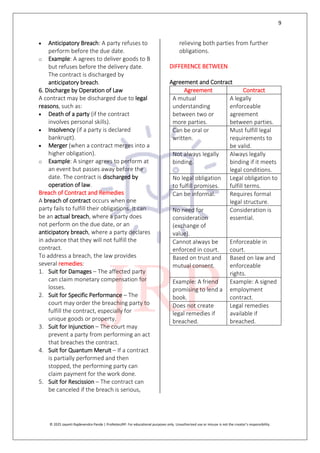
DIFFERENCE BETWEEN
Agreement and Contract
Agreement Contract
A mutual
understanding
between two or
more parties.
A legally
enforceable
agreement
between parties.
Can be oral or
written.
Must fulfill legal
requirements to
be valid.
Not always legally
binding.
Always legally
binding if it meets
legal conditions.
No legal obligation
to fulfill promises.
Legal obligation to
fulfill terms.
Can be informal. Requires formal
legal structure.
No need for
consideration
(exchange of
value).
Consideration is
essential.
Cannot always be
enforced in court.
Enforceable in
court.
Based on trust and
mutual consent.
Based on law and
enforceable
rights.
Example: A friend
promising to lend a
book.
Example: A signed
employment
contract.
Does not create
legal remedies if
breached.
Legal remedies
available if
breached.
10
© 2025 Jayanti Rajdevendra Pande | ProNotesJRP. For educational purposes only. Unauthorized use or misuse is not the creator’s responsibility.
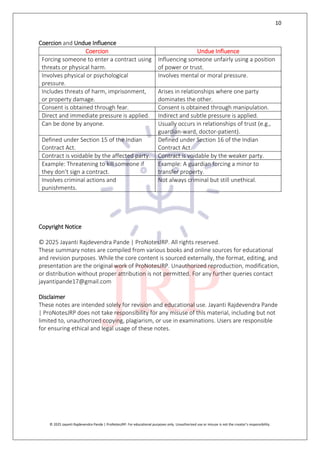
Coercion and Undue Influence
Coercion Undue Influence
Forcing someone to enter a contract using
threats or physical harm.
Influencing someone unfairly using a position
of power or trust.
Involves physical or psychological
pressure.
Involves mental or moral pressure.
Includes threats of harm, imprisonment,
or property damage.
Arises in relationships where one party
dominates the other.
Consent is obtained through fear. Consent is obtained through manipulation.
Direct and immediate pressure is applied. Indirect and subtle pressure is applied.
Can be done by anyone. Usually occurs in relationships of trust (e.g.,
guardian-ward, doctor-patient).
Defined under Section 15 of the Indian
Contract Act.
Defined under Section 16 of the Indian
Contract Act.
Contract is voidable by the affected party. Contract is voidable by the weaker party.
Example: Threatening to kill someone if
they don’t sign a contract.
Example: A guardian forcing a minor to
transfer property.
Involves criminal actions and
punishments.
Not always criminal but still unethical.
Copyright Notice
© 2025 Jayanti Rajdevendra Pande | ProNotesJRP. All rights reserved.
These summary notes are compiled from various books and online sources for educational
and revision purposes. While the core content is sourced externally, the format, editing, and
presentation are the original work of ProNotesJRP. Unauthorized reproduction, modification,
or distribution without proper attribution is not permitted. For any further queries contact
jayantipande17@gmail.com
Disclaimer
These notes are intended solely for revision and educational use. Jayanti Rajdevendra Pande
| ProNotesJRP does not take responsibility for any misuse of this material, including but not
limited to, unauthorized copying, plagiarism, or use in examinations. Users are responsible
for ensuring ethical and legal usage of these notes.

BBA Business Law Unit 1 Summary Notes.pdf

  • 1.
    1 © 2025 JayantiRajdevendra Pande | ProNotesJRP. For educational purposes only. Unauthorized use or misuse is not the creator’s responsibility. BBA Sem 2 NEP Business Law Unit 1: Indian Contract Act 1872 Common Introduction for all Answers The Indian Contract Act, 1872 was introduced to ensure smooth business transactions and maintain trust in trade and commerce. In a growing economy like India, agreements between individuals and businesses needed a legal framework to avoid disputes. This Act provides clear rules on how contracts are formed, what makes them valid, and how they can be enforced. It was enacted on 1st September 1872 and applies across India, except in certain regions. It defines a contract as an agreement enforceable by law and sets conditions for a valid contract, like offer, acceptance, lawful consideration, capacity of parties, and free consent. It helps in resolving disputes, protecting rights, and ensuring legal remedies in case of breaches. The Act plays a crucial role in maintaining fairness, transparency, and accountability in business dealings. Contract A contract is a legally binding agreement between two or more parties that creates mutual obligations. It ensures that promises made in business or personal dealings are enforceable by law. Definition (Section 2(h) of the Indian Contract Act, 1872): "A contract is an agreement enforceable by law." Nature of Contract 1. Agreement: A contract starts with an offer by one party and acceptance by another, leading to a mutual understanding. 2. Enforceable by Law: The agreement must fulfil legal conditions, making it valid and binding in a court of law. Kinds of Contracts 1. On the Basis of Enforceability: o Valid Contract: Legally binding and enforceable (e.g., employment contract). o Void Contract: Initially valid but later unenforceable (e.g., contract for a banned product). o Void Agreement: Never legally enforceable (e.g., betting agreement). o Voidable Contract: Legally valid but can be canceled due to coercion, fraud, etc. (e.g., forced contract). o Illegal Contract: Involves illegal activities, completely unenforceable (e.g., smuggling contract). o Unenforceable Contract: Valid but not enforceable due to technical defects (e.g., unstamped land sale). 2. On the Basis of Formation: o Express Contract: Terms clearly stated (e.g., written house sale agreement). o Implied Contract: Formed by conduct (e.g., taking a taxi and paying fare). o Quasi-Contract: Imposed by law to prevent unfair gain (e.g., mistaken bill payment). o E-Contract: Created through digital means (e.g., software installation agreement). 3. On the Basis of Performance: o Executed Contract: Both parties have fulfilled obligations (e.g., completed house sale). o Executory Contract: Obligations are yet to be performed (e.g., job contract before joining). 4. On the Basis of Obligation: o Unilateral Contract: Only one party makes a promise (e.g., reward for finding a lost pet). o Bilateral Contract: Both parties make mutual promises (e.g., sales contract) Essentials of a Valid Contract
  • 2.
    2 © 2025 JayantiRajdevendra Pande | ProNotesJRP. For educational purposes only. Unauthorized use or misuse is not the creator’s responsibility. A valid contract must meet certain essential conditions as per the Indian Contract Act, 1872. If any of these elements are missing, the contract may become void or unenforceable. The key essentials are: 1. Agreement (Offer & Acceptance): A contract begins with an offer and its unconditional acceptance. (e.g., Selling a bike for ₹50,000 and accepting the price). 2. Intention to Create Legal Relations: There must be a legal obligation, not just a social promise. (e.g., A father promising money for good grades is not a contract). 3. Lawful Consideration: Something of value must be exchanged, and it must be legal. (e.g., Paying for smuggling is not valid). 4. Capacity of Parties: Parties must be competent (i.e., not minors, mentally unsound, or disqualified by law). (e.g., A minor buying on EMI is not enforceable). 5. Free and Genuine Consent: Consent must be free from coercion, fraud, or misrepresentation. (e.g., Selling land under threat makes the contract voidable). 6. Lawful Object: The purpose of the contract must not be illegal or immoral. (e.g., A contract for sharing gambling profits is void). 7. Writing & Registration: Some contracts must be in writing and registered as per law. (e.g., A land sale must be in writing to be valid). 8. Certainty of Terms: The contract terms must be clear and definite. (e.g., A vague contract for "some quantity" of goods is invalid). 9. Possibility of Performance: The contract must be capable of execution. (e.g., A contract to paint a house that no longer exists is void). 10. Agreement Not Expressly Declared Void: Certain agreements, like wagering or trade-restricting agreements, are void. (e.g., A contract never to work for another company is unenforceable). Offer An offer is a proposal made by one party to another, indicating a willingness to enter into a contract on certain terms. When accepted, it becomes an agreement. Definition: According to Section 2(a) of the Indian Contract Act, 1872, an offer is "when one person signifies to another his willingness to do or abstain from doing something, with a view to obtaining the other’s assent to such act or abstinence." How an Offer is Made? 1. Express Offer: Made through words (spoken or written) or conduct. o Example (By Words): A offers to sell his car to B for ₹2,00,000. o Example (By Conduct): A shopkeeper displays a product with a price tag, indicating that it is available for sale. 2. Implied Offer: Made through actions or circumstances without explicitly stating it. o Example: A public transport service runs buses on a fixed route, offering a ride to anyone willing to pay the fare. Essential Elements of a Valid Offer 1. Creates Legal Relationship – The offer must be made with an intention to form a contract. Example: A friend promising to call is not a contract. 2. Clear and Definite – Terms must be specific, not vague. Example: "Selling 10 books for ₹500" is valid, but "selling books for a fair price" is not. 3. Express or Implied – An offer can be stated clearly or understood through
  • 3.
    3 © 2025 JayantiRajdevendra Pande | ProNotesJRP. For educational purposes only. Unauthorized use or misuse is not the creator’s responsibility. actions. Example: Picking items at a store implies an offer to buy at the listed price. 4. Not an Invitation to Offer – An offer is a firm proposal, unlike an invitation to negotiate. Example: A shop displaying "50% off" is not an offer but an invitation. 5. Specific or General – It can be made to a person or the public. Example: A reward for finding a lost pet is a general offer. 6. Must Be Communicated – The offeree must know about the offer. Example: An offer made in a hidden letter is not valid unless read. 7. Seeks Acceptance – The offer should aim at getting consent. Example: Selling a car for ₹50,000 requires the buyer’s agreement. 8. Can Be Conditional – Some offers come with conditions. Example: "I will sell my bike only if you pay ₹5,000 in advance." 9. No Automatic Acceptance – Silence or inaction cannot mean acceptance. Example: If A offers to sell his phone and B stays silent, it is not acceptance. Types of Offer: 1. General Offer – Made to the public; anyone who meets the condition can accept. Example: A reward for returning lost documents. 2. Special Offer – Made to a specific person or group. Example: Selling a laptop to a particular customer. 3. Cross Offer – Two parties unknowingly make identical offers to each other. No contract forms. Example: A offers to sell a bike to B for ₹40,000, and B simultaneously offers to buy it for ₹40,000. 4. Counter-Offer – The offeree modifies the terms, rejecting the original offer. Example: A offers to sell a house for ₹50 lakhs; B offers ₹45 lakhs instead. 5. Standing/Continuing Offer – Open for a period, allowing multiple acceptances. Example: A supplier agrees to provide raw materials for six months. Lapse of Offer: An offer does not stay open forever. It can lapse due to: 1. Revocation – The offeror withdraws before acceptance. Example: A withdraws his house sale offer before B accepts. 2. Rejection – If refused, the offer is no longer valid. Example: B rejects A’s car sale offer and cannot accept it later. 3. Counter-Offer – Modifying an offer cancels the original. Example: B offers ₹45,000 instead of ₹50,000 for A’s bike. 4. Lapse of Time – Not accepted within a deadline or reasonable time. Example: A job offer expires after 10 days if not accepted. 5. Death or Insanity – If either party dies or becomes insane before acceptance. Example: A, a painter, dies before B accepts his service offer. 6. Non-Fulfillment of Condition – If a required condition isn’t met. Example: A land sale offer lapses if the buyer fails to pay the required advance. 7. Supervening Impossibility – If performance becomes illegal or impossible. Example: An offer to export goods lapses if the government bans the export. Acceptance: Acceptance is the agreement to the terms of an offer, creating a legally binding contract. It must be clear, unconditional, and communicated to the offeror. Definition: As per the Indian Contract Act,
  • 4.
    4 © 2025 JayantiRajdevendra Pande | ProNotesJRP. For educational purposes only. Unauthorized use or misuse is not the creator’s responsibility. 1872, "Every promise and every set of promises forming the consideration for each other is an agreement." Who Can Accept an Offer? 1. Specific Offeree: Only the intended recipient can accept a specific offer. 2. General Public: Anyone who fulfills the conditions of a general offer can accept it. Essentials of Valid Acceptance: 1. Absolute and Unqualified: Acceptance must match the offer’s terms without changes. 2. Communicated to Offeror: Silence is not acceptance; it must be expressed. 3. After the Offer: Acceptance must follow a valid offer. 4. By the Intended Person: Only the offeree can accept, unless authorized. 5. Prescribed Mode: If a method is specified, it must be followed. 6. Within Time Limit: Must be accepted within the given or reasonable time. Revocation of Offer Revocation of an offer means withdrawing or canceling the offer before it is accepted. Modes of Revocation 1. By Notice of Revocation – The offeror informs the offeree about the withdrawal before acceptance. 2. By Lapse of Time – If the offer is not accepted within the given time or a reasonable period, it expires. 3. By Non-Fulfillment of Condition Precedent – If the offer requires a condition to be met first and it isn’t fulfilled, the offer is revoked. 4. By Death or Insanity – If the offeror or offeree dies or becomes insane before acceptance, the offer lapses. 5. By Counter-Offer – If the offeree changes the terms of the offer, it acts as a rejection of the original offer. Consideration Consideration is something of value exchanged between parties in a contract, such as money, goods, services, or a promise, making the contract enforceable. Essential Elements of Valid Consideration 1. At the Desire of the Promisor – The act must be done at the promisor’s request (e.g., A builds a house for B at B’s request). 2. May Move from Promisee or Another Person – Anyone can provide consideration, not just the promisee (e.g., A pays for B’s order, and B delivers goods to C). 3. Can Be Past, Present, or Future – Consideration can be given before, during, or after the contract (e.g., a reward for past services). 4. Must Be Something New – The promisor should not already be legally bound to do it (e.g., a police officer cannot claim a reward for catching a criminal). 5. Must Be Real, Not Illusory – It should have actual value and not be impossible or imaginary (e.g., promising to bring the moon is not valid). 6. Must Not Be Illegal or Against Public Policy – The consideration should not involve unlawful activities (e.g., paying someone to commit a crime is void). Exceptions to "No Consideration, No Contract" 1. Natural Love and Affection – A written, registered agreement between close relatives is valid even without consideration. 2. Compensation for Past Voluntary Services – A promise to reward someone for past voluntary service is enforceable. 3. Promise to Pay a Time-Barred Debt – A written promise to repay an expired debt is legally binding. 4. Contracts of Agency – An agent can act on behalf of a principal without separate consideration.
  • 5.
    5 © 2025 JayantiRajdevendra Pande | ProNotesJRP. For educational purposes only. Unauthorized use or misuse is not the creator’s responsibility. 5. Charitable Pledges and Gifts – A donation promise becomes binding if the recipient takes action based on it. Situations When Consideration or Object is Unlawful (Section 23) 1. Forbidden by Law – If an act is legally banned, the contract is void (e.g., selling illegal drugs). 2. Defeats Legal Provisions – Any agreement that tries to bypass the law is unlawful (e.g., using fake documents to avoid taxes). 3. Fraudulent – If the contract involves fraud, it is void (e.g., selling a defective product as new). 4. Causes Injury – A contract that harms a person or property is illegal (e.g., hiring someone to destroy another’s car). 5. Against Public Policy – If an agreement promotes corruption or immoral acts, it is void (e.g., paying for false testimony in court). Kinds of Consideration 1. Past Consideration – Something given or done before the promise is made, e.g., A helps B without expecting anything, and later B promises to reward A. 2. Present (Executed) Consideration – Something given at the time of agreement, e.g., A sells a phone to B, and B pays immediately. 3. Future (Executory) Consideration – A promise to do something in the future, e.g., A agrees to supply goods to B next month, and B agrees to pay later. 4. Unlawful Consideration – Consideration involving illegal acts or those against public policy, e.g., A contracts with B to smuggle goods in exchange for money. 5. Unreal or Illusory Consideration – Consideration that has no actual value or is impossible to perform, e.g., A promises B ₹10,000 if B touches the sky. Capacity of Parties to Contract Capacity refers to the legal ability of a person to enter into a valid contract. As per Section 11 of the Indian Contract Act, a person must be of sound mind, of the age of majority, and not disqualified by law to enter into a contract. Persons Incapable of Contracting:  Minors – Below 18 years; contracts are void, e.g., a minor taking a loan isn’t liable.  Unsound Mind – Mentally incompetent persons cannot contract, e.g., a person with severe schizophrenia.  Disqualified by Law – Convicts, war aliens, insolvents cannot contract, e.g., a bankrupt person selling property. Rules for a Minor’s Agreement A minor (below 18 years, or 21 if under guardianship) cannot enter into a valid contract under the Indian Majority Act, 1875. 1. Void Agreement – A minor’s contract is void ab initio and has no legal effect, e.g., a 16-year-old selling a bicycle. 2. Minor as Beneficiary – A minor can receive benefits but cannot be held liable, e.g., receiving gifted land. 3. No Ratification on Majority (Sec 68) – A minor cannot confirm a void contract after turning 18, e.g., repaying a past loan isn’t enforceable unless a new contract is made. 4. Cannot Be a Shareholder – A minor cannot buy shares directly, but a guardian can do so on their behalf. 5. Parents/Guardians Not Liable – They aren’t responsible unless they personally guarantee the contract, e.g., a minor’s unauthorized loan isn’t their parent’s liability. Persons of Unsound Mind (Section 12) A person must be of sound mind while making a contract. Those incapable of understanding the nature and consequences of a contract are considered
  • 6.
    6 © 2025 JayantiRajdevendra Pande | ProNotesJRP. For educational purposes only. Unauthorized use or misuse is not the creator’s responsibility. unsound under Section 12 of the Indian Contract Act, 1872. 1. Idiocy – A person born with permanent mental incapacity cannot form valid contracts. 2. Lunacy or Insanity – A person with temporary or periodic insanity can only contract during lucid intervals (mentally stable periods). 3. Drunkenness – A person intoxicated to the extent that they cannot understand the contract is considered unsound. 4. Hypnotism – A person under hypnotic influence loses control over their actions, making contracts voidable. 5. Mental Decay – Old age or illness causing a person to lose mental stability disqualifies them from contracting. Persons Disqualified by Law Certain persons are legally restricted from entering into contracts. 1. Alien Enemies – Citizens of enemy countries cannot contract during war. 2. Foreign Sovereigns & Ambassadors – They have immunity but can contract if they waive their privilege. 3. Convicts – A person convicted of a serious crime loses the right to contract while serving a sentence. 4. Insolvent Persons – Once declared insolvent, a person cannot contract until discharged by the court. Free Consent (Section 14) A contract is valid only if both parties agree voluntarily. Consent is free when it is not caused by coercion, undue influence, fraud, misrepresentation, or mistake. Factors Affecting Free Consent 1. Coercion (Section 15) – Forcing someone to enter a contract using threats, force, or unlawful acts. E.g., Threatening to harm someone if they don’t sign a contract. 2. Undue Influence (Section 16) – When one party exploits their position of power over another to gain an unfair advantage. E.g., A doctor pressuring a patient to transfer property. 3. Fraud (Section 17) – Deliberate false statements or concealment of facts to deceive another party. E.g., Selling a defective phone while claiming it is brand new. 4. Misrepresentation (Section 18) – False statements made without intent to deceive, leading the other party to enter the contract. E.g., A seller unknowingly giving incorrect information about a car’s mileage. Mistake (Sections 20-22) – An error regarding facts or law that affects the contract’s validity. E.g., A contract signed under the wrong assumption about the identity of a product. Mistake in a Contract (Sections 20-22) A mistake happens when one or both parties misunderstand something important about the contract. This can make the contract void or valid depending on the type of mistake. Types of Mistakes 1. Mistake of Law – When a person misunderstands the law. a) Indian Law – Not an excuse; the contract stays valid. (E.g., A agrees to pay extra tax due to misunderstanding the law; they cannot cancel the contract.) b) Foreign Law – Treated like a mistake of fact, and the contract may be void. (E.g., A signs a contract in India thinking US law allows it, but it doesn’t.) 2. Mistake of Fact – Misunderstanding about facts related to the contract. a) Bilateral Mistake – Both parties are wrong about an important fact; the contract is void. (E.g., A and B agree to sell a horse, but the horse was already dead.) b) Unilateral Mistake – Only one party
  • 7.
    7 © 2025 JayantiRajdevendra Pande | ProNotesJRP. For educational purposes only. Unauthorized use or misuse is not the creator’s responsibility. is wrong; the contract is usually valid unless caused by fraud or misrepresentation. (E.g., A mistakenly bids higher in an auction; they cannot cancel unless tricked.) Unlawful Consideration & Object (Section 23, Indian Contract Act, 1872) Consideration is the value exchanged in a contract, while the object is its purpose. A contract is void if its consideration or object is unlawful, meaning: 1. Forbidden by Law – If the agreement involves an act prohibited by law (e.g., selling illegal drugs). 2. Defeats Legal Provisions – If it aims to evade laws (e.g., avoiding taxes through fake documents). 3. Fraudulent – If made with intent to deceive (e.g., selling a defective product as new). 4. Causes Injury – If it harms a person, property, or reputation (e.g., hiring someone to damage a car). 5. Against Public Policy – If it harms society, promotes corruption, or is immoral (e.g., paying for false testimony). Void Agreements (Section 2(g), Indian Contract Act, 1872) A void agreement is one that has no legal effect and cannot be enforced by law. It does not create any rights or obligations. E.g., a minor selling property is void. Agreements Expressly Declared as Void 1. Unlawful Consideration or Object (Section 23) – If an agreement involves illegal acts, fraud, or harm, it is void. E.g., a contract for smuggling goods. 2. Agreement by a Minor (Section 11) – A minor cannot enter a valid contract. E.g., a 16-year-old selling a bike. 3. Agreement Without Consideration (Section 25) – A contract without consideration is void, except for love, past services, or time-barred debt. E.g., promising ₹10,000 without reason. 4. Agreement Restraining Marriage (Section 26) – Any contract restricting marriage is void. E.g., agreeing not to marry for money. 5. Agreement Restraining Trade (Section 27) – Contracts that limit a person’s right to conduct business are void, except in cases of goodwill sales or partnership restrictions. E.g., forcing someone not to start a business for money. 6. Agreement Restraining Legal Proceedings (Section 28) – A contract preventing a person from seeking legal remedies is void. E.g., agreeing not to sue each other. 7. Agreement With Uncertain Terms (Section 29) – If an agreement is too vague or unclear, it is void. E.g., agreeing to sell "some quantity" of rice without specifying the amount. 8. Agreement Based on Wagering (Section 30) – Betting agreements are void as they depend on uncertain events. E.g., wagering ₹5,000 on a cricket match outcome. Performance of a Contract A contract must be performed by the responsible party, but in some cases, another person may fulfill the obligation under specific conditions. Sections 37 to 67 of the Indian Contract Act, 1872, govern contract performance. Who May Perform a Contract? 1. By the Promisor Himself – If personal skill or expertise is required, only the promisor can perform. E.g., A famous singer must perform personally. 2. By the Promisor’s Agent – If no personal skill is needed, an agent can perform. E.g., A can appoint an agent to deliver goods. 3. By Legal Representatives – If the promisor dies, their heirs must complete the contract unless personal
  • 8.
    8 © 2025 JayantiRajdevendra Pande | ProNotesJRP. For educational purposes only. Unauthorized use or misuse is not the creator’s responsibility. expertise is required. E.g., Selling land after the owner’s death. 4. By a Third Party – If the promisee accepts performance from a third party, it is valid. E.g., C repays A’s debt to B with B’s consent. Types of Performance of Contracts 1. Actual Performance – The promisor fulfills their obligation, discharging the contract. E.g., A delivers a car to B as per contract. 2. Attempted Performance (Tender of Performance) – The promisor offers performance, but the promisee refuses. The promisor is then discharged. E.g., A delivers goods to B, but B refuses to accept them. Discharge of a Contract A contract is said to be discharged when the obligations under it come to an end, and the parties are no longer bound by its terms. The various ways in which a contract can be discharged are as follows: 1. Discharge by Performance A contract is discharged when both parties fulfill their obligations as agreed. Performance can be:  Actual Performance: Both parties complete their duties, and the contract is discharged. o Example: A sells a car to B for ₹5,00,000, and both fulfill their obligations.  Attempted Performance (Tender of Performance): One party offers to perform, but the other refuses. In such cases, the promisor is discharged from liability. o Example: A delivers goods to B, but B refuses to accept them without reason. A is no longer liable. 2. Discharge by Agreement Parties may mutually agree to terminate the contract before performance. This can happen through:  Novation: Substituting a new contract for the old one.  Alteration: Making changes in contract terms with mutual consent.  Rescission: Canceling the contract with mutual consent.  Waiver: Giving up rights under the contract. o Example: A and B agree to cancel their agreement for the sale of goods. The contract is discharged by mutual agreement. 3. Discharge by Impossibility (Section 56, Indian Contract Act, 1872) If a contract becomes impossible to perform due to unforeseen circumstances, it is discharged.  Initial Impossibility: If the contract was impossible from the start, it is void. o Example: A contracts to sell a non- existent property to B.  Subsequent Impossibility: If performance becomes impossible later due to events like natural disasters, legal changes, etc. o Example: A contracts to build a house, but an earthquake destroys the land. 4. Discharge by Lapse of Time  If a contract is not performed within the prescribed time, it may become unenforceable under the Limitation Act, 1963.  The aggrieved party loses the right to sue after the time limit expires. o Example: A loan repayment contract requires payment within three years. If unpaid beyond the limitation period, it becomes unenforceable. 5. Discharge by Breach of Contract A contract is discharged if one party fails to perform their obligations.  Actual Breach: Failure to perform at the agreed time.
  • 9.
    9 © 2025 JayantiRajdevendra Pande | ProNotesJRP. For educational purposes only. Unauthorized use or misuse is not the creator’s responsibility.  Anticipatory Breach: A party refuses to perform before the due date. o Example: A agrees to deliver goods to B but refuses before the delivery date. The contract is discharged by anticipatory breach. 6. Discharge by Operation of Law A contract may be discharged due to legal reasons, such as:  Death of a party (if the contract involves personal skills).  Insolvency (if a party is declared bankrupt).  Merger (when a contract merges into a higher obligation). o Example: A singer agrees to perform at an event but passes away before the date. The contract is discharged by operation of law. Breach of Contract and Remedies A breach of contract occurs when one party fails to fulfill their obligations. It can be an actual breach, where a party does not perform on the due date, or an anticipatory breach, where a party declares in advance that they will not fulfill the contract. To address a breach, the law provides several remedies: 1. Suit for Damages – The affected party can claim monetary compensation for losses. 2. Suit for Specific Performance – The court may order the breaching party to fulfill the contract, especially for unique goods or property. 3. Suit for Injunction – The court may prevent a party from performing an act that breaches the contract. 4. Suit for Quantum Meruit – If a contract is partially performed and then stopped, the performing party can claim payment for the work done. 5. Suit for Rescission – The contract can be canceled if the breach is serious, relieving both parties from further obligations. DIFFERENCE BETWEEN Agreement and Contract Agreement Contract A mutual understanding between two or more parties. A legally enforceable agreement between parties. Can be oral or written. Must fulfill legal requirements to be valid. Not always legally binding. Always legally binding if it meets legal conditions. No legal obligation to fulfill promises. Legal obligation to fulfill terms. Can be informal. Requires formal legal structure. No need for consideration (exchange of value). Consideration is essential. Cannot always be enforced in court. Enforceable in court. Based on trust and mutual consent. Based on law and enforceable rights. Example: A friend promising to lend a book. Example: A signed employment contract. Does not create legal remedies if breached. Legal remedies available if breached.
  • 10.
    10 © 2025 JayantiRajdevendra Pande | ProNotesJRP. For educational purposes only. Unauthorized use or misuse is not the creator’s responsibility. Coercion and Undue Influence Coercion Undue Influence Forcing someone to enter a contract using threats or physical harm. Influencing someone unfairly using a position of power or trust. Involves physical or psychological pressure. Involves mental or moral pressure. Includes threats of harm, imprisonment, or property damage. Arises in relationships where one party dominates the other. Consent is obtained through fear. Consent is obtained through manipulation. Direct and immediate pressure is applied. Indirect and subtle pressure is applied. Can be done by anyone. Usually occurs in relationships of trust (e.g., guardian-ward, doctor-patient). Defined under Section 15 of the Indian Contract Act. Defined under Section 16 of the Indian Contract Act. Contract is voidable by the affected party. Contract is voidable by the weaker party. Example: Threatening to kill someone if they don’t sign a contract. Example: A guardian forcing a minor to transfer property. Involves criminal actions and punishments. Not always criminal but still unethical. Copyright Notice © 2025 Jayanti Rajdevendra Pande | ProNotesJRP. All rights reserved. These summary notes are compiled from various books and online sources for educational and revision purposes. While the core content is sourced externally, the format, editing, and presentation are the original work of ProNotesJRP. Unauthorized reproduction, modification, or distribution without proper attribution is not permitted. For any further queries contact jayantipande17@gmail.com Disclaimer These notes are intended solely for revision and educational use. Jayanti Rajdevendra Pande | ProNotesJRP does not take responsibility for any misuse of this material, including but not limited to, unauthorized copying, plagiarism, or use in examinations. Users are responsible for ensuring ethical and legal usage of these notes.