Sagar Pokhrel
Faculty, BBA First Semester
Prime College
Marketing
Information System
(MkIS)
Information System (IS)
 “Information systems (IS) is the study of complementary
networks of hardware and software that people and
organizations use to collect, filter, process, create, and
distribute data.”
 In other words, Information systems are interrelated
components working together to collect, process, store,
and disseminate information to support decision making,
coordination, control, analysis, and visualizationof
information in an organization.
 Almost all IS are software applications that takes data as
input and produces meaningful information as input.
2
Business Information System
The term business information systems is
used to describe a variety of types of
information systems (transaction processing,
information reporting, decision support, etc.)
that support the functions of business such as
accounting, finance, marketing, or human
resource management.
3
Business Information System
▪ Business firms are turning to Internet
technologies to integrate the flow of
information among their internal business
functions and their customers and suppliers.
▪ Companies are using the World Wide Web
and their intranets and extranets as the
technology platform for their cross-functional
and inter organizational information systems.
4
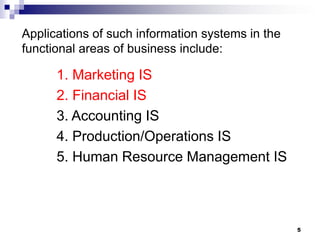
Applications of such information systems in the
functional areas of business include:
1. Marketing IS
2. Financial IS
3. Accounting IS
4. Production/Operations IS
5. Human Resource Management IS
5
Business Information System
▪ In addition, many companies have moved from
functional mainframe legacy systems to cross
functional client/server network applications.
▪ This typically has involved
▪ installing enterprise resource planning (ERP) or supply
chain management (SCM) software.
▪ Instead of focusing on the information processing
requirements of business functions, ERP software
focuses on supporting the supply chain
processes involved in the operations of a
business. 6
7
Marketing Information System
▪ MkIS Marketing Information System (MkIS) collects,
analyses, and supplies a lot of relevant information to the
marketing managers.
▪ It is a valuable tool for planning, implementing and controlling
the marketing activities.
▪ The role of MIS is to identify (find out) what sort of
information is required by the marketing managers.
▪ It then collects and analyzes the information. It supplies this
information to the marketing manager at the right time.
8
Marketing Information System(MkIS)
 The business function of marketing is concerned with the
planning, promotion, and sale of existing products in
existing markets, and the development of new products
and new markets to better serve present and potential
customers.
 Marketing information systems integrate the information
flow required by many marketing activities.
 It Consists of people, equipment, and procedures to
gather, sort, analyze, evaluate, and distribute needed,
timely, and accurate information to marketing decision
makers.
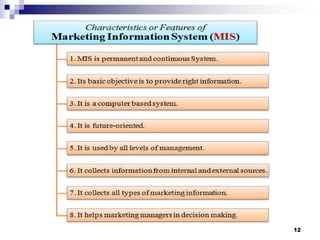
 MkIS is a permanent and continuous process.
9
Marketing Information System(MkIS)
 Marketing information includes all facts, estimates, opinions,
guidelines, policies and other data which is necessary for taking
marketing decisions.
 This information may be collected from both internal and external
sources.
 from customers, competitors, company salesmen, government
sources, specialized agencies, so on.
 This information is analyzed. Then, it is supplied to the marketing
managers. The marketing managers use this information for taking
marketing decisions.
 MkIS also evaluates and stores the information. MkIS uses modern
technology for collecting, analyzing, storing and supplying
information.
10
Marketing information systems provide
information for:
▪ Internet/intranet web sites and services make an interactive
marketing process possible where customers can become
partners in creating, marketing, purchasing, and improving products
and services.
▪ Sales force automation systems use mobile computing and
Internet technologies to automate many information processing
activities for sales support and management.
▪ Other marketing systems assist marketing managers in product
planning, pricing, and other product management decision,
advertising and sales promotion strategies, and market
research and forecasting.
▪ Planning, control, and transaction processing in the marketing
function.
11
Marketing information systems provide
information for:
▪ Control Reporting Systems support the efforts of marketing
managers to control the efficiency and effectiveness of the selling
and distribution of products and services.
▪ Analytical reports provide information on a firm's actual
performance versus planned marketing objectives.
12
13
Characteristics/Features of MkIS
▪ Continuous system : MkIS is a permanent and continuous system
of collecting information. It collects information continuously.
▪ Basic objective : The basic objective of MIS is to provide the right-
information at the right-time to the right-people to help them take
right decisions.
▪ Computer based system : MkIS is a computer-based system. It
uses computers for storing, analyzing and supplying information. It
also uses micro-films for storing information. Therefore, it is very
quick and accurate.
▪ Future-oriented : MkIS is future-oriented. It provides information for
solving future problems. It is not past-oriented.
14
Characteristics/Features of MkIS
▪ Used by all levels : MkIS is used by all three levels of
management, i.e. top, middle and lower. It is used for making
marketing plans, policies and strategies. This is used to solve
marketing problems and to take advantage of business
opportunities.
▪ Sources : MIS collects information from both, internal and external
sources. For example, information is collected from company
records, publications, etc.
▪ Collects marketing information : MIS collects all types of
marketing information. It collects information about the consumer
competition, marketing environment, government policies, etc. It
supplies this information to the marketing managers.
▪ Helps in decision making : MIS supplies up-to-date and accurate
information. It helps marketing managers to take quick and right
decisions.
15
Other features
▪ MkIS provides facilities for analyzing effectiveness of
advertisement campaigns
▪ It helps in finding customer clusters
▪ It also helps in converting potential customers to buyers
▪ Helps in setting price of products
▪ Helps in sales trend analysis
16
Components of Marketing Information
System
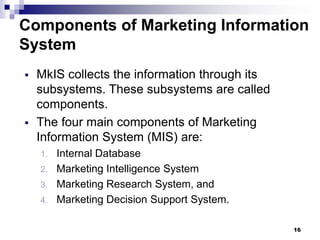
▪ MkIS collects the information through its
subsystems. These subsystems are called
components.
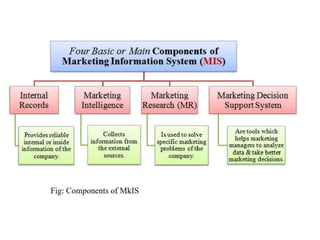
▪ The four main components of Marketing
Information System (MIS) are:
1. Internal Database
2. Marketing Intelligence System
3. Marketing Research System, and
4. Marketing Decision Support System.
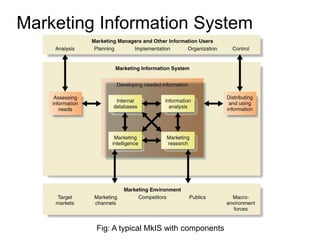
Marketing Information System
Fig: A typical MkIS with components
19
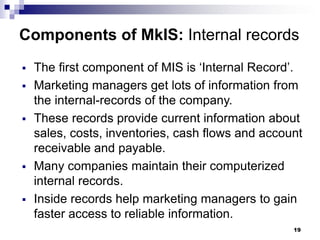
Components of MkIS: Internal records
▪ The first component of MIS is ‘Internal Record’.
▪ Marketing managers get lots of information from
the internal-records of the company.
▪ These records provide current information about
sales, costs, inventories, cash flows and account
receivable and payable.
▪ Many companies maintain their computerized
internal records.
▪ Inside records help marketing managers to gain
faster access to reliable information.
20
Components of MkIS: Marketing intelligence
▪ It collects information from external sources. It provides
information about current marketing-environment and
changing conditions in the market.
▪ This information can be easily gathered from external
sources like; magazines, trade journals, commercial
press, so on.
▪ This information cannot be collected from the Annual
Reports of the Trade Association and Chambers of
Commerce, Annual Report of Companies, etc.
▪ The salesmen’s report also contains information about
market trends.
21
Components of MkIS: Marketing intelligence
▪ The information which is collected from the external
sources cannot be used directly.
▪ It must be first evaluated, cleaned and arranged in a
proper order.
▪ Different types of data visualization software may be used
to represent collected data in understandable forms such
as charts, diagrams or dashboards.
▪ It can be then used by the marketing manager for taking
decisions and making policies about marketing.
▪ So, marketing intelligence is an important component of
MkIS.
22
Components of MkIS: Marketing research
▪ Marketing Research is conducted to solve specific
marketing problems of the company.
▪ It collects data about the problem. This data is tabulated,
analyzed and conclusions are drawn.
▪ Then the recommendations are given for solving the
problem.
▪ Marketing research also provides information to the
marketing managers.
▪ However, this information is specific information. It can be
used only for a particular purpose.
▪ MkIS and MR are not substitutes of each other. The scope
of MkIS is very wide. It includes ‘MR’. However, the scope
of MR is very narrow.
23
Components of MkIS: Marketing decision
support system
▪ These are the tools which help the marketing managers to
analyze data and to take better marketing decisions.
▪ They include hardware, i.e. computer and software
programs.
▪ Computer helps the marketing manager to analyze the
marketing information. It also helps them to take better
decisions.
▪ In fact, today marketing managers cannot work without
computers. There are many software programs, which
help the marketing manager to do market segmentation,
price fixing, advertising budgets, etc.
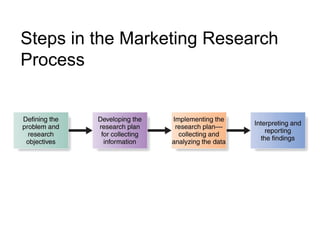
Steps in the Marketing Research
Process
25
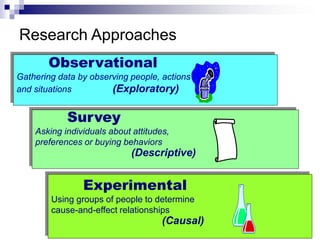
Research Approaches
Survey
Asking individuals about attitudes,
preferences or buying behaviors
(Descriptive)
Experimental
Using groups of people to determine
cause-and-effect relationships
(Causal)
Observational
Gathering data by observing people, actions
and situations (Exploratory)
Simple MkIS and Applications
 Evaluating Marketing Campaign
 Customer Acquisition Cost (CAC)
 Time to Pay back CAC
 Breakeven Analysis
27
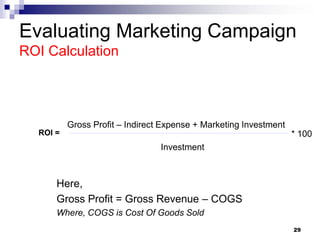
Evaluating Marketing Campaign
▪ Return on investment is always a major
concern when it comes to marketing or any
other business expense.
▪ The idea is to check whether the money you pu
into your marketing plan has resulted in a profit
▪ Must measure the amount spent on each
campaign, versus the amount of sales each
campaign brought in specifically.
28
Evaluating Marketing Campaign
ROI Calculation
Here,
Gross Profit = Gross Revenue – COGS
Where, COGS is Cost Of Goods Sold
29
Gross Profit – Indirect Expense + Marketing Investment
ROI =
Investment
* 100
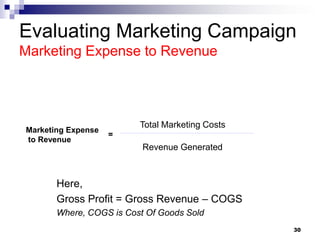
Evaluating Marketing Campaign
Marketing Expense to Revenue
Here,
Gross Profit = Gross Revenue – COGS
Where, COGS is Cost Of Goods Sold
30
Total Marketing Costs
Marketing Expense
to Revenue
Revenue Generated
=
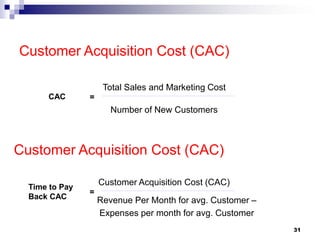
Customer Acquisition Cost (CAC)
31
Total Sales and Marketing Cost
CAC
Number of New Customers
=
Customer Acquisition Cost (CAC)
Customer Acquisition Cost (CAC)Time to Pay
Back CAC Revenue Per Month for avg. Customer –
Expenses per month for avg. Customer
=
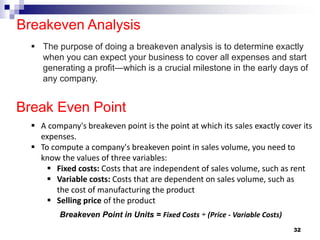
Breakeven Analysis
32
Break Even Point
▪ The purpose of doing a breakeven analysis is to determine exactly
when you can expect your business to cover all expenses and start
generating a profit—which is a crucial milestone in the early days of
any company.
Breakeven Point in Units = Fixed Costs ÷ (Price - Variable Costs)
▪ A company's breakeven point is the point at which its sales exactly cover its
expenses.
▪ To compute a company's breakeven point in sales volume, you need to
know the values of three variables:
▪ Fixed costs: Costs that are independent of sales volume, such as rent
▪ Variable costs: Costs that are dependent on sales volume, such as
the cost of manufacturing the product
▪ Selling price of the product
Breakeven Analysis
33
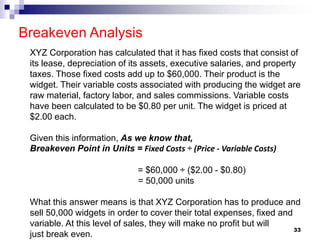
XYZ Corporation has calculated that it has fixed costs that consist of
its lease, depreciation of its assets, executive salaries, and property
taxes. Those fixed costs add up to $60,000. Their product is the
widget. Their variable costs associated with producing the widget are
raw material, factory labor, and sales commissions. Variable costs
have been calculated to be $0.80 per unit. The widget is priced at
$2.00 each.
Given this information, As we know that,
Breakeven Point in Units = Fixed Costs ÷ (Price - Variable Costs)
= $60,000 ÷ ($2.00 - $0.80)
= 50,000 units
What this answer means is that XYZ Corporation has to produce and
sell 50,000 widgets in order to cover their total expenses, fixed and
variable. At this level of sales, they will make no profit but will
just break even.
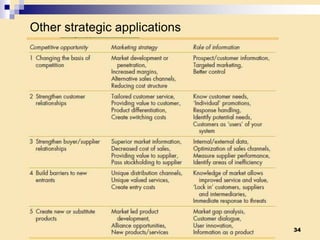
Other strategic applications
34
Advantages of MkIS
 Organized Data collection – Lots of data
can be collected from the market. But the
main word here is “Organized”. Organizing
data is very important else the data is
meaningless. Thus MIS helps you to
organize your database thereby improving
productivity.
35
Advantages of MkIS
 A broad perspective – With a proper
MIS in place, the complete organization
can be tracked which can be used to
analyse independent processes. This
helps in establishing a broader perspective
which helps us know which steps can be
taken to facilitate improvement.
36
Advantages of MkIS
 Storage of Important Data – Several
times in pharmaceuticals, when one drug
is being produced they may need data of
another drug which was produced years
back. Similarly in Media, photographs are
stored in archives. This storage of
important data plays a crucial role in
execution and thus proves again that MIS
is not important only for information but
also for execution. 37
Advantages of MkIS
 Avoidance of Crisis – The best way to
analyse a stock (share market) is to see its
past performance. With an amazing
information system established, you can
know where your organization is moving
and probably avert a crisis long before it
has taken place. Ignoring hints received
from MIS reports is foolhardy.
38
Advantages of MkIS
 Co-ordination – Companies may have
huge number of processes which needs to
be co-ordinated. These companies
depend completely on MIS for the proper
running of the organization. There are
dedicated people for marketing information
systems in such organizations. This is
mainly because of the speed required to
access information and implement it.
39
Advantages of MkIS
 Analysis and Planning – MIS is critical
for planning. You cannot do planning
without information. For planning, the first
thing which is needed is the organizations
capabilities, then the
business environment and
finally competitor analysis. In a proper
MIS, all these are present by default and
are continuously updated. Thus MIS is
very important for planning and analysis. 40
Advantages of MkIS
 Control – Just like MIS can help in a
crisis, in normal times it provides control
as you have information of the various
processes going on and what is happening
across the company. Thus it provides you
with a sense of control.
41
Dis-advantages of MkIS
 Maintenance, complexity and setting up a
MIS are one of the major hindrances to
Marketing information systems.
Furthermore, wrong information being fed
in MIS can become cumbersome and
appropriate filters need to be established.
42

Marketing Information System (MkIS)

  • 1.
    Sagar Pokhrel Faculty, BBAFirst Semester Prime College Marketing Information System (MkIS)
  • 2.
    Information System (IS) “Information systems (IS) is the study of complementary networks of hardware and software that people and organizations use to collect, filter, process, create, and distribute data.”  In other words, Information systems are interrelated components working together to collect, process, store, and disseminate information to support decision making, coordination, control, analysis, and visualizationof information in an organization.  Almost all IS are software applications that takes data as input and produces meaningful information as input. 2
  • 3.
    Business Information System Theterm business information systems is used to describe a variety of types of information systems (transaction processing, information reporting, decision support, etc.) that support the functions of business such as accounting, finance, marketing, or human resource management. 3
  • 4.
    Business Information System ▪Business firms are turning to Internet technologies to integrate the flow of information among their internal business functions and their customers and suppliers. ▪ Companies are using the World Wide Web and their intranets and extranets as the technology platform for their cross-functional and inter organizational information systems. 4
  • 5.
    Applications of suchinformation systems in the functional areas of business include: 1. Marketing IS 2. Financial IS 3. Accounting IS 4. Production/Operations IS 5. Human Resource Management IS 5
  • 6.
    Business Information System ▪In addition, many companies have moved from functional mainframe legacy systems to cross functional client/server network applications. ▪ This typically has involved ▪ installing enterprise resource planning (ERP) or supply chain management (SCM) software. ▪ Instead of focusing on the information processing requirements of business functions, ERP software focuses on supporting the supply chain processes involved in the operations of a business. 6
  • 7.
    7 Marketing Information System ▪MkIS Marketing Information System (MkIS) collects, analyses, and supplies a lot of relevant information to the marketing managers. ▪ It is a valuable tool for planning, implementing and controlling the marketing activities. ▪ The role of MIS is to identify (find out) what sort of information is required by the marketing managers. ▪ It then collects and analyzes the information. It supplies this information to the marketing manager at the right time.
  • 8.
    8 Marketing Information System(MkIS) The business function of marketing is concerned with the planning, promotion, and sale of existing products in existing markets, and the development of new products and new markets to better serve present and potential customers.  Marketing information systems integrate the information flow required by many marketing activities.  It Consists of people, equipment, and procedures to gather, sort, analyze, evaluate, and distribute needed, timely, and accurate information to marketing decision makers.  MkIS is a permanent and continuous process.
  • 9.
    9 Marketing Information System(MkIS) Marketing information includes all facts, estimates, opinions, guidelines, policies and other data which is necessary for taking marketing decisions.  This information may be collected from both internal and external sources.  from customers, competitors, company salesmen, government sources, specialized agencies, so on.  This information is analyzed. Then, it is supplied to the marketing managers. The marketing managers use this information for taking marketing decisions.  MkIS also evaluates and stores the information. MkIS uses modern technology for collecting, analyzing, storing and supplying information.
  • 10.
    10 Marketing information systemsprovide information for: ▪ Internet/intranet web sites and services make an interactive marketing process possible where customers can become partners in creating, marketing, purchasing, and improving products and services. ▪ Sales force automation systems use mobile computing and Internet technologies to automate many information processing activities for sales support and management. ▪ Other marketing systems assist marketing managers in product planning, pricing, and other product management decision, advertising and sales promotion strategies, and market research and forecasting. ▪ Planning, control, and transaction processing in the marketing function.
  • 11.
    11 Marketing information systemsprovide information for: ▪ Control Reporting Systems support the efforts of marketing managers to control the efficiency and effectiveness of the selling and distribution of products and services. ▪ Analytical reports provide information on a firm's actual performance versus planned marketing objectives.
  • 12.
  • 13.
    13 Characteristics/Features of MkIS ▪Continuous system : MkIS is a permanent and continuous system of collecting information. It collects information continuously. ▪ Basic objective : The basic objective of MIS is to provide the right- information at the right-time to the right-people to help them take right decisions. ▪ Computer based system : MkIS is a computer-based system. It uses computers for storing, analyzing and supplying information. It also uses micro-films for storing information. Therefore, it is very quick and accurate. ▪ Future-oriented : MkIS is future-oriented. It provides information for solving future problems. It is not past-oriented.
  • 14.
    14 Characteristics/Features of MkIS ▪Used by all levels : MkIS is used by all three levels of management, i.e. top, middle and lower. It is used for making marketing plans, policies and strategies. This is used to solve marketing problems and to take advantage of business opportunities. ▪ Sources : MIS collects information from both, internal and external sources. For example, information is collected from company records, publications, etc. ▪ Collects marketing information : MIS collects all types of marketing information. It collects information about the consumer competition, marketing environment, government policies, etc. It supplies this information to the marketing managers. ▪ Helps in decision making : MIS supplies up-to-date and accurate information. It helps marketing managers to take quick and right decisions.
  • 15.
    15 Other features ▪ MkISprovides facilities for analyzing effectiveness of advertisement campaigns ▪ It helps in finding customer clusters ▪ It also helps in converting potential customers to buyers ▪ Helps in setting price of products ▪ Helps in sales trend analysis
  • 16.
    16 Components of MarketingInformation System ▪ MkIS collects the information through its subsystems. These subsystems are called components. ▪ The four main components of Marketing Information System (MIS) are: 1. Internal Database 2. Marketing Intelligence System 3. Marketing Research System, and 4. Marketing Decision Support System.
  • 17.
    Marketing Information System Fig:A typical MkIS with components
  • 19.
    19 Components of MkIS:Internal records ▪ The first component of MIS is ‘Internal Record’. ▪ Marketing managers get lots of information from the internal-records of the company. ▪ These records provide current information about sales, costs, inventories, cash flows and account receivable and payable. ▪ Many companies maintain their computerized internal records. ▪ Inside records help marketing managers to gain faster access to reliable information.
  • 20.
    20 Components of MkIS:Marketing intelligence ▪ It collects information from external sources. It provides information about current marketing-environment and changing conditions in the market. ▪ This information can be easily gathered from external sources like; magazines, trade journals, commercial press, so on. ▪ This information cannot be collected from the Annual Reports of the Trade Association and Chambers of Commerce, Annual Report of Companies, etc. ▪ The salesmen’s report also contains information about market trends.
  • 21.
    21 Components of MkIS:Marketing intelligence ▪ The information which is collected from the external sources cannot be used directly. ▪ It must be first evaluated, cleaned and arranged in a proper order. ▪ Different types of data visualization software may be used to represent collected data in understandable forms such as charts, diagrams or dashboards. ▪ It can be then used by the marketing manager for taking decisions and making policies about marketing. ▪ So, marketing intelligence is an important component of MkIS.
  • 22.
    22 Components of MkIS:Marketing research ▪ Marketing Research is conducted to solve specific marketing problems of the company. ▪ It collects data about the problem. This data is tabulated, analyzed and conclusions are drawn. ▪ Then the recommendations are given for solving the problem. ▪ Marketing research also provides information to the marketing managers. ▪ However, this information is specific information. It can be used only for a particular purpose. ▪ MkIS and MR are not substitutes of each other. The scope of MkIS is very wide. It includes ‘MR’. However, the scope of MR is very narrow.
  • 23.
    23 Components of MkIS:Marketing decision support system ▪ These are the tools which help the marketing managers to analyze data and to take better marketing decisions. ▪ They include hardware, i.e. computer and software programs. ▪ Computer helps the marketing manager to analyze the marketing information. It also helps them to take better decisions. ▪ In fact, today marketing managers cannot work without computers. There are many software programs, which help the marketing manager to do market segmentation, price fixing, advertising budgets, etc.
  • 24.
    Steps in theMarketing Research Process
  • 25.
    25 Research Approaches Survey Asking individualsabout attitudes, preferences or buying behaviors (Descriptive) Experimental Using groups of people to determine cause-and-effect relationships (Causal) Observational Gathering data by observing people, actions and situations (Exploratory)
  • 26.
    Simple MkIS andApplications  Evaluating Marketing Campaign  Customer Acquisition Cost (CAC)  Time to Pay back CAC  Breakeven Analysis 27
  • 27.
    Evaluating Marketing Campaign ▪Return on investment is always a major concern when it comes to marketing or any other business expense. ▪ The idea is to check whether the money you pu into your marketing plan has resulted in a profit ▪ Must measure the amount spent on each campaign, versus the amount of sales each campaign brought in specifically. 28
  • 28.
    Evaluating Marketing Campaign ROICalculation Here, Gross Profit = Gross Revenue – COGS Where, COGS is Cost Of Goods Sold 29 Gross Profit – Indirect Expense + Marketing Investment ROI = Investment * 100
  • 29.
    Evaluating Marketing Campaign MarketingExpense to Revenue Here, Gross Profit = Gross Revenue – COGS Where, COGS is Cost Of Goods Sold 30 Total Marketing Costs Marketing Expense to Revenue Revenue Generated =
  • 30.
    Customer Acquisition Cost(CAC) 31 Total Sales and Marketing Cost CAC Number of New Customers = Customer Acquisition Cost (CAC) Customer Acquisition Cost (CAC)Time to Pay Back CAC Revenue Per Month for avg. Customer – Expenses per month for avg. Customer =
  • 31.
    Breakeven Analysis 32 Break EvenPoint ▪ The purpose of doing a breakeven analysis is to determine exactly when you can expect your business to cover all expenses and start generating a profit—which is a crucial milestone in the early days of any company. Breakeven Point in Units = Fixed Costs ÷ (Price - Variable Costs) ▪ A company's breakeven point is the point at which its sales exactly cover its expenses. ▪ To compute a company's breakeven point in sales volume, you need to know the values of three variables: ▪ Fixed costs: Costs that are independent of sales volume, such as rent ▪ Variable costs: Costs that are dependent on sales volume, such as the cost of manufacturing the product ▪ Selling price of the product
  • 32.
    Breakeven Analysis 33 XYZ Corporationhas calculated that it has fixed costs that consist of its lease, depreciation of its assets, executive salaries, and property taxes. Those fixed costs add up to $60,000. Their product is the widget. Their variable costs associated with producing the widget are raw material, factory labor, and sales commissions. Variable costs have been calculated to be $0.80 per unit. The widget is priced at $2.00 each. Given this information, As we know that, Breakeven Point in Units = Fixed Costs ÷ (Price - Variable Costs) = $60,000 ÷ ($2.00 - $0.80) = 50,000 units What this answer means is that XYZ Corporation has to produce and sell 50,000 widgets in order to cover their total expenses, fixed and variable. At this level of sales, they will make no profit but will just break even.
  • 33.
  • 34.
    Advantages of MkIS Organized Data collection – Lots of data can be collected from the market. But the main word here is “Organized”. Organizing data is very important else the data is meaningless. Thus MIS helps you to organize your database thereby improving productivity. 35
  • 35.
    Advantages of MkIS A broad perspective – With a proper MIS in place, the complete organization can be tracked which can be used to analyse independent processes. This helps in establishing a broader perspective which helps us know which steps can be taken to facilitate improvement. 36
  • 36.
    Advantages of MkIS Storage of Important Data – Several times in pharmaceuticals, when one drug is being produced they may need data of another drug which was produced years back. Similarly in Media, photographs are stored in archives. This storage of important data plays a crucial role in execution and thus proves again that MIS is not important only for information but also for execution. 37
  • 37.
    Advantages of MkIS Avoidance of Crisis – The best way to analyse a stock (share market) is to see its past performance. With an amazing information system established, you can know where your organization is moving and probably avert a crisis long before it has taken place. Ignoring hints received from MIS reports is foolhardy. 38
  • 38.
    Advantages of MkIS Co-ordination – Companies may have huge number of processes which needs to be co-ordinated. These companies depend completely on MIS for the proper running of the organization. There are dedicated people for marketing information systems in such organizations. This is mainly because of the speed required to access information and implement it. 39
  • 39.
    Advantages of MkIS Analysis and Planning – MIS is critical for planning. You cannot do planning without information. For planning, the first thing which is needed is the organizations capabilities, then the business environment and finally competitor analysis. In a proper MIS, all these are present by default and are continuously updated. Thus MIS is very important for planning and analysis. 40
  • 40.
    Advantages of MkIS Control – Just like MIS can help in a crisis, in normal times it provides control as you have information of the various processes going on and what is happening across the company. Thus it provides you with a sense of control. 41
  • 41.
    Dis-advantages of MkIS Maintenance, complexity and setting up a MIS are one of the major hindrances to Marketing information systems. Furthermore, wrong information being fed in MIS can become cumbersome and appropriate filters need to be established. 42