GROUP -8
MARKETING
ETHICS
CASE TO UDERSTAND CONCEPT…..
Apple’s case that Samsung copied the iPhone
and iPad
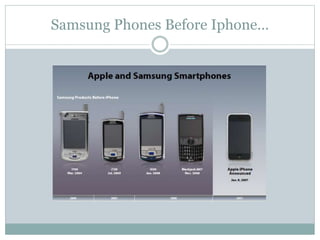
Samsung Phones Before Iphone…
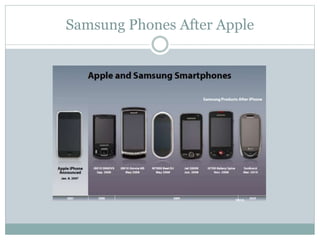
Samsung Phones After Apple
CASE against Samsung
So Apple claimed a case against Samsung that it
became prominent in the smart phone industry, just
by copying Apple….
Question……..
What do you say…?
Is the copying right…?
YES…….!!!!!!!
If YES…..
What moral principles It has….
Copying does spoils the reputation of the company….
NO………!!!!!
If your Answer was No…..
What will Samsung do to
SATISFY CUSTOMERS…….????
DECISION………..???
What would you do as a Marketing head of
Samsung…….??
Will you copy….. Or
Will you follow the same traditional methods…
SO THIS DEPICTS THE SUTUATION WHERE
IS NEEDED
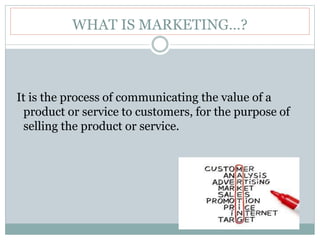
WHAT IS MARKETING…?
It is the process of communicating the value of a
product or service to customers, for the purpose of
selling the product or service.
WHAT IS ETHICS…?
Ethics Is the art and science of determining good and
bad or right or wrong moral behavior.
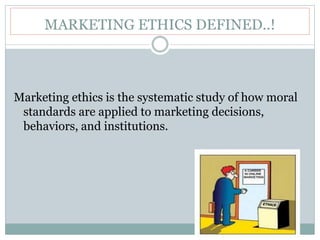
MARKETING ETHICS DEFINED..!
Marketing ethics is the systematic study of how moral
standards are applied to marketing decisions,
behaviors, and institutions.
WHY WE NEED MARKETING ETHICS…?
Marketers face many moral dilemmas.
The best things to do is often unclear.
Because not all managers have fine moral sensitivity….
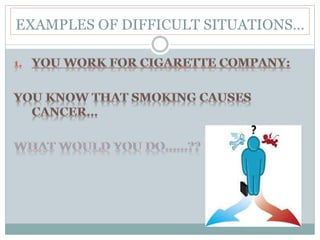
EXAMPLES OF DIFFICULT SITUATIONS…
EXAMPLES Contd…..
2.
- Who has just left the competitor’s company.
- She would be more than happy to tell you all the
competitor’s plan for the coming year….
WHAT WOULD YOU DO….??
An Overview of American Marketing Code of
Ethics
Preamble
The American Marketing Association commits itself to
promoting the highest standards of professional
ethical norms and values for this members.
General Norms
1.Marketers must do not harm.
2.Marketers must foster trust in the marketing system.
Ethical Values….
1. Honesty
2. Responsibility
3. Fairness
4. Respect
5. Openness
6. Citizenship
7. Implementation
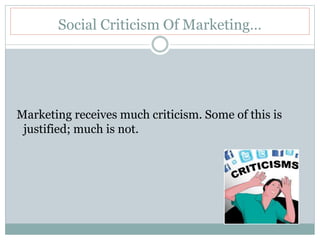
Social Criticism Of Marketing…
Marketing receives much criticism. Some of this is
justified; much is not.
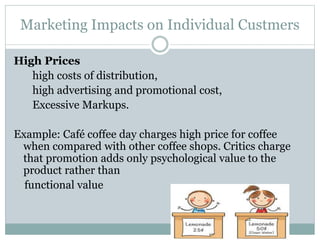
Marketing Impacts on Individual Custmers
High Prices
high costs of distribution,
high advertising and promotional cost,
Excessive Markups.
Example: Café coffee day charges high price for coffee
when compared with other coffee shops. Critics charge
that promotion adds only psychological value to the
product rather than
functional value
Deceptive Practices
Marketers are sometimes accused to deceptive
practices that lead consumers to believe they will get
more value that they actually do.
3 groups:
-pricing
-promotion
-packaging
Contd….
Deceptive pricing
-”flat 70 % discount” , “ factory sale”.
Deceptive promotion
-”Fair and Lovely”, “Complan”
Deceptive Packaging
-”Lays”, “BB creams”
High Pressure Selling
Salespeople are sometimes accused of high pressure
selling that persuades people to buy goods they had
no thought of buying.
It is often insurance, real estates and cars are sold, not
bought
Shoddy or Unsafe Products
 I. Many products are not made well and not services
well
eg. Kure kure chips –wax, MSG, Bricks, Rods
 II.The products deliver little benefit or the product
might be harmful
eg. Coca Cola, mosquito coil, Bikes CC
Contd
 III. Product safety
- electronic goods
For years Consumer Reports magazine and
Websites- have reported various hazards in tested
products: electrical dangers, carbon monoxide
poisoning( refrigerators, air conditioners).
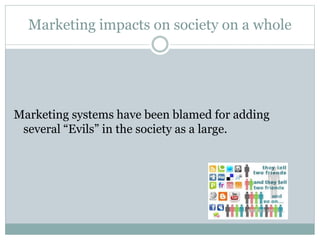
Marketing impacts on society on a whole
Marketing systems have been blamed for adding
several “Evils” in the society as a large.
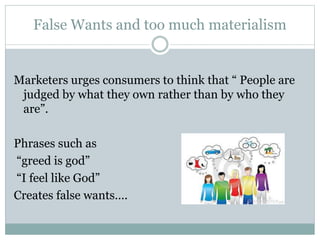
False Wants and too much materialism
Marketers urges consumers to think that “ People are
judged by what they own rather than by who they
are”.
Phrases such as
“greed is god”
“I feel like God”
Creates false wants….
Too few social goods
 Business has been accused of overselling private
goods at the expense of public goods.
 Example: increase in automobile ownership(private
goods)
requires more highways, traffic control,
and police services(public goods)
Cultural Pollution
 Our senses are being constantly assaulted by
advertising.
Pages of ads obscure magazines.
These interruptions continually pollutes people’s
mind with messages of materialism.
Marketing impacts on other businesses
Critics also charge that a company’s marketing
practices can harm other companies and reduce
competition.
I .acquistation of competitors.
II .marketing practices creates barrier to entry.
III.Unfair competitive marketing prices.
Example
Microsoft:
The operating systems installed on more than
90 % of desktop computers.
Customers are essentially locked into windows
OS.
It was nearly a “Monopoly”.
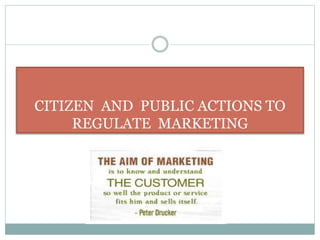
CITIZEN AND PUBLIC ACTIONS TO
REGULATE MARKETING
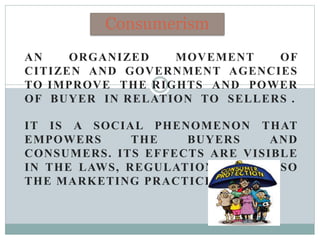
AN ORGANIZED MOVEMENT OF
CITIZEN AND GOVERNMENT AGENCIES
TO IMPROVE THE RIGHTS AND POWER
OF BUYER IN RELATION TO SELLERS .
IT IS A SOCIAL PHENOMENON THAT
EMPOWERS THE BUYERS AND
CONSUMERS. ITS EFFECTS ARE VISIBLE
IN THE LAWS, REGULATIONS AND ALSO
THE MARKETING PRACTICES.
Consumerism
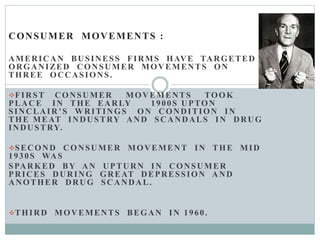
CONSUMER MOVEMENTS :
AMERICAN BUSINESS FIRMS HAVE TARGETED
ORGANIZED CONSUMER MOVEMENTS ON
THREE OCCASIONS.
FIRST CONSUMER MOVEMENTS TOOK
PLACE IN THE EARLY 1900S UPTON
SINCLAIR’S WRITINGS ON CONDITION IN
THE MEAT INDUSTRY AND SCANDALS IN DRUG
INDUSTRY.
SECOND CONSUMER MOVEMENT IN THE MID
1930S WAS
SPARKED BY AN UPTURN IN CONSUMER
PRICES DURING GREAT DEPRESSION AND
ANOTHER DRUG SCANDAL.
THIRD MOVEMENTS BEGAN IN 1960.
THE RIGHTS TO INTRODUCE ANY PRODUCT IN
ANY SIZE AND STYLE PROVIDE IT IS NOT
HAZARDOUS TO PERSONAL HEALTH OR SAFETY
OR IF IT IS TO INCLUDE PROPER WARNING
AND CONTROLS.
THE RIGHTS TO SPEND ANY AMOUNT TO
PROMOTE THE PRODUCT PROVIDED IT IS NOT
DEFINED AS UNFAIR COMPETITION.
THE RIGHT TO USE ANY PRODUCT MESSAGE ,
PROVIDED IT IS NOT DEFINED MISLEADING OR
DISHONEST IN CONTENT OR EXECUTION.
THE RIGHT TO INFLUENCE PRODUCTS AND
MARKETING PRACTICE IN WAYS THAT WILL
IMPROVE THE QUALITY OF LIFE.
Traditional Sellers Rights Include
THE RIGHT TO EXPECT THE PRODUCT
TO BE SAFE.
THE RIGHT TO EXPECT THE PRODUCT
TO PERFORM AS CLAIMED.
THE RIGHT TO BE WELL INFORMED
ABOUT IMPORTANT ASPECTS OF THE
PRODUCT.
CONSUMERS WHO BELIEVE THEY GOT A
BAD DEAL HAVE SEVERAL REMEDIES .
Traditional Buyer Rights Include
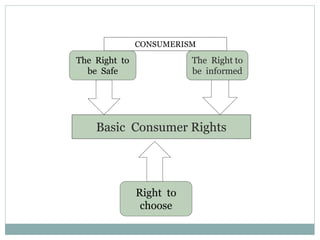
Basic Consumer Rights
The Right to
be Safe
The Right to
be informed
Right to
choose
CONSUMERISM
CONSUMERISM IS THE FAST
EMERGING AS AN ENVIRONMENTAL
FORCE AFFECTING MAJOR
BUSINESS DECISIONS AS
CONSUMER AS BECOME MORE
AWARE ABOUT THEIR RIGHTS.
Conclusion :
A N O R G A N I ZE D M O V E M E NT S O F C O N C E R NE D C I T I ZE N
A N D G O V E R N M E NT A G E N C I E S TO P R O T E CT AN D
I M P R O V E P E O P L E ’ S L I V I N G E N V I R O N M E N T .
ENVIRONMENTALISM
THE FIRST WAVE OF MODERN
ENVIRONMENTALISM IN THE U.S WAS DRIVEN
BY ENVIRONMENTAL GROUP AND CONCERNS
CONSUMERS IN THE 1960S AND 1970S .
THE SECOND ENVIRONMENTALISM WAVE WAS
DRIVEN BY GOVERNMENT WHICH PASSED
LAWS AND REGULATION DURING 1970S AND
1980S GOVERNING INDUSTRIAL PRACTICES
IMPACTING THE ENVIRONMENT.
THIRD WAVE IS STRONGER WAVE IN WHICH
COMPANIES WHERE ACCEPTING
RESPONSIBILITY FOR DOING NO HARM TO THE
ENVIRONMENT.
Waves of Environmentalism
ENVIRONMENTAL SUSTAINABILITY AT MOST
BASIC LEVEL A COMPANY CAN PRACTICE
POLLUTION PREVENTION MEANS
ELIMINATING OR MINIMIZING WASTE
BEFORE IT IS CREATED.
COMPANIES EMPHASIZING PREVENTION
HAVE RESPOND WITH “GREEN MARKETING”
PROGRAMS -DEVELOPING ECOLOGICALLY
SAFER PRODUCTS, RECYCLE PRODUCTS .
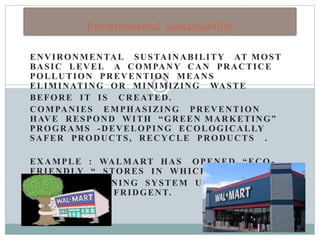
EXAMPLE : WALMART HAS OPENED “ECO -
FRIENDLY “ STORES IN WHICH
AIR CONDITIONING SYSTEM USE NON -OZONE
DEPLETING REFRIDGENT.
Environmental sustainability
ENVIRONMENTAL POLICIES STILL VARY WIDELY
FROM COUNTRY TO COUNTRY .
COUNTRIES SUCH A S DENMARK, GERMANY,
JAPAN, AND UNITED STATES HAVE FULLY
DEVELOPED ENVIRONMENTAL POLICIES AND HIGH
PUBLIC EXPECTATIONS .
BUT MAJOR COUNTRIES SUCH A S CHINA, IND IA
,BRAZIL AND RUSSIA AR E IN ONLY THE EARLY
STAGES OF DEVELOPING SUCH POLICIES .
EXAMPLE : PVC SOFT DR IN K BOTTLES CANNOT BE
USED IN SWITZERLAND OR GERMANY . HOWEVER
THEY ARE PREFERRED IN FRANCE , WHICH HAS
AN EXTENSIVE RECYCLING PROCESS FOR THEM .
A S INTERNATIONAL C OMPAN IES HAV E FOUND IT
DIFFICULT TO DEVELOP STANDARD
ENVIRONMENTAL PRACTIES .
Which all countries have environmental policy
G O G R E E N O R G R E E N WA S H I N G
WA L - M A RT, T H E W O R L D ' S L A R G E S T R E TA I L E R , H E A D Q U A RT E R E D AT
B E N T O N V I L L E , A R K A N S A S , U S A , H A D B E G U N T O F O C U S O N
E N V I R O N M E N TA L S U S TA I N A B I L I T Y I S S U E S I N 2 0 0 5 .
I N T R O D U C T I O N : WA L - M A RT H A S P U B L I C LY A N N O U N C E D G O A L S
T O M A K E T H E M E G A S T O R E P O L I C I E S M O R E
E N V I R O N M E N T A L L Y F R I E N D L Y . T H E Y P L E D G E D T O H AV E A L L
S T O R E S R U N N I N G O F F O F 1 0 0 P E R C E N T R E N E WA B L E E N E R G Y,
C R E AT E Z E R O WA S T E A N D T O M A K E M O R E E N V I R O N M E N TA L LY
F R I E N D LY P R O D U C T S . I N 2 0 0 7 WA L - M A RT R E L E A S E D T H E I R
“ S U S TA I N A B I L I T Y 3 6 0 ″ S T O R E W I D E P O L I C I E S .
WA L - M A RT ’ S E N V I R O N M E N TA L G O A L S C E N T E R A R O U N D R E D U C I N G
WA S T E , E N V I R O N M E N TA L LY F R I E N D LY PA C K A G I N G , O F F E R I N G
E N V I R O N M E N TA L LY F R I E N D LY P R O D U C T S , R U N N I N G S T O R E S O F F O F
R E N E WA B L E E N E R G Y A N D G E N E R A L LY B E C O M I N G M O R E E N E R G Y
E F F I C I E N T.
A C T I O N T O WA R D S E N V I R O N M E N TA L LY F R I E N D LY S T O R E S :
C U R R E N T LY, T H E R E A R E 2 0 U S WA L - M A RT S T O R E S I N C A L I F O R N I A A N D
H AWA I I T H AT R U N P R E D O M I N A N T LY O F F O F S O L A R P O W E R W I T H
A N O T H E R 2 0 - 3 0 P L A N N E D F O R 2 0 1 0 I N A R I Z O N A A N D C A L I F O R N I A .
T H E S E T H I N - F I L M S O L A R PA N E L S A R E E X P E C T E D T O P R O V I D E 2 0 - 3 0
P E R C E N T O F T H E S T O R E ’ S P O W E R N E E D S ( R O U G H LY 2 2 . 5 K W H ) A N D
W I L L B E D E S I G N E D , I N S TA L L E D , M A I N TA I N E D A N D O W N E D B Y
S O L A R C I T Y. WA L - M A RT I S U S I N G B O T H C O P P E R I N D I U M G A L L I U M
S E L E N I D E ( C I G S ) A N D C A D M I U M T E L L U R I D E T H I N F I L M A S I T U S E S
L E S S R AW M AT E R I A L S T H A N T R A D I T I O N A L PA N E L S , M A K I N G L E S S O F
A N E N V I R O N M E N TA L I M PA C T.
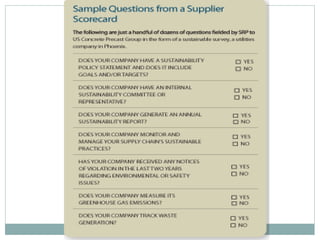
Case study on Wal-mart Environmental sustainability
SU STA INABLE VA LU E N ETWOR KS :
WA L-MART STARTED SEEKING IDEAS FROM ITS
EMPLOY EES , C ON SU LTANTS, N GOS, A N D SU PPLIERS ON
ITS SU STAINABILITY IN ITIATIVES. IT A LSO IN V ITED
EX PERTS FR OM
THE WOR LD WILD LIFE FED ERATION , N ATURAL
RESOURCES DEFENSE COUNCIL ,ENVIRONMENTAL
D EFENSE, A N D GR EEN PEACE FOR D ISC U SSIONS A N D
SU GGESTION S ON ITS GR EEN IN ITIATIVES.
OPER ATIONAL / SU PPLIER IN ITIATIVES :
EX PERTS FELT THAT WA L -MART HA D A HU GE
OPPORTUNITY TO MA KE A D IFFERENCE IN THE
SUSTAINABILITY AREA BY REVAMPING ITS SUPPLY CHAIN.
FOR EX AMPLE, IT TA R GETED TO R ED UCE 5%
PA C KAGING IN A LL ITS PR OD UCTS BY 2013 OV ER 2006
LEV ELS. IT WA S ESTIMATED THAT THE IN ITIATIVE
C OU LD SAV E U S$ 11 BILLION IN THE C OMPANY'S GLOBA L
SU PPLY C HA IN . FR OM FEBR U ARY 1, 2008, THE C OMPANY
WA S A LSO TO BEGIN U SIN G A PA C KAGING SC OR ECARD
TO MEASURE AND EVALUATE ITS ENTIRE SUPPLY
C HA IN . THE SC OR EC ARD HA D ATTRIBUTES C A LLED
THE '7 R 'S OF PA C KAGING' – REMOVE, REDUCE, REUSE ,
R EC YCLE , R EN EW , R EV ENUE , A N D R EA D. U SIN G THE
SC OR EC ARD , EA C H SU PPLIER WA S TO BE EVALUATED
R ELATIVE TO OTHER SU PPLIERS.
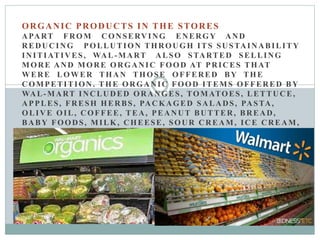
ORGANIC PRODUCTS IN THE STORES
APART FROM CONSERVING ENERGY AND
REDUCING POLLUTION THROUGH ITS SUSTAINABILITY
INITIATIVES, WAL-MART ALSO STARTED SELLING
MORE AND MORE ORGANIC FOOD AT PRICES THAT
WERE LOWER THAN THOSE OFFERED BY THE
COMPETITION. THE ORGANIC FOOD ITEMS OFFERED BY
WAL-MART INCLUDED ORANGES, TOMATOES, LETTUCE,
APPLES, FRESH HERBS, PACKAGED SALADS, PASTA,
OLIVE OIL, COFFEE, TEA, PEANUT BUTTER, BREAD,
BABY FOODS, MILK, CHEESE, SOUR CREAM, ICE CREAM,
SAUCES, AND SEAFOOD. THE ASSORTMENT OF
ORGANIC FOODS IN ANY OF ITS STORES WAS
TAILORED ACCORDING TO THE CUSTOMER BASE OF
THAT STORE. THE ORGANIC OFFERINGS WERE LABELED
SEPARATELY FOR THE CONVENIENCE OF THE
CUSTOMERS AND WERE PRICED NOT MORE THAN 10
PERCENT HIGHER THAN NORMAL PRODUCTS.
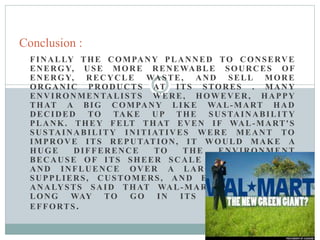
FINALLY THE COMPANY PLANNED TO CONSERVE
ENERGY, USE MORE RENEWABLE SOURCES OF
ENERGY, RECYCLE WASTE, AND SELL MORE
ORGANIC PRODUCTS AT ITS STORES . MANY
ENVIRONMENTALISTS WERE, HOWEVER, HAPPY
THAT A BIG COMPANY LIKE WAL-MART HAD
DECIDED TO TAKE UP THE SUSTAINABILITY
PLANK. THEY FELT THAT EVEN IF WAL-MART'S
SUSTAINABILITY INITIATIVES WERE MEANT TO
IMPROVE ITS REPUTATION, IT WOULD MAKE A
HUGE DIFFERENCE TO THE ENVIRONMENT
BECAUSE OF ITS SHEER SCALE OF OPERATIONS
AND INFLUENCE OVER A LARGE NUMBER OF
SUPPLIERS, CUSTOMERS, AND EMPLOYEES. BUT
ANALYSTS SAID THAT WAL-MART STILL HAD A
LONG WAY TO GO IN ITS SUSTAINABILITY
EFFORTS.
Conclusion :
Business Actions Toward Socially Responsible
Marketing
 Initially many companies opposed consumerism and
environmentalism.
 They thought the criticisms were either unfair or
unimportant.
 But now, most companies have grown to accept the new
consumer rights, at least in principle.
 They might oppose certain pieces of legislation as
inappropriate ways to solve certain consumer problems,
but they recognize the consumer’s right to information
and protection.
 Many of these companies have responded positively to
consumerism and environmentalism in order to serve
consumer needs better.
Business Actions Toward Socially
Responsible Marketing
Enlightened Marketing
 Enlightened marketing refers to a company’s marketing
effort supporting the best long-run performance of the
marketing system and consists of five principles:
I. Consumer-oriented marketing
II. Customer-value marketing
III. Innovative marketing
IV. Sense-of-mission marketing
V. Societal marketing
Business Actions Toward Socially Responsible
Marketing
Enlightened Marketing
Consumer-oriented marketing:
 Consumer-oriented marketing means that a
company should view and organize its marketing
activities from the consumer’s perspective.
 It should work hard to sense, serve, and satisfy the
needs of a defined group of customers.
Business Actions Toward Socially
Responsible Marketing
Enlightened Marketing
Customer-value marketing
 Customer-value marketing means that the company
should put most of its resources into customer-value-
building marketing investments.
 Many things marketers do-one-shot sales promotions,
minor packaging changes, advertising puffery- may raise
sales in the short run but add less value than would actual
improvements in the product’s quality, features, or
convenience.
 Enlightened marketing calls for building long-term
customer loyalty and relationships—by continually
improving the value consumers receive from the firm’s
market offerings.
Business Actions Toward Socially Responsible
Marketing
Enlightened Marketing
Innovative marketing:
Innovative marketing requires the company to
continuously seek real product and marketing
improvements.
The company that overlooks new and better ways to
do things will eventually lode customers to another
company that has found a better way.
Business Actions Toward Socially
Responsible Marketing
Enlightened Marketing
 Sense-of-mission marketing means the company
should define its mission in broad social terms rather than
narrow product terms.
 When a company defines a social mission, employees
feel better about their work and have a clearer sense
of direction.
Business Actions Toward Socially
Responsible Marketing
Enlightened Marketing
Societal marketing:
 Societal marketing means the company makes
marketing decisions by considering consumers’
wants and interests, the company’s requirements,
and society’s long-run interests
• Views societal problems as opportunities
• Designs pleasing and beneficial products
Business Actions Toward Socially
Responsible Marketing
Enlightened Marketing
 Deficient products have neither immediate appeal nor
long-term benefits
• Bad-tasting and ineffective medicine
 Pleasing products have high immediate satisfaction but
may hurt consumers in the long run
• Cigarettes and junk food
Business Actions Toward Socially
Responsible Marketing
Enlightened Marketing
 Salutary products have low appeal but may benefit
consumers in the long run
• Seat belts and air bags
 Desirable products give both immediate satisfaction
and high long-term benefits
• Tasty and nutritious breakfast food
Business Actions Toward Socially
Responsible Marketing
Marketing Ethics
 Corporate marketing ethics are broad guidelines that
everyone in the organization must follow that cover
distributor relations, advertising standards, customer
service, pricing, product development, and general ethical
standards
Business Actions Toward Socially
Responsible Marketing
Marketing Ethics
Philosophies
 Issues are decided by the free market and legal
system.
 Responsibility is not on the system but in the hands
of the individual company and managers
CASE STUDY ON CORPORATE SOCIAL
RESPONSIBILITY
Corporate Social Responsibility: A Case
Study Of TATA Group
OBJECTIVES:
 To understand the concept of CSR
To find out the scope of CSR
To know how the Tata group has fulfilled its
responsibility towards all stakeholders; what
specific activities, programs and strategies it has
set, devised and implemented for the same.
Tata Steel:
Tata Steel has adopted the Corporate Citizenship Index, Tata
Business Excellence Model and the Tata Index for Sustainable
Development. Tata Steel spends 5-7 per cent of its profit after tax on
several CSR initiatives.
1.Self-Help Groups (SHG’s)
 500 self-help groups under various poverty alleviation programs.
 200 are in activities of income generation thorough micro
enterprises.
 Women empowerment programs through Self-Help Groups have
been extended to 700 villages.
2.Supports Social Welfare Organizations:
 Tata Steel Rural Development Society
 Tribal Cultural Society
 Tata Steel Foundation for Family Initiatives
 National Association for the Blind
 Shishu Niketan School of Hope
 Centre for Hearing Impaired Children
 Indian Red Cross Society, East Singhbhum
3. Healthcare Projects
In its 100th year, the healthcare projects includes
 child education
 immunization and childcare
 plantation activities
 creation of awareness of AIDS and other healthcare
projects.
4. Economic Empowerment:
 A program aiming at economic empowerment through
improvised agriculture has been taken up in three
backward tribal blocks in Jharkhand, Orissa and
Chhattisgarh.
 An expenditure of Rs 100 crore has been estimated for
the purpose and this program is expected to benefit
40,000 tribal living in over 400 villages in these three
States.
5.Assistance to government
• 12 Lifeline Expresses in association with the Ministry
of Railways, Impact India Foundation and the
Government of Jharkhand.
• 5000 people have got surgical facilities and over
1,000 people received aids and appliances.
 The National Horticulture Mission program that has
been taken up in collaboration with the Government
of Jharkhand has benefited more than a thousand
households.
 In collaboration with the Ministry of Non
Conventional Energy and the Confederation of
Indian Industry, focus is laid on renewable energy
aiming at enhancing rural livelihood.
Titan In its corporate philosophy CSR is defined as
doing less harm and more good by adopting the
following practices :
Respecting and supporting local communities
Caring for the employees
Being an active member of society
Committed to sustainable development
Putting safety(at work) first Titan has employed
169 disabled people in blue collar workforce at
Hosur.
Significance of the study
A. To the Policy Makers
• This study encourages Private Public Partnership (PPP) for CSR
promotion encompassing infrastructure, pollution, child labor, labor
productivity & morale.
• It may become helpful to make the policy makers at political and
corporate level as well consider CSR an investment and not an expense
as it can become instrumental in increasing goodwill and corporate
image.
B. To the Society
 Development of infrastructure i.e. parks, water purification, education
etc.
 Environment protection
 Uplifting of the rural populace
 Bringing the tribes into the mainstream of the country
C. To the Economy as a whole
 Increase in the growth rate
 Strategic CSR at political and corporate level can make the country a
better investment destination .
 Cumulative results may improve Human Development Index (H.D.I.)
of the country.
PRINCIPLES FOR PUBLIC POLICY TOWARDS
MARKETING
1. The principle of consumer and producer freedom.
2. The principle of curbing potential harm.
3. The principle of meeting basic needs.
4. The principle of economic efficiency.
5. The principle of innovation.
6. The principle of consumer education and
information.
7. The principle of consumer protection.
The principle of consumer and producer
freedom
 Marketing decisions should be made by consumers
and producers under relative freedom.
 Marketing freedom is important if a marketing
system is to deliver a high standard of living.
 People can achieve satisfaction in their own terms
rather than in terms defined by someone else.
 Freedom of producer and consumer is the
cornerstone of dynamic marketing system.
The principle of curbing potential harm
 As much as possible, transactions freely entered
into by producers and consumers are their private
business.
 The political system curbs producer or consumer
freedom only to prevent transactions that harm or
threaten to harm the producer, consumer, or third
parties.
 Transactional harm is a widely recognized grounds
for government intervention.
 The major issue is whether there is sufficient actual
or potential harm to justify the intervention.
The principle of meeting basic needs
 The marketing system should serve disadvantaged consumers as well
as affluent ones.
 In a free enterprise system, producers make goods for markets that
are willing and able to buy.
 Certain groups who lack purchasing power may go without needed
goods and services, causing harm to their physical or psychological
well being.
 The marketing system should support economic and political actions
to solve this problem.
 It should strive to meet the basic needs of all people, and all people
should share to some extent in the standard of living it creates.
The principle of economic efficiency
 To supply goods and services efficiently and at low
prices.
 Society’s needs and wants can be satisfied depends
on how efficiently its scarce resources are used.
 To make profit, competitors must watch their costs
carefully while developing products, prices and
marketing programs that serve buyer needs.
 The presence of active competition and well-
informed buyers keeps quality high and prices low.
The principle of innovation
 The marketing system encourages authentic
innovation to bring down production and
distribution costs and to develop new products to
meet changing consumer needs.
 The consumer may face ten very similar brands in
a product class.
 But an effective marketing system encourages real
product innovation and differentiation to meet the
wants of different market segments.
The principle of consumer education and
information
 An effective marketing system invests heavily in
consumer education and information to increase
long-run consumer satisfaction and welfare.
 Companies will provide enough information about
their products.
 But consumers groups and government can also
give out information and ratings.
The principle of consumer protection
 Consumer education and information cannot do
the whole job of protecting consumers.
 Modern products are so complex that even trained
consumers cannot evaluate them with confidence.
 A government agency has to review and judge the
safety levels.
 Consumer may buy products but fail to understand
the environment consequences.
ARE COCA-COLA GETTING HEALTH
CONSCIOUS?
 It’s scientifically proven that eating refined sugars is a
leading cause of obesity and it’s certainly no secret that most
fizzy drinks have an abundance of sugars in them. So it was
refreshing to see that Coca-Cola have launched a 2 minute
long commercial in the USA battling obesity.
 In the commercial they talk about the Obesity problem in
America and what they are doing to create a solution. A few of
the ways Coca-Cola are battling it are:
 Lowering calories in some of their drinks
 Distributing smaller bottles and cans across the country
 Removing high calorie products from schools
 Get active schemes for children
 Continued R&D
 To Coca-Cola’s credit they indirectly partly blame themselves for
obesity by saying “All calories count no matter where they come
from, including Coca-Cola and everything else with calories. If
you eat and drink more calories than you burn off, you’ll gain
weight”. They even add a small piece on educating the consumer
about calorie in take.
 This is the beginning of a solution however I think the biggest
stimulator for sugary drink consumption is the supermarkets.
Supermarkets always have offers on these types of
products prominently displayed on the end of isles, or eye level on
the rack. The placement in supermarkets of these products and
bulk discounting will need to change if we want peoples calorie
and sugar in take to stabilise. It doesn’t help that Coca-Cola also
promote their benchmark soft drink with the tagline “Open
Happiness“.
 I think this is a great start, and whether Coca-Cola have done this
as a PR exercise or are generally concerned it’s a step in the right
direction.
 To your (ethical) marketing success

Marketing ethics mba

  • 1.
  • 2.
    CASE TO UDERSTANDCONCEPT….. Apple’s case that Samsung copied the iPhone and iPad
  • 3.
  • 4.
  • 5.
    CASE against Samsung SoApple claimed a case against Samsung that it became prominent in the smart phone industry, just by copying Apple….
  • 6.
    Question…….. What do yousay…? Is the copying right…?
  • 7.
    YES…….!!!!!!! If YES….. What moralprinciples It has…. Copying does spoils the reputation of the company….
  • 8.
    NO………!!!!! If your Answerwas No….. What will Samsung do to SATISFY CUSTOMERS…….????
  • 9.
    DECISION………..??? What would youdo as a Marketing head of Samsung…….?? Will you copy….. Or Will you follow the same traditional methods…
  • 10.
    SO THIS DEPICTSTHE SUTUATION WHERE IS NEEDED
  • 11.
    WHAT IS MARKETING…? Itis the process of communicating the value of a product or service to customers, for the purpose of selling the product or service.
  • 12.
    WHAT IS ETHICS…? EthicsIs the art and science of determining good and bad or right or wrong moral behavior.
  • 13.
    MARKETING ETHICS DEFINED..! Marketingethics is the systematic study of how moral standards are applied to marketing decisions, behaviors, and institutions.
  • 14.
    WHY WE NEEDMARKETING ETHICS…? Marketers face many moral dilemmas. The best things to do is often unclear. Because not all managers have fine moral sensitivity….
  • 15.
    EXAMPLES OF DIFFICULTSITUATIONS…
  • 16.
    EXAMPLES Contd….. 2. - Whohas just left the competitor’s company. - She would be more than happy to tell you all the competitor’s plan for the coming year…. WHAT WOULD YOU DO….??
  • 17.
    An Overview ofAmerican Marketing Code of Ethics Preamble The American Marketing Association commits itself to promoting the highest standards of professional ethical norms and values for this members. General Norms 1.Marketers must do not harm. 2.Marketers must foster trust in the marketing system.
  • 18.
    Ethical Values…. 1. Honesty 2.Responsibility 3. Fairness 4. Respect 5. Openness 6. Citizenship 7. Implementation
  • 19.
    Social Criticism OfMarketing… Marketing receives much criticism. Some of this is justified; much is not.
  • 20.
    Marketing Impacts onIndividual Custmers High Prices high costs of distribution, high advertising and promotional cost, Excessive Markups. Example: Café coffee day charges high price for coffee when compared with other coffee shops. Critics charge that promotion adds only psychological value to the product rather than functional value
  • 21.
    Deceptive Practices Marketers aresometimes accused to deceptive practices that lead consumers to believe they will get more value that they actually do. 3 groups: -pricing -promotion -packaging
  • 22.
    Contd…. Deceptive pricing -”flat 70% discount” , “ factory sale”. Deceptive promotion -”Fair and Lovely”, “Complan” Deceptive Packaging -”Lays”, “BB creams”
  • 23.
    High Pressure Selling Salespeopleare sometimes accused of high pressure selling that persuades people to buy goods they had no thought of buying. It is often insurance, real estates and cars are sold, not bought
  • 24.
    Shoddy or UnsafeProducts  I. Many products are not made well and not services well eg. Kure kure chips –wax, MSG, Bricks, Rods  II.The products deliver little benefit or the product might be harmful eg. Coca Cola, mosquito coil, Bikes CC
  • 25.
    Contd  III. Productsafety - electronic goods For years Consumer Reports magazine and Websites- have reported various hazards in tested products: electrical dangers, carbon monoxide poisoning( refrigerators, air conditioners).
  • 26.
    Marketing impacts onsociety on a whole Marketing systems have been blamed for adding several “Evils” in the society as a large.
  • 27.
    False Wants andtoo much materialism Marketers urges consumers to think that “ People are judged by what they own rather than by who they are”. Phrases such as “greed is god” “I feel like God” Creates false wants….
  • 28.
    Too few socialgoods  Business has been accused of overselling private goods at the expense of public goods.  Example: increase in automobile ownership(private goods) requires more highways, traffic control, and police services(public goods)
  • 29.
    Cultural Pollution  Oursenses are being constantly assaulted by advertising. Pages of ads obscure magazines. These interruptions continually pollutes people’s mind with messages of materialism.
  • 30.
    Marketing impacts onother businesses Critics also charge that a company’s marketing practices can harm other companies and reduce competition. I .acquistation of competitors. II .marketing practices creates barrier to entry. III.Unfair competitive marketing prices.
  • 31.
    Example Microsoft: The operating systemsinstalled on more than 90 % of desktop computers. Customers are essentially locked into windows OS. It was nearly a “Monopoly”.
  • 32.
    CITIZEN AND PUBLICACTIONS TO REGULATE MARKETING
  • 33.
    AN ORGANIZED MOVEMENTOF CITIZEN AND GOVERNMENT AGENCIES TO IMPROVE THE RIGHTS AND POWER OF BUYER IN RELATION TO SELLERS . IT IS A SOCIAL PHENOMENON THAT EMPOWERS THE BUYERS AND CONSUMERS. ITS EFFECTS ARE VISIBLE IN THE LAWS, REGULATIONS AND ALSO THE MARKETING PRACTICES. Consumerism
  • 34.
    CONSUMER MOVEMENTS : AMERICANBUSINESS FIRMS HAVE TARGETED ORGANIZED CONSUMER MOVEMENTS ON THREE OCCASIONS. FIRST CONSUMER MOVEMENTS TOOK PLACE IN THE EARLY 1900S UPTON SINCLAIR’S WRITINGS ON CONDITION IN THE MEAT INDUSTRY AND SCANDALS IN DRUG INDUSTRY. SECOND CONSUMER MOVEMENT IN THE MID 1930S WAS SPARKED BY AN UPTURN IN CONSUMER PRICES DURING GREAT DEPRESSION AND ANOTHER DRUG SCANDAL. THIRD MOVEMENTS BEGAN IN 1960.
  • 35.
    THE RIGHTS TOINTRODUCE ANY PRODUCT IN ANY SIZE AND STYLE PROVIDE IT IS NOT HAZARDOUS TO PERSONAL HEALTH OR SAFETY OR IF IT IS TO INCLUDE PROPER WARNING AND CONTROLS. THE RIGHTS TO SPEND ANY AMOUNT TO PROMOTE THE PRODUCT PROVIDED IT IS NOT DEFINED AS UNFAIR COMPETITION. THE RIGHT TO USE ANY PRODUCT MESSAGE , PROVIDED IT IS NOT DEFINED MISLEADING OR DISHONEST IN CONTENT OR EXECUTION. THE RIGHT TO INFLUENCE PRODUCTS AND MARKETING PRACTICE IN WAYS THAT WILL IMPROVE THE QUALITY OF LIFE. Traditional Sellers Rights Include
  • 36.
    THE RIGHT TOEXPECT THE PRODUCT TO BE SAFE. THE RIGHT TO EXPECT THE PRODUCT TO PERFORM AS CLAIMED. THE RIGHT TO BE WELL INFORMED ABOUT IMPORTANT ASPECTS OF THE PRODUCT. CONSUMERS WHO BELIEVE THEY GOT A BAD DEAL HAVE SEVERAL REMEDIES . Traditional Buyer Rights Include
  • 37.
    Basic Consumer Rights TheRight to be Safe The Right to be informed Right to choose CONSUMERISM
  • 39.
    CONSUMERISM IS THEFAST EMERGING AS AN ENVIRONMENTAL FORCE AFFECTING MAJOR BUSINESS DECISIONS AS CONSUMER AS BECOME MORE AWARE ABOUT THEIR RIGHTS. Conclusion :
  • 40.
    A N OR G A N I ZE D M O V E M E NT S O F C O N C E R NE D C I T I ZE N A N D G O V E R N M E NT A G E N C I E S TO P R O T E CT AN D I M P R O V E P E O P L E ’ S L I V I N G E N V I R O N M E N T . ENVIRONMENTALISM
  • 41.
    THE FIRST WAVEOF MODERN ENVIRONMENTALISM IN THE U.S WAS DRIVEN BY ENVIRONMENTAL GROUP AND CONCERNS CONSUMERS IN THE 1960S AND 1970S . THE SECOND ENVIRONMENTALISM WAVE WAS DRIVEN BY GOVERNMENT WHICH PASSED LAWS AND REGULATION DURING 1970S AND 1980S GOVERNING INDUSTRIAL PRACTICES IMPACTING THE ENVIRONMENT. THIRD WAVE IS STRONGER WAVE IN WHICH COMPANIES WHERE ACCEPTING RESPONSIBILITY FOR DOING NO HARM TO THE ENVIRONMENT. Waves of Environmentalism
  • 42.
    ENVIRONMENTAL SUSTAINABILITY ATMOST BASIC LEVEL A COMPANY CAN PRACTICE POLLUTION PREVENTION MEANS ELIMINATING OR MINIMIZING WASTE BEFORE IT IS CREATED. COMPANIES EMPHASIZING PREVENTION HAVE RESPOND WITH “GREEN MARKETING” PROGRAMS -DEVELOPING ECOLOGICALLY SAFER PRODUCTS, RECYCLE PRODUCTS . EXAMPLE : WALMART HAS OPENED “ECO - FRIENDLY “ STORES IN WHICH AIR CONDITIONING SYSTEM USE NON -OZONE DEPLETING REFRIDGENT. Environmental sustainability
  • 43.
    ENVIRONMENTAL POLICIES STILLVARY WIDELY FROM COUNTRY TO COUNTRY . COUNTRIES SUCH A S DENMARK, GERMANY, JAPAN, AND UNITED STATES HAVE FULLY DEVELOPED ENVIRONMENTAL POLICIES AND HIGH PUBLIC EXPECTATIONS . BUT MAJOR COUNTRIES SUCH A S CHINA, IND IA ,BRAZIL AND RUSSIA AR E IN ONLY THE EARLY STAGES OF DEVELOPING SUCH POLICIES . EXAMPLE : PVC SOFT DR IN K BOTTLES CANNOT BE USED IN SWITZERLAND OR GERMANY . HOWEVER THEY ARE PREFERRED IN FRANCE , WHICH HAS AN EXTENSIVE RECYCLING PROCESS FOR THEM . A S INTERNATIONAL C OMPAN IES HAV E FOUND IT DIFFICULT TO DEVELOP STANDARD ENVIRONMENTAL PRACTIES . Which all countries have environmental policy
  • 44.
    G O GR E E N O R G R E E N WA S H I N G WA L - M A RT, T H E W O R L D ' S L A R G E S T R E TA I L E R , H E A D Q U A RT E R E D AT B E N T O N V I L L E , A R K A N S A S , U S A , H A D B E G U N T O F O C U S O N E N V I R O N M E N TA L S U S TA I N A B I L I T Y I S S U E S I N 2 0 0 5 . I N T R O D U C T I O N : WA L - M A RT H A S P U B L I C LY A N N O U N C E D G O A L S T O M A K E T H E M E G A S T O R E P O L I C I E S M O R E E N V I R O N M E N T A L L Y F R I E N D L Y . T H E Y P L E D G E D T O H AV E A L L S T O R E S R U N N I N G O F F O F 1 0 0 P E R C E N T R E N E WA B L E E N E R G Y, C R E AT E Z E R O WA S T E A N D T O M A K E M O R E E N V I R O N M E N TA L LY F R I E N D LY P R O D U C T S . I N 2 0 0 7 WA L - M A RT R E L E A S E D T H E I R “ S U S TA I N A B I L I T Y 3 6 0 ″ S T O R E W I D E P O L I C I E S . WA L - M A RT ’ S E N V I R O N M E N TA L G O A L S C E N T E R A R O U N D R E D U C I N G WA S T E , E N V I R O N M E N TA L LY F R I E N D LY PA C K A G I N G , O F F E R I N G E N V I R O N M E N TA L LY F R I E N D LY P R O D U C T S , R U N N I N G S T O R E S O F F O F R E N E WA B L E E N E R G Y A N D G E N E R A L LY B E C O M I N G M O R E E N E R G Y E F F I C I E N T. A C T I O N T O WA R D S E N V I R O N M E N TA L LY F R I E N D LY S T O R E S : C U R R E N T LY, T H E R E A R E 2 0 U S WA L - M A RT S T O R E S I N C A L I F O R N I A A N D H AWA I I T H AT R U N P R E D O M I N A N T LY O F F O F S O L A R P O W E R W I T H A N O T H E R 2 0 - 3 0 P L A N N E D F O R 2 0 1 0 I N A R I Z O N A A N D C A L I F O R N I A . T H E S E T H I N - F I L M S O L A R PA N E L S A R E E X P E C T E D T O P R O V I D E 2 0 - 3 0 P E R C E N T O F T H E S T O R E ’ S P O W E R N E E D S ( R O U G H LY 2 2 . 5 K W H ) A N D W I L L B E D E S I G N E D , I N S TA L L E D , M A I N TA I N E D A N D O W N E D B Y S O L A R C I T Y. WA L - M A RT I S U S I N G B O T H C O P P E R I N D I U M G A L L I U M S E L E N I D E ( C I G S ) A N D C A D M I U M T E L L U R I D E T H I N F I L M A S I T U S E S L E S S R AW M AT E R I A L S T H A N T R A D I T I O N A L PA N E L S , M A K I N G L E S S O F A N E N V I R O N M E N TA L I M PA C T. Case study on Wal-mart Environmental sustainability
  • 45.
    SU STA INABLEVA LU E N ETWOR KS : WA L-MART STARTED SEEKING IDEAS FROM ITS EMPLOY EES , C ON SU LTANTS, N GOS, A N D SU PPLIERS ON ITS SU STAINABILITY IN ITIATIVES. IT A LSO IN V ITED EX PERTS FR OM THE WOR LD WILD LIFE FED ERATION , N ATURAL RESOURCES DEFENSE COUNCIL ,ENVIRONMENTAL D EFENSE, A N D GR EEN PEACE FOR D ISC U SSIONS A N D SU GGESTION S ON ITS GR EEN IN ITIATIVES. OPER ATIONAL / SU PPLIER IN ITIATIVES : EX PERTS FELT THAT WA L -MART HA D A HU GE OPPORTUNITY TO MA KE A D IFFERENCE IN THE SUSTAINABILITY AREA BY REVAMPING ITS SUPPLY CHAIN. FOR EX AMPLE, IT TA R GETED TO R ED UCE 5% PA C KAGING IN A LL ITS PR OD UCTS BY 2013 OV ER 2006 LEV ELS. IT WA S ESTIMATED THAT THE IN ITIATIVE C OU LD SAV E U S$ 11 BILLION IN THE C OMPANY'S GLOBA L SU PPLY C HA IN . FR OM FEBR U ARY 1, 2008, THE C OMPANY WA S A LSO TO BEGIN U SIN G A PA C KAGING SC OR ECARD TO MEASURE AND EVALUATE ITS ENTIRE SUPPLY C HA IN . THE SC OR EC ARD HA D ATTRIBUTES C A LLED THE '7 R 'S OF PA C KAGING' – REMOVE, REDUCE, REUSE , R EC YCLE , R EN EW , R EV ENUE , A N D R EA D. U SIN G THE SC OR EC ARD , EA C H SU PPLIER WA S TO BE EVALUATED R ELATIVE TO OTHER SU PPLIERS.
  • 47.
    ORGANIC PRODUCTS INTHE STORES APART FROM CONSERVING ENERGY AND REDUCING POLLUTION THROUGH ITS SUSTAINABILITY INITIATIVES, WAL-MART ALSO STARTED SELLING MORE AND MORE ORGANIC FOOD AT PRICES THAT WERE LOWER THAN THOSE OFFERED BY THE COMPETITION. THE ORGANIC FOOD ITEMS OFFERED BY WAL-MART INCLUDED ORANGES, TOMATOES, LETTUCE, APPLES, FRESH HERBS, PACKAGED SALADS, PASTA, OLIVE OIL, COFFEE, TEA, PEANUT BUTTER, BREAD, BABY FOODS, MILK, CHEESE, SOUR CREAM, ICE CREAM, SAUCES, AND SEAFOOD. THE ASSORTMENT OF ORGANIC FOODS IN ANY OF ITS STORES WAS TAILORED ACCORDING TO THE CUSTOMER BASE OF THAT STORE. THE ORGANIC OFFERINGS WERE LABELED SEPARATELY FOR THE CONVENIENCE OF THE CUSTOMERS AND WERE PRICED NOT MORE THAN 10 PERCENT HIGHER THAN NORMAL PRODUCTS.
  • 48.
    FINALLY THE COMPANYPLANNED TO CONSERVE ENERGY, USE MORE RENEWABLE SOURCES OF ENERGY, RECYCLE WASTE, AND SELL MORE ORGANIC PRODUCTS AT ITS STORES . MANY ENVIRONMENTALISTS WERE, HOWEVER, HAPPY THAT A BIG COMPANY LIKE WAL-MART HAD DECIDED TO TAKE UP THE SUSTAINABILITY PLANK. THEY FELT THAT EVEN IF WAL-MART'S SUSTAINABILITY INITIATIVES WERE MEANT TO IMPROVE ITS REPUTATION, IT WOULD MAKE A HUGE DIFFERENCE TO THE ENVIRONMENT BECAUSE OF ITS SHEER SCALE OF OPERATIONS AND INFLUENCE OVER A LARGE NUMBER OF SUPPLIERS, CUSTOMERS, AND EMPLOYEES. BUT ANALYSTS SAID THAT WAL-MART STILL HAD A LONG WAY TO GO IN ITS SUSTAINABILITY EFFORTS. Conclusion :
  • 49.
    Business Actions TowardSocially Responsible Marketing  Initially many companies opposed consumerism and environmentalism.  They thought the criticisms were either unfair or unimportant.  But now, most companies have grown to accept the new consumer rights, at least in principle.  They might oppose certain pieces of legislation as inappropriate ways to solve certain consumer problems, but they recognize the consumer’s right to information and protection.  Many of these companies have responded positively to consumerism and environmentalism in order to serve consumer needs better.
  • 50.
    Business Actions TowardSocially Responsible Marketing Enlightened Marketing  Enlightened marketing refers to a company’s marketing effort supporting the best long-run performance of the marketing system and consists of five principles: I. Consumer-oriented marketing II. Customer-value marketing III. Innovative marketing IV. Sense-of-mission marketing V. Societal marketing
  • 51.
    Business Actions TowardSocially Responsible Marketing Enlightened Marketing Consumer-oriented marketing:  Consumer-oriented marketing means that a company should view and organize its marketing activities from the consumer’s perspective.  It should work hard to sense, serve, and satisfy the needs of a defined group of customers.
  • 52.
    Business Actions TowardSocially Responsible Marketing Enlightened Marketing Customer-value marketing  Customer-value marketing means that the company should put most of its resources into customer-value- building marketing investments.  Many things marketers do-one-shot sales promotions, minor packaging changes, advertising puffery- may raise sales in the short run but add less value than would actual improvements in the product’s quality, features, or convenience.  Enlightened marketing calls for building long-term customer loyalty and relationships—by continually improving the value consumers receive from the firm’s market offerings.
  • 53.
    Business Actions TowardSocially Responsible Marketing Enlightened Marketing Innovative marketing: Innovative marketing requires the company to continuously seek real product and marketing improvements. The company that overlooks new and better ways to do things will eventually lode customers to another company that has found a better way.
  • 54.
    Business Actions TowardSocially Responsible Marketing Enlightened Marketing  Sense-of-mission marketing means the company should define its mission in broad social terms rather than narrow product terms.  When a company defines a social mission, employees feel better about their work and have a clearer sense of direction.
  • 55.
    Business Actions TowardSocially Responsible Marketing Enlightened Marketing Societal marketing:  Societal marketing means the company makes marketing decisions by considering consumers’ wants and interests, the company’s requirements, and society’s long-run interests • Views societal problems as opportunities • Designs pleasing and beneficial products
  • 56.
    Business Actions TowardSocially Responsible Marketing Enlightened Marketing  Deficient products have neither immediate appeal nor long-term benefits • Bad-tasting and ineffective medicine  Pleasing products have high immediate satisfaction but may hurt consumers in the long run • Cigarettes and junk food
  • 57.
    Business Actions TowardSocially Responsible Marketing Enlightened Marketing  Salutary products have low appeal but may benefit consumers in the long run • Seat belts and air bags  Desirable products give both immediate satisfaction and high long-term benefits • Tasty and nutritious breakfast food
  • 58.
    Business Actions TowardSocially Responsible Marketing Marketing Ethics  Corporate marketing ethics are broad guidelines that everyone in the organization must follow that cover distributor relations, advertising standards, customer service, pricing, product development, and general ethical standards
  • 59.
    Business Actions TowardSocially Responsible Marketing Marketing Ethics Philosophies  Issues are decided by the free market and legal system.  Responsibility is not on the system but in the hands of the individual company and managers
  • 60.
    CASE STUDY ONCORPORATE SOCIAL RESPONSIBILITY Corporate Social Responsibility: A Case Study Of TATA Group OBJECTIVES:  To understand the concept of CSR To find out the scope of CSR To know how the Tata group has fulfilled its responsibility towards all stakeholders; what specific activities, programs and strategies it has set, devised and implemented for the same.
  • 61.
    Tata Steel: Tata Steelhas adopted the Corporate Citizenship Index, Tata Business Excellence Model and the Tata Index for Sustainable Development. Tata Steel spends 5-7 per cent of its profit after tax on several CSR initiatives. 1.Self-Help Groups (SHG’s)  500 self-help groups under various poverty alleviation programs.  200 are in activities of income generation thorough micro enterprises.  Women empowerment programs through Self-Help Groups have been extended to 700 villages. 2.Supports Social Welfare Organizations:  Tata Steel Rural Development Society  Tribal Cultural Society  Tata Steel Foundation for Family Initiatives  National Association for the Blind  Shishu Niketan School of Hope  Centre for Hearing Impaired Children  Indian Red Cross Society, East Singhbhum
  • 62.
    3. Healthcare Projects Inits 100th year, the healthcare projects includes  child education  immunization and childcare  plantation activities  creation of awareness of AIDS and other healthcare projects. 4. Economic Empowerment:  A program aiming at economic empowerment through improvised agriculture has been taken up in three backward tribal blocks in Jharkhand, Orissa and Chhattisgarh.  An expenditure of Rs 100 crore has been estimated for the purpose and this program is expected to benefit 40,000 tribal living in over 400 villages in these three States.
  • 63.
    5.Assistance to government •12 Lifeline Expresses in association with the Ministry of Railways, Impact India Foundation and the Government of Jharkhand. • 5000 people have got surgical facilities and over 1,000 people received aids and appliances.  The National Horticulture Mission program that has been taken up in collaboration with the Government of Jharkhand has benefited more than a thousand households.  In collaboration with the Ministry of Non Conventional Energy and the Confederation of Indian Industry, focus is laid on renewable energy aiming at enhancing rural livelihood.
  • 64.
    Titan In itscorporate philosophy CSR is defined as doing less harm and more good by adopting the following practices : Respecting and supporting local communities Caring for the employees Being an active member of society Committed to sustainable development Putting safety(at work) first Titan has employed 169 disabled people in blue collar workforce at Hosur.
  • 65.
    Significance of thestudy A. To the Policy Makers • This study encourages Private Public Partnership (PPP) for CSR promotion encompassing infrastructure, pollution, child labor, labor productivity & morale. • It may become helpful to make the policy makers at political and corporate level as well consider CSR an investment and not an expense as it can become instrumental in increasing goodwill and corporate image. B. To the Society  Development of infrastructure i.e. parks, water purification, education etc.  Environment protection  Uplifting of the rural populace  Bringing the tribes into the mainstream of the country C. To the Economy as a whole  Increase in the growth rate  Strategic CSR at political and corporate level can make the country a better investment destination .  Cumulative results may improve Human Development Index (H.D.I.) of the country.
  • 66.
    PRINCIPLES FOR PUBLICPOLICY TOWARDS MARKETING 1. The principle of consumer and producer freedom. 2. The principle of curbing potential harm. 3. The principle of meeting basic needs. 4. The principle of economic efficiency. 5. The principle of innovation. 6. The principle of consumer education and information. 7. The principle of consumer protection.
  • 67.
    The principle ofconsumer and producer freedom  Marketing decisions should be made by consumers and producers under relative freedom.  Marketing freedom is important if a marketing system is to deliver a high standard of living.  People can achieve satisfaction in their own terms rather than in terms defined by someone else.  Freedom of producer and consumer is the cornerstone of dynamic marketing system.
  • 68.
    The principle ofcurbing potential harm  As much as possible, transactions freely entered into by producers and consumers are their private business.  The political system curbs producer or consumer freedom only to prevent transactions that harm or threaten to harm the producer, consumer, or third parties.  Transactional harm is a widely recognized grounds for government intervention.  The major issue is whether there is sufficient actual or potential harm to justify the intervention.
  • 69.
    The principle ofmeeting basic needs  The marketing system should serve disadvantaged consumers as well as affluent ones.  In a free enterprise system, producers make goods for markets that are willing and able to buy.  Certain groups who lack purchasing power may go without needed goods and services, causing harm to their physical or psychological well being.  The marketing system should support economic and political actions to solve this problem.  It should strive to meet the basic needs of all people, and all people should share to some extent in the standard of living it creates.
  • 70.
    The principle ofeconomic efficiency  To supply goods and services efficiently and at low prices.  Society’s needs and wants can be satisfied depends on how efficiently its scarce resources are used.  To make profit, competitors must watch their costs carefully while developing products, prices and marketing programs that serve buyer needs.  The presence of active competition and well- informed buyers keeps quality high and prices low.
  • 71.
    The principle ofinnovation  The marketing system encourages authentic innovation to bring down production and distribution costs and to develop new products to meet changing consumer needs.  The consumer may face ten very similar brands in a product class.  But an effective marketing system encourages real product innovation and differentiation to meet the wants of different market segments.
  • 72.
    The principle ofconsumer education and information  An effective marketing system invests heavily in consumer education and information to increase long-run consumer satisfaction and welfare.  Companies will provide enough information about their products.  But consumers groups and government can also give out information and ratings.
  • 73.
    The principle ofconsumer protection  Consumer education and information cannot do the whole job of protecting consumers.  Modern products are so complex that even trained consumers cannot evaluate them with confidence.  A government agency has to review and judge the safety levels.  Consumer may buy products but fail to understand the environment consequences.
  • 74.
    ARE COCA-COLA GETTINGHEALTH CONSCIOUS?  It’s scientifically proven that eating refined sugars is a leading cause of obesity and it’s certainly no secret that most fizzy drinks have an abundance of sugars in them. So it was refreshing to see that Coca-Cola have launched a 2 minute long commercial in the USA battling obesity.  In the commercial they talk about the Obesity problem in America and what they are doing to create a solution. A few of the ways Coca-Cola are battling it are:  Lowering calories in some of their drinks  Distributing smaller bottles and cans across the country  Removing high calorie products from schools  Get active schemes for children  Continued R&D
  • 75.
     To Coca-Cola’scredit they indirectly partly blame themselves for obesity by saying “All calories count no matter where they come from, including Coca-Cola and everything else with calories. If you eat and drink more calories than you burn off, you’ll gain weight”. They even add a small piece on educating the consumer about calorie in take.  This is the beginning of a solution however I think the biggest stimulator for sugary drink consumption is the supermarkets. Supermarkets always have offers on these types of products prominently displayed on the end of isles, or eye level on the rack. The placement in supermarkets of these products and bulk discounting will need to change if we want peoples calorie and sugar in take to stabilise. It doesn’t help that Coca-Cola also promote their benchmark soft drink with the tagline “Open Happiness“.  I think this is a great start, and whether Coca-Cola have done this as a PR exercise or are generally concerned it’s a step in the right direction.  To your (ethical) marketing success