The European Commission support for the production of this publication does not constitute an endorsement of the contents, which solely reflect the views of the
authors. The Commission cannot be held responsible for any use which may be made of the information contained herein
Module 5
Starting Point towards eco-innovation
M 5.4.2 Ecological marketing
Learning Outcomes
The learner will be able to create eco-oriented marketing strategies, using eco-
friendly materials and focusing on Green Tourism.
Ecological Marketing Definition:
Green marketing refers to the process of selling products and/or services based on
their environmental benefits. Such a product or service may be environmentally
friendly in itself or produced in an environmentally friendly way, such as:
 Being manufactured in a sustainable fashion
 Not containing toxic materials or ozone-depleting substances
 Able to be recycled and/or is produced from recycled materials
 Being made from renewable materials (such as bamboo, etc.)
 Not making use of excessive packaging
 Being designed to be repairable and not "throwaway"
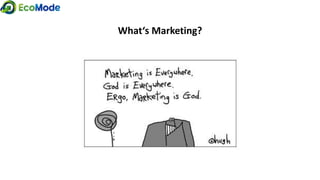
What‘s Marketing?
Green marketing is typically practiced by companies that are committed to sustainable
development and corporate social responsibility.
More organizations are making an effort to implement sustainable business practices as they
recognize that in doing so they can make their products more attractive to consumers and also
reduce expenses, including packaging, transportation, energy/water usage, etc.
Businesses are increasingly discovering that demonstrating a high level of social responsibility can
increase brand loyalty among socially conscious consumers; green marketing can help them do that.
The key barrier to sustainable business practices such as green procurement is:
short versus long term cost;
the cost of "greenness" often doesn't fit into short-term budgets that don't internalize long-term
total costs.
Green Marketing and Sustainable Development
Responsible Marketing:
To put it simply, it is about integrating ecological aspects into all areas of marketing.
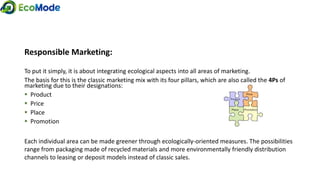
The basis for this is the classic marketing mix with its four pillars, which are also called the 4Ps of
marketing due to their designations:
 Product
 Price
 Place
 Promotion
Each individual area can be made greener through ecologically-oriented measures. The possibilities
range from packaging made of recycled materials and more environmentally friendly distribution
channels to leasing or deposit models instead of classic sales.
Implementation and advantages of green marketing
There are different ways to establish green marketing in a company. They are based on how strongly
the company wants to position itself and what (financial and personnel) effort can/should be made:
Passive: Only the applicable laws and regulations are implemented.
Selective: The selection of ecological measures is based on the competition and goes just minimally
beyond their activities.
Internal: Green marketing focuses on internal company processes like development and production.
Innovative: A comprehensive eco-strategy will be developed, not just based on already known and
proven methods, but also taking innovative paths in the field of environmental protection and
sustainability. The aim is to set new standards and set an example.
Depending on which orientation you choose, green marketing can be reflected in the classic 4P marketing mix
as follows:
 Product policy: The product should consist of natural or at least environmentally friendly materials. In the
best case, it not only helps to protect nature, but also helps to mitigate existing environmental damage.
 Price policy: The additional costs arising from the orientation towards ecological aspects may be reflected
to a certain extent in the price. If the price increase is communicated transparently and plausibly, many
consumers are prepared to pay a higher price for sustainably produced goods. If the opportunity arises,
leasing or sharing options are also possible that simultaneously have resource-saving and social
components.
 Distribution policy: The transport routes required within the framework of a production cycle as well as
the distribution channels are decisive for the ecological footprint of a product. They should therefore be
organized as environmentally friendly and resource-saving as possible. This can be achieved, for example,
by using regional raw materials.
 Communication: On the one hand, this is about making advertising as environmentally friendly as
possible, e.g. by avoiding using flyers, which often end up in the garbage after a brief glance. On the other
hand, a communication strategy must be developed for the company’s own environmental activities.
 Important for external communication of an enterprise
 But also for the internal communication
- promotes the contribution / discussion of employees with
the topic „environment and my company“
- the management is interested to read environmental
reports from (other) companies.
Environmental Reporting
 Trend from environmental report to sustainability reporting
 Environmental protection is a dimension of sustainable development
 Linking environmental issues more closely with economic and social aspects
 Responsible entrepreneurship for economic, social and
environmental responsibility
From Environmental Report to a
Sustainability Report
Project web-page: http://eco-mode-project.eu/
This work is licensed under a

M 5.4.2 ecological marketing

  • 1.
    The European Commissionsupport for the production of this publication does not constitute an endorsement of the contents, which solely reflect the views of the authors. The Commission cannot be held responsible for any use which may be made of the information contained herein Module 5 Starting Point towards eco-innovation
  • 2.
  • 3.
    Learning Outcomes The learnerwill be able to create eco-oriented marketing strategies, using eco- friendly materials and focusing on Green Tourism.
  • 4.
    Ecological Marketing Definition: Greenmarketing refers to the process of selling products and/or services based on their environmental benefits. Such a product or service may be environmentally friendly in itself or produced in an environmentally friendly way, such as:  Being manufactured in a sustainable fashion  Not containing toxic materials or ozone-depleting substances  Able to be recycled and/or is produced from recycled materials  Being made from renewable materials (such as bamboo, etc.)  Not making use of excessive packaging  Being designed to be repairable and not "throwaway"
  • 5.
  • 6.
    Green marketing istypically practiced by companies that are committed to sustainable development and corporate social responsibility. More organizations are making an effort to implement sustainable business practices as they recognize that in doing so they can make their products more attractive to consumers and also reduce expenses, including packaging, transportation, energy/water usage, etc. Businesses are increasingly discovering that demonstrating a high level of social responsibility can increase brand loyalty among socially conscious consumers; green marketing can help them do that. The key barrier to sustainable business practices such as green procurement is: short versus long term cost; the cost of "greenness" often doesn't fit into short-term budgets that don't internalize long-term total costs. Green Marketing and Sustainable Development
  • 7.
    Responsible Marketing: To putit simply, it is about integrating ecological aspects into all areas of marketing. The basis for this is the classic marketing mix with its four pillars, which are also called the 4Ps of marketing due to their designations:  Product  Price  Place  Promotion Each individual area can be made greener through ecologically-oriented measures. The possibilities range from packaging made of recycled materials and more environmentally friendly distribution channels to leasing or deposit models instead of classic sales.
  • 8.
    Implementation and advantagesof green marketing There are different ways to establish green marketing in a company. They are based on how strongly the company wants to position itself and what (financial and personnel) effort can/should be made: Passive: Only the applicable laws and regulations are implemented. Selective: The selection of ecological measures is based on the competition and goes just minimally beyond their activities. Internal: Green marketing focuses on internal company processes like development and production. Innovative: A comprehensive eco-strategy will be developed, not just based on already known and proven methods, but also taking innovative paths in the field of environmental protection and sustainability. The aim is to set new standards and set an example.
  • 9.
    Depending on whichorientation you choose, green marketing can be reflected in the classic 4P marketing mix as follows:  Product policy: The product should consist of natural or at least environmentally friendly materials. In the best case, it not only helps to protect nature, but also helps to mitigate existing environmental damage.  Price policy: The additional costs arising from the orientation towards ecological aspects may be reflected to a certain extent in the price. If the price increase is communicated transparently and plausibly, many consumers are prepared to pay a higher price for sustainably produced goods. If the opportunity arises, leasing or sharing options are also possible that simultaneously have resource-saving and social components.  Distribution policy: The transport routes required within the framework of a production cycle as well as the distribution channels are decisive for the ecological footprint of a product. They should therefore be organized as environmentally friendly and resource-saving as possible. This can be achieved, for example, by using regional raw materials.  Communication: On the one hand, this is about making advertising as environmentally friendly as possible, e.g. by avoiding using flyers, which often end up in the garbage after a brief glance. On the other hand, a communication strategy must be developed for the company’s own environmental activities.
  • 10.
     Important forexternal communication of an enterprise  But also for the internal communication - promotes the contribution / discussion of employees with the topic „environment and my company“ - the management is interested to read environmental reports from (other) companies. Environmental Reporting
  • 11.
     Trend fromenvironmental report to sustainability reporting  Environmental protection is a dimension of sustainable development  Linking environmental issues more closely with economic and social aspects  Responsible entrepreneurship for economic, social and environmental responsibility From Environmental Report to a Sustainability Report
  • 12.