Green Strategy
Common Misconceptions… "It's not pollution that is hurting the environment, it's the impurities in our air and water that are doing it."  -  Dan Quayle - The 44th Vice President of the United States under George H. W. Bush
Introduction to Green Core Pressures Model Green Strategy To Green or Not to Green Triple Bottom Line Model Concluding Remarks
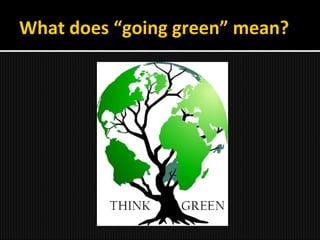
What does “going green” mean?
Eric G. Olson defines a green strategy as: “ Complements the business, operations and asset strategies already understood and articulated by the enterprise… that has a positive impact on the environment” Three principles: Common culture of awareness and action Facilitates decisions and transformation initiatives that improve the environment Attractive value propositions that are cost effective
‘ green consumerism’ as an initial drive shift from individual, ‘microcosmic’ actors towards a ‘macroscopic’ perspective included a growth in segment of “ultra-green” vs. Original “tie-break” consumers This grew to bigger and all-encompassing concerns, pushing companies to evaluate the entire product-life cycle From marketing fad to an all-encompassing environmentally friendly product life cycle
New environmental regulations and laws  were created in 1970’s to protect the environment Formation of CERES (Council for Environmentally Responsible Economics) Council on Economic Priorities grading companies on their environmental performance Involvement of the International Standards Organization created uniform environmental standards From Regulatory  Issues to Looking at them as Strategic Business Issues
The green challenge Attempts to link the green consumer to age or gender demographically have proved inconsistent Green consumer vs. green purchaser  How to attract a green consumer?
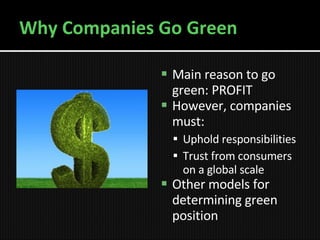
Why Companies Go Green Main reason to go green: PROFIT However, companies must: Uphold responsibilities Trust from consumers on a global scale Other models for determining green position
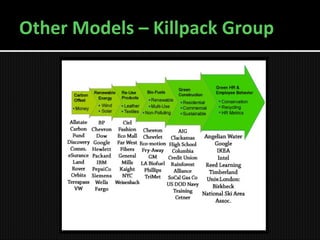
Other Models – Killpack Group
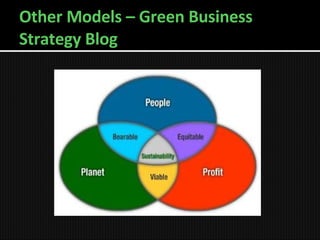
Other Models – Green Business Strategy Blog
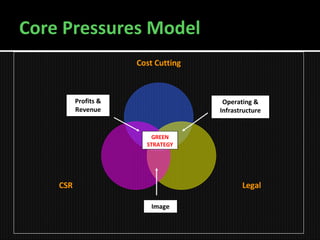
Core Pressures Model Cost Cutting Legal CSR Image Operating & Infrastructure Profits & Revenue GREEN STRATEGY
Three Core Pressures Cost Cutting Examples: switching to eco-efficient light bulbs, or using recycled paper CSR Examples: usage of eco-friendly services/products , or  eco-friendly textiles and resources   Legal Examples: quotas for carbon emissions, or using organic pesticides
Joint Categories – 2 or More Pressures Profits & Revenues Monetary incentives: profits and revenues Operating & Infrastructure Compliance laws and “green” maintenance Image Enhancing CSR through “green” laws
Deciding on a Green Strategy Managers must decide whether corporate head office should use strong control by centralizing decisions regarding environmental issues or provide subsidiaries great autonomy on these issues
Decentralization Advantages of Decentralization : Greater flexibility Increased responsiveness Specific local expertise about products, markets, competitors and customers Disadvantages of Decentralization Loss of scale economies   Duplication of functions   Inconsistencies between divisions   Divisional profitability and short-term goals are put before overall corporate performance
Centralization Advantages of Centralization Consistent procedures between divisions Efficient operations within environmental uncertainty Creation of scale economies Product standardization Disadvantages of Centralization Less flexibility Slower responsiveness to customers’ changing needs Lack of local expertise regarding products, markets and customers
Elements of Environmental Strategy Setting environmental objectives and targets   As product diversification increases   corporate headquarters tend to delegate more to the lower levels decisions about setting environmental objectives and targets   Setting an environmental standard  Since each country has a different standard requirement these decisions tend to be delegated to lower levels Designing environmental programs Highly centralized and monitored by corporate headquarters to ensure consistency
Elements of Environmental Strategy Continued… Allocating resources for environmental programs Strongly centralized Implement environmental performance evaluation system More centralized control is exerted to ensure divisions are equally evaluated
Green or not, however, only those products that are bought by enough numbers of people (critical mass) eventually make it in the marketplace  “There is positive link between the environmental and financial performance of companies”  Comparisons of major companies in: Aerospace, Electronics, Retail, and Automotive
BOEING Boeing has reduced lighting electricity use by up to 90% in some of its plants   Calculates its overall return on investment in the new lighting to be 53%   With the new efficient lighting employee productivity has increased and the probability of human error has drastically decreased   Between 2002 and 2007 Boeing has decreased energy use and carbon dioxide emissions by 24%
By Industry – Aerospace (BOEING) Dropped the hazardous waste of its manufacturing operations by 30% To design the world’s first manned airplane powered by a fuel cell   Remained  a technology and aerospace leader as well as a responsible corporate citizen through its commitment to sustainability and innovation
By Industry – Aerospace AREVA   Large contributor to the global transmission and distribution of energy  Claims to “minimize its environmental impact” through various efforts including solutions that allow for CO 2  free energy generation, for transmitting energy from “environmentally friendly” sources   One of the largest supporters of nuclear energy Continues to support the construction of new reactors
NOKIA   Aims to minimize the environmental impact of its products throughout all operations   First mobile  handset manufacturer which had Eco declarations available for its products as early as 2001   All devices use as little energy as possible, sourcing 25% of its energy from renewable resources and aiming to increase that amount to 50% by 2010
By Industry – Electronics (NOKIA) Searching for new opportunities for using new, environmentally friendly materials Nokia ranks in first place in taking “green” initiatives in the electronics sector   Global leader in mobile devices through its comprehensive environmental strategy to sustainable development
By Industry - Electronics HEWELETT PACKARD   HP’s ENERGY STAR qualified products save consumers money by reducing energy costs and helps protect the environment Committed to offering products and services worldwide that help customers save money, conserve energy and improve the quality of the environment
By Industry – Electronics (HP) Needs to eliminate e-waste and initialize some more recycling initiatives such as a voluntary take-back program like the one NOKIA has in place Needs to completely eliminate hazardous chemicals, such as  polyvinyl chloride plastic and brominated flame retardants, from its entire product portfolio, and use more environmentally friendly materials
THE BODY SHOP   Global manufacturer and retailer of naturally inspired, ethically produced beauty and cosmetics products  First international cosmetics brand to be awarded the Humane Cosmetics Standard for their Against Animal Testing policy   Has own fair trade program called Community Trade, making it the only cosmetics company with such a far-reaching commitment to trading fairly
By Industry – Retail (The Body Shop) Own charity, The Body Shop Foundation which gives financial support to pioneering, front-line organizations that otherwise have little hope of conventional funding  Strongly believes that protecting the planet and supporting community trade will make a positive impact on people’s lives around the world   Maintained a positive corporate image and loyal customer database through its CSR initiatives
By Industry - Retail WAL- MART   Launched an aggressive program to encourage "sustainability" of the world's fisheries, forests and farmlands, to slash energy use and reduce waste, to push its 60,000 suppliers to produce goods that don't harm the environment, and to urge consumers to buy green   Claims they will “reduce solid waste from U.S. stores by 25% within three years,” “cut energy use at its more than 7,000 stores worldwide by 30% and cut greenhouse-gas emissions at existing stores by 20% in seven years”
By Industry – Retail (Wal-Mart) Believes it can earn lots of credits by saving energy, and it can sell them for millions of dollars to companies that cannot, and, all of those savings will go into keeping prices on its products low   R emained open about the fact that it has done all green initiatives solely for the purpose of financial gains and responding to industry-wide competitive pressures
TOYOTA MOTOR CORPORATION   Engaged in business activities under the guiding principle of “contributing to the development of a prosperous society through the manufacture of automobiles  In the manufacturing area production plants are being made sustainable by employing natural energy sources such as solar and wind power, and through ecological preservation by planting greenery around production sites
By Industry – Automotive (Toyota) Toyota’s production system falls in the philosophy of the complete elimination of all waste in all aspects of production in quest of the most efficient production method  Toyota is also engaging in social contribution, establishing the Corporate Citizenship Division to reinforce activities and functions, conducting afforestation programs and educational programs to raise the awareness of global   warming issues
By Industry – Automotive GENERAL MOTORS   Recently responded to the declining sales of its SUV’s and trucks by marketing and advertising green strategies and green technologies, spending $750 million of its advertising budget in 2006 to promote this new green image  GM is responding to environmental pressures to remain profitable, as it still largely engages in producing gas-consuming SUV’s and even maintains its attempts to increase the new fuel economy standards put on vehicles
By Industry – Automotive (GM) Toyota beat General Motors in 2008 and became the global leader in vehicle sales which proved that designing a sustainability strategy has a triple bottom line effect, i.e. profit, community and environment General Motor’s vice-chairman never believed in going green to help the environment; for him it just made a good business sense
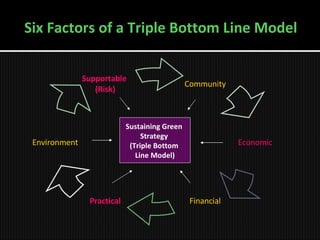
Six Factors of a Triple Bottom Line Model Sustaining Green  Strategy  (Triple Bottom  Line Model) Community Environment Supportable  (Risk) Practical Financial Economic
Basis of Model Main underlying goal a business:  PROFIT Currently, more comprehensive set of goals Human capital Natural capital However, both capitals negatively impact profit Only successful companies are large corporations that have been around for years
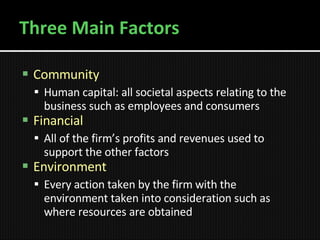
Three Main Factors Community Human capital: all societal aspects relating to the business such as employees and consumers Financial All of the firm’s profits and revenues used to support the other factors Environment Every action taken by the firm with the environment taken into consideration such as where resources are obtained
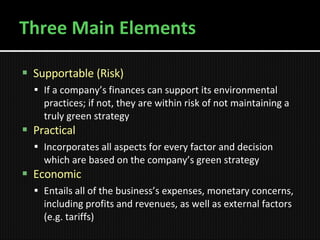
Three Main Elements Supportable (Risk) If a company’s finances can support its environmental practices; if not, they are within risk of not maintaining a truly green strategy Practical Incorporates all aspects for every factor and decision which are based on the company’s green strategy   Economic Entails all of the business’s expenses, monetary concerns, including profits and revenues, as well as external factors (e.g. tariffs)
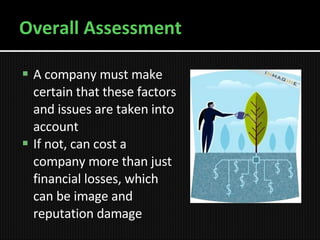
Overall Assessment A company must make certain that these factors and issues are taken into account If not, can cost a company more than just financial losses, which can be image and reputation damage
All companies seek profit as their bottom line, however, by utilizing the  Six Factors for Triple Bottom Line Model , a business can enhance its overall performance Benefits from having a formalized, well-articulated green strategy are certain to vary by industry Early adopters can still harness the enormous potential to opportunistically position themselves with a sustainable green strategic advantage (Olson, 2008)
Concluding Remarks continued… Businesses just starting green initiatives such as global giants (Wal-Mart) are only profit based New companies just starting green initiatives can become truly green if they use all six factors in trying to sustain a green strategy Companies, (The Body Shop), that use all the factors, maintain their green position and strategy and have true success in the global market
 
Works Cited AREVA Homepage . 2008. 04 Jan. 2009  <http://www.areva-td.com/home_tdmain/US_57_Homepage.html>. &quot;The Body Shop At Home - About Us.&quot;  The Body Shop At Home - Home . 29 Oct. 2008 <http://www2.thebodyshopathome.com/about_us.aspx>.  &quot;Boeing: EPA Names Boeing Partner of the Year.&quot;  The Boeing Company . 12 Oct. 2008 <http://www.boeing.com/news/releases/1999/news_release_990414a.html>.  &quot;Boeing Points To Improved Environmental Performance ·.&quot;  Environmental Leader · Green Business, Sustainable Business, and Green Strategy News for Corporate Sustainability Executives . 24 May 2008. 08 Feb. 2009 <http://www.environmentalleader.com/2008/05/24/boeing-points-to-improved-environmental-performance/>. Building a Powerful and Enduring Brand: The Past, Present, and Future of the ENERGY STAR Brand . Publication. June 2007. U.S. Environmental Protection Agency. 25 Oct. 2008 <http://www.energystar.gov/ia/partners/downloads/ENERGY_STARBndManf508.pdf>. Castro, Noelia R., and Juan Pineiro. &quot;An integrated framework for the financial analysis of sustainability.&quot;  Business Strategy and the Environment  15 (2006). CERES Investors and Environmentalists for Sustainable Prosperity . 2007. 25 Sept. 2008.  &quot;DEQ - Green Lights.&quot;  SOM - State of Michigan . Ed. James Baker. 2008. 14 Nov. 2008 <http://www.michigan.gov/deq/0,1607,7-135-3585_4128_4178---,00.html>. Eiadat, Y., et al. &quot;Green and Competitive: An Empirical Test of the Mediating Role of Environmental Innovation Strategy.&quot;  Journal of World Business  43.2 (2008): 131-45.
Works Cited continued… &quot;Environmental Capital - WSJ.com: Out of Lutz: GM and Global Warming.&quot;  Blogs - WSJ.com . 25 Feb. 2008. 08 Feb. 2009 <http://blogs.wsj.com/environmentalcapital/2008/02/25/out-of-lutz-gm-and-global-warming/>. Epstein, Marc J., and Marie-Josée Roy.  &quot;Implementing a Corporate Environmental Strategy: Establishing.&quot;  Business Strategy and the Environment  16 (2007).  &quot;Green definition.&quot;  BusinessDictionary.com - Online Business Dictionary . 02 Jan. 2009 <http://www.businessdictionary.com/definition/green.html>. &quot;Green Business Strategy Blog.&quot;  Business School Case Study Solutions & Answers . 12 Sept. 2008. 27 Oct. 2008 <http://www.mbacasestudysolutions.com/Blog/Green/Index_Green_Business_Strategies_Blog.html>. &quot;Green marketing Definition | Business Dictionaries from AllBusiness.com.&quot;  Business Resources, Advice and Forms for Large and Small Businesses . 02 Jan. 2009 <http://www.allbusiness.com/glossaries/green-marketing/4961576-1.html>. Haanpää, Leena. &quot;Consumers’ Green Commitment: Indication of a Postmodern Lifestyle?&quot;  International Journal of Consumer Studies  31.5 (2007): 478-86. &quot;How does responsible environmental performance affect corporate business results?&quot;  Ethical Investment . 15 Nov. 1999.  &quot;HP Environment: ENERGY STAR.&quot;  HP United States - Computers, Laptops, Servers, Printers and more . 20 Oct. 2008 <http://www.hp.com/hpinfo/globalcitizenship/environment/productdesign/energystar.html>.
Works Cited continued… Hussain, S. S. &quot;The ethics of ‘going green’: the corporate social responsibility debate.&quot;  Business Strategy and the Environment  8 (1999). Kassaye, W. W. &quot;Green dilemma.&quot;  Marketing Intelligence & Planning  19 (2001).  Killpack Group. &quot;Going Green: What Can Be Done?&quot;  Killpack Group: Green Solutions for Today . 2007. 30 Sept. 2008.  Lamming, Richard, Adam Faruk, and Paul Cousins. &quot;Environmental soundness: a pragmatic alternative to expectations of sustainable development in business strategy.&quot;  Business Strategy and the Environment  8 (1999). Meyer, Harvey. &quot;The Greening Corporate America.&quot;  Journal of Business Strategy  21 (2000).  Nakao, Yuriko, Akihiro Amano, Kanichiro Matsumura, Kiminori Genba, and Makiko Nakano. &quot;Relationship between environmental performance and financial performance: an empirical analysis of Japanese corporations.&quot;  Business Strategy and the Environment  16 (2007). &quot;Nokia - Environmental strategy - Our responsibility - Environment.&quot;  Nokia - Nokia on the Web . 16 Oct. 2008 <http://www.nokia.com/A41041089>.  Olson, Eric G. &quot;1. Creating an enterprise-level ‘green’ strategy.&quot;  Journal of Business Strategy  29 (2008).  Ottman, Jacquelyn A. &quot;Industry's response to green consumerism.&quot;  Journal of Business Strategy  3 (1992).  Peattie, Ken. &quot;Golden goose or wild goose? The hunt for the green consumer. &quot;  Business Strategy and the Environment   10.4 (2001): 187.
Works Cited continued… Rhee, Seung-Kyu, and Su-Yol Lee. &quot;Dynamic change of corporate environmental strategy: rhetoric and reality.&quot;  Business Strategy and the Environment  12 (2003). Romm, Joseph J. &quot;Greening the Building and the Bottom Line.&quot; Dec. 1994.  15 Sept. 2008 <https://www.rmi.org/images/PDFs/BuildingsLand/D94-27_GBBL.pdf>.  Rugman, Alam M., and Alain Verbeke. &quot;Corporate strategies and environmental regulations: an organizing framework.&quot;  Strategic Management Journal  19 (1998). Stainer, Alan, and Lorice Stainer. &quot;Ethical dimensions of environmental management.&quot;  European Business Review  97 (1997). &quot;TOYOTA: Company Vision/Philosophy.&quot; (2009). 29 Sept. 2008 <http://www.toyota.co.jp/en/vision/production_system/index.html>.  &quot;USATODAY.com - Wal-Mart grows 'green' strategies.&quot;  News, Travel, Weather, Entertainment,  Sports, Technology, U.S. & World - USATODAY.com . Sept. 9, 2006.  17 Sept. 2008 <http://www.usatoday.com/money/industries/retail/2006-09-24-wal-mart-cover-usat_x.htm>. &quot;World Energy Congress - quit nuclear | Greenpeace International.&quot;  Greenpeace | Greenpeace  USA . Nov. 11, 2007. 02 Jan. 2009 <http://www.greenpeace.org/international/press/releases/world-energy-congress07>.
Pictures http://teamworksweb.com/sitecm/i/holding%20globe.jpg http://www.mdc.edu/environethics/Think%20Green%202006.jpg http://www.coolairsolutions.com/images/green-dollar-sign.jpg http://www.mbacasestudysolutions.com/Blog/Green/Index_Green_Business_Strategies_Blog.html http://ecoble.com/wp-content/uploads/2007/11/go-green.jpg http://images.inmagine.com/img/imagezoo/izs002/izs002791.jpg Ecological Economics

Green Strategy Presentation

  • 1.
  • 2.
    Common Misconceptions… &quot;It'snot pollution that is hurting the environment, it's the impurities in our air and water that are doing it.&quot; - Dan Quayle - The 44th Vice President of the United States under George H. W. Bush
  • 3.
    Introduction to GreenCore Pressures Model Green Strategy To Green or Not to Green Triple Bottom Line Model Concluding Remarks
  • 4.
    What does “goinggreen” mean?
  • 5.
    Eric G. Olsondefines a green strategy as: “ Complements the business, operations and asset strategies already understood and articulated by the enterprise… that has a positive impact on the environment” Three principles: Common culture of awareness and action Facilitates decisions and transformation initiatives that improve the environment Attractive value propositions that are cost effective
  • 6.
    ‘ green consumerism’as an initial drive shift from individual, ‘microcosmic’ actors towards a ‘macroscopic’ perspective included a growth in segment of “ultra-green” vs. Original “tie-break” consumers This grew to bigger and all-encompassing concerns, pushing companies to evaluate the entire product-life cycle From marketing fad to an all-encompassing environmentally friendly product life cycle
  • 7.
    New environmental regulationsand laws  were created in 1970’s to protect the environment Formation of CERES (Council for Environmentally Responsible Economics) Council on Economic Priorities grading companies on their environmental performance Involvement of the International Standards Organization created uniform environmental standards From Regulatory Issues to Looking at them as Strategic Business Issues
  • 8.
    The green challengeAttempts to link the green consumer to age or gender demographically have proved inconsistent Green consumer vs. green purchaser How to attract a green consumer?
  • 9.
    Why Companies GoGreen Main reason to go green: PROFIT However, companies must: Uphold responsibilities Trust from consumers on a global scale Other models for determining green position
  • 10.
    Other Models –Killpack Group
  • 11.
    Other Models –Green Business Strategy Blog
  • 12.
    Core Pressures ModelCost Cutting Legal CSR Image Operating & Infrastructure Profits & Revenue GREEN STRATEGY
  • 13.
    Three Core PressuresCost Cutting Examples: switching to eco-efficient light bulbs, or using recycled paper CSR Examples: usage of eco-friendly services/products , or eco-friendly textiles and resources Legal Examples: quotas for carbon emissions, or using organic pesticides
  • 14.
    Joint Categories –2 or More Pressures Profits & Revenues Monetary incentives: profits and revenues Operating & Infrastructure Compliance laws and “green” maintenance Image Enhancing CSR through “green” laws
  • 15.
    Deciding on aGreen Strategy Managers must decide whether corporate head office should use strong control by centralizing decisions regarding environmental issues or provide subsidiaries great autonomy on these issues
  • 16.
    Decentralization Advantages ofDecentralization : Greater flexibility Increased responsiveness Specific local expertise about products, markets, competitors and customers Disadvantages of Decentralization Loss of scale economies Duplication of functions Inconsistencies between divisions Divisional profitability and short-term goals are put before overall corporate performance
  • 17.
    Centralization Advantages ofCentralization Consistent procedures between divisions Efficient operations within environmental uncertainty Creation of scale economies Product standardization Disadvantages of Centralization Less flexibility Slower responsiveness to customers’ changing needs Lack of local expertise regarding products, markets and customers
  • 18.
    Elements of EnvironmentalStrategy Setting environmental objectives and targets As product diversification increases corporate headquarters tend to delegate more to the lower levels decisions about setting environmental objectives and targets Setting an environmental standard Since each country has a different standard requirement these decisions tend to be delegated to lower levels Designing environmental programs Highly centralized and monitored by corporate headquarters to ensure consistency
  • 19.
    Elements of EnvironmentalStrategy Continued… Allocating resources for environmental programs Strongly centralized Implement environmental performance evaluation system More centralized control is exerted to ensure divisions are equally evaluated
  • 20.
    Green or not,however, only those products that are bought by enough numbers of people (critical mass) eventually make it in the marketplace “There is positive link between the environmental and financial performance of companies” Comparisons of major companies in: Aerospace, Electronics, Retail, and Automotive
  • 21.
    BOEING Boeing hasreduced lighting electricity use by up to 90% in some of its plants Calculates its overall return on investment in the new lighting to be 53% With the new efficient lighting employee productivity has increased and the probability of human error has drastically decreased Between 2002 and 2007 Boeing has decreased energy use and carbon dioxide emissions by 24%
  • 22.
    By Industry –Aerospace (BOEING) Dropped the hazardous waste of its manufacturing operations by 30% To design the world’s first manned airplane powered by a fuel cell Remained a technology and aerospace leader as well as a responsible corporate citizen through its commitment to sustainability and innovation
  • 23.
    By Industry –Aerospace AREVA Large contributor to the global transmission and distribution of energy Claims to “minimize its environmental impact” through various efforts including solutions that allow for CO 2 free energy generation, for transmitting energy from “environmentally friendly” sources One of the largest supporters of nuclear energy Continues to support the construction of new reactors
  • 24.
    NOKIA Aims to minimize the environmental impact of its products throughout all operations First mobile handset manufacturer which had Eco declarations available for its products as early as 2001 All devices use as little energy as possible, sourcing 25% of its energy from renewable resources and aiming to increase that amount to 50% by 2010
  • 25.
    By Industry –Electronics (NOKIA) Searching for new opportunities for using new, environmentally friendly materials Nokia ranks in first place in taking “green” initiatives in the electronics sector Global leader in mobile devices through its comprehensive environmental strategy to sustainable development
  • 26.
    By Industry -Electronics HEWELETT PACKARD HP’s ENERGY STAR qualified products save consumers money by reducing energy costs and helps protect the environment Committed to offering products and services worldwide that help customers save money, conserve energy and improve the quality of the environment
  • 27.
    By Industry –Electronics (HP) Needs to eliminate e-waste and initialize some more recycling initiatives such as a voluntary take-back program like the one NOKIA has in place Needs to completely eliminate hazardous chemicals, such as polyvinyl chloride plastic and brominated flame retardants, from its entire product portfolio, and use more environmentally friendly materials
  • 28.
    THE BODY SHOP Global manufacturer and retailer of naturally inspired, ethically produced beauty and cosmetics products First international cosmetics brand to be awarded the Humane Cosmetics Standard for their Against Animal Testing policy Has own fair trade program called Community Trade, making it the only cosmetics company with such a far-reaching commitment to trading fairly
  • 29.
    By Industry –Retail (The Body Shop) Own charity, The Body Shop Foundation which gives financial support to pioneering, front-line organizations that otherwise have little hope of conventional funding Strongly believes that protecting the planet and supporting community trade will make a positive impact on people’s lives around the world Maintained a positive corporate image and loyal customer database through its CSR initiatives
  • 30.
    By Industry -Retail WAL- MART Launched an aggressive program to encourage &quot;sustainability&quot; of the world's fisheries, forests and farmlands, to slash energy use and reduce waste, to push its 60,000 suppliers to produce goods that don't harm the environment, and to urge consumers to buy green Claims they will “reduce solid waste from U.S. stores by 25% within three years,” “cut energy use at its more than 7,000 stores worldwide by 30% and cut greenhouse-gas emissions at existing stores by 20% in seven years”
  • 31.
    By Industry –Retail (Wal-Mart) Believes it can earn lots of credits by saving energy, and it can sell them for millions of dollars to companies that cannot, and, all of those savings will go into keeping prices on its products low R emained open about the fact that it has done all green initiatives solely for the purpose of financial gains and responding to industry-wide competitive pressures
  • 32.
    TOYOTA MOTOR CORPORATION Engaged in business activities under the guiding principle of “contributing to the development of a prosperous society through the manufacture of automobiles In the manufacturing area production plants are being made sustainable by employing natural energy sources such as solar and wind power, and through ecological preservation by planting greenery around production sites
  • 33.
    By Industry –Automotive (Toyota) Toyota’s production system falls in the philosophy of the complete elimination of all waste in all aspects of production in quest of the most efficient production method Toyota is also engaging in social contribution, establishing the Corporate Citizenship Division to reinforce activities and functions, conducting afforestation programs and educational programs to raise the awareness of global warming issues
  • 34.
    By Industry –Automotive GENERAL MOTORS Recently responded to the declining sales of its SUV’s and trucks by marketing and advertising green strategies and green technologies, spending $750 million of its advertising budget in 2006 to promote this new green image GM is responding to environmental pressures to remain profitable, as it still largely engages in producing gas-consuming SUV’s and even maintains its attempts to increase the new fuel economy standards put on vehicles
  • 35.
    By Industry –Automotive (GM) Toyota beat General Motors in 2008 and became the global leader in vehicle sales which proved that designing a sustainability strategy has a triple bottom line effect, i.e. profit, community and environment General Motor’s vice-chairman never believed in going green to help the environment; for him it just made a good business sense
  • 36.
    Six Factors ofa Triple Bottom Line Model Sustaining Green Strategy (Triple Bottom Line Model) Community Environment Supportable (Risk) Practical Financial Economic
  • 37.
    Basis of ModelMain underlying goal a business: PROFIT Currently, more comprehensive set of goals Human capital Natural capital However, both capitals negatively impact profit Only successful companies are large corporations that have been around for years
  • 38.
    Three Main FactorsCommunity Human capital: all societal aspects relating to the business such as employees and consumers Financial All of the firm’s profits and revenues used to support the other factors Environment Every action taken by the firm with the environment taken into consideration such as where resources are obtained
  • 39.
    Three Main ElementsSupportable (Risk) If a company’s finances can support its environmental practices; if not, they are within risk of not maintaining a truly green strategy Practical Incorporates all aspects for every factor and decision which are based on the company’s green strategy Economic Entails all of the business’s expenses, monetary concerns, including profits and revenues, as well as external factors (e.g. tariffs)
  • 40.
    Overall Assessment Acompany must make certain that these factors and issues are taken into account If not, can cost a company more than just financial losses, which can be image and reputation damage
  • 41.
    All companies seekprofit as their bottom line, however, by utilizing the Six Factors for Triple Bottom Line Model , a business can enhance its overall performance Benefits from having a formalized, well-articulated green strategy are certain to vary by industry Early adopters can still harness the enormous potential to opportunistically position themselves with a sustainable green strategic advantage (Olson, 2008)
  • 42.
    Concluding Remarks continued…Businesses just starting green initiatives such as global giants (Wal-Mart) are only profit based New companies just starting green initiatives can become truly green if they use all six factors in trying to sustain a green strategy Companies, (The Body Shop), that use all the factors, maintain their green position and strategy and have true success in the global market
  • 43.
  • 44.
    Works Cited AREVAHomepage . 2008. 04 Jan. 2009 <http://www.areva-td.com/home_tdmain/US_57_Homepage.html>. &quot;The Body Shop At Home - About Us.&quot; The Body Shop At Home - Home . 29 Oct. 2008 <http://www2.thebodyshopathome.com/about_us.aspx>. &quot;Boeing: EPA Names Boeing Partner of the Year.&quot; The Boeing Company . 12 Oct. 2008 <http://www.boeing.com/news/releases/1999/news_release_990414a.html>. &quot;Boeing Points To Improved Environmental Performance ·.&quot; Environmental Leader · Green Business, Sustainable Business, and Green Strategy News for Corporate Sustainability Executives . 24 May 2008. 08 Feb. 2009 <http://www.environmentalleader.com/2008/05/24/boeing-points-to-improved-environmental-performance/>. Building a Powerful and Enduring Brand: The Past, Present, and Future of the ENERGY STAR Brand . Publication. June 2007. U.S. Environmental Protection Agency. 25 Oct. 2008 <http://www.energystar.gov/ia/partners/downloads/ENERGY_STARBndManf508.pdf>. Castro, Noelia R., and Juan Pineiro. &quot;An integrated framework for the financial analysis of sustainability.&quot; Business Strategy and the Environment 15 (2006). CERES Investors and Environmentalists for Sustainable Prosperity . 2007. 25 Sept. 2008. &quot;DEQ - Green Lights.&quot; SOM - State of Michigan . Ed. James Baker. 2008. 14 Nov. 2008 <http://www.michigan.gov/deq/0,1607,7-135-3585_4128_4178---,00.html>. Eiadat, Y., et al. &quot;Green and Competitive: An Empirical Test of the Mediating Role of Environmental Innovation Strategy.&quot; Journal of World Business 43.2 (2008): 131-45.
  • 45.
    Works Cited continued…&quot;Environmental Capital - WSJ.com: Out of Lutz: GM and Global Warming.&quot; Blogs - WSJ.com . 25 Feb. 2008. 08 Feb. 2009 <http://blogs.wsj.com/environmentalcapital/2008/02/25/out-of-lutz-gm-and-global-warming/>. Epstein, Marc J., and Marie-Josée Roy. &quot;Implementing a Corporate Environmental Strategy: Establishing.&quot; Business Strategy and the Environment 16 (2007). &quot;Green definition.&quot; BusinessDictionary.com - Online Business Dictionary . 02 Jan. 2009 <http://www.businessdictionary.com/definition/green.html>. &quot;Green Business Strategy Blog.&quot; Business School Case Study Solutions & Answers . 12 Sept. 2008. 27 Oct. 2008 <http://www.mbacasestudysolutions.com/Blog/Green/Index_Green_Business_Strategies_Blog.html>. &quot;Green marketing Definition | Business Dictionaries from AllBusiness.com.&quot; Business Resources, Advice and Forms for Large and Small Businesses . 02 Jan. 2009 <http://www.allbusiness.com/glossaries/green-marketing/4961576-1.html>. Haanpää, Leena. &quot;Consumers’ Green Commitment: Indication of a Postmodern Lifestyle?&quot; International Journal of Consumer Studies 31.5 (2007): 478-86. &quot;How does responsible environmental performance affect corporate business results?&quot; Ethical Investment . 15 Nov. 1999. &quot;HP Environment: ENERGY STAR.&quot; HP United States - Computers, Laptops, Servers, Printers and more . 20 Oct. 2008 <http://www.hp.com/hpinfo/globalcitizenship/environment/productdesign/energystar.html>.
  • 46.
    Works Cited continued…Hussain, S. S. &quot;The ethics of ‘going green’: the corporate social responsibility debate.&quot; Business Strategy and the Environment 8 (1999). Kassaye, W. W. &quot;Green dilemma.&quot; Marketing Intelligence & Planning 19 (2001). Killpack Group. &quot;Going Green: What Can Be Done?&quot; Killpack Group: Green Solutions for Today . 2007. 30 Sept. 2008. Lamming, Richard, Adam Faruk, and Paul Cousins. &quot;Environmental soundness: a pragmatic alternative to expectations of sustainable development in business strategy.&quot; Business Strategy and the Environment 8 (1999). Meyer, Harvey. &quot;The Greening Corporate America.&quot; Journal of Business Strategy 21 (2000). Nakao, Yuriko, Akihiro Amano, Kanichiro Matsumura, Kiminori Genba, and Makiko Nakano. &quot;Relationship between environmental performance and financial performance: an empirical analysis of Japanese corporations.&quot; Business Strategy and the Environment 16 (2007). &quot;Nokia - Environmental strategy - Our responsibility - Environment.&quot; Nokia - Nokia on the Web . 16 Oct. 2008 <http://www.nokia.com/A41041089>. Olson, Eric G. &quot;1. Creating an enterprise-level ‘green’ strategy.&quot; Journal of Business Strategy 29 (2008). Ottman, Jacquelyn A. &quot;Industry's response to green consumerism.&quot; Journal of Business Strategy 3 (1992). Peattie, Ken. &quot;Golden goose or wild goose? The hunt for the green consumer. &quot;  Business Strategy and the Environment   10.4 (2001): 187.
  • 47.
    Works Cited continued…Rhee, Seung-Kyu, and Su-Yol Lee. &quot;Dynamic change of corporate environmental strategy: rhetoric and reality.&quot; Business Strategy and the Environment 12 (2003). Romm, Joseph J. &quot;Greening the Building and the Bottom Line.&quot; Dec. 1994. 15 Sept. 2008 <https://www.rmi.org/images/PDFs/BuildingsLand/D94-27_GBBL.pdf>. Rugman, Alam M., and Alain Verbeke. &quot;Corporate strategies and environmental regulations: an organizing framework.&quot; Strategic Management Journal 19 (1998). Stainer, Alan, and Lorice Stainer. &quot;Ethical dimensions of environmental management.&quot; European Business Review 97 (1997). &quot;TOYOTA: Company Vision/Philosophy.&quot; (2009). 29 Sept. 2008 <http://www.toyota.co.jp/en/vision/production_system/index.html>. &quot;USATODAY.com - Wal-Mart grows 'green' strategies.&quot; News, Travel, Weather, Entertainment, Sports, Technology, U.S. & World - USATODAY.com . Sept. 9, 2006. 17 Sept. 2008 <http://www.usatoday.com/money/industries/retail/2006-09-24-wal-mart-cover-usat_x.htm>. &quot;World Energy Congress - quit nuclear | Greenpeace International.&quot; Greenpeace | Greenpeace USA . Nov. 11, 2007. 02 Jan. 2009 <http://www.greenpeace.org/international/press/releases/world-energy-congress07>.
  • 48.
    Pictures http://teamworksweb.com/sitecm/i/holding%20globe.jpg http://www.mdc.edu/environethics/Think%20Green%202006.jpghttp://www.coolairsolutions.com/images/green-dollar-sign.jpg http://www.mbacasestudysolutions.com/Blog/Green/Index_Green_Business_Strategies_Blog.html http://ecoble.com/wp-content/uploads/2007/11/go-green.jpg http://images.inmagine.com/img/imagezoo/izs002/izs002791.jpg Ecological Economics