Job Growers and CCBI
October 11, 2012
Better marketing
= bigger sales
What we’ll cover


•   Why should you care about marketing and
    branding?
•   What is a brand?
•   Your target audiences—perception is reality
•   Generational perspectives and their impact on
    communications
•   What should you communicate? Going beyond
    the “stuff”
•   What actions do you want to inspire?
Where are you now?


•   Where do your customers come from now?
•   How are you finding and reaching new
    customers?
•   What’s your sales process?
•   What’s working?
•   What’s not working?
•   Where are your biggest challenges?
Better marketing = bigger sales


If someone is looking
  for what you offer,
    where are they
       looking?
Better marketing = bigger sales


  If they find you,
what will they see?
Will they understand
 why they should
     choose you?
Better marketing = bigger sales


  Today B2B buyers
   contact you only
   after 60% of the
 purchase decision is
    already made.
What do they want from you?
Better marketing = bigger sales


  A surprise … quick,
    simple, easy …
 information… answer
 my questions … talk to
      me …WIIFM
What’s unexpected?


    Surprise me!
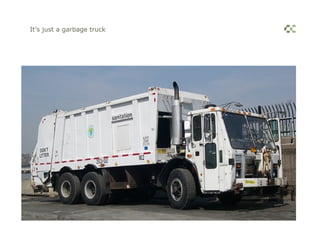
It’s just a garbage truck
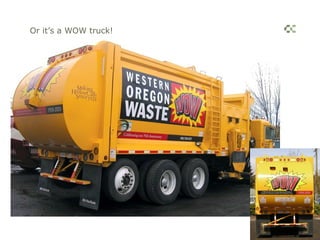
Or it’s a WOW truck!
Why should I care? How does this work?


                  I get it!
What’s in it for me?
Looks easy, simple!
Make it easy to choose


          Good
      information!
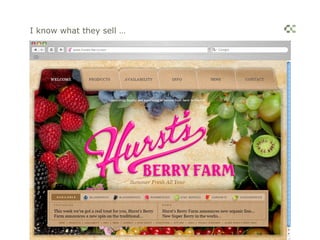
I know what they sell …
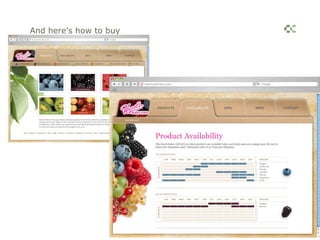
And here’s how to buy
Be relevant to your audience


         Engage me
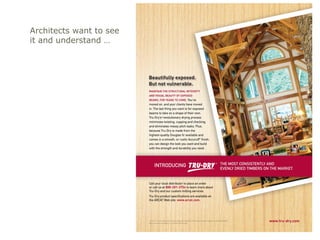
Architects want to see
it and understand …
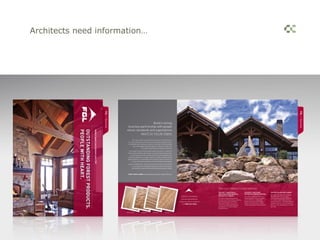
Architects need information…
Maintain consistency


  Who are you?
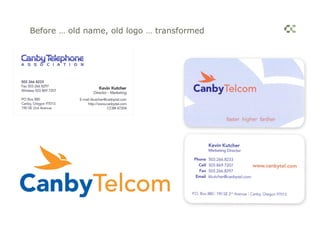
Before … old name, old logo … transformed
After … visible, consistent, recognized
After … information,
communication, entertainment
Marketing is branding


  Why branding?
   Why bother?
We live in an
 overwhelmed,
  time-starved
     culture
   packed with
too many choices
Focus your marketing


      A brand
    brings focus
Glance
and scan

Sound bites

First
impressions
are the only
impressions
Target audiences
Position in your category
     Benefits to the
       audiences
  Where’s the “wow!”?
A brand is an asset


                What is
                a brand?
What is a brand?


What is a brand?
  •   The name of a product or service
  •   A warranty, trusted concept or essence
  •   A preference in the mind of your audience
  •   An expectation of a certain level of service
  •   Confidence in knowing what to expect
  •   Value in the mind of the audience
  •   A bottom-line asset
The Starbucks brand
A brand becomes more than a cup of coffee … “let’s
get a Starbucks”
It’s about the experience, the total of all elements
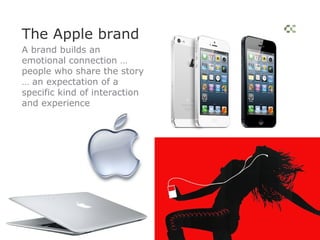
The Apple brand
A brand builds an
emotional connection …
people who share the story
… an expectation of a
specific kind of interaction
and experience
What is a brand?


A brand is more than a logo
  A brand requires a visual and verbal
   vocabulary
  • A distinctive “ look and feel”
  • A common voice, tone and style
  • A system of colors and typography
  • A series of images that build a cohesive whole
What is a brand?


What builds brands?
  • Brands are being built with or without
    management
  • Publicity build brands
  • Blogs, social media, marketing and websites
    build brands
  • Environments build brands
  • Each contact with the organization builds the
    brand
Your marketing must be branded


Why should you
build a brand?
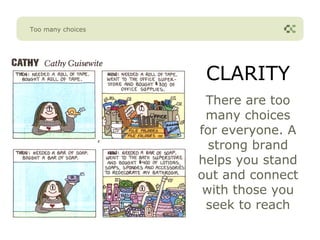
Too many choices


                    CLARITY
                    There are too
                    many choices
                   for everyone. A
                     strong brand
                   helps you stand
                   out and connect
                    with those you
                    seek to reach
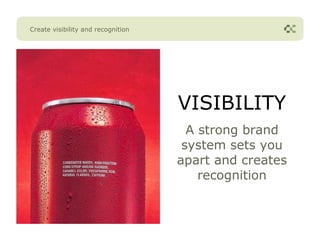
Create visibility and recognition


                                    VISIBILITY
                                      A strong brand
                                     system sets you
                                    apart and creates
                                        recognition
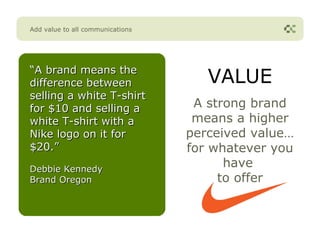
Add value to all communications


“A brand means the
difference between                   VALUE
selling a white T-shirt
for $10 and selling a              A strong brand
white T-shirt with a               means a higher
Nike logo on it for               perceived value…
$20.”                             for whatever you
Debbie Kennedy
                                        have
Brand Oregon                           to offer
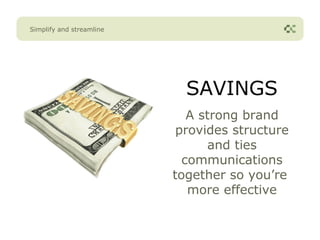
Simplify and streamline


                            SAVINGS
                             A strong brand
                           provides structure
                                and ties
                            communications
                          together so you’re
                             more effective
Building a brand


           but we’re not
             selling to
            consumers,
              we’re selling to
               businesses
Perception is reality
 • Your brand is based on what people
   think about your organization

    …it’s still
 • Communicate clearly from the
   audience’s point of view


  about people
 • Provide value to those you serve


   and communication
Audiences


Perception is reality
  • Your brand is based on what people think
    about your organization
  • To be effective you must communicate clearly
    from your audience’s point of view
  • You must create a brand that is visually
    appealing and communicates the essentials,
    answers their questions
Audiences


Do you know your audiences?
  • Do you know everyone you need to
    communicate with?
  • Do you know what they expect from you?
  • Do you understand their concerns?
  • Speak in the their language; be clear and
    concise (no acronyms!)
Audiences


Business to business
  • People are still people
  • Roles might be different, not the final decision
    maker
  • Sales process might be longer, more people
    and information involved
  • It’s still trust, confidence, relationship
Brand building


   Defining your brand
  character and persona
Defining your brand


What personality do you want to
 present?
    • How do you want to be perceived, known
      and remembered?
    • It is this “persona” that will be remembered
    • It’s the character/personality of your brand
      communication that will create recognition
      and attention
Defining your brand


Made up of the combination of
 numerous elements
    • Overall style of the
      presentation/communication
    • Details such as
        • colors, image
        • language, tone
        • style and overall quality
        • Key messages and phrases
Defining your brand


Is your image what your audience
  wants, expects, will respond to?
    • What’s the “playing field”? What’s
      expected?
    • You may want to appear as a complex,
      intelligent and powerful company
    • Your audience might prefer a simple, folksy
      persona they can relate to
Exercises | Defining your brand


A. Think of your brand as a car
What brand of car would you be?
    • Rank your brand on a scale
    • Consider: image quality, price,
      distinctiveness
       • Exercise (Using the car metaphor helps
         you visualize where you fit.)
Exercises | Defining your brand


B. Consider your brand as a person
Describe that person as they walk
 towards you
    •   What     kind of impression do they project?
    •   What     is their appearance?
    •   What     is your sense of their capabilities?
    •   What     do you believe about them?
Lunch break!
Your audiences


               Each
           generation
           is different
The Generations


Effective marketing requires first
understanding the audiences you’re
trying to reach.
For the first time in history there are four
different generations in the workplace, each with
different values, perspectives and expectations
Target your audiences


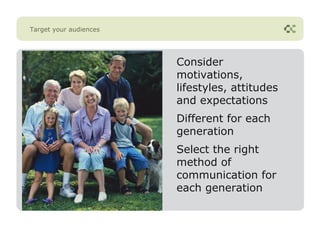
                        Consider
                        motivations,
                        lifestyles, attitudes
                        and expectations
                        Different for each
                        generation
                        Select the right
                        method of
                        communication for
                        each generation
Generations


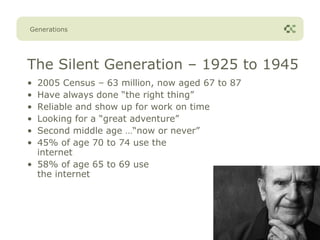
The Silent Generation – 1925 to 1945
• 2005 Census – 63 million, now aged 67 to 87
• Have always done “the right thing”
• Reliable and show up for work on time
• Looking for a “great adventure”
• Second middle age …“now or never”
• 45% of age 70 to 74 use the
  internet
• 58% of age 65 to 69 use
  the internet
Generations


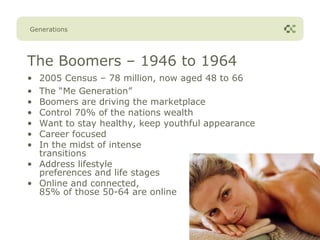
The Boomers – 1946 to 1964
• 2005 Census – 78 million, now aged 48 to 66
• The “Me Generation”
• Boomers are driving the marketplace
• Control 70% of the nations wealth
• Want to stay healthy, keep youthful appearance
• Career focused
• In the midst of intense
  transitions
• Address lifestyle
  preferences and life stages
• Online and connected,
  85% of those 50-64 are online
Generations


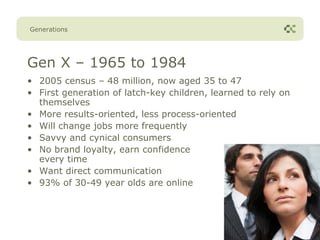
Gen X – 1965 to 1984
• 2005 census – 48 million, now aged 35 to 47
• First generation of latch-key children, learned to rely on
  themselves
• More results-oriented, less process-oriented
• Will change jobs more frequently
• Savvy and cynical consumers
• No brand loyalty, earn confidence
  every time
• Want direct communication
• 93% of 30-49 year olds are online
Generations


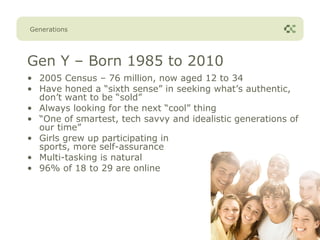
Gen Y – Born 1985 to 2010
• 2005 Census – 76 million, now aged 12 to 34
• Have honed a “sixth sense” in seeking what’s authentic,
  don’t want to be “sold”
• Always looking for the next “cool” thing
• “One of smartest, tech savvy and idealistic generations of
  our time”
• Girls grew up participating in
  sports, more self-assurance
• Multi-tasking is natural
• 96% of 18 to 29 are online
Generations


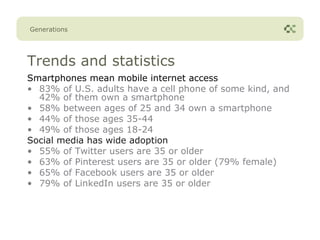
Trends and statistics
Smartphones mean mobile internet access
• 83% of U.S. adults have a cell phone of some kind, and
  42% of them own a smartphone
• 58% between ages of 25 and 34 own a smartphone
• 44% of those ages 35-44
• 49% of those ages 18-24
Social media has wide adoption
• 55% of Twitter users are 35 or older
• 63% of Pinterest users are 35 or older (79% female)
• 65% of Facebook users are 35 or older
• 79% of LinkedIn users are 35 or older
Building a brand


  communicate
   your value
    not just what you do
Features vs. Benefits


You must be clear about the services or
products you’re offering, what are the
benefits?
How can you frame the benefits to connect with
the expectations of each generation?
How does each generation prefer to
communicate? (reading vs. watching vs. sharing)
Features vs. Benefits


Features:
Here’s what the product does, or what the
service is. Descriptive.

Benefits:
Here’s the outcome, what you audience will
receive from the product or service.
Often emotional or personal.
Features vs. benefits


   They’re not buying
          a drill
   They’re buying the
     hole it makes
Audiences


What is needed and wanted by your
audience(s)?
  • What’s the primary reason each audience
    wants/needs/uses your products or services?
  • What do you provide immediately, and over
    the long-term?
Define the message


What value do you provide?
   • Go beyond the “stuff”
   • Identify ideas, messages that address “why
     should I care?” or
   • “What’s in it for me?” (WIIFM)
   • Where’s the “wow!”?
Audiences


Think about why instead of what
  • Why do they need to connect with you?
  • What purpose do you serve?
  • Avoid just listing the “stuff” you do
  • Consider their perspectives – who are they?
    How do they communicate or take in
    information?
  • What’s the role in the purchase?
t ’s y our
Wha
mess age?
(WII FM )
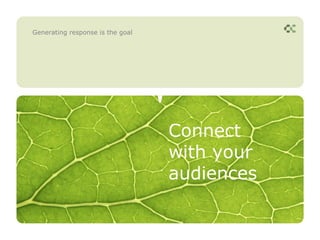
Generating response is the goal


                                  Connect
                                  with your
                                  audiences
Building your brand


Brand building (effective marketing)
 requires focus
  • Focus on your audiences and the benefits
  • Branding requires consistency in message and
    visuals
  • You will get tired of it long before your
    audiences do
Building your brand


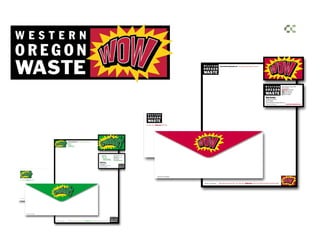
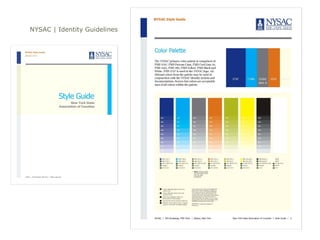
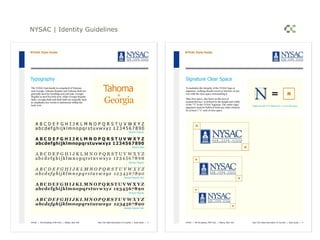
A visual vocabulary ties it together
  • Choose a strong color palette
  • Select typefaces that are distinctive and use
    them consistently
  • Identify the “look and feel” that will stand out
    and create recognition
NYSAC | Identity Guidelines
Communicate


You will see all the messages and
tools, your audience won’t
   • Consistency creates a connection
   • Visually connect all elements, from website to
     mailings to office environment to stationery
     to displays, Emails and brochures…
   • Define messages that are specific and unique
     to you, that tell a story
   • Uncover stories and information to share
     (social media, blog, website, white papers)
A longer sales cycle


Today the buyer is in charge
    • Explosion of information sources (websites,
      blogs, reviews, discussion boards, social)
    • An era of self-serve information
    • Talking to a person is a last resort, not a first
      step
    • B2B – 60% of the purchase decision is made
      before contacting a sales person
    • 2010 – 5.3 sources of information needed,
      2011 – 10.4 sources needed before making a
      buying decision
How to address the focus on information


Be relevant and valuable
    • Help vs. sell, make a customer for life
    • Discover customer needs first – listen,
      research, talk to front line people
    • Integrate offline and online information
    • Provide resources to inform, educate,
      enlighten
Building a brand


      where are
     your contact
       points?
Contacts


Where are the contact points?
  • Where do your target audiences connect with
    you?
  • At what level, for what purpose?
  • How are those contact points branded?
  • Which contacts are critical to the organization,
    the points of choice?
Contact points


Small contacts influence perceptions
•   Reception, how the phone is answered
•   Personal presentation
•   Voice mail message
•   Letter format
•   Fax cover sheet
•   Quality of literature
•   Email format
•   Environment
Contact points


Essential contact points
  • Printed materials—folders, brochures,
    handouts
  • Your website … a primary point of choice
  • Newsletters, magazines and Emails
  • Internal contacts from the handbook to
    employee newsletters
  • Trade shows
  Where do you have the opportunity to present
   your message and engage with your
   audiences?
Contact points


What is a “point of choice”?
  A point of choice is the situation where
 someone will take action, to move to the next
 step in working with you. The point of choice
 is focused on immediate response—taking
 action.
Contact points


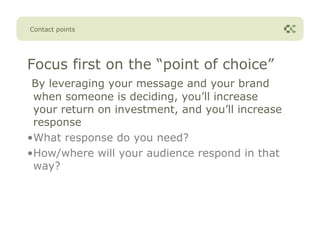
Focus first on the “point of choice”
 By leveraging your message and your brand
 when someone is deciding, you’ll increase
 your return on investment, and you’ll increase
 response
•What response do you need?
•How/where will your audience respond in that
 way?
Worksheet


Define your “points of choice”
Building a brand


            build your
              brand
            message
Brand positioning


The brand positioning
  • Reflects where you fit in the market
  • Separates you from the competition
  • Clarifies key messages for staff and sales
    teams
  • Establishes the foundation and framework for
    ongoing communication
  • Ties together visual and verbal
Brand positioning


The brand positioning …
  Is supported by the brand persona
  •A collection of authentic visual and verbal
  assets, actions and beliefs
  •Your audience recognizes your persona
  through:
         • Colors and images
         • Language and tone
         • Look and feel
         • Quality of interactions
Brand persona


What brand persona is right for your
audience?
  • Is your image what your audience wants,
    expects, will respond to?
  • What’s the “playing field”? What’s expected?
  • How can you go beyond the expected to
    generate recognition and loyalty?
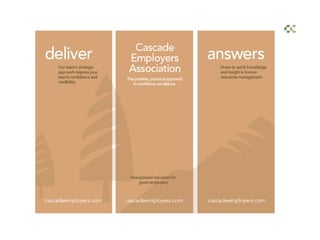
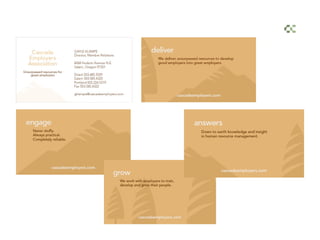
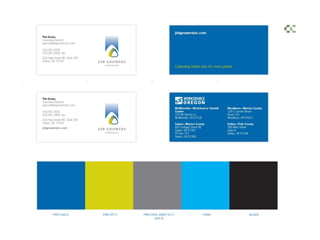
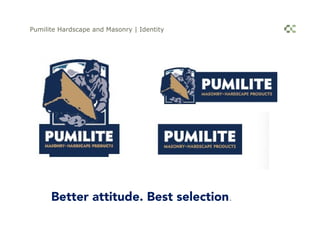
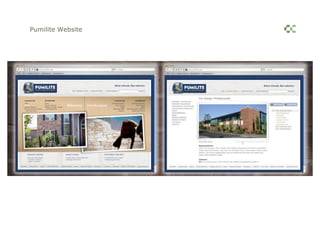
Pumilite Hardscape and Masonry | Identity


      Better attitude. Best selection.
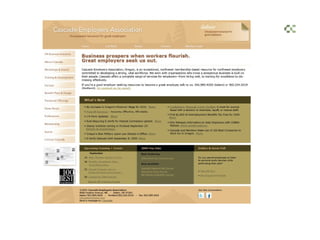
Pumilite Website
Brand persona


Defining your brand persona
  • Supports the strategy and tactics used to
    implement branding
  • Will help you define the communication tools
    you use
  • Reduces the number of options by focusing on
    your audiences and brand
  • Makes each communication more effective
  • You’ll provide what your audience needs to
    connect with you
Build your brand


Understanding your audience’s
 expectations
• Makes each communication more effective
• You’ll provide what your audience needs to
  make a decision
• Each point of contact must build on the others
• Each communication tool and every tactic and
  channel must build the experience
Build your brand


Defining your brand persona
• Directs the visual vocabulary of your brand
• Supports the strategy and tactics you choose
• Will help you select media and define the best
  tools to get results
• Reduces the number of options by focusing on
  your audience, the best contact point and most
  effective medium/tool to communicate your key
  messages
Build your brand


Building your brand
• Will create clarity with internal and external
  audiences
• Builds perceived value
• Generates increased recognition at a lower cost
• Identifies messages that resonate
• Reinforces the “wow!”
• Establishes a stronger presence and clearer
  communications with all audiences
Build your brand


Go forth and market!
•   Brand responsibly
•   Provide value to your audiences
•   Connect where they communicate
•   Build content that builds trust
•   Integrate online and offline
•   Evaluate website, mobile, social media
Questions?


             Jennifer Larsen Morrow

             President
             Creative Company
Give us a call to talk about your brand!


Creative Company, Inc.
726 NE 4th Street
McMinnville, Oregon 97128
503.883.4433
Toll-free 866.363.4433
Creativeco.com
Email to jlmorrow@creativeco.com

Better marketingforbiggersales

  • 1.
    Job Growers andCCBI October 11, 2012 Better marketing = bigger sales
  • 2.
    What we’ll cover • Why should you care about marketing and branding? • What is a brand? • Your target audiences—perception is reality • Generational perspectives and their impact on communications • What should you communicate? Going beyond the “stuff” • What actions do you want to inspire?
  • 3.
    Where are younow? • Where do your customers come from now? • How are you finding and reaching new customers? • What’s your sales process? • What’s working? • What’s not working? • Where are your biggest challenges?
  • 4.
    Better marketing =bigger sales If someone is looking for what you offer, where are they looking?
  • 5.
    Better marketing =bigger sales If they find you, what will they see? Will they understand why they should choose you?
  • 6.
    Better marketing =bigger sales Today B2B buyers contact you only after 60% of the purchase decision is already made.
  • 7.
    What do theywant from you?
  • 8.
    Better marketing =bigger sales A surprise … quick, simple, easy … information… answer my questions … talk to me …WIIFM
  • 9.
  • 10.
    It’s just agarbage truck
  • 11.
    Or it’s aWOW truck!
  • 12.
    Why should Icare? How does this work? I get it!
  • 13.
    What’s in itfor me? Looks easy, simple!
  • 14.
    Make it easyto choose Good information!
  • 15.
    I know whatthey sell …
  • 16.
  • 17.
    Be relevant toyour audience Engage me
  • 18.
    Architects want tosee it and understand …
  • 19.
  • 20.
  • 21.
    Before … oldname, old logo … transformed
  • 22.
    After … visible,consistent, recognized
  • 23.
  • 24.
    Marketing is branding Why branding? Why bother?
  • 25.
    We live inan overwhelmed, time-starved culture packed with too many choices
  • 26.
    Focus your marketing A brand brings focus
  • 27.
  • 28.
    Target audiences Position inyour category Benefits to the audiences Where’s the “wow!”?
  • 29.
    A brand isan asset What is a brand?
  • 30.
    What is abrand? What is a brand? • The name of a product or service • A warranty, trusted concept or essence • A preference in the mind of your audience • An expectation of a certain level of service • Confidence in knowing what to expect • Value in the mind of the audience • A bottom-line asset
  • 31.
    The Starbucks brand Abrand becomes more than a cup of coffee … “let’s get a Starbucks” It’s about the experience, the total of all elements
  • 32.
    The Apple brand Abrand builds an emotional connection … people who share the story … an expectation of a specific kind of interaction and experience
  • 33.
    What is abrand? A brand is more than a logo A brand requires a visual and verbal vocabulary • A distinctive “ look and feel” • A common voice, tone and style • A system of colors and typography • A series of images that build a cohesive whole
  • 34.
    What is abrand? What builds brands? • Brands are being built with or without management • Publicity build brands • Blogs, social media, marketing and websites build brands • Environments build brands • Each contact with the organization builds the brand
  • 35.
    Your marketing mustbe branded Why should you build a brand?
  • 36.
    Too many choices CLARITY There are too many choices for everyone. A strong brand helps you stand out and connect with those you seek to reach
  • 37.
    Create visibility andrecognition VISIBILITY A strong brand system sets you apart and creates recognition
  • 38.
    Add value toall communications “A brand means the difference between VALUE selling a white T-shirt for $10 and selling a A strong brand white T-shirt with a means a higher Nike logo on it for perceived value… $20.” for whatever you Debbie Kennedy have Brand Oregon to offer
  • 39.
    Simplify and streamline SAVINGS A strong brand provides structure and ties communications together so you’re more effective
  • 40.
    Building a brand but we’re not selling to consumers, we’re selling to businesses
  • 41.
    Perception is reality • Your brand is based on what people think about your organization …it’s still • Communicate clearly from the audience’s point of view about people • Provide value to those you serve and communication
  • 42.
    Audiences Perception is reality • Your brand is based on what people think about your organization • To be effective you must communicate clearly from your audience’s point of view • You must create a brand that is visually appealing and communicates the essentials, answers their questions
  • 43.
    Audiences Do you knowyour audiences? • Do you know everyone you need to communicate with? • Do you know what they expect from you? • Do you understand their concerns? • Speak in the their language; be clear and concise (no acronyms!)
  • 44.
    Audiences Business to business • People are still people • Roles might be different, not the final decision maker • Sales process might be longer, more people and information involved • It’s still trust, confidence, relationship
  • 45.
    Brand building Defining your brand character and persona
  • 46.
    Defining your brand Whatpersonality do you want to present? • How do you want to be perceived, known and remembered? • It is this “persona” that will be remembered • It’s the character/personality of your brand communication that will create recognition and attention
  • 47.
    Defining your brand Madeup of the combination of numerous elements • Overall style of the presentation/communication • Details such as • colors, image • language, tone • style and overall quality • Key messages and phrases
  • 48.
    Defining your brand Isyour image what your audience wants, expects, will respond to? • What’s the “playing field”? What’s expected? • You may want to appear as a complex, intelligent and powerful company • Your audience might prefer a simple, folksy persona they can relate to
  • 49.
    Exercises | Definingyour brand A. Think of your brand as a car What brand of car would you be? • Rank your brand on a scale • Consider: image quality, price, distinctiveness • Exercise (Using the car metaphor helps you visualize where you fit.)
  • 50.
    Exercises | Definingyour brand B. Consider your brand as a person Describe that person as they walk towards you • What kind of impression do they project? • What is their appearance? • What is your sense of their capabilities? • What do you believe about them?
  • 51.
  • 52.
    Your audiences Each generation is different
  • 53.
    The Generations Effective marketingrequires first understanding the audiences you’re trying to reach. For the first time in history there are four different generations in the workplace, each with different values, perspectives and expectations
  • 54.
    Target your audiences Consider motivations, lifestyles, attitudes and expectations Different for each generation Select the right method of communication for each generation
  • 55.
    Generations The Silent Generation– 1925 to 1945 • 2005 Census – 63 million, now aged 67 to 87 • Have always done “the right thing” • Reliable and show up for work on time • Looking for a “great adventure” • Second middle age …“now or never” • 45% of age 70 to 74 use the internet • 58% of age 65 to 69 use the internet
  • 56.
    Generations The Boomers –1946 to 1964 • 2005 Census – 78 million, now aged 48 to 66 • The “Me Generation” • Boomers are driving the marketplace • Control 70% of the nations wealth • Want to stay healthy, keep youthful appearance • Career focused • In the midst of intense transitions • Address lifestyle preferences and life stages • Online and connected, 85% of those 50-64 are online
  • 57.
    Generations Gen X –1965 to 1984 • 2005 census – 48 million, now aged 35 to 47 • First generation of latch-key children, learned to rely on themselves • More results-oriented, less process-oriented • Will change jobs more frequently • Savvy and cynical consumers • No brand loyalty, earn confidence every time • Want direct communication • 93% of 30-49 year olds are online
  • 58.
    Generations Gen Y –Born 1985 to 2010 • 2005 Census – 76 million, now aged 12 to 34 • Have honed a “sixth sense” in seeking what’s authentic, don’t want to be “sold” • Always looking for the next “cool” thing • “One of smartest, tech savvy and idealistic generations of our time” • Girls grew up participating in sports, more self-assurance • Multi-tasking is natural • 96% of 18 to 29 are online
  • 59.
    Generations Trends and statistics Smartphonesmean mobile internet access • 83% of U.S. adults have a cell phone of some kind, and 42% of them own a smartphone • 58% between ages of 25 and 34 own a smartphone • 44% of those ages 35-44 • 49% of those ages 18-24 Social media has wide adoption • 55% of Twitter users are 35 or older • 63% of Pinterest users are 35 or older (79% female) • 65% of Facebook users are 35 or older • 79% of LinkedIn users are 35 or older
  • 60.
    Building a brand communicate your value not just what you do
  • 61.
    Features vs. Benefits Youmust be clear about the services or products you’re offering, what are the benefits? How can you frame the benefits to connect with the expectations of each generation? How does each generation prefer to communicate? (reading vs. watching vs. sharing)
  • 62.
    Features vs. Benefits Features: Here’swhat the product does, or what the service is. Descriptive. Benefits: Here’s the outcome, what you audience will receive from the product or service. Often emotional or personal.
  • 63.
    Features vs. benefits They’re not buying a drill They’re buying the hole it makes
  • 64.
    Audiences What is neededand wanted by your audience(s)? • What’s the primary reason each audience wants/needs/uses your products or services? • What do you provide immediately, and over the long-term?
  • 65.
    Define the message Whatvalue do you provide? • Go beyond the “stuff” • Identify ideas, messages that address “why should I care?” or • “What’s in it for me?” (WIIFM) • Where’s the “wow!”?
  • 66.
    Audiences Think about whyinstead of what • Why do they need to connect with you? • What purpose do you serve? • Avoid just listing the “stuff” you do • Consider their perspectives – who are they? How do they communicate or take in information? • What’s the role in the purchase?
  • 67.
    t ’s your Wha mess age? (WII FM )
  • 73.
    Generating response isthe goal Connect with your audiences
  • 74.
    Building your brand Brandbuilding (effective marketing) requires focus • Focus on your audiences and the benefits • Branding requires consistency in message and visuals • You will get tired of it long before your audiences do
  • 75.
    Building your brand Avisual vocabulary ties it together • Choose a strong color palette • Select typefaces that are distinctive and use them consistently • Identify the “look and feel” that will stand out and create recognition
  • 77.
    NYSAC | IdentityGuidelines
  • 78.
    NYSAC | IdentityGuidelines
  • 79.
    Communicate You will seeall the messages and tools, your audience won’t • Consistency creates a connection • Visually connect all elements, from website to mailings to office environment to stationery to displays, Emails and brochures… • Define messages that are specific and unique to you, that tell a story • Uncover stories and information to share (social media, blog, website, white papers)
  • 80.
    A longer salescycle Today the buyer is in charge • Explosion of information sources (websites, blogs, reviews, discussion boards, social) • An era of self-serve information • Talking to a person is a last resort, not a first step • B2B – 60% of the purchase decision is made before contacting a sales person • 2010 – 5.3 sources of information needed, 2011 – 10.4 sources needed before making a buying decision
  • 81.
    How to addressthe focus on information Be relevant and valuable • Help vs. sell, make a customer for life • Discover customer needs first – listen, research, talk to front line people • Integrate offline and online information • Provide resources to inform, educate, enlighten
  • 82.
    Building a brand where are your contact points?
  • 83.
    Contacts Where are thecontact points? • Where do your target audiences connect with you? • At what level, for what purpose? • How are those contact points branded? • Which contacts are critical to the organization, the points of choice?
  • 84.
    Contact points Small contactsinfluence perceptions • Reception, how the phone is answered • Personal presentation • Voice mail message • Letter format • Fax cover sheet • Quality of literature • Email format • Environment
  • 85.
    Contact points Essential contactpoints • Printed materials—folders, brochures, handouts • Your website … a primary point of choice • Newsletters, magazines and Emails • Internal contacts from the handbook to employee newsletters • Trade shows Where do you have the opportunity to present your message and engage with your audiences?
  • 86.
    Contact points What isa “point of choice”? A point of choice is the situation where someone will take action, to move to the next step in working with you. The point of choice is focused on immediate response—taking action.
  • 87.
    Contact points Focus firston the “point of choice” By leveraging your message and your brand when someone is deciding, you’ll increase your return on investment, and you’ll increase response •What response do you need? •How/where will your audience respond in that way?
  • 88.
  • 89.
    Building a brand build your brand message
  • 95.
    Brand positioning The brandpositioning • Reflects where you fit in the market • Separates you from the competition • Clarifies key messages for staff and sales teams • Establishes the foundation and framework for ongoing communication • Ties together visual and verbal
  • 96.
    Brand positioning The brandpositioning … Is supported by the brand persona •A collection of authentic visual and verbal assets, actions and beliefs •Your audience recognizes your persona through: • Colors and images • Language and tone • Look and feel • Quality of interactions
  • 97.
    Brand persona What brandpersona is right for your audience? • Is your image what your audience wants, expects, will respond to? • What’s the “playing field”? What’s expected? • How can you go beyond the expected to generate recognition and loyalty?
  • 98.
    Pumilite Hardscape andMasonry | Identity Better attitude. Best selection.
  • 99.
  • 100.
    Brand persona Defining yourbrand persona • Supports the strategy and tactics used to implement branding • Will help you define the communication tools you use • Reduces the number of options by focusing on your audiences and brand • Makes each communication more effective • You’ll provide what your audience needs to connect with you
  • 101.
    Build your brand Understandingyour audience’s expectations • Makes each communication more effective • You’ll provide what your audience needs to make a decision • Each point of contact must build on the others • Each communication tool and every tactic and channel must build the experience
  • 102.
    Build your brand Definingyour brand persona • Directs the visual vocabulary of your brand • Supports the strategy and tactics you choose • Will help you select media and define the best tools to get results • Reduces the number of options by focusing on your audience, the best contact point and most effective medium/tool to communicate your key messages
  • 103.
    Build your brand Buildingyour brand • Will create clarity with internal and external audiences • Builds perceived value • Generates increased recognition at a lower cost • Identifies messages that resonate • Reinforces the “wow!” • Establishes a stronger presence and clearer communications with all audiences
  • 104.
    Build your brand Goforth and market! • Brand responsibly • Provide value to your audiences • Connect where they communicate • Build content that builds trust • Integrate online and offline • Evaluate website, mobile, social media
  • 105.
    Questions? Jennifer Larsen Morrow President Creative Company
  • 106.
    Give us acall to talk about your brand! Creative Company, Inc. 726 NE 4th Street McMinnville, Oregon 97128 503.883.4433 Toll-free 866.363.4433 Creativeco.com Email to jlmorrow@creativeco.com

Editor's Notes

  • #2 Creative Company BrandACT® 09 Creative Company BrandACT® 09
  • #3 Creative Company BrandACT® 09
  • #4 Creative Company BrandACT® 09
  • #5 Creative Company BrandACT® 09
  • #6 Creative Company BrandACT® 09
  • #7 Creative Company BrandACT® 09
  • #8 Creative Company BrandACT® 09
  • #9 Creative Company BrandACT® 09
  • #10 Creative Company BrandACT® 09
  • #11 Creative Company BrandACT® 09
  • #12 Creative Company BrandACT® 09
  • #13 Creative Company BrandACT® 09
  • #14 Creative Company BrandACT® 09
  • #15 Creative Company BrandACT® 09
  • #16 Creative Company BrandACT® 09
  • #17 Creative Company BrandACT® 09
  • #18 Creative Company BrandACT® 09
  • #19 Creative Company BrandACT® 09
  • #20 Creative Company BrandACT® 09
  • #21 Creative Company BrandACT® 09
  • #22 Creative Company BrandACT® 09
  • #23 Creative Company BrandACT® 09
  • #24 Creative Company BrandACT® 09
  • #25 Creative Company BrandACT® 09
  • #26 Creative Company BrandACT® 09
  • #27 Creative Company BrandACT® 09
  • #28 Creative Company BrandACT® 09
  • #29 Creative Company BrandACT® 09
  • #30 Creative Company BrandACT® 09
  • #31 Creative Company BrandACT® 09
  • #32 Creative Company BrandACT® 09
  • #33 Creative Company BrandACT® 09
  • #34 Creative Company BrandACT® 09
  • #35 Creative Company BrandACT® 09
  • #36 Creative Company BrandACT® 09
  • #37 Creative Company BrandACT® 09
  • #38 Creative Company BrandACT® 09
  • #39 Creative Company BrandACT® 09
  • #40 Creative Company BrandACT® 09
  • #41 Creative Company BrandACT® 09
  • #42 Creative Company BrandACT® 09
  • #43 Creative Company BrandACT® 09
  • #44 Creative Company BrandACT® 09
  • #45 Creative Company BrandACT® 09
  • #46 Creative Company 8 December 2007
  • #47 Creative Company 8 December 2007
  • #48 Creative Company 8 December 2007
  • #49 Creative Company 8 December 2007
  • #50 Creative Company 8 December 2007
  • #51 Creative Company 8 December 2007
  • #52 Creative Company 8 December 2007
  • #53 Creative Company BrandACT® 09
  • #54 Creative Company 8 December 2007
  • #55 Creative Company 8 December 2007
  • #56 Creative Company BrandACT® 09
  • #57 Creative Company BrandACT® 09
  • #58 Creative Company BrandACT® 09
  • #59 Creative Company BrandACT® 09
  • #60 Creative Company BrandACT® 09
  • #61 Creative Company BrandACT® 09
  • #62 Creative Company 8 December 2007
  • #63 Creative Company 8 December 2007
  • #64 Creative Company BrandACT® 09
  • #65 Creative Company BrandACT® 09
  • #66 Creative Company BrandACT® 09
  • #67 Creative Company BrandACT® 09
  • #68 Creative Company BrandACT® 09
  • #69 Creative Company BrandACT® 09
  • #70 Creative Company BrandACT® 09
  • #71 Creative Company BrandACT® 09
  • #72 Creative Company BrandACT® 09
  • #73 Creative Company BrandACT® 09
  • #74 Creative Company BrandACT® 09
  • #75 Creative Company BrandACT® 09
  • #76 Creative Company BrandACT® 09
  • #77 Creative Company BrandACT® 09
  • #78 Creative Company BrandACT® 09
  • #79 Creative Company BrandACT® 09
  • #80 Creative Company BrandACT® 09
  • #81 Creative Company BrandACT® 09
  • #82 Creative Company BrandACT® 09
  • #83 Creative Company BrandACT® 09
  • #84 Creative Company BrandACT® 09
  • #85 Creative Company BrandACT® 09
  • #86 Creative Company BrandACT® 09
  • #90 Creative Company BrandACT® 09
  • #91 Creative Company BrandACT® 09
  • #92 Creative Company BrandACT® 09
  • #93 Creative Company BrandACT® 09
  • #94 Creative Company BrandACT® 09
  • #95 Creative Company BrandACT® 09
  • #96 Creative Company BrandACT® 09
  • #97 Creative Company BrandACT® 09
  • #98 Creative Company BrandACT® 09
  • #99 Creative Company BrandACT® 09
  • #100 Creative Company BrandACT® 09
  • #101 Creative Company BrandACT® 09
  • #102 Creative Company BrandACT® 09
  • #103 Creative Company BrandACT® 09
  • #104 Creative Company BrandACT® 09
  • #105 Creative Company BrandACT® 09
  • #107 Creative Company BrandACT® 09