Concept 1. August 13, 2012
Intro
I developed this tool for a project I was working on. If you can use it, please feel free to do so. I
suspect the model will work well for positioning a few brands (including competitive) in a
given segment but will be difficult for complex brand structures.
The critical success factor is developing and measuring the correct dimensions to map. The
dimensions in the example were specific to automotive aftermarket. You will need to create
your own. I would also include loyalty.
Slide 6 is the brand values Map – I had created this template a while back, (borrowing heavily
from Dr. David Aaker) but in the positioning project wanted to ensure alignment so I
measured along the four quadrants; brand as product, person, organization and symbol.
Finally, let me know if you have questions or have ideas to improve the model. I can be reached via
email at uechido@gmail.com
Background
The toolkit is designed to…
1. Map the value dimensions of current brands
2.Identify position (and possible overlap of all brands in
a portfolio)
3. Map the “Ideal Vector” for a target market
4.Identify brand fit and gaps with target market
5.Identify the need for brand extension, reposition or
new brand
6.Identify key competitors’ brand fit
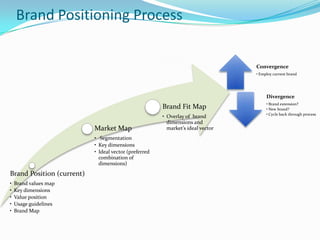
Brand Positioning Process
Brand Position (current)
• Brand values map
• Key dimensions
• Value position
• Usage guidelines
• Brand Map
Market Map
• Segmentation
• Key dimensions
• Ideal vector (preferred
combination of
dimensions)
Brand Fit Map
• Overlay of brand
dimensions and
market’s ideal vector
Convergence
• Employ current brand
Divergence
• Brand extension?
• New brand?
• Cycle back through process
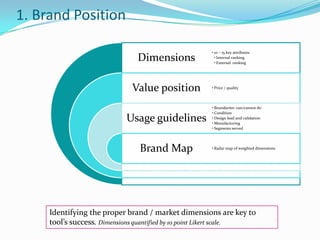
1. Brand Position
Dimensions
Value position
Usage guidelines
Brand Map
• 10 – 15 key attributes
• Internal ranking
• External ranking
• Price / quality
• Boundaries- can/cannot do
• Condition
• Design lead and validation
• Manufacturing
• Segments served
• Radar map of weighted dimensions
Identifying the proper brand / market dimensions are key to
tool’s success. Dimensions quantified by 10 point Likert scale.
Efficient
Brand as
Product
Reliable
Brand as
Organization
Brand as
Person
Brand as
Symbol
Bold
Sample Values Map (Aaker-Monda Model)
DNA and Core Strengths are Immutable!
Endurance
Integrity
Execution
Simplicity
DNAPowerful Relationships
Values Map is the Compass for All Initiatives
Power density
Believable
brand equity Efficiency focused
engineering
Continually
delivering on
100 yr heritage
Durability
Right product, time and
value
Solutions
provider
Strict cost
containment
Process driven No frills
Instills confidence
Practical
Do what we
say, say what
we do
Leader
(market and innovation)
Win-win relationships
Intelligent
service
Transparent
Quality
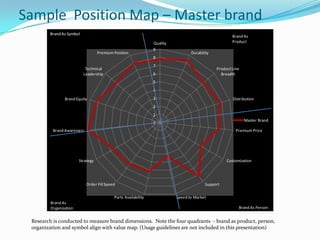
Sample Position Map – Master brand
Research is conducted to measure brand dimensions. Note the four quadrants - brand as product, person,
organization and symbol align with value map. (Usage guidelines are not included in this presentation)
0
1
2
3
4
5
6
7
8
9
Quality
Durability
ProductLine
Breadth
Distribution
Premium Price
Customization
Support
Speed to MarketParts Availability
Order Fill Speed
Strategy
Brand Awareness
Brand Equity
Technical
Leadership
Premium Position
Master Brand
Brand As Symbol
Brand As
Organization Brand As Person
Brand As Symbol
Brand As
Product
2. Target Market Mapping
Segmentation
Dimensions
Ideal vector
map
• Market identification
• 10 – 15 key attributes (same as
brand)
• Internal ranking
• External ranking
• Radar map plotting weighted
dimensions (market needs)
Ideal Market Vector
Once again, research is conducted to measure the ideal market vector for the target market.
0
1
2
3
4
5
6
7
8
Quality
Durability
ProductLine
Breadth
Distribution
Premium Price
Customization
Support
Speed to MarketParts Availability
Order Fill Speed
Strategy
Brand Awareness
Brand Equity
Technical
Leadership
Premium Position
Ideal Market Vector
Brand AsBrand As Symbol
Brand As
Organization Brand As Person
Master Brand / Ideal Market Fit
The position map indicates convergence; it is not necessary to create a new brand. There is general alignment
between the market and the master brand. The good news is that the customers’ acquisition price is a fit but the
master brand will need to become more flexible and responsive in speed to market and in in other service areas.
0
1
2
3
4
5
6
7
8
9
Quality
Durability
ProductLine
Breadth
Distribution
Premium Price
Customization
Support
Speed to MarketParts Availability
Order Fill Speed
Strategy
Brand Awareness
Brand Equity
Technical
Leadership
Premium Position
Master Brand
Ideal Market Vector
Brand AsBrand As Symbol
Brand As
Organization Brand As Person
Competitor overlay
In this example the competitor presents a price challenge, and exhibits general fit to the market’s ideal vector . The
master brand will need emphasize differentiation in brand as product (quality, durability) and brand as person
(support) quadrants, capitalizing on the position gaps.
0
1
2
3
4
5
6
7
8
9
Quality
Durability
ProductLine
Breadth
Distribution
Premium Price
Customization
Support
Speed to MarketParts Availability
Order Fill Speed
Strategy
Brand Awareness
Brand Equity
Technical
Leadership
Premium Position
Master Brand
Comp. 1
Ideal Market Vector
Brand As ProductBrand As Symbol
Brand As
Organization Brand As Person

Brand Positioning Model

  • 1.
  • 2.
    Intro I developed thistool for a project I was working on. If you can use it, please feel free to do so. I suspect the model will work well for positioning a few brands (including competitive) in a given segment but will be difficult for complex brand structures. The critical success factor is developing and measuring the correct dimensions to map. The dimensions in the example were specific to automotive aftermarket. You will need to create your own. I would also include loyalty. Slide 6 is the brand values Map – I had created this template a while back, (borrowing heavily from Dr. David Aaker) but in the positioning project wanted to ensure alignment so I measured along the four quadrants; brand as product, person, organization and symbol. Finally, let me know if you have questions or have ideas to improve the model. I can be reached via email at uechido@gmail.com
  • 3.
    Background The toolkit isdesigned to… 1. Map the value dimensions of current brands 2.Identify position (and possible overlap of all brands in a portfolio) 3. Map the “Ideal Vector” for a target market 4.Identify brand fit and gaps with target market 5.Identify the need for brand extension, reposition or new brand 6.Identify key competitors’ brand fit
  • 4.
    Brand Positioning Process BrandPosition (current) • Brand values map • Key dimensions • Value position • Usage guidelines • Brand Map Market Map • Segmentation • Key dimensions • Ideal vector (preferred combination of dimensions) Brand Fit Map • Overlay of brand dimensions and market’s ideal vector Convergence • Employ current brand Divergence • Brand extension? • New brand? • Cycle back through process
  • 5.
    1. Brand Position Dimensions Valueposition Usage guidelines Brand Map • 10 – 15 key attributes • Internal ranking • External ranking • Price / quality • Boundaries- can/cannot do • Condition • Design lead and validation • Manufacturing • Segments served • Radar map of weighted dimensions Identifying the proper brand / market dimensions are key to tool’s success. Dimensions quantified by 10 point Likert scale.
  • 6.
    Efficient Brand as Product Reliable Brand as Organization Brandas Person Brand as Symbol Bold Sample Values Map (Aaker-Monda Model) DNA and Core Strengths are Immutable! Endurance Integrity Execution Simplicity DNAPowerful Relationships Values Map is the Compass for All Initiatives Power density Believable brand equity Efficiency focused engineering Continually delivering on 100 yr heritage Durability Right product, time and value Solutions provider Strict cost containment Process driven No frills Instills confidence Practical Do what we say, say what we do Leader (market and innovation) Win-win relationships Intelligent service Transparent Quality
  • 7.
    Sample Position Map– Master brand Research is conducted to measure brand dimensions. Note the four quadrants - brand as product, person, organization and symbol align with value map. (Usage guidelines are not included in this presentation) 0 1 2 3 4 5 6 7 8 9 Quality Durability ProductLine Breadth Distribution Premium Price Customization Support Speed to MarketParts Availability Order Fill Speed Strategy Brand Awareness Brand Equity Technical Leadership Premium Position Master Brand Brand As Symbol Brand As Organization Brand As Person Brand As Symbol Brand As Product
  • 8.
    2. Target MarketMapping Segmentation Dimensions Ideal vector map • Market identification • 10 – 15 key attributes (same as brand) • Internal ranking • External ranking • Radar map plotting weighted dimensions (market needs)
  • 9.
    Ideal Market Vector Onceagain, research is conducted to measure the ideal market vector for the target market. 0 1 2 3 4 5 6 7 8 Quality Durability ProductLine Breadth Distribution Premium Price Customization Support Speed to MarketParts Availability Order Fill Speed Strategy Brand Awareness Brand Equity Technical Leadership Premium Position Ideal Market Vector Brand AsBrand As Symbol Brand As Organization Brand As Person
  • 10.
    Master Brand /Ideal Market Fit The position map indicates convergence; it is not necessary to create a new brand. There is general alignment between the market and the master brand. The good news is that the customers’ acquisition price is a fit but the master brand will need to become more flexible and responsive in speed to market and in in other service areas. 0 1 2 3 4 5 6 7 8 9 Quality Durability ProductLine Breadth Distribution Premium Price Customization Support Speed to MarketParts Availability Order Fill Speed Strategy Brand Awareness Brand Equity Technical Leadership Premium Position Master Brand Ideal Market Vector Brand AsBrand As Symbol Brand As Organization Brand As Person
  • 11.
    Competitor overlay In thisexample the competitor presents a price challenge, and exhibits general fit to the market’s ideal vector . The master brand will need emphasize differentiation in brand as product (quality, durability) and brand as person (support) quadrants, capitalizing on the position gaps. 0 1 2 3 4 5 6 7 8 9 Quality Durability ProductLine Breadth Distribution Premium Price Customization Support Speed to MarketParts Availability Order Fill Speed Strategy Brand Awareness Brand Equity Technical Leadership Premium Position Master Brand Comp. 1 Ideal Market Vector Brand As ProductBrand As Symbol Brand As Organization Brand As Person