Marketing 
The Domain of Marketing
What is Marketing? 
• Marketing is the social process by which 
individuals and groups obtain what they need 
and want through creating and exchanging 
products and value with others. Kotler 
• The right product, in the right place, at the 
right time, at the right price .
What is Marketing? 
American Marketing Association : 
Marketing is an organizational function & a set 
of processes for creating ,communicating & 
delivering value to customers and managing 
customer relationships in ways that benefit the 
organization & its stakeholders.
What is Marketing ? …. 
It is a process by which 
-one identifies the needs and wants of the people. 
-one determines and creates a product/service to meet the needs 
and wants. [PRODUCT] 
-one determines a way of taking the product/service to the market 
place. [PLACE] 
-one determines the way of communicating the product to the 
market place. [PROMOTIONS] 
-one determines the value for the product.[PRICE]. 
-one determines the people, who have needs/ wants. [PEOPLE] 
and then creating a transaction for exchanging the product for 
a value. 
and thus creating a satisfaction to the buyer's needs/wants.
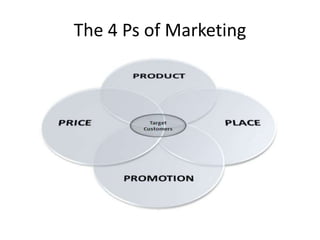
The 4 Ps of Marketing
For an exchange to occur….. 
• There are at least two parties. 
• Each party has something that might be of value 
to the other party. 
• Each party is capable of communication and 
delivery. 
• Each party is free to reject the exchange offer. 
• Each party believes it is appropriate or desirable 
to deal with the other party. 
1-6
What is Marketing Management? 
Marketing management is the 
art and science 
of choosing target markets 
and getting, keeping, and growing 
customers through 
creating, delivering, and communicating 
superior customer value. 
1-7
What gets Marketed ? Or the scope of 
marketing 
• Goods- Physical goods like , cars , trucks , TV, 
watches etc 
• Services – Air line , hotels , car rentals etc 
• Events – Olympics, world cup ect 
• Experiences – water parks , amusements etc 
• Celebrity marketing 
• Places – cities , regions , countries etc – tourism , 
factories , residences , head quarters etc
What gets Marketed ? 
• Properties – real estate & investments like 
stocks , marketed by estate agents & 
banks(investment companies ) respectively 
• Organizations – purposes of Corporate 
building
Demand States 
1-10 
• Negative 
• Nonexistent 
• Latent 
• Declining 
• Irregular 
• Unwholesome 
• Full 
• Overfull
What’s a ‘Market’ 
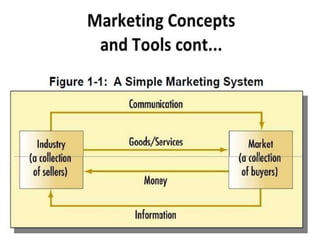
• A set up where two or more parties engage in 
exchange of goods, services and information is 
called a market. Ideally a market is a place where 
two or more parties are involved in buying and 
selling. 
• The two parties involved in a transaction are 
called seller and buyer. 
• The seller sells goods and services to the buyer in 
exchange of money. There has to be more than 
one buyer and seller for the market to be 
competitive.
What’s a ‘Market’ 
• Physical Markets - Physical market is a set up where buyers can physically 
meet the sellers and purchase the desired merchandise from them in 
exchange of money. Shopping malls, department stores, retail stores are 
examples of physical markets. 
• Non Physical Markets/Virtual markets - In such markets, buyers purchase 
goods and services through internet. In such a market the buyers and 
sellers do not meet or interact physically, instead the transaction is done 
through internet. Examples - Rediff shopping, eBay etc. 
• Auction Market - In an auction market the seller sells his goods to one 
who is the highest bidder. 
• Market for Intermediate Goods - Such markets sell raw materials (goods) 
required for the final production of other goods. Commodity Market. 
• Financial Market - Market dealing with the exchange of liquid assets 
(money) is called a financial market. Stock market , bond market , foreign 
exchange market etc.
Key Markets- the decisions marketers 
make 
• Consumer Markets – establish brand image 
• Business Markets – establish corporate image 
& identity 
• Global Markets – how to enter , how to adapt 
products & services , how to adapt 
communication 
• Non- profit & governmental markets – 
universities , churches , Ngos etc
concept of Meta-markets 
• Two or more distinct markets that are associated in some 
way to a product or service. 
• For example, the meta-market 
for house cleaning products includes homeowners 
and domestic cleaning service companies. 
Meta market is a place, where everything connected with a 
certain market can be found. Let’s say a car selling meta 
market would be a website, that sells cars but you will also 
find car parts there, add-ons for cars, colors for cars, 
mechanics reviews and many more.
concept of Meta-markets 
• Meta Market can be a web-based market centered 
around an event or an industry, rather than a single 
product. These are markets of complementary 
products that are closely related in the minds of 
consumers, but spread across different industries. 
• The web allows us to match producers' desire for 
economies of scale, and consumers' desire for variety 
of choice to satisfy a set of needs. 
• Thus we can have a meta market for a wedding (event) 
that includes honeymoon recommendations, sources 
for engagement rings and wedding gowns.
New Marketing Realities – The Major 
Societal Forces- The marketplace isn’t 
what it used to be….
New Marketing Realities – The Major Societal Forces- 
The marketplace isn’t what it used to be…. 
1-17 
• Changing technology 
• Globalization 
• Deregulation 
• Privatization 
• Outsoursing 
• Customer Resistance 
• Retail transformation 
• Heightened Competition 
– resulting in high 
production costs & 
shrinking profit margins 
• Empowerment 
• Customization 
• Convergence- Industrial 
boundaries are blurring at 
an incredibly rapid rate as 
companies recognize that 
opportunities lie at the 
intersection of two or 
more industries. 
• Disintermediation- classic 
egs.- Amazon, E-bay , Aol 
etc .
Explanation of Convergence ( previous 
slide ) 
• Convergence- Industrial boundaries are blurring 
at an incredibly rapid rate as companies recognize 
that opportunities lie at the intersection of two or 
more industries. 
The computing & the electronic industries are 
converging as the giants of the computer world 
such as Dell , Gateway , HP released a stream of 
entertainment devices – from MP3 players to 
Plasma TVs and camcorders. 
The shift to digital technology is fuelling this 
massive convergence .
Explanation of Retail transformation ( 
previous slide ) 
• The power of the Giant Retailers and the so called 
“Category Killers”. 
• The store retailers face competition from 
catalogue houses , direct mail firms , newspapers 
, magazines , D.T.H operators , home shopping 
and so on. 
• In response , entrepreneurial retailers are 
building entertainment in their stores with coffee 
bars , demonstrations etc. with the objective of 
‘marketing an experience rather than a product 
assortment ‘
Company Orientations 
• Production 
• Product 
• Selling 
• Marketing 
• Societal ( elaborated in the next slide) 
• Relational 
1-20
Company Orientations 
• Societal orientation : 
Are companies that successfully satisfy 
consumer wants necessarily acting in the best, 
long-run interests of consumers and society? 
The marketing concept sidesteps the potential 
conflicts among consumer wants, consumer 
interests, and long-run societal welfare.
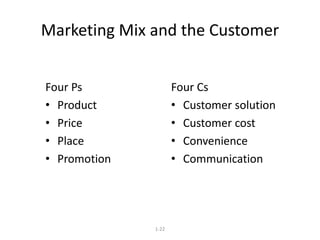
Marketing Mix and the Customer 
1-22 
Four Ps 
• Product 
• Price 
• Place 
• Promotion 
Four Cs 
• Customer solution 
• Customer cost 
• Convenience 
• Communication
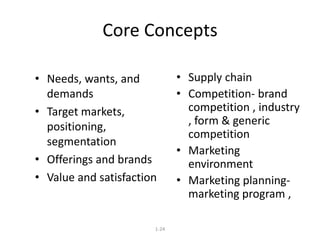
Core Concepts 
• Needs, wants, and 
demands 
• Target markets, 
positioning, 
segmentation 
• Offerings and brands 
• Value and satisfaction 
1-24 
• Supply chain 
• Competition- brand 
competition , industry 
, form & generic 
competition 
• Marketing 
environment 
• Marketing planning-marketing 
program ,
Core Concepts 
• Marketing-mix 
• Relationship Marketing 
• Relationship networks 
• Marketing network 
• Marketing Channels
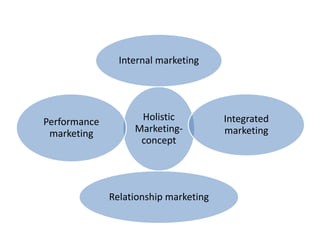
Internal marketing 
Holistic 
Marketing-concept 
Integrated 
marketing 
Relationship marketing 
Performance 
marketing
Marketing Management Tasks 
• Developing marketing 
strategies 
• Capturing marketing 
insights 
• Connecting with 
customers 
• Building strong brands 
1-27 
• Shaping market 
offerings 
• Delivering value 
• Communicating 
value 
• Creating long-term 
growth
1-28 
I want it, I need it….. 
5 Types of Needs 
• Stated needs 
• Real needs 
• Unstated needs 
• Delight needs 
• Secret needs
MARKETING MANAGEMENT 
The Marketing Management Process consists of 
analyzing market opportunities, researching and 
selecting target markets, developing marketing 
strategies, planning marketing tactics, and 
implementing and controlling the marketing 
effort
Market Potential & Market share 
Market Potential: the economic opportunity available to you 
in any geographic market 
Market Share: Market share is the percentage of a market 
(defined in terms of either units or revenue) accounted for by 
a specific entity. 
Marketers need to be able to translate sales targets into 
market share because this will demonstrate whether forecasts 
are to be attained by growing with the market or by capturing 
share from competitors. The latter will almost always be more 
difficult to achieve. Market share is closely monitored for signs 
of change in the competitive landscape, and it frequently 
drives strategic or tactical action.
BUSINESS ENVIRONMENT
BUSINESS ENVIRONMENT 
Business Environment : consists of 
all those factors that have a bearing on 
the business. Business decisions are 
therefore based on environmental 
factors.
BUSINESS ENVIRONMENT 
An organization must have a strategy to achieve 
its missions/objectives/goals. 
A strategy is also defined as establishing a firm-environment- 
fit
Levels Of Environment 
A. INTERNAL ENVIRONMENT 
A. EXTERNAL ENVIRONMENT
INTERNAL ENVIRONMENT 
It’s the internal factors that affect business. 
The internal factors are generally regarded as 
Controllable Factors because the company has 
control over these factors. It can alter or modify 
such factors. 
Example: facilities , personnel , organizational and 
functional means such as marketing-mix etc.
INTERNAL ENVIRONMENT- internal 
factors 
• VALUE SYSTEMS : The value systems of the 
people in the top has an important bearing on 
missions, objectives , policies etc . Eg. Mr. J.R.D. 
Tata .. Social responsibility towards consumers , 
employees , stakeholders. 
• MISSION & OBJECTIVES : The business domain , 
priorities , direction of development , philosophy 
are guided by the mission & objectives. Eg. Tata's 
decided to go transnational
…INTERNAL ENVIRONMENT- internal 
factors 
• MANAGEMENT STRUCTURE & NATURE : Eg the 
composition of the board, extent of professionalization 
of management 
• INTERNAL POWER RELATIONSHIP: the support the top 
management enjoys from shareholders , employees 
etc. 
• HUMAN RESOURCES: the characteristics of recourses 
like skills , quality etc 
• COMPANY IMAGE & BRAND EQUITY: the image of the 
company matters while raising finance , forming joint 
ventures, launching new products etc
…INTERNAL ENVIRONMENT- internal 
factors 
• OTHER FACTORS : 
1. Physical assets 
2. R&D & technological capacities 
3. Marking Resources : Quality of the marketing 
team , distribution which has a direct impact on 
marketing etc 
4. Financial Factors : financial policies , capital 
structure etc
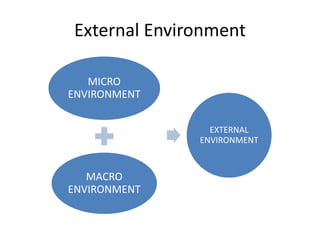
External Environment 
MICRO 
ENVIRONMENT 
MACRO 
ENVIRONMENT 
EXTERNAL 
ENVIRONMENT
MICRO ENVIRONMENT 
The micro environment consists of the actors in 
the company’s immediate environment. 
These are more closely linked to the company. 
They are : 
• Suppliers : The importance of a reliable & 
smooth supply of raw- materials is essential. 
Importance is therefore given to vendor 
development . Change in Supplier’s attitude 
will have an impact on business
…MICRO ENVIRONMENT 
• Customers : the task of business is to create & sustain 
customers. A business exits because of customers. 
Customers( including Indian customers) are going global in 
their shopping. 
• Competitors: not just the other firms who make similar 
products but also those who compete for discretionary 
income.(pocket share) 
• Marketing Intermediaries : the firms that aid the company 
in selling, promoting ad distributing to final consumers 
• Publics: A public is any group that has an actual or 
potential interest in or impact on an organizations ability to 
achieve its goals. They can have a positive &/or a negative 
impact. Eg. Media publics ,local publics , citizens forum etc.
MACRO ENVIRONMENT 
They are the larger forces that shape 
opportunities and/or pose threats to the 
company . 
They are more uncontrollable than the micro 
forces. The success depends on the company’s 
adaptability to the environment . 
Eg. If the cost of imports increase due to an 
increase in import duty , the solution could be 
domestic production
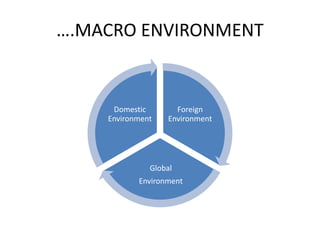
….MACRO ENVIRONMENT 
Foreign 
Environment 
Domestic 
Environment 
Global 
Environment
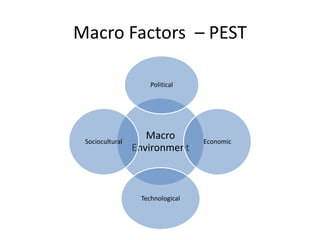
Macro Factors – PEST 
Political 
Macro 
Environment 
Economic 
Technological 
Sociocultural
Political Factors. 
The political arena has a huge influence upon the regulation 
of businesses, and the spending power of consumers and 
other businesses. You must consider issues such as: 
• 1.How stable is the political environment? 
• 2.Will government policy influence laws that regulate or tax 
your business? 
• 3.What is the government's position on marketing ethics? 
• 4. What is the government's policy on the economy? 
• 5. Does the government have a view on culture and 
religion? 
• 6. Is the government involved in trading agreements such 
as EU, NAFTA, ASEAN, or others?
Economic Factors. 
Marketers need to consider the state of a 
trading economy in the short and long-terms. 
This is especially true when planning for 
international marketing. You need to look at: 
• 1. Interest rates. 
• 2. The level of inflation Employment level per 
capita. 
• 3. Long-term prospects for the economy Gross 
Domestic Product (GDP) per capita, and so on
Sociocultural Factors. 
The social and cultural influences on business vary from country to 
country. It is very important that such factors are considered. 
Factors include: 
• 1.What is the dominant religion? 
• 2.What are attitudes to foreign products and services? 
• 3.Does language impact upon the diffusion of products onto 
markets? 
• 4.How much time do consumers have for leisure? 
• 5.What are the roles of men and women within society? 
• 6.How long are the population living? Are the older generations 
wealthy? 
• 7.Do the population have a strong/weak opinion on green issues?
Technological Factors. 
Technology is vital for competitive advantage, and is a major 
driver of globalization. Consider the following points: 
• 1. Does technology allow for products and services to be 
made more cheaply and to a better standard of quality? 
• 2.Do the technologies offer consumers and businesses 
more innovative products and services such as Internet 
banking, new generation mobile telephones, etc? 
• 3.How is distribution changed by new technologies e.g. 
books via the Internet, flight tickets, auctions, etc? 
• 4.Does technology offer companies a new way to 
communicate with consumers e.g. banners, Customer 
Relationship Management (CRM), etc?
Consumer Behavior
What Influences Consumer Behavior? 
Consumer Characteristics are shaped by - 
• Cultural factors 
• Social factors 
• Personal factors 
6-50
Culture 
The fundamental determinant of 
a person’s wants and behaviors 
acquired through socialization 
processes with family 
and other key institutions. 
6-51
Subcultures 
6-52 
• Nationalities 
• Religions 
• Racial groups 
• Geographic regions
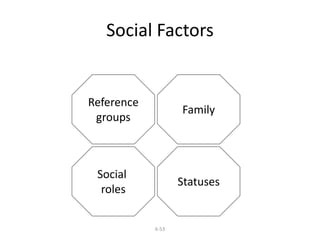
Social Factors 
6-53 
Reference 
groups 
Social 
roles 
Family 
Statuses
Reference Groups 
All those groups that have a direct or indirect influence 
• Membership- have a direct impact ( sanstha, religious 
6-54 
club etc 
• Primary- strong interactions like family , friends , 
neighbor . 
• Secondary- professional , trade unions or religious etc 
• Aspirational- those that people hope to join 
• Dissociative- all those that individuals reject
Family 
6-55 
• Family of Orientation 
– Religion 
– Politics 
– Economics 
• Family of Procreation 
– Everyday buying behavior
Personal Factors 
6-56 
• Age 
• Life cycle stage 
• Occupation 
• Wealth 
• Personality 
• Values 
• Lifestyle 
• Self-concept
Brand Personality 
It is believed that people choose those brands , 
whose personality & closest to their own . 
• Sincerity- down to earth , honest , wholesome & 
cheerful 
• Excitement- daring , spirited , imaginative & up-to- 
6-57 
date 
• Competence- reliable , intelligent & successful 
• Sophistication-upper class, charming 
• Ruggedness - tough & outdoorsy
Consumer Psychology 
• Motivation- the driving force 
• Perception- consumers impression 
• Learning- the study on the brand 
• Memory- retention 
6-58
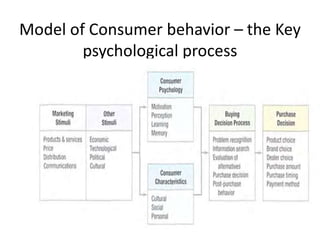
Model of Consumer behavior – the Key 
psychological process
Motivation- pg.155 
• Maslow’s hierarchy of needs 
• Herzberg’s two-factor theory 
6-60
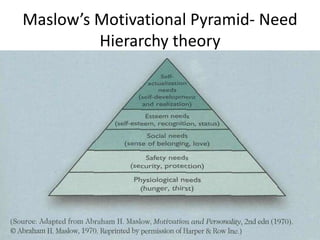
Maslow’s Motivational Pyramid- Need 
Hierarchy theory
Perception 
• Perception is the process by which we select, 
organize ,and interpret information inputs to 
create a meaningful picture
Perception 
• Selective attention- due to bombardment of 
communication 
• Selective retention- retain information that supports 
our attitudes & beliefs- things that we like & of that 
brads that appeal to us etc 
• Selective distortion- interpretation that fits pre-conceptions. 
Consumers distort information to be 
consistent with prior brand beliefs & expectations. 
Blind taste tests… 
• Subliminal perception - covert , embedded messages 
in ads & packages that has a sub conscious effect. 
Although this is not a proven fact . 
6-63
Perception 
Some Facts on Selective attention : 
 People are likely to notice stimuli that relate 
to a current need 
 People are likely to notice stimuli they 
anticipate 
 People are more likely to notice stimuli whose 
deviation are large as compared to normal size 
of stimuli
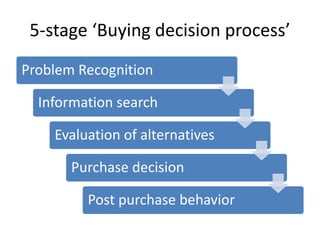
5-stage ‘Buying decision process’ 
Problem Recognition 
Information search 
Evaluation of alternatives 
Purchase decision 
Post purchase behavior
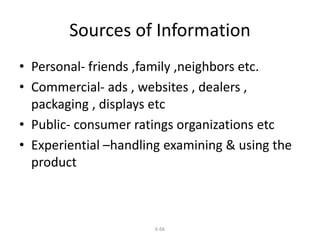
Sources of Information 
• Personal- friends ,family ,neighbors etc. 
• Commercial- ads , websites , dealers , 
packaging , displays etc 
• Public- consumer ratings organizations etc 
• Experiential –handling examining & using the 
product 
6-66
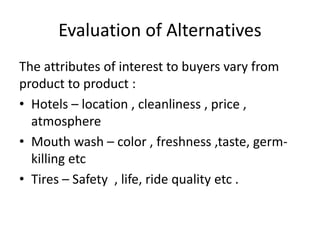
Evaluation of Alternatives 
The attributes of interest to buyers vary from 
product to product : 
• Hotels – location , cleanliness , price , 
atmosphere 
• Mouth wash – color , freshness ,taste, germ-killing 
etc 
• Tires – Safety , life, ride quality etc .
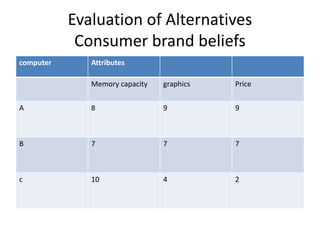
Evaluation of Alternatives 
Consumer brand beliefs 
computer Attributes 
Memory capacity graphics Price 
A 8 9 9 
B 7 7 7 
c 10 4 2
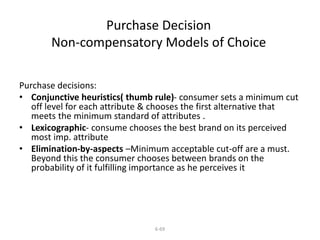
Purchase Decision 
Non-compensatory Models of Choice 
Purchase decisions: 
• Conjunctive heuristics( thumb rule)- consumer sets a minimum cut 
off level for each attribute & chooses the first alternative that 
meets the minimum standard of attributes . 
• Lexicographic- consume chooses the best brand on its perceived 
6-69 
most imp. attribute 
• Elimination-by-aspects –Minimum acceptable cut-off are a must. 
Beyond this the consumer chooses between brands on the 
probability of it fulfilling importance as he perceives it
Perceived Risk( purchase decision) 
6-70 
• Functional- not perform 
as per expectations 
• Physical- affect the 
physical well – being 
• Financial- not worth the 
price 
• Social- results in an 
embarrassment 
• Psychological-affects 
the mental well-being 
• Time- failure of the 
product may result in 
an opportunity cost of 
finding another product
Other Theories of 
Consumer Decision Making 
6-71 
Involvement 
• Elaboration 
Likelihood Model 
• Low-involvement 
marketing strategies 
• Variety-seeking 
buying behavior 
Decision Heuristics 
• Availability 
• Representativeness 
• Anchoring and 
adjustment
Analyzing Business Markets
Organizational Buying 
Decision-making process by which 
formal organizations establish the 
need for purchased products and 
services, and identify 
evaluate, and choose among 
alternative brands and suppliers. 
7-73
Characteristics of Business Markets 
7-74 
• Fewer, larger buyers 
• Close supplier-customer 
relationships 
• Professional purchasing 
• Many buying influences 
• Multiple sales calls 
• Derived demand-demand 
for industrial product is 
derived out of demand 
for the final consumer 
product eg. cars 
• Inelastic demand-relatively 
inelastic 
• Fluctuating demand 
• Geographically 
concentrated buyers 
• Direct purchasing
The Buy- Grid Model of B2B sales - Buying 
Situation 
7-75 
• Straight rebuy 
• Modified rebuy 
• New task
The Buying Center 
• Initiators- users or others in the org. who request that 
something is purchased 
• Users- usually they are the initiators 
• Influencers- people who influence buying decisions-define 
specifications or info. Regards alternatives eg. 
7-76 
Technical persons 
• Deciders- people who decide on requirements or 
suppliers 
• Approvers-people who authorize the action of buyers 
• Buyers- major role of selecting vendors & negotiating 
• Gatekeepers- eg. Purchasing agents , telephone 
operators , receptionists who prevent vendors from 
reaching the buyers
Of Concern to Business Marketers 
• Who are the major decision participants? 
• What decisions do they influence? 
• What is their level of influence? 
• What evaluation criteria do they use? 
7-77
Handling Price-Oriented Customers 
• Limit quantity purchased 
• Allow no refunds 
• Make no adjustments 
• Provide no services 
7-78
Forms of Electronic Marketplaces 
• Catalog sites 
• Vertical markets- specific websites called e-hubs- eg. 
For plastics – plastics.com 
• Pure play auction sites- like ebay, freemarkets.com for 
industrial parts, raw materials etc 
• Spot markets- on spot electronic markets where prices 
change by the minute- eg.chemconnect.com for 
7-79 
chemicals 
• Private exchanges-specially invited groups of suppliers. 
IBM, Walmart practice this 
• Barter markets 
• Buying alliances-sometimes companies buting the 
same goods form a buying consotia
Order Routine Specification and Inventory 
• Stockless purchase plans- JIT 
• Vendor-managed inventory 
• Continuous replenishment 
7-80
Desirable Outcomes of a B2B transaction: 
OTIFNE 
7-81 
• On time 
• In full 
• No error
Establishing Corporate Credibility 
7-82 
• Expertise 
• Trustworthiness 
• Likeability
Factors Affecting 
Buyer-Supplier Relationships 
• Availability of alternatives 
• Importance of supply 
• Complexity of supply 
• Supply market dynamism 
7-83
Categories of Buyer-Seller 
Relationships 
7-84 
• Basic buying and selling-routine 
exchanges –little 
information sharing 
• Bare bones-more 
adaptation by the seller – 
less info sharing by buyer 
• Contractual transaction-formal 
contracts with low 
trust & cooperation 
• Customer supply-competition 
governs 
• Cooperative systems-here 
partners are united & 
neither demonstrates 
structural commitments 
through legal means 
• Collaborative-must trust 
and commitment 
• Mutually adaptive-parties 
make relationship-specific 
adaptations , but without 
much trust 
• Customer is king- seller 
adapts
Opportunism 
Some form of cheating or 
undersupply relative to an 
implicit or explicit contract. 
7-85
Segmentation & Targeting 
Markets
Effective Targeting Requires… 
• Identify and profile distinct groups of buyers 
who differ in their needs and preferences. 
• Select one or more market segments to enter. 
• Establish and communicate the distinctive 
benefits of the market offering. 
8-87
Four Levels of Micromarketing 
8-88 
• Segments 
• Niches 
• Local areas 
• Individuals
Segment Marketing 
Targeting a group of customers 
who share a similar set of 
needs and wants. 
It has benefits over mass-marketing as your 
Products can be better designed , priced etc 
& above all marketing efforts can be fine –tuned 
8-89
Flexible Marketing Offerings 
8-90 
• Naked solution 
– Product and service 
elements that all 
segment members 
value 
• Discretionary options 
– Some segment 
members value 
– Options may carry 
additional charges 
– Eg airlines , cars etc
Niches 
• It is a more narrowly define customer groups 
seeking a distinctive mix of benefits. 
• When segments are further divided into sub-segments 
niches are formed 
• Eg- Ezee a liquid detergent from Godrej only 
for woolen clothes 
Aastha channel, Crack cream etc 
NOTE : niches though small should have growth 
& profit potential .
Local marketing 
• Marketing programs tailored for specific 
needs & wants of local customer groups. 
eg NRI branches in Kerala by SBI 
Spiderman 3 was released in India in 5 different 
languages
Customization/ Individuals 
Combines operationally driven 
mass customization with customized 
marketing in a way that empowers 
consumers to design the 
product and service offering 
of their choice. 
Here the segment size is 1 
Eg: dell , Asian paints, J&N 
8-93
Segmenting Consumer Markets 
8-94 
• Geographic 
• Demographic 
• Psychographic 
• Behavioral
Demographic Segmentation 
• Age and Life Cycle-pears soap, cartoon network etc 
• Life Stage- kitchen equipment , cupboards, furniture 
• Gender- TV programs of Ekta Kapoor meant for women 
• Income- Nirma power for the low income group . Samll 
sachets etc 
• Generation- 
• Social Class- SEC ( socio-economic class)2 individuals 
with the same income may have different tastes 
8-95
Psychographic segmentation 
It is the science of Psychology & demographics to better 
understand consumers. 
Here buyer segments are divided into different groups on 
the basis of personality traits, lifestyles , values & belief 
systems . 
People withinthe same demographic group can exhibit 
very different psychographic profiles. Religion also has a 
significant influence on values & lifestyles. 
Eg MacD had to adjust its menu to suite Indians’ 
preferences by introducing veg burgers. Sonata for value-for- 
money seekers , maggie for people on the move ( 
could be of any demo. Segment)
Psychographic segmentation 
Some other egs. Of psychographic groups : 
Fore runners , Achievers , followers , survivors 
Thinkers 
Intellectuals 
Extroverts 
Introverts 
Innovators etc
Behavioral Segmentation 
8-98 
Decision Roles 
• Initiator 
• Influencer 
• Decider 
• Buyer 
• User 
Behavioral Variables 
• Occasions- cards on birthdays , 
weddings etc 
• Benefits-multiple benefit seeks 
from the same product eg. 
Shampoo for texture & dandruff 
• User Status-potential users, first 
time users , non users 
• Usage Rate- light , medium & 
heavy users 
• Buyer-Readiness 
• Loyalty Status 
• Attitude – enthusiastic, positive , 
indiffrent , hostile
Segmenting for Business Markets- Table 8.3, 
page209 
• Demographic 
• Operating Variable 
• Purchasing Approaches 
• Situational Factors 
• Personal Characteristics 
8-99
Models of Sequential Segmentation 
8-100 
• Stage of decision 
• First-time prospects 
• Novices 
• Sophisticates 
• Orientation 
• Price-oriented 
• Solution-oriented 
• Strategic-value
Steps in Segmentation Process pg. 220, 
table 8.3 
• Needs-based segmentation 
• Segment identification 
• Segment attractiveness 
• Segment profitability 
• Segment positioning 
• Segment acid test 
• Marketing mix strategy 
8-101
Effective Segmentation Criteria 
8-102 
• Measurable 
• Substantial 
• Accessible 
• Differentiable 
• Actionable
Back to P’s of Marketing 
• We are aware of the 4 ps – product , price ,place & 
promotion . 
The Traditional Marketing Mix or The 4 P's of Marketing 
• The marketing mix was designed as a simple way to focus 
attention on the main elements of marketing for a business 
and to create a marketing strategy either at business, 
product or campaign level. 
One thought is that it is too product focused and doesn't 
translate well into the growing service based economy we live 
in 
As service has become an almost invincible part of any offer 
the 4 ps are now extended to 7 ps
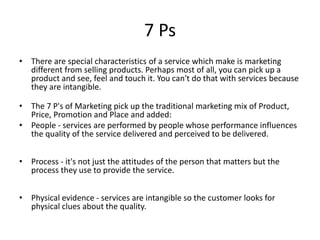
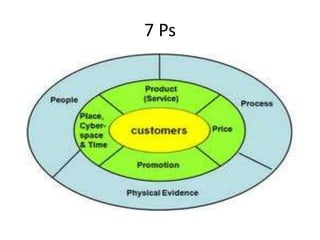
7 Ps 
• There are special characteristics of a service which make is marketing 
different from selling products. Perhaps most of all, you can pick up a 
product and see, feel and touch it. You can't do that with services because 
they are intangible. 
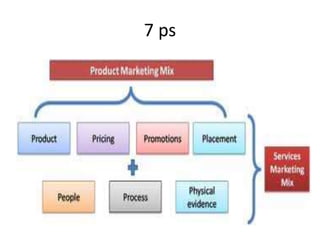
• The 7 P's of Marketing pick up the traditional marketing mix of Product, 
Price, Promotion and Place and added: 
• People - services are performed by people whose performance influences 
the quality of the service delivered and perceived to be delivered. 
• Process - it's not just the attitudes of the person that matters but the 
process they use to provide the service. 
• Physical evidence - services are intangible so the customer looks for 
physical clues about the quality.
7 Ps
7 ps
GATHERING INFORMATION & 
SCANNING THE EVIRONMENT
7 Ps
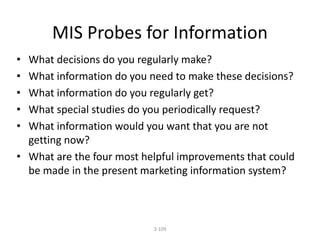
MIS Probes for Information 
• What decisions do you regularly make? 
• What information do you need to make these decisions? 
• What information do you regularly get? 
• What special studies do you periodically request? 
• What information would you want that you are not 
3-109 
getting now? 
• What are the four most helpful improvements that could 
be made in the present marketing information system?
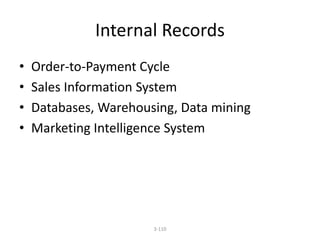
Internal Records 
• Order-to-Payment Cycle 
• Sales Information System 
• Databases, Warehousing, Data mining 
• Marketing Intelligence System 
3-110
Steps to Improve Marketing Intelligence 
• Train and motivate sales force 
• Motivate channel members to share intelligence 
• Network externally 
• Utilize customer advisory panel 
• Utilize government data resources 
• Purchase information 
• Collect customer feedback online 
3-111
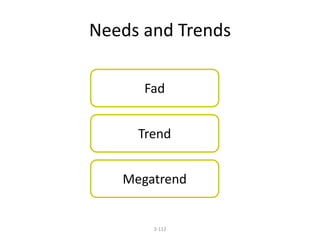
Needs and Trends 
Fad 
Trend 
Megatrend 
3-112
10 Megatrends Shaping the 
Consumer Landscape 
3-113 
• Aging boomers 
• Delayed retirement 
• Changing nature of 
work 
• Greater educational 
attainment 
• Labor shortages 
• Increased immigration 
• Rising Hispanic 
influence 
• Shifting birth trends 
• Widening geographic 
differences 
• Changing age structure
Environmental Forces 
3-114 
• Demographic 
• Economic 
• Socio-Cultural 
• Natural 
• Technological 
• Political-Legal
Population and Demographics 
3-115 
• Size 
• Growth rate 
• Age distribution 
• Ethnic mix 
• Educational levels 
• Household 
patterns 
• Regional 
characteristics 
• Movement
Economic Environment 
$ Purchasing Power 
$ Income Distribution 
$ Savings Rate 
$ Debt 
$ Credit Availability 
3-116
Types of Industrial Structures 
• Industrial economies 
• Industrializing economies 
• Raw-material exporting economies 
• Subsistence economies 
3-117
Social-Cultural Environment 
• Views of themselves 
• Views of others 
• Views of organizations 
• Views of society 
• Views of nature 
• Views of the universe 
3-118
Natural Environment 
• Shortage of raw materials 
• Increased energy costs 
• Anti-pollution pressures 
• Governmental protections 
3-119
Technological Environment 
• Pace of change 
• Opportunities for innovation 
• Varying R&D budgets 
• Increased regulation of change 
3-120
Marketing 
Marketing Strategies
What’s a ‘STRATEGY’? 
• It is a plan you adopt in order to get 
something done, especially in politics , 
economics or business 
• It is the art of planning the best way to 
achieve something or to be successful in a 
particular field
What’s a ‘STRATEGY’? 
• Strategy is a route to a destination; an 
objective is the destination. Selecting a route 
represents a decision. Driving along it is the 
implementation of that decision.
Improving Value Delivery the 
Japanese Way 
• Zero customer feedback time 
• Zero product improvement time 
• Zero purchasing time 
• Zero setup time 
• Zero defects 
2-124
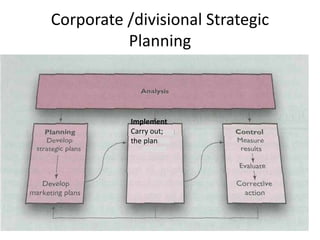
Corporate /divisional Strategic 
Planning 
Implement 
Carry out; 
the plan
The Process for Marketing Plan 
• Market analysis, 
• Planning, 
• implementation 
• and control
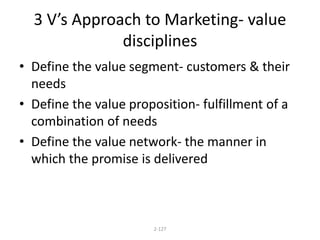
3 V’s Approach to Marketing- value 
disciplines 
• Define the value segment- customers & their 
needs 
• Define the value proposition- fulfillment of a 
combination of needs 
• Define the value network- the manner in 
which the promise is delivered 
2-127
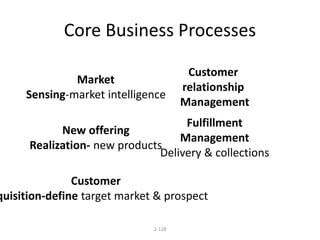
Core Business Processes 
Realization- new products 
2-128 
Market 
Sensing-market intelligence 
Customer 
relationship 
Management 
Fulfillment 
Management 
Delivery & collections 
New offering 
Customer 
Acquisition-define target market & prospect
Characteristics of Core Competencies 
• A source of competitive advantage 
• Applications in a wide variety of markets 
• Difficult to imitate 
2-129
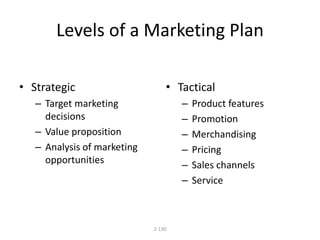
Levels of a Marketing Plan 
2-130 
• Strategic 
– Target marketing 
decisions 
– Value proposition 
– Analysis of marketing 
opportunities 
• Tactical 
– Product features 
– Promotion 
– Merchandising 
– Pricing 
– Sales channels 
– Service
Corporate Headquarters’ Planning Activities 
Define the corporate mission 
Establish SBUs 
Assign resources to each SBU 
Assess growth opportunities 
2-131
Good Mission Statements 
• Focus on limited number of goals 
• Stress major policies and values 
• Define major competitive spheres 
2-132
Major Competitive Spheres 
2-133 
• Industry 
• Products 
• Competence 
• Market segment 
• Vertical channels 
• Geographical
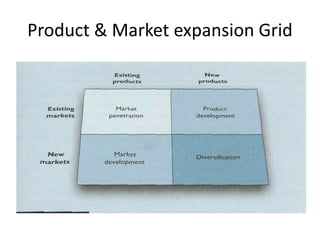
Product & Market expansion Grid
Characteristics of SBUs 
• It is a single business or collection of related 
businesses 
• It has its own set of competitors 
• It has a leader responsible for: 
2-135 
– Strategic planning 
– Profitability 
– Efficiency
Organizations 
2-136 
• Culture 
• Policies 
• Structure
Market Opportunity Analysis (MOA) 
• Can the benefits involved in the opportunity 
be articulated convincingly to a defined target 
market? 
• Can the target market be located and reached 
with cost-effective media and trade channels? 
• Does the company possess or have access to 
the critical capabilities and resources needed 
to deliver the customer benefits? 
2-137
Market Opportunity Analysis (MOA)_2 
• Can the company deliver the benefits better 
than any actual or potential competitors? 
• Will the financial rate of return meet or 
exceed the company’s required threshold for 
investment? 
SWOT & PEST …. A must 
2-138
Porter’s Generic Strategies 
Michael Porter proposed 3 generic strategies that 
provide a good starting point for strategic thinking 
• Overall cost leadership- work hard to reducing 
production & distribution cost 
• Differentiation- superior in some area of 
customer benefit – like best components etc 
• Focus- focus on one or more narrow market 
segment and focus energies on them 
2-139
Categories of Marketing Alliances 
• Product or Service Alliances-Produce or market 
complimentary products – HUL & Pepsi for launch 
of Lipton Iced tea in glass bottles 
• Promotional Alliances- joint promotional 
activities – Bombay Dyeing used for marketing 
Ariel 
• Logistics Alliances- Transport Corporation of India 
& Mitsui Japan – provide logistics for Toyota , 
Bangalore 
• Pricing collaborations- eg, air line , hotels , car 
rentals can join hands for attractive rates 
2-140
Marketing Plan Contents 
 Executive summary 
 Table of contents 
 Situation analysis 
 Marketing strategy 
 Financial projections 
 Implementation controls 
2-141
Evaluating a Marketing Plan 
 Is the plan simple? 
 Is the plan specific? 
 Is the plan realistic? 
 Is the plan complete? 
2-142
Strategic plans & Marketing Plans 
• Strategic plans stem out of the Mission of the 
company 
• Marketing plans help strategic plans to actualize 
• Marketing Today is no more just a function , but a 
way of doing business 
• There is much overlap between overall company 
strategy and marketing strategy. 
• Marketing looks at consumer needs and the 
company's ability to satisfy them ; these factors 
guide the company mission and objectives.
Strategic plans & Marketing Plans 
• Company strategic planning deals with 
marketing variables - market share, market 
development, growth - and it is sometimes 
hard to separate strategic planning from 
marketing planning. 
• Some companies refer to their strategic 
planning as 'strategic marketing planning'.
Strategic plans & Marketing Plans 
• Marketing plays a key role in the company's 
strategic planning in several ways. 
First, marketing provides a guiding philosophy - 
company strategy should revolve around serving 
the needs of important consumer groups. 
Second, marketing provides inputs to strategic 
planners by helping to identify attractive market 
opportunities and by assessing the firm's potential 
to take advantage of them. 
Finally, within individual business units, marketing 
designs strategies for reaching the unit's objectives.
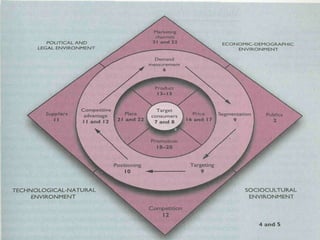
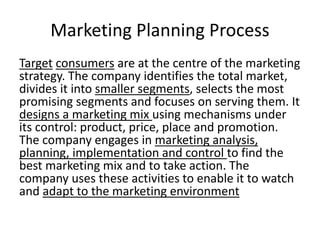
Marketing Planning Process 
Target consumers are at the centre of the marketing 
strategy. The company identifies the total market, 
divides it into smaller segments, selects the most 
promising segments and focuses on serving them. It 
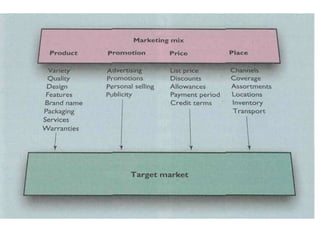
designs a marketing mix using mechanisms under 
its control: product, price, place and promotion. 
The company engages in marketing analysis, 
planning, implementation and control to find the 
best marketing mix and to take action. The 
company uses these activities to enable it to watch 
and adapt to the marketing environment
Types of Organizations 
• Functional Management organizations 
• Product Management organizations 
• Market/ Customer based organizations 
• Geographic Organizations 
• Matrix organizations
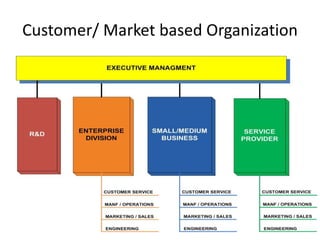
Customer/ Market based Organization
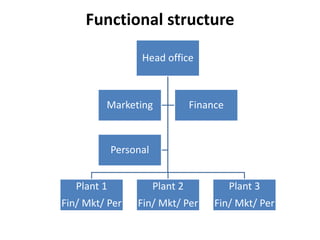
Functional structure 
Head office 
Marketing Finance 
Plant 1 
Fin/ Mkt/ Per 
Plant 2 
Fin/ Mkt/ Per 
Plant 3 
Fin/ Mkt/ Per 
Personal
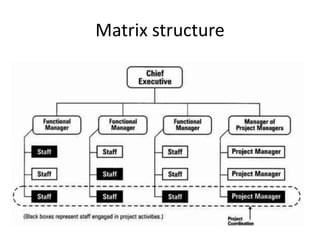
Matrix structure
Marketing evaluation & control 
• No marketing process, even the most carefully 
developed, is guaranteed to result in 
maximum benefit for a company. In addition, 
because every market is changing constantly, a 
strategy that is effective today may not be 
effective in the future. It is important to 
evaluate a marketing program periodically to 
be sure that it is achieving its objectives
Marketing Audits 
• The Encyclopedia Britannica (2005 edition) describes the marketing audit 
thus: 
• "... (I)t covers all aspects of the marketing climate (unlike a functional 
audit, which analyzes one marketing activity), looking at both macro-environment 
factors (demographic, economic, ecological, technological, 
political, and cultural) and micro- or task-environment factors (markets, 
customers, competitors, distributors, dealers, suppliers, facilitators, and 
publics). The audit includes analyses of the company's marketing 
strategy, marketing organization, marketing systems, and marketing 
productivity. It must be systematic in order to provide concrete 
conclusions based on these analyses. To ensure objectivity, a marketing 
audit is best done by a person, department, or organization that is 
independent of the company or marketing program. Marketing audits 
should be done not only when the value of a company's current 
marketing plan is in question; they must be done periodically in order to 
isolate and solve problems before they arise."
Marketing Audits 
• The marketing audit is, in some respects, the 
raw material for the strategic control. Its role 
is to periodically make sure that the marketing 
plan emphasizes the country's strengths in 
ways that are compatible with shifting market 
sentiments, current events, fashions, 
preferences, needs, and priorities of relevant 
market players. This helps to identify 
marketing opportunities and new or potential 
markets.

marketing

  • 1.
  • 2.
    What is Marketing? • Marketing is the social process by which individuals and groups obtain what they need and want through creating and exchanging products and value with others. Kotler • The right product, in the right place, at the right time, at the right price .
  • 3.
    What is Marketing? American Marketing Association : Marketing is an organizational function & a set of processes for creating ,communicating & delivering value to customers and managing customer relationships in ways that benefit the organization & its stakeholders.
  • 4.
    What is Marketing? …. It is a process by which -one identifies the needs and wants of the people. -one determines and creates a product/service to meet the needs and wants. [PRODUCT] -one determines a way of taking the product/service to the market place. [PLACE] -one determines the way of communicating the product to the market place. [PROMOTIONS] -one determines the value for the product.[PRICE]. -one determines the people, who have needs/ wants. [PEOPLE] and then creating a transaction for exchanging the product for a value. and thus creating a satisfaction to the buyer's needs/wants.
  • 5.
    The 4 Psof Marketing
  • 6.
    For an exchangeto occur….. • There are at least two parties. • Each party has something that might be of value to the other party. • Each party is capable of communication and delivery. • Each party is free to reject the exchange offer. • Each party believes it is appropriate or desirable to deal with the other party. 1-6
  • 7.
    What is MarketingManagement? Marketing management is the art and science of choosing target markets and getting, keeping, and growing customers through creating, delivering, and communicating superior customer value. 1-7
  • 8.
    What gets Marketed? Or the scope of marketing • Goods- Physical goods like , cars , trucks , TV, watches etc • Services – Air line , hotels , car rentals etc • Events – Olympics, world cup ect • Experiences – water parks , amusements etc • Celebrity marketing • Places – cities , regions , countries etc – tourism , factories , residences , head quarters etc
  • 9.
    What gets Marketed? • Properties – real estate & investments like stocks , marketed by estate agents & banks(investment companies ) respectively • Organizations – purposes of Corporate building
  • 10.
    Demand States 1-10 • Negative • Nonexistent • Latent • Declining • Irregular • Unwholesome • Full • Overfull
  • 11.
    What’s a ‘Market’ • A set up where two or more parties engage in exchange of goods, services and information is called a market. Ideally a market is a place where two or more parties are involved in buying and selling. • The two parties involved in a transaction are called seller and buyer. • The seller sells goods and services to the buyer in exchange of money. There has to be more than one buyer and seller for the market to be competitive.
  • 12.
    What’s a ‘Market’ • Physical Markets - Physical market is a set up where buyers can physically meet the sellers and purchase the desired merchandise from them in exchange of money. Shopping malls, department stores, retail stores are examples of physical markets. • Non Physical Markets/Virtual markets - In such markets, buyers purchase goods and services through internet. In such a market the buyers and sellers do not meet or interact physically, instead the transaction is done through internet. Examples - Rediff shopping, eBay etc. • Auction Market - In an auction market the seller sells his goods to one who is the highest bidder. • Market for Intermediate Goods - Such markets sell raw materials (goods) required for the final production of other goods. Commodity Market. • Financial Market - Market dealing with the exchange of liquid assets (money) is called a financial market. Stock market , bond market , foreign exchange market etc.
  • 13.
    Key Markets- thedecisions marketers make • Consumer Markets – establish brand image • Business Markets – establish corporate image & identity • Global Markets – how to enter , how to adapt products & services , how to adapt communication • Non- profit & governmental markets – universities , churches , Ngos etc
  • 14.
    concept of Meta-markets • Two or more distinct markets that are associated in some way to a product or service. • For example, the meta-market for house cleaning products includes homeowners and domestic cleaning service companies. Meta market is a place, where everything connected with a certain market can be found. Let’s say a car selling meta market would be a website, that sells cars but you will also find car parts there, add-ons for cars, colors for cars, mechanics reviews and many more.
  • 15.
    concept of Meta-markets • Meta Market can be a web-based market centered around an event or an industry, rather than a single product. These are markets of complementary products that are closely related in the minds of consumers, but spread across different industries. • The web allows us to match producers' desire for economies of scale, and consumers' desire for variety of choice to satisfy a set of needs. • Thus we can have a meta market for a wedding (event) that includes honeymoon recommendations, sources for engagement rings and wedding gowns.
  • 16.
    New Marketing Realities– The Major Societal Forces- The marketplace isn’t what it used to be….
  • 17.
    New Marketing Realities– The Major Societal Forces- The marketplace isn’t what it used to be…. 1-17 • Changing technology • Globalization • Deregulation • Privatization • Outsoursing • Customer Resistance • Retail transformation • Heightened Competition – resulting in high production costs & shrinking profit margins • Empowerment • Customization • Convergence- Industrial boundaries are blurring at an incredibly rapid rate as companies recognize that opportunities lie at the intersection of two or more industries. • Disintermediation- classic egs.- Amazon, E-bay , Aol etc .
  • 18.
    Explanation of Convergence( previous slide ) • Convergence- Industrial boundaries are blurring at an incredibly rapid rate as companies recognize that opportunities lie at the intersection of two or more industries. The computing & the electronic industries are converging as the giants of the computer world such as Dell , Gateway , HP released a stream of entertainment devices – from MP3 players to Plasma TVs and camcorders. The shift to digital technology is fuelling this massive convergence .
  • 19.
    Explanation of Retailtransformation ( previous slide ) • The power of the Giant Retailers and the so called “Category Killers”. • The store retailers face competition from catalogue houses , direct mail firms , newspapers , magazines , D.T.H operators , home shopping and so on. • In response , entrepreneurial retailers are building entertainment in their stores with coffee bars , demonstrations etc. with the objective of ‘marketing an experience rather than a product assortment ‘
  • 20.
    Company Orientations •Production • Product • Selling • Marketing • Societal ( elaborated in the next slide) • Relational 1-20
  • 21.
    Company Orientations •Societal orientation : Are companies that successfully satisfy consumer wants necessarily acting in the best, long-run interests of consumers and society? The marketing concept sidesteps the potential conflicts among consumer wants, consumer interests, and long-run societal welfare.
  • 22.
    Marketing Mix andthe Customer 1-22 Four Ps • Product • Price • Place • Promotion Four Cs • Customer solution • Customer cost • Convenience • Communication
  • 24.
    Core Concepts •Needs, wants, and demands • Target markets, positioning, segmentation • Offerings and brands • Value and satisfaction 1-24 • Supply chain • Competition- brand competition , industry , form & generic competition • Marketing environment • Marketing planning-marketing program ,
  • 25.
    Core Concepts •Marketing-mix • Relationship Marketing • Relationship networks • Marketing network • Marketing Channels
  • 26.
    Internal marketing Holistic Marketing-concept Integrated marketing Relationship marketing Performance marketing
  • 27.
    Marketing Management Tasks • Developing marketing strategies • Capturing marketing insights • Connecting with customers • Building strong brands 1-27 • Shaping market offerings • Delivering value • Communicating value • Creating long-term growth
  • 28.
    1-28 I wantit, I need it….. 5 Types of Needs • Stated needs • Real needs • Unstated needs • Delight needs • Secret needs
  • 29.
    MARKETING MANAGEMENT TheMarketing Management Process consists of analyzing market opportunities, researching and selecting target markets, developing marketing strategies, planning marketing tactics, and implementing and controlling the marketing effort
  • 30.
    Market Potential &Market share Market Potential: the economic opportunity available to you in any geographic market Market Share: Market share is the percentage of a market (defined in terms of either units or revenue) accounted for by a specific entity. Marketers need to be able to translate sales targets into market share because this will demonstrate whether forecasts are to be attained by growing with the market or by capturing share from competitors. The latter will almost always be more difficult to achieve. Market share is closely monitored for signs of change in the competitive landscape, and it frequently drives strategic or tactical action.
  • 31.
  • 32.
    BUSINESS ENVIRONMENT BusinessEnvironment : consists of all those factors that have a bearing on the business. Business decisions are therefore based on environmental factors.
  • 33.
    BUSINESS ENVIRONMENT Anorganization must have a strategy to achieve its missions/objectives/goals. A strategy is also defined as establishing a firm-environment- fit
  • 34.
    Levels Of Environment A. INTERNAL ENVIRONMENT A. EXTERNAL ENVIRONMENT
  • 35.
    INTERNAL ENVIRONMENT It’sthe internal factors that affect business. The internal factors are generally regarded as Controllable Factors because the company has control over these factors. It can alter or modify such factors. Example: facilities , personnel , organizational and functional means such as marketing-mix etc.
  • 36.
    INTERNAL ENVIRONMENT- internal factors • VALUE SYSTEMS : The value systems of the people in the top has an important bearing on missions, objectives , policies etc . Eg. Mr. J.R.D. Tata .. Social responsibility towards consumers , employees , stakeholders. • MISSION & OBJECTIVES : The business domain , priorities , direction of development , philosophy are guided by the mission & objectives. Eg. Tata's decided to go transnational
  • 37.
    …INTERNAL ENVIRONMENT- internal factors • MANAGEMENT STRUCTURE & NATURE : Eg the composition of the board, extent of professionalization of management • INTERNAL POWER RELATIONSHIP: the support the top management enjoys from shareholders , employees etc. • HUMAN RESOURCES: the characteristics of recourses like skills , quality etc • COMPANY IMAGE & BRAND EQUITY: the image of the company matters while raising finance , forming joint ventures, launching new products etc
  • 38.
    …INTERNAL ENVIRONMENT- internal factors • OTHER FACTORS : 1. Physical assets 2. R&D & technological capacities 3. Marking Resources : Quality of the marketing team , distribution which has a direct impact on marketing etc 4. Financial Factors : financial policies , capital structure etc
  • 39.
    External Environment MICRO ENVIRONMENT MACRO ENVIRONMENT EXTERNAL ENVIRONMENT
  • 40.
    MICRO ENVIRONMENT Themicro environment consists of the actors in the company’s immediate environment. These are more closely linked to the company. They are : • Suppliers : The importance of a reliable & smooth supply of raw- materials is essential. Importance is therefore given to vendor development . Change in Supplier’s attitude will have an impact on business
  • 41.
    …MICRO ENVIRONMENT •Customers : the task of business is to create & sustain customers. A business exits because of customers. Customers( including Indian customers) are going global in their shopping. • Competitors: not just the other firms who make similar products but also those who compete for discretionary income.(pocket share) • Marketing Intermediaries : the firms that aid the company in selling, promoting ad distributing to final consumers • Publics: A public is any group that has an actual or potential interest in or impact on an organizations ability to achieve its goals. They can have a positive &/or a negative impact. Eg. Media publics ,local publics , citizens forum etc.
  • 42.
    MACRO ENVIRONMENT Theyare the larger forces that shape opportunities and/or pose threats to the company . They are more uncontrollable than the micro forces. The success depends on the company’s adaptability to the environment . Eg. If the cost of imports increase due to an increase in import duty , the solution could be domestic production
  • 43.
    ….MACRO ENVIRONMENT Foreign Environment Domestic Environment Global Environment
  • 44.
    Macro Factors –PEST Political Macro Environment Economic Technological Sociocultural
  • 45.
    Political Factors. Thepolitical arena has a huge influence upon the regulation of businesses, and the spending power of consumers and other businesses. You must consider issues such as: • 1.How stable is the political environment? • 2.Will government policy influence laws that regulate or tax your business? • 3.What is the government's position on marketing ethics? • 4. What is the government's policy on the economy? • 5. Does the government have a view on culture and religion? • 6. Is the government involved in trading agreements such as EU, NAFTA, ASEAN, or others?
  • 46.
    Economic Factors. Marketersneed to consider the state of a trading economy in the short and long-terms. This is especially true when planning for international marketing. You need to look at: • 1. Interest rates. • 2. The level of inflation Employment level per capita. • 3. Long-term prospects for the economy Gross Domestic Product (GDP) per capita, and so on
  • 47.
    Sociocultural Factors. Thesocial and cultural influences on business vary from country to country. It is very important that such factors are considered. Factors include: • 1.What is the dominant religion? • 2.What are attitudes to foreign products and services? • 3.Does language impact upon the diffusion of products onto markets? • 4.How much time do consumers have for leisure? • 5.What are the roles of men and women within society? • 6.How long are the population living? Are the older generations wealthy? • 7.Do the population have a strong/weak opinion on green issues?
  • 48.
    Technological Factors. Technologyis vital for competitive advantage, and is a major driver of globalization. Consider the following points: • 1. Does technology allow for products and services to be made more cheaply and to a better standard of quality? • 2.Do the technologies offer consumers and businesses more innovative products and services such as Internet banking, new generation mobile telephones, etc? • 3.How is distribution changed by new technologies e.g. books via the Internet, flight tickets, auctions, etc? • 4.Does technology offer companies a new way to communicate with consumers e.g. banners, Customer Relationship Management (CRM), etc?
  • 49.
  • 50.
    What Influences ConsumerBehavior? Consumer Characteristics are shaped by - • Cultural factors • Social factors • Personal factors 6-50
  • 51.
    Culture The fundamentaldeterminant of a person’s wants and behaviors acquired through socialization processes with family and other key institutions. 6-51
  • 52.
    Subcultures 6-52 •Nationalities • Religions • Racial groups • Geographic regions
  • 53.
    Social Factors 6-53 Reference groups Social roles Family Statuses
  • 54.
    Reference Groups Allthose groups that have a direct or indirect influence • Membership- have a direct impact ( sanstha, religious 6-54 club etc • Primary- strong interactions like family , friends , neighbor . • Secondary- professional , trade unions or religious etc • Aspirational- those that people hope to join • Dissociative- all those that individuals reject
  • 55.
    Family 6-55 •Family of Orientation – Religion – Politics – Economics • Family of Procreation – Everyday buying behavior
  • 56.
    Personal Factors 6-56 • Age • Life cycle stage • Occupation • Wealth • Personality • Values • Lifestyle • Self-concept
  • 57.
    Brand Personality Itis believed that people choose those brands , whose personality & closest to their own . • Sincerity- down to earth , honest , wholesome & cheerful • Excitement- daring , spirited , imaginative & up-to- 6-57 date • Competence- reliable , intelligent & successful • Sophistication-upper class, charming • Ruggedness - tough & outdoorsy
  • 58.
    Consumer Psychology •Motivation- the driving force • Perception- consumers impression • Learning- the study on the brand • Memory- retention 6-58
  • 59.
    Model of Consumerbehavior – the Key psychological process
  • 60.
    Motivation- pg.155 •Maslow’s hierarchy of needs • Herzberg’s two-factor theory 6-60
  • 61.
    Maslow’s Motivational Pyramid-Need Hierarchy theory
  • 62.
    Perception • Perceptionis the process by which we select, organize ,and interpret information inputs to create a meaningful picture
  • 63.
    Perception • Selectiveattention- due to bombardment of communication • Selective retention- retain information that supports our attitudes & beliefs- things that we like & of that brads that appeal to us etc • Selective distortion- interpretation that fits pre-conceptions. Consumers distort information to be consistent with prior brand beliefs & expectations. Blind taste tests… • Subliminal perception - covert , embedded messages in ads & packages that has a sub conscious effect. Although this is not a proven fact . 6-63
  • 64.
    Perception Some Factson Selective attention :  People are likely to notice stimuli that relate to a current need  People are likely to notice stimuli they anticipate  People are more likely to notice stimuli whose deviation are large as compared to normal size of stimuli
  • 65.
    5-stage ‘Buying decisionprocess’ Problem Recognition Information search Evaluation of alternatives Purchase decision Post purchase behavior
  • 66.
    Sources of Information • Personal- friends ,family ,neighbors etc. • Commercial- ads , websites , dealers , packaging , displays etc • Public- consumer ratings organizations etc • Experiential –handling examining & using the product 6-66
  • 67.
    Evaluation of Alternatives The attributes of interest to buyers vary from product to product : • Hotels – location , cleanliness , price , atmosphere • Mouth wash – color , freshness ,taste, germ-killing etc • Tires – Safety , life, ride quality etc .
  • 68.
    Evaluation of Alternatives Consumer brand beliefs computer Attributes Memory capacity graphics Price A 8 9 9 B 7 7 7 c 10 4 2
  • 69.
    Purchase Decision Non-compensatoryModels of Choice Purchase decisions: • Conjunctive heuristics( thumb rule)- consumer sets a minimum cut off level for each attribute & chooses the first alternative that meets the minimum standard of attributes . • Lexicographic- consume chooses the best brand on its perceived 6-69 most imp. attribute • Elimination-by-aspects –Minimum acceptable cut-off are a must. Beyond this the consumer chooses between brands on the probability of it fulfilling importance as he perceives it
  • 70.
    Perceived Risk( purchasedecision) 6-70 • Functional- not perform as per expectations • Physical- affect the physical well – being • Financial- not worth the price • Social- results in an embarrassment • Psychological-affects the mental well-being • Time- failure of the product may result in an opportunity cost of finding another product
  • 71.
    Other Theories of Consumer Decision Making 6-71 Involvement • Elaboration Likelihood Model • Low-involvement marketing strategies • Variety-seeking buying behavior Decision Heuristics • Availability • Representativeness • Anchoring and adjustment
  • 72.
  • 73.
    Organizational Buying Decision-makingprocess by which formal organizations establish the need for purchased products and services, and identify evaluate, and choose among alternative brands and suppliers. 7-73
  • 74.
    Characteristics of BusinessMarkets 7-74 • Fewer, larger buyers • Close supplier-customer relationships • Professional purchasing • Many buying influences • Multiple sales calls • Derived demand-demand for industrial product is derived out of demand for the final consumer product eg. cars • Inelastic demand-relatively inelastic • Fluctuating demand • Geographically concentrated buyers • Direct purchasing
  • 75.
    The Buy- GridModel of B2B sales - Buying Situation 7-75 • Straight rebuy • Modified rebuy • New task
  • 76.
    The Buying Center • Initiators- users or others in the org. who request that something is purchased • Users- usually they are the initiators • Influencers- people who influence buying decisions-define specifications or info. Regards alternatives eg. 7-76 Technical persons • Deciders- people who decide on requirements or suppliers • Approvers-people who authorize the action of buyers • Buyers- major role of selecting vendors & negotiating • Gatekeepers- eg. Purchasing agents , telephone operators , receptionists who prevent vendors from reaching the buyers
  • 77.
    Of Concern toBusiness Marketers • Who are the major decision participants? • What decisions do they influence? • What is their level of influence? • What evaluation criteria do they use? 7-77
  • 78.
    Handling Price-Oriented Customers • Limit quantity purchased • Allow no refunds • Make no adjustments • Provide no services 7-78
  • 79.
    Forms of ElectronicMarketplaces • Catalog sites • Vertical markets- specific websites called e-hubs- eg. For plastics – plastics.com • Pure play auction sites- like ebay, freemarkets.com for industrial parts, raw materials etc • Spot markets- on spot electronic markets where prices change by the minute- eg.chemconnect.com for 7-79 chemicals • Private exchanges-specially invited groups of suppliers. IBM, Walmart practice this • Barter markets • Buying alliances-sometimes companies buting the same goods form a buying consotia
  • 80.
    Order Routine Specificationand Inventory • Stockless purchase plans- JIT • Vendor-managed inventory • Continuous replenishment 7-80
  • 81.
    Desirable Outcomes ofa B2B transaction: OTIFNE 7-81 • On time • In full • No error
  • 82.
    Establishing Corporate Credibility 7-82 • Expertise • Trustworthiness • Likeability
  • 83.
    Factors Affecting Buyer-SupplierRelationships • Availability of alternatives • Importance of supply • Complexity of supply • Supply market dynamism 7-83
  • 84.
    Categories of Buyer-Seller Relationships 7-84 • Basic buying and selling-routine exchanges –little information sharing • Bare bones-more adaptation by the seller – less info sharing by buyer • Contractual transaction-formal contracts with low trust & cooperation • Customer supply-competition governs • Cooperative systems-here partners are united & neither demonstrates structural commitments through legal means • Collaborative-must trust and commitment • Mutually adaptive-parties make relationship-specific adaptations , but without much trust • Customer is king- seller adapts
  • 85.
    Opportunism Some formof cheating or undersupply relative to an implicit or explicit contract. 7-85
  • 86.
  • 87.
    Effective Targeting Requires… • Identify and profile distinct groups of buyers who differ in their needs and preferences. • Select one or more market segments to enter. • Establish and communicate the distinctive benefits of the market offering. 8-87
  • 88.
    Four Levels ofMicromarketing 8-88 • Segments • Niches • Local areas • Individuals
  • 89.
    Segment Marketing Targetinga group of customers who share a similar set of needs and wants. It has benefits over mass-marketing as your Products can be better designed , priced etc & above all marketing efforts can be fine –tuned 8-89
  • 90.
    Flexible Marketing Offerings 8-90 • Naked solution – Product and service elements that all segment members value • Discretionary options – Some segment members value – Options may carry additional charges – Eg airlines , cars etc
  • 91.
    Niches • Itis a more narrowly define customer groups seeking a distinctive mix of benefits. • When segments are further divided into sub-segments niches are formed • Eg- Ezee a liquid detergent from Godrej only for woolen clothes Aastha channel, Crack cream etc NOTE : niches though small should have growth & profit potential .
  • 92.
    Local marketing •Marketing programs tailored for specific needs & wants of local customer groups. eg NRI branches in Kerala by SBI Spiderman 3 was released in India in 5 different languages
  • 93.
    Customization/ Individuals Combinesoperationally driven mass customization with customized marketing in a way that empowers consumers to design the product and service offering of their choice. Here the segment size is 1 Eg: dell , Asian paints, J&N 8-93
  • 94.
    Segmenting Consumer Markets 8-94 • Geographic • Demographic • Psychographic • Behavioral
  • 95.
    Demographic Segmentation •Age and Life Cycle-pears soap, cartoon network etc • Life Stage- kitchen equipment , cupboards, furniture • Gender- TV programs of Ekta Kapoor meant for women • Income- Nirma power for the low income group . Samll sachets etc • Generation- • Social Class- SEC ( socio-economic class)2 individuals with the same income may have different tastes 8-95
  • 96.
    Psychographic segmentation Itis the science of Psychology & demographics to better understand consumers. Here buyer segments are divided into different groups on the basis of personality traits, lifestyles , values & belief systems . People withinthe same demographic group can exhibit very different psychographic profiles. Religion also has a significant influence on values & lifestyles. Eg MacD had to adjust its menu to suite Indians’ preferences by introducing veg burgers. Sonata for value-for- money seekers , maggie for people on the move ( could be of any demo. Segment)
  • 97.
    Psychographic segmentation Someother egs. Of psychographic groups : Fore runners , Achievers , followers , survivors Thinkers Intellectuals Extroverts Introverts Innovators etc
  • 98.
    Behavioral Segmentation 8-98 Decision Roles • Initiator • Influencer • Decider • Buyer • User Behavioral Variables • Occasions- cards on birthdays , weddings etc • Benefits-multiple benefit seeks from the same product eg. Shampoo for texture & dandruff • User Status-potential users, first time users , non users • Usage Rate- light , medium & heavy users • Buyer-Readiness • Loyalty Status • Attitude – enthusiastic, positive , indiffrent , hostile
  • 99.
    Segmenting for BusinessMarkets- Table 8.3, page209 • Demographic • Operating Variable • Purchasing Approaches • Situational Factors • Personal Characteristics 8-99
  • 100.
    Models of SequentialSegmentation 8-100 • Stage of decision • First-time prospects • Novices • Sophisticates • Orientation • Price-oriented • Solution-oriented • Strategic-value
  • 101.
    Steps in SegmentationProcess pg. 220, table 8.3 • Needs-based segmentation • Segment identification • Segment attractiveness • Segment profitability • Segment positioning • Segment acid test • Marketing mix strategy 8-101
  • 102.
    Effective Segmentation Criteria 8-102 • Measurable • Substantial • Accessible • Differentiable • Actionable
  • 103.
    Back to P’sof Marketing • We are aware of the 4 ps – product , price ,place & promotion . The Traditional Marketing Mix or The 4 P's of Marketing • The marketing mix was designed as a simple way to focus attention on the main elements of marketing for a business and to create a marketing strategy either at business, product or campaign level. One thought is that it is too product focused and doesn't translate well into the growing service based economy we live in As service has become an almost invincible part of any offer the 4 ps are now extended to 7 ps
  • 104.
    7 Ps •There are special characteristics of a service which make is marketing different from selling products. Perhaps most of all, you can pick up a product and see, feel and touch it. You can't do that with services because they are intangible. • The 7 P's of Marketing pick up the traditional marketing mix of Product, Price, Promotion and Place and added: • People - services are performed by people whose performance influences the quality of the service delivered and perceived to be delivered. • Process - it's not just the attitudes of the person that matters but the process they use to provide the service. • Physical evidence - services are intangible so the customer looks for physical clues about the quality.
  • 105.
  • 106.
  • 107.
    GATHERING INFORMATION & SCANNING THE EVIRONMENT
  • 108.
  • 109.
    MIS Probes forInformation • What decisions do you regularly make? • What information do you need to make these decisions? • What information do you regularly get? • What special studies do you periodically request? • What information would you want that you are not 3-109 getting now? • What are the four most helpful improvements that could be made in the present marketing information system?
  • 110.
    Internal Records •Order-to-Payment Cycle • Sales Information System • Databases, Warehousing, Data mining • Marketing Intelligence System 3-110
  • 111.
    Steps to ImproveMarketing Intelligence • Train and motivate sales force • Motivate channel members to share intelligence • Network externally • Utilize customer advisory panel • Utilize government data resources • Purchase information • Collect customer feedback online 3-111
  • 112.
    Needs and Trends Fad Trend Megatrend 3-112
  • 113.
    10 Megatrends Shapingthe Consumer Landscape 3-113 • Aging boomers • Delayed retirement • Changing nature of work • Greater educational attainment • Labor shortages • Increased immigration • Rising Hispanic influence • Shifting birth trends • Widening geographic differences • Changing age structure
  • 114.
    Environmental Forces 3-114 • Demographic • Economic • Socio-Cultural • Natural • Technological • Political-Legal
  • 115.
    Population and Demographics 3-115 • Size • Growth rate • Age distribution • Ethnic mix • Educational levels • Household patterns • Regional characteristics • Movement
  • 116.
    Economic Environment $Purchasing Power $ Income Distribution $ Savings Rate $ Debt $ Credit Availability 3-116
  • 117.
    Types of IndustrialStructures • Industrial economies • Industrializing economies • Raw-material exporting economies • Subsistence economies 3-117
  • 118.
    Social-Cultural Environment •Views of themselves • Views of others • Views of organizations • Views of society • Views of nature • Views of the universe 3-118
  • 119.
    Natural Environment •Shortage of raw materials • Increased energy costs • Anti-pollution pressures • Governmental protections 3-119
  • 120.
    Technological Environment •Pace of change • Opportunities for innovation • Varying R&D budgets • Increased regulation of change 3-120
  • 121.
  • 122.
    What’s a ‘STRATEGY’? • It is a plan you adopt in order to get something done, especially in politics , economics or business • It is the art of planning the best way to achieve something or to be successful in a particular field
  • 123.
    What’s a ‘STRATEGY’? • Strategy is a route to a destination; an objective is the destination. Selecting a route represents a decision. Driving along it is the implementation of that decision.
  • 124.
    Improving Value Deliverythe Japanese Way • Zero customer feedback time • Zero product improvement time • Zero purchasing time • Zero setup time • Zero defects 2-124
  • 125.
    Corporate /divisional Strategic Planning Implement Carry out; the plan
  • 126.
    The Process forMarketing Plan • Market analysis, • Planning, • implementation • and control
  • 127.
    3 V’s Approachto Marketing- value disciplines • Define the value segment- customers & their needs • Define the value proposition- fulfillment of a combination of needs • Define the value network- the manner in which the promise is delivered 2-127
  • 128.
    Core Business Processes Realization- new products 2-128 Market Sensing-market intelligence Customer relationship Management Fulfillment Management Delivery & collections New offering Customer Acquisition-define target market & prospect
  • 129.
    Characteristics of CoreCompetencies • A source of competitive advantage • Applications in a wide variety of markets • Difficult to imitate 2-129
  • 130.
    Levels of aMarketing Plan 2-130 • Strategic – Target marketing decisions – Value proposition – Analysis of marketing opportunities • Tactical – Product features – Promotion – Merchandising – Pricing – Sales channels – Service
  • 131.
    Corporate Headquarters’ PlanningActivities Define the corporate mission Establish SBUs Assign resources to each SBU Assess growth opportunities 2-131
  • 132.
    Good Mission Statements • Focus on limited number of goals • Stress major policies and values • Define major competitive spheres 2-132
  • 133.
    Major Competitive Spheres 2-133 • Industry • Products • Competence • Market segment • Vertical channels • Geographical
  • 134.
    Product & Marketexpansion Grid
  • 135.
    Characteristics of SBUs • It is a single business or collection of related businesses • It has its own set of competitors • It has a leader responsible for: 2-135 – Strategic planning – Profitability – Efficiency
  • 136.
    Organizations 2-136 •Culture • Policies • Structure
  • 137.
    Market Opportunity Analysis(MOA) • Can the benefits involved in the opportunity be articulated convincingly to a defined target market? • Can the target market be located and reached with cost-effective media and trade channels? • Does the company possess or have access to the critical capabilities and resources needed to deliver the customer benefits? 2-137
  • 138.
    Market Opportunity Analysis(MOA)_2 • Can the company deliver the benefits better than any actual or potential competitors? • Will the financial rate of return meet or exceed the company’s required threshold for investment? SWOT & PEST …. A must 2-138
  • 139.
    Porter’s Generic Strategies Michael Porter proposed 3 generic strategies that provide a good starting point for strategic thinking • Overall cost leadership- work hard to reducing production & distribution cost • Differentiation- superior in some area of customer benefit – like best components etc • Focus- focus on one or more narrow market segment and focus energies on them 2-139
  • 140.
    Categories of MarketingAlliances • Product or Service Alliances-Produce or market complimentary products – HUL & Pepsi for launch of Lipton Iced tea in glass bottles • Promotional Alliances- joint promotional activities – Bombay Dyeing used for marketing Ariel • Logistics Alliances- Transport Corporation of India & Mitsui Japan – provide logistics for Toyota , Bangalore • Pricing collaborations- eg, air line , hotels , car rentals can join hands for attractive rates 2-140
  • 141.
    Marketing Plan Contents  Executive summary  Table of contents  Situation analysis  Marketing strategy  Financial projections  Implementation controls 2-141
  • 142.
    Evaluating a MarketingPlan  Is the plan simple?  Is the plan specific?  Is the plan realistic?  Is the plan complete? 2-142
  • 143.
    Strategic plans &Marketing Plans • Strategic plans stem out of the Mission of the company • Marketing plans help strategic plans to actualize • Marketing Today is no more just a function , but a way of doing business • There is much overlap between overall company strategy and marketing strategy. • Marketing looks at consumer needs and the company's ability to satisfy them ; these factors guide the company mission and objectives.
  • 144.
    Strategic plans &Marketing Plans • Company strategic planning deals with marketing variables - market share, market development, growth - and it is sometimes hard to separate strategic planning from marketing planning. • Some companies refer to their strategic planning as 'strategic marketing planning'.
  • 145.
    Strategic plans &Marketing Plans • Marketing plays a key role in the company's strategic planning in several ways. First, marketing provides a guiding philosophy - company strategy should revolve around serving the needs of important consumer groups. Second, marketing provides inputs to strategic planners by helping to identify attractive market opportunities and by assessing the firm's potential to take advantage of them. Finally, within individual business units, marketing designs strategies for reaching the unit's objectives.
  • 147.
    Marketing Planning Process Target consumers are at the centre of the marketing strategy. The company identifies the total market, divides it into smaller segments, selects the most promising segments and focuses on serving them. It designs a marketing mix using mechanisms under its control: product, price, place and promotion. The company engages in marketing analysis, planning, implementation and control to find the best marketing mix and to take action. The company uses these activities to enable it to watch and adapt to the marketing environment
  • 149.
    Types of Organizations • Functional Management organizations • Product Management organizations • Market/ Customer based organizations • Geographic Organizations • Matrix organizations
  • 150.
  • 151.
    Functional structure Headoffice Marketing Finance Plant 1 Fin/ Mkt/ Per Plant 2 Fin/ Mkt/ Per Plant 3 Fin/ Mkt/ Per Personal
  • 152.
  • 153.
    Marketing evaluation &control • No marketing process, even the most carefully developed, is guaranteed to result in maximum benefit for a company. In addition, because every market is changing constantly, a strategy that is effective today may not be effective in the future. It is important to evaluate a marketing program periodically to be sure that it is achieving its objectives
  • 154.
    Marketing Audits •The Encyclopedia Britannica (2005 edition) describes the marketing audit thus: • "... (I)t covers all aspects of the marketing climate (unlike a functional audit, which analyzes one marketing activity), looking at both macro-environment factors (demographic, economic, ecological, technological, political, and cultural) and micro- or task-environment factors (markets, customers, competitors, distributors, dealers, suppliers, facilitators, and publics). The audit includes analyses of the company's marketing strategy, marketing organization, marketing systems, and marketing productivity. It must be systematic in order to provide concrete conclusions based on these analyses. To ensure objectivity, a marketing audit is best done by a person, department, or organization that is independent of the company or marketing program. Marketing audits should be done not only when the value of a company's current marketing plan is in question; they must be done periodically in order to isolate and solve problems before they arise."
  • 155.
    Marketing Audits •The marketing audit is, in some respects, the raw material for the strategic control. Its role is to periodically make sure that the marketing plan emphasizes the country's strengths in ways that are compatible with shifting market sentiments, current events, fashions, preferences, needs, and priorities of relevant market players. This helps to identify marketing opportunities and new or potential markets.