Rules 13-17 of the International Regulations
for Preventing Collisions at Sea
Group 1: Maeve, Rajeev, Rahul, Rowena
Maritime Law
Introduction
Convention on the International Regulations for preventing Collisions at Sea, 1972
First International Maritime conference on regulations – 1889 at Washington
Adopted by US and UK, in 1897
1910 Brussels Conference – Remained in force until 1954
1954, 1972 – Amendments
Last major amendments – Oct.1972/ Came in force 1977
Ratified by159 Countries
Objective: Prevent Collisions and to minimise their effects
Obligation: To give effect to the rules and other annexes
Introduction
United Kingdom :
Statutory instrument – Merchant Shipping
(Distress Signals and Prevention of Collisions) Regulations 1996
Under the authority of Sec. 81/ MSA 95
Singapore: Merchant Shipping Act (Ch. 179/ Sec. 208)
Extract from Relevant Court judgment – To show
how the rules are interpreted.
Collision Regulations
Collision Regulations are broken into five parts.
Particularly relevant to liability for collision are:
Part B – Steering and sailing Rules (Rules 5 to 19/ Divided in 3 sections) and
Part D – Sound and Light Signals (Rules 34 to 36)
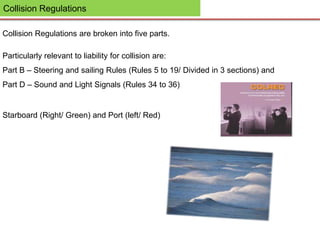
Starboard (Right/ Green) and Port (left/ Red)
Rule 13 Overtaking
Rule 13
Overtaking
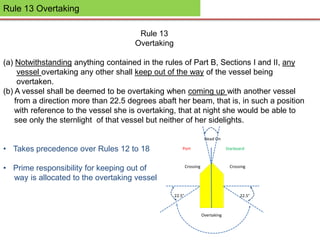
(a) Notwithstanding anything contained in the rules of Part B, Sections I and II, any
vessel overtaking any other shall keep out of the way of the vessel being
overtaken.
(b) A vessel shall be deemed to be overtaking when coming up with another vessel
from a direction more than 22.5 degrees abaft her beam, that is, in such a position
with reference to the vessel she is overtaking, that at night she would be able to
see only the sternlight of that vessel but neither of her sidelights.
• Takes precedence over Rules 12 to 18
• Prime responsibility for keeping out of
way is allocated to the overtaking vessel
Head On
Port Starboard
Crossing Crossing
22.5° 22.5°
Overtaking
Rule 13 Overtaking
(c) When a vessel is in doubt as to whether she is overtaking another, she shall
assume that this is the case and act accordingly.
(d) Any subsequent alteration of bearing between the two vessels shall not make the
overtaking vessel a crossing vessel within the meaning of these rules or relieve
her of the duly of keeping clear of the overtaken vessel until she is finally past and
clear.
Situation 1 Situation 2
Baines Hawkins – Moilere (1893) – Overtaking rule applied
Aurigua – Manuel Campos (1977) – Distance too great to apply overtaking
----------------------------------------------------------------------------------------x----
5 nmile
-----------------------------------
---------------------------------------------------------------x-----
1 nmile
-----------------------------------
Rule 13 Overtaking
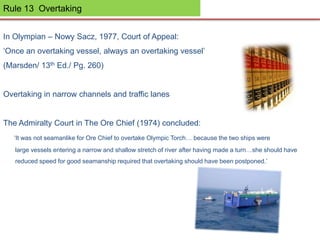
In Olympian – Nowy Sacz, 1977, Court of Appeal:
‘Once an overtaking vessel, always an overtaking vessel’
(Marsden/ 13th Ed./ Pg. 260)
Overtaking in narrow channels and traffic lanes
The Admiralty Court in The Ore Chief (1974) concluded:
‘It was not seamanlike for Ore Chief to overtake Olympic Torch… because the two ships were
large vessels entering a narrow and shallow stretch of river after having made a turn…she should have
reduced speed for good seamanship required that overtaking should have been postponed.’
Rule 14 Head-on situation
Rule 14
Head-on Situation
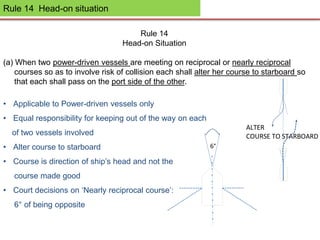
(a) When two power-driven vessels are meeting on reciprocal or nearly reciprocal
courses so as to involve risk of collision each shall alter her course to starboard so
that each shall pass on the port side of the other.
• Applicable to Power-driven vessels only
• Equal responsibility for keeping out of the way on each
of two vessels involved
• Alter course to starboard
• Course is direction of ship’s head and not the
course made good
• Court decisions on ‘Nearly reciprocal course’:
6° of being opposite
ALTER
COURSE TO STARBOARD
6°
Rule 14 Head-on situation
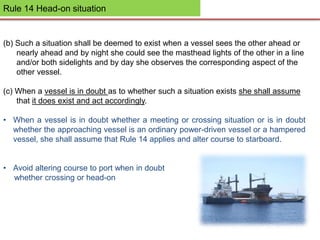
(b) Such a situation shall be deemed to exist when a vessel sees the other ahead or
nearly ahead and by night she could see the masthead lights of the other in a line
and/or both sidelights and by day she observes the corresponding aspect of the
other vessel.
(c) When a vessel is in doubt as to whether such a situation exists she shall assume
that it does exist and act accordingly.
• When a vessel is in doubt whether a meeting or crossing situation or is in doubt
whether the approaching vessel is an ordinary power-driven vessel or a hampered
vessel, she shall assume that Rule 14 applies and alter course to starboard.
• Avoid altering course to port when in doubt
whether crossing or head-on
Rule 14 – Head-on situation
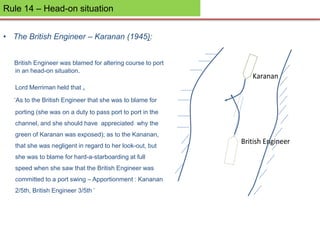
• The British Engineer – Karanan (1945):
British Engineer was blamed for altering course to port
in an head-on situation.
Lord Merriman held that ,
‘As to the British Engineer that she was to blame for
porting (she was on a duty to pass port to port in the
channel, and she should have appreciated why the
green of Karanan was exposed); as to the Kananan,
that she was negligent in regard to her look-out, but
she was to blame for hard-a-starboarding at full
speed when she saw that the British Engineer was
committed to a port swing – Apportionment : Kananan
2/5th, British Engineer 3/5th ’
Karanan
British Engineer
Rule 16: Action by the Give-way vessel
Rule 16
Action by Give-way vessel
Every vessel which is directed to keep out of the way of another vessel shall, so far
as possible, take early and substantial action to keep well clear.
• It overlaps with rule 8(c), which provides for any action to be made in ample time
and with due regard to the observance of good seamanship
• In The Billings Victory (1948), Wilmer J. held:
‘The duty of give-way vessel is to take timely action to keep clear. Moreover it
is her duty to act…handsomely, so as to leave stand-on vessel in no
possible doubt as to what the give-way vessel is doing.’
• In The Maloja II (1993), Sheen J. said:
‘The structure of the collision regulations is designed to ensure that, whenever possible, ships will not
reach a close quarter situation in which there is risk of collision and in which decisions have to be taken
without time for proper thought……Manoeuvres should be such as to be readily apparent to the other
ship…’
Rule 15 – Crossing Situation
Rule 15
Crossing Situation
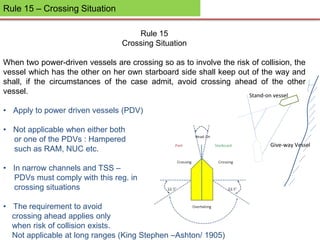
When two power-driven vessels are crossing so as to involve the risk of collision, the
vessel which has the other on her own starboard side shall keep out of the way and
shall, if the circumstances of the case admit, avoid crossing ahead of the other
vessel.
• Apply to power driven vessels (PDV)
• Not applicable when either both
or one of the PDVs : Hampered
such as RAM, NUC etc.
• In narrow channels and TSS –
PDVs must comply with this reg. in
crossing situations
• The requirement to avoid
crossing ahead applies only
when risk of collision exists.
Not applicable at long ranges (King Stephen –Ashton/ 1905)
Stand-on vessel
Give-way Vessel
Rule 15 – Crossing Situation
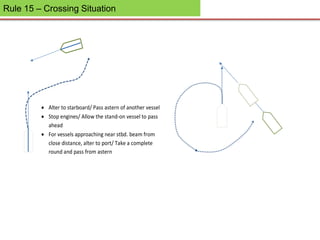
Alter to starboard/ Pass astern of another vessel
Stop engines/ Allow the stand-on vessel to pass
ahead
For vessels approaching near stbd. beam from
close distance, alter to port/ Take a complete
round and pass from astern
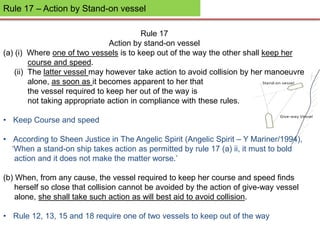
Rule 17 – Action by Stand-on vessel
Rule 17
Action by stand-on vessel
(a) (i) Where one of two vessels is to keep out of the way the other shall keep her
course and speed.
(ii) The latter vessel may however take action to avoid collision by her manoeuvre
alone, as soon as it becomes apparent to her that
the vessel required to keep her out of the way is
not taking appropriate action in compliance with these rules.
• Keep Course and speed
• According to Sheen Justice in The Angelic Spirit (Angelic Spirit – Y Mariner/1994),
‘When a stand-on ship takes action as permitted by rule 17 (a) ii, it must to bold
action and it does not make the matter worse.’
(b) When, from any cause, the vessel required to keep her course and speed finds
herself so close that collision cannot be avoided by the action of give-way vessel
alone, she shall take such action as will best aid to avoid collision.
• Rule 12, 13, 15 and 18 require one of two vessels to keep out of the way
Rule 15 & 17
(c) The power-driven vessel which takes action in a crossing situation in accordance
with sub paragraph (a)(ii) to avoid collision with another power-driven vessel
shall, if the circumstances of the case admit, not alter course to port for a vessel
on her port side.
(d) This rule does not relieve the give-way vessel of her obligation to keep out of the
way.
• Avoid turning to port to avoid collision
with another power driven vessel
• The Topaz and Irapua [2003] EWHC
320:
Irapua (Give-way)
(From Necochea to Fortaleza)
Topaz (Stand-on)
(From Mohammedia to Ponta Ubu)
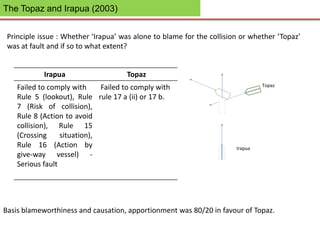
The Topaz and Irapua (2003)
Topaz
Irapua
Irapua Topaz
Failed to comply with
Rule 5 (lookout), Rule
7 (Risk of collision),
Rule 8 (Action to avoid
collision), Rule 15
(Crossing situation),
Rule 16 (Action by
give-way vessel) -
Serious fault
Failed to comply with
rule 17 a (ii) or 17 b.
Basis blameworthiness and causation, apportionment was 80/20 in favour of Topaz.
Principle issue : Whether ‘Irapua’ was alone to blame for the collision or whether ‘Topaz’
was at fault and if so to what extent?
Conclusion
In maritime cases, Each case is to be taken in the round and the faults of each ship weighed
in balance before an apportionment is made.
In another case of ‘Haugland v Karamea (1922)’, The House of lords emphasised that in
apportioning liability under the act (Maritime Conventions Act 1911) only faults that
contributed to the damage or loss should be taken into account.
In apportioning liability the degree of culpability and causative potency of all relevant faults
must be taken into account (per Lord Brandon, Tulane Law Review 1977)
Bibliography
• Howard Bennett, Maritime Law, Course Notes 2013.
• Simon Gault, Steven J. Hazelwood, 2003. Marsden on Collisions at Sea.
13th ed. London: Sweet and Maxwell
• A N Cockroft, J N F Lameijer, 2012. A guide to the collision
avoidance rules. 7th ed. London: Butterworth-Heinemann
• IMO 2003. COLREGS. 4th ed: IMO Publication
• The Topaz and Irapua (2003) EWHC 320
• The Ore Chief Lloyd's Law Reports, [1974] 2 Lloyd's Rep. 427
• Haugland v Karamea Lloyd's Law Reports , (1921) 9 Ll.L.Rep. 375
• The Angelic Spirit [ 1994] 2 LI LR 595
• The Maloja II (1993) 1 Lloyd’s Rep 48
• The 'British Engineer", Lloyd's Law Reports, (1944) 78 LL.L.Rep. 31
• Billings Victory (1949) 82 LI.L. Rep. 877
• Baines Hawkins (Moliere) 1893 7 Asp. 364 69
Thank you

Maritime law presenation

  • 1.
    Rules 13-17 ofthe International Regulations for Preventing Collisions at Sea Group 1: Maeve, Rajeev, Rahul, Rowena Maritime Law
  • 2.
    Introduction Convention on theInternational Regulations for preventing Collisions at Sea, 1972 First International Maritime conference on regulations – 1889 at Washington Adopted by US and UK, in 1897 1910 Brussels Conference – Remained in force until 1954 1954, 1972 – Amendments Last major amendments – Oct.1972/ Came in force 1977 Ratified by159 Countries Objective: Prevent Collisions and to minimise their effects Obligation: To give effect to the rules and other annexes
  • 3.
    Introduction United Kingdom : Statutoryinstrument – Merchant Shipping (Distress Signals and Prevention of Collisions) Regulations 1996 Under the authority of Sec. 81/ MSA 95 Singapore: Merchant Shipping Act (Ch. 179/ Sec. 208) Extract from Relevant Court judgment – To show how the rules are interpreted.
  • 4.
    Collision Regulations Collision Regulationsare broken into five parts. Particularly relevant to liability for collision are: Part B – Steering and sailing Rules (Rules 5 to 19/ Divided in 3 sections) and Part D – Sound and Light Signals (Rules 34 to 36) Starboard (Right/ Green) and Port (left/ Red)
  • 5.
    Rule 13 Overtaking Rule13 Overtaking (a) Notwithstanding anything contained in the rules of Part B, Sections I and II, any vessel overtaking any other shall keep out of the way of the vessel being overtaken. (b) A vessel shall be deemed to be overtaking when coming up with another vessel from a direction more than 22.5 degrees abaft her beam, that is, in such a position with reference to the vessel she is overtaking, that at night she would be able to see only the sternlight of that vessel but neither of her sidelights. • Takes precedence over Rules 12 to 18 • Prime responsibility for keeping out of way is allocated to the overtaking vessel Head On Port Starboard Crossing Crossing 22.5° 22.5° Overtaking
  • 6.
    Rule 13 Overtaking (c)When a vessel is in doubt as to whether she is overtaking another, she shall assume that this is the case and act accordingly. (d) Any subsequent alteration of bearing between the two vessels shall not make the overtaking vessel a crossing vessel within the meaning of these rules or relieve her of the duly of keeping clear of the overtaken vessel until she is finally past and clear. Situation 1 Situation 2 Baines Hawkins – Moilere (1893) – Overtaking rule applied Aurigua – Manuel Campos (1977) – Distance too great to apply overtaking ----------------------------------------------------------------------------------------x---- 5 nmile ----------------------------------- ---------------------------------------------------------------x----- 1 nmile -----------------------------------
  • 7.
    Rule 13 Overtaking InOlympian – Nowy Sacz, 1977, Court of Appeal: ‘Once an overtaking vessel, always an overtaking vessel’ (Marsden/ 13th Ed./ Pg. 260) Overtaking in narrow channels and traffic lanes The Admiralty Court in The Ore Chief (1974) concluded: ‘It was not seamanlike for Ore Chief to overtake Olympic Torch… because the two ships were large vessels entering a narrow and shallow stretch of river after having made a turn…she should have reduced speed for good seamanship required that overtaking should have been postponed.’
  • 8.
    Rule 14 Head-onsituation Rule 14 Head-on Situation (a) When two power-driven vessels are meeting on reciprocal or nearly reciprocal courses so as to involve risk of collision each shall alter her course to starboard so that each shall pass on the port side of the other. • Applicable to Power-driven vessels only • Equal responsibility for keeping out of the way on each of two vessels involved • Alter course to starboard • Course is direction of ship’s head and not the course made good • Court decisions on ‘Nearly reciprocal course’: 6° of being opposite ALTER COURSE TO STARBOARD 6°
  • 9.
    Rule 14 Head-onsituation (b) Such a situation shall be deemed to exist when a vessel sees the other ahead or nearly ahead and by night she could see the masthead lights of the other in a line and/or both sidelights and by day she observes the corresponding aspect of the other vessel. (c) When a vessel is in doubt as to whether such a situation exists she shall assume that it does exist and act accordingly. • When a vessel is in doubt whether a meeting or crossing situation or is in doubt whether the approaching vessel is an ordinary power-driven vessel or a hampered vessel, she shall assume that Rule 14 applies and alter course to starboard. • Avoid altering course to port when in doubt whether crossing or head-on
  • 10.
    Rule 14 –Head-on situation • The British Engineer – Karanan (1945): British Engineer was blamed for altering course to port in an head-on situation. Lord Merriman held that , ‘As to the British Engineer that she was to blame for porting (she was on a duty to pass port to port in the channel, and she should have appreciated why the green of Karanan was exposed); as to the Kananan, that she was negligent in regard to her look-out, but she was to blame for hard-a-starboarding at full speed when she saw that the British Engineer was committed to a port swing – Apportionment : Kananan 2/5th, British Engineer 3/5th ’ Karanan British Engineer
  • 11.
    Rule 16: Actionby the Give-way vessel Rule 16 Action by Give-way vessel Every vessel which is directed to keep out of the way of another vessel shall, so far as possible, take early and substantial action to keep well clear. • It overlaps with rule 8(c), which provides for any action to be made in ample time and with due regard to the observance of good seamanship • In The Billings Victory (1948), Wilmer J. held: ‘The duty of give-way vessel is to take timely action to keep clear. Moreover it is her duty to act…handsomely, so as to leave stand-on vessel in no possible doubt as to what the give-way vessel is doing.’ • In The Maloja II (1993), Sheen J. said: ‘The structure of the collision regulations is designed to ensure that, whenever possible, ships will not reach a close quarter situation in which there is risk of collision and in which decisions have to be taken without time for proper thought……Manoeuvres should be such as to be readily apparent to the other ship…’
  • 12.
    Rule 15 –Crossing Situation Rule 15 Crossing Situation When two power-driven vessels are crossing so as to involve the risk of collision, the vessel which has the other on her own starboard side shall keep out of the way and shall, if the circumstances of the case admit, avoid crossing ahead of the other vessel. • Apply to power driven vessels (PDV) • Not applicable when either both or one of the PDVs : Hampered such as RAM, NUC etc. • In narrow channels and TSS – PDVs must comply with this reg. in crossing situations • The requirement to avoid crossing ahead applies only when risk of collision exists. Not applicable at long ranges (King Stephen –Ashton/ 1905) Stand-on vessel Give-way Vessel
  • 13.
    Rule 15 –Crossing Situation Alter to starboard/ Pass astern of another vessel Stop engines/ Allow the stand-on vessel to pass ahead For vessels approaching near stbd. beam from close distance, alter to port/ Take a complete round and pass from astern
  • 14.
    Rule 17 –Action by Stand-on vessel Rule 17 Action by stand-on vessel (a) (i) Where one of two vessels is to keep out of the way the other shall keep her course and speed. (ii) The latter vessel may however take action to avoid collision by her manoeuvre alone, as soon as it becomes apparent to her that the vessel required to keep her out of the way is not taking appropriate action in compliance with these rules. • Keep Course and speed • According to Sheen Justice in The Angelic Spirit (Angelic Spirit – Y Mariner/1994), ‘When a stand-on ship takes action as permitted by rule 17 (a) ii, it must to bold action and it does not make the matter worse.’ (b) When, from any cause, the vessel required to keep her course and speed finds herself so close that collision cannot be avoided by the action of give-way vessel alone, she shall take such action as will best aid to avoid collision. • Rule 12, 13, 15 and 18 require one of two vessels to keep out of the way
  • 15.
    Rule 15 &17 (c) The power-driven vessel which takes action in a crossing situation in accordance with sub paragraph (a)(ii) to avoid collision with another power-driven vessel shall, if the circumstances of the case admit, not alter course to port for a vessel on her port side. (d) This rule does not relieve the give-way vessel of her obligation to keep out of the way. • Avoid turning to port to avoid collision with another power driven vessel • The Topaz and Irapua [2003] EWHC 320: Irapua (Give-way) (From Necochea to Fortaleza) Topaz (Stand-on) (From Mohammedia to Ponta Ubu)
  • 16.
    The Topaz andIrapua (2003) Topaz Irapua Irapua Topaz Failed to comply with Rule 5 (lookout), Rule 7 (Risk of collision), Rule 8 (Action to avoid collision), Rule 15 (Crossing situation), Rule 16 (Action by give-way vessel) - Serious fault Failed to comply with rule 17 a (ii) or 17 b. Basis blameworthiness and causation, apportionment was 80/20 in favour of Topaz. Principle issue : Whether ‘Irapua’ was alone to blame for the collision or whether ‘Topaz’ was at fault and if so to what extent?
  • 17.
    Conclusion In maritime cases,Each case is to be taken in the round and the faults of each ship weighed in balance before an apportionment is made. In another case of ‘Haugland v Karamea (1922)’, The House of lords emphasised that in apportioning liability under the act (Maritime Conventions Act 1911) only faults that contributed to the damage or loss should be taken into account. In apportioning liability the degree of culpability and causative potency of all relevant faults must be taken into account (per Lord Brandon, Tulane Law Review 1977)
  • 18.
    Bibliography • Howard Bennett,Maritime Law, Course Notes 2013. • Simon Gault, Steven J. Hazelwood, 2003. Marsden on Collisions at Sea. 13th ed. London: Sweet and Maxwell • A N Cockroft, J N F Lameijer, 2012. A guide to the collision avoidance rules. 7th ed. London: Butterworth-Heinemann • IMO 2003. COLREGS. 4th ed: IMO Publication • The Topaz and Irapua (2003) EWHC 320 • The Ore Chief Lloyd's Law Reports, [1974] 2 Lloyd's Rep. 427 • Haugland v Karamea Lloyd's Law Reports , (1921) 9 Ll.L.Rep. 375 • The Angelic Spirit [ 1994] 2 LI LR 595 • The Maloja II (1993) 1 Lloyd’s Rep 48 • The 'British Engineer", Lloyd's Law Reports, (1944) 78 LL.L.Rep. 31 • Billings Victory (1949) 82 LI.L. Rep. 877 • Baines Hawkins (Moliere) 1893 7 Asp. 364 69 Thank you