



USING WEB-LOGS  IN THE EFL CLASS Presented by Christina Markoulaki, an EFL teacher,  yet always a student markakischool.blogspot.com 7/3/2009 BLOGS IN THE EFL CLASS
AN OUTLINE OF THE PRESENTATION What is a web-log Why use it in the EFL class How teachers can use it (ideas and examples) How students can use it (ideas and examples) How to create your own web-log  The web-log elements  7/3/2009 BLOGS IN THE EFL CLASS
SOME POSITIVE THINKING “ You don't have to be great to start,  but you have to start to be great.” By  Zig Ziglar 7/3/2009 BLOGS IN THE EFL CLASS
INTRODUCTION Modern computer technology has made possible a new and rich learning experience. The development of viable software for communication and online publishing as well as improved networking speeds has made possible a variety of activities within a traditional class setting that extend the walls of the classroom. by  Julie Lindsay 7/3/2009 BLOGS IN THE EFL CLASS
SAMPLES OF STUDENTS’ BLOGS Take a look at these pages. xouakina.blogspot.com vasilis-panagiotis.blogspot.com These are students’ creations, which have also been awarded a prize in ‘ kseblogare ’ Greek blog competition . This is a sample of the vast potential blogs as innovative teaching tools offer. 7/3/2009 BLOGS IN THE EFL CLASS
WHAT IS A BLOG ANYWAY?  A  blog  (a  contraction  of the term  weblog ) is a  website , usually maintained by an individual with regular entries of commentary, descriptions of events, or other material such as graphics or video. Entries are commonly displayed in reverse-chronological order. "Blog" can also be used as a verb, meaning  to maintain or add content to a blog . ( en.wikipedia.org/wiki/Blog ) 7/3/2009 BLOGS IN THE EFL CLASS
WHAT IS A BLOG?  (2) Many blogs provide commentary or news on a particular subject; others function as more personal  online diaries . A typical blog combines text, images, and links to other blogs,  Web pages , and other media related to its topic. The ability for readers to leave comments in an interactive format is an important part of many blogs.  ( en.wikipedia.org/wiki/Blog ) 7/3/2009 BLOGS IN THE EFL CLASS
WHY BLOG? (1) This is exactly one reason why I want my kids to blog; and just as importantly, to read the blogs of others. Blogs are doors to the rest of the world. This is a powerful explanation of what we try to do. We “invite other people to know our lives,” you “read others’ blogs and discover their lives in other places.” This is why I am adamant that my kids link to, read, and comment on the blogs of people who live in other parts of the globe. I want them to hear from  Australian kids , from  Brazilian kids . From kids who live in major urban centres, and from those who live in small towns just like they do. They need to learn about their differences, see their similarities, and understand about how, on this ever - shrinking globe, they are a generation of people who will have many problems to solve when they inherit what we are leaving behind. Clarence Fisher from  Remote Access 7/3/2009 BLOGS IN THE EFL CLASS
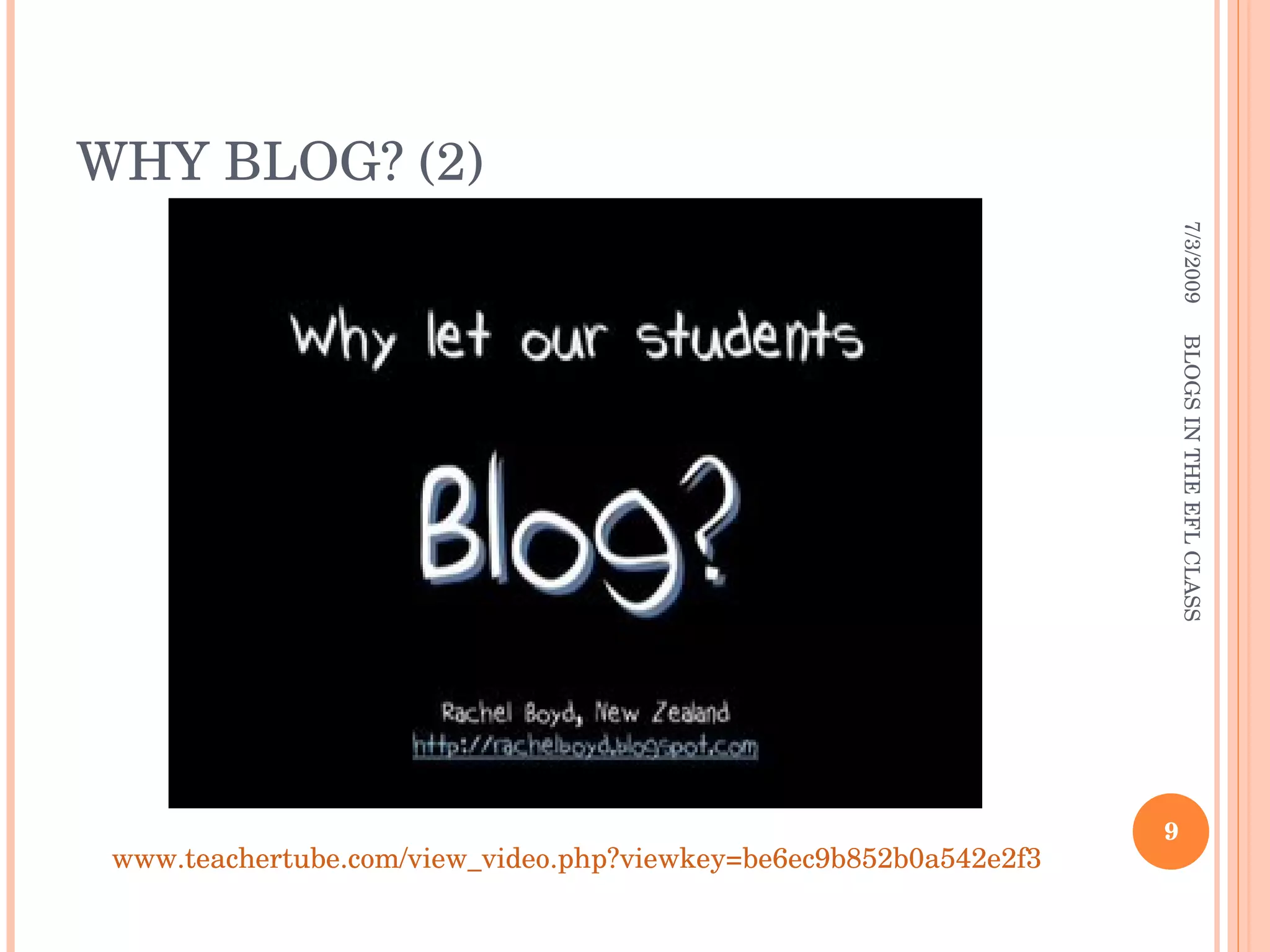
WHY BLOG? (2) 7/3/2009 BLOGS IN THE EFL CLASS www.teachertube.com/view_video.php?viewkey=be6ec9b852b0a542e2f3
WHAT A TEACHER CAN DO WITH A BLOG post photographs, texts or videos relevant to classroom activities,  then assign a task to students (i.e. ask them to write a comment or a post on their blog) Examples: bullying c class Rwanda Mr Fisher1  &  2   7/3/2009 BLOGS IN THE EFL CLASS
WHAT A TEACHER CAN DO WITH A BLOG 2 include useful links (link lists about all language areas)->  encourage self study Example:  Mr Fisher’s blog Markaki school blog 7/3/2009 BLOGS IN THE EFL CLASS
WHAT A TEACHER CAN DO WITH A BLOG 3 publish homework or other teaching notes (e.g. in pps format) by embedding them -> an e-class  markakischool.blogspot.com/2008/11/u2-lyrics-one-lyrics.html 7/3/2009 BLOGS IN THE EFL CLASS
WHAT A TEACHER CAN DO WITH A BLOG 4 provide reading practice-> have a professional write  about their job->  Ss read and ask questions -> the writer replies  Mary Hillis’s  post about a wedding cakes designer  7/3/2009 BLOGS IN THE EFL CLASS
WHAT A TEACHER CAN DO WITH A BLOG 5 publish students’ scanned work  create an on-line magazine markaki-students.blogspot.com 7/3/2009 BLOGS IN THE EFL CLASS
WHAT A TEACHER CAN DO WITH A BLOG 6 promote multiculturalism eTwinning project:  Are we really different?  (Portugal, Italy, Poland) 7/3/2009 BLOGS IN THE EFL CLASS
SOME FOOD FOR THOUGHT: If you had just completed  a unit on the  Past Perfect Simple  with your  C’ Class (A2) level students ,  what kind of follow-up task  would you choose  to include in your blog?  7/3/2009 BLOGS IN THE EFL CLASS
PUT THE PREVIOUS IDEAS INTO PRACTICE T  writes the rule, Ss provide the funniest examples possible in comment form: By the time the teacher started talking again, all the students had slept. Ss take turns to narrate a story: Alice had a really bad day yesterday. First, she woke up in the morning. After she had woken up, she stumbled on her way to the bathroom.  After she had stumbled…, she… embed YouTube videos  before  and  after  Hurricane Hugo hit-> Ss describe the scenes by leaving a comment, e.g. Before the hurricane hit, there hadn’t been any damage.  After it had hit, the weakest buildings were toppled down.  links to grammar quizzes 7/3/2009 BLOGS IN THE EFL CLASS
WHAT A STUDENT CAN DO WITH A BLOG (INDIVIDUALLY OR IN A TEAM) publish work done in class essays, poems, book reviews, news articles -> a  digital portfolio Examples: Adel : opinion on important issues, folktales, news articles class blog  by Spanish students: entry about 2 nd  conditional 7/3/2009 BLOGS IN THE EFL CLASS
WHAT A STUDENT CAN DO WITH A BLOG 2 keep an on-line diary about their  routine interests personal problems thoughts Examples Dora ’s blog Toni’s blog : mixture of personal thoughts and class work 7/3/2009 BLOGS IN THE EFL CLASS
WHAT A STUDENT CAN DO WITH A BLOG 3 discuss with classmates  or students in other countries and teacher about current issues Toni’s blog  about teenagers GK-hall  about Black History Month 7/3/2009 BLOGS IN THE EFL CLASS
WHAT A STUDENT CAN DO WITH A BLOG 4 embed  crossword puzzles   embed  glogs   to consolidate new vocabulary taught in class  C’ class Halloween glog 7/3/2009 BLOGS IN THE EFL CLASS
WHAT A STUDENT CAN DO WITH A BLOG 5 create other activities for classmates to solve  For example: gapped sentences riddles surveys 7/3/2009 BLOGS IN THE EFL CLASS
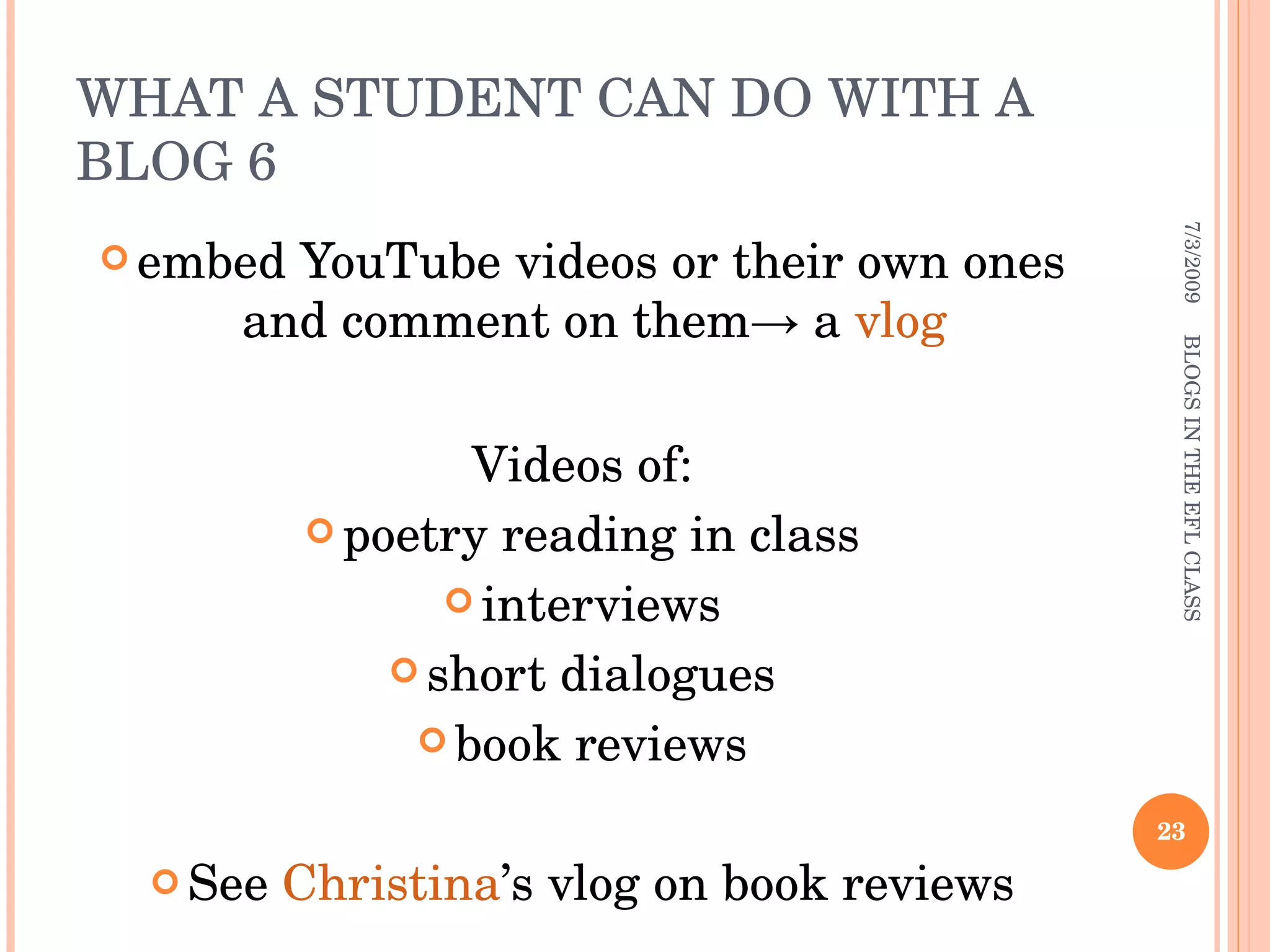
WHAT A STUDENT CAN DO WITH A BLOG 6 embed YouTube videos or their own ones and comment on them-> a  vlog   Videos of: poetry reading in class interviews short dialogues book reviews See  Christina ’s vlog on book reviews 7/3/2009 BLOGS IN THE EFL CLASS
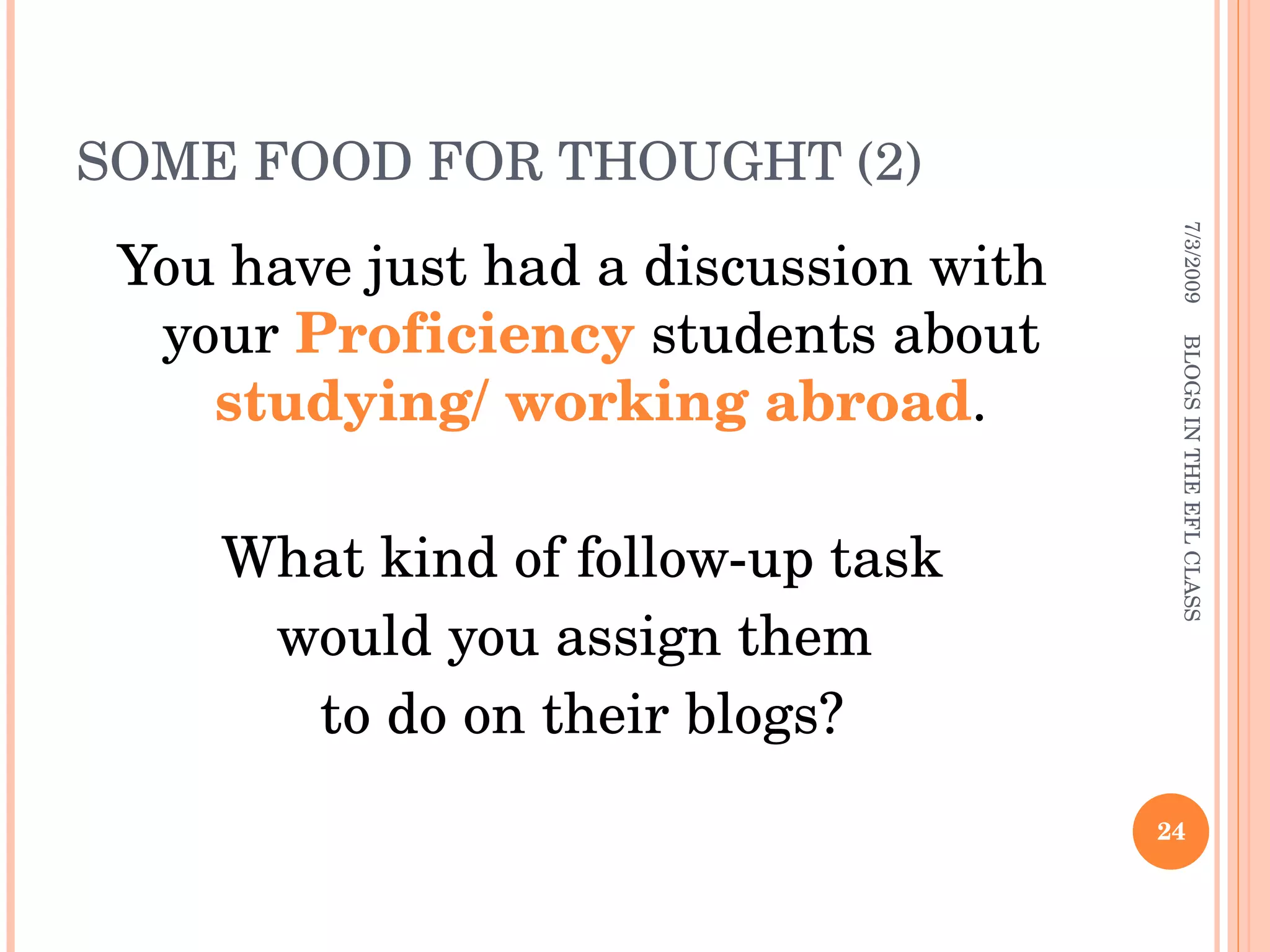
SOME FOOD FOR THOUGHT (2) You have just had a discussion with your  Proficiency  students about  studying/ working abroad . What kind of follow-up task  would you assign them  to do on their blogs? 7/3/2009 BLOGS IN THE EFL CLASS
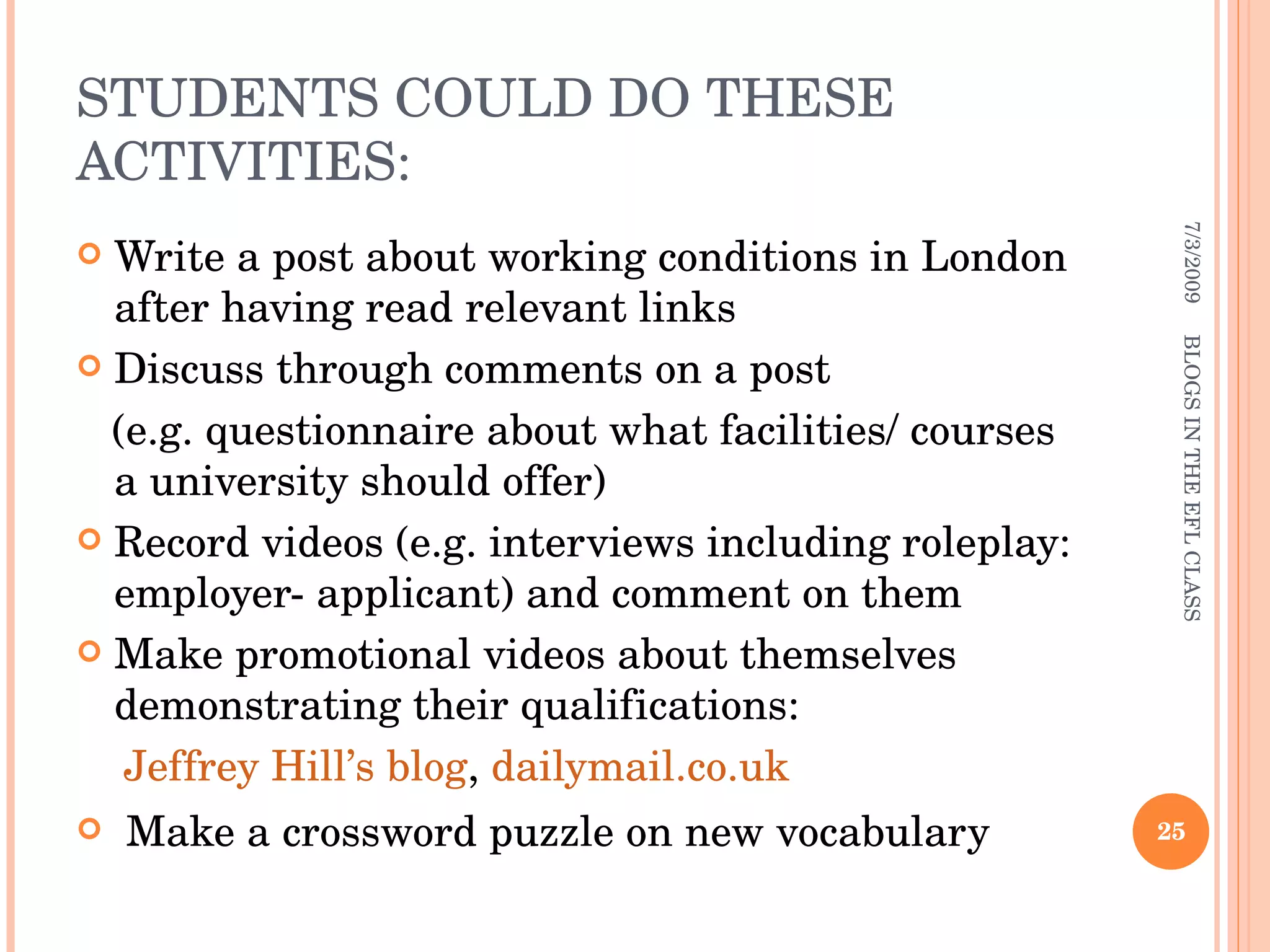
STUDENTS COULD DO THESE ACTIVITIES: Write a post about working conditions in London after having read relevant links Discuss through comments on a post (e.g. questionnaire about what facilities/ courses a university should offer) Record videos (e.g. interviews including roleplay: employer- applicant) and comment on them Make promotional videos about themselves demonstrating their qualifications: Jeffrey Hill’s blog ,  dailymail.co.uk Make a crossword puzzle on new vocabulary 7/3/2009 BLOGS IN THE EFL CLASS
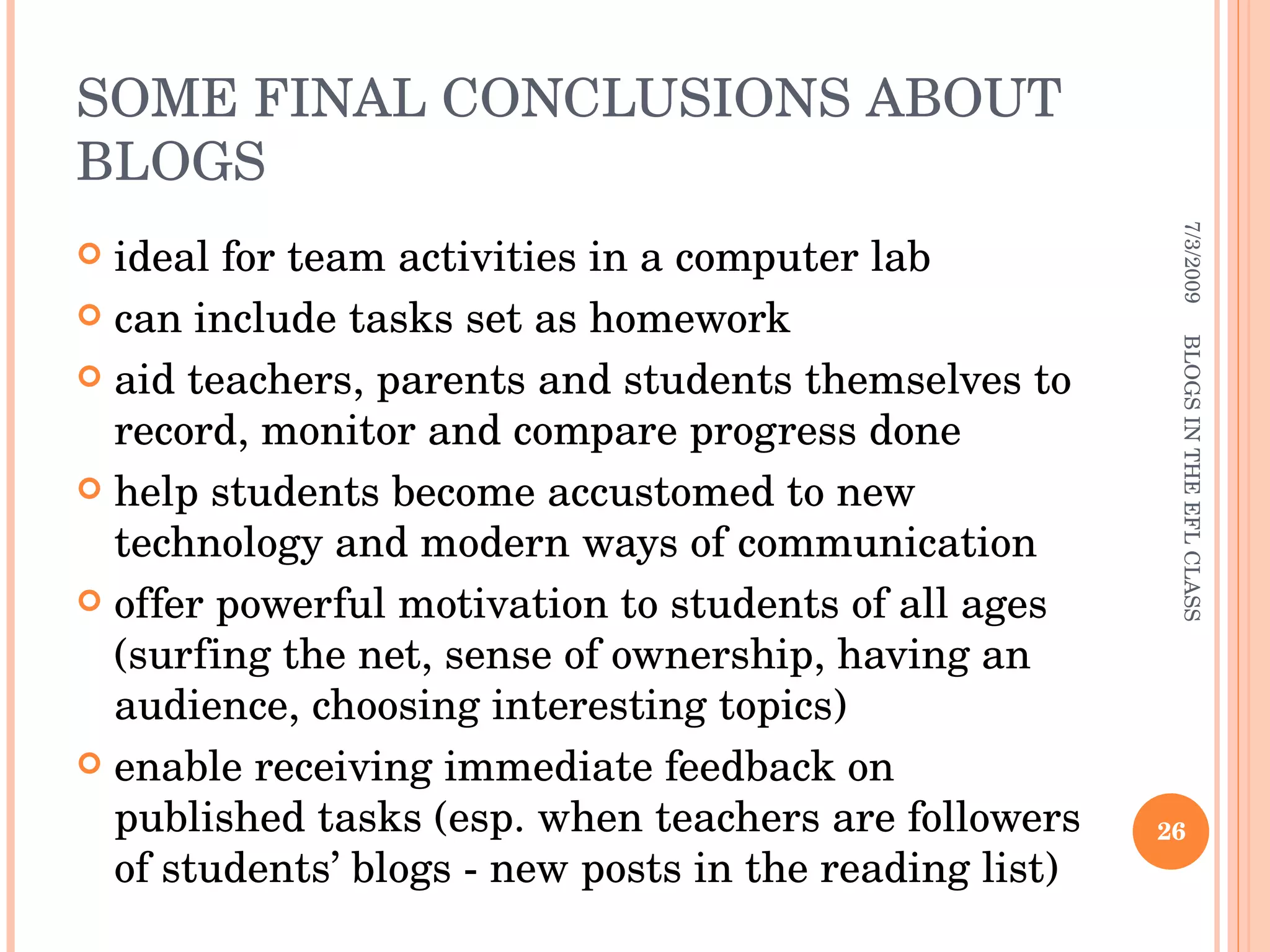
SOME FINAL CONCLUSIONS ABOUT BLOGS ideal for team activities in a computer lab can include tasks set as homework aid teachers, parents and students themselves to record, monitor and compare progress done help students become accustomed to new technology and modern ways of communication offer powerful motivation to students of all ages (surfing the net, sense of ownership, having an audience, choosing interesting topics)  enable receiving immediate feedback on published tasks (esp. when teachers are followers of students’ blogs - new posts in the reading list) 7/3/2009 BLOGS IN THE EFL CLASS
HOW TO SET UP A BLOGGER ACCOUNT 1.  Visit  www.blogger.com 2 . Click on ‘ create a blog ’ button 3.  Fill in all the required fields -> you need to: a) give a  valid  email address b) give a  display  or user  name  (like a signature)  4.  Write a  title  and find an available  URL address , which will also be relatively short and indicative of the purpose of the blog (e.g. Bclass.blogspot.com) 5 . Choose a  template  (the overall design of your blog) 6.  Start posting and customizing your blog! 7.  Main fields:  Posting  (to edit texts),  Settings  (to perform all kinds of adjustments),  Layout  (to arrange or add blog elements),  View Blog  (to view changes) 8 . To sign in again, visit  www.blogger.com 7/3/2009 BLOGS IN THE EFL CLASS
THE ELEMENTS OF A BLOG Header  = the title at the top of the page Posts = the texts in the main column Gadgets  = anything that can be added in all columns of the blog, that is: Pictures, texts, profile box, blog archive Various lists, link lists, list of followers, blog list Polls, slideshows of your photographs Video bar, newsreel, labels of all posts HTML code so as any other gadget to be embedded,  e.g. a clock, a daily renewed list of motivational quotes, a shelf with recommended books  Spot all the above on this teacher’s blog:  theenglishyouneedblog.blogspot.com 7/3/2009 BLOGS IN THE EFL CLASS
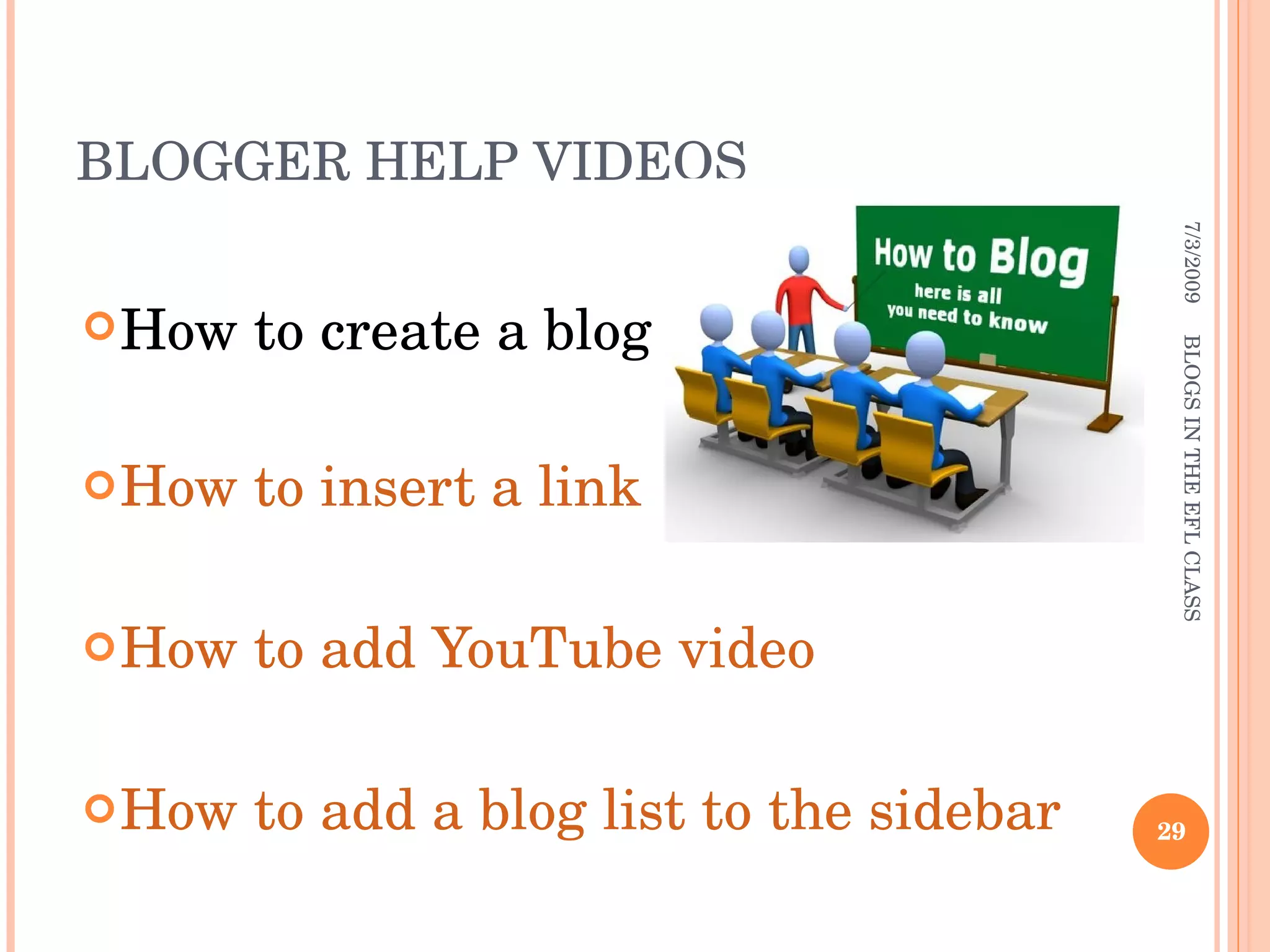
BLOGGER HELP VIDEOS How to create a blog How to insert a link How to add YouTube video How to add a blog list to the sidebar 7/3/2009 BLOGS IN THE EFL CLASS
MORE INTERNET RESOURCES ABOUT THE USE OF WEB LOGS IN THE EFL CLASS How to involve students in blogging  by Mary Hillis Various teachers and students’ blogs A Wikispace on blogs   by blogwalker eTwinning blogs  ‘Excellent classroom practices from Mr Fisher’  on The Cool Cat Teacher blog ‘ Weblogs for Use with ESL Classes ’ by A.P. Campbell ‘ Creating a Writing Course Utilizing Class and Student Blogs ’ by Andrew Johnson Weblogs links on The Internet TESL Journal EFL and ESL and web 2.0  on Teacher Dude’s blog Blogging for educators  on ‘One Teacher’s Journey’  blog The Edublogs magazine 7/3/2009 BLOGS IN THE EFL CLASS
IF YOU FEEL IN A SIMILAR WAY, BE SURE THAT REAL WORK STARTS NOW! 7/3/2009 BLOGS IN THE EFL CLASS

Using Web Logs in the EFL Class

  • 1.
    USING WEB-LOGS IN THE EFL CLASS Presented by Christina Markoulaki, an EFL teacher, yet always a student markakischool.blogspot.com 7/3/2009 BLOGS IN THE EFL CLASS
  • 2.
    AN OUTLINE OFTHE PRESENTATION What is a web-log Why use it in the EFL class How teachers can use it (ideas and examples) How students can use it (ideas and examples) How to create your own web-log The web-log elements 7/3/2009 BLOGS IN THE EFL CLASS
  • 3.
    SOME POSITIVE THINKING“ You don't have to be great to start, but you have to start to be great.” By Zig Ziglar 7/3/2009 BLOGS IN THE EFL CLASS
  • 4.
    INTRODUCTION Modern computertechnology has made possible a new and rich learning experience. The development of viable software for communication and online publishing as well as improved networking speeds has made possible a variety of activities within a traditional class setting that extend the walls of the classroom. by Julie Lindsay 7/3/2009 BLOGS IN THE EFL CLASS
  • 5.
    SAMPLES OF STUDENTS’BLOGS Take a look at these pages. xouakina.blogspot.com vasilis-panagiotis.blogspot.com These are students’ creations, which have also been awarded a prize in ‘ kseblogare ’ Greek blog competition . This is a sample of the vast potential blogs as innovative teaching tools offer. 7/3/2009 BLOGS IN THE EFL CLASS
  • 6.
    WHAT IS ABLOG ANYWAY? A blog (a contraction of the term weblog ) is a website , usually maintained by an individual with regular entries of commentary, descriptions of events, or other material such as graphics or video. Entries are commonly displayed in reverse-chronological order. "Blog" can also be used as a verb, meaning to maintain or add content to a blog . ( en.wikipedia.org/wiki/Blog ) 7/3/2009 BLOGS IN THE EFL CLASS
  • 7.
    WHAT IS ABLOG? (2) Many blogs provide commentary or news on a particular subject; others function as more personal online diaries . A typical blog combines text, images, and links to other blogs, Web pages , and other media related to its topic. The ability for readers to leave comments in an interactive format is an important part of many blogs. ( en.wikipedia.org/wiki/Blog ) 7/3/2009 BLOGS IN THE EFL CLASS
  • 8.
    WHY BLOG? (1)This is exactly one reason why I want my kids to blog; and just as importantly, to read the blogs of others. Blogs are doors to the rest of the world. This is a powerful explanation of what we try to do. We “invite other people to know our lives,” you “read others’ blogs and discover their lives in other places.” This is why I am adamant that my kids link to, read, and comment on the blogs of people who live in other parts of the globe. I want them to hear from Australian kids , from Brazilian kids . From kids who live in major urban centres, and from those who live in small towns just like they do. They need to learn about their differences, see their similarities, and understand about how, on this ever - shrinking globe, they are a generation of people who will have many problems to solve when they inherit what we are leaving behind. Clarence Fisher from Remote Access 7/3/2009 BLOGS IN THE EFL CLASS
  • 9.
    WHY BLOG? (2)7/3/2009 BLOGS IN THE EFL CLASS www.teachertube.com/view_video.php?viewkey=be6ec9b852b0a542e2f3
  • 10.
    WHAT A TEACHERCAN DO WITH A BLOG post photographs, texts or videos relevant to classroom activities, then assign a task to students (i.e. ask them to write a comment or a post on their blog) Examples: bullying c class Rwanda Mr Fisher1 & 2 7/3/2009 BLOGS IN THE EFL CLASS
  • 11.
    WHAT A TEACHERCAN DO WITH A BLOG 2 include useful links (link lists about all language areas)-> encourage self study Example: Mr Fisher’s blog Markaki school blog 7/3/2009 BLOGS IN THE EFL CLASS
  • 12.
    WHAT A TEACHERCAN DO WITH A BLOG 3 publish homework or other teaching notes (e.g. in pps format) by embedding them -> an e-class markakischool.blogspot.com/2008/11/u2-lyrics-one-lyrics.html 7/3/2009 BLOGS IN THE EFL CLASS
  • 13.
    WHAT A TEACHERCAN DO WITH A BLOG 4 provide reading practice-> have a professional write about their job-> Ss read and ask questions -> the writer replies Mary Hillis’s post about a wedding cakes designer 7/3/2009 BLOGS IN THE EFL CLASS
  • 14.
    WHAT A TEACHERCAN DO WITH A BLOG 5 publish students’ scanned work create an on-line magazine markaki-students.blogspot.com 7/3/2009 BLOGS IN THE EFL CLASS
  • 15.
    WHAT A TEACHERCAN DO WITH A BLOG 6 promote multiculturalism eTwinning project: Are we really different? (Portugal, Italy, Poland) 7/3/2009 BLOGS IN THE EFL CLASS
  • 16.
    SOME FOOD FORTHOUGHT: If you had just completed a unit on the Past Perfect Simple with your C’ Class (A2) level students , what kind of follow-up task would you choose to include in your blog? 7/3/2009 BLOGS IN THE EFL CLASS
  • 17.
    PUT THE PREVIOUSIDEAS INTO PRACTICE T writes the rule, Ss provide the funniest examples possible in comment form: By the time the teacher started talking again, all the students had slept. Ss take turns to narrate a story: Alice had a really bad day yesterday. First, she woke up in the morning. After she had woken up, she stumbled on her way to the bathroom. After she had stumbled…, she… embed YouTube videos before and after Hurricane Hugo hit-> Ss describe the scenes by leaving a comment, e.g. Before the hurricane hit, there hadn’t been any damage. After it had hit, the weakest buildings were toppled down. links to grammar quizzes 7/3/2009 BLOGS IN THE EFL CLASS
  • 18.
    WHAT A STUDENTCAN DO WITH A BLOG (INDIVIDUALLY OR IN A TEAM) publish work done in class essays, poems, book reviews, news articles -> a digital portfolio Examples: Adel : opinion on important issues, folktales, news articles class blog by Spanish students: entry about 2 nd conditional 7/3/2009 BLOGS IN THE EFL CLASS
  • 19.
    WHAT A STUDENTCAN DO WITH A BLOG 2 keep an on-line diary about their routine interests personal problems thoughts Examples Dora ’s blog Toni’s blog : mixture of personal thoughts and class work 7/3/2009 BLOGS IN THE EFL CLASS
  • 20.
    WHAT A STUDENTCAN DO WITH A BLOG 3 discuss with classmates or students in other countries and teacher about current issues Toni’s blog about teenagers GK-hall about Black History Month 7/3/2009 BLOGS IN THE EFL CLASS
  • 21.
    WHAT A STUDENTCAN DO WITH A BLOG 4 embed crossword puzzles embed glogs to consolidate new vocabulary taught in class C’ class Halloween glog 7/3/2009 BLOGS IN THE EFL CLASS
  • 22.
    WHAT A STUDENTCAN DO WITH A BLOG 5 create other activities for classmates to solve For example: gapped sentences riddles surveys 7/3/2009 BLOGS IN THE EFL CLASS
  • 23.
    WHAT A STUDENTCAN DO WITH A BLOG 6 embed YouTube videos or their own ones and comment on them-> a vlog Videos of: poetry reading in class interviews short dialogues book reviews See Christina ’s vlog on book reviews 7/3/2009 BLOGS IN THE EFL CLASS
  • 24.
    SOME FOOD FORTHOUGHT (2) You have just had a discussion with your Proficiency students about studying/ working abroad . What kind of follow-up task would you assign them to do on their blogs? 7/3/2009 BLOGS IN THE EFL CLASS
  • 25.
    STUDENTS COULD DOTHESE ACTIVITIES: Write a post about working conditions in London after having read relevant links Discuss through comments on a post (e.g. questionnaire about what facilities/ courses a university should offer) Record videos (e.g. interviews including roleplay: employer- applicant) and comment on them Make promotional videos about themselves demonstrating their qualifications: Jeffrey Hill’s blog , dailymail.co.uk Make a crossword puzzle on new vocabulary 7/3/2009 BLOGS IN THE EFL CLASS
  • 26.
    SOME FINAL CONCLUSIONSABOUT BLOGS ideal for team activities in a computer lab can include tasks set as homework aid teachers, parents and students themselves to record, monitor and compare progress done help students become accustomed to new technology and modern ways of communication offer powerful motivation to students of all ages (surfing the net, sense of ownership, having an audience, choosing interesting topics) enable receiving immediate feedback on published tasks (esp. when teachers are followers of students’ blogs - new posts in the reading list) 7/3/2009 BLOGS IN THE EFL CLASS
  • 27.
    HOW TO SETUP A BLOGGER ACCOUNT 1. Visit www.blogger.com 2 . Click on ‘ create a blog ’ button 3. Fill in all the required fields -> you need to: a) give a valid email address b) give a display or user name (like a signature) 4. Write a title and find an available URL address , which will also be relatively short and indicative of the purpose of the blog (e.g. Bclass.blogspot.com) 5 . Choose a template (the overall design of your blog) 6. Start posting and customizing your blog! 7. Main fields: Posting (to edit texts), Settings (to perform all kinds of adjustments), Layout (to arrange or add blog elements), View Blog (to view changes) 8 . To sign in again, visit www.blogger.com 7/3/2009 BLOGS IN THE EFL CLASS
  • 28.
    THE ELEMENTS OFA BLOG Header = the title at the top of the page Posts = the texts in the main column Gadgets = anything that can be added in all columns of the blog, that is: Pictures, texts, profile box, blog archive Various lists, link lists, list of followers, blog list Polls, slideshows of your photographs Video bar, newsreel, labels of all posts HTML code so as any other gadget to be embedded, e.g. a clock, a daily renewed list of motivational quotes, a shelf with recommended books Spot all the above on this teacher’s blog: theenglishyouneedblog.blogspot.com 7/3/2009 BLOGS IN THE EFL CLASS
  • 29.
    BLOGGER HELP VIDEOSHow to create a blog How to insert a link How to add YouTube video How to add a blog list to the sidebar 7/3/2009 BLOGS IN THE EFL CLASS
  • 30.
    MORE INTERNET RESOURCESABOUT THE USE OF WEB LOGS IN THE EFL CLASS How to involve students in blogging by Mary Hillis Various teachers and students’ blogs A Wikispace on blogs by blogwalker eTwinning blogs ‘Excellent classroom practices from Mr Fisher’ on The Cool Cat Teacher blog ‘ Weblogs for Use with ESL Classes ’ by A.P. Campbell ‘ Creating a Writing Course Utilizing Class and Student Blogs ’ by Andrew Johnson Weblogs links on The Internet TESL Journal EFL and ESL and web 2.0 on Teacher Dude’s blog Blogging for educators on ‘One Teacher’s Journey’ blog The Edublogs magazine 7/3/2009 BLOGS IN THE EFL CLASS
  • 31.
    IF YOU FEELIN A SIMILAR WAY, BE SURE THAT REAL WORK STARTS NOW! 7/3/2009 BLOGS IN THE EFL CLASS