Ljubljana, 18-20 may, 2011


               Radiofrequencies
Experimental Studies, Mechanisms of Interaction

                  Carmela Marino

        ENEA, Unit of Radiation Biology and Human Health, Rome, Italy
Cost action BM0704

Working Group 4: EMF - Biology
Carmela Marino, Isabelle Lagroye,
Claudio Pioli, Maria Rosaria Scarfi and Zenon
Sienkiewicz,
WG4-Children and EMF                                            In vitro studies


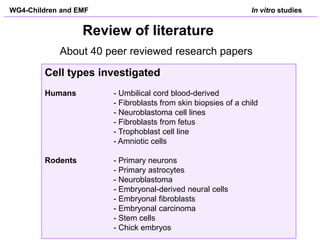
                  Review of literature
            About 40 peer reviewed research papers

        Cell types investigated
        Humans         - Umbilical cord blood-derived
                       - Fibroblasts from skin biopsies of a child
                       - Neuroblastoma cell lines
                       - Fibroblasts from fetus
                       - Trophoblast cell line
                       - Amniotic cells

        Rodents        - Primary neurons
                       - Primary astrocytes
                       - Neuroblastoma
                       - Embryonal-derived neural cells
                       - Embryonal fibroblasts
                       - Embryonal carcinoma
                       - Stem cells
                       - Chick embryos
WG4- RF and Children                                        In vitro studies


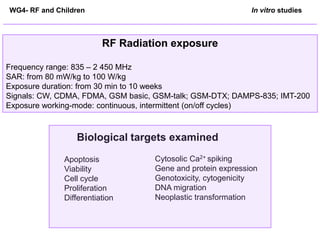
                         RF Radiation exposure

Frequency range: 835 – 2 450 MHz
SAR: from 80 mW/kg to 100 W/kg
Exposure duration: from 30 min to 10 weeks
Signals: CW, CDMA, FDMA, GSM basic, GSM-talk; GSM-DTX; DAMPS-835; IMT-200
Exposure working-mode: continuous, intermittent (on/off cycles)


                 Biological targets examined
              Apoptosis            Cytosolic Ca2+ spiking
              Viability            Gene and protein expression
              Cell cycle           Genotoxicity, cytogenicity
              Proliferation        DNA migration
              Differentiation      Neoplastic transformation
WG4- RF and Children                                                  In vitro studies


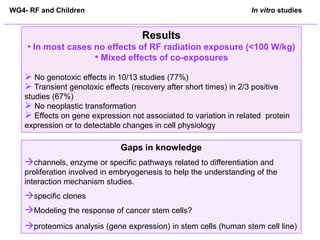
                                      Results
    • In most cases no effects of RF radiation exposure (<100 W/kg)
                        • Mixed effects of co-exposures
     No genotoxic effects in 10/13 studies (77%)
     Transient genotoxic effects (recovery after short times) in 2/3 positive
    studies (67%)
     No neoplastic transformation
     Effects on gene expression not associated to variation in related protein
    expression or to detectable changes in cell physiology

                                Gaps in knowledge
   channels, enzyme or specific pathways related to differentiation and
   proliferation involved in embryogenesis to help the understanding of the
   interaction mechanism studies.
   specific clones
   Modeling the response of cancer stem cells?
   proteomics analysis (gene expression) in stem cells (human stem cell line)
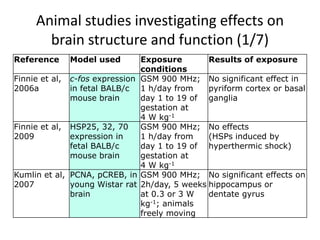
Animal studies investigating effects on
       brain structure and function (1/7)
Reference    Model used        Exposure        Results of exposure
                               conditions
Finnie et al, c-fos expression GSM 900 MHz; No significant effect in
2006a         in fetal BALB/c 1 h/day from     pyriform cortex or basal
              mouse brain      day 1 to 19 of ganglia
                               gestation at
                               4 W kg-1
Finnie et al, HSP25, 32, 70    GSM 900 MHz; No effects
2009          expression in    1 h/day from    (HSPs induced by
              fetal BALB/c     day 1 to 19 of hyperthermic shock)
              mouse brain      gestation at
                               4 W kg-1
Kumlin et al, PCNA, pCREB, in GSM 900 MHz; No significant effects on
2007          young Wistar rat 2h/day, 5 weeks hippocampus or
              brain            at 0.3 or 3 W   dentate gyrus
                               kg-1; animals
                               freely moving
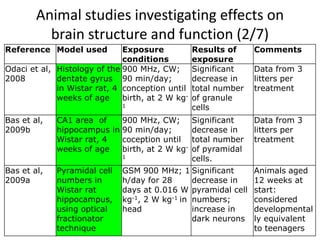
Animal studies investigating effects on
          brain structure and function (2/7)
Reference Model used          Exposure            Results of     Comments
                              conditions          exposure
Odaci et al, Histology of the 900 MHz, CW;        Significant    Data from 3
2008         dentate gyrus 90 min/day;            decrease in    litters per
             in Wistar rat, 4 conception until    total number   treatment
             weeks of age     birth, at 2 W kg-   of granule
                              1                   cells
Bas et al,   CA1 area of    900 MHz, CW;        Significant      Data from 3
2009b        hippocampus in 90 min/day;         decrease in      litters per
             Wistar rat, 4  coception until     total number     treatment
             weeks of age   birth, at 2 W kg-   of pyramidal
                              1                 cells.
Bas et al,   Pyramidal cell   GSM 900 MHz; 1 Significant         Animals aged
2009a        numbers in       h/day for 28      decrease in      12 weeks at
             Wistar rat       days at 0.016 W pyramidal cell     start:
             hippocampus,     kg-1, 2 W kg-1 in numbers;         considered
             using optical    head              increase in      developmental
             fractionator                       dark neurons     ly equivalent
             technique                                           to teenagers
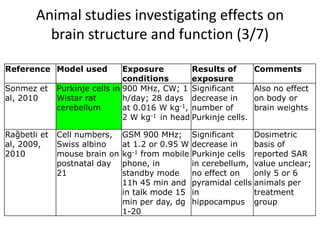
Animal studies investigating effects on
         brain structure and function (3/7)

Reference Model used            Exposure         Results of        Comments
                                conditions       exposure
Sonmez et     Purkinje cells in 900 MHz, CW; 1 Significant         Also no effect
al, 2010      Wistar rat        h/day; 28 days decrease in         on body or
              cerebellum        at 0.016 W kg-1, number of         brain weights
                                2 W kg-1 in head Purkinje cells.

Rağbetli et   Cell numbers,    GSM 900 MHz;       Significant     Dosimetric
al, 2009,     Swiss albino     at 1.2 or 0.95 W   decrease in     basis of
2010          mouse brain on   kg-1 from mobile   Purkinje cells reported SAR
              postnatal day    phone, in          in cerebellum, value unclear;
              21               standby mode       no effect on    only 5 or 6
                               11h 45 min and     pyramidal cells animals per
                               in talk mode 15    in              treatment
                               min per day, dg    hippocampus group
                               1-20
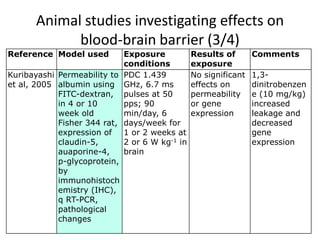
Animal studies investigating effects on
            blood-brain barrier (3/4)
Reference Model used        Exposure           Results of       Comments
                            conditions         exposure
Kuribayashi Permeability to PDC 1.439          No significant   1,3-
et al, 2005 albumin using GHz, 6.7 ms          effects on       dinitrobenzen
            FITC-dextran, pulses at 50         permeability     e (10 mg/kg)
            in 4 or 10      pps; 90            or gene          increased
            week old        min/day, 6         expression       leakage and
            Fisher 344 rat, days/week for                       decreased
            expression of 1 or 2 weeks at                       gene
            claudin-5,      2 or 6 W kg-1 in                    expression
            auaporine-4,    brain
            p-glycoprotein,
            by
            immunohistoch
            emistry (IHC),
            q RT-PCR,
            pathological
            changes
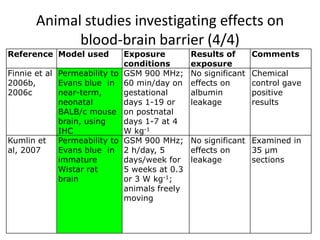
Animal studies investigating effects on
            blood-brain barrier (4/4)
Reference Model used         Exposure         Results of       Comments
                             conditions       exposure
Finnie et al Permeability to GSM 900 MHz;     No significant   Chemical
2006b,       Evans blue in 60 min/day on      effects on       control gave
2006c        near-term,      gestational      albumin          positive
             neonatal        days 1-19 or     leakage          results
             BALB/c mouse on postnatal
             brain, using    days 1-7 at 4
             IHC             W kg-1
Kumlin et    Permeability to GSM 900 MHz;     No significant Examined in
al, 2007     Evans blue in 2 h/day, 5         effects on     35 μm
             immature        days/week for    leakage        sections
             Wistar rat      5 weeks at 0.3
             brain           or 3 W kg-1;
                             animals freely
                             moving
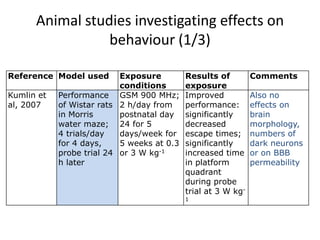
Animal studies investigating effects on
                 behaviour (1/3)

Reference Model used       Exposure         Results of         Comments
                           conditions       exposure
Kumlin et   Performance GSM 900 MHz;        Improved           Also no
al, 2007    of Wistar rats 2 h/day from     performance:       effects on
            in Morris      postnatal day    significantly      brain
            water maze; 24 for 5            decreased          morphology,
            4 trials/day   days/week for    escape times;      numbers of
            for 4 days,    5 weeks at 0.3   significantly      dark neurons
            probe trial 24 or 3 W kg-1      increased time     or on BBB
            h later                         in platform        permeability
                                            quadrant
                                            during probe
                                            trial at 3 W kg-
                                            1
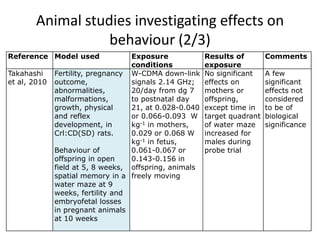
Animal studies investigating effects on
                  behaviour (2/3)
Reference Model used               Exposure             Results of        Comments
                                   conditions           exposure
Takahashi     Fertility, pregnancy W-CDMA down-link     No significant    A few
et al, 2010   outcome,             signals 2.14 GHz;    effects on        significant
              abnormalities,       20/day from dg 7     mothers or        effects not
              malformations,       to postnatal day     offspring,        considered
              growth, physical     21, at 0.028-0.040   except time in    to be of
              and reflex           or 0.066-0.093 W     target quadrant   biological
              development, in      kg-1 in mothers,     of water maze     significance
              Crl:CD(SD) rats.     0.029 or 0.068 W     increased for
                                   kg-1 in fetus,       males during
              Behaviour of         0.061-0.067 or       probe trial
              offspring in open    0.143-0.156 in
              field at 5, 8 weeks, offspring, animals
              spatial memory in a freely moving
              water maze at 9
              weeks, fertility and
              embryofetal losses
              in pregnant animals
              at 10 weeks
Animal studies investigating effects on
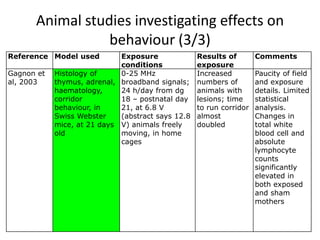
                 behaviour (3/3)
Reference Model used         Exposure              Results of        Comments
                             conditions            exposure
Gagnon et   Histology of     0-25 MHz              Increased         Paucity of field
al, 2003    thymus, adrenal, broadband signals;    numbers of        and exposure
            haematology,     24 h/day from dg      animals with      details. Limited
            corridor         18 – postnatal day    lesions; time     statistical
            behaviour, in    21, at 6.8 V          to run corridor   analysis.
            Swiss Webster    (abstract says 12.8   almost            Changes in
            mice, at 21 days V) animals freely     doubled           total white
            old              moving, in home                         blood cell and
                             cages                                   absolute
                                                                     lymphocyte
                                                                     counts
                                                                     significantly
                                                                     elevated in
                                                                     both exposed
                                                                     and sham
                                                                     mothers
Animal studies investigating effects on
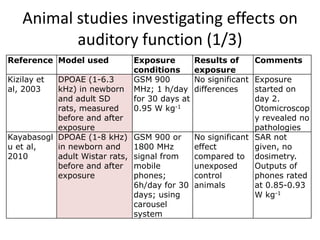
          auditory function (1/3)
Reference Model used          Exposure      Results of     Comments
                              conditions    exposure
Kizilay et DPOAE (1-6.3       GSM 900       No significant Exposure
al, 2003   kHz) in newborn    MHz; 1 h/day  differences    started on
           and adult SD       for 30 days at               day 2.
           rats, measured     0.95 W kg-1                  Otomicroscop
           before and after                                y revealed no
           exposure                                        pathologies
Kayabasogl DPOAE (1-8 kHz) GSM 900 or       No significant SAR not
u et al,   in newborn and     1800 MHz      effect         given, no
2010       adult Wistar rats, signal from   compared to dosimetry.
           before and after mobile          unexposed      Outputs of
           exposure           phones;       control        phones rated
                              6h/day for 30 animals        at 0.85-0.93
                              days; using                  W kg-1
                              carousel
                              system
Animal studies investigating effects on
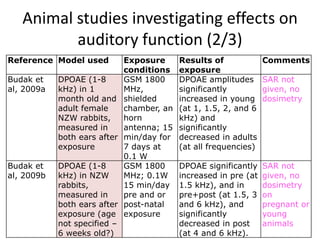
          auditory function (2/3)
Reference Model used          Exposure      Results of             Comments
                              conditions    exposure
Budak et    DPOAE (1-8        GSM 1800      DPOAE amplitudes       SAR not
al, 2009a   kHz) in 1         MHz,          significantly          given, no
            month old and     shielded      increased in young     dosimetry
            adult female      chamber, an   (at 1, 1.5, 2, and 6
            NZW rabbits,      horn          kHz) and
            measured in       antenna; 15   significantly
            both ears after   min/day for   decreased in adults
            exposure          7 days at     (at all frequencies)
                              0.1 W
Budak et    DPOAE (1-8        GSM 1800      DPOAE significantly    SAR not
al, 2009b   kHz) in NZW       MHz; 0.1W     increased in pre (at   given, no
            rabbits,          15 min/day    1.5 kHz), and in       dosimetry
            measured in       pre and or    pre+post (at 1.5, 3    on
            both ears after   post-natal    and 6 kHz), and        pregnant or
            exposure (age     exposure      significantly          young
            not specified –                 decreased in post      animals
            6 weeks old?)                   (at 4 and 6 kHz).
Animal studies investigating effects on
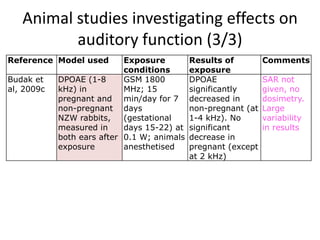
          auditory function (3/3)
Reference Model used        Exposure         Results of         Comments
                            conditions       exposure
Budak et    DPOAE (1-8      GSM 1800         DPOAE              SAR not
al, 2009c   kHz) in         MHz; 15          significantly      given, no
            pregnant and min/day for 7       decreased in       dosimetry.
            non-pregnant days                non-pregnant (at   Large
            NZW rabbits,    (gestational     1-4 kHz). No       variability
            measured in     days 15-22) at   significant        in results
            both ears after 0.1 W; animals   decrease in
            exposure        anesthetised     pregnant (except
                                             at 2 kHz)
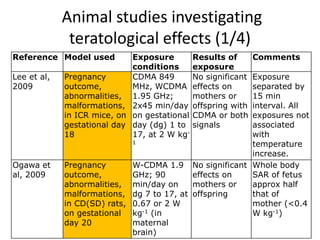
Animal studies investigating
              teratological effects (1/4)
Reference Model used         Exposure         Results of       Comments
                             conditions       exposure
Lee et al,   Pregnancy       CDMA 849         No significant
                                                       Exposure
2009         outcome,        MHz, WCDMA       effects on
                                                       separated by
             abnormalities, 1.95 GHz;         mothers or
                                                       15 min
             malformations, 2x45 min/day      offspring with
                                                       interval. All
             in ICR mice, on on gestational   CDMA or both
                                                       exposures not
             gestational day day (dg) 1 to    signals  associated
             18              17, at 2 W kg-            with
                             1                         temperature
                                                       increase.
Ogawa et     Pregnancy       W-CDMA 1.9 No significant Whole body
al, 2009     outcome,        GHz; 90       effects on  SAR of fetus
             abnormalities, min/day on     mothers or  approx half
             malformations, dg 7 to 17, at offspring   that of
             in CD(SD) rats, 0.67 or 2 W               mother (<0.4
             on gestational kg-1 (in                   W kg-1)
             day 20          maternal
                             brain)
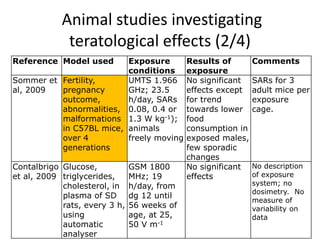
Animal studies investigating
             teratological effects (2/4)
Reference Model used     Exposure            Results of       Comments
                         conditions          exposure
Sommer et Fertility,     UMTS 1.966          No significant   SARs for 3
al, 2009  pregnancy      GHz; 23.5           effects except   adult mice per
          outcome,       h/day, SARs         for trend        exposure
          abnormalities, 0.08, 0.4 or        towards lower    cage.
          malformations 1.3 W kg-1);         food
          in C57BL mice, animals             consumption in
          over 4         freely moving       exposed males,
          generations                        few sporadic
                                             changes
Contalbrigo Glucose,           GSM 1800      No significant   No description
et al, 2009 triglycerides,     MHz; 19       effects          of exposure
            cholesterol, in    h/day, from                    system; no
                                                              dosimetry. No
            plasma of SD       dg 12 until
                                                              measure of
            rats, every 3 h,   56 weeks of                    variability on
            using              age, at 25,                    data
            automatic          50 V m-1
            analyser
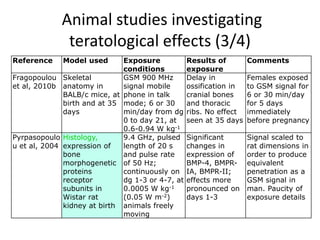
Animal studies investigating
                 teratological effects (3/4)
Reference       Model used      Exposure            Results of        Comments
                                conditions          exposure
Fragopoulou     Skeletal        GSM 900 MHz         Delay in          Females exposed
et al, 2010b    anatomy in      signal mobile       ossification in   to GSM signal for
                BALB/c mice, at phone in talk       cranial bones     6 or 30 min/day
                birth and at 35 mode; 6 or 30       and thoracic      for 5 days
                days            min/day from dg     ribs. No effect   immediately
                                0 to day 21, at     seen at 35 days   before pregnancy
                                0.6-0.94 W kg-1
Pyrpasopoulo    Histology,      9.4 GHz, pulsed     Significant       Signal scaled to
u et al, 2004   expression of   length of 20 s      changes in        rat dimensions in
                bone            and pulse rate      expression of     order to produce
                morphogenetic of 50 Hz;             BMP-4, BMPR-      equivalent
                proteins        continuously on     IA, BMPR-II;      penetration as a
                receptor        dg 1-3 or 4-7, at   effects more      GSM signal in
                subunits in     0.0005 W kg-1       pronounced on     man. Paucity of
                Wistar rat      (0.05 W m-2)        days 1-3          exposure details
                kidney at birth animals freely
                                moving
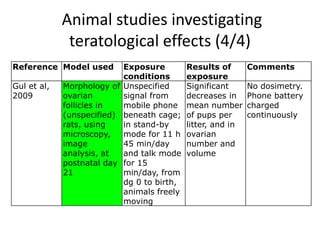
Animal studies investigating
              teratological effects (4/4)
Reference Model used       Exposure         Results of       Comments
                           conditions       exposure
Gul et al,   Morphology of Unspecified      Significant      No dosimetry.
2009         ovarian       signal from      decreases in     Phone battery
             follicles in  mobile phone     mean number      charged
             (unspecified) beneath cage;    of pups per      continuously
             rats, using   in stand-by      litter, and in
             microscopy,   mode for 11 h    ovarian
             image         45 min/day       number and
             analysis, at  and talk mode    volume
             postnatal day for 15
             21            min/day, from
                           dg 0 to birth,
                           animals freely
                           moving
Animal studies investigating effects on
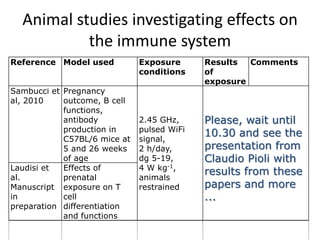
           the immune system
Reference Model used          Exposure      Results  Comments
                              conditions    of
                                            exposure
Sambucci et Pregnancy
al, 2010    outcome, B cell
            functions,
            antibody          2.45 GHz,     Please, wait until
            production in     pulsed WiFi
            C57BL/6 mice at   signal,
                                            10.30 and see the
            5 and 26 weeks    2 h/day,      presentation from
            of age            dg 5-19,      Claudio Pioli with
Laudisi et  Effects of        4 W kg-1,
                                            results from these
al.         prenatal          animals
Manuscript exposure on T      restrained    papers and more
in          cell                            ...
preparation differentiation
            and functions
Animal studies investigating effects on
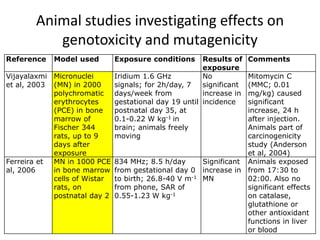
          genotoxicity and mutagenicity
Reference   Model used        Exposure conditions      Results of    Comments
                                                       exposure
Vijayalaxmi Micronuclei       Iridium 1.6 GHz          No           Mitomycin C
et al, 2003 (MN) in 2000      signals; for 2h/day, 7   significant  (MMC; 0.01
            polychromatic     days/week from           increase in  mg/kg) caused
            erythrocytes      gestational day 19 until incidence    significant
            (PCE) in bone     postnatal day 35, at                  increase, 24 h
            marrow of         0.1-0.22 W kg-1 in                    after injection.
            Fischer 344       brain; animals freely                 Animals part of
            rats, up to 9     moving                                carcinogenicity
            days after                                              study (Anderson
            exposure                                                et al, 2004)
Ferreira et MN in 1000 PCE    834 MHz; 8.5 h/day        Significant Animals exposed
al, 2006    in bone marrow    from gestational day 0    increase in from 17:30 to
            cells of Wistar   to birth; 26.8-40 V m-1   MN          02:00. Also no
            rats, on          from phone, SAR of                    significant effects
            postnatal day 2   0.55-1.23 W kg-1                      on catalase,
                                                                    glutathione or
                                                                    other antioxidant
                                                                    functions in liver
                                                                    or blood
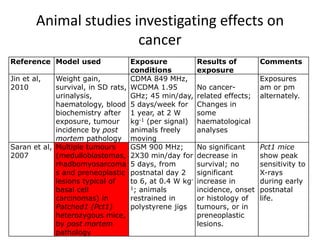
Animal studies investigating effects on
                        cancer
Reference Model used                 Exposure             Results of         Comments
                                     conditions           exposure
Jin et al,   Weight gain,            CDMA 849 MHz,                           Exposures
2010         survival, in SD rats,   WCDMA 1.95           No cancer-         am or pm
             urinalysis,             GHz; 45 min/day,     related effects;   alternately.
             haematology, blood      5 days/week for      Changes in
             biochemistry after      1 year, at 2 W       some
             exposure, tumour        kg-1 (per signal)    haematological
             incidence by post       animals freely       analyses
             mortem pathology        moving
Saran et al, Multiple tumours        GSM 900 MHz;         No significant     Pct1 mice
2007         (medulloblastomas,      2X30 min/day for     decrease in        show peak
             rhadbomyosarcoma        5 days, from         survival; no       sensitivity to
             s and preneoplastic     postnatal day 2      significant        X-rays
             lesions typical of      to 6, at 0.4 W kg-   increase in        during early
             basal cell              1; animals           incidence, onset   postnatal
             carcinomas) in          restrained in        or histology of    life.
             Patched1 (Pct1)         polystyrene jigs     tumours, or in
             heterozygous mice,                           preneoplastic
             by post mortem                               lesions.
             pathology
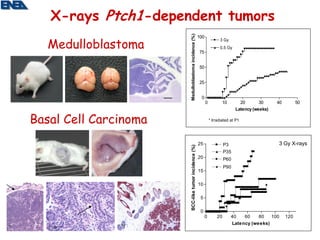
X-rays Ptch1-dependent tumors


                       Medulloblastoma incidence (%)
   Medulloblastoma
                                                       100
                                                                       3 Gy
                                                                       0.5 Gy
                                                       75


                                                       50


                                                       25


                                                        0
                                                             0           10       20       30     40         50
                                                                                Latency (weeks)

Basal Cell Carcinoma                                             * Irradiated at P1


                                                       25                 P3                      3 Gy X-rays


                       BCC-like tumor incidence (%)
                                                                          P35
                                                       20                 P60
                                                                          P90
                                                       15

                                                       10

                                                        5

                                                        0
                                                             0       20        40   60    80   100     120
                                                                               Latency (weeks)
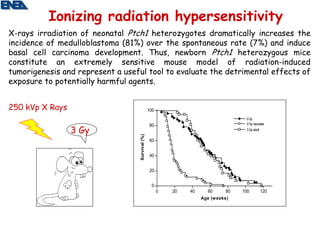
Ionizing radiation hypersensitivity
X-rays irradiation of neonatal Ptch1 heterozygotes dramatically increases the
incidence of medulloblastoma (81%) over the spontaneous rate (7%) and induce
basal cell carcinoma development. Thus, newborn Ptch1 heterozygous mice
constitute an extremely sensitive mouse model of radiation-induced
tumorigenesis and represent a useful tool to evaluate the detrimental effects of
exposure to potentially harmful agents.


250 kVp X Rays                                    100
                                                                                       0 Gy
                                                                                       3 Gy neonatal

                 3 Gy
                                                  80
                                                                                       3 Gy adult


                                   Survival (%)   60


                                                  40


                                                  20


                                                   0
                                                        0   20   40     60       80   100           120
                                                                      Age (w eeks)
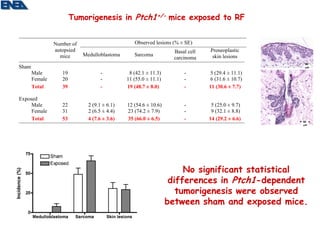
Tumorigenesis in Ptch1+/- mice exposed to RF


                Number of                        Observed lesions (% ± SE)
                autopsied                                          Basal cell   Preneoplastic
                  mice      Medulloblastoma      Sarcoma                         skin lesions
                                                                   carcinoma
                                                                                                   50
Sham                                                                                               mm

       Male        19               -          8 (42.1 ± 11.3)         -         5 (29.4 ± 11.1)
       Female      20               -         11 (55.0 ± 11.1)         -         6 (31.6 ± 10.7)
       Total       39               -         19 (48.7 ± 8.0)          -        11 (30.6 ± 7.7)

Exposed
     Male          22         2 (9.1 ± 6.1)   12 (54.6 ± 10.6)         -         5 (25.0 ± 9.7)
     Female        31         2 (6.5 ± 4.4)   23 (74.2 ± 7.9)          -         9 (32.1 ± 8.8)
     Total         53         4 (7.6 ± 3.6)   35 (66.0 ± 6.5)          -        14 (29.2 ± 6.6)    50
                                                                                                   mm


                                                                      No significant statistical
                                                                  differences in Ptch1-dependent
                                                                    tumorigenesis were observed
                                                                 between sham and exposed mice.
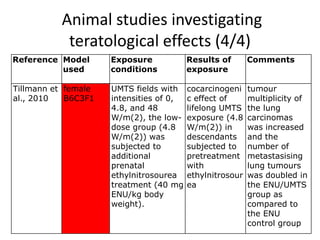
Animal studies investigating
           teratological effects (4/4)
Reference Model      Exposure            Results of       Comments
          used       conditions          exposure

Tillmann et female   UMTS fields with    cocarcinogeni    tumour
al., 2010   B6C3F1   intensities of 0,   c effect of      multiplicity of
                     4.8, and 48         lifelong UMTS    the lung
                     W/m(2), the low-    exposure (4.8    carcinomas
                     dose group (4.8     W/m(2)) in       was increased
                     W/m(2)) was         descendants      and the
                     subjected to        subjected to     number of
                     additional          pretreatment     metastasising
                     prenatal            with             lung tumours
                     ethylnitrosourea    ethylnitrosour   was doubled in
                     treatment (40 mg    ea               the ENU/UMTS
                     ENU/kg body                          group as
                     weight).                             compared to
                                                          the ENU
                                                          control group
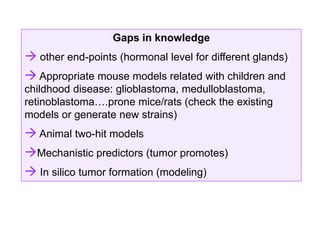
Gaps in knowledge
 other end-points (hormonal level for different glands)
 Appropriate mouse models related with children and
childhood disease: glioblastoma, medulloblastoma,
retinoblastoma….prone mice/rats (check the existing
models or generate new strains)
 Animal two-hit models
Mechanistic predictors (tumor promotes)
 In silico tumor formation (modeling)
Gaps in knowledge
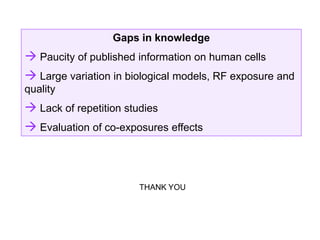
 Paucity of published information on human cells
 Large variation in biological models, RF exposure and
quality
 Lack of repetition studies
 Evaluation of co-exposures effects


                        THANK YOU

Marino

  • 1.
    Ljubljana, 18-20 may,2011 Radiofrequencies Experimental Studies, Mechanisms of Interaction Carmela Marino ENEA, Unit of Radiation Biology and Human Health, Rome, Italy
  • 2.
    Cost action BM0704 WorkingGroup 4: EMF - Biology Carmela Marino, Isabelle Lagroye, Claudio Pioli, Maria Rosaria Scarfi and Zenon Sienkiewicz,
  • 3.
    WG4-Children and EMF In vitro studies Review of literature About 40 peer reviewed research papers Cell types investigated Humans - Umbilical cord blood-derived - Fibroblasts from skin biopsies of a child - Neuroblastoma cell lines - Fibroblasts from fetus - Trophoblast cell line - Amniotic cells Rodents - Primary neurons - Primary astrocytes - Neuroblastoma - Embryonal-derived neural cells - Embryonal fibroblasts - Embryonal carcinoma - Stem cells - Chick embryos
  • 4.
    WG4- RF andChildren In vitro studies RF Radiation exposure Frequency range: 835 – 2 450 MHz SAR: from 80 mW/kg to 100 W/kg Exposure duration: from 30 min to 10 weeks Signals: CW, CDMA, FDMA, GSM basic, GSM-talk; GSM-DTX; DAMPS-835; IMT-200 Exposure working-mode: continuous, intermittent (on/off cycles) Biological targets examined Apoptosis Cytosolic Ca2+ spiking Viability Gene and protein expression Cell cycle Genotoxicity, cytogenicity Proliferation DNA migration Differentiation Neoplastic transformation
  • 5.
    WG4- RF andChildren In vitro studies Results • In most cases no effects of RF radiation exposure (<100 W/kg) • Mixed effects of co-exposures  No genotoxic effects in 10/13 studies (77%)  Transient genotoxic effects (recovery after short times) in 2/3 positive studies (67%)  No neoplastic transformation  Effects on gene expression not associated to variation in related protein expression or to detectable changes in cell physiology Gaps in knowledge channels, enzyme or specific pathways related to differentiation and proliferation involved in embryogenesis to help the understanding of the interaction mechanism studies. specific clones Modeling the response of cancer stem cells? proteomics analysis (gene expression) in stem cells (human stem cell line)
  • 6.
    Animal studies investigatingeffects on brain structure and function (1/7) Reference Model used Exposure Results of exposure conditions Finnie et al, c-fos expression GSM 900 MHz; No significant effect in 2006a in fetal BALB/c 1 h/day from pyriform cortex or basal mouse brain day 1 to 19 of ganglia gestation at 4 W kg-1 Finnie et al, HSP25, 32, 70 GSM 900 MHz; No effects 2009 expression in 1 h/day from (HSPs induced by fetal BALB/c day 1 to 19 of hyperthermic shock) mouse brain gestation at 4 W kg-1 Kumlin et al, PCNA, pCREB, in GSM 900 MHz; No significant effects on 2007 young Wistar rat 2h/day, 5 weeks hippocampus or brain at 0.3 or 3 W dentate gyrus kg-1; animals freely moving
  • 7.
    Animal studies investigatingeffects on brain structure and function (2/7) Reference Model used Exposure Results of Comments conditions exposure Odaci et al, Histology of the 900 MHz, CW; Significant Data from 3 2008 dentate gyrus 90 min/day; decrease in litters per in Wistar rat, 4 conception until total number treatment weeks of age birth, at 2 W kg- of granule 1 cells Bas et al, CA1 area of 900 MHz, CW; Significant Data from 3 2009b hippocampus in 90 min/day; decrease in litters per Wistar rat, 4 coception until total number treatment weeks of age birth, at 2 W kg- of pyramidal 1 cells. Bas et al, Pyramidal cell GSM 900 MHz; 1 Significant Animals aged 2009a numbers in h/day for 28 decrease in 12 weeks at Wistar rat days at 0.016 W pyramidal cell start: hippocampus, kg-1, 2 W kg-1 in numbers; considered using optical head increase in developmental fractionator dark neurons ly equivalent technique to teenagers
  • 8.
    Animal studies investigatingeffects on brain structure and function (3/7) Reference Model used Exposure Results of Comments conditions exposure Sonmez et Purkinje cells in 900 MHz, CW; 1 Significant Also no effect al, 2010 Wistar rat h/day; 28 days decrease in on body or cerebellum at 0.016 W kg-1, number of brain weights 2 W kg-1 in head Purkinje cells. Rağbetli et Cell numbers, GSM 900 MHz; Significant Dosimetric al, 2009, Swiss albino at 1.2 or 0.95 W decrease in basis of 2010 mouse brain on kg-1 from mobile Purkinje cells reported SAR postnatal day phone, in in cerebellum, value unclear; 21 standby mode no effect on only 5 or 6 11h 45 min and pyramidal cells animals per in talk mode 15 in treatment min per day, dg hippocampus group 1-20
  • 9.
    Animal studies investigatingeffects on blood-brain barrier (3/4) Reference Model used Exposure Results of Comments conditions exposure Kuribayashi Permeability to PDC 1.439 No significant 1,3- et al, 2005 albumin using GHz, 6.7 ms effects on dinitrobenzen FITC-dextran, pulses at 50 permeability e (10 mg/kg) in 4 or 10 pps; 90 or gene increased week old min/day, 6 expression leakage and Fisher 344 rat, days/week for decreased expression of 1 or 2 weeks at gene claudin-5, 2 or 6 W kg-1 in expression auaporine-4, brain p-glycoprotein, by immunohistoch emistry (IHC), q RT-PCR, pathological changes
  • 10.
    Animal studies investigatingeffects on blood-brain barrier (4/4) Reference Model used Exposure Results of Comments conditions exposure Finnie et al Permeability to GSM 900 MHz; No significant Chemical 2006b, Evans blue in 60 min/day on effects on control gave 2006c near-term, gestational albumin positive neonatal days 1-19 or leakage results BALB/c mouse on postnatal brain, using days 1-7 at 4 IHC W kg-1 Kumlin et Permeability to GSM 900 MHz; No significant Examined in al, 2007 Evans blue in 2 h/day, 5 effects on 35 μm immature days/week for leakage sections Wistar rat 5 weeks at 0.3 brain or 3 W kg-1; animals freely moving
  • 11.
    Animal studies investigatingeffects on behaviour (1/3) Reference Model used Exposure Results of Comments conditions exposure Kumlin et Performance GSM 900 MHz; Improved Also no al, 2007 of Wistar rats 2 h/day from performance: effects on in Morris postnatal day significantly brain water maze; 24 for 5 decreased morphology, 4 trials/day days/week for escape times; numbers of for 4 days, 5 weeks at 0.3 significantly dark neurons probe trial 24 or 3 W kg-1 increased time or on BBB h later in platform permeability quadrant during probe trial at 3 W kg- 1
  • 12.
    Animal studies investigatingeffects on behaviour (2/3) Reference Model used Exposure Results of Comments conditions exposure Takahashi Fertility, pregnancy W-CDMA down-link No significant A few et al, 2010 outcome, signals 2.14 GHz; effects on significant abnormalities, 20/day from dg 7 mothers or effects not malformations, to postnatal day offspring, considered growth, physical 21, at 0.028-0.040 except time in to be of and reflex or 0.066-0.093 W target quadrant biological development, in kg-1 in mothers, of water maze significance Crl:CD(SD) rats. 0.029 or 0.068 W increased for kg-1 in fetus, males during Behaviour of 0.061-0.067 or probe trial offspring in open 0.143-0.156 in field at 5, 8 weeks, offspring, animals spatial memory in a freely moving water maze at 9 weeks, fertility and embryofetal losses in pregnant animals at 10 weeks
  • 13.
    Animal studies investigatingeffects on behaviour (3/3) Reference Model used Exposure Results of Comments conditions exposure Gagnon et Histology of 0-25 MHz Increased Paucity of field al, 2003 thymus, adrenal, broadband signals; numbers of and exposure haematology, 24 h/day from dg animals with details. Limited corridor 18 – postnatal day lesions; time statistical behaviour, in 21, at 6.8 V to run corridor analysis. Swiss Webster (abstract says 12.8 almost Changes in mice, at 21 days V) animals freely doubled total white old moving, in home blood cell and cages absolute lymphocyte counts significantly elevated in both exposed and sham mothers
  • 14.
    Animal studies investigatingeffects on auditory function (1/3) Reference Model used Exposure Results of Comments conditions exposure Kizilay et DPOAE (1-6.3 GSM 900 No significant Exposure al, 2003 kHz) in newborn MHz; 1 h/day differences started on and adult SD for 30 days at day 2. rats, measured 0.95 W kg-1 Otomicroscop before and after y revealed no exposure pathologies Kayabasogl DPOAE (1-8 kHz) GSM 900 or No significant SAR not u et al, in newborn and 1800 MHz effect given, no 2010 adult Wistar rats, signal from compared to dosimetry. before and after mobile unexposed Outputs of exposure phones; control phones rated 6h/day for 30 animals at 0.85-0.93 days; using W kg-1 carousel system
  • 15.
    Animal studies investigatingeffects on auditory function (2/3) Reference Model used Exposure Results of Comments conditions exposure Budak et DPOAE (1-8 GSM 1800 DPOAE amplitudes SAR not al, 2009a kHz) in 1 MHz, significantly given, no month old and shielded increased in young dosimetry adult female chamber, an (at 1, 1.5, 2, and 6 NZW rabbits, horn kHz) and measured in antenna; 15 significantly both ears after min/day for decreased in adults exposure 7 days at (at all frequencies) 0.1 W Budak et DPOAE (1-8 GSM 1800 DPOAE significantly SAR not al, 2009b kHz) in NZW MHz; 0.1W increased in pre (at given, no rabbits, 15 min/day 1.5 kHz), and in dosimetry measured in pre and or pre+post (at 1.5, 3 on both ears after post-natal and 6 kHz), and pregnant or exposure (age exposure significantly young not specified – decreased in post animals 6 weeks old?) (at 4 and 6 kHz).
  • 16.
    Animal studies investigatingeffects on auditory function (3/3) Reference Model used Exposure Results of Comments conditions exposure Budak et DPOAE (1-8 GSM 1800 DPOAE SAR not al, 2009c kHz) in MHz; 15 significantly given, no pregnant and min/day for 7 decreased in dosimetry. non-pregnant days non-pregnant (at Large NZW rabbits, (gestational 1-4 kHz). No variability measured in days 15-22) at significant in results both ears after 0.1 W; animals decrease in exposure anesthetised pregnant (except at 2 kHz)
  • 17.
    Animal studies investigating teratological effects (1/4) Reference Model used Exposure Results of Comments conditions exposure Lee et al, Pregnancy CDMA 849 No significant Exposure 2009 outcome, MHz, WCDMA effects on separated by abnormalities, 1.95 GHz; mothers or 15 min malformations, 2x45 min/day offspring with interval. All in ICR mice, on on gestational CDMA or both exposures not gestational day day (dg) 1 to signals associated 18 17, at 2 W kg- with 1 temperature increase. Ogawa et Pregnancy W-CDMA 1.9 No significant Whole body al, 2009 outcome, GHz; 90 effects on SAR of fetus abnormalities, min/day on mothers or approx half malformations, dg 7 to 17, at offspring that of in CD(SD) rats, 0.67 or 2 W mother (<0.4 on gestational kg-1 (in W kg-1) day 20 maternal brain)
  • 18.
    Animal studies investigating teratological effects (2/4) Reference Model used Exposure Results of Comments conditions exposure Sommer et Fertility, UMTS 1.966 No significant SARs for 3 al, 2009 pregnancy GHz; 23.5 effects except adult mice per outcome, h/day, SARs for trend exposure abnormalities, 0.08, 0.4 or towards lower cage. malformations 1.3 W kg-1); food in C57BL mice, animals consumption in over 4 freely moving exposed males, generations few sporadic changes Contalbrigo Glucose, GSM 1800 No significant No description et al, 2009 triglycerides, MHz; 19 effects of exposure cholesterol, in h/day, from system; no dosimetry. No plasma of SD dg 12 until measure of rats, every 3 h, 56 weeks of variability on using age, at 25, data automatic 50 V m-1 analyser
  • 19.
    Animal studies investigating teratological effects (3/4) Reference Model used Exposure Results of Comments conditions exposure Fragopoulou Skeletal GSM 900 MHz Delay in Females exposed et al, 2010b anatomy in signal mobile ossification in to GSM signal for BALB/c mice, at phone in talk cranial bones 6 or 30 min/day birth and at 35 mode; 6 or 30 and thoracic for 5 days days min/day from dg ribs. No effect immediately 0 to day 21, at seen at 35 days before pregnancy 0.6-0.94 W kg-1 Pyrpasopoulo Histology, 9.4 GHz, pulsed Significant Signal scaled to u et al, 2004 expression of length of 20 s changes in rat dimensions in bone and pulse rate expression of order to produce morphogenetic of 50 Hz; BMP-4, BMPR- equivalent proteins continuously on IA, BMPR-II; penetration as a receptor dg 1-3 or 4-7, at effects more GSM signal in subunits in 0.0005 W kg-1 pronounced on man. Paucity of Wistar rat (0.05 W m-2) days 1-3 exposure details kidney at birth animals freely moving
  • 20.
    Animal studies investigating teratological effects (4/4) Reference Model used Exposure Results of Comments conditions exposure Gul et al, Morphology of Unspecified Significant No dosimetry. 2009 ovarian signal from decreases in Phone battery follicles in mobile phone mean number charged (unspecified) beneath cage; of pups per continuously rats, using in stand-by litter, and in microscopy, mode for 11 h ovarian image 45 min/day number and analysis, at and talk mode volume postnatal day for 15 21 min/day, from dg 0 to birth, animals freely moving
  • 21.
    Animal studies investigatingeffects on the immune system Reference Model used Exposure Results Comments conditions of exposure Sambucci et Pregnancy al, 2010 outcome, B cell functions, antibody 2.45 GHz, Please, wait until production in pulsed WiFi C57BL/6 mice at signal, 10.30 and see the 5 and 26 weeks 2 h/day, presentation from of age dg 5-19, Claudio Pioli with Laudisi et Effects of 4 W kg-1, results from these al. prenatal animals Manuscript exposure on T restrained papers and more in cell ... preparation differentiation and functions
  • 22.
    Animal studies investigatingeffects on genotoxicity and mutagenicity Reference Model used Exposure conditions Results of Comments exposure Vijayalaxmi Micronuclei Iridium 1.6 GHz No Mitomycin C et al, 2003 (MN) in 2000 signals; for 2h/day, 7 significant (MMC; 0.01 polychromatic days/week from increase in mg/kg) caused erythrocytes gestational day 19 until incidence significant (PCE) in bone postnatal day 35, at increase, 24 h marrow of 0.1-0.22 W kg-1 in after injection. Fischer 344 brain; animals freely Animals part of rats, up to 9 moving carcinogenicity days after study (Anderson exposure et al, 2004) Ferreira et MN in 1000 PCE 834 MHz; 8.5 h/day Significant Animals exposed al, 2006 in bone marrow from gestational day 0 increase in from 17:30 to cells of Wistar to birth; 26.8-40 V m-1 MN 02:00. Also no rats, on from phone, SAR of significant effects postnatal day 2 0.55-1.23 W kg-1 on catalase, glutathione or other antioxidant functions in liver or blood
  • 23.
    Animal studies investigatingeffects on cancer Reference Model used Exposure Results of Comments conditions exposure Jin et al, Weight gain, CDMA 849 MHz, Exposures 2010 survival, in SD rats, WCDMA 1.95 No cancer- am or pm urinalysis, GHz; 45 min/day, related effects; alternately. haematology, blood 5 days/week for Changes in biochemistry after 1 year, at 2 W some exposure, tumour kg-1 (per signal) haematological incidence by post animals freely analyses mortem pathology moving Saran et al, Multiple tumours GSM 900 MHz; No significant Pct1 mice 2007 (medulloblastomas, 2X30 min/day for decrease in show peak rhadbomyosarcoma 5 days, from survival; no sensitivity to s and preneoplastic postnatal day 2 significant X-rays lesions typical of to 6, at 0.4 W kg- increase in during early basal cell 1; animals incidence, onset postnatal carcinomas) in restrained in or histology of life. Patched1 (Pct1) polystyrene jigs tumours, or in heterozygous mice, preneoplastic by post mortem lesions. pathology
  • 24.
    X-rays Ptch1-dependent tumors Medulloblastoma incidence (%) Medulloblastoma 100 3 Gy 0.5 Gy 75 50 25 0 0 10 20 30 40 50 Latency (weeks) Basal Cell Carcinoma * Irradiated at P1 25 P3 3 Gy X-rays BCC-like tumor incidence (%) P35 20 P60 P90 15 10 5 0 0 20 40 60 80 100 120 Latency (weeks)
  • 25.
    Ionizing radiation hypersensitivity X-raysirradiation of neonatal Ptch1 heterozygotes dramatically increases the incidence of medulloblastoma (81%) over the spontaneous rate (7%) and induce basal cell carcinoma development. Thus, newborn Ptch1 heterozygous mice constitute an extremely sensitive mouse model of radiation-induced tumorigenesis and represent a useful tool to evaluate the detrimental effects of exposure to potentially harmful agents. 250 kVp X Rays 100 0 Gy 3 Gy neonatal 3 Gy 80 3 Gy adult Survival (%) 60 40 20 0 0 20 40 60 80 100 120 Age (w eeks)
  • 26.
    Tumorigenesis in Ptch1+/-mice exposed to RF Number of Observed lesions (% ± SE) autopsied Basal cell Preneoplastic mice Medulloblastoma Sarcoma skin lesions carcinoma 50 Sham mm Male 19 - 8 (42.1 ± 11.3) - 5 (29.4 ± 11.1) Female 20 - 11 (55.0 ± 11.1) - 6 (31.6 ± 10.7) Total 39 - 19 (48.7 ± 8.0) - 11 (30.6 ± 7.7) Exposed Male 22 2 (9.1 ± 6.1) 12 (54.6 ± 10.6) - 5 (25.0 ± 9.7) Female 31 2 (6.5 ± 4.4) 23 (74.2 ± 7.9) - 9 (32.1 ± 8.8) Total 53 4 (7.6 ± 3.6) 35 (66.0 ± 6.5) - 14 (29.2 ± 6.6) 50 mm No significant statistical differences in Ptch1-dependent tumorigenesis were observed between sham and exposed mice.
  • 27.
    Animal studies investigating teratological effects (4/4) Reference Model Exposure Results of Comments used conditions exposure Tillmann et female UMTS fields with cocarcinogeni tumour al., 2010 B6C3F1 intensities of 0, c effect of multiplicity of 4.8, and 48 lifelong UMTS the lung W/m(2), the low- exposure (4.8 carcinomas dose group (4.8 W/m(2)) in was increased W/m(2)) was descendants and the subjected to subjected to number of additional pretreatment metastasising prenatal with lung tumours ethylnitrosourea ethylnitrosour was doubled in treatment (40 mg ea the ENU/UMTS ENU/kg body group as weight). compared to the ENU control group
  • 28.
    Gaps in knowledge other end-points (hormonal level for different glands)  Appropriate mouse models related with children and childhood disease: glioblastoma, medulloblastoma, retinoblastoma….prone mice/rats (check the existing models or generate new strains)  Animal two-hit models Mechanistic predictors (tumor promotes)  In silico tumor formation (modeling)
  • 29.
    Gaps in knowledge Paucity of published information on human cells  Large variation in biological models, RF exposure and quality  Lack of repetition studies  Evaluation of co-exposures effects THANK YOU