Long-term exposure to nicotine causes nicotinic acetylcholine receptors (nAChRs) in Caenorhabditis elegans to undergo changes in abundance and activity. Specifically, prolonged nicotine treatment results in a decrease in nAChRs controlling egg-laying behavior and a reduction in sensitivity to nicotinic agonists. This nicotine adaptation requires the protein kinase C homolog TPA-1, as mutants lacking TPA-1 do not show adaptation and retain high nAChR levels. The results suggest that PKC-dependent signaling may regulate nAChR levels through effects on synthesis or degradation during nicotine adaptation.
![magnitude lower than their concentrations in the growth medium (Lewis
et al., 1980).
Microscopy. The strain ZZ2001 (genotype, unc-29(x29); Ex[rol-6d,
unc-29::GFP]; kindly provided by Jim Lewis) was used for localization of
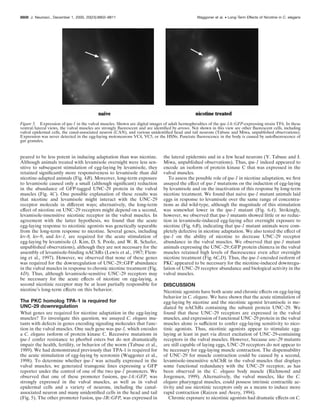
UNC-29 receptors. For visualization of VC–vulval muscle synapses, we used
the strain NM670 [genotype, lin-15(n765); jsIs42x [punc-4::snb-1::GFP, lin-
15(ϩ)]; kindly provided by Mike Nonet (1999)]. For visualization of the tpa-1
gene product protein kinase C (PKC), the strain TF6 (see below) was used.
Worms were placed on agar pads and immobilized with 30 mM sodium
azide. Green fluorescent protein (GFP) was visualized using standard
immunofluorescence techniques at a magnification of 100ϫ. Images were
collected using a high-speed monochrome CCD camera (Hamamatsu) and
analyzed using Metamorph image-processing software. To quantitate flu-
orescence intensity, the average background intensity was determined for
each image and subtracted from the final fluorescent intensity. Then, the
average, maximum, and minimum intensities were measured, along with
the average area of fluorescence. unc-29::GFP-expressing lines generated
in our own laboratory using dpy-20(ϩ) as a coinjection marker showed
fluorescence in essentially the same set of cells as ZZ2001 (data not
shown).
Generation of transgenic lines. Transgenic lines expressing the UNC-29
protein in specific cell types were constructed in the following manner. To
express UNC-29 in the vulval muscles, a 2510 bp piece of unc-29 cDNA
was cut from the plasmid pPD95.86. This piece was subcloned into the
vector pSAK-10 (obtained from A. Fire) downstream of the region con-
taining 18 repeats of the vulval muscle-specific ndE-box enhancer. This
plasmid was injected at ϳ100 ng/l into unc-29(x29); dpy-20(e1282) worms
using wild-type dpy-20(ϩ) DNA as a coinjection marker (25 ng/l). The F1
generation was scored for rescue of the dpy phenotype. Transgenic lines
transmitting an ndE-box::unc-29; dpy-20(ϩ) extrachromosomal array were
identified by assaying the non-Dpy progeny of non-Dpy F1 transformants
for egg-laying in the presence of 25 M levamisole in M9.
tpa-1::GFP reporter constructs. The expression pattern of tpa-1 was
evaluated using the strain TF6 (genotype, unc-119(e2498); Is
[tpa-1A::GFP; unc-119(ϩ)]). Two mRNA species, tpa-1A and tpa-1B, are
transcribed from the tpa-1 gene, which consists of 11 exons. The tpa-1A
mRNA contains all of the 11 exons, and the tpa-1B mRNA contains exons
V–XI. The tpa-1A::GFP reporter construct was generated by inserting a 9
kb NaeI fragment, which contained the tpa-1A 5Ј upstream region along
with the first two exons of the tpa-1A-coding sequence, into the SmaI site
of the GFP expression plasmid pGFP-N3 (Clontech, Cambridge, UK).
The resulting plasmid tpa-1A::GFP was injected into the germ lines of
unc-119 mutant animals using wild-type unc-119(ϩ) DNA as a cotransfor-
mation marker; rescued transgenic lines expressing tpa-1A::GFP were
identified among the progeny. The [tpa-1A::GFP; unc-119(ϩ)] extrachro-
mosomal array was integrated into the chromosome by UV irradiation.
Analysis of egg-laying patterns. Egg-laying in C. elegans occurs in a
specific temporal pattern; egg-laying events are clustered, with periods of
active egg-laying, or active phases, separated by long inactive phases
during which eggs are retained. Both the duration of the inactive phases
(“intercluster intervals”) and the duration of intervals between egg-laying
events in a cluster (“intracluster intervals”) model as exponential random
variables with different time constants (Waggoner et al., 1998). We found
(Table 1) that in wild-type animals treated overnight with nicotine, the
duration of the inactive phase was significantly lengthened, while the rate
of egg-laying within the active phase was actually increased (Table 1, rows
1, 2). Even after 24 hr in the absence of drug, nicotine-adapted animals
exhibited significantly longer inactive egg-laying periods (Table 1, row 3).
unc-29 mutant animals also showed a longer-than-normal inactive phase
(Table 1, row 4). The egg-laying behavior of individual animals on solid
media (NGM agar) was recorded for 4–8 hr as described using an auto-
mated tracking system (Waggoner et al., 1998).
Maximum likelihood estimates of intercluster and intracluster time
constants were determined as described (Zhou et al., 1998). Briefly, the
intracluster time constant is the reciprocal of the estimated parameter 1,
and the intercluster time constant is the reciprocal of the product of the
parameters p and 2. The expected variance of estimated time constants
was determined by generating 100 independent sets of simulated egg-
laying data using the coupled Poisson probability density function and
computing the SD of the parameters estimated from these simulations.
RESULTS
Nicotinic receptors containing UNC-29 stimulate egg-
laying in C. elegans
Both nicotine and the more specific nicotinic agonist levamisole
have dramatic effects on nematode egg-laying behavior. For exam-
ple, both nicotine and levamisole stimulate egg-laying in hyper-
tonic liquid medium (M9), a condition that normally inhibits egg-
laying (Trent et al., 1983; Weinshenker et al., 1995). To identify the
receptor that mediates this response, we assayed the effect of these
drugs on the egg-laying behavior of mutants known to be defective
in specific nicotinic acetylcholine receptor (nAChR) subunit pro-
teins. In the body muscle, levamisole specifically activates a nico-
tinic receptor subtype containing a non-␣ subunit encoded by the
unc-29 gene (Fleming et al., 1997). We observed that whereas
wild-type animals showed a robust dose-dependent stimulation of
egg-laying by levamisole, mutants carrying recessive alleles of
unc-29 showed little or no response to levamisole (Fig. 1A). unc-29
mutants were also less responsive to stimulation of egg-laying by
acute treatment with the more general agonist nicotine (Fig. 1B).
These results indicated that a nicotinic receptor containing the
UNC-29 subunit protein facilitated egg-laying in C. elegans and
that stimulation of egg-laying by the agonist levamisole represents
a functional assay for the activity of these receptors in vivo.
To understand how the UNC-29-containing receptor promotes
egg-laying, we investigated the expression pattern of the UNC-29
protein. Recently published studies indicated that UNC-29 recep-
tors are expressed in the body wall muscle, as well as some uniden-
tified neurons (Fleming et al., 1997); however, UNC-29 receptor
expression within the cells involved in egg-laying was not reported.
To determine whether the egg-laying neurons or muscle cells
contained UNC-29 receptors, we used a sensitive CCD imaging
system to investigate the expression pattern of a chimeric
UNC-29 protein tagged with GFP at its C terminal. This
UNC-29::GFP chimera was expressed under the control of its
own promoter and could functionally rescue the movement
(Fleming et al., 1997) and egg-laying (see Fig. 3A) phenotypes of
unc-29 recessive mutants. In multiple independent transgenic
lines, we observed expression of UNC-29::GFP protein in the
vulval muscles (Fig. 1C). UNC-29::GFP expression was also
detected in one of the two classes of egg-laying motoneurons,
the VCs. To determine whether activation of UNC-29 receptors
in the vulval muscles functioned to promote egg-laying, we
analyzed the egg-laying behavior of animals that expressed
functional UNC-29 protein only in these cells. We analyzed a
transgenic line that carried an unc-29 loss-of-function allele on
its chromosomes and expressed a functional unc-29 gene under
the control of the ndE-box promoter, which drives expression
only in the vulval muscles (Harfe and Fire, 1998). For this
transgenic line, levamisole induced robust, dose-dependent
Table 1. Effect of long-term nicotine treatment on the temporal pattern of egg-laying
Animal type (number, hours,
intervals)
Intraclus-
ter time
constant
(1/1; sec)
Intercluster
time constant
(1/p2; sec) p
1
(secϪ1
)
2
(secϪ1
ϫ 10Ϫ3
)
N2 (naive) (8, 46, 237) 18 Ϯ 2 1240 Ϯ 160 0.545 Ϯ 0.035 0.057 Ϯ 0.008 1.5 Ϯ 0.22
Nicotine-adapted N2 (t ϭ 0 hr)
(6, 33, 50) 5 Ϯ 2 3840** Ϯ 1080 0.380 Ϯ 0.082 0.203 Ϯ 0.152 0.7 Ϯ 0.25
Nicotine-adapted N2 (t ϭ 24 hr)
(5, 30, 105) 11 Ϯ 2 2040** Ϯ 1080 0.490 Ϯ 0.053 0.095 Ϯ 0.021 1.0 Ϯ 0.22
unc-29(x29) (3, 19, 78) 11 Ϯ 2 1980** Ϯ 480 0.673 Ϯ 0.050 0.090 Ϯ 0.015 0.75 Ϯ 0.38
**The intercluster intervals (Ͼ300 sec in duration) were significantly longer than those in wild type as determined by the Mann-Whitney rank-sum test (p Ͻ 0.05). See Materials
and Methods for parameter estimation and SD calculation.
Waggoner et al. • Long-Term Effects of Nicotine in C. elegans J. Neurosci., December 1, 2000, 20(23):8802–8811 8803](https://image.slidesharecdn.com/c1a130b1-07a8-47da-93bc-5d8c76d76c92-161109214335/85/JofNeuroscience2000-2-320.jpg)
![stimulation of egg-laying, indicating that the activity of vulval
muscle UNC-29 receptors was sufficient to promote egg-laying
(Fig. 1D). Thus, egg-laying in response to levamisole resulted at
least in part from the activity of UNC-29 receptors in the vulval
muscles.
Effects of long-term nicotine exposure on
egg-laying behavior
Using egg-laying as an assay, we investigated whether long-term
exposure to nicotinic agonists led to adaptation of unc-29-
dependent nicotinic responses. We therefore cultured wild-type
hermaphrodites for long (16 hr) periods in the presence of nicotine
and then assayed their egg-laying behavior. We observed that
chronic nicotine treatment did not prevent egg-laying muscle con-
traction per se. However, the nicotine-adapted animals were
strongly resistant to stimulation of egg-laying by levamisole (Fig.
2A). Because these animals still laid eggs in response to the
neurotransmitter serotonin, long-term nicotine treatment appeared
to downregulate specifically the egg-laying response to levamisole.
This adaptive response to nicotine was induced slowly, because loss
Figure 1. Requirement of the UNC-29 receptor protein for the acute response to nicotinic agonists. Egg-laying responses to levamisole or nicotine were
assayed in liquid M9 after 1 hr of drug exposure. The unc-29(x29) allele contains a stop codon that interrupts the conserved fourth transmembrane region
of the UNC-29 receptor protein (D. S. Poole, unpublished observations) and thus should result in a severe, if not complete, loss of receptor function. The
N2 strain is the wild-type strain in these assays. A, Response of unc-29 mutants to levamisole is shown. Animals carrying any of three unc-29 mutant alleles
showed a dramatic reduction in levamisole-induced egg-laying. Individual points and error bars indicate the mean and SEM of the following numbers of
trials: N2, 155; e193, 144; e1072, 96; x29, 96. Asterisks indicate significantly less egg-laying according to the Mann–Whitney rank-sum test (**p Ͻ 0.001;
*p Ͻ 0.01). Other genes that were required for the levamisole response in this assay included unc-38, unc-63, unc-74, lev-1, lev-8, and lev-9 (Kim, Poole,
and Schafer, unpublished observations). B, Response of unc-29 mutants to nicotine is shown. unc-29 mutants showed a significant reduction in
nicotine-induced egg-laying. Individual points and error bars indicate the mean and SEM of at least 12 trials. Asterisks indicate significantly less egg-laying
according to the Mann–Whitney rank-sum test (*p Ͻ 0.01). C, Localization of GFP-tagged UNC-29 protein is shown on a digital image of a ZZ2001 adult
hermaphrodite (genotype: unc-29(x29); Ex[ punc-29::unc-29::GFP, rol-6d]), which expresses unc-29::GFP under the control of the unc-29 promoter. In this
ventral/lateral view, the VC5 neuronal cell body and one set of vulval muscles are strongly fluorescent. Not shown in this view are other fluorescent cells,
including additional ventral cord motoneurons and various unidentified head and tail neurons. Punctate body fluorescence is caused by autofluorescence
of gut granules. D, UNC-29 receptors function in the vulval muscles. The graph compares the levamisole response of an unc-29 mutant [ZZ29,
unc-29(x29)] with that of a transgenic line that express a functional unc-29 allele under control of the vulval muscle-specific 18ndE-box enhancer (AQ497,
unc-29(x29); dpy-20(e1282); ljEx8[18ndE-box::unc-29, dpy-20(ϩ)]). Individual points and error bars indicate the mean and SEM of 20 or more trials. At
25 M, the AQ497 worms laid significantly more eggs according to the Mann–Whitney rank-sum test (*p Ͻ 0.001).
8804 J. Neurosci., December 1, 2000, 20(23):8802–8811 Waggoner et al. • Long-Term Effects of Nicotine in C. elegans](https://image.slidesharecdn.com/c1a130b1-07a8-47da-93bc-5d8c76d76c92-161109214335/85/JofNeuroscience2000-3-320.jpg)
![of the levamisole response occurred only after 1–3 hr of nicotine
exposure (Fig. 2B). Adaptation to nicotine was also surprisingly
long lasting; when nicotine-adapted animals were transferred to
drug-free medium, even 24 hr after removal from nicotine most
animals remained levamisole insensitive (Fig. 2C). Only at 36 hr
after removal from nicotine did the nicotine-adapted animals re-
cover their full responsiveness to levamisole. Thus, prolonged
exposure to nicotine resulted in a persistent loss of sensitivity to
nicotinic agonists with respect to egg-laying behavior. Because
transgenic lines that expressed functional UNC-29 only in the
vulval muscles also became levamisole insensitive after overnight
nicotine treatment (Fig. 2D), this adaptation to nicotine appeared
to affect the nicotinic response of the vulval muscles themselves.
Long-term nicotine treatment also caused changes in egg-laying
behavior in the absence of drug. Egg-laying in C. elegans occurs in
a specific temporal pattern; egg-laying events are clustered, with
periods of active egg-laying, or active phases, separated by long
inactive phases during which eggs are retained. Both the duration
of the inactive phases (intercluster intervals) and the duration of
intervals between egg-laying events in a cluster (intracluster inter-
vals) model as exponential random variables with different time
constants (Waggoner et al., 1998). Although wild-type hermaphro-
dites that had been exposed to nicotine overnight could still lay
eggs, their pattern of egg-laying behavior was abnormal; their
overall rate of egg-laying was lower, and the inactive egg-laying
phase was significantly longer than that of naive animals under the
Figure 2. Long-term adaptation of levamisole receptors to nicotine. A, Effect of overnight nicotine treatment on the levamisole response. Shown are
levamisole dose–response curves for wild-type animals cultured overnight in the presence of nicotine (30 mM); the dose–response curve of naive animals
under the same conditions is shown as a control. Egg-laying was measured after 4 hr at the indicated condition. Points and error bars indicate the mean
and SEM of 18 or more trials; at 25 M, the nicotine-adapted animals laid significantly fewer eggs than did the naive animals according to the
Mann–Whitney rank-sum test (*p Ͻ 0.001). These nicotine-adapted animals responded normally to serotonin; egg-laying rates in M9 salts containing 7.5
mM serotonin were as follows: naive, 2.7 Ϯ 1.2 eggs/hr; nicotine-adapted, 2.5 Ϯ 0.6 eggs/hr (n ϭ 12 in both cases). B, Time course of nicotine adaptation.
N2 hermaphrodites were placed on seeded NGM containing 30 mM nicotine for the indicated length of time and then assayed individually for egg-laying
in M9 ϩ 25 M levamisole as described in A. Points and error bars indicate the mean and SEM of 18 trials. C, Long-term persistence of nicotine adaptation.
The histogram shows the time course of recovery of levamisole responses in nicotine-adapted animals. N2 animals were grown overnight on NGM with
30 mM nicotine and then transferred to drug-free NGM plates for the indicated times; egg-laying in response to 25 M levamisole was tested as described.
Asterisks indicate time points in which the levamisole response was significantly lower in the nicotine-adapted animals than in the mock-treated animals
grown on NGM without nicotine (*p Ͻ 0.001). Vertical bars and error bars indicate the mean and SEM of at least 18 trials. D, Nicotine adaptation in
animals expressing only vulval muscle UNC-29 receptors. Shown are the levamisole dose–response curves for nicotine-treated animals expressing unc-29
only in the vulval muscles; naive animals are shown as a control. Animals of the strain AQ497 (genotype unc-29(x29); dpy-20(e1282); ljEx8
[18ndE-box::unc-29, dpy-20(ϩ)]) were cultured overnight on NGM containing 30 mM nicotine and then assayed for egg-laying in response to levamisole
as described. Points and error bars represent the mean and SEM of 20 or more trials. An asterisk indicates significantly less egg-laying according to the
Mann–Whitney rank-sum test (*p Ͻ 0.001).
Waggoner et al. • Long-Term Effects of Nicotine in C. elegans J. Neurosci., December 1, 2000, 20(23):8802–8811 8805](https://image.slidesharecdn.com/c1a130b1-07a8-47da-93bc-5d8c76d76c92-161109214335/85/JofNeuroscience2000-4-320.jpg)
![same condition. This temporal pattern was similar to (although
more severely abnormal than) the pattern seen in animals carrying
mutations in unc-29 (Table 1). These results were therefore con-
sistent with the possibility that the alteration in egg-laying behavior
induced by long-term nicotine exposure resulted at least in part
from a loss of unc-29 function in the vulval muscles.
Chronic nicotine treatment results in decreased
UNC-29 abundance
In principle, inactivation of UNC-29 receptor activity could occur
by a variety of mechanisms. One possibility we considered was that
chronic nicotine exposure could cause changes in the expression or
localization of the UNC-29 receptor protein, leading to a reduction
in the number of receptors at the cell surface. To investigate this
possibility, we used transgenic animals expressing GFP-tagged
UNC-29 protein to examine the effect of long-term nicotine expo-
sure on UNC-29 protein levels. The unc-29::GFP chimera we used
functionally rescued the behavioral abnormalities of unc-29 loss-
of-function mutations, including those associated with egg-laying,
and the levamisole response mediated by the chimeric receptor
protein was also subject to adaptation by long-term nicotine treat-
ment (Fig. 3A). Interestingly, we observed that chronic nicotine
treatment also caused a dramatic reduction in the level of
UNC-29::GFP fluorescence in the vulval muscles (Fig. 3B). This
nicotine-induced reduction in UNC-29::GFP did not require the
unc-29 promoter or 3Ј-untranslated region (3Ј-UTR), because
transgenic animals that expressed UNC-29::GFP in the vulval
muscles under the control of the ectopic myo-3 promoter and
unc-54 3Ј-UTR showed a qualitatively and quantitatively similar
response (Fig. 3C). The time course of downregulation of
UNC-29::GFP abundance was slow; 12–24 hr of nicotine exposure
was required to observe the maximum effect (Fig. 3D). The loss of
UNC-29::GFP fluorescence was not merely the result of a nonspe-
cific effect of nicotine on GFP, because long-term nicotine exposure
did not alter the fluorescent intensity of a VC-expressed
VAMP::GFP synaptic marker (Fig. 4A) or of GFP itself expressed
in the vulval muscles under the control of the tpa-1 promoter (see
Figure 3. Effect of long-term nicotine on
UNC-29 receptor abundance. A, Nicotine
response and adaptation in animals ex-
pressing UNC-29::GFP chimeric receptors.
The levamisole dose–response curves for
nicotine-adapted (i.e., cultured overnight
on 30 mM nicotine) and naive animals of
the strain ZZ2171 (genotype, unc-29(x29);
Ex[pmyo-3::unc-29::GFP, rol-6d]), which
expresses GFP-tagged UNC-29 protein in
vulval and body muscles, are shown. Points
and error bars represent the mean and SEM
of 20 or more trials. Asterisks indicate sig-
nificantly less egg-laying according to the
Mann–Whitney rank-sum test (*p Ͻ 0.05;
**p Ͻ 0.02). Similar results were obtained in
animals expressing UNC-29::GFP under
the control of the unc-29 promoter (data not
shown). B, Effect of chronic nicotine on vul-
val muscle UNC-29::GFP levels. Shown is a
digital image of a nicotine-treated adult her-
maphrodite expressing UNC- 29::GFP in
the vulval muscles under the control of the
unc-29 promoter (indicated by long arrows;
the vulva indicated by a short arrow). An
image of a naive animal of the same trans-
genic line (strain ZZ2001; genotype, unc-
29(x29); Ex[punc- 29::unc-29::GFP, rol-6d])
is shown for comparison. C, Effect of nico-
tine on vulval muscle UNC-29 levels in
pmyo-3::unc-29::GFP animals. Shown are
images of nicotine-adapted and naive
ZZ2171 hermaphrodites, which express
UNC-29::GFP in the vulval muscles under
the control of the muscle myosin promoter
pmyo-3. Long arrows indicate vulval mus-
cles; a short arrow indicates the vulva. D,
Time course of loss of UNC-29::GFP ex-
pression in the vulval muscles. ZZ2171 her-
maphrodites were placed on seeded NGM
containing 30 mM nicotine for the indicated
length of time; fluorescence intensity of the
vulval muscles is indicated. Vertical bars and
error bars indicate the mean and SEM of
five or more trials. Asterisks indicate signif-
icantly less fluorescence according to the
Mann–Whitney rank-sum test (*p Ͻ 0.05;
**p Ͻ 0.001). Lost UNC-29::GFP fluores-
cence was 60% recovered after 24 hr on
drug-free medium and completely recov-
ered after 36 hr (data not shown).
8806 J. Neurosci., December 1, 2000, 20(23):8802–8811 Waggoner et al. • Long-Term Effects of Nicotine in C. elegans](https://image.slidesharecdn.com/c1a130b1-07a8-47da-93bc-5d8c76d76c92-161109214335/85/JofNeuroscience2000-5-320.jpg)
![Fig. 5). Thus, the inhibitory effect of chronic nicotine on vulval
muscle nAChR activity was apparently accompanied by a corre-
sponding reduction in UNC-29 receptor abundance in the vulval
muscle cells, an effect most likely mediated via a post-
transcriptional regulatory mechanism.
Interestingly, the more specific nicotinic agonist levamisole ap-
Figure 4. Specificity of the long-term effects of nicotine on egg-laying. A, Effect of long-term nicotine on VC–vulval muscle synapses. Shown here is the
expression pattern of a synaptic marker (VAMP::GFP) that illuminates the VC–vulval muscle synapse, in both nicotine-treated (right) and naive (left) adult
animals (synapse identified by long arrows; the vulva identified by a short arrow). Animals of the strain NM670 (genotype, lin-15(n765); jsIs42x
[punc-4:snb-1::GFP, lin-15(ϩ)]) were cultured on NGM containing 30 mM nicotine overnight, and images were captured as described in Materials and
Methods. Naive animals cultured on NGM alone are shown for comparison. B, Effect of chronic levamisole treatment on the levamisole response. Shown
is the levamisole dose–response curve of wild-type animals grown in the presence of levamisole; the dose–response curve of naive animals under the same
conditions is shown as a control. N2 hermaphrodites were cultured overnight on NGM containing 50 M levamisole and then assayed individually for
egg-laying for 4 hr under the indicated condition as described in Figure 2. Points and error bars indicate the mean and SEM of 18 or more trials. C, Effect
of chronic levamisole treatment on UNC-29 receptor abundance. The histogram compares the UNC-29::GFP fluorescence intensity in the vulval muscles
between naive ZZ2171 animals (see Fig. 3) and ZZ2171 animals treated overnight with levamisole (50 M) or nicotine (30 mM). Vertical bars and error
bars indicate the mean and SEM of five or more trials; asterisks indicate a statistically significant difference from naive animals according to the
Mann–Whitney rank-sum test (*p Ͻ 0.02). D, Effect of nicotine on vulval muscle UNC-29 protein levels in lev-1 mutants. Shown are digital images of naive
(left) and nicotine-treated (right) lev-1 hermaphrodites expressing UNC-29::GFP in the vulval muscles. Animals of the strain AQ533 (genotype,
unc-29(x29); lev-1(e211); Ex [punc-29::unc-29::GFP; rol-6d]) were cultured on NGM containing 30 mM nicotine overnight; UNC-29::GFP fluorescence was
measured as described previously (long arrows indicate vulval muscles, a short arrow indicates the vulva). Average fluorescence intensities were 120 Ϯ 20
(naive) and 0 Ϯ 0 (nicotine-treated); the difference between these values was statistically significant ( p Ͻ 0.001) according to the Mann–Whitney rank-sum
test. Similar effects were seen in lev-8 and lev-9 mutant animals (J. Kim and W. R. Schafer, unpublished observations).
Waggoner et al. • Long-Term Effects of Nicotine in C. elegans J. Neurosci., December 1, 2000, 20(23):8802–8811 8807](https://image.slidesharecdn.com/c1a130b1-07a8-47da-93bc-5d8c76d76c92-161109214335/85/JofNeuroscience2000-6-320.jpg)
![elegans egg-laying behavior that were long lasting and specific.
Overnight treatment with nicotine induced a strong and persistent
resistance to the stimulation of egg-laying by levamisole and re-
sulted in an altered egg-laying pattern resembling that of nicotinic
receptor-deficient mutants. Yet this adaptation to nicotine did not
prevent egg-laying muscle contraction per se, nor did it affect the
stimulation of egg-laying by noncholinergic agents such as seroto-
nin. Chronic nicotine treatment also attenuated the levamisole
responses of animals expressing functional UNC-29 protein only in
the vulval muscles, indicating that the behavioral effects of long-
Figure 6. Dependence of nicotine adaptation on PKC. A, Response of tpa-1 mutants to levamisole. Levamisole dose–response curves for wild-type (N2)
and tpa-1 mutant animals are shown. Animals were assayed for 4 hr under the indicated condition; points and error bars indicate the mean and SEM of
at least 12 trials. B, Defect of tpa-1 mutants in nicotine adaptation. Levamisole dose–response curves (assayed at 4 hr) for wild-type and tpa-1 mutant
strains after overnight treatment with 30 mM nicotine are shown. Points and error bars indicate the mean and SEM of at least 12 trials. The responses of
both tpa-1 mutants were significantly greater than that of the wild-type under this condition according to the Mann–Whitney rank-sum test (*p Ͻ 0.001).
By the same test, the tpa-1 mutants showed no significant reduction in response to levamisole after overnight nicotine treatment ( p Ͼ 0.5). C, Effect of
nicotine on vulval muscle UNC-29 protein levels in tpa-1 mutants. Shown here are digital images of naive (left) and nicotine-treated (right) tpa-1 mutant
hermaphrodites expressing UNC-29::GFP in the vulval muscles under the control of the myo-3 promoter (see Fig. 4). Long arrows indicate vulval muscles,
and a short arrow indicates the vulva. Animals of the strain AQ521 (genotype, unc-29(x29); tpa-1(k501); Ex [pmyo-3::unc-29::GFP; rol-6d]) were cultured
on NGM containing 30 mM nicotine overnight; UNC-29::GFP fluorescence was measured as described previously. D, Quantification of UNC-29::GFP and
SNB-1::GFP fluorescence in nicotine-treated and untreated animals. The average intensity of fluorescence for nicotine-treated and naive animals
expressing UNC-29::GFP protein under the control of the unc-29 promoter (unc-29::GFP) or the myo-3 promoter (myo-3::unc-29::GFP) or the synaptic
marker VAMP::GFP under the control of the VC-specific unc-4 promoter ( punc-4::snb-1::GFP) are shown. Asterisks indicate significantly less fluorescence
after nicotine treatment according to the Mann–Whitney rank-sum test (*p Ͻ 0.001). The histogram and error bars represent the mean and SEM of five trials.
Waggoner et al. • Long-Term Effects of Nicotine in C. elegans J. Neurosci., December 1, 2000, 20(23):8802–8811 8809](https://image.slidesharecdn.com/c1a130b1-07a8-47da-93bc-5d8c76d76c92-161109214335/85/JofNeuroscience2000-8-320.jpg)