Marginal Costing – Problems &
Solutions
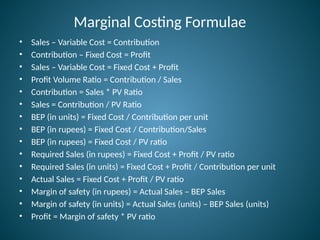
Marginal Costing Formulae
• Sales – Variable Cost = Contribution
• Contribution – Fixed Cost = Profit
• Sales – Variable Cost = Fixed Cost + Profit
• Profit Volume Ratio = Contribution / Sales
• Contribution = Sales * PV Ratio
• Sales = Contribution / PV Ratio
• BEP (in units) = Fixed Cost / Contribution per unit
• BEP (in rupees) = Fixed Cost / Contribution/Sales
• BEP (in rupees) = Fixed Cost / PV ratio
• Required Sales (in rupees) = Fixed Cost + Profit / PV ratio
• Required Sales (in units) = Fixed Cost + Profit / Contribution per unit
• Actual Sales = Fixed Cost + Profit / PV ratio
• Margin of safety (in rupees) = Actual Sales – BEP Sales
• Margin of safety (in units) = Actual Sales (units) – BEP Sales (units)
• Profit = Margin of safety * PV ratio
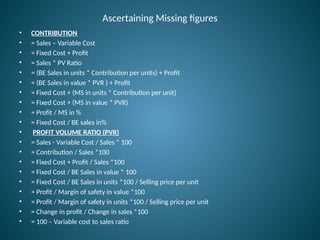
Ascertaining Missing figures
• CONTRIBUTION
• = Sales – Variable Cost
• = Fixed Cost + Profit
• = Sales * PV Ratio
• = (BE Sales in units * Contribution per units) + Profit
• = (BE Sales in value * PVR ) + Profit
• = Fixed Cost + (MS in units * Contribution per unit)
• = Fixed Cost + (MS in value * PVR)
• = Profit / MS in %
• = Fixed Cost / BE sales in%
• PROFIT VOLUME RATIO (PVR)
• = Sales - Variable Cost / Sales * 100
• = Contribution / Sales *100
• = Fixed Cost + Profit / Sales *100
• = Fixed Cost / BE Sales in value * 100
• = Fixed Cost / BE Sales in units *100 / Selling price per unit
• = Profit / Margin of safety in value *100
• = Profit / Margin of safety in units *100 / Selling price per unit
• = Change in profit / Change in sales *100
• = 100 – Variable cost to sales ratio
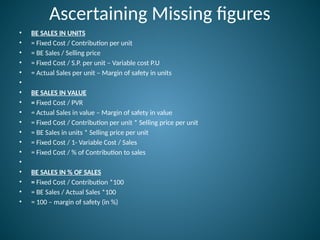
Ascertaining Missing figures
• BE SALES IN UNITS
• = Fixed Cost / Contribution per unit
• = BE Sales / Selling price
• = Fixed Cost / S.P. per unit – Variable cost P.U
• = Actual Sales per unit – Margin of safety in units
•
• BE SALES IN VALUE
• = Fixed Cost / PVR
• = Actual Sales in value – Margin of safety in value
• = Fixed Cost / Contribution per unit * Selling price per unit
• = BE Sales in units * Selling price per unit
• = Fixed Cost / 1- Variable Cost / Sales
• = Fixed Cost / % of Contribution to sales
•
• BE SALES IN % OF SALES
• = Fixed Cost / Contribution *100
• = BE Sales / Actual Sales *100
• = 100 – margin of safety (in %)
Ascertaining Missing figures
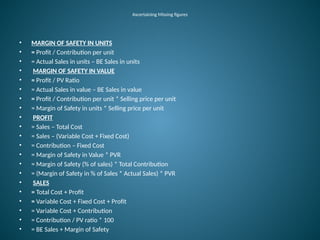
• MARGIN OF SAFETY IN UNITS
• = Profit / Contribution per unit
• = Actual Sales in units – BE Sales in units
• MARGIN OF SAFETY IN VALUE
• = Profit / PV Ratio
• = Actual Sales in value – BE Sales in value
• = Profit / Contribution per unit * Selling price per unit
• = Margin of Safety in units * Selling price per unit
• PROFIT
• = Sales – Total Cost
• = Sales – (Variable Cost + Fixed Cost)
• = Contribution – Fixed Cost
• = Margin of Safety in Value * PVR
• = Margin of Safety (% of sales) * Total Contribution
• = (Margin of Safety in % of Sales * Actual Sales) * PVR
• SALES
• = Total Cost + Profit
• = Variable Cost + Fixed Cost + Profit
• = Variable Cost + Contribution
• = Contribution / PV ratio * 100
• = BE Sales + Margin of Safety
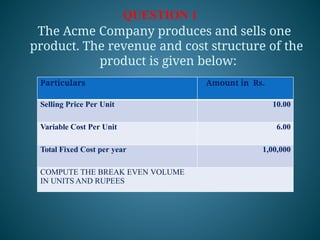
QUESTION 1
The Acme Company produces and sells one
product. The revenue and cost structure of the
product is given below:
Particulars Amount in Rs.
Selling Price Per Unit 10.00
Variable Cost Per Unit 6.00
Total Fixed Cost per year 1,00,000
COMPUTE THE BREAK EVEN VOLUME
IN UNITS AND RUPEES
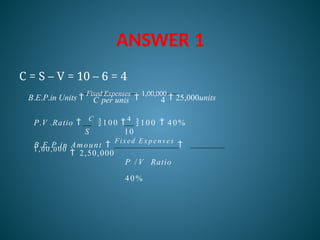
ANSWER 1
C per unis 4
C = S – V = 10 – 6 = 4
B.E.P.in Units 
Fixed Expenses

1,00,000
 25,000units
P.V .Ratio 
C
100 
4
100  40%
S 10
B.E.P.in Amount 
Fixed E x p e n s e s

1,00,000
 2,50,000
P / V Ratio
40%
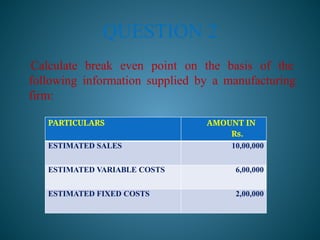
QUESTION 2
Calculate break even point on the basis of the
following information supplied by a manufacturing
firm:
PARTICULARS AMOUNT IN
Rs.
ESTIMATED SALES 10,00,000
ESTIMATED VARIABLE COSTS 6,00,000
ESTIMATED FIXED COSTS 2,00,000
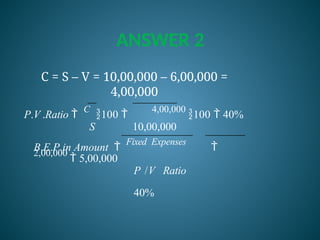
ANSWER 2
C = S – V = 10,00,000 – 6,00,000 =
4,00,000
P.V .Ratio 
C
100 
4,00,000
100  40%
S 10,00,000
B.E.P.in Amount 
Fixed Expenses

2,00,000
 5,00,000
P /V Ratio
40%
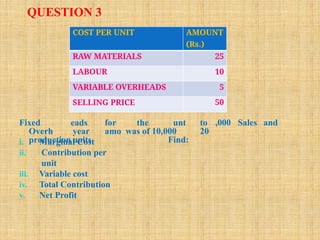
QUESTION 3
,000 Sales and
Fixed
Overh
production
eads for the
year amo was of 10,000
units.
unt to
20
Find:
i. Marginal Cost
ii. Contribution per
unit
iii. Variable cost
iv. Total Contribution
v. Net Profit
COST PER UNIT AMOUNT
(Rs.)
RAW MATERIALS 25
LABOUR 10
VARIABLE OVERHEADS 5
SELLING PRICE 50
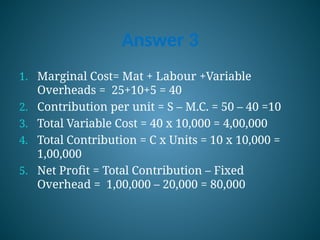
Answer 3
1. Marginal Cost= Mat + Labour +Variable
Overheads = 25+10+5 = 40
2. Contribution per unit = S – M.C. = 50 – 40 =10
3. Total Variable Cost = 40 x 10,000 = 4,00,000
4. Total Contribution = C x Units = 10 x 10,000 =
1,00,000
5. Net Profit = Total Contribution – Fixed
Overhead = 1,00,000 – 20,000 = 80,000
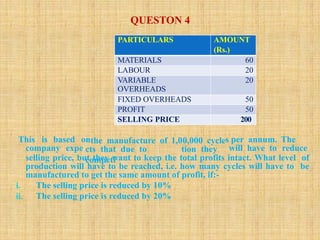
QUESTON 4
the manufacture of 1,00,000 cycle
cts that due to
competi
tion they
This is based on s per annum. The
company expe will have to reduce
selling price, but they want to keep the total profits intact. What level of
production will have to be reached, i.e. how many cycles will have to be
manufactured to get the same amount of profit, if:-
i. The selling price is reduced by 10%
ii. The selling price is reduced by 20%
PARTICULARS AMOUNT
(Rs.)
MATERIALS 60
LABOUR 20
VARIABLE
OVERHEADS
20
FIXED OVERHEADS 50
PROFIT 50
SELLING PRICE 200
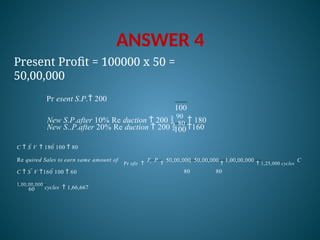
ANSWER 4
100
100
New S..P.after 20% Re duction  200 
80
160
Present Profit = 100000 x 50 =
50,00,000
Pr esent S.P. 200
New S.P.after 10% Re duction  200 
90
 180
60
1,00,00,000
cycles  1,66,667
Pr ofit 
F  P

50,00,000  50,00,000

1,00,00,000
 1,25,000 cycles
C
80 80
Re quired Sales to earn same amount of
C  S V 160 100  60
C  S V  180 100  80
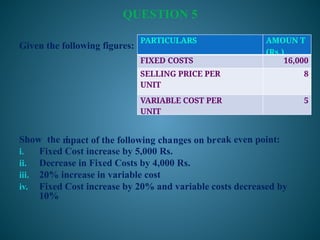
QUESTION 5
Given the following figures:
mpact of the following changes on br
Show the i eak even point:
i. Fixed Cost increase by 5,000 Rs.
ii. Decrease in Fixed Costs by 4,000 Rs.
iii. 20% increase in variable cost
iv. Fixed Cost increase by 20% and variable costs decreased by
10%
PARTICULARS AMOUN T
(Rs.)
FIXED COSTS 16,000
SELLING PRICE PER
UNIT
8
VARIABLE COST PER
UNIT
5
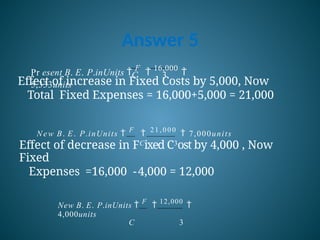
Answer 5
Effect of increase in Fixed Costs by 5,000, Now
Total Fixed Expenses = 16,000+5,000 = 21,000
C 3
Pr esent B. E. P.inUnits 
F

16,000

5,333units
New B. E. P.inUnits 
F

2 1 , 0 0 0
 7,000units
Effect of decrease in FCixed C3ost by 4,000 , Now
Fixed
Expenses =16,000 -4,000 = 12,000
New B. E. P.inUnits 
F

12,000

4,000units
C 3
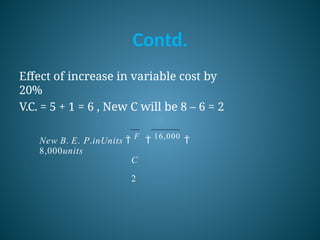
Contd.
Effect of increase in variable cost by
20%
V.C. = 5 + 1 = 6 , New C will be 8 – 6 = 2
New B. E. P.inUnits 
F

16,000

8,000units
C
2
QUESTION 6
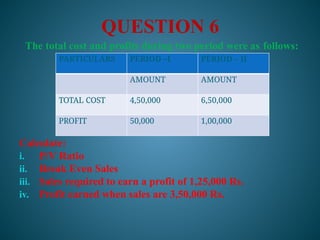
The total cost and profits during two period were as follows:
Calculate:
i. P/V Ratio
ii. Break Even Sales
iii. Sales required to earn a profit of 1,25,000 Rs.
iv. Profit earned when sales are 3,50,000 Rs.
PARTICULARS PERIOD –I PERIOD – II
AMOUNT AMOUNT
TOTAL COST 4,50,000 6,50,000
PROFIT 50,000 1,00,000
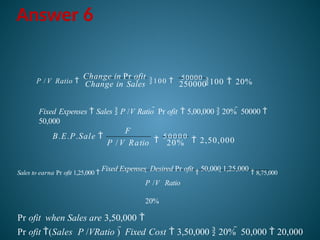
Answer 6
250000
50000
100  20%
Change in Sales
P / V Ratio 
Change in Pr ofit
100 
Fixed Expenses  Sales  P /V Ratio  Pr ofit  5,00,000  20%  50000 
50,000

5 0 0 0 0
 2,50,000
P / V Ratio 20%
F
B.E.P.Sale 
Sales to earna Pr ofit 1,25,000 
Fixed Expenses  Desired Pr ofit

50,000 1,25,000
 8,75,000
P /V Ratio
20%
Pr ofit when Sales are 3,50,000 
Pr ofit (Sales P /VRatio )  Fixed Cost  3,50,000  20%  50,000  20,000
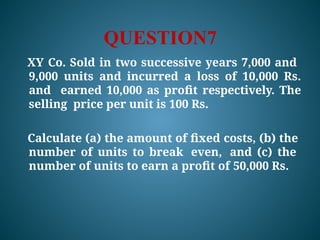
QUESTION7
XY Co. Sold in two successive years 7,000 and
9,000 units and incurred a loss of 10,000 Rs.
and earned 10,000 as profit respectively. The
selling price per unit is 100 Rs.
Calculate (a) the amount of fixed costs, (b) the
number of units to break even, and (c) the
number of units to earn a profit of 50,000 Rs.
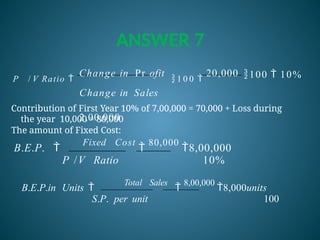
ANSWER 7
100  10%
P / V Ratio 
Change in Pr ofit
 1 0 0 
20,000
Change in Sales
2,00,000
The amount of Fixed Cost:
Contribution of First Year 10% of 7,00,000 = 70,000 + Loss during
the year 10,000 = 80,000
B.E.P. 
Fixed Cost

80,000
8,00,000
P /V Ratio 10%
B.E.P.in Units 
Total Sales

8,00,000
8,000units
S.P. per unit 100
Contd.
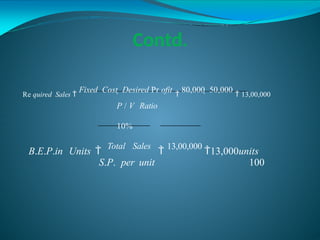
Re quired Sales 
Fixed Cost  Desired Pr ofit

80,000  50,000
 13,00,000
P / V Ratio
10%
B.E.P.in Units 
Total Sales

13,00,000
13,000units
S.P. per unit 100
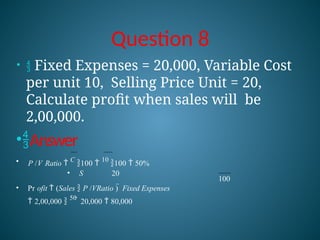
Question 8
100
•  Fixed Expenses = 20,000, Variable Cost
per unit 10, Selling Price Unit = 20,
Calculate profit when sales will be
2,00,000.
•Answer
• P /V Ratio 
C
100 
10
100  50%
• S 20
• Pr ofit  (Sales  P /VRatio )  Fixed Expenses
 2,00,000 
50
 20,000  80,000
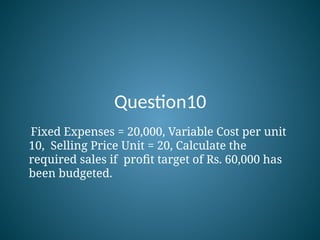
Question10
Fixed Expenses = 20,000, Variable Cost per unit
10, Selling Price Unit = 20, Calculate the
required sales if profit target of Rs. 60,000 has
been budgeted.
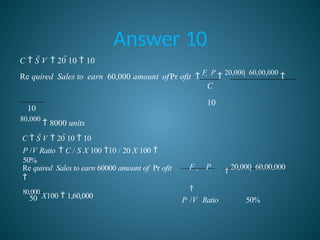
Answer 10
10
C  S V  20 10  10
Re quired Sales to earn 60,000 amount ofPr ofit 
F  P

20,000  60,00,000

C
10
80,000
 8000 units
50
80,000
X100  1,60,000
F  P

20,000  60,00,000

P /V Ratio 50%
Re quired Sales to earn 60000 amount of Pr ofit

C  S V  20 10  10
P /V Ratio  C / S X 100 10 / 20 X 100 
50%
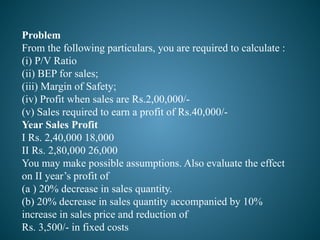
Problem
From the following particulars, you are required to calculate :
(i) P/V Ratio
(ii) BEP for sales;
(iii) Margin of Safety;
(iv) Profit when sales are Rs.2,00,000/-
(v) Sales required to earn a profit of Rs.40,000/-
Year Sales Profit
I Rs. 2,40,000 18,000
II Rs. 2,80,000 26,000
You may make possible assumptions. Also evaluate the effect
on II year’s profit of
(a ) 20% decrease in sales quantity.
(b) 20% decrease in sales quantity accompanied by 10%
increase in sales price and reduction of
Rs. 3,500/- in fixed costs
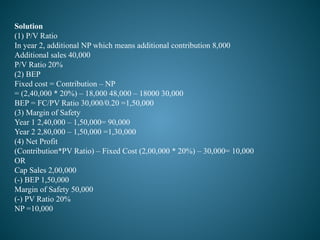
Solution
(1) P/V Ratio
In year 2, additional NP which means additional contribution 8,000
Additional sales 40,000
P/V Ratio 20%
(2) BEP
Fixed cost = Contribution – NP
= (2,40,000 * 20%) – 18,000 48,000 – 18000 30,000
BEP = FC/PV Ratio 30,000/0.20 =1,50,000
(3) Margin of Safety
Year 1 2,40,000 – 1,50,000= 90,000
Year 2 2,80,000 – 1,50,000 =1,30,000
(4) Net Profit
(Contribution*PV Ratio) – Fixed Cost (2,00,000 * 20%) – 30,000= 10,000
OR
Cap Sales 2,00,000
(-) BEP 1,50,000
Margin of Safety 50,000
(-) PV Ratio 20%
NP =10,000
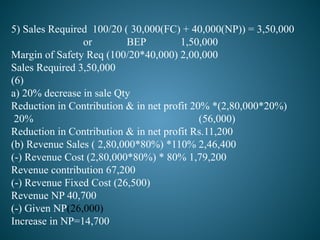
5) Sales Required 100/20 ( 30,000(FC) + 40,000(NP)) = 3,50,000
or BEP 1,50,000
Margin of Safety Req (100/20*40,000) 2,00,000
Sales Required 3,50,000
(6)
a) 20% decrease in sale Qty
Reduction in Contribution & in net profit 20% *(2,80,000*20%)
20% (56,000)
Reduction in Contribution & in net profit Rs.11,200
(b) Revenue Sales ( 2,80,000*80%) *110% 2,46,400
(-) Revenue Cost (2,80,000*80%) * 80% 1,79,200
Revenue contribution 67,200
(-) Revenue Fixed Cost (26,500)
Revenue NP 40,700
(-) Given NP(26,000)
Increase in NP=14,700
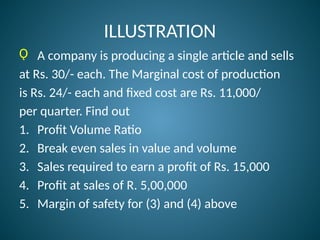
ILLUSTRATION
Ǫ A company is producing a single article and sells
at Rs. 30/- each. The Marginal cost of production
is Rs. 24/- each and fixed cost are Rs. 11,000/
per quarter. Find out
1. Profit Volume Ratio
2. Break even sales in value and volume
3. Sales required to earn a profit of Rs. 15,000
4. Profit at sales of R. 5,00,000
5. Margin of safety for (3) and (4) above
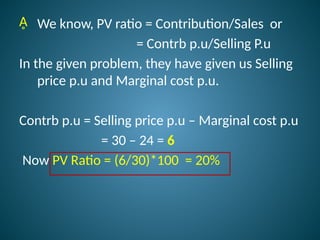
Ḁ We know, PV ratio = Contribution/Sales or
= Contrb p.u/Selling P.u
In the given problem, they have given us Selling
price p.u and Marginal cost p.u.
Contrb p.u = Selling price p.u – Marginal cost p.u
= 30 – 24 = 6
Now PV Ratio = (6/30)*100 = 20%
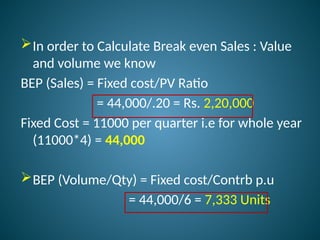
In order to Calculate Break even Sales : Value
and volume we know
BEP (Sales) = Fixed cost/PV Ratio
= 44,000/.20 = Rs. 2,20,000
Fixed Cost = 11000 per quarter i.e for whole year
(11000*4) = 44,000
BEP (Volume/Qty) = Fixed cost/Contrb p.u
= 44,000/6 = 7,333 Units
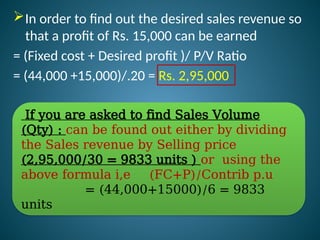
In order to find out the desired sales revenue so
that a profit of Rs. 15,000 can be earned
= (Fixed cost + Desired profit )/ P/V Ratio
= (44,000 +15,000)/.20 = Rs. 2,95,000
If you are asked to find Sales Volume
(Qty) : can be found out either by dividing
the Sales revenue by Selling price
(2,95,000/30 = 9833 units ) or using the
above formula i,e (FC+P)/Contrib p.u
= (44,000+15000)/6 = 9833
units
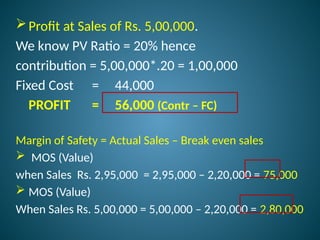
Profit at Sales of Rs. 5,00,000.
We know PV Ratio = 20% hence
contribution = 5,00,000*.20 = 1,00,000
Fixed Cost = 44,000
PROFIT = 56,000 (Contr – FC)
Margin of Safety = Actual Sales – Break even sales
 MOS (Value)
when Sales Rs. 2,95,000 = 2,95,000 – 2,20,000 = 75,000
 MOS (Value)
When Sales Rs. 5,00,000 = 5,00,000 – 2,20,000 = 2,80,000
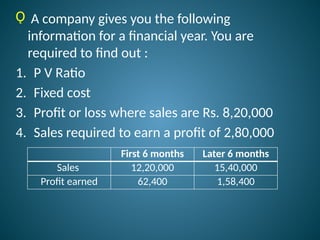
Ǫ A company gives you the following
information for a financial year. You are
required to find out :
1. P V Ratio
2. Fixed cost
3. Profit or loss where sales are Rs. 8,20,000
4. Sales required to earn a profit of 2,80,000
First 6 months Later 6 months
Sales 12,20,000 15,40,000
Profit earned 62,400 1,58,400
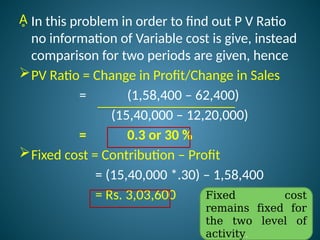
Ḁ In this problem in order to find out P V Ratio
no information of Variable cost is give, instead
comparison for two periods are given, hence
PV Ratio = Change in Profit/Change in Sales
= (1,58,400 – 62,400)
(15,40,000 – 12,20,000)
= 0.3 or 30 %
Fixed cost = Contribution – Profit
= (15,40,000 *.30) – 1,58,400
= Rs. 3,03,600 Fixed cost
remains fixed for
the two level of
activity.
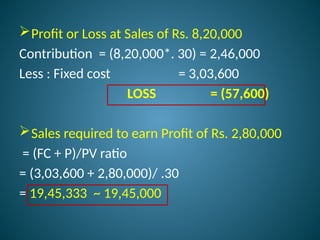
Profit or Loss at Sales of Rs. 8,20,000
Contribution = (8,20,000*. 30) = 2,46,000
Less : Fixed cost = 3,03,600
LOSS = (57,600)
Sales required to earn Profit of Rs. 2,80,000
= (FC + P)/PV ratio
= (3,03,600 + 2,80,000)/ .30
= 19,45,333 ~ 19,45,000
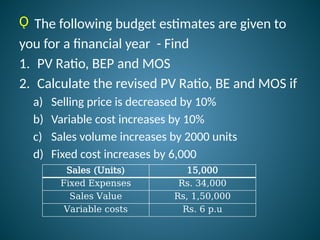
Ǫ The following budget estimates are given to
you for a financial year - Find
1. PV Ratio, BEP and MOS
2. Calculate the revised PV Ratio, BE and MOS if
a) Selling price is decreased by 10%
b) Variable cost increases by 10%
c) Sales volume increases by 2000 units
d) Fixed cost increases by 6,000
Sales (Units) 15,000
Fixed Expenses Rs. 34,000
Sales Value Rs, 1,50,000
Variable costs Rs. 6 p.u
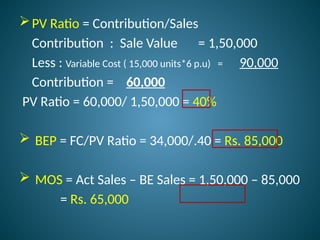
PV Ratio = Contribution/Sales
Contribution : Sale Value = 1,50,000
Less : Variable Cost ( 15,000 units*6 p.u) = 90,000
Contribution = 60,000
PV Ratio = 60,000/ 1,50,000 = 40%
 BEP = FC/PV Ratio = 34,000/.40 = Rs. 85,000
 MOS = Act Sales – BE Sales = 1,50,000 – 85,000
= Rs. 65,000
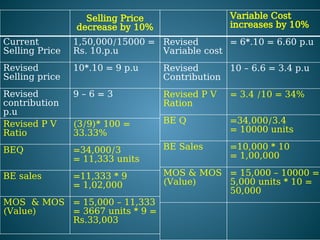
Selling Price
decrease by 10%
Current
Selling Price
1,50,000/15000 =
Rs. 10.p.u
Revised
Selling price
10*.10 = 9 p.u
Revised
contribution
p.u
9 – 6 = 3
Revised P V
Ratio
(3/9)* 100 =
33.33%
BEQ =34,000/3
= 11,333 units
BE sales =11,333 * 9
= 1,02,000
MOS & MOS
(Value)
= 15,000 – 11,333
= 3667 units * 9 =
Rs.33,003
Variable Cost
increases by 10%
Revised
Variable cost
= 6*.10 = 6.60 p.u
Revised
Contribution
10 – 6.6 = 3.4 p.u
Revised P V
Ration
= 3.4 /10 = 34%
BE Q =34,000/3.4
= 10000 units
BE Sales =10,000 * 10
= 1,00,000
MOS & MOS
(Value)
= 15,000 – 10000 =
5,000 units * 10 =
50,000
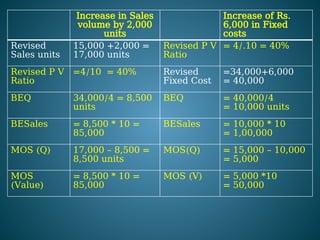
Increase in Sales
volume by 2,000
units
Revised
Sales units
15,000 +2,000 =
17,000 units
Revised P V
Ratio
=4/10 = 40%
BEQ 34,000/4 = 8,500
units
BESales = 8,500 * 10 =
85,000
MOS (Q) 17,000 – 8,500 =
8,500 units
MOS
(Value)
= 8,500 * 10 =
85,000
Increase of Rs.
6,000 in Fixed
costs
Revised P V
Ratio
= 4/.10 = 40%
Revised
Fixed Cost
=34,000+6,000
= 40,000
BEQ = 40,000/4
= 10,000 units
BESales = 10,000 * 10
= 1,00,000
MOS(Q) = 15,000 – 10,000
= 5,000
MOS (V) = 5,000 *10
= 50,000
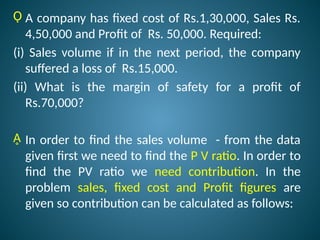
Ǫ A company has fixed cost of Rs.1,30,000, Sales Rs.
4,50,000 and Profit of Rs. 50,000. Required:
(i) Sales volume if in the next period, the company
suffered a loss of Rs.15,000.
(ii) What is the margin of safety for a profit of
Rs.70,000?
Ḁ In order to find the sales volume - from the data
given first we need to find the P V ratio. In order to
find the PV ratio we need contribution. In the
problem sales, fixed cost and Profit figures are
given so contribution can be calculated as follows:
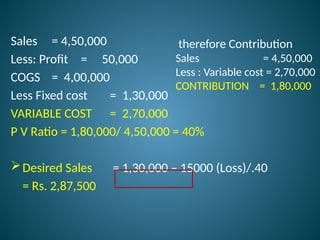
Sales = 4,50,000
Less: Profit = 50,000
COGS = 4,00,000
Less Fixed cost = 1,30,000
VARIABLE COST = 2,70,000
P V Ratio = 1,80,000/ 4,50,000 = 40%
Desired Sales = 1,30,000 – 15000 (Loss)/.40
= Rs. 2,87,500
therefore Contribution
Sales = 4,50,000
Less : Variable cost = 2,70,000
CONTRIBUTION = 1,80,000
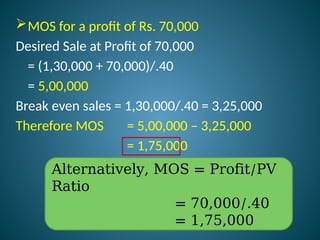
MOS for a profit of Rs. 70,000
Desired Sale at Profit of 70,000
= (1,30,000 + 70,000)/.40
= 5,00,000
Break even sales = 1,30,000/.40 = 3,25,000
Therefore MOS = 5,00,000 – 3,25,000
= 1,75,000
Alternatively, MOS = Profit/PV
Ratio
= 70,000/.40
= 1,75,000
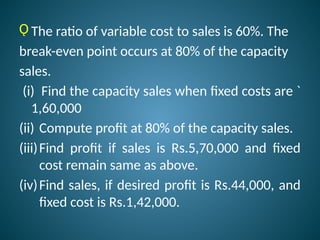
Ǫ The ratio of variable cost to sales is 60%. The
break-even point occurs at 80% of the capacity
sales.
(i) Find the capacity sales when fixed costs are `
1,60,000
(ii) Compute profit at 80% of the capacity sales.
(iii)Find profit if sales is Rs.5,70,000 and fixed
cost remain same as above.
(iv)Find sales, if desired profit is Rs.44,000, and
fixed cost is Rs.1,42,000.
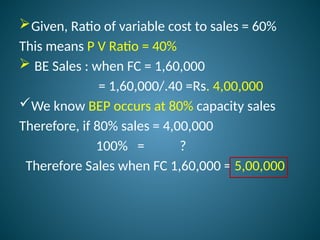
Given, Ratio of variable cost to sales = 60%
This means P V Ratio = 40%
 BE Sales : when FC = 1,60,000
= 1,60,000/.40 =Rs. 4,00,000
We know BEP occurs at 80% capacity sales
Therefore, if 80% sales = 4,00,000
100% = ?
Therefore Sales when FC 1,60,000 = 5,00,000
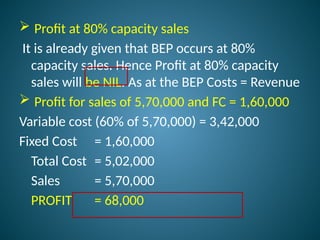
 Profit at 80% capacity sales
It is already given that BEP occurs at 80%
capacity sales. Hence Profit at 80% capacity
sales will be NIL. As at the BEP Costs = Revenue
 Profit for sales of 5,70,000 and FC = 1,60,000
Variable cost (60% of 5,70,000) = 3,42,000
Fixed Cost = 1,60,000
Total Cost = 5,02,000
Sales = 5,70,000
PROFIT = 68,000
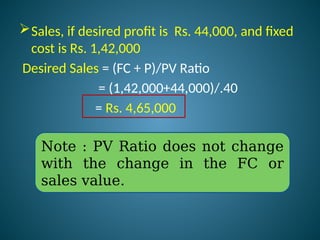
Sales, if desired profit is Rs. 44,000, and fixed
cost is Rs. 1,42,000
Desired Sales = (FC + P)/PV Ratio
= (1,42,000+44,000)/.40
= Rs. 4,65,000
Note : PV Ratio does not change
with the change in the FC or
sales value.
Ǫ If margin of safety is Rs 2, 40,000 (40% of sales) and
P/V ratio is 30% of Gupta Ltd, calculate its
(1) Break even sales, and
(2) Amount of profit on sales of ` 9,00,000.
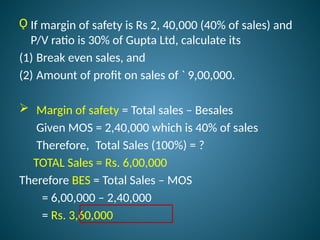
 Margin of safety = Total sales – Besales
Given MOS = 2,40,000 which is 40% of sales
Therefore, Total Sales (100%) = ?
TOTAL Sales = Rs. 6,00,000
Therefore BES = Total Sales – MOS
= 6,00,000 – 2,40,000
= Rs. 3,60,000
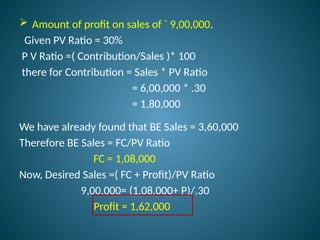
 Amount of profit on sales of ` 9,00,000.
Given PV Ratio = 30%
P V Ratio =( Contribution/Sales )* 100
there for Contribution = Sales * PV Ratio
= 6,00,000 * .30
= 1,80,000
We have already found that BE Sales = 3,60,000
Therefore BE Sales = FC/PV Ratio
FC = 1,08,000
Now, Desired Sales =( FC + Profit)/PV Ratio
9,00,000= (1,08,000+ P)/.30
Profit = 1,62,000
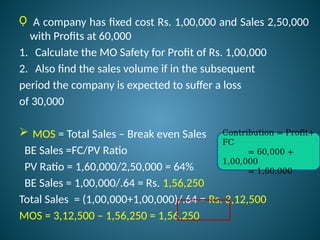
Ǫ A company has fixed cost Rs. 1,00,000 and Sales 2,50,000
with Profits at 60,000
1. Calculate the MO Safety for Profit of Rs. 1,00,000
2. Also find the sales volume if in the subsequent
period the company is expected to suffer a loss
of 30,000
 MOS = Total Sales – Break even Sales
BE Sales =FC/PV Ratio
PV Ratio = 1,60,000/2,50,000 = 64%
BE Sales = 1,00,000/.64 = Rs. 1,56,250
Total Sales = (1,00,000+1,00,000)/.64 = Rs. 3,12,500
MOS = 3,12,500 – 1,56,250 = 1,56,250
Contribution = Profit+
FC
= 60,000 +
1,00,000
= 1,60,000
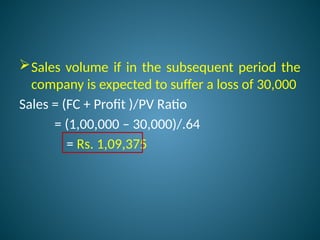
Sales volume if in the subsequent period the
company is expected to suffer a loss of 30,000
Sales = (FC + Profit )/PV Ratio
= (1,00,000 – 30,000)/.64
= Rs. 1,09,375
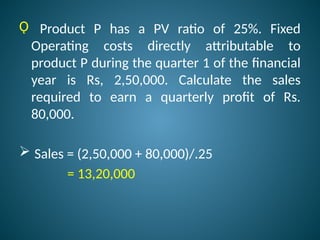
Ǫ Product P has a PV ratio of 25%. Fixed
Operating costs directly attributable to
product P during the quarter 1 of the financial
year is Rs, 2,50,000. Calculate the sales
required to earn a quarterly profit of Rs.
80,000.
 Sales = (2,50,000 + 80,000)/.25
= 13,20,000

371252194-Marginal-Costing-Problems-Solutions-2.pptx

  • 1.
    Marginal Costing –Problems & Solutions
  • 2.
    Marginal Costing Formulae •Sales – Variable Cost = Contribution • Contribution – Fixed Cost = Profit • Sales – Variable Cost = Fixed Cost + Profit • Profit Volume Ratio = Contribution / Sales • Contribution = Sales * PV Ratio • Sales = Contribution / PV Ratio • BEP (in units) = Fixed Cost / Contribution per unit • BEP (in rupees) = Fixed Cost / Contribution/Sales • BEP (in rupees) = Fixed Cost / PV ratio • Required Sales (in rupees) = Fixed Cost + Profit / PV ratio • Required Sales (in units) = Fixed Cost + Profit / Contribution per unit • Actual Sales = Fixed Cost + Profit / PV ratio • Margin of safety (in rupees) = Actual Sales – BEP Sales • Margin of safety (in units) = Actual Sales (units) – BEP Sales (units) • Profit = Margin of safety * PV ratio
  • 3.
    Ascertaining Missing figures •CONTRIBUTION • = Sales – Variable Cost • = Fixed Cost + Profit • = Sales * PV Ratio • = (BE Sales in units * Contribution per units) + Profit • = (BE Sales in value * PVR ) + Profit • = Fixed Cost + (MS in units * Contribution per unit) • = Fixed Cost + (MS in value * PVR) • = Profit / MS in % • = Fixed Cost / BE sales in% • PROFIT VOLUME RATIO (PVR) • = Sales - Variable Cost / Sales * 100 • = Contribution / Sales *100 • = Fixed Cost + Profit / Sales *100 • = Fixed Cost / BE Sales in value * 100 • = Fixed Cost / BE Sales in units *100 / Selling price per unit • = Profit / Margin of safety in value *100 • = Profit / Margin of safety in units *100 / Selling price per unit • = Change in profit / Change in sales *100 • = 100 – Variable cost to sales ratio
  • 4.
    Ascertaining Missing figures •BE SALES IN UNITS • = Fixed Cost / Contribution per unit • = BE Sales / Selling price • = Fixed Cost / S.P. per unit – Variable cost P.U • = Actual Sales per unit – Margin of safety in units • • BE SALES IN VALUE • = Fixed Cost / PVR • = Actual Sales in value – Margin of safety in value • = Fixed Cost / Contribution per unit * Selling price per unit • = BE Sales in units * Selling price per unit • = Fixed Cost / 1- Variable Cost / Sales • = Fixed Cost / % of Contribution to sales • • BE SALES IN % OF SALES • = Fixed Cost / Contribution *100 • = BE Sales / Actual Sales *100 • = 100 – margin of safety (in %)
  • 5.
    Ascertaining Missing figures •MARGIN OF SAFETY IN UNITS • = Profit / Contribution per unit • = Actual Sales in units – BE Sales in units • MARGIN OF SAFETY IN VALUE • = Profit / PV Ratio • = Actual Sales in value – BE Sales in value • = Profit / Contribution per unit * Selling price per unit • = Margin of Safety in units * Selling price per unit • PROFIT • = Sales – Total Cost • = Sales – (Variable Cost + Fixed Cost) • = Contribution – Fixed Cost • = Margin of Safety in Value * PVR • = Margin of Safety (% of sales) * Total Contribution • = (Margin of Safety in % of Sales * Actual Sales) * PVR • SALES • = Total Cost + Profit • = Variable Cost + Fixed Cost + Profit • = Variable Cost + Contribution • = Contribution / PV ratio * 100 • = BE Sales + Margin of Safety
  • 6.
    QUESTION 1 The AcmeCompany produces and sells one product. The revenue and cost structure of the product is given below: Particulars Amount in Rs. Selling Price Per Unit 10.00 Variable Cost Per Unit 6.00 Total Fixed Cost per year 1,00,000 COMPUTE THE BREAK EVEN VOLUME IN UNITS AND RUPEES
  • 7.
    ANSWER 1 C perunis 4 C = S – V = 10 – 6 = 4 B.E.P.in Units  Fixed Expenses  1,00,000  25,000units P.V .Ratio  C 100  4 100  40% S 10 B.E.P.in Amount  Fixed E x p e n s e s  1,00,000  2,50,000 P / V Ratio 40%
  • 8.
    QUESTION 2 Calculate breakeven point on the basis of the following information supplied by a manufacturing firm: PARTICULARS AMOUNT IN Rs. ESTIMATED SALES 10,00,000 ESTIMATED VARIABLE COSTS 6,00,000 ESTIMATED FIXED COSTS 2,00,000
  • 9.
    ANSWER 2 C =S – V = 10,00,000 – 6,00,000 = 4,00,000 P.V .Ratio  C 100  4,00,000 100  40% S 10,00,000 B.E.P.in Amount  Fixed Expenses  2,00,000  5,00,000 P /V Ratio 40%
  • 10.
    QUESTION 3 ,000 Salesand Fixed Overh production eads for the year amo was of 10,000 units. unt to 20 Find: i. Marginal Cost ii. Contribution per unit iii. Variable cost iv. Total Contribution v. Net Profit COST PER UNIT AMOUNT (Rs.) RAW MATERIALS 25 LABOUR 10 VARIABLE OVERHEADS 5 SELLING PRICE 50
  • 11.
    Answer 3 1. MarginalCost= Mat + Labour +Variable Overheads = 25+10+5 = 40 2. Contribution per unit = S – M.C. = 50 – 40 =10 3. Total Variable Cost = 40 x 10,000 = 4,00,000 4. Total Contribution = C x Units = 10 x 10,000 = 1,00,000 5. Net Profit = Total Contribution – Fixed Overhead = 1,00,000 – 20,000 = 80,000
  • 12.
    QUESTON 4 the manufactureof 1,00,000 cycle cts that due to competi tion they This is based on s per annum. The company expe will have to reduce selling price, but they want to keep the total profits intact. What level of production will have to be reached, i.e. how many cycles will have to be manufactured to get the same amount of profit, if:- i. The selling price is reduced by 10% ii. The selling price is reduced by 20% PARTICULARS AMOUNT (Rs.) MATERIALS 60 LABOUR 20 VARIABLE OVERHEADS 20 FIXED OVERHEADS 50 PROFIT 50 SELLING PRICE 200
  • 13.
    ANSWER 4 100 100 New S..P.after20% Re duction  200  80 160 Present Profit = 100000 x 50 = 50,00,000 Pr esent S.P. 200 New S.P.after 10% Re duction  200  90  180 60 1,00,00,000 cycles  1,66,667 Pr ofit  F  P  50,00,000  50,00,000  1,00,00,000  1,25,000 cycles C 80 80 Re quired Sales to earn same amount of C  S V 160 100  60 C  S V  180 100  80
  • 14.
    QUESTION 5 Given thefollowing figures: mpact of the following changes on br Show the i eak even point: i. Fixed Cost increase by 5,000 Rs. ii. Decrease in Fixed Costs by 4,000 Rs. iii. 20% increase in variable cost iv. Fixed Cost increase by 20% and variable costs decreased by 10% PARTICULARS AMOUN T (Rs.) FIXED COSTS 16,000 SELLING PRICE PER UNIT 8 VARIABLE COST PER UNIT 5
  • 15.
    Answer 5 Effect ofincrease in Fixed Costs by 5,000, Now Total Fixed Expenses = 16,000+5,000 = 21,000 C 3 Pr esent B. E. P.inUnits  F  16,000  5,333units New B. E. P.inUnits  F  2 1 , 0 0 0  7,000units Effect of decrease in FCixed C3ost by 4,000 , Now Fixed Expenses =16,000 -4,000 = 12,000 New B. E. P.inUnits  F  12,000  4,000units C 3
  • 16.
    Contd. Effect of increasein variable cost by 20% V.C. = 5 + 1 = 6 , New C will be 8 – 6 = 2 New B. E. P.inUnits  F  16,000  8,000units C 2
  • 17.
    QUESTION 6 The totalcost and profits during two period were as follows: Calculate: i. P/V Ratio ii. Break Even Sales iii. Sales required to earn a profit of 1,25,000 Rs. iv. Profit earned when sales are 3,50,000 Rs. PARTICULARS PERIOD –I PERIOD – II AMOUNT AMOUNT TOTAL COST 4,50,000 6,50,000 PROFIT 50,000 1,00,000
  • 18.
    Answer 6 250000 50000 100 20% Change in Sales P / V Ratio  Change in Pr ofit 100  Fixed Expenses  Sales  P /V Ratio  Pr ofit  5,00,000  20%  50000  50,000  5 0 0 0 0  2,50,000 P / V Ratio 20% F B.E.P.Sale  Sales to earna Pr ofit 1,25,000  Fixed Expenses  Desired Pr ofit  50,000 1,25,000  8,75,000 P /V Ratio 20% Pr ofit when Sales are 3,50,000  Pr ofit (Sales P /VRatio )  Fixed Cost  3,50,000  20%  50,000  20,000
  • 19.
    QUESTION7 XY Co. Soldin two successive years 7,000 and 9,000 units and incurred a loss of 10,000 Rs. and earned 10,000 as profit respectively. The selling price per unit is 100 Rs. Calculate (a) the amount of fixed costs, (b) the number of units to break even, and (c) the number of units to earn a profit of 50,000 Rs.
  • 20.
    ANSWER 7 100 10% P / V Ratio  Change in Pr ofit  1 0 0  20,000 Change in Sales 2,00,000 The amount of Fixed Cost: Contribution of First Year 10% of 7,00,000 = 70,000 + Loss during the year 10,000 = 80,000 B.E.P.  Fixed Cost  80,000 8,00,000 P /V Ratio 10% B.E.P.in Units  Total Sales  8,00,000 8,000units S.P. per unit 100
  • 21.
    Contd. Re quired Sales Fixed Cost  Desired Pr ofit  80,000  50,000  13,00,000 P / V Ratio 10% B.E.P.in Units  Total Sales  13,00,000 13,000units S.P. per unit 100
  • 22.
    Question 8 100 • Fixed Expenses = 20,000, Variable Cost per unit 10, Selling Price Unit = 20, Calculate profit when sales will be 2,00,000. •Answer • P /V Ratio  C 100  10 100  50% • S 20 • Pr ofit  (Sales  P /VRatio )  Fixed Expenses  2,00,000  50  20,000  80,000
  • 23.
    Question10 Fixed Expenses =20,000, Variable Cost per unit 10, Selling Price Unit = 20, Calculate the required sales if profit target of Rs. 60,000 has been budgeted.
  • 24.
    Answer 10 10 C S V  20 10  10 Re quired Sales to earn 60,000 amount ofPr ofit  F  P  20,000  60,00,000  C 10 80,000  8000 units 50 80,000 X100  1,60,000 F  P  20,000  60,00,000  P /V Ratio 50% Re quired Sales to earn 60000 amount of Pr ofit  C  S V  20 10  10 P /V Ratio  C / S X 100 10 / 20 X 100  50%
  • 25.
    Problem From the followingparticulars, you are required to calculate : (i) P/V Ratio (ii) BEP for sales; (iii) Margin of Safety; (iv) Profit when sales are Rs.2,00,000/- (v) Sales required to earn a profit of Rs.40,000/- Year Sales Profit I Rs. 2,40,000 18,000 II Rs. 2,80,000 26,000 You may make possible assumptions. Also evaluate the effect on II year’s profit of (a ) 20% decrease in sales quantity. (b) 20% decrease in sales quantity accompanied by 10% increase in sales price and reduction of Rs. 3,500/- in fixed costs
  • 26.
    Solution (1) P/V Ratio Inyear 2, additional NP which means additional contribution 8,000 Additional sales 40,000 P/V Ratio 20% (2) BEP Fixed cost = Contribution – NP = (2,40,000 * 20%) – 18,000 48,000 – 18000 30,000 BEP = FC/PV Ratio 30,000/0.20 =1,50,000 (3) Margin of Safety Year 1 2,40,000 – 1,50,000= 90,000 Year 2 2,80,000 – 1,50,000 =1,30,000 (4) Net Profit (Contribution*PV Ratio) – Fixed Cost (2,00,000 * 20%) – 30,000= 10,000 OR Cap Sales 2,00,000 (-) BEP 1,50,000 Margin of Safety 50,000 (-) PV Ratio 20% NP =10,000
  • 27.
    5) Sales Required100/20 ( 30,000(FC) + 40,000(NP)) = 3,50,000 or BEP 1,50,000 Margin of Safety Req (100/20*40,000) 2,00,000 Sales Required 3,50,000 (6) a) 20% decrease in sale Qty Reduction in Contribution & in net profit 20% *(2,80,000*20%) 20% (56,000) Reduction in Contribution & in net profit Rs.11,200 (b) Revenue Sales ( 2,80,000*80%) *110% 2,46,400 (-) Revenue Cost (2,80,000*80%) * 80% 1,79,200 Revenue contribution 67,200 (-) Revenue Fixed Cost (26,500) Revenue NP 40,700 (-) Given NP(26,000) Increase in NP=14,700
  • 28.
    ILLUSTRATION Ǫ A companyis producing a single article and sells at Rs. 30/- each. The Marginal cost of production is Rs. 24/- each and fixed cost are Rs. 11,000/ per quarter. Find out 1. Profit Volume Ratio 2. Break even sales in value and volume 3. Sales required to earn a profit of Rs. 15,000 4. Profit at sales of R. 5,00,000 5. Margin of safety for (3) and (4) above
  • 29.
    Ḁ We know,PV ratio = Contribution/Sales or = Contrb p.u/Selling P.u In the given problem, they have given us Selling price p.u and Marginal cost p.u. Contrb p.u = Selling price p.u – Marginal cost p.u = 30 – 24 = 6 Now PV Ratio = (6/30)*100 = 20%
  • 30.
    In order toCalculate Break even Sales : Value and volume we know BEP (Sales) = Fixed cost/PV Ratio = 44,000/.20 = Rs. 2,20,000 Fixed Cost = 11000 per quarter i.e for whole year (11000*4) = 44,000 BEP (Volume/Qty) = Fixed cost/Contrb p.u = 44,000/6 = 7,333 Units
  • 31.
    In order tofind out the desired sales revenue so that a profit of Rs. 15,000 can be earned = (Fixed cost + Desired profit )/ P/V Ratio = (44,000 +15,000)/.20 = Rs. 2,95,000 If you are asked to find Sales Volume (Qty) : can be found out either by dividing the Sales revenue by Selling price (2,95,000/30 = 9833 units ) or using the above formula i,e (FC+P)/Contrib p.u = (44,000+15000)/6 = 9833 units
  • 32.
    Profit at Salesof Rs. 5,00,000. We know PV Ratio = 20% hence contribution = 5,00,000*.20 = 1,00,000 Fixed Cost = 44,000 PROFIT = 56,000 (Contr – FC) Margin of Safety = Actual Sales – Break even sales  MOS (Value) when Sales Rs. 2,95,000 = 2,95,000 – 2,20,000 = 75,000  MOS (Value) When Sales Rs. 5,00,000 = 5,00,000 – 2,20,000 = 2,80,000
  • 33.
    Ǫ A companygives you the following information for a financial year. You are required to find out : 1. P V Ratio 2. Fixed cost 3. Profit or loss where sales are Rs. 8,20,000 4. Sales required to earn a profit of 2,80,000 First 6 months Later 6 months Sales 12,20,000 15,40,000 Profit earned 62,400 1,58,400
  • 34.
    Ḁ In thisproblem in order to find out P V Ratio no information of Variable cost is give, instead comparison for two periods are given, hence PV Ratio = Change in Profit/Change in Sales = (1,58,400 – 62,400) (15,40,000 – 12,20,000) = 0.3 or 30 % Fixed cost = Contribution – Profit = (15,40,000 *.30) – 1,58,400 = Rs. 3,03,600 Fixed cost remains fixed for the two level of activity.
  • 35.
    Profit or Lossat Sales of Rs. 8,20,000 Contribution = (8,20,000*. 30) = 2,46,000 Less : Fixed cost = 3,03,600 LOSS = (57,600) Sales required to earn Profit of Rs. 2,80,000 = (FC + P)/PV ratio = (3,03,600 + 2,80,000)/ .30 = 19,45,333 ~ 19,45,000
  • 36.
    Ǫ The followingbudget estimates are given to you for a financial year - Find 1. PV Ratio, BEP and MOS 2. Calculate the revised PV Ratio, BE and MOS if a) Selling price is decreased by 10% b) Variable cost increases by 10% c) Sales volume increases by 2000 units d) Fixed cost increases by 6,000 Sales (Units) 15,000 Fixed Expenses Rs. 34,000 Sales Value Rs, 1,50,000 Variable costs Rs. 6 p.u
  • 37.
    PV Ratio =Contribution/Sales Contribution : Sale Value = 1,50,000 Less : Variable Cost ( 15,000 units*6 p.u) = 90,000 Contribution = 60,000 PV Ratio = 60,000/ 1,50,000 = 40%  BEP = FC/PV Ratio = 34,000/.40 = Rs. 85,000  MOS = Act Sales – BE Sales = 1,50,000 – 85,000 = Rs. 65,000
  • 38.
    Selling Price decrease by10% Current Selling Price 1,50,000/15000 = Rs. 10.p.u Revised Selling price 10*.10 = 9 p.u Revised contribution p.u 9 – 6 = 3 Revised P V Ratio (3/9)* 100 = 33.33% BEQ =34,000/3 = 11,333 units BE sales =11,333 * 9 = 1,02,000 MOS & MOS (Value) = 15,000 – 11,333 = 3667 units * 9 = Rs.33,003 Variable Cost increases by 10% Revised Variable cost = 6*.10 = 6.60 p.u Revised Contribution 10 – 6.6 = 3.4 p.u Revised P V Ration = 3.4 /10 = 34% BE Q =34,000/3.4 = 10000 units BE Sales =10,000 * 10 = 1,00,000 MOS & MOS (Value) = 15,000 – 10000 = 5,000 units * 10 = 50,000
  • 39.
    Increase in Sales volumeby 2,000 units Revised Sales units 15,000 +2,000 = 17,000 units Revised P V Ratio =4/10 = 40% BEQ 34,000/4 = 8,500 units BESales = 8,500 * 10 = 85,000 MOS (Q) 17,000 – 8,500 = 8,500 units MOS (Value) = 8,500 * 10 = 85,000 Increase of Rs. 6,000 in Fixed costs Revised P V Ratio = 4/.10 = 40% Revised Fixed Cost =34,000+6,000 = 40,000 BEQ = 40,000/4 = 10,000 units BESales = 10,000 * 10 = 1,00,000 MOS(Q) = 15,000 – 10,000 = 5,000 MOS (V) = 5,000 *10 = 50,000
  • 40.
    Ǫ A companyhas fixed cost of Rs.1,30,000, Sales Rs. 4,50,000 and Profit of Rs. 50,000. Required: (i) Sales volume if in the next period, the company suffered a loss of Rs.15,000. (ii) What is the margin of safety for a profit of Rs.70,000? Ḁ In order to find the sales volume - from the data given first we need to find the P V ratio. In order to find the PV ratio we need contribution. In the problem sales, fixed cost and Profit figures are given so contribution can be calculated as follows:
  • 41.
    Sales = 4,50,000 Less:Profit = 50,000 COGS = 4,00,000 Less Fixed cost = 1,30,000 VARIABLE COST = 2,70,000 P V Ratio = 1,80,000/ 4,50,000 = 40% Desired Sales = 1,30,000 – 15000 (Loss)/.40 = Rs. 2,87,500 therefore Contribution Sales = 4,50,000 Less : Variable cost = 2,70,000 CONTRIBUTION = 1,80,000
  • 42.
    MOS for aprofit of Rs. 70,000 Desired Sale at Profit of 70,000 = (1,30,000 + 70,000)/.40 = 5,00,000 Break even sales = 1,30,000/.40 = 3,25,000 Therefore MOS = 5,00,000 – 3,25,000 = 1,75,000 Alternatively, MOS = Profit/PV Ratio = 70,000/.40 = 1,75,000
  • 43.
    Ǫ The ratioof variable cost to sales is 60%. The break-even point occurs at 80% of the capacity sales. (i) Find the capacity sales when fixed costs are ` 1,60,000 (ii) Compute profit at 80% of the capacity sales. (iii)Find profit if sales is Rs.5,70,000 and fixed cost remain same as above. (iv)Find sales, if desired profit is Rs.44,000, and fixed cost is Rs.1,42,000.
  • 44.
    Given, Ratio ofvariable cost to sales = 60% This means P V Ratio = 40%  BE Sales : when FC = 1,60,000 = 1,60,000/.40 =Rs. 4,00,000 We know BEP occurs at 80% capacity sales Therefore, if 80% sales = 4,00,000 100% = ? Therefore Sales when FC 1,60,000 = 5,00,000
  • 45.
     Profit at80% capacity sales It is already given that BEP occurs at 80% capacity sales. Hence Profit at 80% capacity sales will be NIL. As at the BEP Costs = Revenue  Profit for sales of 5,70,000 and FC = 1,60,000 Variable cost (60% of 5,70,000) = 3,42,000 Fixed Cost = 1,60,000 Total Cost = 5,02,000 Sales = 5,70,000 PROFIT = 68,000
  • 46.
    Sales, if desiredprofit is Rs. 44,000, and fixed cost is Rs. 1,42,000 Desired Sales = (FC + P)/PV Ratio = (1,42,000+44,000)/.40 = Rs. 4,65,000 Note : PV Ratio does not change with the change in the FC or sales value.
  • 47.
    Ǫ If marginof safety is Rs 2, 40,000 (40% of sales) and P/V ratio is 30% of Gupta Ltd, calculate its (1) Break even sales, and (2) Amount of profit on sales of ` 9,00,000.  Margin of safety = Total sales – Besales Given MOS = 2,40,000 which is 40% of sales Therefore, Total Sales (100%) = ? TOTAL Sales = Rs. 6,00,000 Therefore BES = Total Sales – MOS = 6,00,000 – 2,40,000 = Rs. 3,60,000
  • 48.
     Amount ofprofit on sales of ` 9,00,000. Given PV Ratio = 30% P V Ratio =( Contribution/Sales )* 100 there for Contribution = Sales * PV Ratio = 6,00,000 * .30 = 1,80,000 We have already found that BE Sales = 3,60,000 Therefore BE Sales = FC/PV Ratio FC = 1,08,000 Now, Desired Sales =( FC + Profit)/PV Ratio 9,00,000= (1,08,000+ P)/.30 Profit = 1,62,000
  • 49.
    Ǫ A companyhas fixed cost Rs. 1,00,000 and Sales 2,50,000 with Profits at 60,000 1. Calculate the MO Safety for Profit of Rs. 1,00,000 2. Also find the sales volume if in the subsequent period the company is expected to suffer a loss of 30,000  MOS = Total Sales – Break even Sales BE Sales =FC/PV Ratio PV Ratio = 1,60,000/2,50,000 = 64% BE Sales = 1,00,000/.64 = Rs. 1,56,250 Total Sales = (1,00,000+1,00,000)/.64 = Rs. 3,12,500 MOS = 3,12,500 – 1,56,250 = 1,56,250 Contribution = Profit+ FC = 60,000 + 1,00,000 = 1,60,000
  • 50.
    Sales volume ifin the subsequent period the company is expected to suffer a loss of 30,000 Sales = (FC + Profit )/PV Ratio = (1,00,000 – 30,000)/.64 = Rs. 1,09,375
  • 51.
    Ǫ Product Phas a PV ratio of 25%. Fixed Operating costs directly attributable to product P during the quarter 1 of the financial year is Rs, 2,50,000. Calculate the sales required to earn a quarterly profit of Rs. 80,000.  Sales = (2,50,000 + 80,000)/.25 = 13,20,000